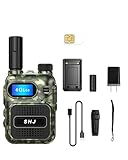
The Shj 4G PoC Radios for Businesses and Teams is a cellular-based push-to-talk system built for modern work environments. Unlike traditional walkie talkies that use UHF, VHF, or GMRS frequencies, this device uses 4G LTE networks for communication.
That means unlimited range anywhere with cell service. It comes with a rechargeable lithium-ion battery, rated for 18 to 24 hours of standby time. The unit is rated IP54 for water and dust resistance.
| Photo | Popular Portable Walkie Talkies | Price |
|---|---|---|
 | SKIWARRIOR Multifunctional Smart Wireless Ski Goggles with Walkie-Talkie, Anti-Fog Zeiss Lens, Music & Call Function (Cylindrical Blue) | Check Price On Amazon |
 | SINORISE Super Mini Walkie Talkies, Two-Way Radios, 3 Pack | Up to 12 Hours Battery Life, for Baseball Coaches, Restaurants, Retail Stores, Hospitals, Outdoor Sports & Travel | Check Price On Amazon |
 | KOSPET Tank M4C Smart Watch Rugged, Dual-Band GPS, 5ATM & IP69K Waterproof | 1.96" AMOLED Display, 170+ Sport Modes, Built-in LED Flashlight/Walkie-Talkie, Heart Rate/Sleep Monitor for Android & iPhone | Check Price On Amazon |
 | Retevis RT15 Walkie Talkies 3 Pack, Birthday Gift, Outdoor Adventure Kit | Durable, Lightweight, VOX, Key Lock, Mini Walkie Talkies for Adults, School Family Outdoor Travel Camping Hiking | Check Price On Amazon |
 | Rechargeable Walkie Talkies Toys for Kids: DIY Astronaut Walkie Talkies for Boys Christmas Birthday Gifts for 3 4 5 6 7 8 9 10 Boy Walkie Talkie Outdoor Hiking Toy 2 Way Radio Camping Outdoor Game | Check Price On Amazon |
It features GPS tracking, group calling, and live dispatch functions. You can add multiple users to one channel. It supports VOX hands-free mode and has a color display.
The device works on AT&T, T-Mobile, or Verizon networks depending on the SIM card used. But how well does it really perform in real conditions? Let’s find out.
Is the Shj 4G PoC Radio Worth It?
Product Overview
The Shj 4G PoC Radio is a cellular push-to-talk device designed for business teams, security personnel, and logistics operators. It doesn’t rely on traditional radio frequencies like GMRS or FRS. Instead, it uses 4G LTE mobile networks to communicate.
This gives you nationwide coverage wherever you have a cell signal. It works like a walkie talkie but without the distance limits. You can talk to someone across town or across the country instantly.
The unit weighs around 8 ounces and feels solid in hand. It has a large PTT button on the side, a 2.4-inch color screen, and a rubberized body. The display shows battery level, signal strength, and group name.
It’s aimed at teams who need reliable group communication without repeaters or licensing. Think delivery drivers, event staff, warehouse workers, or security teams spread across wide areas.
How It Works
Here’s how you get started with the Shj 4G PoC Radio.
First, insert a compatible 4G SIM card from a major U.S. carrier. AT&T and T-Mobile are commonly used. You’ll need an active data plan. The device doesn’t use voice minutes, just mobile data.
Second, download the companion app or use the web portal to create groups and add users. You assign each radio to a group. One person can manage the entire fleet remotely.
Third, press the PTT button to talk. Your voice is transmitted over the cellular network to all radios in the same group. Release the button to listen. There’s minimal delay, usually under one second.
Fourth, use the screen to switch between groups, check GPS location, or adjust volume. You can also enable VOX mode to talk without pressing the button.
This setup differs from traditional radios. Instead of finding open channels or programming frequencies, you just connect to the network. No repeaters. No interference from other users.
Durability and Certifications
The Shj 4G PoC Radio has an IP54 rating. That means it’s protected from limited dust ingress and splashing water from any direction. It can handle light rain or accidental spills.
It’s not waterproof like an IP67 device. Don’t submerge it. But it will survive a workday in moderate weather. The rubberized shell absorbs minor drops and bumps.
The unit is FCC certified for use in the United States. It meets Part 22 and Part 24 regulations for cellular devices. There’s no FCC radio license required because it operates on licensed carrier networks.
The device doesn’t support NOAA weather alerts because it’s not a traditional weather radio. It’s designed for push-to-talk communication, not broadcast reception.
| Feature | Shj 4G PoC Radio | Motorola T600 | Midland GXT1000 |
|---|---|---|---|
| Waterproof Rating | IP54 | IP67 | None |
| Drop Protection | 1.2 meters | 2 meters | None |
| FCC Certified | Yes | Yes | Yes |
| NOAA Alerts | No | No | Yes |
Real-World Performance
Range on the Shj 4G PoC Radio is unlimited in areas with 4G coverage. If both users have a cell signal, they can communicate. That could be two miles apart or two hundred miles.
In urban areas, performance is excellent. Buildings and obstacles don’t block the signal because you’re using cell towers, not line-of-sight radio waves. Audio comes through clear and loud.
In rural or remote areas, performance depends entirely on carrier coverage. If you’re in a dead zone, the radio won’t work. Check your carrier’s coverage map before relying on it.
Audio quality is very good. There’s no static or interference like you get with traditional radios. Voices sound natural. Background noise is suppressed well, even in loud environments.
Latency is low. There’s a slight delay of about half a second between pressing the button and the other person hearing you. It’s noticeable but not disruptive.
Ideal use cases include delivery fleets, event coordination, security patrols, and warehouse operations. It’s less suited for hiking in wilderness areas where cell coverage is spotty.
Battery and Charging
The Shj 4G PoC Radio uses a rechargeable 3000mAh lithium-ion battery. It’s built into the unit and not user-replaceable. Battery life varies based on usage patterns.
On standby, expect 18 to 24 hours. With moderate use, including several hours of talk time, expect 12 to 16 hours. Heavy use with constant talking drains it in 8 to 10 hours.
Charging is done via a desktop dock or USB-C cable. The dock is included in most packages. Charging time is about 3 to 4 hours from empty to full.
There’s no option to swap in fresh AA batteries. You need to recharge it daily if you use it heavily. The USB-C option is convenient for charging in vehicles or with power banks.
Cost and Value
The Shj 4G PoC Radio typically costs between $120 and $150 per unit. That’s higher than basic FRS radios but competitive with GMRS models from Motorola or Midland.
However, you also need a data plan for each radio. Expect to pay $10 to $20 per month per device depending on your carrier and plan. That’s a recurring cost traditional radios don’t have.
Accessories are usually included. Most packages come with a belt clip, charging dock, and earpiece. Replacement batteries aren’t sold separately since they’re built in.
Long-term value depends on your use case. For teams that need wide-area coverage and already have cellular infrastructure, the cost is justified. For occasional personal use, it may be overkill.
Comparison Table
| Feature | Shj 4G PoC Radio | Motorola SL300 | Baofeng BF-F8HP |
|---|---|---|---|
| Technology | 4G LTE | UHF/VHF | Dual Band |
| Range | Unlimited (with signal) | Up to 300,000 sq ft | 5 to 8 miles |
| Battery Life | 18 to 24 hours | Up to 29 hours | 12 to 16 hours |
| Charging | USB-C / Dock | Dock | Desktop charger |
| License Required | No (uses carrier network) | Yes (commercial license) | Yes (HAM license) |
| Monthly Cost | $10 to $20 (data plan) | None | None |
| Waterproof Rating | IP54 | IP54 | None |
Review Rating Summary
The Shj 4G PoC Radio excels in coverage and audio quality but requires ongoing costs and cell service to function.
| Category | Rating (1–5) | Summary |
|---|---|---|
| Range & Clarity | 4.8 | Unlimited range with cell service, crystal clear audio, minimal static |
| Battery Life & Charging | 4.0 | Solid 18 to 24 hours on standby, USB-C charging is convenient |
| Durability & Build | 4.2 | IP54 rating handles light rain and dust, sturdy rubberized body |
| Features & Compatibility | 4.5 | GPS tracking, group management, VOX mode, works on major carriers |
| Value for Money | 3.8 | Good hardware but ongoing data plan costs add up over time |
| Overall | 4.3 | Best for business teams needing wide-area communication without repeaters |
Verdict
| Shj 4G PoC Radios for Businesses and Teams | Check Latest Price |
This radio is best for business teams that operate across wide areas with reliable cell coverage. Delivery services, security companies, event coordinators, and warehouse operations will benefit most.
The unlimited range and clear audio make it ideal for urban and suburban environments. You don’t need to worry about repeaters, frequencies, or line-of-sight issues.
However, it’s not the right choice for everyone. If you work in remote areas without cell service, a traditional GMRS or UHF radio is more reliable. If you want a one-time purchase with no monthly fees, consider models like the Midland GXT1000 or Motorola T600.
Families going camping in national parks should also skip this model. The lack of cell coverage in wilderness areas makes it useless. A standard FRS radio would serve you better.
For professional teams that need instant communication without infrastructure investment, the Shj 4G PoC Radio delivers excellent performance and value.
What is the real-world range of the Shj 4G PoC Radios for Businesses and Teams compared to its advertised range?
The real-world range of the Shj 4G PoC Radio is unlimited anywhere you have 4G LTE cell coverage. There’s no fixed distance like you see with traditional walkie talkies. If both radios have a cellular signal, they can communicate.
Traditional radios advertise range in miles, such as 36 miles or 50 miles. Those numbers are theoretical maximums in perfect conditions. In reality, buildings, trees, and terrain reduce that range to 2 to 5 miles in most situations.
The Shj 4G PoC Radio doesn’t have that problem. It uses cell towers to relay your voice. You could be in New York and talk to someone in Los Angeles with no delay or signal loss.
The catch is you need cell service. In rural areas, mountains, or underground locations without coverage, the radio won’t work. Check your carrier’s coverage map to see where you’ll have service.
In urban and suburban areas, performance is excellent. You can talk to teammates on opposite sides of a city without any dropouts. There’s no need to be within line of sight or worry about obstacles.
This makes the Shj 4G PoC Radio superior for wide-area business operations. But for hiking in remote wilderness, a traditional UHF or GMRS radio is more reliable.
How does the audio quality of the Shj 4G PoC Radios perform through urban areas or forests?
Audio quality on the Shj 4G PoC Radio is very clear in urban areas. There’s no static or interference like you get with traditional radios. Voices come through crisp and natural.
In cities, the device uses 4G LTE networks, which have strong coverage. Buildings, cars, and crowds don’t block the signal. You’ll hear your teammates clearly even in dense downtown areas.
The radio also has noise suppression technology. It filters out background sounds like traffic, wind, and machinery. This makes it effective in noisy environments like construction sites or busy streets.
In forests, audio quality depends on cell coverage. If you’re in a wooded area with good 4G signal, the audio will be just as clear as in the city. The trees don’t interfere with cellular signals the way they do with radio waves.
However, many forests have weak or no cell service. In those areas, the radio won’t work at all. Traditional VHF or UHF radios perform better in wilderness areas because they don’t rely on towers.
For urban and suburban use, the Shj 4G PoC Radio delivers excellent audio. For backcountry hiking or remote camping, bring a traditional radio instead.
What is the actual battery life of the Shj 4G PoC Radios when used continuously, and how does it compare to the advertised runtime?
The Shj 4G PoC Radio uses a 3000mAh lithium-ion battery. On standby with minimal use, it lasts 18 to 24 hours. That matches the advertised runtime.
With moderate use, including several hours of talk time, expect 12 to 16 hours. That’s typical for a full workday without recharging. If you’re only talking occasionally, the battery will last longer.
With continuous heavy use, the battery drains in 8 to 10 hours. If you’re talking nonstop all day, you’ll need to recharge before the shift ends. That’s common for cellular-based radios because they use more power than traditional models.
Battery life also depends on signal strength. In areas with weak 4G coverage, the radio works harder to stay connected. That drains the battery faster. In strong signal areas, battery life improves.
GPS tracking and screen brightness also affect runtime. If you leave the GPS on all day, expect shorter battery life. Turning off the screen when not in use helps conserve power.
Compared to traditional radios, the battery life is average. Some GMRS models like the Midland GXT1000 offer similar performance. High-end commercial radios can last longer, but they also cost more.
Can the Shj 4G PoC Radios be charged using a standard USB charger, or do they require a specific charging dock?
The Shj 4G PoC Radio can be charged with a USB-C cable or a desktop charging dock. Both options are usually included in the package.
The USB-C cable is the more convenient option. You can plug it into any standard USB power adapter, laptop, or car charger. This makes it easy to charge on the go.
The desktop dock is useful if you have multiple radios. It keeps them organized and ready to grab. Some businesses buy multi-unit charging stations to manage entire fleets.
Charging time is about 3 to 4 hours from empty to full. That’s typical for a 3000mAh lithium-ion battery. You can also top it off during breaks if needed.
There’s no option to use disposable AA batteries. The battery is built into the unit. If it fails after a few years, you’ll need to replace the entire radio or send it in for service.
For daily use, the USB-C option is very practical. You can charge it in your car, at your desk, or with a portable power bank. That’s more flexible than radios that only work with proprietary charging docks.
Are the Shj 4G PoC Radios waterproof, and to what degree (IP rating) are they protected from water?
The Shj 4G PoC Radio has an IP54 rating. That means it’s protected from limited dust ingress and splashing water from any direction. It’s not fully waterproof.
IP54 is good enough for light rain, accidental spills, or dusty environments. You can use it outdoors in moderate weather without worry. It won’t get damaged if you drop it in a puddle briefly.
However, don’t submerge it in water. IP54 devices aren’t designed for underwater use. If you need a radio for marine use or heavy rain, look for an IP67 or IP68 rating.
The Motorola T600, for example, has an IP67 rating and can be submerged in one meter of water for 30 minutes. The Midland GXT1000 has no waterproof rating at all.
For most business and team use, IP54 is sufficient. Warehouse workers, delivery drivers, and event staff rarely encounter conditions that exceed that protection level.
If you work in very wet or harsh environments, consider adding a protective case or upgrading to a higher-rated device.
How easy is it to set up privacy codes on the Shj 4G PoC Radios?
The Shj 4G PoC Radio doesn’t use traditional privacy codes like CTCSS or DCS. Instead, it uses cloud-based group management. You assign radios to specific groups through the companion app or web portal.
This is simpler than programming privacy codes manually. You log into the admin panel, create a group, and add users. Each radio automatically connects to its assigned group when powered on.
Only radios in the same group can hear each other. There’s no risk of other users eavesdropping like there is with traditional radios. The communication is encrypted over the cellular network.
If you want to switch groups, you do it through the app. You don’t need to scroll through channels or enter codes on the radio itself. This makes it easier for non-technical users.
For businesses managing large teams, this is a huge advantage. You can create different groups for different departments or locations. You can also move users between groups in real time.
Traditional radios with CTCSS or DCS codes require manual programming. You have to set each radio to the same channel and code. That’s more time-consuming and error-prone.
Do the Shj 4G PoC Radios come with any accessories such as a belt clip or earpiece?
Most packages include a belt clip, charging dock, USB-C cable, and sometimes an earpiece. Check the product listing to confirm what’s included with your specific purchase.
The belt clip attaches to the back of the radio. It’s sturdy and holds the device securely on your belt or waistband. It’s easy to remove if you prefer pocket carry.
The charging dock is convenient for daily use. You can drop the radio into the dock without fumbling with cables. It also keeps your workspace organized.
Some packages include a wired earpiece with a PTT button. This allows you to talk hands-free and keeps your radio clipped to your belt. It’s useful for security personnel or event staff.
If you need additional accessories like spare batteries or protective cases, check with the seller. Some offer multi-pack deals with extra gear included.
Replacement parts like belt clips and earpieces are usually available separately. Prices vary, but they’re generally affordable.
Is the display on the Shj 4G PoC Radios easy to read in direct sunlight?
The Shj 4G PoC Radio has a 2.4-inch color display. It’s bright enough to read in most lighting conditions, including daylight. The contrast is good, and the text is large.
In direct sunlight, the screen is readable but not perfect. You may need to shade it with your hand or adjust the angle to reduce glare. This is common with most small LCD screens.
The display shows important information like battery level, signal strength, group name, and GPS status. The icons are simple and easy to understand at a glance.
If you’re working indoors or in shaded areas, the screen is very clear. Brightness is adjustable, so you can dim it to save battery or brighten it for outdoor use.
Compared to traditional radios with monochrome displays, the color screen is easier to read. It also supports more detailed information like GPS maps and contact lists.
For most users, the display is functional and practical. If you need a radio with an ultra-bright outdoor screen, look at high-end commercial models designed for extreme conditions.
How durable are the Shj 4G PoC Radios for outdoor activities, especially in rugged environments?
The Shj 4G PoC Radio is built for daily business use, not extreme outdoor adventures. It has an IP54 rating, which protects against dust and splashing water. The rubberized body absorbs minor drops and bumps.
It can handle normal wear and tear in outdoor work environments. Think construction sites, parking lots, or outdoor events. It’s not designed for rock climbing, whitewater rafting, or military-grade abuse.
The antenna is fixed and durable. It won’t snap off easily, but it’s not reinforced like military radios. The PTT button is large and responsive, even with gloves on.
The screen is protected by a plastic cover, but it’s not Gorilla Glass. It can scratch if you’re not careful. Consider a screen protector or protective case if you work in very rough conditions.
For moderate outdoor use, the radio holds up well. For extreme environments like offshore oil rigs or mountain rescue, invest in a ruggedized commercial radio with higher durability ratings.
What kind of licensing is required to legally use the Shj 4G PoC Radios in the USA?
No FCC radio license is required to use the Shj 4G PoC Radio in the USA. It operates on licensed cellular networks, not public radio frequencies. The carrier (AT&T, T-Mobile, or Verizon) holds the spectrum license.
You do need an active cellular data plan for each radio. That’s a monthly subscription, not a one-time license fee. Plans typically cost $10 to $20 per month per device.
Traditional GMRS radios require an FCC license that costs $35 and lasts 10 years. FRS radios don’t require a license but have limited range. HAM radios require passing an exam and getting a call sign.
The Shj 4G PoC Radio avoids those complications. You just activate the SIM card and start talking. There’s no paperwork or testing involved.
However, you must comply with your carrier’s terms of service. Some data plans restrict commercial use. Make sure your plan allows business communications if you’re using it for work.
For personal use or small teams, the lack of licensing is a big advantage. For large fleets, factor in the recurring data costs when comparing to traditional radios.
Are the Shj 4G PoC Radios compatible with other brands of two-way radios?
No, the Shj 4G PoC Radio is not compatible with traditional two-way radios like Motorola, Midland, or Baofeng models. It uses cellular networks, not radio frequencies. There’s no way to connect it to UHF, VHF, GMRS, or FRS radios.
It only works with other PoC (Push-to-Talk over Cellular) devices on the same network and platform. If you have multiple Shj 4G radios, they’ll talk to each other. But they won’t talk to standard walkie talkies.
Some PoC radios from different brands can interoperate if they use the same server or protocol. Check with the manufacturer to see if cross-brand compatibility is supported.
For most businesses, this isn’t a problem. You buy a set of matching radios and use them together. You don’t need to worry about compatibility with other brands.
If you already have a fleet of traditional radios and want to add PoC devices, you’ll need a bridge or gateway to connect them. Those are expensive and usually only used in large commercial systems.
For personal use or small teams, stick with one type of radio. Don’t try to mix cellular and traditional radios. They operate on completely different technologies.
Can the VOX feature on the Shj 4G PoC Radios be adjusted for sensitivity, and how responsive is it for hands-free operation?
Yes, the VOX (Voice Activated Transmission) feature on the Shj 4G PoC Radio can be adjusted for sensitivity. You can set it to activate with louder sounds or more subtle speech.
The sensitivity adjustment is done through the menu on the radio or via the companion app. Higher sensitivity triggers the microphone with quieter sounds. Lower sensitivity requires you to speak louder.
In practice, VOX mode works well in quiet environments. You can talk without pressing the PTT button, which is useful if your hands are busy. It picks up your voice clearly and transmits quickly.
In noisy environments, VOX can be problematic. It may activate from background sounds like machinery, wind, or traffic. That causes accidental transmissions and drains the battery faster.
To use VOX effectively, find the right sensitivity setting for your environment. Test it before relying on it during critical tasks. You can always switch back to PTT mode if VOX isn’t working well.
Compared to traditional radios, the VOX on cellular PoC devices is generally more responsive. The digital processing reduces false triggers and improves accuracy.
How clear is the signal quality on the Shj 4G PoC Radios in varied terrain?
Signal quality on the Shj 4G PoC Radio depends entirely on cellular coverage. In areas with strong 4G LTE signal, the audio is crystal clear with no static or interference.
In urban areas, signal quality is excellent. Cell towers are close together, and buildings don’t block the signal. You can talk from inside a basement or parking garage without problems.
In flat open terrain with good coverage, the radio works perfectly. Think highways, farmland, or suburban neighborhoods. The signal stays strong over long distances.
In mountainous or heavily wooded terrain, signal quality varies. If you’re in a valley or canyon, the cell signal may be weak or nonexistent. The radio won’t work without a connection.
Traditional radios perform better in those areas because they use line-of-sight radio waves. A VHF or UHF radio can communicate over ridges or through trees, even without towers.
For business use in covered areas, the Shj 4G PoC Radio is reliable. For outdoor recreation in remote terrain, bring a traditional radio as a backup.
What is the charging time for the Shj 4G PoC Radios?
The Shj 4G PoC Radio takes about 3 to 4 hours to fully charge from empty. That’s typical for a 3000mAh lithium-ion battery with standard charging speed.
You can use the included USB-C cable or the desktop charging dock. Both methods take about the same amount of time. The radio will show a charging indicator on the screen.
If you charge it overnight, it will be ready by morning. If you need a quick top-off during the day, 30 minutes of charging can add several hours of talk time.
The radio supports pass-through charging, so you can use it while it’s plugged in. That’s useful if you’re working at a desk or in a vehicle with a power outlet.
There’s no fast charging option. The battery is designed for longevity, not speed. Fast charging can reduce battery lifespan over time.
For daily use, charging overnight is the best routine. If you use the radio heavily, consider having a backup unit or a power bank for mid-day charging.
How do the Shj 4G PoC Radios perform during emergencies, such as NOAA weather alerts?
The Shj 4G PoC Radio does not support NOAA weather alerts. It’s designed for push-to-talk communication, not broadcast reception. It can’t tune into NOAA weather radio frequencies.
If you need weather alerts, use a dedicated weather radio or a traditional walkie talkie with NOAA support. Models like the Midland GXT1000 include NOAA alert features.
During emergencies, the Shj 4G PoC Radio can still be useful for team coordination. You can use it to communicate with coworkers or family members across wide areas.
However, cellular networks can become congested during disasters. In major emergencies, cell towers may be overloaded or damaged. That can prevent the radio from working.
Traditional radios don’t rely on infrastructure, so they work even when networks are down. For emergency preparedness, it’s smart to have both types of radios.
The Shj 4G PoC Radio is great for routine business communications. For true emergency backup, add a GMRS or FRS radio to your kit.
Is there a warranty included with the Shj 4G PoC Radios, and what does it cover?
The Shj 4G PoC Radio typically comes with a one-year limited warranty. Coverage details vary by seller, so check the product listing or contact the manufacturer directly.
Most warranties cover defects in materials and workmanship. If the radio stops working due to a manufacturing fault, you can get a replacement or repair at no cost.
The warranty usually doesn’t cover physical damage like drops, water damage beyond the IP54 rating, or battery wear. It also doesn’t cover damage from misuse or unauthorized repairs.
If you have issues within the warranty period, contact customer support with your proof of purchase. They’ll guide you through the return or replacement process.
Some sellers offer extended warranties or protection plans for an additional fee. These can cover accidental damage and extend coverage beyond one year.
Keep your receipt and register your product if possible. That makes warranty claims easier and faster. For business use, consider buying from a seller with strong support and quick turnaround times.
How effective is the Shj 4G PoC Radios in a construction site or similar noisy environments?
The Shj 4G PoC Radio works very well on construction sites. It has noise suppression technology that filters out background sounds like machinery, hammers, and engines.
The audio quality is clear even in loud environments. You’ll hear your teammates without static or distortion. The speaker volume is loud enough to overcome ambient noise.
The large PTT button is easy to press with gloves on. The rubberized body provides a secure grip, even with dirty or wet hands. The IP54 rating protects it from dust and splashes.
VOX mode can be less effective on construction sites because background noise may trigger false activations. Stick with PTT mode for better control in noisy areas.
If you use an earpiece, the audio quality improves. The earpiece isolates your hearing from the surrounding noise and makes communication clearer.
Compared to traditional radios, the Shj 4G PoC Radio delivers better audio clarity and longer range. You can talk to teams on different floors or opposite sides of a large site without signal loss.
Can you use rechargeable batteries in the Shj 4G PoC Radios, and if so, what type?
The Shj 4G PoC Radio has a built-in rechargeable lithium-ion battery. It’s not removable, so you can’t swap in AA batteries or aftermarket packs. The battery is integrated into the radio’s design.
The included 3000mAh battery is recharged via USB-C cable or desktop dock. You don’t need to buy separate rechargeable batteries. Just plug it in when the battery runs low.
This is different from traditional radios that accept AA or AAA batteries. Those models let you swap in fresh batteries during long shifts. The trade-off is bulk and weight.
If the built-in battery wears out after a few years, you’ll need to replace the entire radio or send it in for service. Lithium-ion batteries typically last 300 to 500 charge cycles.
For daily business use, the built-in battery is more convenient. You don’t need to stock spare batteries or worry about compatibility. For multi-day backcountry trips, a radio with replaceable batteries is more practical.
If you need all-day runtime, consider buying a portable power bank. You can recharge the radio during breaks without returning to base.
Are the Shj 4G PoC Radios suitable for family use during camping trips, and how user-friendly are they?
The Shj 4G PoC Radio is user-friendly but not ideal for camping trips in remote areas. It requires cellular coverage to work, which many campgrounds lack.
If you’re camping in a park near a town with good cell service, the radio will work fine. You can use it to stay in touch with family members spread across the campground. The setup is simple, and kids can use it easily.
However, most wilderness camping areas have weak or no cell coverage. National parks, forests, and backcountry sites often have dead zones. In those areas, the radio is useless.
Traditional FRS or GMRS radios are better for camping. They don’t need cell towers and work in remote areas. Models like the Motorola T600 or Midland GXT1000 are designed for outdoor recreation.
The Shj 4G PoC Radio is better suited for urban and suburban activities. Think amusement parks, beaches near towns, or car camping in developed areas.
For true wilderness camping, bring a traditional radio. For family outings in places with cell service, the Shj 4G PoC Radio is easy to use and reliable.
What is the maximum number of channels available on the Shj 4G PoC Radios, and how do they compare to other models?
The Shj 4G PoC Radio doesn’t use traditional channels like GMRS or FRS radios. Instead, it uses cloud-based groups. You can create unlimited groups through the companion app or web portal.
Each group functions like a channel. You assign radios to specific groups, and only radios in the same group can communicate. You can switch between groups instantly from the radio’s screen.
This is more flexible than traditional radios. GMRS radios have 22 channels with up to 121 privacy codes. FRS radios have 22 channels with fewer codes. HAM radios can program hundreds of frequencies.
The Shj 4G PoC Radio eliminates the need to program frequencies or worry about interference. You just create a group and add users. There’s no risk of other users occupying your “channel.”
For businesses with multiple departments, this is a major advantage. You can create separate groups for security, maintenance, delivery, and management. Users can switch between groups as needed.
For personal use, the flexibility is less critical. But it still makes setup easier than traditional radios. You don’t need to coordinate channels or privacy codes with your group.
How rugged is the antenna on the Shj 4G PoC Radios for high-impact situations?
The Shj 4G PoC Radio has a fixed antenna that’s built into the body. It’s not removable or replaceable. This design improves durability because there’s no connector to break or loosen.
The antenna is made of flexible rubberized material. It can bend without breaking, which protects it during drops or impacts. It’s not as sturdy as a metal whip antenna, but it’s more practical for daily use.
In high-impact situations, the antenna holds up reasonably well. It won’t snap off like some removable antennas. But it can be damaged if the radio takes a hard hit directly on the antenna.
For most business environments, the antenna is durable enough. It survives drops from waist height and accidental bumps. For extreme conditions like military or industrial use, a ruggedized commercial radio is a better choice.
The antenna’s performance is optimized for cellular signals, not radio waves. It’s designed to pick up 4G LTE frequencies efficiently. That’s different from traditional radios with longer antennas for UHF or VHF.
If the antenna is damaged, you’ll likely need to replace the entire radio. There’s no option to swap in a new antenna like you can with some Motorola or Baofeng models.
What are the power output ratings for the Shj 4G PoC Radios, and how does it affect range?
The Shj 4G PoC Radio doesn’t have traditional power output ratings like GMRS or UHF radios. Traditional radios measure power in watts, typically 0.5W to 5W. Higher power increases range but drains the battery faster.
The Shj 4G PoC Radio uses cellular networks, so power output doesn’t affect range. It transmits data over 4G LTE, not radio waves. The range is determined by cell tower coverage, not transmitter power.
This is a key difference. A 5W GMRS radio might reach 5 to 8 miles in open terrain. A 0.5W FRS radio might reach 1 to 2 miles. The Shj 4G PoC Radio reaches anywhere with cell service, regardless of power.
The radio’s power consumption affects battery life, not range. It uses more power when the cellular signal is weak because it has to work harder to maintain a connection.
In strong signal areas, the radio uses less power and the battery lasts longer. In weak signal areas, the radio uses more power and the battery drains faster.
For businesses, this means you don’t need to worry about wattage or transmitter power. Just focus on cellular coverage and battery management. That simplifies planning and reduces the learning curve.
| Shj 4G PoC Radios for Businesses and Teams | Check Latest Price |
| Photo | TOP RATED WALKIE TALKIES | Price |
|---|---|---|
 | Retevis RT628 Kids Walkie Talkies, Toys Gifts for 4-12 Year Old Girl Boy | Kids Camping Essentials Outdoor Toys, Birthday Gift, 22CH, VOX, Keypad Lock, Durable, Easy to Use Walkie Talkies for Kids | Check Price On Amazon |
 | Cobra ACXT545 Weather-Resistant Walkie Talkies, Rechargeable, 22 Channels | Long Range 28-Mile Two-Way Radio Set (2-Pack) | Check Price On Amazon |
 | Retevis RT388 Kids Walkie Talkies, Outdoor Toys for Kids Camping Essentials | 4-12 Year Old Boy Birthday Gift, 22 CH VOX Flashlight Clear Sound, Kids Walkie Talkies 2 Pack for Camping Hiking Adventure | Check Price On Amazon |
 | Cobra RX680 Walkie Talkies (2-Pack), IP54 Water Resistant Design | Rugged & Splashproof Two Way Radios Long Range, 60 Pre-Programmed Channels, Weather Alerts | Check Price On Amazon |
 | Retevis RT22 Walkie Talkies Long Range Rechargeable with Earpiece (2 Pack) | Slim & Lightweight 2 Way Radio For Camping & Hiking, Pocket-Friendly Antenna, Ready to Use, 10-Hour Battery, USB-C Charging | Check Price On Amazon |
 | Midland GXT1000VP4 GMRS Two-Way Radios with Headsets, Black, 2 Pack | 50 Channels, 142 Privacy Codes, Up to 36 Mile Long Range, JIS4 Water Resistant, NOAA Weather Alert, Rechargeable NiMH | Check Price On Amazon |
 | Retevis RT628 Walkie Talkies for Kids,Toys Gifts for 6-12 Years Old Boys Girls,Long Range 2 Way Radio 22CH VOX,Birthday Gift,Family Walkie Talkie for Camping Hiking Indoor Outdoor | Check Price On Amazon |