When you were a kid, do you recall playing with walkie talkies?
Although it may have been great fun, there is so much more to walkie talkies than a toy. This useful tool could also save lives, whether you are travelling, working, hunting or camping.
| Photo | Popular Portable Walkie Talkies | Price |
|---|---|---|
 | SKIWARRIOR Multifunctional Smart Wireless Ski Goggles with Walkie-Talkie, Anti-Fog Zeiss Lens, Music & Call Function (Cylindrical Blue) | Check Price On Amazon |
 | SINORISE Super Mini Walkie Talkies, Two-Way Radios, 3 Pack | Up to 12 Hours Battery Life, for Baseball Coaches, Restaurants, Retail Stores, Hospitals, Outdoor Sports & Travel | Check Price On Amazon |
 | KOSPET Tank M4C Smart Watch Rugged, Dual-Band GPS, 5ATM & IP69K Waterproof | 1.96" AMOLED Display, 170+ Sport Modes, Built-in LED Flashlight/Walkie-Talkie, Heart Rate/Sleep Monitor for Android & iPhone | Check Price On Amazon |
 | Retevis RT15 Walkie Talkies 3 Pack, Birthday Gift, Outdoor Adventure Kit | Durable, Lightweight, VOX, Key Lock, Mini Walkie Talkies for Adults, School Family Outdoor Travel Camping Hiking | Check Price On Amazon |
 | Rechargeable Walkie Talkies Toys for Kids: DIY Astronaut Walkie Talkies for Boys Christmas Birthday Gifts for 3 4 5 6 7 8 9 10 Boy Walkie Talkie Outdoor Hiking Toy 2 Way Radio Camping Outdoor Game | Check Price On Amazon |
But if you want to use a radio, you have to learn the language of a walkie talkie. Since the receivers will hear a mixed message on the other side if you begin speaking normally.
Why should you try walkie talkie codes? And what’s the must-know lingo? Read on for a full guide.
Why Try the Lingo?
It might seem a little comical to use walkie talkie lingo, can’t you just talk over the radio normally?
Radios do not have the same level of audio as smartphones do. If you talk normally, this implies that recipients will lose several words on the way. This results in a transmission that is ambiguous, which can be frustrating.
It keeps your message short and sweet using radio talk codes and the right lingo. For individuals whose lives rely on direct radio contact, this is important. The military, firefighters, civilian pilots, and other agencies,
Walkie Talkie Standard Codes
Depending on the field of work, the language of the walkie talkie can vary. Airplane pilots, police, or movie crews, for example, may have variations on the codes. But there are several uniform codes for radio chat.
You should be able to connect with someone if you use the lingo below.
Get Started
It is necessary to start a transmission, particularly if you’re connected with several individuals. Use these intros to connect with the correct person:
Come in John (Are you there John ?)
Go Ahead, (Transmit your message)
Go for John (“John” wants to contact me and I’m happy to listen) Acknowledgements
John Calling Kate (I, Kate, want to talk with John)
John, Come In (John, are you there?)
The path to a clear discussion is opened up by a clear start.
Back to Basics
Now you know how the simple lingo needs to be learned to initiate communication:
Affirmative (Yes)
Copy (Message understood)
Disregard (Ignore the previous transmission)
Eyes on… (I can see what we’re talking about)
Negative (No)
On It (I’m in the process of doing what you asked)
Roger, or Roger That (Message understood)
Stand By (At the moment, I’m busy, I’ll call you asap)
What’s Your 20? (Where are you located?)
It will decrease uncertainty to know the simple lingo and they are more likely to get the message.
Communication Issues
You’ll have communication difficulties now and then. Rather than crying, “Hello, hello, can you hear me?” “Instead, try these codes:
Do You Copy? (Can you hear me?)
Loud and Clear (Your radio is working)
Mic Check or Radio Check (Is my radio working?)
Say Again or Go Again (Retransmit your message)
Not only are these terms recognised internationally for problems, but they are a friendly way of interacting in the world of walkie talkies.
Finish Strong
A “bye, see you later” will be enough in a normal conversation. But a simple ending is important in the walkie talkie language:
Out (for now, I’m done transmitting)
Over (I have finished my part of the transmission for your reply)
Using these words would make it possible for the person listening to know exactly when the topic is over.
10- Codes
In 1937, Illinois police officers invented a series of codes. The aim was to help police officers engage in a succinct and speedy manner. This was particularly useful when the line was not too clear.
You simply say ‘ten’ when using a 10-code and add the corresponding number. It’s just as easy!
Sadly, a lot of 10-codes differ from department to department. They will fill you in on what the local lingo is if you’re working in a certain area. But all over the world, the following ten codes below are standard:
10-1 (Transmission unreadable or receiving poorly)
10-2 (Signal good)
10-3 (Abort transmission)
10-4 (Message received, understood)
10-5 (Relay message to someone else)
10-6 (Busy, stand by)
10-7 (Out of service)
10-8 (In-service)
10-9 (Repeat message)
10-10 (Transmission complete)
10-20 (What’s your location? Or what’s your 20?)
On a comical note, “I need a quick restroom break” is also known as 10-1. Although “I need a long restroom break” is often referred to as 10-2. Number 1 and number 2, aren’t they?
Alfa, Bravo, Charlie
You can need to spell something on the radio now and then, especially if it’s a place name. But because it can be tricky to sound out letters over a transmission, use the NATO Phonetic Alphabet instead:
A-Alfa
B-Bravo
C-Charlie
D-Delta
E-Echo
F-Foxtrot
G-Golf
H-Hotel
I-India
J-Juliet
K-Kilo
L-Lima
M-Mike
N-November
O-Oscar
P-Papa
Q-Quebec
R-Romeo
S-Sierra
T-Tango
U-Uniform
V-Victor
W-Whiskey
X-X-ray
Y-Yankee
Z-Zulu
All the numbers can be pronounced as they are. Except for number 9, which still means “niner.”
All over the world, this code is well-known. And it can make all the difference to get to know this handy alphabet. Especially if it’s a situation that is life-threatening, such as a search and rescue operation.
How to Speak on a Walkie Talkie
You know the lingo now, you’re halfway through. You need to learn HOW to talk about a walkie talkie next. You should obey a certain etiquette.
First, since it is more difficult to understand the voices of people over a broadcast, consistent pronunciation is important. Words mix together to get your point across, so speak slowly. Enunciate simply and pause to make sure they understand the point after important terms.
But that doesn’t mean that you need to scream. The standard volume of speech is more than adequate. You’ll just muffle the mic if you’re too loud, and the message will sound vague.
And last but not least, before you start talking, do not forget to hit the transmission button. This is because it takes a few seconds for radios to begin transmitting correctly. When you start too soon, they will skip the beginning of your post.
The same goes for the conversation’s end. “A few seconds after you’ve said: “over and out,” take your finger off the trigger. This will ensure that the end of your message is received by them.
You’ve got to speak the radio lingo before you can give yourself a walkie talkie code name. Think of this list as a dictionary for a walkie talkie:
10-1-“I must go to the bathroom” (number 1)
10-2: “I have to go to the bathroom” (number 2)
10-4-“I comprehended the message”
20-location; as in, “What is your 20?” “
Copy- “I heard and understood the message”
“I did not comprehend the message, please repeat,” Go Again. You can say “come back on that” as well.
“Eyes on…-When someone or something is spotted; as in “I have Spielberg’s eyes” or “Does anyone have lunch box eyes? “
First team – in a scene, the main actors, as in: “walking first team to set”
Second Squad – the principal actors’ stand-ins
“Don’t let anyone through” Lock it Up. This is typically an order to a PA who has been told of a door or area they have to block.
Flying in, as in, “I’m flying in masking tape” while someone or something is en route.
On it-Once you understand and actively work on the submission. Use only if you have started the job.
For Nicky, Ethan- ‘Ethan’ is your name,’ Nicky’ is the person you want to meet.
“Go for Nicky—the answer. “What’s up, I heard you call for me?
Walkie Check-You will respond with “Good Check” when you first turn on your walkie talkie. Someone will answer with “Good Check” so you know that your walkie talkies are working.
“Keying-When someone accidentally holds down the “chat” button on their walkie. Someone catches it and says “keying” or “keying of someone.
Going off the walkie-when you take off your walkie talkie or can no longer speak.
Spin that, please, if anything that needs to be passed along to other channels is said on channel 1. This is usually allocated before the shoot to a main set PA or 2nd 2nd AD.
“Standby-“I hear you, but to respond, I am too busy.
I have completed the mission and am awaiting further guidance,” Standing by.”
Strike (or 86)-When something needs to be withdrawn, such as “Strike that prop” or “86 from staging those C-stands.”
“Kill-When it is necessary to turn something off; as in “Kill the fog machine.[]
Whether you’re going hiking with a two-way radio or need reliable communication for film production work, understanding these codes is essential. For families interested in outdoor activities, choosing the right walkie talkie for family use means everyone can communicate effectively using these standard terms.
For those new to using two-way radios, it’s helpful to review how to properly use a walkie talkie alongside learning these communication codes. And if you’re planning to use your radio in challenging environments, understanding how walkie talkie range works will help ensure clear communication when it matters most.
| Photo | TOP RATED WALKIE TALKIES | Price |
|---|---|---|
 | Retevis RT628 Kids Walkie Talkies, Toys Gifts for 4-12 Year Old Girl Boy | Kids Camping Essentials Outdoor Toys, Birthday Gift, 22CH, VOX, Keypad Lock, Durable, Easy to Use Walkie Talkies for Kids | Check Price On Amazon |
 | Cobra ACXT545 Weather-Resistant Walkie Talkies, Rechargeable, 22 Channels | Long Range 28-Mile Two-Way Radio Set (2-Pack) | Check Price On Amazon |
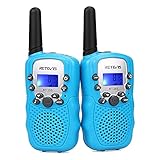 | Retevis RT388 Kids Walkie Talkies, Outdoor Toys for Kids Camping Essentials | 4-12 Year Old Boy Birthday Gift, 22 CH VOX Flashlight Clear Sound, Kids Walkie Talkies 2 Pack for Camping Hiking Adventure | Check Price On Amazon |
 | Cobra RX680 Walkie Talkies (2-Pack), IP54 Water Resistant Design | Rugged & Splashproof Two Way Radios Long Range, 60 Pre-Programmed Channels, Weather Alerts | Check Price On Amazon |
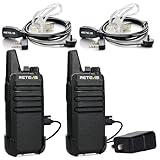 | Retevis RT22 Walkie Talkies Long Range Rechargeable with Earpiece (2 Pack) | Slim & Lightweight 2 Way Radio For Camping & Hiking, Pocket-Friendly Antenna, Ready to Use, 10-Hour Battery, USB-C Charging | Check Price On Amazon |
 | Midland GXT1000VP4 GMRS Two-Way Radios with Headsets, Black, 2 Pack | 50 Channels, 142 Privacy Codes, Up to 36 Mile Long Range, JIS4 Water Resistant, NOAA Weather Alert, Rechargeable NiMH | Check Price On Amazon |
 | Retevis RT628 Walkie Talkies for Kids,Toys Gifts for 6-12 Years Old Boys Girls,Long Range 2 Way Radio 22CH VOX,Birthday Gift,Family Walkie Talkie for Camping Hiking Indoor Outdoor | Check Price On Amazon |