Radio modulation directly impacts aviation safety through clear communications. 100% modulation provides optimal clarity for your aviation radio transmissions. This guide explains technical concepts and practical techniques to achieve perfect modulation every time. You’ll learn to adjust your equipment, use proper microphone technique, and troubleshoot common problems for consistently clear communications.
Understanding Modulation in Aviation Radio Communications
Modulation in aviation radio communications is often misunderstood, yet it’s fundamental to ensuring your transmissions are heard clearly. Let’s break down what modulation actually means and why 100% is the sweet spot you should aim for.
| Photo | Popular Portable Walkie Talkies | Price |
|---|---|---|
 | SKIWARRIOR Multifunctional Smart Wireless Ski Goggles with Walkie-Talkie, Anti-Fog Zeiss Lens, Music & Call Function (Cylindrical Blue) | Check Price On Amazon |
 | SINORISE Super Mini Walkie Talkies, Two-Way Radios, 3 Pack | Up to 12 Hours Battery Life, for Baseball Coaches, Restaurants, Retail Stores, Hospitals, Outdoor Sports & Travel | Check Price On Amazon |
 | KOSPET Tank M4C Smart Watch Rugged, Dual-Band GPS, 5ATM & IP69K Waterproof | 1.96" AMOLED Display, 170+ Sport Modes, Built-in LED Flashlight/Walkie-Talkie, Heart Rate/Sleep Monitor for Android & iPhone | Check Price On Amazon |
 | Retevis RT15 Walkie Talkies 3 Pack, Birthday Gift, Outdoor Adventure Kit | Durable, Lightweight, VOX, Key Lock, Mini Walkie Talkies for Adults, School Family Outdoor Travel Camping Hiking | Check Price On Amazon |
 | Rechargeable Walkie Talkies Toys for Kids: DIY Astronaut Walkie Talkies for Boys Christmas Birthday Gifts for 3 4 5 6 7 8 9 10 Boy Walkie Talkie Outdoor Hiking Toy 2 Way Radio Camping Outdoor Game | Check Price On Amazon |
In aviation communications, amplitude modulation (AM) is the standard. Modulation is the process where your voice information gets encoded onto a carrier wave. When you speak into your microphone, your voice alters (modulates) the strength of the radio signal. 100% modulation means your voice is using the full capacity of the carrier wave without distortion.
Many pilots confuse modulation with volume or loudness. While related, they’re different concepts. Modulation refers to how efficiently your voice information is carried by the radio signal, while volume simply refers to how loud the audio sounds. Proper modulation ensures your message is transmitted with maximum clarity and range.
According to RTCA DO-186B standards, aviation radios are designed to operate optimally at 100% modulation. Under-modulation results in weak, hard-to-hear transmissions. Over-modulation causes distortion and potentially interferes with adjacent frequencies.
The Science Behind Radio Modulation
To truly master aviation radio communications, understanding the basic science behind modulation helps you make better adjustments to your equipment and technique.
Radio communication works through carrier waves, which are continuous radio frequency signals. When you transmit, your voice modifies this carrier wave. In AM radio (used in aviation), your voice alters the amplitude or height of these waves.
AM radio differs from FM (used in music broadcasting) in how information is encoded. AM encodes by changing signal strength, while FM changes frequency. Aviation uses AM because it’s more reliable for voice communications in variable conditions, though it’s more susceptible to static.
When modulation occurs, it creates “sidebands” on either side of the main carrier frequency. These sidebands contain your actual voice information. Proper modulation ensures these sidebands contain clear voice data without distortion or weakness.
The Impact of Modulation on Transmission Clarity
The difference between properly modulated and poorly modulated transmissions can literally be the difference between being understood clearly and being asked to repeat yourself multiple times.
Under-modulated transmissions sound weak and may be difficult to hear, especially in busy airspace or areas with background noise. Your transmission might fade into the background, forcing controllers to ask for multiple repeats, which increases radio congestion and workload.
Over-modulated transmissions suffer from “clipping” where parts of your words get cut off, creating a garbled, distorted sound. This can be just as unintelligible as a weak signal, despite being loud.
“The number one issue we face during busy periods isn’t volume but modulation quality,” says John Martin, an air traffic controller at a major international airport. “A properly modulated transmission at 100% cuts through background noise and is immediately understandable, saving precious seconds.”
Aviation radio systems are specifically designed to operate at 100% modulation for optimal clarity and range. This is why learning to achieve consistent 100% modulation is worth the effort.
Identifying Modulation Problems in Your Radio Transmissions
Before you can fix modulation issues, you need to know how to recognize them. Here are the telltale signs that your radio transmissions aren’t hitting that optimal 100% modulation mark.
Controllers and other pilots provide the most immediate feedback about your transmission quality. Listen carefully to their responses, which often contain clues about your modulation.
Signs of Under-Modulation
Under-modulation occurs when your voice isn’t fully utilizing the carrier wave’s capacity, resulting in weak transmissions that might not be heard clearly, especially in busy airspace.
Watch for these indicators of under-modulation:
- Controllers respond with “aircraft calling, say again” even in good reception areas
- You frequently hear “your transmission is weak” or “barely readable”
- Others ask you to “speak louder” or “adjust your microphone”
- Your transmissions seem to have less range than other aircraft
- Controllers ask you to verify information multiple times
Under-modulation typically occurs when speaking too far from the microphone, using insufficient volume, or having improper microphone gain settings. It results in poor signal-to-noise ratio, where your voice barely rises above the background static.
Signs of Over-Modulation
Over-modulation is when your voice input exceeds what the radio can properly transmit, resulting in distorted, ‘clipped’ transmissions that can be just as difficult to understand as weak ones.
Common indicators of over-modulation include:
- Controllers respond with “your transmission is distorted” or “breaking up”
- You hear descriptions like “garbled” or “unclear” despite good signal strength
- Feedback indicating only portions of your message were understood
- Reports that your transmission sounds “harsh” or “scratchy”
- Others mention that consonants (especially ‘p’ and ‘t’ sounds) are distorted
Over-modulation typically results from speaking too loudly, positioning the microphone too close to your mouth, or having microphone gain settings too high which can cause distorted transmissions. The technical term “flat-topping” describes how the waveform gets clipped when it exceeds the transmitter’s capacity.
Aviation Radio Equipment and Modulation Performance
Your radio equipment plays a critical role in achieving optimal modulation. Understanding how different components affect your transmission quality helps you make better equipment choices and adjustments.
Panel-Mount vs. Handheld Radio Differences
Panel-mount and handheld aviation radios have significant differences in their modulation capabilities and adjustments, which directly impacts your transmission clarity.
| Feature | Panel-Mount Radios | Handheld Radios |
|---|---|---|
| Power Output | Typically 5-10 watts | Usually 1.5-6 watts |
| Modulation Adjustment | Often adjustable through internal settings | Limited or fixed settings |
| Audio Processing | More sophisticated filters and processors | Basic processing capabilities |
| Microphone Options | Multiple types compatible | Limited to built-in or specific types |
| Power Source | Aircraft electrical system (consistent) | Batteries (variable voltage) |
Panel-mount radios like the Garmin GTR 225 and Icom A220 generally provide more consistent modulation due to stable power supply and better audio processing. They typically include adjustable microphone gain settings that can be optimized for your specific voice and headset.
Handheld radios like the Icom A25N and Yaesu FTA-750L have fewer adjustment options but serve as valuable backups. Their modulation performance can vary with battery level, making fresh batteries essential for optimal transmission clarity.
Headset and Microphone Impact on Modulation
Your headset and microphone setup can significantly impact modulation quality, sometimes more than the radio itself.
Microphone impedance is a critical factor. Aviation microphones typically have impedance ratings between 150-600 ohms, and mismatches between your headset and radio can cause significant modulation issues. Most aviation radios are designed for 150-ohm microphones.
Dynamic microphones (found in passive headsets like David Clark H10 series) use mechanical components and generally provide more consistent modulation but require proper positioning. Electret microphones (found in many ANR headsets like Bose A20) use electronics to amplify your voice and may be more sensitive to positioning and power issues.
Noise-cancelling technology in modern aviation headsets can significantly improve modulation by filtering out cockpit noise before it enters the microphone. This prevents background noise from competing with your voice for modulation capacity.
Popular aviation headsets vary in their modulation characteristics:
- David Clark H10 series: Consistent modulation with well-defined polar pattern requiring precise positioning
- Lightspeed Zulu 3: Excellent noise rejection with slightly more sensitive microphone gain
- Bose A20: Very clean audio with sophisticated processing but potentially more sensitive to positioning
The Perfect Mic Technique for 100% Modulation
Your microphone technique is perhaps the single most important factor in achieving optimal modulation. Here’s exactly how to position and use your mic for crystal-clear transmissions.
Microphone Positioning for Different Headset Types
Different aviation headset designs require slightly different microphone positioning techniques to achieve optimal modulation.
For standard boom microphones (most aviation headsets):
- Position the microphone 1/8 to 1/4 inch from the corner of your mouth (not directly in front)
- Align it so your breath doesn’t blow directly across or into the microphone
- Ensure the microphone is at the same level as your lips, not above or below
- Check that the talk/listen side of the mic faces your mouth (many have markers)
For David Clark headsets:
- Position slightly closer (1/8 inch) from the corner of your mouth
- Ensure the white dot or labeled side faces your lips
- Bend the boom so the microphone comes in at a slight angle
For Bose A20 and similar ANR headsets:
- Position 1/4 inch from your mouth corner
- Ensure windscreen faces your mouth
- Avoid allowing the mic to touch your face or facial hair
For helicopter headsets with mask microphones:
- Position so the microphone cups lightly touch your face
- Ensure even contact around the entire rim
- Adjust straps to maintain consistent position during head movement
Regardless of headset type, check your position before every flight, as headsets often shift during storage or while putting them on.
Speaking Techniques for Optimal Modulation
How you speak into the microphone significantly impacts your modulation quality. These techniques will help you maintain consistent, clear transmissions.
- Voice volume: Speak in a normal conversational tone, not louder. Increasing volume often causes over-modulation rather than improving clarity.
- Consistent distance: Maintain the same distance from the microphone throughout your transmission. Avoid turning your head away while speaking.
- Articulation: Pronounce words clearly and completely without rushing. Consonants (especially at the ends of words) are often lost in radio transmissions.
- Pacing: Speak slightly slower than normal conversation but not unnaturally slow. Aim for about 100 words per minute.
- Breathing technique: Turn slightly away when taking a breath to avoid sending breath noise. Don’t breathe directly into the microphone.
- High-noise adaptation: In loud environments, cup your hand around the microphone and your mouth to create a partial seal that blocks ambient noise.
Practice these techniques on the ground using a handheld radio and a receiver to hear yourself. Many pilots are surprised by how their voice actually sounds over the radio compared to how they think they sound.
Adjusting Your Aviation Radio for Optimal Modulation
Different aviation radio models have various adjustment options that affect modulation. Here’s how to properly configure your specific equipment for the clearest possible transmissions.
The core principle of radio adjustment is finding the right balance for your specific voice, microphone, and operating environment. Most problems come from improper setup rather than equipment limitations.
Adjusting Panel-Mount Aviation Radios
Panel-mount radios offer several adjustment options that affect modulation quality. Here’s how to optimize the most common models found in general aviation aircraft.
For Garmin GTR 225 and GNC series radios:
- Access the configuration menu by pressing and holding the VOL/SQ knob
- Navigate to the “MISC” submenu, then “MIC GAIN” setting
- Adjust in small increments (start with middle settings)
- Test after each adjustment with a radio check
For Icom A220 and similar models:
- Power off the unit
- Hold the MENU key while powering on to access service menu
- Navigate to “MIC LEVEL” settings
- Make small adjustments (typically 3-4 is optimal for most setups)
Sidetone adjustment is equally important. Sidetone lets you hear your own voice in your headset while transmitting. Proper adjustment helps you naturally maintain appropriate speaking volume:
- Set sidetone loud enough to hear yourself clearly
- Avoid excessive sidetone that encourages speaking too softly
- For most Garmin radios, sidetone is adjusted in the same menu as mic gain
Audio panels like the Garmin GMA 340 or PS Engineering PMA450B provide additional adjustment points. The intercom volume and squelch settings should be adjusted separately from the radio transmit settings.
Optimizing Handheld Aviation Radios
Handheld aviation radios have unique considerations for achieving optimal modulation, especially when used with different headset adapters.
For Icom A25N and similar models:
- Access the function menu and find “MIC GAIN” settings
- Start at the middle setting (usually 3 of 5)
- Use fresh batteries or ensure full charge before testing
- When using external headsets, ensure adapter matches your headset impedance
For Yaesu FTA series:
- Press and hold MENU button to access settings
- Navigate to “Config” then “Mic Select”
- Choose appropriate setting based on whether using internal mic or headset
- If using headset, verify adapter compatibility
When using handheld radios as emergency backup plans when primary radios fail, remember that battery voltage affects modulation. As batteries deplete, modulation performance can degrade. Always carry spare batteries or ensure full charge before flights.
The push-to-talk (PTT) switch quality also affects modulation. Intermittent PTT connections can cause modulation to cut in and out. Ensure your PTT switch makes clean, consistent contact.
Testing and Verifying Your Radio’s Modulation
Once you’ve adjusted your equipment and technique, you need to verify that you’re actually achieving optimal modulation. Here’s how to properly test your radio’s performance.
The Proper Radio Check Procedure
A radio check is the most common way pilots verify their transmission quality, but there’s a right and wrong way to conduct one for evaluating modulation.
Use this specific phrasing when requesting a modulation check:
- “[Station name], [your callsign], radio check with modulation check, over.”
- Speak in your normal transmission voice, not louder or softer than usual
- Include a longer phrase that contains various sounds (e.g., “requesting radio check with specific feedback on modulation quality”)
- Ask specifically about clarity rather than just strength
When interpreting responses, listen for specific terminology:
- “Loud and clear” means good volume and good modulation
- “Loud but distorted” indicates over-modulation
- “Weak but readable” suggests under-modulation
- “Scratchy” or “breaking up” points to modulation problems
Ground testing before flight is ideal. UNICOM operators at smaller airports are often willing to provide detailed feedback during non-busy periods. Flight schools and authorities who check equipment compliance can also be good resources for detailed radio checks.
Advanced Testing Methods
For pilots who want objective verification of their modulation quality, these advanced methods provide more technical feedback than standard radio checks.
Recording and analysis method:
- Use a second radio with recording capability to capture your transmissions
- Record both your transmission and others for comparison
- Listen for clarity, consistent volume, and absence of distortion
- Compare your recordings to professional aviation recordings
Working with avionics professionals:
- Schedule time with an avionics technician who can measure modulation with an oscilloscope
- Request a bench test that objectively measures modulation percentage
- Have them verify transmitter power output alongside modulation
When making adjustments, use a methodical before/after testing approach. Change only one variable at a time (microphone position, gain setting, or speaking technique) and test the result before making additional changes.
Troubleshooting Common Modulation Problems
Even with proper technique and equipment setup, modulation issues can still occur. This systematic troubleshooting guide will help you identify and resolve the most common problems.
Resolving Under-Modulation Issues
If you’re consistently receiving reports of weak or barely audible transmissions, these specific solutions address the most common causes of under-modulation.
Problem: Microphone too far from mouth
- Solution: Reposition microphone to 1/8-1/4 inch from corner of mouth
- Prevention: Mark correct boom position with small piece of colored tape
Problem: Insufficient microphone gain setting
- Solution: Increase mic gain one step at a time until optimal
- Prevention: Document optimal settings for your headset/voice combination
Problem: Speaking too softly
- Solution: Maintain consistent, conversational volume; adjust sidetone to hear yourself
- Prevention: Practice standard phrases at proper volume
Problem: Impedance mismatch between headset and radio
- Solution: Verify headset impedance matches radio requirements; use appropriate adapter
- Prevention: Purchase headsets compatible with your specific radio equipment
Problem: Low voltage or power issues
- Solution: Check aircraft electrical system or replace/recharge handheld batteries
- Prevention: Monitor voltage during preflight checks
Resolving Over-Modulation Issues
Distorted, garbled transmissions are typically caused by over-modulation. Here’s how to fix these issues for clearer communications.
Problem: Microphone too close to mouth
- Solution: Reposition microphone slightly further from mouth (aim for 1/4 inch)
- Prevention: Check position before each transmission
Problem: Speaking too loudly
- Solution: Use normal conversational tone; avoid raising voice
- Prevention: Practice with recorded feedback to find optimal volume
Problem: Excessive microphone gain
- Solution: Reduce mic gain settings one step at a time until distortion disappears
- Prevention: Note optimal settings for future reference
Problem: Plosive sounds (“p,” “b,” “t” sounds) causing spikes
- Solution: Position mic at corner of mouth rather than directly in front
- Prevention: Practice speaking technique to soften plosives
Problem: Intercom volume affecting transmission modulation
- Solution: Adjust intercom and radio settings separately; they often interact
- Prevention: Understand your specific audio panel’s interaction between intercom and radio
Special Considerations for Challenging Environments
Different flying environments present unique challenges for radio modulation. These specialized techniques will help you maintain clear communications in difficult conditions.
High-Noise Environment Techniques
High-noise cockpit environments like helicopters or open-cockpit aircraft create special challenges for achieving optimal modulation.
- Headset selection: For extremely loud environments, choose headsets with superior passive noise reduction and effective noise-cancelling microphones like the David Clark DC ONE-X or Lightspeed Delta Zulu
- Microphone positioning: Position microphone slightly closer than normal (1/8 inch) to improve signal-to-noise ratio
- Voice technique: Speak slightly louder than normal but focus on clear articulation rather than volume
- Cupping technique: In extreme noise, create a partial seal around the microphone with your hand to block ambient noise
- ANR considerations: Active Noise Reduction can dramatically improve your ability to hear yourself through sidetone, helping maintain proper speaking volume
Some open-cockpit aircraft pilots find success using throat microphones or masks with integrated microphones that physically block wind and engine noise from reaching the microphone element.
Emergency Communication Clarity
During emergencies, clear communication becomes even more critical. These specialized techniques ensure your emergency phraseology and critical communications under pressure achieve optimal modulation even under stress.
- Pre-transmit pause: Take a deep breath and pause briefly before pressing the PTT to collect your thoughts
- Deliberate speech: Slow your speaking pace by about 25% from normal
- Microphone check: Quickly verify microphone position before emergency transmissions
- Phrase planning: Plan critical phrases mentally before transmitting
- Backup radio preparation: Have handheld radio positioned and ready with proper volume/squelch settings
- Prioritize clarity over brevity: In true emergencies, clear communication trumps radio brevity
Practice emergency communications regularly during your normal flight training. Muscle memory and practiced phrases help maintain composure and proper technique during actual emergencies.
Advanced Radio Communication Equipment for Optimal Modulation
For pilots who frequently experience modulation challenges or who want the absolute best communication clarity, these advanced equipment options offer enhanced performance.
Modern digital audio panels provide significantly improved modulation control:
| Product | Key Modulation Features | Best For |
|---|---|---|
| Garmin GMA 345 | Digital audio processing, automatic squelch, Bluetooth | Modern glass cockpit integration |
| PS Engineering PMA450B | IntelliAudio dimensional sound, parametric EQ, voice recognition | Complex multi-radio environments |
| Trig TY96A with TX-8 | Digital voice processing, dual watch monitoring | Retrofit installations, budget-conscious upgrades |
Premium aviation headsets with enhanced modulation features:
- Bose A30: Advanced digital signal processing for clearer voice transmission ($1,099)
- David Clark One-X: Hybrid electronic noise cancellation with superior microphone ($950)
- Lightspeed Delta Zulu: Hearing protection technology with exceptional mic clarity ($1,099)
Aftermarket microphone upgrades are available for many headsets. Companies like Avcomm and Gulf Coast Avionics offer noise-cancelling microphone elements that can replace stock microphones for improved modulation without replacing the entire headset.
Digital signal processing (DSP) technology in modern aviation radios helps maintain optimal modulation automatically. These systems analyze your voice in real-time and make micro-adjustments to maintain consistent modulation levels regardless of how loudly or softly you speak.
Future technologies are focusing on adaptive modulation systems that automatically adjust to individual voices and ambient noise conditions. Some airports have multiple tower frequencies with different equipment, so having adaptable transmission technology becomes increasingly valuable.
For complex installations with multiple radios using a single audio system, specialized audio isolation amplifiers can prevent cross-talk and modulation issues between systems.
Conclusion: Achieving Consistent 100% Modulation
Achieving and maintaining optimal modulation is a combination of understanding the technical principles, using proper technique, making appropriate equipment adjustments, and regular testing.
Key takeaways for optimal modulation:
- Position your microphone 1/8 to 1/4 inch from the corner of your mouth
- Speak in a normal, conversational tone without raising your voice
- Adjust your radio’s mic gain settings for your specific voice and headset
- Regularly test your transmissions and solicit specific feedback
- Address both equipment and technique when troubleshooting
- Consider environment-specific adjustments for challenging conditions
Remember that clear communication isn’t just about professionalism, it’s a critical safety factor. Taking the time to optimize your radio modulation ensures your intentions are understood the first time, every time, reducing the potential for miscommunication during critical phases of flight.
By applying the techniques and adjustments outlined in this guide, you’ll achieve consistent 100% modulation, resulting in crystal-clear transmissions that enhance safety and efficiency in all your aviation communications.
| Photo | TOP RATED WALKIE TALKIES | Price |
|---|---|---|
 | Retevis RT628 Kids Walkie Talkies, Toys Gifts for 4-12 Year Old Girl Boy | Kids Camping Essentials Outdoor Toys, Birthday Gift, 22CH, VOX, Keypad Lock, Durable, Easy to Use Walkie Talkies for Kids | Check Price On Amazon |
 | Cobra ACXT545 Weather-Resistant Walkie Talkies, Rechargeable, 22 Channels | Long Range 28-Mile Two-Way Radio Set (2-Pack) | Check Price On Amazon |
 | Retevis RT388 Kids Walkie Talkies, Outdoor Toys for Kids Camping Essentials | 4-12 Year Old Boy Birthday Gift, 22 CH VOX Flashlight Clear Sound, Kids Walkie Talkies 2 Pack for Camping Hiking Adventure | Check Price On Amazon |
 | Cobra RX680 Walkie Talkies (2-Pack), IP54 Water Resistant Design | Rugged & Splashproof Two Way Radios Long Range, 60 Pre-Programmed Channels, Weather Alerts | Check Price On Amazon |
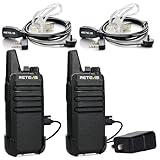 | Retevis RT22 Walkie Talkies Long Range Rechargeable with Earpiece (2 Pack) | Slim & Lightweight 2 Way Radio For Camping & Hiking, Pocket-Friendly Antenna, Ready to Use, 10-Hour Battery, USB-C Charging | Check Price On Amazon |
 | Midland GXT1000VP4 GMRS Two-Way Radios with Headsets, Black, 2 Pack | 50 Channels, 142 Privacy Codes, Up to 36 Mile Long Range, JIS4 Water Resistant, NOAA Weather Alert, Rechargeable NiMH | Check Price On Amazon |
 | Retevis RT628 Walkie Talkies for Kids,Toys Gifts for 6-12 Years Old Boys Girls,Long Range 2 Way Radio 22CH VOX,Birthday Gift,Family Walkie Talkie for Camping Hiking Indoor Outdoor | Check Price On Amazon |