Antenna switching systems solve the common challenge of connecting multiple radio transceivers to a limited number of antennas. These specialized devices allow operators to efficiently share antenna resources without physical reconnection, saving space and money while increasing operational flexibility. This guide covers everything from basic switching concepts to advanced automation, helping you build the optimal setup for your station.
Understanding Antenna Switching Fundamentals
Antenna switching systems solve a common problem in radio communications: how to connect multiple radios to a limited number of antennas. Let’s explore the core concepts behind how these systems work and why they’re essential for many station setups.
| Photo | Popular Portable Walkie Talkies | Price |
|---|---|---|
 | SKIWARRIOR Multifunctional Smart Wireless Ski Goggles with Walkie-Talkie, Anti-Fog Zeiss Lens, Music & Call Function (Cylindrical Blue) | Check Price On Amazon |
 | SINORISE Super Mini Walkie Talkies, Two-Way Radios, 3 Pack | Up to 12 Hours Battery Life, for Baseball Coaches, Restaurants, Retail Stores, Hospitals, Outdoor Sports & Travel | Check Price On Amazon |
 | KOSPET Tank M4C Smart Watch Rugged, Dual-Band GPS, 5ATM & IP69K Waterproof | 1.96" AMOLED Display, 170+ Sport Modes, Built-in LED Flashlight/Walkie-Talkie, Heart Rate/Sleep Monitor for Android & iPhone | Check Price On Amazon |
 | Retevis RT15 Walkie Talkies 3 Pack, Birthday Gift, Outdoor Adventure Kit | Durable, Lightweight, VOX, Key Lock, Mini Walkie Talkies for Adults, School Family Outdoor Travel Camping Hiking | Check Price On Amazon |
 | Rechargeable Walkie Talkies Toys for Kids: DIY Astronaut Walkie Talkies for Boys Christmas Birthday Gifts for 3 4 5 6 7 8 9 10 Boy Walkie Talkie Outdoor Hiking Toy 2 Way Radio Camping Outdoor Game | Check Price On Amazon |
At its most basic, an antenna switch is a device that allows multiple transmitters or receivers to share one or more antennas without physically disconnecting and reconnecting cables. This capability is crucial for amateur radio operators who often work with multiple bands, modes, or radios but have limited space for antennas.
When choosing between switching and splitting, it’s important to understand the fundamental difference: splitting divides signals (reducing power and potentially creating interference), while switching routes the full signal to selected destinations. This distinction makes switching generally preferable for most amateur radio applications.
The benefits of proper antenna diversity systems extend beyond convenience. By eliminating the need to manually change connections, operators reduce wear on expensive connectors, minimize downtime between band changes, and create more efficient station workflows.
Key Specifications Explained: What They Mean and Why They Matter
When evaluating antenna switches, several key specifications determine performance and suitability. Understanding these specifications is crucial for selecting the right switch for your needs.
Isolation refers to how effectively a switch prevents signal leakage between ports. Measured in decibels (dB), higher values indicate better isolation. For multi-radio operations, isolation of at least 50dB is generally recommended to prevent interference between systems.
| Specification | What It Measures | Ideal Values | Impact on Operation |
|---|---|---|---|
| Isolation | Signal separation between ports | 50+ dB | Prevents interference between radios |
| Insertion Loss | Signal power lost through switch | < 0.2 dB | Maintains signal strength |
| VSWR | Signal reflection | < 1.2:1 | Ensures efficient power transfer |
| Power Handling | Maximum transmit power | Depends on usage | Prevents switch damage |
| Frequency Range | Operational frequencies | Matches station needs | Determines usable bands |
Insertion loss indicates how much signal power is lost when passing through the switch. Even small losses (measured in dB) can significantly impact weak signal work, especially at higher frequencies. Quality switches typically have insertion loss below 0.2dB at HF frequencies.
Power handling capability is particularly important for transmitting stations. Switches must handle your maximum power output with a safety margin. Remember that power handling often decreases at higher frequencies and may be affected by environmental conditions such as cold weather, which can impact various radio components.
Types of Antenna Switches: Comparing Your Options
Antenna switches come in several forms, each with distinct advantages and limitations. This section breaks down the major categories to help you identify which type best suits your station requirements.
Manual Coaxial Switches
Manual coaxial switches are the simplest and most reliable option. These mechanical devices use physical rotary or toggle controls to redirect RF signals. They require no power source and offer excellent isolation characteristics when properly constructed.
Desktop manual switches sit within easy reach of the operator, allowing quick band or antenna changes. Remote manual switches place the switching mechanism near the antenna entry point, reducing feedline losses but requiring a trip outside for changes.
Quality manual switches typically use ceramic insulation and silver-plated contacts to maintain low insertion loss and high isolation. Their simplicity makes them extremely reliable, with potential lifespans of decades when properly maintained.
Automated/Electronic Switches
Automated switching systems use electrically controlled relays or solid-state components to route signals. These systems allow remote operation, computer control, and integration with station automation systems.
Relay-based switches use electromagnetic relays to physically move contacts, creating or breaking connections. They offer excellent isolation and power handling but can eventually wear out mechanically after thousands of operations.
Solid-state switches use PIN diodes or other semiconductor devices to route RF signals without moving parts. While more reliable mechanically, they typically have lower power handling capabilities and may introduce more insertion loss than relay-based alternatives.
| Switch Type | Pros | Cons | Typical Price Range |
|---|---|---|---|
| Manual Coaxial | No power needed, reliable, excellent isolation | Requires physical access, no remote operation | $30-150 |
| Relay-Based Automated | Remote operation, high power handling | Requires power, mechanical wear | $100-500 |
| Solid-State | No mechanical wear, fast switching | Lower power handling, higher insertion loss | $150-600 |
| Matrix Systems | Flexible routing, comprehensive control | Complex setup, higher cost | $300-1500+ |
| Sequential | Optimized for contesting, preset configurations | Less flexible for general use | $200-800 |
Matrix switches represent the most sophisticated option, allowing any input to connect to any output in various configurations. These systems are ideal for complex stations with multiple radios and antennas but come with corresponding increases in cost and complexity.
Manual vs. Automated Switching: When to Choose Each
The choice between manual and automated switching significantly impacts both your budget and operating experience. Let’s examine when each approach makes the most sense.
| Factor | Manual Switching | Automated Switching | Best Suited For |
|---|---|---|---|
| Budget | Lower cost ($30-150) | Higher cost ($100-1500+) | Manual: Budget-conscious operators Automated: Contest stations |
| Reliability | Extremely high, no power needed | Dependent on power, electronics | Manual: Emergency stations Automated: Standard home use |
| Operating Style | Slower band changes | Rapid band/antenna switching | Manual: Casual operators Automated: Contesters, DXers |
| Remote Operation | Not possible | Fully supported | Manual: In-shack operation Automated: Remote sites |
| Integration | Standalone operation | Computer/logging integration | Manual: Simple stations Automated: Complex setups |
Manual switches excel in simplicity and reliability, making them ideal for emergency communications where power may be unavailable. They’re also perfect for operators who change bands infrequently or who value maximum reliability over convenience.
Automated systems shine in contest environments where rapid band changes are essential. They’re also the only viable option for remote station operation, where physical access to the equipment isn’t possible during operation.
How to Choose the Right Antenna Switch for Your Station
Selecting the ideal antenna switch involves evaluating several factors specific to your station setup and operating goals. Follow this step-by-step approach to make the right choice.
Step 1: Assess Your Station Requirements
Begin by documenting your current and planned station configuration:
- Number of transceivers: Count all radios that need antenna access
- Number of antennas: List all available antennas
- Power levels: Note maximum power for each transmitter
- Frequency ranges: Document all bands you operate
- Operating modes: Different modes may benefit from different antennas
Step 2: Consider Your Operating Style
Your operating habits significantly impact switch selection:
- Casual operation: Manual switches may suffice
- Contesting: Automated solutions with quick access are preferred
- Remote operation: Requires electronic switching with network control
- Multi-operator: May need complex matrix switching
Step 3: Evaluate Environmental Factors
Installation location affects switch requirements:
- Indoor shack: Most switch types are suitable
- Outdoor mounting: Requires weatherproof construction
- Tower mounting: Consider weight, wind load, and remote control
- Extreme environments: Special temperature and humidity ratings
When dealing with regulatory matters for your antenna system, understanding certification standards and type acceptance procedures can be helpful, especially for commercial or aviation-related installations.
Step 4: Match Specifications to Requirements
Ensure the switch specifications match your needs:
- Power handling: Select switches rated at least 25% above your maximum power
- Frequency range: Must cover all bands you operate
- Insertion loss: Lower is better, especially for weak signal work
- Isolation: Higher is better, particularly for multi-radio setups
- Control interface: Compatible with your station automation
Step 5: Consider Future Expansion
Plan for station growth:
- Select switches with more positions than currently needed
- Consider expandable systems that allow adding modules
- Choose products with upgrade paths when possible
- Budget for long-term needs rather than minimum requirements
Installation Best Practices: Maximizing Performance and Protection
Proper installation of your antenna switching system is crucial for optimal performance, longevity, and safety. This section covers essential installation practices that minimize signal loss and protect your equipment.
Physical Placement Considerations
The location of your switch significantly impacts system performance:
- Indoor switches should be positioned for easy access and short cable runs
- Outdoor switches should be placed to minimize feedline lengths
- Maintain adequate spacing from other equipment to reduce interference
- Consider serviceability for future maintenance
- Mount securely to prevent vibration or movement
Cable Selection and Routing
Proper cabling is essential for switch performance:
- Use high-quality coaxial cable appropriate for your frequency range
- Select proper cable impedance (typically 50 ohms for amateur radio)
- Use the minimum length needed to reduce losses
- Route cables away from interference sources
- Support cables properly to prevent strain on connectors
- Use consistent cable types throughout the system when possible
Connector Installation
Connectors are often the weakest link in RF systems:
- Use high-quality connectors appropriate for your power level
- Follow manufacturer guidelines for connector installation
- Weatherproof outdoor connections using appropriate materials
- Tighten connectors to specification (don’t overtighten)
- Consider using connector savers on expensive equipment
Grounding and Lightning Protection: Critical Safety Considerations
Proper grounding and lightning protection are essential elements of any antenna switching installation. These measures protect both your equipment and your safety.
Every switching system should include:
- RF grounding to prevent common-mode currents
- Safety grounding to protect against electrical faults
- Lightning protection components at antenna entry points
- Bonding between all system components
- Single-point ground for the entire station when possible
Common grounding mistakes include:
- Using inadequate conductor sizes
- Creating ground loops with multiple paths
- Insufficient bonding between components
- Relying solely on AC safety grounds
- Improper lightning arrestor installation
Follow the “shortest and straightest” rule for ground connections. Lightning protection components should be installed at all antenna entry points and bonded directly to your station ground system using appropriate conductors.
Common Switching Configurations for Different Applications
Different operating scenarios require specific switching configurations to maximize efficiency and flexibility. This section illustrates common setups for various station types and operating goals.
Basic Home Station Configuration
A typical home station with 1-2 radios and 2-3 antennas represents the most common configuration:
- Components needed:
- Single manual or remote switch (1-in, 2-3 out)
- Quality coaxial cable
- Optional bandpass filters for interference mitigation
- Advantages:
- Simple setup with minimal complexity
- Low cost entry point
- Easy maintenance and troubleshooting
- Limitations:
- Limited flexibility for expansion
- Manual band/antenna changes
- No simultaneous multi-band operation
SO2R (Single Operator Two Radio) Configuration Guide
SO2R (Single Operator Two Radio) operation represents one of the most challenging switching scenarios, requiring careful configuration to prevent interference while maximizing operating efficiency.
A complete SO2R station typically includes:
- Two transceivers capable of independent operation
- Matrix antenna switch allowing any radio to access any antenna
- Band-pass filters to prevent receiver desensitization
- Audio switching system for operator headphones
- Band decoders to track frequency information
- Sequencers to control amplifiers and prevent hot-switching
Critical considerations for SO2R include:
- Maintaining at least 70dB isolation between radio systems
- Preventing transmitting into receiving antennas
- Implementing “lockouts” to prevent transmitting on multiple radios simultaneously
- Configuring software for efficient band/mode tracking
According to successful contest operators, proper bandpass filtering is often the difference between a working SO2R setup and constant interference problems. Many operators rely on backwards compatibility when building their stations to ensure components work together seamlessly.
Multi-Operator Station Configuration
Multi-operator stations present unique challenges for antenna switching:
- Components needed:
- Matrix switching system with multiple inputs/outputs
- Band-specific filters for each operating position
- Computerized control system with lockouts
- Extensive grounding and isolation
- Advantages:
- Allows multiple simultaneous operators
- Flexible antenna assignment
- Centralized control of resources
- Limitations:
- Significant complexity and cost
- Requires careful planning and testing
- Needs ongoing maintenance
Emergency Communications Setup
EmComm stations prioritize reliability and rapid deployment:
- Components needed:
- Manual switches (no power dependency)
- Pre-labeled connections for quick setup
- Weatherproof components
- Simplified configurations
- Advantages:
- Works without external power
- Simple troubleshooting
- High reliability
- Limitations:
- Less flexibility than automated systems
- Requires manual operation
- Limited remote capabilities
Troubleshooting Common Antenna Switching Problems
Even well-designed switching systems can encounter issues. This troubleshooting guide helps you identify and resolve common problems quickly to minimize downtime and frustration.
High SWR After Switching
High SWR readings after switching often indicate connection problems:
- Symptoms:
- SWR meter shows elevated readings
- Automatic tuners struggle to find match
- Reduced transmit power (with protection circuits)
- Diagnostic Steps:
- Check all connectors for proper seating
- Verify correct switch position selection
- Test with bypass cable to isolate switch issues
- Inspect switch contacts for corrosion or damage
- Solutions:
- Clean or replace connectors
- Repair or replace damaged cables
- Service switch contacts
- Check for water infiltration in outdoor components
Intermittent Connections
Intermittent connections can be particularly frustrating to diagnose:
- Symptoms:
- Signal cutting in and out
- SWR fluctuations during operation
- Inconsistent performance
- Diagnostic Steps:
- Physically secure all cables and connections
- Check for loose screws or mounting hardware
- Test with movement to identify mechanical issues
- Inspect control cables and power connections
- Solutions:
- Tighten all mechanical connections
- Secure cables with proper strain relief
- Replace worn components
- Weatherproof outdoor connections
RF Feedback and Interference
RF feedback often indicates insufficient isolation or grounding problems:
- Symptoms:
- Audio distortion during transmission
- Erratic computer or equipment behavior
- Interference between radios
- Diagnostic Steps:
- Verify proper grounding of all equipment
- Check for common-mode currents on feedlines
- Ensure adequate isolation between systems
- Test with reduced power to confirm RF issues
- Solutions:
- Improve station grounding
- Add ferrite chokes to reduce common-mode currents
- Install bandpass filters
- Increase separation between antennas
- Upgrade to switches with better isolation
For pilots and aviation enthusiasts, the Sporty’s SP-400 radio offers an interesting perspective on portable communications with simplified switching between COM channels, though it uses a different approach than the antenna switching systems discussed here.
Advanced Topics: Automation and Integration
Modern station design often incorporates automated antenna switching as part of a comprehensive control system. This section explores advanced integration options that can enhance operating efficiency and station capabilities.
Software Control Systems: Enhancing Flexibility and Remote Operation
Software control of antenna switching systems dramatically enhances station flexibility and enables remote operation capabilities. This section explores available software solutions and their implementation.
Popular control software options include:
- Ham Radio Deluxe: Integrated logging and equipment control
- N1MM+ Logger: Contest-focused with extensive switching support
- RemoteRig: Specialized for remote station operation
- FlexRadio SmartSDR: Advanced integration for SDR-based stations
- PstRotator: Primarily for rotator control but includes antenna switching
Hardware interfaces for software control typically use:
- USB connections for direct computer control
- Ethernet interfaces for network accessibility
- Serial ports for older equipment
- Dedicated controllers with API access
Remote operation security considerations include:
- Implementing strong authentication for all access points
- Using VPN connections for secure remote control
- Creating fail-safe configurations that default to safe states
- Installing watchdog timers to prevent system lockups
- Maintaining backup control methods when primary systems fail
Band Decoder Integration
Band decoders monitor radio frequencies and automatically trigger appropriate antenna selections:
- Components needed:
- Band data output from transceiver (CAT, BCD, analog)
- Band decoder unit (commercial or DIY)
- Interface to switching system
- Optional amplifier control integration
- Advantages:
- Automatic antenna selection based on frequency
- Prevents transmission on wrong antenna
- Simplifies band changes
- Integrates with logging software
Sequencer Operation
Sequencers ensure proper timing when switching between transmit and receive modes:
- Components needed:
- Sequencer unit (typically 4-8 channels)
- PTT input from radio
- Connections to amplifiers, preamps, switches
- Adjustable timing controls
- Typical sequence:
- Step 1: Disable receive preamplifiers
- Step 2: Set antenna switches to transmit position
- Step 3: Enable amplifier
- Step 4: Allow radio to transmit
- (Reverse sequence for returning to receive)
DIY Antenna Switching Projects: Build Your Own Solutions
Building your own antenna switching systems can provide cost savings while creating customized solutions for specific needs. These DIY projects range from simple manual switches to sophisticated automated systems.
Simple Manual Coax Switch
A basic 1×2 or 1×3 manual switch can be built for under $30:
- Materials needed:
- Metal enclosure (die-cast aluminum recommended)
- High-quality rotary switch with ceramic insulation
- SO-239 or N-type connectors (3-4 total)
- RG-142 or RG-400 coaxial cable for internal wiring
- Mounting hardware
- Construction steps:
- Layout and drill connector holes in enclosure
- Mount rotary switch in center position
- Install and secure connectors
- Create short, direct internal connections with coax
- Ensure good electrical contact with enclosure
- Performance expectations:
- Power handling: Up to 1kW at HF frequencies
- Isolation: Typically 50-60dB
- Insertion loss: Around 0.1-0.2dB if well-constructed
- Frequency range: DC to 150MHz for basic designs
Remote Relay-Based Switch
A remote relay switch can be built for $50-100:
- Materials needed:
- Weatherproof enclosure
- DPDT relays (12V coil) with appropriate current rating
- Coaxial connectors (SO-239 or N-type)
- Control cable and connectors
- Control box for indoor use
- Construction steps:
- Mount relays in weatherproof enclosure
- Install RF connectors with short, direct wiring
- Create control interface with indicator LEDs
- Run control cabling separate from RF lines
- Add lightning protection on control lines
- Performance expectations:
- Power handling: Depends on relay specifications
- Isolation: Typically 60-70dB with quality relays
- Reliability: Excellent if properly weatherproofed
- Control options: Simple switch panel or computer interface
Arduino/Raspberry Pi Controlled Switch
Advanced builders can create sophisticated switching systems:
- Materials needed:
- Arduino Uno/Nano or Raspberry Pi
- Relay shield or module
- Weatherproof enclosure
- RF-grade relays or switch modules
- Network interface (optional)
- Construction steps:
- Program microcontroller for desired functionality
- Configure control interface (web, physical, or both)
- Design RF section for proper isolation
- Implement safety features and failure modes
- Create documentation for operation and maintenance
- Performance expectations:
- Highly customizable operation
- Network/remote control options
- Integration with station automation
- Expandable design for future needs
Comparing Top Commercial Antenna Switching Products
The market offers numerous commercial antenna switching products across various price points and capability levels. This unbiased comparison will help you evaluate leading products based on performance, features, and value.
Manual Coaxial Switches
| Model | Configuration | Power Rating | Frequency Range | Price Range | Best For |
|---|---|---|---|---|---|
| Diamond CX-210A | 2-position | 1.5kW | DC-600MHz | $30-40 | Basic HF/VHF switching |
| MFJ-1702C | 2-position with ground | 2.5kW | DC-650MHz | $40-50 | HF use with ground position |
| Alpha Delta 2B | 2-position | 1.5kW | DC-500MHz | $60-70 | Outdoor/weatherproof use |
| Daiwa CS-201 | 2-position | 1kW | DC-900MHz | $25-35 | Budget-friendly option |
Remote/Automated Systems
| Model | Configuration | Control Interface | Power Rating | Price Range | Best For |
|---|---|---|---|---|---|
| Ameritron RCS-4 | 4-position | Wired remote | 1.5kW | $140-160 | Basic remote switching |
| Array Solutions SixPak | 6×2 matrix | Multiple options | 5kW | $400-500 | Contest stations |
| microHAM Station Master | Complex matrix | Computer/network | 1.5kW | $700-900 | Full station automation |
| Green Heron Engineering | Customizable | Network/serial | Varies | $300-700 | Remote site operations |
Performance data from real-world testing shows that high-end commercial switches like the Array Solutions SixPak typically provide 80dB+ isolation compared to 60-70dB for budget options. This difference becomes critical in multi-radio operations where preventing interference is essential.
Weatherproofing quality varies significantly between manufacturers. Alpha Delta and Array Solutions products consistently receive high marks for outdoor durability, while some less expensive options may require additional protection for outdoor mounting.
Specialized Applications and Considerations
Certain operating scenarios present unique challenges and requirements for antenna switching. This section addresses specialized applications and the specific considerations they entail.
Contesting and DXpedition Requirements
Contest and DXpedition stations have extreme demands:
- Critical requirements:
- Extremely high isolation (80dB+) between systems
- Rapid band changing capabilities
- Integration with logging software
- Reliable operation under continuous use
- Fail-safe protection systems
- Recommended solutions:
- Matrix switching systems with computer control
- Dedicated bandpass filters for each band
- Automated antenna selection based on frequency
- Redundant control systems for critical operations
Emergency Communications Applications
Emergency communications operations present unique requirements for antenna switching systems, with emphasis on reliability, simplicity, and rapid deployment.
EmComm stations prioritize:
- Reliability under adverse conditions
- Operation without commercial power
- Quick deployment and clear labeling
- Weatherproof construction
- Simple troubleshooting and repair
Recommended configurations include:
- Manual switches with clear position markings
- Pre-assembled and tested cable sets
- Laminated connection diagrams
- Backup switching options
- Lightning protection components
According to emergency communications specialists, simplicity trumps sophistication in disaster response scenarios. Manual systems with minimal points of failure are strongly preferred over complex automated solutions that may be difficult to troubleshoot under field conditions.
Remote Site Installations
Remote sites require special considerations:
- Critical requirements:
- Network control capabilities
- Robust security features
- Extensive environmental protection
- Power failure recovery systems
- Remote diagnostic capabilities
- Recommended solutions:
- Web-based control interfaces
- Backup control paths
- Automatic recovery procedures
- VSWR monitoring and protection
- Remote power cycling capabilities
Future Trends in Antenna Switching Technology
Antenna switching technology continues to evolve with advances in materials, control systems, and integration capabilities. Understanding emerging trends helps ensure your station remains current and adaptable.
Key trends shaping the future of antenna switching include:
Network-Centric Control Systems
- Web-based interfaces replacing dedicated controllers
- Cloud integration for remote monitoring and control
- API access for third-party software integration
- Mobile applications for station management
- Secure VPN access to switching resources
Advanced Materials and Components
- Improved solid-state switches with higher power handling
- Lower-loss dielectric materials
- More efficient relay designs with longer lifespans
- Integrated cooling systems for high-power applications
- 3D-printed customized enclosures and mounting systems
Integration and Automation
- AI-assisted band and antenna selection
- Automated tuning and optimization
- Integration with SDR technologies
- Predictive maintenance and component monitoring
- Self-healing network configurations
According to industry experts, station automation will continue to evolve toward comprehensive ecosystem management rather than discrete component control. Future systems will likely make intelligent decisions about optimal antenna configurations based on band conditions, operating goals, and performance metrics.
Conclusion: Creating Your Antenna Switching Strategy
Effective antenna switching forms a critical part of any multi-radio station, balancing performance requirements with practical constraints. This final section helps you develop a personalized strategy based on your specific needs and goals.
When developing your antenna switching strategy, consider these key points:
- Begin with a thorough assessment of your current and anticipated needs
- Prioritize reliability and performance over unnecessary features
- Plan for expansion with modular, upgradable components
- Document your system thoroughly for future maintenance
- Implement proper protection mechanisms from the start
For most operators, a phased approach works best:
- Start with quality manual switches for basic functionality
- Add remote control capabilities as needs evolve
- Implement automation for frequently used functions
- Integrate computer control when justified by operating style
- Continuously evaluate and optimize system performance
Remember that the ultimate goal of any switching system is to enhance your operating experience while protecting your equipment investment. The ideal system balances complexity with usability, providing the features you need without unnecessary complications.
By understanding the principles covered in this guide, you’ll be well-equipped to design, implement, and maintain an antenna switching system that meets your specific requirements, whether for casual operation, contesting, emergency communications, or remote station management.
| Photo | TOP RATED WALKIE TALKIES | Price |
|---|---|---|
 | Retevis RT628 Kids Walkie Talkies, Toys Gifts for 4-12 Year Old Girl Boy | Kids Camping Essentials Outdoor Toys, Birthday Gift, 22CH, VOX, Keypad Lock, Durable, Easy to Use Walkie Talkies for Kids | Check Price On Amazon |
 | Cobra ACXT545 Weather-Resistant Walkie Talkies, Rechargeable, 22 Channels | Long Range 28-Mile Two-Way Radio Set (2-Pack) | Check Price On Amazon |
 | Retevis RT388 Kids Walkie Talkies, Outdoor Toys for Kids Camping Essentials | 4-12 Year Old Boy Birthday Gift, 22 CH VOX Flashlight Clear Sound, Kids Walkie Talkies 2 Pack for Camping Hiking Adventure | Check Price On Amazon |
 | Cobra RX680 Walkie Talkies (2-Pack), IP54 Water Resistant Design | Rugged & Splashproof Two Way Radios Long Range, 60 Pre-Programmed Channels, Weather Alerts | Check Price On Amazon |
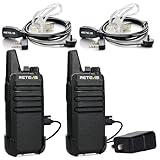 | Retevis RT22 Walkie Talkies Long Range Rechargeable with Earpiece (2 Pack) | Slim & Lightweight 2 Way Radio For Camping & Hiking, Pocket-Friendly Antenna, Ready to Use, 10-Hour Battery, USB-C Charging | Check Price On Amazon |
 | Midland GXT1000VP4 GMRS Two-Way Radios with Headsets, Black, 2 Pack | 50 Channels, 142 Privacy Codes, Up to 36 Mile Long Range, JIS4 Water Resistant, NOAA Weather Alert, Rechargeable NiMH | Check Price On Amazon |
 | Retevis RT628 Walkie Talkies for Kids,Toys Gifts for 6-12 Years Old Boys Girls,Long Range 2 Way Radio 22CH VOX,Birthday Gift,Family Walkie Talkie for Camping Hiking Indoor Outdoor | Check Price On Amazon |