Search and rescue communications serve as the lifeline between emergency teams, coordinators, and survivors during critical operations. Effective communication systems can mean the difference between successful rescues and tragic outcomes. This guide covers nine essential protocols for coordinating emergency responses across multiple agencies and environments, with special focus on aviation integration and field-tested techniques.
The Fundamentals of SAR Communication Systems
Effective search and rescue communications rest on three fundamental pillars: reliability, clarity, and interoperability. Before exploring specific protocols, it’s essential to understand these core systems that form the foundation of all SAR communication operations.
| Photo | Popular Portable Walkie Talkies | Price |
|---|---|---|
 | SKIWARRIOR Multifunctional Smart Wireless Ski Goggles with Walkie-Talkie, Anti-Fog Zeiss Lens, Music & Call Function (Cylindrical Blue) | Check Price On Amazon |
 | SINORISE Super Mini Walkie Talkies, Two-Way Radios, 3 Pack | Up to 12 Hours Battery Life, for Baseball Coaches, Restaurants, Retail Stores, Hospitals, Outdoor Sports & Travel | Check Price On Amazon |
 | KOSPET Tank M4C Smart Watch Rugged, Dual-Band GPS, 5ATM & IP69K Waterproof | 1.96" AMOLED Display, 170+ Sport Modes, Built-in LED Flashlight/Walkie-Talkie, Heart Rate/Sleep Monitor for Android & iPhone | Check Price On Amazon |
 | Retevis RT15 Walkie Talkies 3 Pack, Birthday Gift, Outdoor Adventure Kit | Durable, Lightweight, VOX, Key Lock, Mini Walkie Talkies for Adults, School Family Outdoor Travel Camping Hiking | Check Price On Amazon |
 | Rechargeable Walkie Talkies Toys for Kids: DIY Astronaut Walkie Talkies for Boys Christmas Birthday Gifts for 3 4 5 6 7 8 9 10 Boy Walkie Talkie Outdoor Hiking Toy 2 Way Radio Camping Outdoor Game | Check Price On Amazon |
SAR communication systems operate within a structured framework designed to maintain order during chaotic emergency situations. The primary communication channels include command channels (for leadership coordination), tactical channels (for operational teams), and emergency channels (for critical messages). These channels work together to create a comprehensive network that supports all aspects of rescue operations.
The core aviation radio frequency used globally for emergencies is 121.5 MHz, monitored by aircraft, control towers, and search and rescue units worldwide. Other common frequencies include 123.1 MHz for SAR operations and various VHF-FM channels used by ground teams. Radio failure procedures during flights are critical knowledge for aviation personnel involved in search operations.
Within the Incident Command System (ICS), communications follow a structured hierarchy:
- Incident Commander: Oversees all communications
- Communications Unit Leader: Manages technical systems
- Radio Operators: Handle message traffic
- Field Communicators: Relay information from operational areas
Interoperability between agencies remains one of the biggest challenges in SAR operations. Different organizations often use incompatible equipment, frequencies, and terminology. Successful operations require preplanning to address these challenges through shared channels, common terminology, and liaison officers who can “translate” between systems.
Aviation Radio Systems in SAR Operations
Aviation radio systems serve as the critical link between ground teams and aerial assets during SAR operations. Their proper integration can dramatically improve search efficiency and coordination.
SAR aviation communications typically utilize three main frequency bands:
- VHF-AM (118-137 MHz): Standard aircraft communications
- VHF-FM (136-174 MHz): Commonly used by ground SAR teams
- UHF (380-512 MHz): Used by military and some government agencies
Equipment requirements for aviation-compatible radio systems include multi-band capability, weatherproof construction, extended battery life, and noise-canceling microphones. These features are essential for maintaining reliable communications in challenging field conditions and high-noise aircraft environments. Cold weather conditions can significantly impact radio battery performance and electronic reliability during winter SAR operations.
Air-to-ground communication requires specific protocols to overcome challenges like aircraft noise, distance limitations, and frequency differences. Teams must establish clear procedures for position reporting, landing zone communications, and emergency signals that work across platforms.
The Role of Digital and Satellite Communication Technologies
While traditional radio remains the backbone of SAR communications, digital and satellite technologies have revolutionized capabilities, particularly in remote operations.
Modern SAR teams increasingly rely on satellite phones for operations in areas without cellular or radio coverage. These devices provide global connectivity regardless of local infrastructure, though they come with limitations including cost, slight transmission delays, and battery constraints.
Digital mobile radio (DMR) systems offer significant advantages for SAR operations:
- Clearer audio with less static and noise
- Multiple talk groups on a single frequency
- Text messaging capabilities for non-verbal information
- GPS location tracking of team members
- Extended battery life compared to analog systems
However, overmodulation problems can cause audio distortion in both analog and digital systems, requiring proper training and equipment adjustment to maintain clear communications.
Comparison of Traditional vs. Digital Systems:
| Factor | Traditional Analog | Digital Systems |
|---|---|---|
| Audio Quality | Variable, degrades with distance | Consistent until signal loss threshold |
| Range | Generally better in marginal conditions | More defined coverage boundaries |
| Battery Life | Lower efficiency | 25-40% longer operation time |
| Data Capability | Voice only | Text, GPS, status updates |
Protocol 1: Establishing the Communication Command Structure
The first critical protocol in any SAR operation is establishing a clear communication command structure. This foundation determines how all information flows throughout the incident.
Establishing an effective SAR communication structure requires these specific steps:
- Designate a Communications Unit Leader: This person manages all communication resources and ensures integration between systems.
- Establish a Communications Center: Create a physical location for radio operators and dispatchers with appropriate equipment.
- Assign radio channels/frequencies: Designate specific channels for command, operations, logistics, and emergency traffic.
- Distribute communication equipment: Ensure all team members have appropriate radios, spare batteries, and frequency lists.
- Brief all personnel on the communication plan: Conduct pre-operation briefings to ensure everyone understands protocols.
Each key communication role has specific responsibilities:
- Communications Unit Leader: Oversees all communication systems, resolves technical issues, and ensures interoperability
- Radio Operators: Monitor assigned frequencies, log all traffic, and relay messages between units
- Field Communicators: Maintain contact between search teams and command, report findings, and request resources
Common pitfalls when establishing command structures include inadequate radio coverage planning, failure to establish clear channel assignments, and overlooking battery management plans. Addressing these issues proactively prevents communication breakdowns during critical phases.
Protocol 2: Radio Discipline and Standardized Messaging
Radio discipline and standardized messaging form the second critical protocol, ensuring clear, concise communication that reduces misunderstandings during high-stress operations.
Effective radio communication depends on these core principles:
- Think before transmitting: Plan your message mentally before keying the microphone
- Be brief and precise: Transmit only essential information using clear, concise language
- Use standard terminology: Avoid slang, codes, or abbreviations not universally understood
- Confirm critical information: Have recipients repeat back coordinates, dosages, or other vital details
- Maintain proper microphone technique: Hold microphones 1-2 inches from mouth and shield from wind
Standardized message formats significantly improve communication efficiency. The SMEAC format (Situation, Mission, Execution, Administration/Logistics, Command/Signal) provides a comprehensive structure for operational briefings. For field communications, the WHO-WHAT-WHERE-WHEN format ensures all critical information is included.
Example of standardized message: “Command, this is Team Alpha. We have located a missing hiker at coordinates 44.523 north, 123.456 west. Adult male, conscious with possible ankle fracture. Request medical team and evacuation. Over.”
The phonetic alphabet is essential for clearly transmitting letters, especially in poor conditions:
- A – Alpha
- B – Bravo
- C – Charlie
- D – Delta
- E – Echo
- F – Foxtrot
Message priority classification ensures critical information gets precedence:
- Emergency: Life-threatening situations requiring immediate action
- Priority: Urgent operational information needing prompt attention
- Routine: Standard information without time sensitivity
Protocol 3: Multi-Agency Coordination and Interoperability
When multiple agencies converge on a SAR operation, communication interoperability becomes both essential and challenging. The third protocol addresses how to effectively coordinate across organizational boundaries.
Interoperability challenges typically fall into three categories:
- Technical barriers: Incompatible radio frequencies, equipment types, and encryption systems
- Procedural differences: Varying protocols, terminology, and standard operating procedures
- Organizational boundaries: Different command structures, priorities, and information-sharing cultures
Effective solutions to these challenges include:
- Unified Command Structure: Establish a joint command with representatives from each agency authorized to make decisions
- Shared Frequency Plan: Designate specific interoperable channels for cross-agency communication
- Gateway Systems: Deploy technical solutions that bridge different radio systems
- Liaison Officers: Assign personnel specifically tasked with facilitating communication between agencies
- Common Terminology: Agree on standardized language and avoid agency-specific codes or jargon
Equipment compatibility issues require advance planning through regular testing of interoperability during training exercises. Many agencies now employ different channel bandwidths that must be aligned before operations begin.
Liaison officers play a crucial role in bridging communication gaps. These individuals should have knowledge of both their home agency and partner organization procedures, equipment, and terminology. They serve as translators between systems and can quickly resolve misunderstandings before they impact operations.
Joint briefings before operations begin ensure all agencies share a common operating picture. These briefings should cover:
- Communication plan with specific frequencies and channels
- Contact information for key personnel
- Equipment compatibility notes
- Reporting schedules and formats
- Contingency plans for communication failures
Protocol 4: Air-to-Ground Communication Coordination
The coordination between aerial assets and ground teams represents one of the most critical and complex aspects of SAR communications. This fourth protocol establishes clear procedures for effective air-to-ground coordination.
Air-to-ground communications typically utilize specific designated frequencies:
- Primary: 123.1 MHz (VHF-AM) – International SAR frequency
- Backup: Locally designated VHF-FM frequencies
- Emergency: 121.5 MHz – International distress frequency
Different aircraft types require specific communication approaches. Fixed-wing aircraft move quickly through search areas and typically maintain higher altitudes, requiring advance planning for communication windows. Helicopters operate lower and slower, allowing more detailed coordination but often with increased rotor noise interference. P25 digital aviation systems are being trialed to improve clarity and reliability in these challenging environments.
When radio communications are difficult, visual signaling methods become essential:
- Ground-to-air signal panels in contrasting colors
- Signal mirrors for daytime communication
- Chemical light sticks arranged in patterns for night operations
- Smoke signals in open areas (with fire safety protocols)
- Standardized arm signals for helicopter landing guidance
Position reporting requires standardized formats to ensure clarity. The most effective method combines:
- GPS coordinates in decimal degrees format
- Prominent landmark references
- Distance and direction from known points
- Terrain features visible from the air
Landing zone (LZ) communications follow a specific sequence:
- Initial notification of LZ location with coordinates and description
- Hazard briefing including obstacles, wires, slopes, and surface conditions
- Wind direction indicators (natural or placed)
- Final approach confirmation with updated conditions
- Post-landing ground coordination procedures
The Air Operations Branch Director serves as the critical link in the communication chain, coordinating between incident command, air resources, and ground teams. This role requires specialized training in both aviation and ground SAR operations.
Communication with Drones and Unmanned Aerial Systems
The increasing deployment of unmanned aerial systems (UAS) in SAR operations introduces new communication requirements and opportunities.
UAS communications require distinct infrastructure considerations:
- Command and control links operating on specific frequencies
- Video downlink systems for real-time observation
- Integration with existing radio networks
- Spectrum management to prevent interference
Unlike traditional aircraft communications that primarily use voice, UAS operations heavily rely on data transmission. This includes flight telemetry, real-time video feeds, and command signals. These data streams require greater bandwidth and different management approaches than voice radio.
Best practices for UAS team communication include:
- Designating a UAS team coordinator who communicates with both the pilot and incident command
- Establishing clear handoff procedures between visual observers
- Creating standardized terminology for describing findings and locations
- Developing protocols for immediate reporting of critical discoveries
Regulatory considerations for UAS communications include frequency authorization, potential for interference with manned aircraft, and coordination with air traffic control in certain airspaces. These factors must be addressed before deployment in emergency operations.
Protocol 5: Communication in Remote and Challenging Environments
SAR operations frequently occur in environments that challenge even the most robust communication systems. The fifth protocol addresses maintaining effective communications when facing geographical and environmental obstacles.
Different environments present unique communication challenges:
- Mountainous Terrain: Signal blocking, reflected signals causing multipath interference, limited line-of-sight
- Dense Forests: Signal absorption by vegetation, reduced range, unpredictable coverage
- Canyons and Ravines: Signal shadowing, echoes, highly directional transmission paths
- Maritime Environments: Salt spray affecting equipment, horizon limitations, vessel movement
- Desert/Arctic: Extreme temperatures affecting battery life, lack of repeater infrastructure
Technical solutions to overcome these challenges include:
- Portable Repeaters: Strategically placed to extend radio coverage into difficult areas
- Cross-band Repeaters: Bridge different frequency bands to maximize compatibility
- Mesh Network Systems: Create self-healing networks where each radio acts as a node
- High-gain Antennas: Directional antennas that can be pointed toward specific locations
- Satellite Communication Devices: Provide coverage independent of terrain limitations
Human solutions complement technical approaches:
- Relay Teams: Positioned at strategic locations to manually pass messages between units
- High-point Communicators: Team members designated to climb to elevated positions for transmissions
- Scheduled Communications: Predetermined times when teams move to locations with better coverage
- Message Runners: In extreme cases, physical message delivery when electronic means fail
Field-tested techniques for improving signal quality include:
- Holding radios above head height to improve line-of-sight
- Positioning with your back to metal objects (vehicles, cliffs) to reflect signal forward
- Moving just a few feet laterally when in marginal coverage areas
- Speaking slowly and clearly rather than loudly when signal is poor
Protocol 6: Emergency Communication Backup and Contingency Planning
Even the best communication systems fail. The sixth protocol ensures operations can continue effectively when primary systems are compromised.
The foundation of communication contingency planning is the PACE model:
- Primary: The main communication system expected to work in normal conditions
- Alternate: The first backup when the primary system fails
- Contingency: Secondary backup requiring different technology or approach
- Emergency: Last-resort methods when all electronic communications fail
A comprehensive contingency plan must address various failure scenarios. The following decision matrix guides responses to common communication problems:
| Failure Type | Immediate Action | Secondary Response |
|---|---|---|
| Complete Radio Failure | Switch to cellular/satellite phones | Deploy runners or visual signals |
| Repeater Outage | Switch to simplex (direct) mode | Deploy portable repeater or relay teams |
| Battery Depletion | Implement battery conservation protocol | Deploy fresh batteries from cache |
| Interference/Jamming | Switch to alternate frequencies | Use non-RF communication methods |
During degraded communications, teams must prioritize transmission of minimum essential information:
- Team location and status (especially any injuries)
- Subject findings or significant clues
- Resource requirements (medical, evacuation, supplies)
- Safety hazards or emergency conditions
Non-radio alternatives require preplanning and training:
- Visual Signals: Predetermined symbols using panels, flashlights, or smoke
- Sound Signals: Whistle or horn patterns (3 blasts typically indicates emergency)
- Hand Signals: Standardized gestures for close-range communication
- Mobile Rally Points: Designated locations where teams meet at specific times
Regular testing of contingency plans is essential. Teams should conduct communications failure drills during training to ensure everyone knows how to implement backup systems without confusion.
Protocol 7: Managing Information Flow and Message Priority
During large-scale SAR operations, communication networks can quickly become overwhelmed. The seventh protocol establishes systems for managing information flow and ensuring critical messages receive priority.
Effective message classification helps manage radio traffic. A three-tier system provides clear guidance:
- Emergency: Life-threatening situations requiring immediate response. Example: “Team Bravo has member with severe bleeding, requesting immediate medical evacuation.”
- Priority: Time-sensitive operational information. Example: “Command, Team Charlie has found fresh tracks heading east from last known point.”
- Routine: Standard updates and logistical requests. Example: “Base, Team Alpha requesting water resupply at next scheduled check-in.”
Information filtering at different command levels prevents overload:
- Field Teams: Report significant findings, status changes, and resource needs
- Sector Leaders: Consolidate information from multiple teams before forwarding
- Operations Section: Filter tactical details while passing strategic information to command
- Incident Command: Receive synthesized information focused on decision-making requirements
During high-volume periods, implement these traffic management techniques:
- Designated listening periods where only emergency traffic is permitted
- Scheduled check-ins to prevent random status reports
- Message relay through single points of contact for each sector
- Use of text or digital messaging for non-urgent information when available
The Communications Unit must maintain comprehensive documentation of all significant messages. Standard logs should include:
- Time of transmission
- Sending and receiving stations
- Message content (verbatim for critical information)
- Actions taken in response
- Message classification
Dispatchers play a crucial role in traffic management by:
- Screening messages for appropriate routing
- Prioritizing traffic during high-volume periods
- Tracking response status to emergency messages
- Documenting all significant communications
Protocol 8: Communicating with Survivors and the Public
SAR communications extend beyond operational coordination to include interactions with survivors, families, and sometimes the public. The eighth protocol addresses these specialized communication needs.
When communicating with survivors in distress, SAR personnel should:
- Use clear, simple language free of technical terms
- Speak calmly and confidently, even in critical situations
- Give one instruction at a time and confirm understanding
- Explain what is happening and what to expect next
- Provide realistic timeframes for assistance
Gathering essential information from stressed individuals requires specific techniques:
- Ask direct, simple questions requiring short answers
- Focus first on information needed for immediate response
- Use closed-ended questions when possible (yes/no or specific choices)
- Confirm critical details through repetition
- Allow time for responses while gently keeping focus
During high-profile SAR operations, public information management becomes crucial. The Public Information Officer should:
- Establish a single source of official information
- Schedule regular updates at predetermined times
- Coordinate all public statements with Incident Command
- Provide appropriate information without compromising operations
- Manage media access to operational areas
Privacy and confidentiality considerations include:
- Never transmitting personally identifiable information over open radio channels
- Using coded references or cell phones for sensitive information
- Respecting survivor dignity by limiting descriptive details
- Following HIPAA guidelines for medical information
- Obtaining consent before taking or sharing photographs
Cross-cultural and language barriers require special attention:
- Using universal hand signals when verbal communication fails
- Carrying picture cards showing common needs and questions
- Speaking slowly and clearly rather than loudly
- Avoiding slang, idioms, or complex sentences
- Confirming understanding through demonstration rather than asking
Protocol 9: After-Action Documentation and Communication Improvement
The final protocol occurs after operations conclude, focusing on systematic analysis of communication effectiveness and continuous improvement.
Complete documentation of communication activities provides the foundation for improvement. Essential records include:
- Radio logs with timestamps and message content
- Communication equipment deployment records
- Frequency utilization and interference reports
- Coverage maps noting areas of difficulty
- System failure incidents and workarounds applied
A structured communications after-action review should address:
- System Performance: How well did equipment and infrastructure function?
- Personnel Performance: How effectively did team members follow protocols?
- Information Flow: Was critical information delivered to decision-makers promptly?
- Interoperability: How well did different agencies and systems work together?
- Contingency Response: How effectively were communication problems addressed?
Common communication failure patterns to identify include:
- Radio discipline breakdown during high-stress periods
- Information bottlenecks at specific points in the command structure
- Equipment failures in particular environmental conditions
- Misunderstandings from terminology differences between agencies
- Delayed reporting of critical information due to unclear priorities
The process for implementing lessons learned should follow this sequence:
- Document specific findings with supporting evidence
- Categorize issues by type (equipment, training, procedure, etc.)
- Develop specific, measurable improvement actions
- Assign responsibility for each action item
- Set deadlines for implementation
- Schedule testing to verify improvements
Essential SAR Communication Equipment Guide
Effective SAR communications depend on selecting the right equipment for specific operational environments. This guide helps teams identify and evaluate critical communication tools.
SAR communication equipment falls into several key categories:
Ground Team Equipment
- Portable VHF/UHF Radios: Primary field communication tools with 5-7 watt output, multiple channels, and weather resistance
- Extended Batteries: High-capacity options providing 12+ hours of operation
- Speaker-Microphones: Remote units allowing radio use while kept protected
- Chest Harnesses: Keeping radios accessible while hands remain free
Command Post Equipment
- Base Station Radios: Higher power (25-50 watt) units with improved reception
- Multi-band Scanners: Monitoring multiple frequencies simultaneously
- Antenna Systems: External, elevated antennas to maximize range
- Power Management: Battery backups and generators for extended operations
Aviation Communication Equipment
- Air Band Transceivers: Covering 118-137 MHz with appropriate certification
- Dual-band Radios: Supporting both air and ground frequencies
- Noise-Canceling Headsets: Essential for use in aircraft environments
- Antenna Selection: Appropriate for air-to-ground communication patterns
Equipment selection should consider 25 kHz migration requirements that affect channel bandwidth and compatibility with newer systems across different regions.
Budget considerations range from basic to advanced solutions:
| Budget Level | Equipment Focus | Approximate Cost |
|---|---|---|
| Basic/Volunteer | Commercial-grade handheld radios, simple accessories | $3,000-5,000 for small team |
| Intermediate | Professional-grade equipment, limited repeaters, some specialized units | $10,000-25,000 for operations |
| Advanced/Agency | Complete systems with redundancy, vehicle installations, multiple repeaters | $50,000+ for comprehensive coverage |
Proper maintenance and testing protocols are essential:
- Weekly radio checks of all equipment
- Monthly battery capacity testing
- Quarterly repeater system verification
- Bi-annual full system exercises
- Annual preventive maintenance service
Battery management best practices include:
- Implementing rotation systems for field use
- Proper charging protocols to maximize battery life
- Cold weather protection procedures
- Backup power sources for extended operations
- Proper disposal and replacement schedules
Aviation-Specific Radio Equipment
Aviation radio equipment requires specific features to ensure reliable communication between air and ground assets during SAR operations.
Key specifications for aviation band radios include:
- Frequency Range: Full coverage of 118-137 MHz aviation band
- Channel Spacing: 8.33 kHz or 25 kHz selectable spacing
- Power Output: Minimum 5 watts for handheld, 10+ watts for base stations
- Certification: Appropriate regulatory approval for aviation use
- Weatherproofing: IP67 or better for field operations
Portable aviation radios offer flexibility for ground teams but come with limitations in range and battery life. Fixed base station equipment provides greater coverage and reliability but lacks mobility for field operations.
Antenna selection significantly impacts aviation communication effectiveness:
- Ground Team Use: Quarter-wave flexible antennas balance durability with performance
- Command Post: High-gain omnidirectional antennas mounted as high as possible
- Field Deployable: Portable J-pole or roll-up antennas for temporary enhancement
Top recommended aviation radio models balance reliability, performance, and value:
- For Field Teams: Icom IC-A25N offers GPS functionality, Bluetooth connectivity, and excellent battery life
- For Command Posts: Icom IC-A220 provides reliable base station capabilities with 8.33/25 kHz channel compatibility
- Multi-Purpose Option: Yaesu FTA-850L combines aviation band with navigation features in a rugged package
Training Your Team: Communication Skills Development
Effective SAR communication is a skill that requires systematic training and regular practice. This framework helps teams develop and maintain essential communication capabilities.
A progressive training methodology builds competence through distinct stages:
- Foundational Skills: Basic radio operation, terminology, and protocols
- Operational Proficiency: Message handling, coordination, and problem-solving
- Environmental Adaptation: Communication in challenging conditions and environments
- Integrated Operations: Multi-agency coordination and complex scenarios
- Instructional Capability: Training others and system improvement
Effective scenario-based training exercises include:
- Message Relay Challenge: Teams pass complex information through multiple stations, checking accuracy
- Communication Failure Exercise: Planned outages force teams to implement backup systems
- High Traffic Simulation: Multiple teams generate message volume to practice prioritization
- Night Operations Scenario: Communication without visual cues or in limited visibility
- Multi-Agency Coordination: Joint exercises with partner organizations using different systems
Communication stress testing helps identify weaknesses under pressure:
- Introducing artificial noise or interference
- Creating information overload situations
- Simulating equipment failures during critical phases
- Adding time pressure to communication tasks
- Creating scenarios with conflicting or ambiguous information
Regular skill maintenance activities prevent degradation of capabilities:
- Weekly radio checks with brief procedural review
- Monthly tabletop exercises focusing on specific protocols
- Quarterly field exercises with full equipment deployment
- Annual multi-agency integrated training scenarios
- Continuous education on new technologies and techniques
Evaluation metrics help track communication proficiency:
- Message accuracy (percentage of information correctly transmitted)
- Response time to priority traffic
- Protocol adherence during high-stress periods
- Problem resolution effectiveness
- Interoperability success with partner agencies
Case Studies: Learning from SAR Communication Successes and Failures
Examining real-world SAR operations provides valuable insights into both effective communication practices and critical failures. These case studies highlight key lessons applicable to diverse operational contexts.
Case Study 1: Mount Hood Climbing Disaster – Communication Failure
Situation: A winter climbing expedition on Mount Hood in Oregon encountered severe weather conditions. Despite carrying cell phones and a locator beacon, the climbers were unable to establish consistent communication with rescuers during critical decision points.
Communication Factors:
- Reliance on cellular technology in an area with marginal coverage
- Battery failure due to extreme cold temperatures
- Delayed activation of emergency beacon
- Lack of regular check-in protocol with base contacts
- No redundant communication systems
Outcome: By the time search teams located the party, three climbers had perished. Rescue teams spent crucial hours searching incorrect areas due to communication gaps.
Lessons Learned:
- Multiple communication systems with different technological bases are essential
- Cold-weather operations require specialized battery management
- Clear check-in protocols with escalation procedures for missed contacts
- Pre-planning for known coverage limitations in remote areas
- Immediate activation of emergency systems when conditions deteriorate
Case Study 2: Yosemite National Park Multi-Agency Response – Communication Success
Situation: A complex search in Yosemite National Park involved park rangers, county search and rescue, helicopter units from multiple agencies, and volunteer teams covering vast wilderness areas for a missing hiker.
Communication Factors:
- Pre-established interagency frequency plan
- Deployment of portable repeaters at strategic locations
- Clear division of radio channels by operational function
- Designated communication officers at each command level
- Regular scheduled briefings using standardized formats
- Integrated air-to-ground communication protocols
Outcome: Despite challenging terrain and multiple operational areas, the missing hiker was located within 48 hours. Real-time coordination between aerial spotters and ground teams enabled rapid extraction from a difficult location.
Lessons Learned:
- Interagency communication planning before incidents occurs pays dividends
- Strategic repeater placement dramatically improves coverage in difficult terrain
- Segmenting radio traffic by function prevents channel congestion
- Standardized briefing formats ensure complete information transfer
- Direct air-to-ground communication channels speed response to findings
These case studies demonstrate how communication can either significantly hinder or enable successful SAR operations. The Yosemite success reflects implementation of many protocols discussed in this guide, while the Mount Hood tragedy highlights the consequences of communication system inadequacies.
Both incidents have influenced current best practices, particularly regarding redundant systems, environmental considerations, and the integration of aviation assets in mountain rescue operations.
The Future of SAR Communications: Emerging Technologies and Trends
While core communication principles remain constant, the technologies and capabilities available to SAR teams continue to evolve rapidly. Understanding these emerging trends helps teams prepare for future operations.
Several technologies are reshaping SAR communications:
- Broadband Global Area Network (BGAN) terminals provide high-speed data and voice capabilities virtually anywhere, enabling remote telehealth consultation and real-time video from field locations.
- Mesh network systems create self-forming, self-healing networks where each radio serves as both user device and network node. These systems automatically route around obstacles and extend coverage with each additional unit deployed.
- Low Earth Orbit (LEO) satellite constellations like Starlink are beginning to offer high-bandwidth connections in remote areas, potentially revolutionizing data transmission capabilities for SAR teams.
- Software-defined radios provide unprecedented flexibility, allowing a single device to operate across multiple bands and protocols through software configuration rather than hardware changes.
Artificial intelligence is being integrated into communications in several ways:
- Automated voice-to-text transcription for logging radio traffic
- Real-time language translation for international operations
- Pattern recognition to identify important messages amid radio traffic
- Predictive signal mapping to optimize repeater placement
- Voice quality enhancement for difficult conditions
Augmented reality shows promise for enhancing field communications:
- Heads-up displays showing team member locations and status
- Visual overlays of search sectors and coverage areas
- Real-time mapping of radio signal strength
- Visual indicators of incoming priority messages
- Shared visual reference points between field teams and command
To stay current with evolving technology, SAR teams should:
- Establish technology evaluation committees with regular review schedules
- Participate in industry conferences and training events
- Develop relationships with technology vendors for testing opportunities
- Create controlled testing protocols to evaluate new systems
- Budget for ongoing equipment upgrades and training
Conclusion: Building an Integrated SAR Communication System
Effective search and rescue communication integrates protocols, equipment, training, and continuous improvement into a cohesive system that supports mission success.
The nine critical protocols covered in this guide form a comprehensive framework for SAR communications:
- Establishing clear command structures
- Maintaining radio discipline and standardized messaging
- Coordinating across multiple agencies
- Managing air-to-ground communications
- Adapting to challenging environments
- Planning for contingencies and system failures
- Managing information flow and priorities
- Communicating effectively with survivors and the public
- Documenting and improving from experience
Remember that communication systems are not just about technology but about people and processes working together. The most sophisticated equipment cannot compensate for poor protocols or inadequate training.
The time to develop these systems is before emergencies occur. Regular training, equipment maintenance, and relationship building with partner agencies create the foundation for successful operations when lives are at stake.
By implementing these protocols and continuously improving your team’s communication capabilities, you directly contribute to more effective search and rescue operations and, ultimately, more lives saved.
| Photo | TOP RATED WALKIE TALKIES | Price |
|---|---|---|
 | Retevis RT628 Kids Walkie Talkies, Toys Gifts for 4-12 Year Old Girl Boy | Kids Camping Essentials Outdoor Toys, Birthday Gift, 22CH, VOX, Keypad Lock, Durable, Easy to Use Walkie Talkies for Kids | Check Price On Amazon |
 | Cobra ACXT545 Weather-Resistant Walkie Talkies, Rechargeable, 22 Channels | Long Range 28-Mile Two-Way Radio Set (2-Pack) | Check Price On Amazon |
 | Retevis RT388 Kids Walkie Talkies, Outdoor Toys for Kids Camping Essentials | 4-12 Year Old Boy Birthday Gift, 22 CH VOX Flashlight Clear Sound, Kids Walkie Talkies 2 Pack for Camping Hiking Adventure | Check Price On Amazon |
 | Cobra RX680 Walkie Talkies (2-Pack), IP54 Water Resistant Design | Rugged & Splashproof Two Way Radios Long Range, 60 Pre-Programmed Channels, Weather Alerts | Check Price On Amazon |
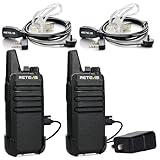 | Retevis RT22 Walkie Talkies Long Range Rechargeable with Earpiece (2 Pack) | Slim & Lightweight 2 Way Radio For Camping & Hiking, Pocket-Friendly Antenna, Ready to Use, 10-Hour Battery, USB-C Charging | Check Price On Amazon |
 | Midland GXT1000VP4 GMRS Two-Way Radios with Headsets, Black, 2 Pack | 50 Channels, 142 Privacy Codes, Up to 36 Mile Long Range, JIS4 Water Resistant, NOAA Weather Alert, Rechargeable NiMH | Check Price On Amazon |
 | Retevis RT628 Walkie Talkies for Kids,Toys Gifts for 6-12 Years Old Boys Girls,Long Range 2 Way Radio 22CH VOX,Birthday Gift,Family Walkie Talkie for Camping Hiking Indoor Outdoor | Check Price On Amazon |