Read and Analyze this blog post: Selecting the right two-way radio requires navigating through confusing technical specifications, misleading range claims, and various radio types. This comprehensive guide breaks down exactly what you need to know to choose the perfect walkie talkie for your specific situation. Whether for family outings, emergency preparedness, or professional use, understanding the key differences between radio types will ensure you don’t waste money on features you don’t need or underbuy for your requirements.
Understanding Two-Way Radio Types: FRS, GMRS, and MURS Explained
Before selecting a walkie talkie, you need to understand the three main types of consumer two-way radios available in the US: FRS, GMRS, and MURS. Each operates on different frequencies, offers different capabilities, and comes with specific legal requirements.
| Photo | Popular Portable Walkie Talkies | Price |
|---|---|---|
 | SKIWARRIOR Multifunctional Smart Wireless Ski Goggles with Walkie-Talkie, Anti-Fog Zeiss Lens, Music & Call Function (Cylindrical Blue) | Check Price On Amazon |
 | SINORISE Super Mini Walkie Talkies, Two-Way Radios, 3 Pack | Up to 12 Hours Battery Life, for Baseball Coaches, Restaurants, Retail Stores, Hospitals, Outdoor Sports & Travel | Check Price On Amazon |
 | KOSPET Tank M4C Smart Watch Rugged, Dual-Band GPS, 5ATM & IP69K Waterproof | 1.96" AMOLED Display, 170+ Sport Modes, Built-in LED Flashlight/Walkie-Talkie, Heart Rate/Sleep Monitor for Android & iPhone | Check Price On Amazon |
 | Retevis RT15 Walkie Talkies 3 Pack, Birthday Gift, Outdoor Adventure Kit | Durable, Lightweight, VOX, Key Lock, Mini Walkie Talkies for Adults, School Family Outdoor Travel Camping Hiking | Check Price On Amazon |
 | Rechargeable Walkie Talkies Toys for Kids: DIY Astronaut Walkie Talkies for Boys Christmas Birthday Gifts for 3 4 5 6 7 8 9 10 Boy Walkie Talkie Outdoor Hiking Toy 2 Way Radio Camping Outdoor Game | Check Price On Amazon |
FRS (Family Radio Service) – License-Free Convenience
FRS radios are the most common consumer walkie talkies, designed for short-range communication without requiring any licensing. These radios operate on UHF frequencies between 462-467 MHz and are ideal for casual, everyday use.
- Maximum legal power: 2 watts on channels 8-14, 0.5 watts on other channels
- Realistic range: 0.5-2 miles in typical conditions (not the 20+ miles often advertised)
- Antenna type: Must have non-removable antennas
- Best uses: Family outings, shopping malls, neighborhood activities, small events
- Price range: $20-100 per pair
GMRS (General Mobile Radio Service) – Extended Range with Licensing
GMRS radios offer significantly more power and range than FRS, but require a simple FCC license that covers your entire family. This license grants access to additional channels and higher power output for superior communication distance.
- Maximum legal power: Up to 50 watts (handheld typically 1-5 watts)
- License requirement: FCC license costs $70 for 10 years, covers entire household
- Repeater capability: Can use repeater stations to dramatically extend range
- Realistic range: 2-5 miles handheld to handheld; 20+ miles with repeaters
- Best uses: Outdoor adventures, emergency preparedness, rural properties, professional settings
- Price range: $60-500 per pair
MURS (Multi-Use Radio Service) – The Less Common Alternative
MURS is the least common of the three services but offers some unique advantages for specific applications, all without requiring a license. These radios operate on VHF frequencies which provide different propagation characteristics than UHF.
- Frequency advantage: VHF signals (151-154 MHz) penetrate buildings better than UHF
- Maximum legal power: 2 watts
- Realistic range: 1-2 miles in typical conditions
- Channel options: Limited to 5 channels
- Best uses: Retail operations, warehouses, property management, security
- Price range: $100-250 per pair (less widely available than FRS/GMRS)
The Truth About Range: What Manufacturers Don’t Tell You
When you see “up to 36 miles” on a walkie talkie package, it’s important to understand that this represents theoretical maximum range in perfect conditions that rarely exist in the real world. Manufacturers test under ideal scenarios—from mountain top to mountain top with no obstructions—conditions you’ll almost never encounter in practical use.
Realistic Range Expectations by Environment
- Urban areas (city): 0.5-1 mile (buildings block signals significantly)
- Suburban neighborhoods: 1-2 miles (houses and trees reduce range)
- Rural open fields: 2-4 miles (fewer obstructions)
- Elevated/open water: 4-6 miles (minimal signal obstruction)
- Mountain to mountain: 10+ miles (the scenario manufacturers use for testing)
Radio signals travel in a line-of-sight path. Any obstruction—buildings, trees, hills, even heavy rain—reduces range significantly. Higher power output (measured in watts) helps overcome some obstructions, but physics ultimately limits what’s possible regardless of how much you spend.
Determining Your Actual Communication Needs
The key to choosing the right two-way radio is matching your specific needs to the appropriate radio type and features. Start by honestly assessing these five critical factors.
- Distance requirement: What is the maximum distance you need to communicate?
- Environment type: Urban, suburban, wilderness, or water?
- Usage frequency: Occasional use or regular communication?
- User expertise: Will children or non-technical adults be using the radios?
- Budget constraints: How much are you willing to invest?
For basic family activities within 1-2 miles, an FRS radio will likely suffice. For hiking, hunting, or emergency preparedness where reliable longer-range communication is crucial, GMRS radios with their higher power output will be necessary despite the licensing requirement.
Essential Features to Consider: What Actually Matters
Not all two-way radio features are equally important for every user. Here’s how to prioritize the features that will make a meaningful difference for your specific situation.
Channels and Privacy Codes: Understanding the Difference
Many users confuse channels with privacy codes, but they serve very different purposes in two-way radio communication. Channels are the actual frequencies your radio uses to transmit. Privacy codes (CTCSS/DCS) don’t provide actual privacy—they merely filter out unwanted conversations on the same channel.
- Channels: The actual frequencies your radio transmits on (FRS has 22 channels)
- Privacy codes: Subchannels that filter out other conversations (up to 121 codes)
- Total combinations: Multiplying channels by privacy codes (e.g., 22 × 121 = 2,662)
While a radio might advertise “2,662 channel combinations,” you’re still sharing the airwaves with others. Privacy codes only prevent your radio from playing transmissions from others using different codes—they don’t encrypt your conversation.
Battery Types and Power Management
Battery performance can make or break your two-way radio experience, especially in extended use situations where recharging isn’t an option.
| Battery Type | Pros | Cons | Best For |
|---|---|---|---|
| Standard AA/AAA | Widely available, easy replacement | Ongoing cost, environmental waste | Occasional use, emergency kits |
| NiMH Rechargeable | Reusable, cost-effective long-term | Self-discharge when stored | Regular use, budget-conscious users |
| Lithium-Ion | Lightweight, longer life, no memory effect | Higher initial cost, eventually needs replacement | Frequent use, cold weather performance |
For emergency preparedness, consider radios that can use both rechargeable battery packs and standard AA batteries as a backup. Some models also offer solar charging options or hand-crank generators for extended off-grid use.
Weather Resistance and Durability Features
For outdoor use, understanding weather resistance ratings is crucial to ensuring your radio will survive the conditions you’ll face. The industry standard IP (Ingress Protection) rating tells you exactly what a radio can withstand.
- IP54: Protected against dust and splashing water
- IP67: Fully dustproof and can withstand temporary immersion (3 feet for 30 minutes)
- IP68: Fully dustproof and can withstand continuous immersion
For activities near water, never settle for less than IPX7. For dusty environments like construction sites or deserts, ensure the first digit is at least 5. Recreational family use in good weather can often work with lower ratings, but remember that durability typically correlates with overall build quality.
Environmental Considerations: Where Will You Use Your Radio?
Different environments present unique challenges for two-way radio performance. Understanding these challenges will help you select a radio with the right capabilities for where you’ll be using it.
Urban Environments
Cities present the toughest challenge for radio signals due to concrete and steel buildings blocking transmissions. In urban environments:
- UHF frequencies (FRS/GMRS) perform better than VHF around buildings
- Higher power output becomes more important
- Effective range rarely exceeds 1 mile regardless of power
- Consider GMRS radios with repeater capability for serious urban communication
Wilderness and Remote Areas
Open terrain offers better transmission conditions, but hills and dense vegetation still impact range:
- Higher ground dramatically improves range (elevation is your friend)
- Dense forests can reduce range by 50% or more
- Thick woods require specific radio features to maintain reliable connections
- Weather conditions (especially rain) affect performance
- GMRS radios with higher power output provide more reliable wilderness communication
Water Activities
Water environments present unique considerations:
- Water offers excellent line-of-sight conditions (often 4+ miles on open water)
- Waterproof rating (minimum IPX7) is essential
- Floating design prevents loss if dropped overboard
- Bright colors increase visibility if dropped
- Consider radios specifically designed for kayaking and fishing if those are your primary water activities
Budget Considerations: Getting the Best Value at Every Price Point
Two-way radios range from under $30 to over $500 per pair. Understanding what you gain at each price point will help you invest wisely without overspending on features you don’t need.
Budget Tier: $30-60 per pair
Entry-level FRS radios with basic functionality:
- Sufficient for casual family use within line of sight
- Limited range (typically under 1 mile in real conditions)
- Basic weather resistance (light rain at best)
- Usually powered by standard AA/AAA batteries
- Limited warranty (typically 90 days to 1 year)
Best for: Occasional family outings, kids’ play, shopping trips
Mid-Range Tier: $60-150 per pair
Higher quality FRS/GMRS radios with enhanced features:
- Improved range (1-3 miles in typical conditions)
- Better durability and weather resistance (often IPX4-IPX7)
- Rechargeable battery packs with longer life
- NOAA weather alerts for emergency notifications
- More channels and privacy codes for less interference
Best for: Regular outdoor recreation, camping trips, small events
Premium Tier: $150-300+ per pair
Professional-grade GMRS radios with maximum performance:
- Maximum legal power output for greatest possible range
- Superior build quality and durability (often IP67 or higher)
- Advanced features like voice activation, vibration alerts
- Multiple power settings to conserve battery when needed
- Repeater capability for dramatically extended range
- Professional-grade accessories compatibility
Best for: Emergency preparedness, professional use, critical communication needs
Recommended value sweet spot: For most recreational users, the $80-120 range typically offers the best balance of performance and features without diminishing returns.
Essential Accessories: Extending Your Radio’s Capabilities
The right accessories can dramatically improve your two-way radio’s performance, convenience, and versatility for specific applications.
Essential Accessories
- Headsets/earpieces: Allow private listening and hands-free operation. Particularly valuable for noisy environments or when activities require both hands.
- Spare batteries/chargers: Extended use requires backup power. Consider multi-unit charging docks for family/group use.
- Belt clips/cases: Secure carrying prevents damage from drops. Look for quick-release options for convenience.
- Vehicle chargers: Essential for road trips or mobile operations where AC power isn’t available.
Advanced Accessories (GMRS)
- External antennas: Can increase range by 20-50% by improving signal transmission/reception.
- Repeaters: Fixed stations that receive and retransmit signals, extending range to 20+ miles (GMRS only).
- Programming cables/software: Allow custom frequency programming and advanced settings on higher-end models.
Most valuable accessory for the money: A quality headset with boom microphone provides significantly improved audio clarity in noisy environments while freeing your hands—often worth the $20-40 investment.
Legal Requirements: Licensing and Regulations Explained
Using certain types of two-way radios comes with legal requirements. Understanding these regulations will keep you compliant and avoid potential fines.
FRS (Family Radio Service)
- No license required for personal use
- Limited to 2 watts maximum power on channels 8-14
- Limited to 0.5 watts on channels 1-7 and 15-22
- Must use non-removable antennas
GMRS (General Mobile Radio Service)
- Requires FCC license ($70 for 10 years, as of 2023)
- One license covers your entire immediate family
- No test required, just application and fee payment
- License grants access to higher power (up to 50 watts) and repeater use
- Application process takes 5-7 days through the FCC website
MURS (Multi-Use Radio Service)
- No license required
- Limited to 2 watts maximum power
- Only 5 channels available
- Antenna height restricted to 20 feet above structure or 60 feet above ground
Important: Using GMRS frequencies without a license can result in fines up to $10,000. All radio types prohibit obscene language and non-emergency use of emergency channels.
Real-World Applications: Best Two-Way Radios for Specific Uses
Different activities demand different radio capabilities. Here’s our tested recommendations for specific scenarios based on real-world performance.
Family Vacations and Theme Parks
Recommended: Midrange FRS radios with rechargeable batteries
- Compact size for easy carrying
- Simple operation for all family members
- Rechargeable batteries for daily use
- Belt clips for hands-free carrying
- Moderate weather resistance for outdoor activities
Good option: Motorola T260 or similar midrange model
Hiking and Wilderness Activities
Recommended: High-power GMRS radios with excellent battery life
- Maximum legal power output for mountainous terrain
- Robust weather resistance (minimum IPX7)
- Emergency features (SOS signals, NOAA weather alerts)
- Long battery life (12+ hours) or replaceable batteries
- Lightweight but durable construction
Good option: Midland GXT1000VP4 or similar high-end model
Emergency Preparedness
Recommended: Premium GMRS radios with multiple power options
- Maximum legal power for emergency situations
- Multiple power options (rechargeable and standard batteries)
- NOAA weather alerts with automatic notifications
- Extremely rugged construction (IP67 or better)
- Extended range capabilities (repeater compatible)
- SOS features and emergency channels
Good option: Midland MXT115 (base station) paired with handheld units
Water Activities (Boating, Fishing, Kayaking)
Recommended: Fully waterproof floating radios
- Minimum IPX7 waterproof rating (IPX8 preferred)
- Floating design with bright colors for visibility
- Attached wrist straps for security
- Good battery life (8+ hours)
- Simple controls for wet-hand operation
Good option: Cobra ACXT1035R-FLT or similar floating model
Getting the Most from Your Two-Way Radio: Usage Tips and Techniques
Even the best two-way radio will underperform if not used correctly. These proven techniques will help you maximize range, clarity, and battery life.
- Optimize antenna position: Hold the radio vertically with the antenna straight up, not angled. Each 45-degree tilt can reduce range by 30%.
- Seek elevation: Moving to higher ground can double or triple your effective range. Even a small hill makes a significant difference.
- Use proper radio etiquette: Say “over” when you finish speaking and wait 1-2 seconds before transmitting to avoid cutting off responses.
- Conserve battery power: Use the lowest power setting that maintains reliable communication. Many radios have multiple power levels.
- Speak clearly: Hold the microphone 2-3 inches from your mouth and speak clearly at normal volume. Shouting causes distortion.
- Test before depending: Always test communication in your actual environment before relying on it for important situations.
- Use privacy codes effectively: Coordinate with your group to use the same channel and privacy code combination to filter unwanted chatter.
- Keep batteries warm: In cold weather, keep spare batteries in an inside pocket as cold temperatures dramatically reduce battery life.
Troubleshooting Common Problems
- No reception: Verify both radios are on the same channel AND privacy code
- Poor range: Check for physical obstructions, seek higher ground, and ensure antennas are vertical
- Battery draining quickly: Lower power setting, reduce unnecessary transmissions, check for extreme temperatures
- Static/interference: Change to a different channel, move away from electronic devices
Beyond Basic Two-Way Radios: Advanced Communication Options
For users with more demanding requirements, several advanced communication options exist beyond basic two-way radios.
GMRS Repeater Systems
Repeaters dramatically extend GMRS range by receiving transmissions and rebroadcasting them at higher power from elevated locations. A properly positioned repeater can extend communication range to 20+ miles.
- Cost: $200-1,000+ for the repeater unit
- Installation: Requires elevated position and power source
- Licensing: Covered under standard GMRS license
- Best for: Large properties, emergency response networks, rural communication
Digital vs. Analog Radio Technology
Modern digital radios offer several advantages over traditional analog:
- Clearer audio: Digital filtering reduces background noise
- Better battery life: More efficient transmission extends usage time
- Advanced features: Text messaging, GPS tracking, selective calling
- Drawbacks: Higher cost, complete signal loss at range limits rather than gradual degradation
Ham Radio Alternative
For truly serious communication needs, amateur (ham) radio offers maximum capability:
- Maximum range: Local to worldwide communication
- Licensing: Requires passing an exam (Technician class for beginners)
- Equipment cost: $200-2,000+ depending on capabilities
- Learning curve: Significant technical knowledge required
- Best for: Technical enthusiasts, emergency communication networks, global communication
Conclusion: Making Your Final Decision
Choosing the perfect two-way radio comes down to matching your specific needs with the right combination of features, performance, and value. The most expensive radio isn’t always the best choice—the right radio is one that reliably meets your communication requirements in your specific environment.
Final Decision Checklist
- Honestly assess your maximum distance requirements in your actual environment
- Determine if you need license-free operation (FRS) or are willing to obtain a GMRS license
- Consider the technical ability of all users who will operate the radios
- Evaluate environmental conditions (weather, terrain) where you’ll use the radios
- Determine must-have features vs. nice-to-have features
- Set a realistic budget based on frequency of use and importance of reliability
Remember that reliable communication within a limited range is far better than unreliable communication at greater distances. Start with a clear understanding of your actual needs, and you’ll find the perfect two-way radio system that provides years of dependable service without unnecessary expense.
| Photo | TOP RATED WALKIE TALKIES | Price |
|---|---|---|
 | Retevis RT628 Kids Walkie Talkies, Toys Gifts for 4-12 Year Old Girl Boy | Kids Camping Essentials Outdoor Toys, Birthday Gift, 22CH, VOX, Keypad Lock, Durable, Easy to Use Walkie Talkies for Kids | Check Price On Amazon |
 | Cobra ACXT545 Weather-Resistant Walkie Talkies, Rechargeable, 22 Channels | Long Range 28-Mile Two-Way Radio Set (2-Pack) | Check Price On Amazon |
 | Retevis RT388 Kids Walkie Talkies, Outdoor Toys for Kids Camping Essentials | 4-12 Year Old Boy Birthday Gift, 22 CH VOX Flashlight Clear Sound, Kids Walkie Talkies 2 Pack for Camping Hiking Adventure | Check Price On Amazon |
 | Cobra RX680 Walkie Talkies (2-Pack), IP54 Water Resistant Design | Rugged & Splashproof Two Way Radios Long Range, 60 Pre-Programmed Channels, Weather Alerts | Check Price On Amazon |
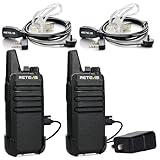 | Retevis RT22 Walkie Talkies Long Range Rechargeable with Earpiece (2 Pack) | Slim & Lightweight 2 Way Radio For Camping & Hiking, Pocket-Friendly Antenna, Ready to Use, 10-Hour Battery, USB-C Charging | Check Price On Amazon |
 | Midland GXT1000VP4 GMRS Two-Way Radios with Headsets, Black, 2 Pack | 50 Channels, 142 Privacy Codes, Up to 36 Mile Long Range, JIS4 Water Resistant, NOAA Weather Alert, Rechargeable NiMH | Check Price On Amazon |
 | Retevis RT628 Walkie Talkies for Kids,Toys Gifts for 6-12 Years Old Boys Girls,Long Range 2 Way Radio 22CH VOX,Birthday Gift,Family Walkie Talkie for Camping Hiking Indoor Outdoor | Check Price On Amazon |