FRS, GMRS, and Ham Radio are three distinct personal radio services regulated by the FCC, each with different capabilities, ranges, and licensing requirements. FRS is license-free with limited range (0.5-2 miles), GMRS offers increased power and range (2-5+ miles) with a simple $35 license, while Ham Radio provides maximum capabilities (local to worldwide) but requires passing a technical exam. This guide compares all three services across technical specifications, practical applications, and regulatory requirements to help you choose the right option.
| Feature | FRS | GMRS | Ham Radio |
|---|---|---|---|
| License Required | No | Yes ($35 for 10 years) | Yes (exam required) |
| Exam Required | No | No | Yes (written test) |
| Power Limit | 2 watts max | 5-50 watts (varies by channel) | 5-1500 watts (varies by band/license) |
| Typical Range | 0.5-2 miles | 2-5+ miles (30+ with repeaters) | 1-2000+ miles (worldwide with HF) |
| Equipment Cost | $15-$100 | $50-$500 | $30-$3000+ |
| Primary Uses | Family, recreation, basic coordination | Outdoor activities, family, emergency prep | Hobby, technical interest, emergency, worldwide |
Understanding Radio Communication Services: The Basics
Before diving into the specifics of each radio service, it’s essential to understand the fundamental principles of radio communications that apply to all these services. Radio communication works by converting sound into electromagnetic waves that travel through the air and are then converted back to sound by a receiver.
| Photo | Popular Portable Walkie Talkies | Price |
|---|---|---|
 | SKIWARRIOR Multifunctional Smart Wireless Ski Goggles with Walkie-Talkie, Anti-Fog Zeiss Lens, Music & Call Function (Cylindrical Blue) | Check Price On Amazon |
 | SINORISE Super Mini Walkie Talkies, Two-Way Radios, 3 Pack | Up to 12 Hours Battery Life, for Baseball Coaches, Restaurants, Retail Stores, Hospitals, Outdoor Sports & Travel | Check Price On Amazon |
 | KOSPET Tank M4C Smart Watch Rugged, Dual-Band GPS, 5ATM & IP69K Waterproof | 1.96" AMOLED Display, 170+ Sport Modes, Built-in LED Flashlight/Walkie-Talkie, Heart Rate/Sleep Monitor for Android & iPhone | Check Price On Amazon |
 | Retevis RT15 Walkie Talkies 3 Pack, Birthday Gift, Outdoor Adventure Kit | Durable, Lightweight, VOX, Key Lock, Mini Walkie Talkies for Adults, School Family Outdoor Travel Camping Hiking | Check Price On Amazon |
 | Rechargeable Walkie Talkies Toys for Kids: DIY Astronaut Walkie Talkies for Boys Christmas Birthday Gifts for 3 4 5 6 7 8 9 10 Boy Walkie Talkie Outdoor Hiking Toy 2 Way Radio Camping Outdoor Game | Check Price On Amazon |
The Federal Communications Commission (FCC) regulates all radio communications in the United States, allocating specific frequency bands for different services and establishing rules for their use. This regulation ensures that various radio services can coexist without interfering with each other.
Key terms you should understand include:
- Frequency: Measured in Hertz (Hz), this is the number of wave cycles per second. Radio services use frequencies in the Megahertz (MHz) range.
- Bandwidth: The range of frequencies a radio signal occupies, affecting how much information it can carry.
- Power output: Measured in watts, this determines how strong a signal is and directly impacts range.
- Modulation: The method used to encode information onto radio waves (FM, AM, digital modes).
The radio spectrum is divided into bands, with specific portions allocated to FRS, GMRS, and Ham Radio. These bands have different characteristics affecting range, obstacle penetration, and interference susceptibility.
Radio Wave Propagation and How It Affects Range
To understand the practical differences in range between FRS, GMRS, and Ham Radio, you need to understand how radio waves travel and what factors affect their propagation. Most personal radio services operate primarily as “line-of-sight” communications.
Line-of-sight means radio signals travel in relatively straight paths and are blocked by obstacles like hills, buildings, and even the curvature of the Earth. The higher your antenna, the farther your signal can travel before being blocked by Earth’s curvature.
Factors that significantly affect radio range include:
- Transmitter power: Higher power (watts) generally means greater range
- Antenna height and quality: Higher antennas see farther; better antennas capture more signal
- Frequency: Lower frequencies (like HF Ham bands) can follow the Earth’s curvature and bounce off the atmosphere; higher frequencies (like FRS/GMRS) travel more directly
- Terrain: Hills, mountains, buildings, and forests all block or absorb radio signals
- Weather conditions: Heavy rain or fog can weaken signals, particularly at higher frequencies
These propagation principles directly impact the effective range of each radio service we’ll discuss next. The advertised ranges on packaging (often claiming “up to 30+ miles”) typically represent perfect conditions rarely achieved in real-world use.
Family Radio Service (FRS): The Entry-Level Option
The Family Radio Service (FRS) represents the most accessible entry point into personal radio communications, requiring no license while still providing useful short-range capabilities. FRS was created by the FCC in 1996 specifically for short-range communications between family members and small groups.
FRS radios operate on 22 channels in the Ultra High Frequency (UHF) band between 462.5625 MHz and 467.7125 MHz. These frequencies travel in relatively straight lines and can penetrate light obstacles like trees and some buildings, but are easily blocked by hills, dense structures, and other terrain features.
Current FRS Regulations and Specifications
In 2021, the FCC updated FRS regulations, increasing power limits and consolidating some aspects with GMRS. Current FRS specifications include:
- Channels: 22 channels total (channels 1-22)
- Power limits: Maximum 2 watts Effective Radiated Power (ERP) on channels 1-22
- Antenna restrictions: Must use built-in, non-removable antennas only
- Licensing: No license required for operation
- Usage restrictions: Personal use only, not for business operations
FRS channels 1-7 and 15-22 are shared with GMRS, while channels 8-14 are exclusively for FRS. This overlap can cause confusion when purchasing radios, as many are labeled for both services.
Typical Range and Limitations
Despite manufacturer claims of “up to 30+ miles,” real-world FRS range is typically:
- Urban areas: 0.25-0.5 miles
- Suburban areas: 0.5-1 mile
- Open rural areas: 1-2 miles
- Elevated positions with clear line-of-sight: Up to 3-4 miles in ideal conditions
The limited power and fixed antenna restrictions significantly impact FRS range. Additionally, FRS cannot use repeaters to extend range, limiting communications to direct radio-to-radio contact.
Equipment and Costs
FRS radios are widely available and typically cost between $15-$100 for a pair. Most come in multi-packs and feature:
- Simple push-to-talk operation
- Channel selection
- Privacy codes (CTCSS/DCS tones that reduce interference but don’t provide actual privacy)
- Battery life indicators
- Weather resistance (on higher-end models)
Most FRS radios use rechargeable batteries or standard AA/AAA batteries, making them convenient for casual use.
Best Uses for FRS Radio
FRS radios excel in specific situations where simplicity and ease of use are more important than extended range or advanced features. The best applications include:
- Family outings: Perfect for keeping in touch during shopping trips, theme park visits, or local events where family members might separate briefly.
- Camping in established campgrounds: Ideal for communicating between nearby campsites or coordinating activities within a small area.
- Neighborhood watch or community events: Useful for coordinating volunteers or security within a small area.
- Kids’ activities: Simple enough for children to use during backyard games or neighborhood play.
- Small venue coordination: Handy for staff communications at small events, parties, or gatherings.
FRS shines in scenarios where users need simple, instant communication without technical knowledge or licensing requirements. However, the limited range means it’s not suitable for activities where group members might spread out over large distances.
While FRS offers license-free simplicity, GMRS provides enhanced capabilities for those willing to obtain a simple license, as we’ll explore next.
General Mobile Radio Service (GMRS): Enhanced Capabilities with Simple Licensing
The General Mobile Radio Service (GMRS) occupies the middle ground in our comparison, offering significantly enhanced capabilities over FRS while being more accessible than Ham radio. GMRS provides substantial improvements in power, range, and flexibility while requiring only a simple license without testing.
GMRS operates in the UHF band between 462.5625 MHz and 467.7125 MHz, partially overlapping with FRS frequencies. However, GMRS users can transmit at much higher power levels and use external antennas and repeaters, dramatically extending effective range.
Current GMRS Regulations and Specifications
Following the FCC’s 2021 rule changes, current GMRS specifications include:
- Channels: 22 channels (shared with FRS) plus 8 repeater input/output pairs
- Power limits:
- 5 watts maximum on shared FRS channels (1-7 and 15-22)
- 50 watts maximum on dedicated GMRS repeater channels
- Antenna options: Detachable antennas allowed, including high-gain antennas
- Repeater use: Allowed, significantly extending range
- Licensing: Required ($35 for 10 years, covers entire immediate family)
- Digital transmission: Now permitted for voice and data
GMRS licenses cover you, your spouse, children, parents, grandparents, siblings, and in-laws—a significant value for family communication needs.
Typical Range and Capabilities
GMRS offers significantly better range than FRS due to higher power limits and antenna options:
- Handheld units in urban areas: 1-2 miles
- Handheld units in suburban areas: 2-5 miles
- Mobile units (vehicle-mounted): 5-10+ miles
- Base stations with elevated antennas: 10-20+ miles
- Through repeaters: 20-50+ miles
These ranges represent realistic expectations based on typical conditions, though actual performance will vary with terrain, antenna quality, and environmental factors.
Equipment and Costs
GMRS equipment spans a wider range of prices and capabilities than FRS:
- Handheld units: $50-$200
- Mobile units (vehicle): $100-$300
- Base stations: $150-$500
- Repeaters: $300-$1,500
- Antennas: $20-$200
Higher-end GMRS radios often include features like:
- Weather alerts
- Digital display
- Selectable power levels
- Repeater capability
- Waterproof construction
- Longer battery life
- Digital voice/data modes
How to Obtain a GMRS License: Step-by-Step Guide
Obtaining a GMRS license is a straightforward process that requires no testing, just a simple application and fee payment. Here’s how to get licensed:
- Create an FCC Registration Number (FRN): Visit the FCC CORES system at https://apps.fcc.gov/cores/userLogin.do and register for an FRN.
- Access the application system: Go to the FCC Universal Licensing System at https://www.fcc.gov/wireless/universal-licensing-system.
- Complete Form 605: Select “New” under the “Purpose” section and “ZA – General Mobile Radio (GMRS)” under the “Service” section.
- Submit your application: Review and submit your completed form.
- Pay the fee: The current fee is $35 for a 10-year license (as of 2023).
- Receive your call sign: The FCC typically processes applications within 1-2 business days, after which you’ll receive your call sign.
Eligibility requirements include being at least 18 years old and not being a representative of a foreign government. No technical knowledge test is required.
With this simple licensing process, GMRS provides a significant upgrade from FRS. Now, let’s explore the most powerful and versatile option: Amateur (Ham) Radio.
Amateur Radio (Ham): The Ultimate in Flexibility and Capability
Amateur Radio, commonly known as Ham radio, represents the most capable and flexible radio service available to civilians, offering worldwide communication potential, diverse operating modes, and a vibrant community of enthusiasts. Ham radio operators can communicate locally via handheld radios similar to FRS/GMRS or globally using HF frequencies that can bounce off the atmosphere.
Unlike FRS and GMRS, which are limited to specific channels and modes, Ham radio provides access to a vast frequency spectrum and permits experimentation with different communication technologies. This flexibility comes with more stringent licensing requirements involving technical examinations.
License Classes and Privileges
The US Amateur Radio service has three license classes, each offering progressively greater privileges:
- Technician: Entry-level license providing full privileges on all Amateur bands above 50 MHz plus limited HF privileges.
- General: Intermediate license granting access to significant portions of all Amateur bands.
- Amateur Extra: Top-level license providing full privileges on all Amateur bands and frequencies.
Each license requires passing a progressively more difficult multiple-choice examination testing radio theory, regulations, and operating practices.
Frequency Allocations and Capabilities
Ham radio operators have access to numerous frequency bands spanning from 1.8 MHz to above 275 GHz. Key bands include:
- HF bands (1.8-30 MHz): Capable of worldwide communication by reflecting off the ionosphere
- VHF bands (50-144-222 MHz): Good for regional communication, more reliable than HF
- UHF bands (420-450 MHz and higher): Excellent for local communication with good building penetration
- Microwave bands (902 MHz and up): Used for specialized applications and experimentation
Power limits for Ham radio range from 5 watts for novice operators to 1,500 watts for all license classes on most bands, though most operators use 100 watts or less for typical communications.
Communication Modes
Ham radio supports numerous communication modes beyond simple voice, including:
- Voice: FM, AM, SSB (Single Sideband)
- Digital modes: FT8, PSK31, RTTY, packet, SSTV (slow-scan TV)
- Morse code (CW): No longer required for licensing but still widely used
- Image transmission: Both analog and digital
- Satellite communications: Using Amateur satellites in orbit
- EME (Earth-Moon-Earth): Bouncing signals off the moon
- Internet-linked systems: Echolink, IRLP, DMR, D-STAR, Fusion
This diversity of modes allows Ham operators to choose the best method for their specific communication needs and conditions.
Equipment and Costs
Ham radio equipment spans a huge range in complexity and price:
- Entry-level handheld radios: $30-$100
- Mobile VHF/UHF radios: $100-$500
- Base station HF transceivers: $700-$3,000+
- Antennas: $25-$1,000+
- Accessories (power supplies, tuners, amplifiers): $100-$2,000+
A beginner can start with a simple handheld VHF/UHF radio for under $50, while an advanced station for worldwide communication might cost $2,000 or more.
Ham Radio Licensing Exams: What to Expect and How to Prepare
Unlike FRS (no license) and GMRS (simple registration), Ham radio requires passing a formal examination testing your knowledge of radio theory, regulations, and operating practices. Here’s what to expect:
| License Class | Questions | Passing Score | Question Pool Size | Topics Covered |
|---|---|---|---|---|
| Technician | 35 | 26 correct (74%) | ~400 | Basic regulations, operating practices, radio phenomena, basic electronics |
| General | 35 | 26 correct (74%) | ~500 | Expanded regulations, components, circuits, signals, emissions, antennas, propagation |
| Amateur Extra | 50 | 37 correct (74%) | ~700 | Advanced electronics theory, specialized modes, detailed regulations, complex circuits |
To prepare for these exams:
- Study the question pool: All possible exam questions are published and available free online
- Use study resources: Books like the ARRL License Manuals, websites like HamStudy.org, or mobile apps
- Take practice tests: Many free practice tests are available online
- Find an exam session: Visit the ARRL website (www.arrl.org/find-an-amateur-radio-license-exam-session) to locate testing sessions near you
- Bring required items: Government-issued ID, test fee (typically $15), calculator, and pencils
Many people can pass the Technician exam with 2-3 weeks of casual study. The General exam typically requires more technical knowledge, while the Extra exam demands significant electronics understanding.
While the licensing process requires study and preparation, thousands of people from all walks of life successfully earn their Ham licenses each year. Now, let’s compare all three radio services directly to help you make the right choice.
Direct Comparison: FRS vs GMRS vs Ham Radio
With a basic understanding of each radio service, let’s directly compare them across multiple factors to help you determine which one best meets your specific needs.
| Feature | FRS | GMRS | Ham Radio |
|---|---|---|---|
| Licensing | None required | $35 for 10 years No exam required Covers family members | $15 exam fee Technical exam required Individual licenses only |
| Frequencies | 462-467 MHz UHF 22 channels | 462-467 MHz UHF 22 channels + 8 repeater pairs | 1.8 MHz – 275+ GHz Multiple bands, thousands of frequencies |
| Power Limits | 2 watts maximum | 5 watts on shared channels 50 watts on repeater channels | Up to 1,500 watts (varies by band and license class) |
| Typical Range | Urban: 0.25-0.5 miles Suburban: 0.5-1 mile Rural: 1-2 miles | Handheld: 1-5 miles Mobile: 5-10+ miles With repeaters: 20-50+ miles | VHF/UHF: Similar to GMRS HF: Worldwide Via repeaters: City/regional Via satellites: Continental/global |
| Antenna Options | Fixed, non-removable only | Removable, external antennas allowed | Unlimited options Highly customizable |
| Equipment Cost | $15-$100 per pair | Handheld: $50-$200 Mobile: $100-$300 Base: $150-$500 | Entry: $30-$100 Mid-range: $300-$1,000 High-end: $1,000-$3,000+ |
| Technical Knowledge | None required | Basic understanding helpful | Moderate to extensive (required for licensing) |
| Communication Modes | Voice only (FM) | Voice (FM) Limited digital data | Voice (FM/AM/SSB) Digital modes (dozens) Morse code Video/image Data networking |
| Repeater Access | Not permitted | Permitted, enhancing range | Extensive networks Diverse linking systems |
| Privacy Options | Privacy codes (reduce interference only, not truly private) | Privacy codes Digital modes with basic security | Limited by regulations (communications must be unencrypted) |
| International Use | Varies by country Often permitted | Generally not permitted internationally | Permitted in many countries with reciprocal agreements |
| Community Support | Limited | Growing community Some local repeater groups | Extensive worldwide community Clubs, events, magazines |
The primary technical difference between these services is their power limitations and frequency access, which directly impact range and capabilities. Range increases with power, antenna height, and access to repeaters, with Ham radio offering the most options in all these areas.
Choosing the Right Radio Service for Your Needs
With a clear understanding of the technical differences between FRS, GMRS, and Ham Radio, let’s determine which service is best suited for various common scenarios and user types.
Best Choice Based on Use Case
Choose FRS if:
- You need simple, immediate communication with no licensing hassle
- Your communication needs are limited to short distances (under 2 miles)
- You’re shopping, at theme parks, camping in established campgrounds, or in other close-quarter situations
- You want the lowest cost option with minimal technical knowledge required
- You need multiple family members or friends to have radios
Choose GMRS if:
- You need more range than FRS provides but don’t want the complexity of Ham radio
- You’re hiking, off-roading, hunting, or doing outdoor activities where groups might spread out
- You want a simple license that covers your entire family
- You want to use repeaters for extended coverage without taking a technical exam
- You’re building a neighborhood emergency communications network
Choose Ham Radio if:
- You’re interested in radio as a hobby, not just a communication tool
- You want maximum flexibility in frequencies, power, and communication modes
- You’re willing to study for and pass a technical exam
- You want to communicate over very long distances (potentially worldwide)
- You’re interested in technical aspects of radio and potential experimentation
- You want to join an established community with extensive support networks
Decision Factors: Time, Cost, and Complexity
Time Investment:
- FRS: None (buy and use immediately)
- GMRS: Minimal (15-30 minutes to apply for license online)
- Ham Radio: Moderate (10-40 hours study time for Technician exam)
Total Cost Comparison (First Year):
- FRS: $30-$100 (equipment only)
- GMRS: $85-$250 ($35 license + $50-$200 equipment)
- Ham Radio: $45-$500+ ($15 exam + $30-$500+ equipment)
Learning Curve:
- FRS: Very low (essentially push-to-talk)
- GMRS: Low to moderate (basic radio concepts helpful)
- Ham Radio: Moderate to high (technical knowledge required)
Common Use Case Examples
- Family at a theme park or mall: FRS is ideal – simple, no license, adequate range for the environment.
- Camping trip in a national park: GMRS offers better range for separated campsites or hiking activities.
- Off-road vehicle group: GMRS with mobile units provides excellent coverage for convoys and trail communication.
- Neighborhood emergency preparedness: GMRS for most users with a few Ham operators for outside communication links.
- Long-distance hiking (Pacific Crest Trail, etc.): Ham radio for access to mountaintop repeaters and wider coverage.
- Technical hobbyist: Ham radio provides the most room for experimentation and learning.
- Global communication interest: Only Ham radio offers worldwide communication potential via HF bands.
Now that we’ve identified which radio service best matches different needs, let’s examine the equipment options for each service.
Equipment Guide: Radio Options for FRS, GMRS, and Ham
The radio equipment landscape varies significantly between FRS, GMRS, and Ham radio, with important differences in features, capabilities, and price points. Understanding these differences helps you make appropriate purchasing decisions for your chosen service.
FRS Radio Equipment
FRS radios are the simplest and most standardized of the three services:
Entry-level FRS radios ($15-$30 per pair) typically include:
- Access to all 22 FRS channels
- CTCSS/DCS privacy codes
- 0.5-2 watt power output
- Simple LCD display
- Belt clip
- Battery life of 8-12 hours
Mid-range FRS radios ($30-$60 per pair) add features like:
- Rechargeable batteries with charging dock
- Weather alerts
- Hands-free VOX operation
- Backlit display
- Vibration alerts
- Longer battery life
Premium FRS radios ($60-$100 per pair) might include:
- Waterproof construction (IPX4-IPX7 rating)
- Full 2-watt power on all channels
- Emergency features
- Bluetooth connectivity
- USB charging
- Flashlight function
Recommended entry-level option: Midland X-TALKER T51X, offering good balance of features and value.
GMRS Radio Equipment
GMRS equipment offers more variety and capability:
Handheld GMRS radios ($50-$100) typically include:
- 5-watt maximum power output
- All GMRS channels plus repeater capabilities
- Removable antenna option (SMA connector)
- Weather alerts
- Longer battery life than FRS units
Mid-range GMRS handhelds ($100-$200) add:
- Improved battery capacity
- Better antenna options
- Waterproof construction
- Programmable channels
- Digital display with more information
- More rugged construction
Mobile GMRS radios ($100-$300) feature:
- 15-50 watt power output
- External antenna connections
- Vehicle power integration
- Enhanced speaker/microphone for vehicle environment
- Mounting brackets
Base stations and repeaters ($200-$1,500) offer:
- Fixed installation capability
- Maximum legal power output
- Advanced antenna options
- Extended coverage area
- Constant power supply
Recommended entry-level option: Midland MXT115 MicroMobile GMRS radio for vehicle use or the Radioddity GM-30 for handheld use.
Ham Radio Equipment
Ham radio equipment spans the widest range of options and capabilities:
Entry-level VHF/UHF handhelds ($30-$100) include:
- Typically 5-8 watts output
- Programming capabilities (often requiring computer software)
- Multiple bands (usually 2m/70cm)
- Repeater capabilities with CTCSS/DCS tones
Mid-range mobile/base VHF/UHF ($200-$500) add:
- 25-75 watts output
- Better receivers with improved sensitivity
- More memory channels
- Packet radio capabilities
- Digital modes on some models (DMR, D-STAR, Fusion)
HF transceivers ($600-$3,000+) offer:
- Access to all HF bands for worldwide communication
- 100+ watts output power
- Multiple modulation types (SSB, AM, FM, CW, digital)
- Built-in antenna tuners (on higher-end models)
- Computer interfaces
- Spectrum displays
Antennas and accessories vary widely:
- Simple handheld antennas: $15-$50
- Mobile antennas: $30-$100
- Base antennas: $50-$500+
- Power supplies: $50-$300
- Antenna tuners: $100-$500
Recommended entry-level option: Baofeng UV-5R for absolute beginners (with programming cable) or the Yaesu FT-65R for better quality.
Equipment Compatibility Considerations
When purchasing radio equipment, note these important compatibility factors:
- FRS/GMRS hybrid radios: Many consumer radios are marketed for both services, but:
- Must be used at FRS power levels (2W max) if you don’t have a GMRS license
- Often limited in capability compared to dedicated GMRS radios
- Part 95 Certification: All FRS and GMRS radios must be FCC certified for these services
- Ham radios for GMRS: Not legal – GMRS requires Part 95 certified equipment
- Programming capabilities: Many Ham and higher-end GMRS radios require computer programming
With an understanding of the equipment options, let’s address some frequently asked questions about these radio services.
Frequently Asked Questions About Radio Services
As you consider which radio service meets your needs, you likely have specific questions about licensing, usage, and capabilities. Here are answers to the most common questions about FRS, GMRS, and Ham radio.
Licensing and Legal Questions
Q: Can I use one radio for multiple services?
A: Only if the radio is certified for those specific services. Many consumer radios are certified for both FRS and GMRS. Ham radios cannot legally be used for FRS or GMRS, even if on the same frequencies.
Q: What happens if I use a radio service without proper licensing?
A: Operating GMRS or Ham radio without appropriate licensing can result in FCC fines starting at several hundred dollars and potentially reaching thousands of dollars for willful violations.
Q: Can my children use these radios legally?
A: Children can use FRS without restriction. For GMRS, they must be operating under the supervision of a licensed family member. For Ham radio, there is no age restriction to get licensed, and many children as young as 6-7 have obtained licenses.
Q: Can I modify my radio equipment legally?
A: For FRS and GMRS, no modifications affecting transmission characteristics are permitted. For Ham radio, you may modify equipment as long as you maintain compliance with technical standards and operating within your license privileges.
Technical and Capability Questions
Q: How do repeaters work and how do they extend range?
A: Repeaters are strategically located radio stations (usually on hills or towers) that receive signals on one frequency and retransmit them on another. They effectively extend range by receiving your signal and rebroadcasting it from a higher location with better coverage.
Q: How do weather and terrain affect radio performance?
A: Hills, mountains, buildings, and dense forests significantly reduce range by blocking signals. Heavy rain or snow can attenuate signals, particularly at higher frequencies. Temperature inversions can sometimes extend VHF/UHF range beyond normal limits.
Q: Are these communications private/secure?
A: No. All three services transmit in the clear and can be monitored by anyone with an appropriate receiver. Privacy codes (CTCSS/DCS) only prevent your radio from receiving unwanted transmissions, they don’t provide encryption. By regulation, Ham radio prohibits encryption entirely.
Q: How do digital modes work?
A: Digital modes convert voice or data into digital signals for transmission. In GMRS, digital voice maintains clarity at range limits. In Ham radio, digital modes include voice systems (DMR, D-STAR, Fusion) and text-based data modes (FT8, RTTY, PSK31) that can communicate under poor conditions.
Practical Usage Questions
Q: How do these compare to CB radio?
A: CB operates at 27 MHz with limited power (4 watts AM/12 watts SSB), requiring no license. It offers potentially longer range than FRS/GMRS under certain conditions due to lower frequency, but suffers more from noise and interference. Ham radio offers vastly more capabilities than CB.
Q: Can I use these radios internationally?
A: FRS frequencies are often permitted in other countries, though regulations vary. GMRS is primarily a US system and generally not legal abroad. Ham radio operators can operate in many countries under reciprocal agreements, though frequency privileges may differ.
Q: Can I talk to police/fire/EMS with these radios?
A: Generally no. While you can legally listen to unencrypted public safety communications, transmitting on their frequencies is prohibited. During emergencies, Ham operators sometimes coordinate with emergency services through established emergency protocols and organizations.
Q: What’s the actual cost of ownership over time?
A: FRS: $30-100 initial, batteries only ongoing.
GMRS: $85-250 initial, $35 license renewal every 10 years.
Ham: $45-1000+ initial, optional club memberships ($20-50/year), $15 license renewal every 10 years (no retest required).
Q: How difficult is the Ham radio exam really?
A: The Technician exam is accessible to most people with 10-20 hours of study. It requires basic electronics knowledge but no complex math. Many children and adults with no technical background pass it regularly. Free study resources and practice tests make preparation straightforward.
These answers address many common questions, but emergency communications deserves special attention as it’s a primary reason many people invest in radio equipment.
Emergency Communications: How Each Radio Service Performs
When normal communications infrastructure fails during emergencies, personal radio services can provide crucial connectivity. Each service offers different capabilities and limitations in emergency scenarios. Understanding these differences is vital for emergency preparedness planning.
FRS Emergency Capabilities
FRS provides basic local emergency communications:
- Range: Limited to 0.5-2 miles in most conditions
- Power requirements: Low, typically using AA or AAA batteries
- Reliability: Simple operation but limited coverage
- Emergency features: Some units have emergency alert buttons
- Weather information: Many include NOAA weather alert reception
Best for: Family coordination during localized emergencies when separated by short distances, like evacuating a neighborhood or communicating between nearby buildings.
Limitations: Insufficient for coordination with distant emergency services or across widespread disaster areas.
GMRS Emergency Capabilities
GMRS offers significantly enhanced emergency communication potential:
- Range: 2-5+ miles direct, 20-50+ miles with repeaters
- Power requirements: Moderate, rechargeable batteries for handhelds, vehicle power for mobile units
- Reliability: Good with proper equipment
- Emergency features: Weather alerts, SOS signals, some with GPS capabilities
- Organization potential: Growing networks of GMRS repeaters in many areas
Real-world example: During the 2018 Paradise, CA fire, local GMRS repeaters helped coordinate evacuations when cell networks failed.
Best for: Community emergency networks, family coordination across moderate distances, communication in rural areas with repeater coverage.
Limitations: Limited to line-of-sight or repeater coverage areas, no built-in nationwide emergency network.
Ham Radio Emergency Capabilities
Ham radio provides the most comprehensive emergency communication options:
- Range: Local to worldwide, depending on band, mode, and conditions
- Power requirements: Varied, with extensive options for alternative power (solar, generator)
- Reliability: High with proper equipment and experience
- Emergency organizations: ARES (Amateur Radio Emergency Service), RACES (Radio Amateur Civil Emergency Service), Skywarn
- Official relationships: Established protocols with government agencies, Red Cross, hospitals
- Communication modes: Multiple options to adapt to conditions (voice, digital, CW)
Real-world examples: Ham radio operators provided critical communications during Hurricane Maria in Puerto Rico (2017), Haiti Earthquake (2010), and Hurricane Katrina (2005) when all other systems failed.
Best for: Long-distance emergency communications, formal message handling with agencies, adaptable communications under varying conditions.
Limitations: Requires more technical knowledge, more complex equipment, and established networks to be fully effective.
Emergency Preparation Recommendations
For effective emergency communications:
- Multiple power options: Always have spare batteries, charging options, solar chargers, or generators
- Written procedures: Document frequencies, contacts, and protocols before emergencies occur
- Regular testing: Practice using your equipment monthly, not just during emergencies
- Layered approach: Ideally, have access to multiple services (FRS for simplicity, GMRS or Ham for range)
- Join networks: Connect with local GMRS repeater groups or Ham radio emergency organizations
Understanding these emergency capabilities is vital, but equally important is ensuring you operate legally and responsibly within FCC regulations.
Legal Considerations and Best Practices
Operating any radio service comes with legal responsibilities and regulations established by the FCC. Understanding these rules ensures you communicate legally and avoid potential penalties.
FRS Legal Requirements
- No license required
- Maximum 2 watts ERP on all channels
- Must use only built-in, non-removable antennas
- Equipment must be FCC certified for FRS (Part 95A)
- Cannot use for business communications
- Prohibited communications include:
- False distress calls
- Obscene/profane language
- Selling products/services
- Continuous or repeated transmissions
GMRS Legal Requirements
- License required ($35 for 10 years, covers family members)
- Maximum 5 watts on simplex channels, 50 watts on repeater channels
- Equipment must be FCC certified for GMRS (Part 95A)
- Station identification required (call sign) at end of transmissions and every 15 minutes
- Limited business use permitted for licensee’s business
- Same prohibited communications as FRS
- Must give priority to emergency communications
Ham Radio Legal Requirements
- License required (exam-based, three classes)
- Power limits vary by license class and frequency band (generally up to 1,500 watts PEP)
- Station identification required every 10 minutes and at end of contact
- No encryption or coded messages allowed
- No business communications (with very limited exceptions)
- No music transmission
- No retransmission of other broadcast services
- Must maintain station control and responsibility at all times
- Must operate only within privileges of your license class
Penalties for Violations
The FCC can and does enforce these regulations with:
- Warnings for minor infractions
- Fines ranging from hundreds to tens of thousands of dollars
- Equipment seizure in serious cases
- License suspension or revocation for Ham operators
Radio Etiquette Best Practices
Regardless of which service you use, good operating practices include:
- Listen before transmitting to avoid interrupting ongoing communications
- Keep transmissions brief to allow others to use the channel
- Identify properly according to the rules of your service
- Use plain language for clarity
- Reserve emergency channels for actual emergencies
- Yield to emergency traffic immediately
- Speak clearly without shouting into the microphone
- Use proper procedural words appropriate to your service
With a clear understanding of the legal framework, let’s look at how these radio services compare to other communication technologies.
Beyond Radio Services: Comparison with Other Communication Technologies
While FRS, GMRS, and Ham Radio offer unique capabilities, it’s important to understand how they compare to other communication technologies like cell phones, satellite communications, and CB radio.
| Feature | FRS/GMRS | Ham Radio | Cell Phones | Satellite Phones | CB Radio |
|---|---|---|---|---|---|
| Range | FRS: 0.5-2 miles GMRS: 2-50+ miles | Local to worldwide | Limited to cell coverage | Global with clear sky view | 1-15 miles |
| Infrastructure Dependence | None (direct) Limited (GMRS repeaters) | Optional (repeaters) None for direct/HF | Completely dependent | Dependent on satellites | None |
| Monthly Cost | None | None (optional club dues) | $20-$100+ | $40-$150+ | None |
| Initial Cost | $30-$500 | $45-$3,000+ | $100-$1,500 | $300-$1,500 | $40-$200 |
| Privacy | None (public) | None (public) | Moderate to high | Moderate | None (public) |
| Group Communication | Excellent (built-in) | Excellent (built-in) | Limited (requires apps) | Limited | Good (built-in) |
| Emergency Reliability | Good (within range) | Excellent | Poor during disasters | Good (weather dependent) | Fair (congestion issues) |
When Radio Services Excel
Radio services are superior to other technologies in these scenarios:
- During infrastructure failures: When cell towers are down or overloaded
- Remote areas: Where cell coverage is absent
- Group coordination: When multiple people need to hear the same information simultaneously
- Cost-sensitive operations: No per-minute charges or monthly fees
- Simplicity: Push-to-talk operation requires minimal training
- Off-grid use: Battery-powered operation independent of power grid
When Other Technologies May Be Better
- Private conversations: Cell or encrypted satellite phones
- Data-heavy communications: Internet-based solutions
- Guaranteed delivery: Text messaging or email (store and forward)
- Long messages: Written communications like email
- Unknown recipient location: Phone or internet with addressing
Hybrid Communication Strategies
The most robust communication strategy combines multiple technologies:
- Primary: Cell phones for convenience and ubiquity
- Local backup: FRS/GMRS for family/group coordination when cell networks fail
- Extended backup: Ham radio for regional/national communication during major disasters
- Specialized needs: Satellite communicators for remote wilderness travel
This layered approach ensures you have communication options regardless of the situation. Each technology has strengths and weaknesses, making a combined strategy most effective.
Understanding these comparisons helps position radio services within your broader communication strategy. Let’s conclude with a look at getting started with your chosen radio service.
Getting Started: Next Steps for Your Radio Journey
Once you’ve decided which radio service best meets your needs, these practical next steps will help you get started quickly and effectively.
Getting Started with FRS
- Purchase equipment: Buy a pair (or more) of FRS radios from any major retailer
- Read the manual: Understand channel selection, privacy codes, and other features
- Test in your environment: Practice using the radios in areas where you’ll typically need them
- Establish protocols: Decide on which channels your group will use and when
- Create a communication plan: Document how and when radios will be used
Recommended first purchase: Midland X-TALKER T71VP3 or Motorola T800 for reliable, feature-rich options.
Getting Started with GMRS
- Obtain your license: Apply online through the FCC ULS system ($35 for 10 years)
- Purchase equipment: Choose handhelds, mobile units, or base stations based on your needs
- Program your radios: Set up channels, privacy codes, and repeater frequencies
- Learn about local repeaters: Find and program nearby GMRS repeaters into your radio
- Practice proper identification: Learn to use your call sign as required
Recommended first purchase: Midland MXT275 MicroMobile for vehicle use or Wouxun KG-905G for a quality handheld.
Getting Started with Ham Radio
- Study for the exam: Use resources like ARRL License Manual, HamStudy.org, or Ham Radio Prep
- Take practice tests: Ensure you’re consistently scoring above 74%
- Find an exam session: Search ARRL’s website for nearby test sessions
- Pass your exam: Take the Technician test ($15 fee) and wait for your license to appear in the FCC database
- Purchase your first radio: Start with a simple handheld dual-band (2m/70cm) radio
- Join a local club: Connect with experienced operators who can help you
- Program local repeaters: Get on the air through nearby repeaters
Recommended first purchase: Yaesu FT-65R or Alinco DJ-VX50T for reliable entry-level handhelds.
Learning Resources
For FRS/GMRS:
- MyGMRS.com – Community and repeater database
- BuyTwoWayRadios.com – Educational videos and resources
- Midland Radio Blog – Tips and guidelines
For Ham Radio:
- ARRL.org – The national association for amateur radio
- HamStudy.org – Free study resources and practice tests
- YouTube channels: “Ham Radio Crash Course” and “Dave Casler”
- Local clubs – Hands-on mentoring and practice
Common Pitfalls to Avoid
- Overspending initially: Start with basic equipment and upgrade as you learn
- Underspending on antennas: Antennas matter more than power for effective communication
- Skipping practice: Don’t wait for emergencies to use your equipment
- Ignoring manuals: Understanding your specific equipment is crucial
- Exceeding your authorization: Stay within legal power and frequency limits
By following these steps, you’ll be well on your way to effective radio communications with your chosen service.
Conclusion: Making Your Radio Service Decision
Choosing between FRS, GMRS, and Ham Radio ultimately depends on balancing your communication needs, budget, time investment, and technical interests. Each service offers a different mix of capability, complexity, and cost:
- FRS provides simple, license-free operation perfect for short-range family and recreational use. It offers the lowest barrier to entry but has significant range and power limitations.
- GMRS strikes an excellent balance between capability and accessibility, offering much better range and features than FRS with only a simple license requirement and no testing.
- Ham Radio delivers unmatched flexibility, range, and communication options, but requires studying for a technical exam and typically involves more complex equipment.
For most casual users seeking reliable communication beyond cell phone range, GMRS offers the best combination of capability and simplicity. For those interested in radio as a hobby and willing to learn, Ham radio opens up a world of possibilities beyond simple communication.
Remember that these services aren’t mutually exclusive – many enthusiasts start with FRS, upgrade to GMRS as their needs grow, and eventually explore Ham radio as their interest in the technical aspects develops. Whichever path you choose, personal radio services provide valuable communication capabilities that can serve you in everyday life and during emergencies when other systems fail.
The most important step is to get started, practice regularly, and build your skills progressively. Radio communication is both a practical tool and a rewarding pursuit that connects you to a community of like-minded individuals who value self-reliance and effective communication.
| Photo | TOP RATED WALKIE TALKIES | Price |
|---|---|---|
 | Retevis RT628 Kids Walkie Talkies, Toys Gifts for 4-12 Year Old Girl Boy | Kids Camping Essentials Outdoor Toys, Birthday Gift, 22CH, VOX, Keypad Lock, Durable, Easy to Use Walkie Talkies for Kids | Check Price On Amazon |
 | Cobra ACXT545 Weather-Resistant Walkie Talkies, Rechargeable, 22 Channels | Long Range 28-Mile Two-Way Radio Set (2-Pack) | Check Price On Amazon |
 | Retevis RT388 Kids Walkie Talkies, Outdoor Toys for Kids Camping Essentials | 4-12 Year Old Boy Birthday Gift, 22 CH VOX Flashlight Clear Sound, Kids Walkie Talkies 2 Pack for Camping Hiking Adventure | Check Price On Amazon |
 | Cobra RX680 Walkie Talkies (2-Pack), IP54 Water Resistant Design | Rugged & Splashproof Two Way Radios Long Range, 60 Pre-Programmed Channels, Weather Alerts | Check Price On Amazon |
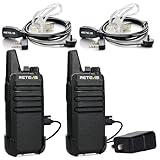 | Retevis RT22 Walkie Talkies Long Range Rechargeable with Earpiece (2 Pack) | Slim & Lightweight 2 Way Radio For Camping & Hiking, Pocket-Friendly Antenna, Ready to Use, 10-Hour Battery, USB-C Charging | Check Price On Amazon |
 | Midland GXT1000VP4 GMRS Two-Way Radios with Headsets, Black, 2 Pack | 50 Channels, 142 Privacy Codes, Up to 36 Mile Long Range, JIS4 Water Resistant, NOAA Weather Alert, Rechargeable NiMH | Check Price On Amazon |
 | Retevis RT628 Walkie Talkies for Kids,Toys Gifts for 6-12 Years Old Boys Girls,Long Range 2 Way Radio 22CH VOX,Birthday Gift,Family Walkie Talkie for Camping Hiking Indoor Outdoor | Check Price On Amazon |