External antennas are essential upgrades that significantly improve the range and clarity of two-way radio communications. They replace stock antennas with more efficient designs that can boost your signal range by 20-200% depending on antenna type and installation. This guide covers everything you need to select, install, and optimize the right external antenna for your specific communication needs.
Understanding Two-Way Radio External Antennas: The Basics
External antennas capture and transmit radio waves more effectively than stock antennas by providing better signal gain and reception capability. They connect to your radio via compatible connectors and dramatically improve communication range and clarity in challenging environments.
| Photo | Popular Portable Walkie Talkies | Price |
|---|---|---|
 | SKIWARRIOR Multifunctional Smart Wireless Ski Goggles with Walkie-Talkie, Anti-Fog Zeiss Lens, Music & Call Function (Cylindrical Blue) | Check Price On Amazon |
 | SINORISE Super Mini Walkie Talkies, Two-Way Radios, 3 Pack | Up to 12 Hours Battery Life, for Baseball Coaches, Restaurants, Retail Stores, Hospitals, Outdoor Sports & Travel | Check Price On Amazon |
 | KOSPET Tank M4C Smart Watch Rugged, Dual-Band GPS, 5ATM & IP69K Waterproof | 1.96" AMOLED Display, 170+ Sport Modes, Built-in LED Flashlight/Walkie-Talkie, Heart Rate/Sleep Monitor for Android & iPhone | Check Price On Amazon |
 | Retevis RT15 Walkie Talkies 3 Pack, Birthday Gift, Outdoor Adventure Kit | Durable, Lightweight, VOX, Key Lock, Mini Walkie Talkies for Adults, School Family Outdoor Travel Camping Hiking | Check Price On Amazon |
 | Rechargeable Walkie Talkies Toys for Kids: DIY Astronaut Walkie Talkies for Boys Christmas Birthday Gifts for 3 4 5 6 7 8 9 10 Boy Walkie Talkie Outdoor Hiking Toy 2 Way Radio Camping Outdoor Game | Check Price On Amazon |
Unlike stock antennas, which are designed for basic functionality and portability, external antennas are engineered for optimal performance in specific applications. They use high-quality materials and precise designs to maximize signal strength in your operating environment.
How External Antennas Improve Two-Way Radio Performance
External antennas deliver several measurable performance improvements for two-way radio systems:
- Extended Range: Quality external antennas typically increase communication range by 30-100% for handheld radios and up to 200% for base station applications.
- Better Signal Clarity: External antennas improve signal-to-noise ratio, resulting in clearer audio with less static and fewer dropouts.
- Reduced Dead Spots: Higher gain and better radiation patterns minimize dead zones in your communication area.
- Building Penetration: External antennas, particularly those designed for UHF frequencies, improve signal penetration through walls, floors, and other obstacles.
- Consistent Performance: Less signal fluctuation means more reliable communications across your entire coverage area.
Key Antenna Terminology You Need to Know
Understanding these essential terms will help you make informed decisions when selecting an external antenna:
- Gain (dB): Measure of how efficiently an antenna focuses radio energy in specific directions compared to a reference antenna. Higher gain increases range in specific directions while reducing coverage in others.
- SWR (Standing Wave Ratio): Measurement of how efficiently radio frequency power is transmitted from the radio to the antenna. Lower SWR (closer to 1:1) means better power transfer and less wasted energy.
- Impedance: Electrical resistance of an antenna system, typically 50 ohms for most two-way radio equipment. Matching impedance ensures maximum power transfer.
- Polarization: Orientation of radio waves (vertical, horizontal, or circular). Most two-way radio antennas use vertical polarization for best performance.
- Wavelength: Physical distance a radio wave travels in one complete cycle. Antenna length is often designed as a fraction of wavelength (1/4, 1/2, 5/8, etc.).
Types of External Antennas for Two-Way Radios
Two-way radio antennas come in several distinct types, each designed for specific applications and performance characteristics. Understanding the differences will help you select the right antenna for your needs.
Whip Antennas: The All-Around Performers
Whip antennas are versatile, portable external antennas that provide significant performance improvements while maintaining reasonable size and weight. They’re ideal for handheld radios and portable applications.
- Design: Straight, flexible rods typically ranging from 6-15 inches in length
- Gain: 2.15-3.0 dBi (moderate gain)
- Best for: Portable applications, field operations, everyday use
- Price range: $15-$45
- Popular models: Nagoya NA-771 and ABBREE Foldable
Whip antennas balance performance and portability, making them ideal upgrades for handheld radios. They significantly outperform stock antennas while maintaining reasonable size and weight.
Mobile Antennas: Optimized for Vehicle Communications
Mobile antennas mount on vehicles to provide maximum range for on-the-go communications. They use the vehicle’s metal body as a ground plane to improve performance.
- Design: Vertical antennas with various mounting systems (magnetic, through-hole, trunk lip)
- Gain: 2.15-5.5 dBi
- Best for: Vehicle-based communications, fleet operations, mobile command centers
- Price range: $25-$150
- Popular models: Tram 1180 and Comet CA-2x4SR
Mobile antennas provide substantial range improvements by utilizing vehicle height and metal surfaces to enhance signal propagation, making them essential for professional fleet communications.
Base Station Antennas: Maximum Range for Fixed Locations
Base station antennas provide maximum range and performance for fixed locations. They’re larger, mounted at height, and designed for permanent installation.
- Design: Fixed antennas mounted on buildings, towers, or masts
- Gain: 3.0-9.0 dBi
- Best for: Command centers, home base stations, businesses, repeater sites
- Price range: $50-$200+
- Popular models: Diamond X50A
Base station antennas deliver the greatest possible range and coverage for fixed communications centers, making them ideal for coordinating with mobile teams across large areas.
Directional vs. Omnidirectional Antennas: Focused vs. All-Around Coverage
The choice between directional and omnidirectional antennas represents a fundamental decision in your antenna selection process.
Omnidirectional Antennas:
- Radiate signal equally in all horizontal directions
- Provide 360-degree coverage
- Ideal for communicating with multiple stations in different directions
- Include most whip, mobile, and standard base antennas
- Best for general use and mobile applications
Directional Antennas:
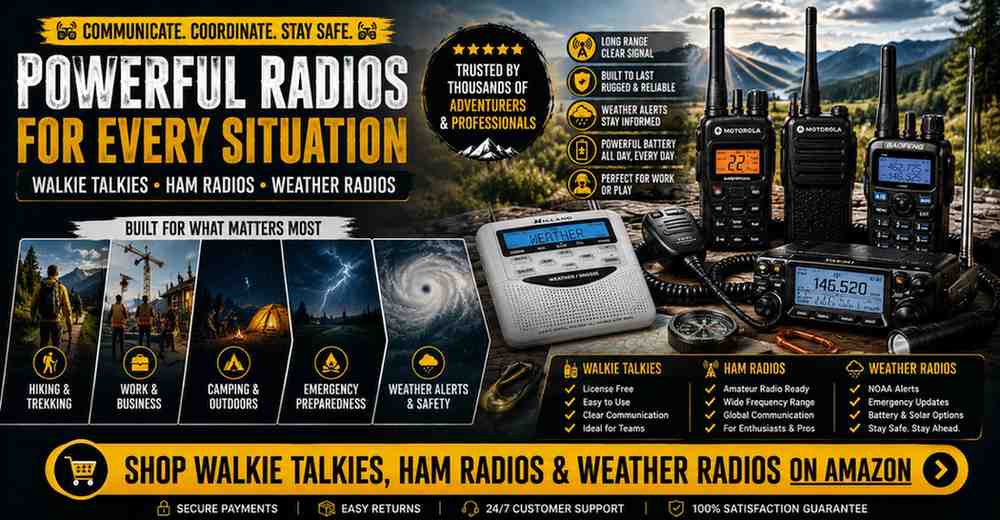
- Focus signal power in specific directions
- Provide greater range in the target direction
- Reduce interference from other directions
- Include Yagi, beam, and panel antenna designs
- Best for fixed point-to-point communications or reaching distant stations
Choose omnidirectional antennas when you need to communicate with multiple stations in different directions. Select directional antennas when you need maximum range to specific locations or when dealing with interference.
How to Choose the Right External Antenna for Your Two-Way Radio
Selecting the optimal external antenna requires matching several key factors to your specific communication needs. Follow this structured approach to identify the perfect antenna for your radio.
- Identify your radio’s frequency band(s) – Check if your radio operates on VHF, UHF, or both bands
- Determine your primary use environment – Indoor, outdoor, vehicle, fixed location
- Assess your range requirements – Typical communication distances needed
- Consider mounting options and limitations – Available mounting locations and restrictions
- Check connector compatibility – Match antenna connections to your radio
- Evaluate your budget – Balance performance needs with available funds
For most users, the ideal external antenna provides a balance between performance, convenience, and cost. Don’t automatically select the highest gain antenna – consider your specific communication environment and needs.
VHF vs. UHF Antennas: Matching Your Radio’s Frequency
The most critical aspect of antenna selection is matching the antenna to your radio’s operating frequency. VHF and UHF antennas are designed for different frequency bands and offer distinct performance characteristics.
VHF (Very High Frequency):
- Frequency range: 136-174 MHz
- Longer wavelength requires larger antennas
- Better for long-distance outdoor communications
- Superior performance in open terrain and rural areas
- Less effective through buildings and urban environments
- Common for marine, aviation, and rural public safety
UHF (Ultra High Frequency):
- Frequency range: 400-520 MHz
- Shorter wavelength allows smaller antennas
- Better building penetration
- Superior performance in urban environments
- Less effective over very long distances in open terrain
- Common for business, industrial, and urban public safety
For dual-band radios, dual-band antennas provide acceptable performance on both bands, though with some compromise compared to single-band antennas. Always match your antenna to your radio’s frequency band for optimal performance.
Understanding Antenna Gain: Finding the Right Balance
Antenna gain is perhaps the most misunderstood specification when selecting an external antenna. Higher gain isn’t always better – it’s about finding the right balance for your specific needs.
Gain represents how an antenna focuses radio energy. Higher gain provides more distance in specific directions but reduces coverage in others. Think of it like a flashlight: a focused beam reaches further but covers less area than a wide beam.
- Low gain (0-3 dBi): Near-equal radiation in all directions, good for communicating with stations in various directions at shorter ranges
- Medium gain (3-6 dBi): Moderate focusing effect, balances range and coverage angle, good for most mobile and general applications
- High gain (6+ dBi): Significant focusing effect with extended range in specific directions, reduced coverage angle, best for long-distance fixed applications
For mobile and portable applications, moderate gain (2-5 dBi) usually provides the best balance. For base stations with height advantage, higher gain (5-9 dBi) can maximize range without sacrificing necessary coverage.
Antenna Connectors and Compatibility Guide
Even the best antenna won’t work if it can’t physically connect to your radio. Understanding connector types ensures compatibility between your radio and antenna.
Common Connector Types:
- SMA: Small threaded connector with center pin, common on handheld radios
- BNC: Bayonet-style connector with quick-connect/disconnect capability
- UHF/PL-259: Larger threaded connector common on mobile and base radios
- N-Type: Weather-resistant threaded connector for professional applications
- TNC: Threaded version of BNC connector with better RF performance
Radio Brand Connector Guide:
- Baofeng, Wouxun: SMA-Female (male pin on radio)
- Kenwood: SMA-Male (female receptacle on radio)
- Motorola Commercial: Different by model (often proprietary)
- Icom/Yaesu: BNC or SMA depending on model
When the antenna and radio have different connector types, adapters can be used but should be high-quality to avoid signal loss. Direct connections are always preferable to using adapters.
How to Install External Antennas for Maximum Performance
Proper installation is critical for realizing the full potential of your external antenna. Follow these installation guidelines to ensure optimal range and clarity for your communications.
General Installation Principles:
- Install antennas as high as safely possible
- Keep antennas away from metal objects that could interfere with signals
- Ensure connections are secure and weatherproofed when outdoors
- Route cables to prevent damage, water ingress, and signal interference
- Check antenna SWR after installation to verify proper setup
Handheld Radio Antenna Installation Guide
Connecting an external antenna to a handheld radio can dramatically improve its range. Follow these steps for proper installation:
- Identify your radio’s connector type (usually SMA or BNC)
- Remove the stock antenna by turning counterclockwise
- Inspect threads for damage or debris
- Align the new antenna with the connector and turn clockwise
- Hand-tighten only – avoid using tools that could damage threads
- For remote antennas, secure coaxial cable to prevent strain on connector
Installation Tips:
- Use adapter cables with strain relief for remote antenna connections
- Keep cables as short as possible to minimize signal loss
- Consider a belt clip adapter for improved performance while worn
- Never transmit without an antenna connected (can damage radio)
Vehicle Antenna Installation: A Complete Guide
Vehicle-mounted antennas offer the greatest performance improvement for mobile communications. Choose the appropriate mount type and follow these installation guidelines:
Magnetic Mount Installation:
- Select a flat, clean metal surface on vehicle roof or trunk
- Clean mounting surface thoroughly with alcohol
- Place magnetic base firmly on clean surface
- Route cable through door or window (avoid pinching)
- Connect to radio and secure excess cable
Permanent Mount Installation:
- Select appropriate location (center of roof ideal)
- Drill appropriate-sized hole for mount type
- Remove metal burrs and apply anti-corrosion treatment
- Install mount with proper sealing gaskets
- Connect coaxial cable and route to radio location
- Weatherproof all external connections
Trunk/Hatch Lip Mount:
- Identify suitable edge on trunk or hatch
- Open lip mount clamp and position on edge
- Tighten clamp screws securely
- Route cable through trunk to radio location
- Ensure adequate clearance for trunk/hatch operation
Vehicle installations benefit from the metal body acting as a ground plane. Center roof mounting provides the best all-around performance for most applications.
Base Station Antenna Installation for Maximum Range
Base station antennas offer the greatest potential range but require careful installation. Follow these guidelines for optimal performance:
- Select mounting location with clear line of sight to communication area
- Use proper mounting hardware rated for antenna weight and wind load
- Install antenna as high as safely possible
- Use high-quality, properly-sized coaxial cable
- Implement proper grounding for lightning protection
- Weatherproof all connections thoroughly
- Secure cables to prevent movement and strain
Safety Considerations:
- Never install near power lines
- Use proper safety equipment for elevated work
- Consider professional installation for tall masts
- Check local regulations and building codes
- Install proper lightning protection
Base station antenna height is critical – each doubling of height typically increases range by 40%. Even a few extra feet can make a significant difference in communication range.
Testing and Optimizing Your Antenna’s Performance
After installation, testing and optimizing your antenna system ensures maximum performance. These practical methods help measure and improve your antenna’s effectiveness.
Basic Testing Methods (No Special Equipment):
- Range Test: Establish communication with a station at a known distance and compare signal reports before and after antenna installation
- Coverage Test: Check communication quality at various locations in your operating area
- Audio Quality Test: Compare audio clarity and signal strength with previous setup
Advanced Testing Methods:
- SWR Measurement: Use an SWR meter to check antenna system efficiency
- Field Strength Measurement: Use a field strength meter to check radiation pattern
- Comparative Testing: Test multiple antennas under identical conditions
Understanding and Measuring SWR
Standing Wave Ratio (SWR) is the most important measurement for evaluating antenna performance. Low SWR indicates efficient power transfer from radio to antenna.
SWR represents how well your antenna system matches the 50-ohm impedance of your radio. High SWR means power is being reflected back to the radio instead of being radiated as a signal.
How to Measure SWR:
- Connect SWR meter between radio and antenna
- Set radio to low power on your operating frequency
- Follow meter instructions to calibrate (if required)
- Key transmitter and note SWR reading
- Check reading at lower and upper ends of your frequency range
SWR Interpretation:
- 1.0-1.5: Excellent (optimal performance)
- 1.5-2.0: Good (acceptable for most applications)
- 2.0-3.0: Marginal (usable but inefficient)
- Above 3.0: Poor (indicates problem requiring correction)
High SWR can damage your radio by reflecting power back to the transmitter. Most modern radios reduce power output when they detect high SWR, but prolonged operation with poor SWR should be avoided.
Troubleshooting Common Antenna Problems
Even with careful selection and installation, antenna systems sometimes don’t perform as expected. This troubleshooting guide helps identify and resolve common issues.
Poor Range Despite Proper Installation:
- Possible Causes: Incorrect frequency band, damaged cable, high SWR, nearby interference sources
- Solutions: Verify antenna matches radio frequency, check cable for damage, measure SWR, relocate antenna away from interference
Intermittent Reception:
- Possible Causes: Loose connections, damaged cable, water ingress, corroded connectors
- Solutions: Check and tighten all connections, inspect cable for damage, ensure proper weatherproofing
High SWR Readings:
- Possible Causes: Incorrect antenna length, improper ground plane, nearby metal objects, damaged antenna
- Solutions: Adjust antenna length (if tunable), improve ground plane, relocate away from metal objects, replace if damaged
Reduced Performance in Rain or Humidity:
- Possible Causes: Water in connectors or cable, corroded connections
- Solutions: Improve weatherproofing, check for water ingress points, replace corroded components
When troubleshooting, change only one element at a time and test after each change. This methodical approach helps identify the specific cause of performance issues.
Antenna Maintenance and Care Guide
A well-maintained antenna system will provide years of reliable service. Follow these maintenance guidelines to ensure continued optimal performance.
Regular Inspection Schedule:
- Monthly: Visual inspection of antenna, mounts, and visible cables
- Quarterly: Check all connections for tightness and corrosion
- Bi-annually: Complete system check including SWR measurement
- After Storms: Inspect for physical damage and water ingress
Maintenance Procedures:
- Connection Maintenance: Clean connections with contact cleaner, check for corrosion, apply dielectric grease to prevent moisture
- Weatherproofing: Replace deteriorated tape or sealant, check for water ingress points
- Physical Inspection: Check for cracks, bent elements, loose hardware, and UV damage
- Winter Preparation: Additional weatherproofing, ice guard installation where needed
Mobile antennas require special attention due to exposure to car washes, road salt, and physical hazards. Magnetic mounts should be removed and cleaned underneath regularly to prevent paint damage.
Top Recommended External Antennas by Category
After extensive testing and evaluation, these external antennas represent the best options in each category, considering performance, durability, ease of installation, and value.
Best Handheld Radio External Antennas
Best Overall Handheld Antenna: Nagoya NA-771
- Frequency: Dual band (VHF/UHF)
- Gain: 2.15 dBi
- Length: 15.6 inches
- Pros: Excellent performance improvement, durable construction, flexible whip design
- Cons: Length may be unwieldy for some users
- Price Range: $15-20
Best Compact Handheld Antenna: Nagoya NA-701
- Frequency: Dual band (VHF/UHF)
- Gain: 2.15 dBi
- Length: 8 inches
- Pros: Compact size, good performance improvement, highly portable
- Cons: Less range improvement than longer antennas
- Price Range: $12-18
Best Mobile Radio External Antennas
Best Overall Mobile Antenna: Diamond K400-3/8C with NR770HNMO
- Frequency: Dual band (VHF/UHF)
- Gain: 3.0/5.5 dBi
- Mount Type: Trunk lip mount with NMO connector
- Pros: Excellent performance, high-quality construction, no drilling required
- Cons: Higher price point, cable routing can be challenging
- Price Range: $90-120 (complete system)
Best Budget Mobile Antenna: Tram 1185 Magnetic Mount
- Frequency: Dual band (VHF/UHF)
- Gain: 2.4/4.0 dBi
- Mount Type: Magnetic mount
- Pros: Easy installation, good performance, no permanent modifications
- Cons: Magnetic mount less secure at high speeds, limited ground plane connection
- Price Range: $30-40
Best Base Station External Antennas
Best Overall Base Antenna: Diamond X300A
- Frequency: Dual band (VHF/UHF)
- Gain: 6.5/9.0 dBi
- Length: 10 feet
- Pros: Outstanding performance, excellent build quality, wide bandwidth
- Cons: Requires substantial mounting support, higher price point
- Price Range: $120-150
Best Budget Base Antenna: Tram 1481
- Frequency: Dual band (VHF/UHF)
- Gain: 5.5/7.5 dBi
- Length: 5.5 feet
- Pros: Good performance, easier mounting, reasonable price
- Cons: Less durable than premium options, slightly lower gain
- Price Range: $50-70
Budget vs. Premium Antennas: What’s the Real Difference?
The price range for external antennas varies dramatically. Understanding the actual performance differences will help you make an informed investment.
Construction Quality Differences:
- Budget Antennas: Basic materials, standard manufacturing tolerances, limited weather resistance
- Premium Antennas: Higher-grade materials, precision manufacturing, superior weatherproofing
Performance Differences:
- Budget Antennas: 70-80% of the performance of premium models, adequate for most casual users
- Premium Antennas: Optimized gain patterns, better efficiency, more consistent performance across frequency ranges
Longevity Differences:
- Budget Antennas: 1-3 years typical lifespan with regular use
- Premium Antennas: 5-10+ years with minimal performance degradation
For occasional or recreational users, budget antennas often provide adequate performance at reasonable cost. For professional, safety-critical, or high-reliability applications, premium antennas justify their higher cost through superior performance and longevity.
Conclusion and Next Steps
Upgrading to an external antenna is one of the most effective ways to improve your two-way radio’s performance. With the information in this guide, you’re now equipped to select, install, and optimize the perfect antenna for your specific needs.
Remember these key points:
- Always match your antenna to your radio’s frequency band
- Higher gain isn’t always better – choose based on your specific communication pattern
- Proper installation is critical for optimal performance
- Regular maintenance ensures continued reliable operation
- Test your system after installation to verify performance improvement
For most users, a quality external antenna will provide immediate and noticeable improvement in communication range and clarity. Whether you choose a simple whip antenna for a handheld radio or a high-gain base station antenna, the performance increase will transform your radio communications experience.
| Photo | TOP RATED WALKIE TALKIES | Price |
|---|---|---|
 | Retevis RT628 Kids Walkie Talkies, Toys Gifts for 4-12 Year Old Girl Boy | Kids Camping Essentials Outdoor Toys, Birthday Gift, 22CH, VOX, Keypad Lock, Durable, Easy to Use Walkie Talkies for Kids | Check Price On Amazon |
 | Cobra ACXT545 Weather-Resistant Walkie Talkies, Rechargeable, 22 Channels | Long Range 28-Mile Two-Way Radio Set (2-Pack) | Check Price On Amazon |
 | Retevis RT388 Kids Walkie Talkies, Outdoor Toys for Kids Camping Essentials | 4-12 Year Old Boy Birthday Gift, 22 CH VOX Flashlight Clear Sound, Kids Walkie Talkies 2 Pack for Camping Hiking Adventure | Check Price On Amazon |
 | Cobra RX680 Walkie Talkies (2-Pack), IP54 Water Resistant Design | Rugged & Splashproof Two Way Radios Long Range, 60 Pre-Programmed Channels, Weather Alerts | Check Price On Amazon |
 | Retevis RT22 Walkie Talkies Long Range Rechargeable with Earpiece (2 Pack) | Slim & Lightweight 2 Way Radio For Camping & Hiking, Pocket-Friendly Antenna, Ready to Use, 10-Hour Battery, USB-C Charging | Check Price On Amazon |
 | Midland GXT1000VP4 GMRS Two-Way Radios with Headsets, Black, 2 Pack | 50 Channels, 142 Privacy Codes, Up to 36 Mile Long Range, JIS4 Water Resistant, NOAA Weather Alert, Rechargeable NiMH | Check Price On Amazon |
 | Retevis RT628 Walkie Talkies for Kids,Toys Gifts for 6-12 Years Old Boys Girls,Long Range 2 Way Radio 22CH VOX,Birthday Gift,Family Walkie Talkie for Camping Hiking Indoor Outdoor | Check Price On Amazon |