When your walkie talkie refuses to power on, communication stops instantly. This problem happens to many two-way radio users, but most power issues can be fixed without specialized equipment. Battery problems cause about 70% of power failures, with contact issues, charging system failures, and physical damage accounting for most other cases. This guide walks you through every possible solution to get your device working again.
Common Causes When Your Walkie Talkie Won’t Power On
When your walkie talkie refuses to turn on, several key components could be at fault. Understanding these common failure points will help guide your troubleshooting process.
| Photo | Popular Portable Walkie Talkies | Price |
|---|---|---|
 | SKIWARRIOR Multifunctional Smart Wireless Ski Goggles with Walkie-Talkie, Anti-Fog Zeiss Lens, Music & Call Function (Cylindrical Blue) | Check Price On Amazon |
 | SINORISE Super Mini Walkie Talkies, Two-Way Radios, 3 Pack | Up to 12 Hours Battery Life, for Baseball Coaches, Restaurants, Retail Stores, Hospitals, Outdoor Sports & Travel | Check Price On Amazon |
 | KOSPET Tank M4C Smart Watch Rugged, Dual-Band GPS, 5ATM & IP69K Waterproof | 1.96" AMOLED Display, 170+ Sport Modes, Built-in LED Flashlight/Walkie-Talkie, Heart Rate/Sleep Monitor for Android & iPhone | Check Price On Amazon |
 | Retevis RT15 Walkie Talkies 3 Pack, Birthday Gift, Outdoor Adventure Kit | Durable, Lightweight, VOX, Key Lock, Mini Walkie Talkies for Adults, School Family Outdoor Travel Camping Hiking | Check Price On Amazon |
 | Rechargeable Walkie Talkies Toys for Kids: DIY Astronaut Walkie Talkies for Boys Christmas Birthday Gifts for 3 4 5 6 7 8 9 10 Boy Walkie Talkie Outdoor Hiking Toy 2 Way Radio Camping Outdoor Game | Check Price On Amazon |
Walkie talkies use a fairly simple power system: batteries supply electricity through metal contacts to a circuit board that controls all functions. Any break in this chain prevents operation.
Studies of repair data show battery-related issues cause over 70% of all power failures. Environmental factors like moisture, dust, and temperature extremes worsen these problems significantly.
- Battery depletion or failure
- Corroded or dirty battery contacts
- Charging system malfunctions
- Power button/switch failures
- Water or moisture damage
- Internal circuit problems
- Physical damage to components
Many problems can be fixed by users with basic tools, while others require professional repair. Following this troubleshooting sequence will help identify which you’re facing.
Quick Diagnostic Checklist Before Detailed Troubleshooting
Before diving into detailed fixes, run through this quick diagnostic checklist to potentially identify and resolve simple issues in minutes.
- Check battery installation: Remove and reinstall batteries, ensuring correct polarity (+ and – aligned properly)
- Try fresh batteries: Replace with known good batteries
- Inspect battery contacts: Look for visible corrosion or bent contacts
- Examine power button: Press firmly and hold for 3-5 seconds
- Check for physical damage: Look for cracks, water indicators, or loose parts
- Attempt a reset: Remove batteries for 30 seconds, then reinstall
If these quick checks don’t resolve the issue, continue to the detailed troubleshooting sections below.
Battery Issues: The #1 Cause of Walkie Talkie Power Failure
Battery problems account for over 70% of all walkie talkie power issues. Let’s systematically check and resolve these common battery-related failures.
Different walkie talkie models use various battery types, each with specific behaviors:
- AA/AAA Alkaline batteries: Common in consumer models, they provide 1.5V per cell when new but drop to around 1.0V when depleted
- NiMH rechargeable: Provide 1.2V per cell, last through hundreds of charge cycles but self-discharge faster than alkaline
- Li-ion packs: Used in professional models, deliver 3.7V per cell with longer life but fail permanently if fully discharged
First, verify you’re using the correct battery type for your model. Using NiMH batteries in a device designed for alkaline can cause power issues since NiMH cells provide slightly lower voltage (1.2V vs 1.5V).
Battery age significantly impacts performance. Most rechargeable batteries lose capacity after 1-2 years of regular use. Even unused alkaline batteries degrade after 5-7 years.
Temperature extremes affect battery performance dramatically. Cold weather can reduce capacity by up to 50%, making a walkie talkie appear dead even with charged batteries. Warming the device to room temperature often restores function.
How to Test If Your Walkie Talkie Battery Is Dead
Determining if your battery is the culprit requires a systematic approach. Here’s how to properly test your walkie talkie batteries using both simple and more advanced methods.
Simple tests without tools:
- Try the batteries in another device that uses the same type
- Swap with known good batteries from a working device
- For rechargeable packs, try an alternate charging method if available
Testing with a multimeter:

- Set multimeter to DC voltage
- For alkaline AA/AAA: Good batteries show 1.3-1.5V, replace if below 1.2V
- For NiMH AA/AAA: Good batteries show 1.2-1.4V when charged, replace if below 1.0V
- For Li-ion packs: Good batteries show 3.7-4.2V, replace if below 3.3V
Visual inspection can also reveal problems. Look for leakage (white, blue or green crust), bulging, or deformation, which indicate battery failure requiring immediate replacement.
Fixing Battery Contact Issues and Corrosion
Even with good batteries, poor connections can prevent power flow. Corrosion and misalignment of battery contacts are common but fixable issues.
To clean corroded contacts safely:
- Remove batteries completely
- For light corrosion, use a cotton swab moistened with isopropyl alcohol (at least 90%)
- For moderate corrosion, make a paste with baking soda and water, apply with a cotton swab, then clean with alcohol
- For severe corrosion, use white vinegar on a cotton swab, let fizz for 2 minutes, then neutralize with baking soda and clean with alcohol
- Gently scrub contacts with a soft toothbrush
- Let dry completely before reinstalling batteries
If contacts appear bent, carefully straighten them using non-metal tools (plastic or wooden toothpick). Metal tools can cause shorts or further damage.
Signs of serious internal corrosion include green or blue residue inside the battery compartment, unusual odors, or visible damage to internal components. These may require professional service.
To prevent future corrosion, remove batteries during long-term storage and keep devices in dry environments.
Charging System Problems and Solutions
If your walkie talkie won’t turn on after charging, the issue may lie with the charging system rather than the battery itself. Let’s diagnose and fix charging-related power failures.
First, verify the charger is working properly:
- Check if the charging indicator lights up when connected
- Try a different wall outlet
- Inspect the charging cable for damage or bent pins
- Clean charging ports on both the device and charger
Charging indicators vary by brand but generally follow these patterns:
- Solid red: Actively charging
- Solid green: Fully charged
- Blinking red: Battery too low to begin normal charging or charging fault
- No light: No connection, charger failure, or battery too depleted
For charging port issues, use a flashlight to inspect for debris or bent pins. Clean ports carefully with compressed air or a soft brush. Never insert metal objects into charging ports.
For devices with cradle chargers, ensure the contact points on both the radio and cradle are clean. Wipe with alcohol on a cotton swab while disconnected from power.
If standard charging fails, some models allow direct battery charging outside the radio using a compatible battery charger. Check your user manual for compatibility information.
How to Properly Charge Different Types of Walkie Talkies
Different walkie talkie models use various charging systems, each with specific requirements. Understanding your device’s charging needs is essential for proper power management.
- Motorola consumer models: Typically use mini-USB or cradle chargers. Require 8-10 hours for first charge, 3-4 hours for subsequent charges
- Motorola professional models: Use proprietary drop-in chargers with specific charging algorithms. Never substitute chargers between different series
- Midland models: Many use direct AC adaptors or USB charging. Complete charging cycle requires 12 hours for initial charge
- Baofeng models: Use drop-in cradles. Best practice is to charge for exactly the time specified (typically 4-5 hours) and not leave in charger continuously
Temperature significantly affects charging efficiency. Most walkie talkies charge optimally between 50-85°F (10-30°C). Charging in extreme temperatures can permanently damage batteries or prevent proper charging.
Warning signs of charging system failure include:
- Unusual heat during charging
- Rapidly depleting batteries after apparently full charge
- Charging indicator behavior that doesn’t match manual descriptions
- Intermittent charging that stops and starts
Power Switch and Button Malfunctions
A faulty power switch or button can prevent your walkie talkie from turning on even when the battery and charging systems are working properly. Here’s how to identify and address these mechanical issues.
Power switches in walkie talkies typically work in one of two ways:
- Mechanical switches: Physically move to complete an electrical circuit
- Electronic buttons: Send a signal to a circuit board to control power
To test a power switch:
- Press firmly and hold for 3-5 seconds (some models have delay protection)
- Try rotating volume/power knobs through their full range several times
- For dual-function buttons, try pressing different areas of the button
Common power button problems include dirt accumulation underneath, physical damage, or internal disconnection. For accessible buttons, cleaning around the edges with compressed air or isopropyl alcohol on a cotton swab can resolve sticking issues.
If the button physically moves but doesn’t activate the device, the internal contact may be faulty. This usually requires repair, but temporary fixes include:
- Pressing the button while applying slight pressure in different directions
- For knob-style controls, turning past the normal stopping point (carefully)
- Tapping the device gently on a soft surface while attempting to power on
If these workarounds fail, the switch likely needs replacement by a repair technician.
Moisture Damage and Water Exposure Solutions
Water and moisture exposure is a leading cause of walkie talkie power failure. Quick and proper action can often save a device that’s been exposed to moisture.
If your walkie talkie has been exposed to water:
- Act immediately: Remove batteries and any accessories
- Don’t press buttons: This can push water further inside
- Blot, don’t wipe: Use absorbent cloth to blot exterior moisture
- Drain excess water: Gently shake out visible water
- Dry properly: Place in dry, warm area with good airflow for 24-48 hours
Effective drying methods:
- Use silica gel packets placed near (not on) the device
- Place in front of a fan at room temperature
- Use uncooked rice as a last resort (less effective but better than nothing)
Dangerous myths to avoid:
- Never use a microwave, oven, or hair dryer (heat can damage components)
- Don’t use a freezer (condensation forms when warming)
- Avoid compressed air until completely dry (can push moisture deeper)
Water damage indicators are often found inside the battery compartment – white stickers that turn red or pink when wet. If these are triggered, warranty service may be voided.
Different exposure types affect recovery chances:
- Rain exposure: High recovery chance if dried promptly
- Fresh water submersion: Moderate recovery chance if action taken immediately
- Salt water exposure: Low recovery chance due to corrosive nature
- High humidity over time: Variable recovery depending on condensation level
For future reference, waterproof ratings like IP67 mean the device can handle submersion in 1 meter of water for 30 minutes, while IPX4 only protects against splashes. If you need reliable communication in wet environments, consider investing in [waterproof walkie talkies](https://talkiewaves.com/waterproof-walkie-talkies/) specifically designed to withstand these conditions.
Internal Circuit Problems and Reset Procedures
Sometimes walkie talkies fail to power on due to software glitches or minor circuit issues that can be resolved through proper reset procedures.
Modern walkie talkies contain small microprocessors running firmware (permanent software) that controls all functions. Like any computer, these systems can experience crashes or memory errors that prevent normal operation, including powering on.
A proper reset often resolves these issues by clearing the memory and restarting the system. Think of it as rebooting a computer.
Basic reset procedure for most walkie talkies:
- Remove all batteries and external power
- Press and hold the power button for 15-20 seconds (discharges capacitors)
- Leave batteries out for at least 2 minutes
- Reinsert batteries and attempt to power on
This process clears temporary memory and resets the processor but doesn’t affect channel programming or stored settings in most models.
More stubborn issues might require a factory reset, which restores all settings to default. This varies by manufacturer but often involves holding specific button combinations while powering on.
Signs that indicate more serious circuit problems beyond a simple reset:
- Device gets unusually hot during operation or charging
- Visible damage to circuit board (if accessible)
- Burning smell when attempting to power on
- Device powers on but immediately shuts off
- Strange noises (clicking, buzzing) when attempting to operate
These symptoms likely require professional repair or replacement.
Brand-Specific Reset Procedures
Different walkie talkie brands have specific reset procedures. Follow these exact steps for your device’s make and model to properly reset its internal systems.
Motorola Talkabout Models:
- Remove batteries
- Hold PTT (Push-to-Talk) and Monitor buttons simultaneously
- While holding both buttons, reinsert batteries
- Continue holding for 3 seconds until you hear a tone
- Release buttons – unit should reset to Channel 1
Midland GXT/LXT Series:
- Turn radio off
- Press and hold Menu button
- While holding Menu, turn radio on
- Continue holding Menu until you hear two beeps
- Release button – display should show “rS” briefly
Baofeng UV-5R and Similar:
- Turn radio off
- Press and hold MENU and # keys simultaneously
- While holding both keys, turn radio on
- Display will show “RESET” then “VFO”
- All settings return to factory default
Cobra microTALK:
- Turn radio off
- Press and hold Mode/Power and Call buttons
- Turn on while holding both buttons
- Continue holding for 5 seconds
- Radio will reset to Channel 1, default settings
If standard reset procedures fail, try removing the battery, connecting to a charger, then attempting to power on with external power only.
When to Repair vs. Replace Your Walkie Talkie
After exhausting troubleshooting options, you may need to decide whether to repair or replace your non-functioning walkie talkie. This decision framework will help you make the most cost-effective choice.
Consider these factors when deciding:
- Device age: Walkie talkies older than 5 years are generally better candidates for replacement due to parts availability issues
- Original cost: The repair-replace threshold should be about 50% of original cost (repair if less, replace if more)
- Usage requirements: Professional users may need exact model replacement for compatibility with existing systems
- Repair complexity: Battery and contact issues are worth fixing; main board failures usually aren’t
Professional repair typically costs $30-75 for consumer models and $100-200 for professional grade units, plus parts. Many repair shops offer free diagnostics to determine the specific issue before committing to repair.
DIY repairs are feasible for:
- Battery replacements
- Cleaning and contact repairs
- Simple switch/button fixes
- Antenna replacements
But should be avoided for:
- Circuit board repairs
- Water damage restoration
- Charging port replacement
- Display issues
Warranty coverage varies significantly by brand. Motorola typically offers 1-3 years, Midland 1-3 years depending on model, and Baofeng usually 1 year. Most warranties exclude water damage and physical damage.
From an environmental perspective, repair is preferable when feasible. If replacement is necessary, many electronics retailers offer recycling programs for old devices.
Preventative Maintenance to Avoid Future Power Issues
The best solution to power problems is preventing them in the first place. These maintenance practices will significantly extend your walkie talkie’s reliability and operational life.
- Regular battery maintenance: Remove batteries during storage longer than 2 weeks
- Proper charging habits: Follow manufacturer guidelines for charge times and avoid constant charging
- Contact cleaning: Clean battery contacts quarterly with isopropyl alcohol
- Storage practices: Store in cool, dry places away from direct sunlight
- Case usage: Use protective cases in harsh environments
- Moisture prevention: Use silicone covers or waterproof cases in humid/wet conditions
- Battery rotation: For frequently used devices, maintain two sets of batteries and rotate weekly
- Physical protection: Use belt clips or lanyards to prevent drops
Temperature extremes significantly impact walkie talkie reliability. Avoid leaving devices in vehicles during summer or winter, as temperatures can exceed safe operating ranges (typically 14°F to 122°F or -10°C to 50°C).
For professional users, implementing a regular maintenance schedule with documented checks can identify potential issues before critical failure occurs. Following proper [walkie talkie maintenance](https://talkiewaves.com/walkie-talkie-maintenance/) procedures is essential for keeping your two-way radios in optimal condition.
Proper Battery Storage and Maintenance
Battery care is the single most important factor in preventing walkie talkie power issues. Follow these specific storage and maintenance guidelines to maximize battery life and performance.
Alkaline (AA/AAA) battery maintenance:
- Store unused batteries at room temperature in original packaging
- Remove from devices during storage longer than 2 weeks
- Check expiration dates before installation
- Never mix old and new batteries
NiMH rechargeable maintenance:
- Store at 40-50% charge, not fully charged or depleted
- Recharge every 3 months during storage
- Run complete discharge/recharge cycles monthly during regular use
- Replace after 300-500 charge cycles or 2-3 years
Li-ion pack maintenance:
- Store at 40-60% charge in cool environment (60-70°F/15-21°C ideal)
- Avoid complete discharge (can permanently damage cells)
- Charge before fully depleted
- Replace after 300-500 charge cycles or visible swelling
Warning signs that indicate battery replacement is needed:
- Operating time less than 50% of original duration
- Excessive heating during use or charging
- Physical deformation or leakage
- Failure to hold charge when not in use
Proper disposal is essential for all battery types. Most hardware stores, electronics retailers, and municipal waste facilities offer battery recycling services.
Emergency Communication Alternatives When Your Walkie Talkie Fails
When your walkie talkie won’t turn on and immediate communication is critical, these alternative solutions can help maintain contact until your device is operational again.
Short-range alternatives (under 2 miles):
- Cell phones: Most reliable when service is available
- Bluetooth communicators: Work up to 100-300 feet between devices
- Emergency whistles: Effective for signaling in line-of-sight situations
- Visual signals: Flashlights, mirrors, or bright clothing for daytime visibility
Medium-range alternatives (2-5 miles):
- CB radios: Vehicle-mounted systems work in many rural areas
- GMRS radios: Higher power alternative to FRS walkie talkies (license required)
- Marine band radios: Effective near water (but restricted to marine use)
Long-range alternatives (5+ miles):
- Satellite phones: Work almost anywhere with clear sky view
- Ham radios: Excellent range but require licensing
- Satellite messengers: Devices like Garmin inReach or SPOT allow text messaging via satellite
Emergency power solutions:
- Portable power banks with proper adapters
- Solar chargers for extended field use
- Hand-crank emergency radios with USB outputs
- Battery adapters that allow using alternative battery types
Establish communication protocols with your group before departure, including check-in times and procedures if primary communications fail. Having a designated backup device carrier improves group reliability. For emergency preparedness, consider adding reliable [emergency radios](https://talkiewaves.com/best-emergency-radios/) to your essential equipment.
Conclusion: Key Takeaways for Walkie Talkie Power Issues
Successfully diagnosing and resolving walkie talkie power issues requires a systematic approach and understanding of common failure points.
Start with the most common causes – battery problems and contact issues – before proceeding to more complex troubleshooting. The majority of power failures can be resolved through proper battery maintenance, cleaning contacts, and knowing the correct reset procedures for your specific model.
Prevention remains the most effective strategy. Regular maintenance, proper storage, and following manufacturer guidelines for charging will significantly reduce unexpected failures.
When troubleshooting fails, make the repair vs. replace decision based on device age, original cost, and specific fault identified. For critical communications, always maintain backup options appropriate to your usage scenario.
Remember that environmental factors dramatically affect walkie talkie performance – temperature extremes and moisture exposure account for many preventable failures.
With proper care and the troubleshooting knowledge in this guide, your walkie talkies will provide reliable communication when you need it most. If you’re new to using two-way radios, check out this comprehensive [walkie talkie beginners guide](https://talkiewaves.com/walkie-talkie-beginners-guide/) to learn all the essentials for effective communication.
| Photo | TOP RATED WALKIE TALKIES | Price |
|---|---|---|
 | Retevis RT628 Kids Walkie Talkies, Toys Gifts for 4-12 Year Old Girl Boy | Kids Camping Essentials Outdoor Toys, Birthday Gift, 22CH, VOX, Keypad Lock, Durable, Easy to Use Walkie Talkies for Kids | Check Price On Amazon |
 | Cobra ACXT545 Weather-Resistant Walkie Talkies, Rechargeable, 22 Channels | Long Range 28-Mile Two-Way Radio Set (2-Pack) | Check Price On Amazon |
 | Retevis RT388 Kids Walkie Talkies, Outdoor Toys for Kids Camping Essentials | 4-12 Year Old Boy Birthday Gift, 22 CH VOX Flashlight Clear Sound, Kids Walkie Talkies 2 Pack for Camping Hiking Adventure | Check Price On Amazon |
 | Cobra RX680 Walkie Talkies (2-Pack), IP54 Water Resistant Design | Rugged & Splashproof Two Way Radios Long Range, 60 Pre-Programmed Channels, Weather Alerts | Check Price On Amazon |
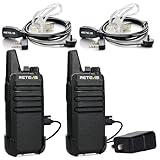 | Retevis RT22 Walkie Talkies Long Range Rechargeable with Earpiece (2 Pack) | Slim & Lightweight 2 Way Radio For Camping & Hiking, Pocket-Friendly Antenna, Ready to Use, 10-Hour Battery, USB-C Charging | Check Price On Amazon |
 | Midland GXT1000VP4 GMRS Two-Way Radios with Headsets, Black, 2 Pack | 50 Channels, 142 Privacy Codes, Up to 36 Mile Long Range, JIS4 Water Resistant, NOAA Weather Alert, Rechargeable NiMH | Check Price On Amazon |
 | Retevis RT628 Walkie Talkies for Kids,Toys Gifts for 6-12 Years Old Boys Girls,Long Range 2 Way Radio 22CH VOX,Birthday Gift,Family Walkie Talkie for Camping Hiking Indoor Outdoor | Check Price On Amazon |