Walkie-talkies transformed battlefield communication during World War II before evolving into essential tools for both professionals and consumers. These portable two-way radios began as bulky military equipment developed by multiple inventors working independently in the late 1930s. Over eight decades, they’ve evolved from vacuum tube technology to sophisticated digital devices while maintaining their core advantage: reliable direct communication without infrastructure.
Despite smartphones dominating personal communication, walkie-talkies remain irreplaceable in emergency services, industrial settings, and disaster scenarios where network-independent communication is critical. Their journey from military necessity to everyday tool reflects a remarkable technological evolution that continues today.
| Photo | Popular Portable Walkie Talkies | Price |
|---|---|---|
 | SKIWARRIOR Multifunctional Smart Wireless Ski Goggles with Walkie-Talkie, Anti-Fog Zeiss Lens, Music & Call Function (Cylindrical Blue) | Check Price On Amazon |
 | SINORISE Super Mini Walkie Talkies, Two-Way Radios, 3 Pack | Up to 12 Hours Battery Life, for Baseball Coaches, Restaurants, Retail Stores, Hospitals, Outdoor Sports & Travel | Check Price On Amazon |
 | KOSPET Tank M4C Smart Watch Rugged, Dual-Band GPS, 5ATM & IP69K Waterproof | 1.96" AMOLED Display, 170+ Sport Modes, Built-in LED Flashlight/Walkie-Talkie, Heart Rate/Sleep Monitor for Android & iPhone | Check Price On Amazon |
 | Retevis RT15 Walkie Talkies 3 Pack, Birthday Gift, Outdoor Adventure Kit | Durable, Lightweight, VOX, Key Lock, Mini Walkie Talkies for Adults, School Family Outdoor Travel Camping Hiking | Check Price On Amazon |
 | Rechargeable Walkie Talkies Toys for Kids: DIY Astronaut Walkie Talkies for Boys Christmas Birthday Gifts for 3 4 5 6 7 8 9 10 Boy Walkie Talkie Outdoor Hiking Toy 2 Way Radio Camping Outdoor Game | Check Price On Amazon |
The Origins Debate: Who Really Invented the Walkie-Talkie?
The invention of the walkie-talkie is not attributed to a single person, but rather emerged through parallel development by multiple inventors and engineers working in different countries during the late 1930s and early 1940s. Three key figures stand out in this developmental race, each contributing unique elements to what we now recognize as portable two-way radio technology.
Early portable radio communication devices were being developed simultaneously in the United States and Canada, with slightly different approaches and applications. The terminology itself creates some confusion – what Americans called the “Handie-Talkie” was the smaller handheld unit (SCR-536), while the “Walkie-Talkie” originally referred to the larger backpack unit (SCR-300).
Al Gross: The Radio Pioneer Behind the SCR-536
Alfred J. Gross began experimenting with portable radio technology in 1938 while still a student in Cleveland, Ohio. His early work focused on creating lightweight, handheld radio units that operated in the high-frequency range. By 1941, Gross had developed working prototypes that caught the attention of the U.S. military.
The Signal Corps adopted Gross’s design as the SCR-536, the first true handheld transceiver used widely in combat. Weighing about 5 pounds and roughly the size of a large brick, it became known as the “Handie-Talkie.” The device operated on a fixed frequency with a range of about one mile under ideal conditions.
Gross later worked with the Office of Strategic Services (OSS), developing specialized communication equipment for covert operations. After the war, he continued pioneering wireless communication, developing the pager and working on early mobile phone technology. Despite his contributions, Gross received relatively modest financial rewards for his innovations.
Donald Hings and the Canadian Contribution
In 1937, Canadian inventor Donald Hings created a portable radio signaling system he called the “packset” while working for Consolidated Mining and Smelting Company (CM&S) in British Columbia. Initially designed for communication in remote mining operations, Hings’s device proved to have much broader applications.
When World War II began, Hings was called to Ottawa to refine his packset for military use. His work resulted in the C-58 packset, which was used by Canadian and British forces. Hings received 12 patents for his designs and was eventually awarded the Order of Canada in 2001 for his contributions.
The Canadian packset featured more robust construction for field use than many contemporary designs. Hings’s contribution is often overlooked in U.S.-centric histories despite his clear priority in developing functional portable two-way radio systems before the war began.
Motorola and the Development of the SCR-300
Galvin Manufacturing Corporation (which later became Motorola) made perhaps the most significant industrial contribution to walkie-talkie development. Under the leadership of engineer Henryk Magnuski, the company developed the SCR-300 backpack radio in 1940, which became the standard backpack radio for U.S. troops.
The SCR-300 was larger than the handheld SCR-536, weighing about 35 pounds, but offered greater range (3-5 miles) and more reliable performance. Over 50,000 units were produced during the war. The device operated in the FM band, providing clearer communication than earlier AM-based radios.
Galvin Manufacturing leveraged its wartime experience to dominate the post-war radio market. Motorola (as the company was renamed in 1947) continued refining two-way radio technology, becoming the leading manufacturer in both military and civilian markets for decades.
Walkie-Talkies in WWII: How They Changed Military Communication
World War II was the catalyst that transformed experimental portable radio technology into essential military equipment, revolutionizing battlefield communication and tactics. Before walkie-talkies, field communication relied on fixed radio stations, telephone wires that had to be physically laid across battlefields, or human messengers – all with severe limitations in mobile warfare.
The introduction of portable voice communication dramatically improved coordination between units during rapidly changing combat situations. Infantry squads could maintain contact while separated by terrain or enemy positions. Artillery spotters could call in coordinates without returning to command posts. Tank commanders could coordinate movements across wider areas.
General George Patton reportedly said that portable radio equipment was the “most valuable” communication development of the war. By 1943, walkie-talkies had become standard equipment for Allied forces, with hundreds of thousands of units deployed across all theaters of war.
Technical Specifications of WWII Walkie-Talkies
The two primary radio units that defined WWII field communication had distinctly different capabilities and applications:
- SCR-536 (Handie-Talkie): Weighed 5 pounds, measured 3.5 × 6.5 × 9.5 inches, had a range of about 1 mile, operated on AM band (3.5-6.0 MHz), used vacuum tubes, required two battery packs (one A battery for filaments, one B battery for plate voltage), and offered 1.5 watts of power.
- SCR-300 (Walkie-Talkie): Weighed 35 pounds, was carried in a backpack configuration, had a range of 3-5 miles, operated on FM band (40-48 MHz), used 18 vacuum tubes, required larger battery packs lasting 20-30 hours, featured replaceable antenna systems, and offered 5 watts of power with better voice clarity.
Both units relied on vacuum tube technology, which made them bulky and fragile compared to modern electronics. Each vacuum tube functioned as an amplifier or oscillator in the circuit, similar to how transistors work in modern devices. The tubes required separate battery voltages and warmed up before operation, creating significant power demands.
Field maintenance was challenging. Tubes frequently broke from rough handling, and battery life was limited. Soldiers often carried spare tubes and batteries, adding to their already heavy loads. Despite these limitations, the technology was revolutionary for its time.
Battlefield Impact and Tactical Advantages
The D-Day landings at Normandy in June 1944 demonstrated the tactical advantage of portable radio communications. When units were scattered during the chaotic beach landings, those with functioning walkie-talkies could coordinate regrouping efforts and call for support. Units without radio contact often remained isolated and ineffective for longer periods.
In the Pacific theater, dense jungle terrain made traditional wire-based field telephones impractical. Marine Corps units using SCR-300 radios maintained communication during island-hopping campaigns, coordinating naval gunfire support and air strikes with ground movements.
Colonel Lewis B. Puller of the U.S. Marine Corps noted: “The portable radio gave us an advantage the Japanese never matched. We could adjust artillery fire and coordinate movements while dispersed through jungle terrain.”
Limitations remained significant. In urban environments, buildings blocked signals. Heavy rainfall degraded performance. Enemy forces could intercept unsecured transmissions. Despite these challenges, portable radio communications had become indispensable to modern warfare.
Post-War Evolution: From Military Tool to Civilian Technology
After World War II, walkie-talkie technology transitioned from purely military applications to civilian and commercial use, beginning a period of rapid innovation and miniaturization. The key technological breakthrough enabling this transition was the replacement of vacuum tubes with transistors.
In 1948, the Federal Communications Commission established the Citizens Band (CB) radio service, allocating radio frequencies for personal and business use without requiring specialized licenses. This regulatory change opened the door for widespread civilian adoption of two-way radio technology.
Motorola led commercial development, leveraging its wartime experience to introduce the first transistorized portable radios in the mid-1950s. The Motorola Handie-Talkie became a brand name synonymous with portable two-way radios, similar to how “Kleenex” became associated with facial tissues.
Early consumer models remained expensive, with prices equivalent to several thousand dollars in today’s currency. The first models targeted businesses rather than individual consumers – construction companies, security firms, and event management operations became early adopters.
The Transistor Revolution: Smaller, Lighter, More Reliable
The invention of the transistor in 1947 by Bell Laboratories scientists transformed radio technology. Transistors performed the same functions as vacuum tubes but were smaller, more durable, consumed less power, generated less heat, and required no warm-up time.
The first transistor radios appeared on the market in 1954, but complete transistorization of two-way radios took longer due to higher power requirements for transmission. By the early 1960s, fully transistorized walkie-talkies had become available, dramatically reducing size and weight.
A comparison shows the dramatic improvement:
- 1944 Vacuum Tube SCR-536: 5 pounds, brick-sized, 1.5-watt output, 1-mile range, 8-hour battery life
- 1963 Transistorized HT-200: 28 ounces, hand-sized, 2-watt output, 2-mile range, 10-hour battery life
Motorola’s introduction of the HT-200 series in 1963 marked a turning point in professional two-way radio design. These handheld units were small enough to be carried on a belt yet powerful enough for professional applications in public safety and industry.
Regulatory Development and Frequency Allocation
The FCC created the Citizens Band Radio Service in 1948, allocating frequencies near 460 MHz. In 1958, the commission established the Class D Citizens Radio Service at 27 MHz, which became what most people today recognize as “CB radio.”
Initially, CB radio required licenses, but the requirements were minimal compared to amateur radio. By 1976, the FCC had stopped enforcing the licensing requirement due to the overwhelming number of users.
Other key frequency allocations included:
- Family Radio Service (FRS): Established in 1996, allowing very low-power, license-free communication
- General Mobile Radio Service (GMRS): Higher-power service requiring licenses
- Multi-Use Radio Service (MURS): License-free VHF band service established in 2000
- Business Band: Various frequency allocations for commercial use requiring licenses
International regulations varied by country, creating challenges for manufacturers wanting to sell globally. The European PMR446 service, established in the 1990s, became roughly equivalent to America’s FRS.
These regulatory frameworks determined maximum power output, antenna specifications, and technical features, directly shaping the devices manufacturers could legally produce.
The Golden Age of Consumer Walkie-Talkies (1960s-1980s)
The period from the 1960s through the 1980s represented the golden age of consumer walkie-talkies, when they became household items, popular toys, and featured prominently in popular culture. Several factors converged to drive this boom in two-way radio popularity.
Price points dropped significantly as manufacturing scaled up and technology improved. By the mid-1960s, basic consumer walkie-talkies were available for $15-30 per pair ($120-240 in today’s dollars), making them accessible to middle-class families.
The CB radio craze of the 1970s further fueled interest in personal radio communication. The 1973 oil crisis and resulting nationwide 55 mph speed limit led truck drivers to use CB radios to locate fuel and warn each other about speed traps. The popular culture embraced CB lingo and culture, with films like “Smokey and the Bandit” (1977) featuring CB radio prominently.
Toy manufacturers produced simplified walkie-talkies for children, often themed around popular TV shows like “Star Trek” or “The Man from U.N.C.L.E.” These toys typically operated on lower power and frequencies around 49 MHz, providing limited but functional communication over short distances.
Walkie-Talkies in Popular Culture and Entertainment
Two-way radios became essential props in film and television, symbolizing action, adventure, and technology. Notable appearances included:
- Military films like “The Longest Day” (1962) featuring authentic WWII radio equipment
- Police procedurals where “calling for backup” over a handheld radio became a standard dramatic moment
- Science fiction shows like “Star Trek,” whose communicators influenced later flip-phone designs
- Children’s shows like “Inspector Gadget,” featuring watch-based communication devices
Marketing campaigns emphasized adventure and emergency preparedness. A 1978 Radio Shack catalog described their TRC-200 walkie-talkies as “your link to safety and security” while showing a family camping scene.
Collector interest in vintage units began emerging by the 1980s. Early transistor models from the 1960s became particularly sought after, with working Motorola HT-200 units from 1963 now valued at hundreds of dollars among collectors.
The cultural impact extended to language itself, with phrases like “over and out,” “copy that,” and “10-4 good buddy” entering everyday speech through exposure to radio procedures in media.
Professional and Industrial Applications: Beyond Consumer Use
While consumer walkie-talkies gained popularity, specialized professional two-way radios evolved along a separate but parallel path, becoming essential tools in numerous industries where reliable communication is critical. Professional-grade radios developed with features specifically designed for demanding environments and applications.
Key industries adopting specialized radio systems included:
- Public Safety: Police, fire, and emergency medical services required ruggedized radios with secure communications
- Construction: Coordination between workers across large sites in high-noise environments
- Manufacturing: Communication in facilities with machinery and metal structures
- Event Management: Coordination of security, logistics, and production at large gatherings
- Hospitality: Staff communication in hotels, resorts, and cruise ships
- Transportation: Airports, railroads, and shipping operations
Professional radios commanded premium prices, often costing 5-10 times more than consumer models. This price difference reflected enhanced durability, reliability, and specialized features like:
- Intrinsically safe designs for explosive environments
- Water and dust resistance (later formalized as IP ratings)
- Emergency alert buttons
- Noise-canceling microphones
- Specialized audio accessories for high-noise environments
- Extended battery life for long shifts
Motorola dominated the professional market with their Professional Radio series, while companies like Harris, Kenwood, and Icom established strong positions in specific industries and regions.
Emergency Services and Public Safety Applications
Public safety communication represents the most demanding application for two-way radio technology. Police officers, firefighters, and paramedics rely on their radios in life-or-death situations, often in hazardous environments.
The 1970s saw the development of unified public safety radio systems in major metropolitan areas. These systems used higher-power base stations and repeaters to extend handheld radio range across entire cities.
The New York City Police Department’s radio system, developed after communication failures during the 1977 blackout, became a model for urban police communications. It featured multiple channels for different precincts, car-to-portable communication, and dispatcher coordination.
Fire services developed specialized radio features like:
- Emergency distress buttons that transmitted location data
- Heat-resistant microphones and controls operable with heavy gloves
- Voice activation for hands-free operation during rescues
- Automatic identification of the transmitting unit
Battalion Chief Robert Thompson of the Chicago Fire Department noted, “Reliable radio communication has saved more firefighter lives than any other single technology improvement. When you can’t see through smoke, your radio becomes your lifeline.”
The 1995 Oklahoma City bombing and 2001 World Trade Center attacks highlighted interoperability challenges when multiple agencies needed to communicate during major incidents, driving development of shared systems and standards.
The Digital Revolution: Modern Two-Way Radio Technology
The transition from analog to digital technology in the late 20th and early 21st centuries represented the most significant advancement in two-way radio since the invention of the transistor. Digital radio systems fundamentally changed how voice information is transmitted, processed, and managed across radio networks.
Analog radio transmits voice by directly modulating radio waves in patterns that correspond to sound waves. [Digital systems convert voice into binary data before transmission](https://talkiewaves.com/digital-analog-walkie-talkies/), then reconstruct it at the receiving end. This fundamental difference enables numerous advantages:
- Clearer audio quality, especially at range limits
- More efficient use of frequency spectrum
- Enhanced privacy and security options
- Integration of voice and data on the same channel
- Advanced features like text messaging and GPS location
Three major digital standards emerged:
- Digital Mobile Radio (DMR): An open standard widely adopted for commercial and industrial applications
- Project 25 (P25): Developed specifically for North American public safety agencies
- Terrestrial Trunked Radio (TETRA): European standard used globally for public safety and transportation
Motorola introduced their ASTRO digital system in 1997, marking the beginning of large-scale digital radio adoption. By 2010, most professional radio systems sold were digital, though analog systems remained common in less demanding applications due to lower cost.
Digital Features and Capabilities Explained
Digital voice processing improves communication clarity through error correction algorithms that filter out background noise and maintain voice quality at the edge of transmission range. While analog signals gradually degrade with distance (becoming increasingly static-filled), digital signals maintain clarity until they reach the limits of reception, where they stop working entirely.
Text messaging capabilities allow users to send brief messages when voice communication is impractical or inappropriate. A security guard can silently report a situation without alerting nearby people, or workers in extremely noisy environments can communicate when voice transmission would be unintelligible.
GPS integration enables dispatchers to track the location of each radio unit in the field. This feature proves invaluable for coordinating emergency responders, managing delivery fleets, or locating workers in dangerous environments. Some systems automatically transmit location when an emergency button is pressed.
Multiple talk groups allow organizations to segment their communications while using a single radio system. A hospital might have separate talk groups for security, maintenance, nursing, and administration, all operating on the same infrastructure but unable to hear each other’s routine communications.
Battery efficiency improved dramatically with digital technology. While early digital radios consumed more power than analog counterparts, advanced sleep modes and transmission techniques in modern units can extend battery life by 30-40% compared to analog radios.
Walkie-Talkies in the Smartphone Era: Why They Endure
Despite the ubiquity of smartphones with seemingly limitless communication capabilities, traditional two-way radio technology continues to thrive in numerous applications where its unique advantages remain unmatched. Several fundamental characteristics explain this continued relevance.
The most critical advantage is infrastructure independence. While cell phones require a complex network of towers, switching centers, and internet connections, [walkie-talkies communicate directly with each other](https://talkiewaves.com/walkie-talkie-vs-cell-phones/). When cellular networks become overloaded during emergencies or fail due to power outages, two-way radios continue functioning.
Group communication efficiency represents another key benefit. With a single transmission, a team leader can communicate instructions to an entire workforce simultaneously. Recipients don’t need to answer calls or check messages – the communication is immediate and acknowledged with simple protocols.
Durability in extreme conditions continues to favor purpose-built radio equipment. Modern professional two-way radios are designed to withstand drops onto concrete, submersion in water, extreme temperatures, and dusty environments. While ruggedized smartphones exist, they rarely match the durability of professional radio equipment.
Simplicity of operation provides critical advantages in stressful situations. Radio communication requires minimal user interaction – press a button and speak. This simplicity proves valuable in emergencies when fine motor skills diminish under stress and complex smartphone interfaces become difficult to navigate.
Industry sales figures confirm this enduring relevance. The global two-way radio market continues growing at approximately 8% annually, reaching $7.9 billion in 2022 according to industry analysts. Motorola Solutions, the market leader, reported increased professional radio sales even as smartphone technology matured.
When Reliability Matters: Disaster Response and Emergency Preparedness
Natural disasters repeatedly demonstrate the superiority of two-way radio communication in crisis situations. During Hurricane Katrina in 2005, cellular networks throughout New Orleans failed completely, while radio systems (though strained) continued operating. Similarly, after the 2011 earthquake and tsunami in Japan, damaged infrastructure left many areas without cellular service for weeks, while radio communications were restored within hours.
The Federal Emergency Management Agency (FEMA) recommends two-way radios as essential equipment for emergency response teams. Their 2023 field operations guide specifically notes: “Communications networks that depend on complex infrastructure should be supplemented with direct unit-to-unit capabilities for resilience during infrastructure disruptions.”
The amateur radio community plays a crucial role in disaster communications. Licensed operators with portable equipment often provide emergency communication services when other systems fail. During Hurricane Maria in Puerto Rico (2017), amateur radio operators were the sole source of communication for several remote communities for more than two weeks.
Red Cross emergency communication protocols explicitly include two-way radio procedures for all disaster response teams. Their training materials note that “team members should be proficient in radio operation even if they primarily use cellular communication during normal operations.”
Emergency management professional Carlos Castillo observed after coordinating Hurricane Sandy response: “When everything else fails, the simplest technology often proves most reliable. Basic two-way radio communication saved lives when smart systems went dark.”
Collecting and Preserving Vintage Walkie-Talkies
The rich history of walkie-talkie development has created a vibrant collector community dedicated to preserving, restoring, and documenting these historic communication devices. Military models from WWII command the highest prices, with functioning SCR-536 units selling for $1,000-$3,000 depending on condition and completeness.
Notable models sought by collectors include:
- Military Models: SCR-536, SCR-300, BC-611, and TBY series from WWII
- Early Transistor Models: Motorola HT-200 series from the 1960s
- First Consumer Models: Raytheon TWR-1 and Herald S-15 from the late 1950s
- CB Radio Boom Models: Classic Midland, Cobra, and Radio Shack units from the 1970s
- Toy Models: Character-themed children’s units from major manufacturers like Remco and Mego
Preservation challenges include battery compartment corrosion, fragile plastic components, and frequency compliance issues. Many vintage units operate on frequencies no longer legal for transmission, meaning collectors can only display them rather than use them.
The Military Radio Collectors Association provides resources for authentication, including serial number databases and identification guides. Online communities like RadioNerds.com and the Vintage Radio Forum offer restoration tutorials and parts exchange networks.
Museums with significant walkie-talkie collections include the Smithsonian National Museum of American History, the Military Communications Museum at Fort Gordon, and the Museum of Radio and Technology in Huntington, West Virginia. These institutions preserve not just the hardware but the stories of how these devices shaped military operations and civilian life.
The Future of Two-Way Radio Technology
As communication technology continues to evolve, two-way radio systems are integrating new capabilities while maintaining the core strengths that have made them indispensable for over 80 years. Several key trends are shaping the future of this resilient technology.
Integration with broader communications ecosystems represents the most significant development. Modern professional radio systems can interface with cellular networks, internet-based dispatch systems, and other communication technologies. A field worker can use a two-way radio to communicate with a supervisor using a smartphone app or desktop computer.
Software-defined radio (SDR) technology allows devices to be updated with new capabilities without hardware changes. Radio parameters that were once fixed in physical components can now be modified through software updates, extending the useful life of equipment and allowing adaptation to new requirements.
Artificial intelligence applications are beginning to appear in high-end radio systems. These include:
- Automatic language translation for international operations
- Noise cancellation that adapts to specific environments
- Voice recognition for hands-free operation
- Automated prioritization of emergency traffic
Environmental sustainability has become a design priority, with manufacturers developing energy-efficient components, longer-lasting batteries, and recyclable materials. Several major manufacturers now offer trade-in programs to ensure proper recycling of old equipment.
Regulatory changes continue to shape the industry. The ongoing reallocation of radio spectrum for cellular data services has pushed two-way radio manufacturers to develop more spectrum-efficient technologies. Digital transmission methods now allow multiple conversations on frequencies that previously could carry only one.
Dr. Elena Sanchez, communications technology researcher, predicts: “The fundamental advantages of direct device-to-device communication will ensure two-way radio technology remains relevant even as other communications methods evolve. We’ll see increasing hybridization rather than replacement.”
From their origins on World War II battlefields to today’s sophisticated digital devices, walkie-talkies demonstrate how a technology can evolve while maintaining its essential purpose. As long as humans need immediate, reliable, group-oriented communication that works independently of infrastructure, [the descendants of those first portable radios](https://talkiewaves.com/future-of-walkie-talkies/) will continue to find their place alongside newer technologies.
| Photo | TOP RATED WALKIE TALKIES | Price |
|---|---|---|
 | Retevis RT628 Kids Walkie Talkies, Toys Gifts for 4-12 Year Old Girl Boy | Kids Camping Essentials Outdoor Toys, Birthday Gift, 22CH, VOX, Keypad Lock, Durable, Easy to Use Walkie Talkies for Kids | Check Price On Amazon |
 | Cobra ACXT545 Weather-Resistant Walkie Talkies, Rechargeable, 22 Channels | Long Range 28-Mile Two-Way Radio Set (2-Pack) | Check Price On Amazon |
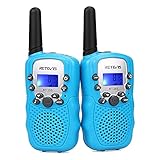 | Retevis RT388 Kids Walkie Talkies, Outdoor Toys for Kids Camping Essentials | 4-12 Year Old Boy Birthday Gift, 22 CH VOX Flashlight Clear Sound, Kids Walkie Talkies 2 Pack for Camping Hiking Adventure | Check Price On Amazon |
 | Cobra RX680 Walkie Talkies (2-Pack), IP54 Water Resistant Design | Rugged & Splashproof Two Way Radios Long Range, 60 Pre-Programmed Channels, Weather Alerts | Check Price On Amazon |
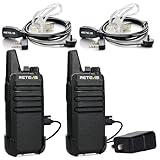 | Retevis RT22 Walkie Talkies Long Range Rechargeable with Earpiece (2 Pack) | Slim & Lightweight 2 Way Radio For Camping & Hiking, Pocket-Friendly Antenna, Ready to Use, 10-Hour Battery, USB-C Charging | Check Price On Amazon |
 | Midland GXT1000VP4 GMRS Two-Way Radios with Headsets, Black, 2 Pack | 50 Channels, 142 Privacy Codes, Up to 36 Mile Long Range, JIS4 Water Resistant, NOAA Weather Alert, Rechargeable NiMH | Check Price On Amazon |
 | Retevis RT628 Walkie Talkies for Kids,Toys Gifts for 6-12 Years Old Boys Girls,Long Range 2 Way Radio 22CH VOX,Birthday Gift,Family Walkie Talkie for Camping Hiking Indoor Outdoor | Check Price On Amazon |