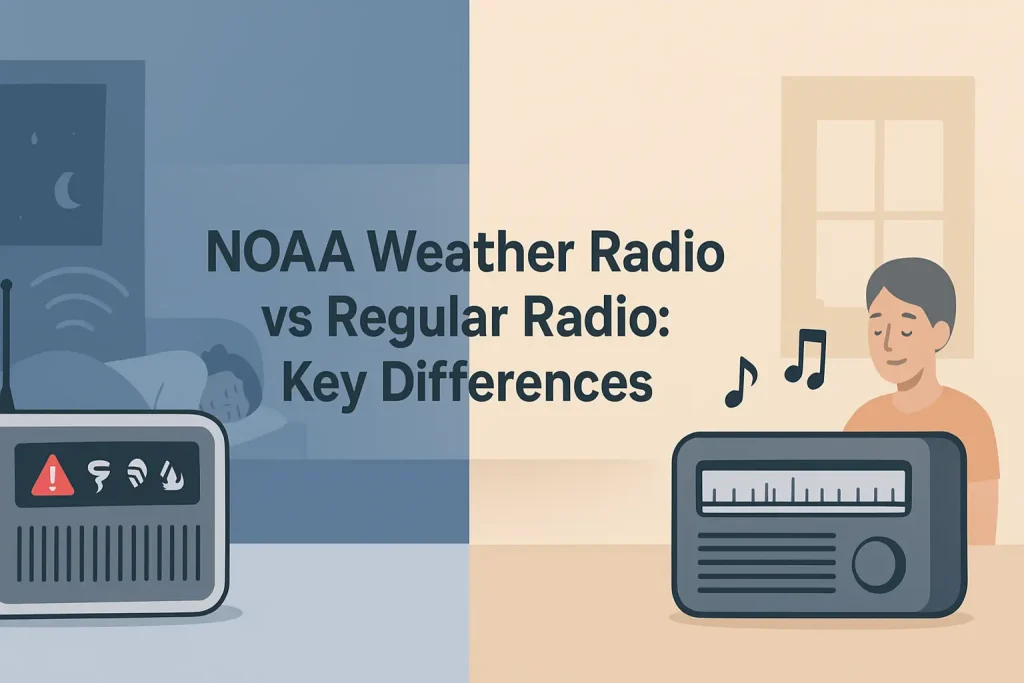
Most weather radios ship with every NOAA channel active and zero location filtering turned on. That means your radio will sound an alarm for a tornado warning 200 miles away just as loudly as it will for one heading directly toward your neighborhood. Programming your weather radio takes about 10 minutes and changes that completely.
This guide covers the complete programming process for any NOAA weather radio, including manual channel selection, S.A.M.E. (Specific Area Message Encoding) county code entry, alert type filtering, and alarm tone setup. It applies to all major brands including Midland, Uniden, Sangean, Motorola, and RadioShack models.
| Photo | Popular Portable Walkie Talkies | Price |
|---|---|---|
 | SKIWARRIOR Multifunctional Smart Wireless Ski Goggles with Walkie-Talkie, Anti-Fog Zeiss Lens, Music & Call Function (Cylindrical Blue) | Check Price On Amazon |
 | SINORISE Super Mini Walkie Talkies, Two-Way Radios, 3 Pack | Check Price On Amazon |
 | KOSPET Tank M4C Smart Watch Rugged, Dual-Band GPS, 5ATM & IP69K Waterproof | Check Price On Amazon |
 | Retevis RT15 Walkie Talkies 3 Pack, Birthday Gift, Outdoor Adventure Kit | Check Price On Amazon |
 | Rechargeable Walkie Talkies Toys for Kids: DIY Astronaut Walkie Talkies for Boys Christmas Birthday Gifts for 3 4 5 6 7 8 9 10 Boy Walkie Talkie Outdoor Hiking Toy 2 Way Radio Camping Outdoor Game | Check Price On Amazon |
What Is a NOAA Weather Radio and Why Does Programming Matter?
A NOAA weather radio is a dedicated receiver that monitors one or more of the seven NOAA Weather Radio All Hazards (NWR) broadcast frequencies between 162.400 MHz and 162.550 MHz, 24 hours a day. It is not an AM or FM broadcast radio. It receives a continuous government-operated signal transmitted by the National Weather Service from over 1,000 transmitters across the United States, Puerto Rico, and the US Virgin Islands.
Without programming, your radio alerts you to every event broadcast by your local NOAA transmitter, covering counties you do not live in, event types that do not apply to you, and alerts that trigger at 3 a.m. for situations 150 miles away. Programming solves all three problems at once.
A programmed weather radio uses S.A.M.E. technology to decode a digital header embedded in every NOAA broadcast. That header contains a 6-digit FIPS (Federal Information Processing Standards) code identifying the target county or zone, plus an event code identifying the alert type. Your radio compares those codes against the ones you programmed in. If they do not match, the alarm stays silent.
According to NOAA NWR documentation, S.A.M.E. technology was standardized across the NWR network to allow receivers to filter alerts by location and type, replacing the older tone-only system that triggered for all alerts in a broadcast area regardless of relevance. Understanding how to use a weather radio effectively starts with understanding this filtering system.
The result of proper programming is a radio that wakes you up only when your county faces a real threat, and stays quiet the rest of the time. That distinction matters most at night, when a false alarm at full volume can be as disruptive as the emergency it warns about.
Programming your weather radio is the single step that converts it from a general alarm device into a targeted early warning system for your specific location.
By the Numbers
NOAA Weather Radio Programming – Key Facts and Specifications
Sources: NOAA National Weather Service, FCC Part 11, FEMA IPAWS documentation
What Are the Seven NOAA Weather Radio Frequencies?
NOAA broadcasts on seven dedicated VHF frequencies between 162.400 MHz and 162.550 MHz. These frequencies are reserved exclusively for NWR transmissions under FCC Part 11 and are not shared with other radio services. Your radio must be tuned to the correct frequency for your area to receive alerts reliably.
Use the table below to identify the seven standard NOAA broadcast frequencies and their common channel designations.
| Channel | Frequency (MHz) | Primary Coverage Region |
|---|---|---|
| WX1 | 162.550 MHz | Widely used nationwide, most common primary frequency |
| WX2 | 162.400 MHz | Common in Midwest, Pacific Northwest, and Southeast |
| WX3 | 162.475 MHz | Used in Northeast, Texas, and Western states |
| WX4 | 162.425 MHz | Common in Southeast, Gulf Coast, and Mid-Atlantic |
| WX5 | 162.450 MHz | Used in Central US, Plains, and Mountain West |
| WX6 | 162.500 MHz | Common in Great Lakes, Pacific Coast, and Southwest |
| WX7 | 162.525 MHz | Used in Alaska, Hawaii, and supplemental coverage areas |
Most weather radios include an automatic scan function that cycles through all seven frequencies and locks onto the one with the strongest signal. Run the auto-scan before manually selecting a channel. The frequency your radio locks to is the correct one for your location.
You can verify the correct frequency for your exact address using the NOAA transmitter frequency lookup by county, which shows the primary and backup frequencies for every US county. NOAA also publishes this data at weather.gov/nwr.

Selecting the strongest available frequency for your location is the first step in programming, and it determines which transmitter your radio monitors for all alerts going forward.
What Is a S.A.M.E. Code and How Do You Find Yours?
A S.A.M.E. code (Specific Area Message Encoding) is a 6-digit FIPS location code that identifies a specific county or equivalent jurisdiction within the NOAA alert system. Every NOAA weather alert broadcast includes one or more S.A.M.E. codes identifying which counties the alert applies to. When you program your radio with your county’s S.A.M.E. code, the radio only activates its alarm when an alert targets that code.
This filtering is the core function that separates a properly programmed weather radio from an unfiltered one. Without a S.A.M.E. code entered, your radio responds to every alert broadcast by your local transmitter, which may cover 20 to 40 counties in your region.
FIPS codes follow a standard format. The first two digits are the state FIPS code. The last three digits identify the specific county within that state. A leading zero is added to make the total six digits when necessary.
For example, the S.A.M.E. code for Cook County, Illinois is 017031. The “17” identifies Illinois, and “031” identifies Cook County within Illinois. Every county in the United States has a unique 6-digit FIPS code assigned by the US Census Bureau and used by NOAA for NWR broadcasts.
To find your S.A.M.E. code, use one of these three methods:
- Visit weather.gov/nwr and use the SAME code lookup tool by state and county name
- Check the printed S.A.M.E. code list included in your radio’s manual (most manuals include a full state-by-state list)
- Call your local National Weather Service office, which can provide the correct code for your county
Most weather radios allow you to program between 1 and 5 S.A.M.E. location codes simultaneously. If you live near a county border, program both your home county and the adjacent county to avoid missing alerts that originate just outside your line.
The complete explanation of how S.A.M.E. technology works in weather radios covers the full digital encoding system, including how event codes and location codes are combined in a single broadcast header.
Entering the correct S.A.M.E. code for your county is the most important programming step and the one that eliminates unnecessary nighttime alarms from distant counties.
What Alert Types Can You Program a Weather Radio to Filter?
Most S.A.M.E.-capable weather radios allow you to filter not just by location but also by event type. NOAA uses standardized 3-letter event codes in every broadcast header. A weather radio with programmable alert filtering can be set to alarm only for certain event types, ignoring others even when they match your county’s S.A.M.E. code.
According to NOAA NWR technical documentation, the alert event code system includes over 60 distinct event types across weather, environmental, and civil emergency categories. The most common categories are listed below.
| Event Code | Alert Type | Urgency Level |
|---|---|---|
| TOR | Tornado Warning | Immediate |
| SVR | Severe Thunderstorm Warning | Immediate |
| FFW | Flash Flood Warning | Immediate |
| HUW | Hurricane Warning | Immediate |
| SVA | Severe Thunderstorm Watch | Expected |
| TOA | Tornado Watch | Expected |
| WSW | Winter Storm Warning | Urgent |
| HMW | Hazardous Materials Warning | Urgent |
| CAE | Child Abduction Emergency (AMBER Alert) | Urgent |
Budget weather radios with S.A.M.E. capability typically allow you to choose between “All Alerts,” “Warning Only,” or a custom selection. Mid-range and premium models like the Midland WR400 and Uniden BC365CRS let you select specific event codes individually, giving you precise control over which alerts trigger the alarm.
The recommended minimum configuration for most households is to enable all Warning-level events (TOR, SVR, FFW, HUW, EWW, SMW, LSW) and the Civil Emergency Message (CEM) code, while setting Watch-level events to a softer tone or display-only mode. This approach gives you immediate audible warning for life-threatening situations without waking the household for watches issued hours in advance.
Selecting the right alert types for your geographic risk profile, not just your county code, is what makes a S.A.M.E. weather radio genuinely useful rather than simply loud.
What Do You Need Before You Start Programming?
Before touching any buttons, gather three pieces of information: the correct NOAA frequency for your area, your 6-digit FIPS S.A.M.E. code, and your radio’s model-specific programming button sequence. The first two are universal across all brands. The third varies significantly between manufacturers and even between models from the same brand.
Here is what to have on hand before starting:
- Your radio’s owner’s manual (the button labels vary widely by brand)
- Your 6-digit county FIPS S.A.M.E. code from weather.gov/nwr
- The strongest NOAA frequency for your location (run auto-scan first or check the NOAA transmitter map)
- Fresh batteries or AC power (losing power mid-programming on some models resets all settings)
- A pen and paper to write down your S.A.M.E. code before entry (entering a wrong digit is a common error)
If you no longer have your manual, search for the model number followed by “owner’s manual PDF” on the manufacturer’s website. Midland, Uniden, and Sangean all provide free PDF downloads. For discontinued RadioShack models, the FCC equipment authorization database at fcc.gov/oet/ea often contains original manuals.
One important hardware note: some entry-level weather radios, including many sub-$25 models, do not have S.A.M.E. capability at all. These radios cannot be programmed for location filtering. They receive all seven NOAA frequencies and play all alerts without discrimination. Check your model’s spec sheet for “S.A.M.E.” or “SAME” before attempting location programming.
Key Specifications to check before programming:
- S.A.M.E. capable: listed as “S.A.M.E.” or “SAME” in product specs
- Number of programmable location codes: typically 1 to 5 (more is better for border counties)
- Number of programmable alert types: ranges from 3-level to 60+ individual event codes
- Memory backup: whether settings survive a battery removal
Having all three pieces of information ready before you start means the entire programming process takes under 10 minutes with no restarts.
How to Program a Weather Radio: Universal Step-by-Step Process
The programming sequence below applies to the vast majority of S.A.M.E.-capable weather radios from Midland, Uniden, Sangean, Motorola, Cobra, and RadioShack. Brand-specific button names are noted where they differ. Refer to the brand-specific sections below if the universal steps do not match your model’s menu structure exactly.
The following step-by-step guide covers the complete programming process from initial channel selection through S.A.M.E. code entry and alert type selection.
Step-by-Step Guide
How to Program Any S.A.M.E. Weather Radio – Complete Process
8 steps – Estimated time: 10 minutes
Power on the radio and run the automatic channel scan
Press the “Scan” or “Auto Scan” button. The radio cycles through all seven NOAA frequencies (162.400 to 162.550 MHz) and locks onto the strongest signal in your area. Note which channel number (WX1 through WX7) it selects.
Confirm you can hear the NOAA broadcast clearly
You should hear a continuous spoken weather broadcast or a repeating tone. If you hear static or silence, the radio has not locked onto a strong signal. Move it to a window, extend the antenna fully, or try manually selecting a different WX channel.
Enter the S.A.M.E. programming mode
Press the button labeled “Program,” “S.A.M.E.,” “Menu,” or “Setup” depending on your model. On Midland radios this is typically the “Prog” button. On Uniden models it is usually labeled “Menu.” Hold the button for 2-3 seconds if a single press does not activate programming mode.
Select “S.A.M.E.” or “Location” from the programming menu
Use the up/down arrow buttons or channel knob to navigate to the S.A.M.E. or Location entry screen. On radios with a numeric display, the screen will typically show “0000000” or blank dashes waiting for input. Press “Enter” or “Set” to begin digit entry.
Enter your 6-digit FIPS S.A.M.E. code using the numeric keypad or arrow buttons
Type each digit in sequence. On radios without a numeric keypad, use the up/down arrows to scroll each digit from 0-9, then press “Enter” or the channel button to advance to the next digit. Enter all six digits including any leading zero. Double-check the display before confirming.
Confirm and save the S.A.M.E. code
Press “Enter,” “Set,” or “Program” to save the code to memory location 1. If your radio supports multiple location codes (most allow 1 to 5), repeat steps 4 and 5 for each additional county you want to monitor. Each county gets its own memory slot.
Configure alert type filtering (if your model supports it)
Navigate to the “Alert Type,” “Event,” or “Hazards” menu. Select which event types trigger the alarm. At minimum, enable Tornado Warning (TOR), Severe Thunderstorm Warning (SVR), Flash Flood Warning (FFW), and Civil Emergency Message (CEM). Disable or soften Watch-level alerts if nighttime interruptions are a concern.
Test the programming using the manual test function
Press the “Test” or “Alert Test” button on your radio. This triggers a simulated alert using your programmed S.A.M.E. code and alert settings. If the alarm sounds, programming is confirmed. If nothing happens, check that the radio is in “Alert” or “Standby” mode, not “Monitor” mode.
After completing all eight steps, your radio is fully programmed and will alarm only when NOAA broadcasts an alert that matches both your county S.A.M.E. code and your selected event types.
How Do You Program a Midland Weather Radio?
Midland weather radios, including the WR120B, WR400, WR300, and WR120EZ, use a consistent programming interface across most models in the lineup. The “Prog” button enters programming mode, the up and down arrow buttons navigate menus and scroll digits, and the “Enter” button confirms each selection.
The Midland WR120B is one of the most widely owned S.A.M.E. weather radios in the United States. You can read the detailed Midland WR120B full review covering alert performance and programming walkthrough for a model-specific guide.
Key Specifications (Midland WR120B):
- Frequencies: 162.400 to 162.550 MHz (all 7 NOAA channels)
- S.A.M.E. location codes: up to 25 programmable
- Alert types: 25 selectable NOAA event categories
- Power: AC adapter with 3x AA battery backup
- Display: backlit LCD with channel, S.A.M.E. status, and alert type indicator
Programming sequence for Midland WR120B and WR400:
- Press and hold the “Prog” button for 3 seconds until the display flashes
- Use the up/down arrows to select “SAME Location” and press “Enter”
- Select memory location 1 (or 2 through 25 for additional counties) and press “Enter”
- Use the up/down arrows to scroll the first digit of your S.A.M.E. code, press “Enter” to advance
- Repeat for all six digits
- Press “Prog” again to exit location entry and advance to alert type selection
- Use arrows to enable or disable each event type, pressing “Enter” after each selection
- Press “Prog” a final time to save all settings and return to standby mode
On the WR120B, if the display shows “ALL” next to the S.A.M.E. indicator, the radio has not been programmed with a location code yet and will alarm for all counties in the broadcast area. The indicator should show your 6-digit code or an abbreviated county name after successful programming.
Midland’s programming sequence is the most beginner-friendly of any major weather radio brand because the display walks you through each step with text prompts rather than icon-only navigation.
How Do You Program a Uniden Weather Radio?
Uniden weather radios, including the BC365CRS, BC75XLT with weather receive, and the HomePatrol series with NWR monitoring, use a “Menu” button to enter programming mode. Navigation uses the up/down or left/right arrow buttons, and “Enter” or the tuning knob confirms selections.
The Uniden BC365CRS is a combination AM/FM/weather radio that includes S.A.M.E. programming. Its programming interface differs slightly from dedicated weather-only radios because the menu system also controls AM/FM functions.
Key Specifications (Uniden BC365CRS):
- Frequencies: 162.400 to 162.550 MHz (7 NOAA channels) plus AM 520-1710 kHz and FM 87.5-108 MHz
- S.A.M.E. location codes: up to 7 programmable
- Alert memory: stores last 10 alert messages with time and date stamp
- Power: AC adapter with 6x AA battery backup
- Display: large LCD with alert history review function
Programming sequence for Uniden BC365CRS:
- Switch the radio to WX mode using the “WX” or “Weather” button
- Press “Menu” to enter the settings menu
- Navigate to “S.A.M.E.” using the up/down arrows and press “Enter”
- Select “Edit” or “Program” and choose memory location 1
- Use the numeric keypad (if present) or arrow buttons to enter each digit of your 6-digit FIPS code
- Press “Enter” after the sixth digit to save
- Navigate to “Alert Type” in the menu to configure event filtering
- Press “Menu” or “Exit” to return to standby monitoring mode
One Uniden-specific issue: several BC365CRS units reset their S.A.M.E. programming if the battery backup is removed and AC power is simultaneously interrupted. After replacing batteries or restoring power after an outage, verify the S.A.M.E. code is still active before the next potential storm season.
Checking your Uniden’s programmed settings after any power interruption takes 30 seconds and prevents the frustrating discovery that the radio lost its county filter at exactly the wrong moment.
How Do You Program a Sangean Weather Radio?
Sangean weather radios, particularly the CL-100 and MMR-88 models, use a rotary dial combined with dedicated function buttons for programming. The CL-100 is unusual in that it uses a physical location selector dial rather than a fully digital menu, which makes it faster to set up but limits flexibility for households near multiple county borders.
The Sangean CL-100 supports S.A.M.E. county programming with alert type selection and is popular for its clear audio output and large speaker.
Key Specifications (Sangean CL-100):
- Frequencies: 162.400 to 162.550 MHz (7 NOAA channels)
- S.A.M.E. location codes: up to 5 programmable counties
- Alert volume: adjustable from whisper to 90 dB alarm mode
- Power: AC adapter with 4x AA or rechargeable NiMH battery backup
- Additional features: AM/FM reception, backlit display, headphone jack
Programming sequence for Sangean CL-100:
- Press and hold the “S.A.M.E.” button until the display enters edit mode (approximately 3 seconds)
- Press “S.A.M.E.” again to select memory position 1
- Use the “+” and “-” buttons to scroll to the first digit of your FIPS code, press “S.A.M.E.” to advance
- Repeat for all six digits
- After the sixth digit is confirmed, the radio automatically saves and returns to the county list display
- To configure alert types, press “Alert” and use the “+” and “-” buttons to step through event categories, pressing “Alert” to toggle each one on or off
- Press and hold “Alert” for 2 seconds to exit alert type programming and return to standby
The Sangean CL-100 displays a brief county name abbreviation on screen after successful programming, giving you a quick visual confirmation without needing to re-enter the programming mode to verify the code.
How Do You Program a Hand-Crank or Portable Emergency Weather Radio?
Hand-crank and solar-powered emergency radios, including models from Kaito, RunningSnail, FosPower, and Midland’s ER series, vary significantly in their S.A.M.E. capability. Many emergency hand-crank radios do not include S.A.M.E. filtering at all. They receive all seven NOAA frequencies but cannot be programmed for county-specific alerting.
Before attempting to program a hand-crank radio, check the product description or manual for the words “S.A.M.E.” If that term does not appear, the radio is a receive-only weather monitor, not a programmable alert radio. It will play all broadcasts from your local NOAA transmitter but cannot be filtered.
For hand-crank radios that do include S.A.M.E. (such as the Midland ER310 emergency crank radio), the programming process is identical to the standard Midland sequence described above. The physical crank and solar panel are power backup features only and do not affect the programming interface.
Key Specifications (Midland ER310):
- Frequencies: 162.400 to 162.550 MHz (7 NOAA channels)
- S.A.M.E.: yes, up to 25 county codes
- Power options: hand crank, solar panel, 3x AA batteries, USB-C input
- Additional features: AM/FM, USB phone charging output, LED flashlight, SOS beacon
- Battery backup runtime: approximately 8 hours on AA batteries at medium volume
If your emergency radio lacks S.A.M.E. capability, it can still serve as a reliable weather monitor. Place it near a window with the antenna extended and set it to the strongest NOAA channel. It will broadcast all alerts from your regional transmitter without filtering. This is better than no coverage, but less precise than a programmed S.A.M.E. unit.
For serious emergency preparedness purposes, a dedicated S.A.M.E.-capable radio like the Midland WR400 with S.A.M.E. alert filtering provides more reliable nighttime alerting than a general-purpose emergency crank radio without S.A.M.E. decoding hardware.
The distinction between a weather-receive radio and a S.A.M.E.-programmable alert radio is the most important specification to check before purchasing any emergency weather radio.
How to Program a Weather Radio for Multiple Locations
Most S.A.M.E.-capable weather radios support between 1 and 25 programmable location codes simultaneously. Programming multiple locations is useful when you live near a county border, travel frequently between locations, or want to monitor alerts for a relative’s county in addition to your own.
The process for adding a second or third S.A.M.E. location code is identical to adding the first. After saving the first county code to memory slot 1, return to the S.A.M.E. programming menu, select memory slot 2, and enter the second 6-digit FIPS code. The radio monitors all programmed codes equally and alarms when any broadcast matches any stored code.
There is one important caveat: adding more location codes increases the chance of receiving alerts for events in neighboring counties that do not directly affect your immediate area. A useful strategy is to program your home county in slot 1 and adjacent counties only if you live within 5 miles of a county line or have family members in those areas.
For families with multiple households across different states, some premium weather radios like the Uniden Bearcat series weather radios allow up to 7 simultaneous location codes, making them suitable for monitoring multiple family addresses from a single base-station unit.
The recommended approach for most single-household users is to program the home county code in slot 1 and leave all other memory slots empty, then add adjacent county codes only after confirming the radio responds correctly to the primary location code first.
How Do You Test a Weather Radio After Programming?
Testing confirms that your S.A.M.E. programming is active and that the alarm will function during an actual event. There are two ways to test a weather radio: using the built-in manual test function and waiting for an official NOAA weekly test broadcast.
The built-in manual test on most radios is triggered by pressing the “Test” or “Alert Test” button. This simulates a received S.A.M.E. alert using the currently programmed codes and alert types. If the alarm sounds, the programming is confirmed. If no alarm occurs, check three things:
- The radio must be in “Alert” or “Standby” mode, not “Monitor” (monitor mode plays audio continuously but disables the alarm function on many models)
- The alert volume must be set above zero (some radios have a separate alert volume independent of the main speaker volume)
- The S.A.M.E. code entry must be confirmed (return to the programming menu and verify the 6-digit code is displayed in memory slot 1)
The second testing method is the official NOAA weekly test broadcast. NOAA transmits a required weekly test on all NWR frequencies, typically on Wednesday mornings between 11 a.m. and noon local time, though the exact time varies by transmitter site. This test uses the standard S.A.M.E. header with event code “RWT” (Required Weekly Test) and targets all counties served by that transmitter.
If your radio is programmed correctly and the alert type RWT is enabled, the radio will alarm during this weekly test. If your radio does not respond to the Wednesday test, verify that RWT is included in your enabled alert types, as some radios default to disabling test broadcasts to prevent unnecessary weekly interruptions.
NOAA also transmits a Required Monthly Test (RMT) with event code “RMT” on the first Wednesday of each month. Both tests use real S.A.M.E. headers and are the most reliable way to confirm your programming is active and responding correctly.
Running both the manual test and confirming the weekly NOAA test response gives you two independent verifications that the radio will function when a real alert occurs.
Why Is Your Weather Radio Not Receiving Alerts? Common Programming Problems
If a properly programmed weather radio fails to alarm during a known event in your county, the problem is almost always one of four things: a wrong NOAA frequency, an incorrect S.A.M.E. code digit, an alert type that is disabled, or the radio being in monitor mode instead of alert mode.
Here are the most common programming failures and their specific fixes:
Wrong NOAA Channel Selected
If your radio is locked to a frequency that does not serve your county, it will not receive the correct S.A.M.E. broadcasts even if the location code and alert types are programmed correctly. This happens because different NOAA transmitters serve different geographic areas, and a transmitter on an adjacent frequency may not include your county in its broadcast coverage.
Fix: Run the auto-scan function again while standing near a window with the antenna fully extended. The radio should lock to the frequency with the strongest signal in your location. Confirm this frequency matches the one listed for your county at weather.gov/nwr.
Incorrect Digit in the S.A.M.E. Code
A single transposed digit in your 6-digit FIPS code causes the radio to filter for the wrong county entirely. The radio appears to be programmed and the display shows a code, but it will never alarm for your actual county because the stored code does not match any broadcast header targeting your area.
Fix: Return to the S.A.M.E. programming menu and read the stored code digit by digit against the verified FIPS code from weather.gov/nwr. If any digit is wrong, delete the entry and re-enter the full 6-digit code from scratch. Do not attempt to correct a single digit mid-entry on most models, as the digit-entry sequence resets.
Alert Type Is Disabled
If a specific event type such as Tornado Warning (TOR) is disabled in your alert type settings, the radio will not alarm for that event even when the location code matches your county perfectly. This is a frequent cause of missed nighttime tornado warnings on radios where the user disabled all Watch and Warning alerts to reduce false alarms.
Fix: Navigate to the alert type menu and confirm that TOR, SVR, FFW, and CEM are all enabled. Re-enable any critical Warning-level events that were previously turned off.
Radio Is in Monitor Mode Instead of Alert Mode
Many weather radios have two operational modes: Monitor (plays NOAA audio continuously like a broadcast radio) and Alert (stays silent and only activates for matching S.A.M.E. alerts). In Monitor mode, the alarm function is disabled on most models.
Fix: Check the mode indicator on the display. Look for “ALT,” “Alert,” or a bell icon indicating the radio is in alert standby. If the display shows “MON” or “Monitor,” press the mode or alert button to switch to alert standby mode.
Low or Dead Battery Backup Disabling Alert Function
Several Midland and Uniden models disable the audible alarm function when the battery backup drops below a threshold voltage, even when running on AC power. This prevents an alert from sounding at reduced volume if AC power fails during an event. The symptom is that the radio plays NOAA audio normally but the alarm does not trigger on test.
Fix: Replace the battery backup cells. For guidance on identifying the correct replacement batteries and checking battery status on specific models, the step-by-step guide to weather radio battery replacement and backup power covers the process for all major brands.
Verifying all four of these factors after initial programming takes less than five minutes and eliminates the most common causes of alert failure before the next storm season.
How to Program a Weather Radio Without a Manual
If you have lost the owner’s manual for your weather radio, you can still program it using one of four sources. Most manuals are available free online, and the programming sequences for the most common models are well-documented by the radio community.
Here are the best resources for finding programming instructions without the original manual:
- Manufacturer website: Midland, Uniden, and Sangean all host downloadable PDF manuals at their official sites. Search by model number on midlandusa.com, uniden.com, or sangean.com.
- FCC equipment authorization database: Search fcc.gov/oet/ea by the FCC ID printed on the bottom of your radio. This database contains original manuals for nearly every FCC-authorized radio sold in the United States, including discontinued models.
- ManualsLib.com: A community-maintained library with uploaded scans of original manuals for thousands of consumer electronics including weather radios.
- YouTube model-specific tutorials: Search your exact model number plus “programming” on YouTube. For popular models like the Midland WR120B and Uniden BC365CRS, multiple verified walkthroughs exist.
If you cannot find documentation for your specific model, the universal programming sequence in the step-by-step section above will work for most S.A.M.E.-capable radios. The key variation between brands is the name of the button that enters programming mode (Prog, Menu, Setup, or S.A.M.E.) and whether digit entry uses a numeric keypad or arrow scrolling.
Systematically trying each button labeled “Program,” “Menu,” “Set,” or “S.A.M.E.” while monitoring the display for a mode change is an effective approach when the manual is unavailable and online sources are exhausted.
What Is the Difference Between S.A.M.E. and Non-S.A.M.E. Weather Radios?
A non-S.A.M.E. weather radio receives all NOAA broadcasts on one or more WX frequencies and activates its alarm for every single alert transmitted by the local NOAA station, regardless of county or event type. A S.A.M.E.-capable radio decodes the digital header embedded in each broadcast and compares it against your programmed county code and event types before deciding whether to sound the alarm.
Use the table below to compare the capabilities of S.A.M.E. and non-S.A.M.E. weather radios across the decisions that matter most for home use.
| Feature | Non-S.A.M.E. Radio | S.A.M.E.-Capable Radio |
|---|---|---|
| County location filtering | No | Yes (6-digit FIPS code) |
| Alert type filtering | No | Yes (25 to 60+ event codes) |
| False alarms from distant counties | Frequent | Eliminated with correct code |
| Nighttime alarm reliability | Unreliable (alarm fatigue) | High (only local threats alarm) |
| Typical price range | $10 to $25 | $25 to $80 |
| Programming required | None | 10 minutes initial setup |
| Best for | Camping, travel, secondary backup | Home, bedroom, primary alert |
The practical impact of this difference is most significant at night. A non-S.A.M.E. radio in a border state can alarm 10 to 20 times per night during active storm seasons because NOAA transmitters often cover regions spanning multiple state lines. A S.A.M.E.-programmed radio in the same location will alarm only when the specific threat reaches the programmed county.
For a deeper look at what NOAA weather radio is and how the NWR broadcast network operates, the complete guide to NOAA weather radio and how the alert system works explains the full infrastructure behind every broadcast your radio receives.
For home use, S.A.M.E. capability is not optional: it is the single feature that determines whether your weather radio is a reliable early warning system or a noise machine that trains your household to ignore it.
The following widget shows common weather radio programming scenarios based on your location type and how you plan to use the radio. It will help you decide between basic receive-only and S.A.M.E.-programmable models based on your actual alert needs.
Interactive Tool
Weather Radio Programming Setup Finder
Answer 2 questions to get a tailored programming recommendation for your specific situation.
Quick Reference: Key Weather Radio Programming Terms
Weather Radio Programming Glossary
S.A.M.E. (Specific Area Message Encoding): A digital filtering system embedded in NOAA broadcasts that allows a weather radio to alarm only for alerts matching your programmed county and event type codes.
FIPS Code: A 6-digit Federal Information Processing Standards code that identifies a specific county or equivalent jurisdiction. The first two digits identify the state, and the last three identify the county within that state.
NWR (NOAA Weather Radio All Hazards): The government-operated network of over 1,000 VHF transmitters broadcasting continuous weather and emergency alerts on seven dedicated frequencies between 162.400 and 162.550 MHz.
WX Channel: The channel designation (WX1 through WX7) used by weather radios to identify each of the seven NOAA broadcast frequencies. WX1 corresponds to 162.550 MHz.
Event Code: A 3-letter code embedded in each NOAA S.A.M.E. broadcast header identifying the type of alert. Examples include TOR (Tornado Warning), SVR (Severe Thunderstorm Warning), and FFW (Flash Flood Warning).
Alert Mode: The operating state in which a weather radio stays silent and only activates its alarm when a matching S.A.M.E. broadcast is received. Distinct from Monitor Mode.
Monitor Mode: An operating state in which the weather radio plays NOAA audio continuously like a broadcast radio. The alarm function is typically disabled in this mode.
Required Weekly Test (RWT): A mandatory NOAA test broadcast transmitted on all NWR frequencies, typically on Wednesday mornings, using a standard S.A.M.E. header. A properly programmed radio will alarm for RWT if that event code is enabled.
EAS (Emergency Alert System): The national public warning system that distributes alerts via broadcast television, radio, cable, and the NOAA weather radio network. NWR is one of the primary EAS distribution channels.
Battery Backup: The secondary power source (typically AA or AAA alkaline or NiMH batteries) that keeps a weather radio powered during AC power outages. Essential for nighttime storm alerts when power often fails before or during the event.
Squelch: A circuit that mutes the radio speaker when no signal is being received. On weather radios, the squelch opens only when a valid NOAA signal is present, eliminating static noise between broadcasts.
How Often Should You Re-Program or Verify Your Weather Radio Settings?
A properly programmed weather radio does not require regular reprogramming if it is installed in a fixed location and the batteries are maintained. The S.A.M.E. county code and alert type settings are stored in non-volatile memory on most models and survive normal power cycling. However, certain events can cause settings to reset or become unreliable.
Check and verify your weather radio programming in these situations:
- After any extended power outage lasting more than 4 hours (some models lose settings if both AC and battery backup are depleted simultaneously)
- After replacing the battery backup cells (some Uniden models reset settings when batteries are removed)
- At the start of each severe weather season in your region (spring tornado season, June 1 hurricane season, November winter storm season)
- After moving to a new home or relocating the radio to a different county
- After any firmware or software update, if your radio has update capability
The fastest verification method is the Wednesday NOAA weekly test. If your radio alarms on Wednesday morning, the programming is confirmed active. If it does not alarm, enter the programming menu and verify the county code and alert type settings before the next storm event.
For detailed guidance on keeping your weather radio battery backup in working condition year-round, the complete guide to weather radio battery maintenance and replacement schedules covers replacement intervals for AA, AAA, and rechargeable NiMH backup cells across all major brands.
An annual programming check at the start of your region’s primary severe weather season is the minimum maintenance standard for any S.A.M.E. weather radio used as a primary home alert device.
Can You Program a Weather Radio to Receive Alerts for Multiple States?
Yes, if your weather radio supports multiple S.A.M.E. location codes, you can program county FIPS codes from any state in the country, not just the state where the radio is located. The radio does not validate codes geographically. It stores any valid 6-digit FIPS code and alarms when a broadcast matches that code, regardless of the state the code belongs to.
This capability is useful in three specific situations: when you live near a state line and want alerts for counties just across the border, when you have a second home or vacation property in another state, or when a family member in another state relies on your radio for remote monitoring.
The practical limitation is signal range. NOAA transmitters cover approximately 40 miles under normal conditions. Your radio can only receive broadcasts from transmitters within range of its physical location. Programming a county code for a location 500 miles away will store the code successfully but the radio will never receive the matching broadcast because the transmitter covering that county is too far away.
For multi-state coverage, the solution is one radio per location, each programmed with the local FIPS code. A single radio cannot physically receive NOAA transmissions from distant states regardless of how many location codes are programmed.
Programming codes for nearby state-border counties works reliably because the same NOAA transmitter often covers areas on both sides of a state line, and the broadcasts include FIPS codes for all counties within the transmitter’s coverage area regardless of state boundaries.
How to Use a Weather Radio After It Is Programmed
Once programmed, a S.A.M.E. weather radio requires almost no day-to-day interaction. Leave it in Alert or Standby mode with the volume set at an audible level for your home’s sleeping area. The radio monitors NOAA broadcasts continuously and wakes only when an alert matches your programmed county code and enabled event types.
For complete guidance on day-to-day weather radio operation, interpreting alert tones, understanding the message format, and responding to different alert levels, the complete guide to using a weather radio effectively during emergencies covers everything from initial alert response to the difference between Warnings, Watches, and Advisories.
The three things to do after each alert the radio receives:
- Press the “Alert Silence” or “Stop” button to stop the alarm tone while leaving the radio in alert standby for subsequent alerts
- Listen to the spoken broadcast that follows the tone, which contains the specific event type, the counties affected, the duration, and any recommended actions
- Do not press “Reset” or return to Monitor mode during an active event, as doing so may prevent the radio from alarming for follow-up bulletins or event upgrades
One programming-related behavior worth knowing: on some Midland and Uniden models, pressing the silence button during the initial alert tone will confirm the alert in the display memory but silence the audible alarm. This is the correct way to acknowledge an alert without disabling future alerts during the same event period.
After the alert event expires (NOAA broadcasts a cancellation or the event duration passes), your radio automatically returns to its programmed alert standby state and resumes monitoring for the next broadcast.
Is Your Weather Radio Actually Receiving NOAA Broadcasts? How to Check Signal Quality
A weather radio that is not receiving a strong NOAA signal will still appear to function normally in standby mode. The display may show an active channel and alert settings, but the radio cannot respond to alerts it is not receiving. Poor signal quality is the most common invisible problem with weather radios placed in basements, interior rooms, or metal-frame buildings.
Here is how to verify your radio is actually receiving the NOAA broadcast:
- Switch the radio to Monitor mode temporarily. You should hear a continuous NOAA spoken weather broadcast or a repeating tone with no static.
- If you hear heavy static, move the radio to a window and extend the antenna to full length. The 162 MHz VHF signals from NOAA transmitters are line-of-sight and do not penetrate concrete, metal framing, or below-grade walls effectively.
- Try the other WX channels manually. If WX1 (162.550 MHz) is staticky, WX3 (162.475 MHz) or WX4 (162.425 MHz) may be served by a different transmitter with better coverage to your specific location.
- Check the NOAA transmitter coverage map at weather.gov/nwr to confirm your address falls within the service area of the transmitter on your selected frequency. Some addresses near the edge of a coverage area may receive marginal signal at ground level.
If signal quality remains poor regardless of antenna position, an external antenna is the most effective solution. An outdoor-mounted VHF antenna tuned for 162 MHz can be connected to many desktop weather radios using a standard BNC or SMA adapter, and improves reception dramatically in fringe coverage areas.
A radio that cannot receive a clear NOAA signal cannot alert you, regardless of how precisely the S.A.M.E. codes are programmed. Verifying signal quality is as important as verifying programming.
Can You Program a Combination Scanner Radio to Monitor NOAA Weather Channels?
Yes. Many handheld and desktop scanner radios, including models from Uniden (BC125AT, SDS100) and Whistler (WS1010, WS1040), include dedicated NOAA weather channel monitoring alongside their scanner functions. These radios can be programmed to receive all seven NOAA frequencies and, on models with S.A.M.E. decoding capability, to alarm for county-specific events.
The Uniden BC125AT handheld scanner receives all seven NOAA weather frequencies in WX monitor mode. It does not include S.A.M.E. decoding, so it functions as a receive-only weather monitor rather than a programmable alert radio. For S.A.M.E. capability in a scanner platform, the Uniden SDS100 digital scanner includes full NWR S.A.M.E. decoding with county filtering.
Programming weather channels on a scanner radio follows the same principles as programming a dedicated weather radio, but the menu navigation is typically more complex. Consult the scanner-specific manual for the WX alert setup sequence, as scanner radios use different menu paths than dedicated weather radios for S.A.M.E. configuration.
For most home and emergency preparedness applications, a dedicated weather radio provides more reliable alerting than a scanner with weather receive capability because the dedicated radio’s single-purpose design means the alert function is never competing with scanner functions for the processor or alarm output.
Does Programming Differ Between Digital and Analog Weather Radios?
The S.A.M.E. programming process is identical between digital-display and analog-dial weather radios. S.A.M.E. decoding is a function of the radio’s receiver chip and firmware, not its display type. A weather radio with a digital LCD display and one with a traditional analog dial use the same county FIPS code entry method if both have S.A.M.E. capability.
The practical difference is in the programming interface. Digital-display radios show each digit of the FIPS code on screen as you enter it, allowing you to verify accuracy before saving. Analog-dial radios with S.A.M.E. capability (which are increasingly rare) typically use a secondary digital display panel just for the S.A.M.E. programming interface while the main display remains analog for channel and volume indication.
All S.A.M.E.-capable weather radios sold in the United States after the NOAA S.A.M.E. standard was fully implemented use the same 6-digit FIPS code system with the same event code library. Programming is consistent across all brands and display types because the underlying NOAA broadcast standard is universal.
The brand-to-brand variation is entirely in the button sequence used to enter programming mode, not in the codes themselves. Once you know your county FIPS code and the entry button for your specific model, the programming steps are the same regardless of whether the radio cost $25 or $80.
What Should You Do If the Weather Radio Alarms While You Are Sleeping?
When a weather radio sounds its alarm at night, the first action is to silence the alarm tone while keeping the radio in alert standby mode. Use the “Silence” or “Alert Off” button rather than “Reset” or “Power Off.” This stops the audible alarm but leaves the radio active to receive follow-up alerts if the event escalates or extends.
After silencing the alarm, listen to the spoken NOAA broadcast. The message will identify the specific event type (Tornado Warning, Severe Thunderstorm Warning, etc.), the affected counties, the expected duration, and recommended protective actions. For a Tornado Warning, the standard NWS recommended action is to move to an interior room on the lowest floor of a sturdy building immediately.
Do not go back to sleep after a Tornado Warning. A Tornado Watch can be monitored from bed, but a Warning means a tornado has been detected or spotted and protective action is needed now.
After the event ends (NOAA broadcasts a cancellation or the programmed event duration expires), the radio returns automatically to alert standby. No reprogramming is required after an alert event.
Frequently Asked Questions About Programming a Weather Radio
Can I program my weather radio without knowing my exact county S.A.M.E. code?
You can use your radio’s auto-scan function to lock onto the strongest NOAA frequency, but you still need the 6-digit FIPS code to activate county filtering. Without the code, the radio will alarm for all counties in the broadcast area. Find your code at weather.gov/nwr by entering your state and county name.
The NOAA S.A.M.E. code lookup tool at weather.gov/nwr is free and takes under 30 seconds to use. Your radio’s manual also contains a full state-by-state FIPS code list printed in the back. If neither source is available, search your state name plus “county FIPS codes” for a complete list from the US Census Bureau.
What happens if I enter the wrong S.A.M.E. code?
If you enter a wrong digit in your county FIPS code, your radio stores an incorrect location code and will never alarm for events targeting your actual county. The radio will not show an error because any valid 6-digit number is accepted as a code. It may alarm for a completely different county if the incorrect code happens to match a real FIPS code elsewhere in the country.
The only way to detect this error is to check whether your radio alarms during the Wednesday NOAA required weekly test. If your location is served by the NOAA transmitter you are receiving, the RWT broadcast will include your county’s FIPS code. If the radio does not alarm on Wednesday, return to the S.A.M.E. menu and verify each digit of your stored code against the verified FIPS from weather.gov/nwr.
Do I need to reprogram my weather radio if I move to a new home in the same county?
No reprogramming of the county S.A.M.E. code is necessary if you move within the same county, since the FIPS code identifies the county, not your street address. You may need to run the auto-scan function again to confirm the radio is still receiving the strongest available NOAA frequency at the new address, particularly if the new home has a different orientation, construction type, or proximity to obstructions.
If you move to a different county, update the FIPS code in memory slot 1 to the new county’s code before the radio’s first night in the new home. An incorrectly programmed weather radio will not alarm for your new location’s events, even if it alarms correctly for the old county code.
What is the difference between a Tornado Warning and a Tornado Watch on a weather radio?
A Tornado Warning (event code TOR) means a tornado has been confirmed by radar or a spotter and is occurring or imminent in the specified area. Protective action is required immediately. A Tornado Watch (event code TOA) means atmospheric conditions are favorable for tornado development, but no tornado has been detected yet. A watch is an advance advisory to stay alert and be ready to act.
For programming purposes, Tornado Warnings should always be enabled at full alarm volume. Tornado Watches can be set to a softer alert tone or display-only notification if nighttime alarm fatigue is a concern. Never disable the TOR event code. It is the highest-urgency alert in the NOAA event code library.
Why does my weather radio alarm for counties I did not program?
If your weather radio alarms for events outside your programmed county, one of two things is happening. Either the S.A.M.E. programming was not saved correctly and the radio is in unfiltered mode (alarming for all broadcasts), or you programmed multiple location codes in memory slots 2 through 5 and forgot about them. Enter the S.A.M.E. programming menu and check all memory slots. Delete any unintended codes from secondary memory positions.
On some budget S.A.M.E. radios, a programming entry that times out without being confirmed is ignored and the radio defaults to “all locations” mode. If your radio does not display a FIPS code in the S.A.M.E. status indicator, the programming did not save. Re-enter the code, confirm each digit carefully, and press “Enter” or “Set” firmly after the sixth digit to force the save before the menu times out.
Can I use a weather radio to receive AMBER Alerts?
Yes. AMBER Alerts are broadcast over the NOAA weather radio network using the event code CAE (Child Abduction Emergency). If CAE is enabled in your alert type settings, your weather radio will alarm for AMBER Alerts targeting your programmed county. Many weather radios enable CAE by default, but it is worth verifying this is active in your alert type configuration, particularly on older models that may have a limited default event type list.
NOAA also broadcasts Civil Emergency Messages (CEM) for non-weather emergencies including industrial accidents, hazardous materials releases, and public safety events. Enabling CEM alongside weather event codes gives your radio comprehensive all-hazards alert capability beyond weather alone.
How do I know which NOAA frequency serves my exact address?
The NOAA Weather Radio transmitter coverage map at weather.gov/nwr shows transmitter locations, coverage areas, and primary frequencies for every location in the United States. Enter your state and county to see the primary and backup frequencies, the transmitter name and location, and whether your address falls within the primary or fringe coverage zone.
The auto-scan function on your radio is the most practical method. It selects the frequency with the strongest received signal at your physical location, accounting for your home’s construction, the antenna position, and local terrain. The frequency the auto-scan selects is the correct one to use, even if it differs from the primary frequency listed in the NOAA coverage data for your county.
Can I program a weather radio to only alarm for the most severe events and ignore everything else?
Yes. Most S.A.M.E.-capable weather radios allow you to select specific event types to enable or disable independently. To alarm only for life-threatening events, enable only Warning-level codes: TOR (Tornado Warning), SVR (Severe Thunderstorm Warning), FFW (Flash Flood Warning), HUW (Hurricane Warning), EWW (Extreme Wind Warning), and CEM (Civil Emergency Message). Disable all Watch-level codes (TOA, SVA, HUA) and all Advisory-level codes.
This configuration eliminates the majority of nighttime alerts that wake households for non-immediate threats while preserving response to the events that require immediate action. The trade-off is that you will not receive advance notice through Watch-level alerts, which typically precede Warning-level events by 1 to 6 hours. For households with children or elderly members who need maximum advance notice, enabling Watch alerts at a reduced volume is a better compromise than disabling them entirely.
My weather radio shows “ALERT” but no alarm sounded. What happened?
If the display shows “ALERT” or a stored alert message but no audible alarm occurred, the alert volume is likely set to zero or the radio was in Monitor mode when the alert was received. Check the alert volume setting independently from the main speaker volume. On many Midland and Uniden models, these are separate controls and the alert volume can be at zero while the broadcast audio plays normally.
The second possibility is that the alert was received while the radio was in Monitor mode, which typically stores the alert in memory but does not trigger the audible alarm. Switch the radio to Alert or Standby mode and verify the alert volume is at a detectable level before the next event.
Is there a difference between programming a desktop weather radio and a portable one?
The S.A.M.E. programming process is identical between desktop and portable weather radios from the same manufacturer. The FIPS county code, event type selection, and frequency scan all work the same way regardless of form factor. The differences between desktop and portable models are in the power source (AC plus battery backup vs battery or crank only), speaker size and volume, and display size, none of which affect the programming sequence.
One practical consideration: portable radios running on batteries may time out of programming mode faster if the battery level is low, causing the entry to be abandoned before saving. Always program a portable weather radio with fresh batteries or while connected to USB power to avoid timeout interruptions mid-entry.
Does programming a weather radio affect its ability to receive regular NOAA weather broadcasts?
No. Programming a weather radio with S.A.M.E. codes and alert type settings only affects the alarm trigger conditions. It does not affect the radio’s ability to receive and play the continuous NOAA weather broadcast in Monitor mode. You can switch between Monitor mode (listen to live weather broadcasts at any time) and Alert mode (silent standby with alarm on matching events) at any time without affecting the stored programming.
The S.A.M.E. programming operates as a filter on the alarm function only. The underlying receive capability covering all seven NOAA frequencies between 162.400 and 162.550 MHz remains unchanged by any programming you apply.
What is the best weather radio for programming ease for elderly users?
The Midland WR120B and WR120EZ offer the most straightforward programming interface for users unfamiliar with menu-driven electronics. The WR120EZ in particular uses text-prompt menus that display full words (“ENTER COUNTY CODE”) rather than icons or abbreviated codes. Button labels are large and clearly marked. The Midland WR400 adds more advanced filtering capability while maintaining the same beginner-friendly programming sequence.
The Midland WR120EZ weather alert radio is specifically designed with simplified programming as its primary feature. It walks the user through each step with on-screen text instructions, making it the most reliable choice for households where the radio may need to be reprogrammed without technical assistance.
How do I program a weather radio to monitor a different county when I am traveling?
Look up the FIPS code for your destination county at weather.gov/nwr before you leave home. Enter the programming menu and replace the stored code in memory slot 1 with the destination county’s FIPS code, or add it in slot 2 if you want to keep your home county monitoring active. Run the auto-scan function once you arrive at your destination to confirm the radio is locked onto the strongest local NOAA frequency.
Remember to reprogram your home county code when you return. Traveling weather radio users often forget this step and return home with the radio still programmed for a distant county. A quick Wednesday morning test confirms whether the home county code is active.
Programming a weather radio correctly is a one-time investment of about 10 minutes that transforms it from a blunt alarm into a precise early warning system for exactly the threats that matter to your household. Enter your 6-digit FIPS code, select your alert types, verify the signal is strong, and test the alarm before storm season. Then leave it in standby mode and let it do its job.
The weather radio does not need attention after initial setup. It monitors NOAA broadcasts continuously, filters every alert against your programmed county code and event types, and wakes you only when a real threat is heading toward your specific location.
| Photo | TOP RATED WALKIE TALKIES | Price |
|---|---|---|
 | Retevis RT628 Kids Walkie Talkies, Toys Gifts for 4-12 Year Old Girl Boy | Check Price On Amazon |
 | Cobra ACXT545 Weather-Resistant Walkie Talkies, Rechargeable, 22 Channels | Check Price On Amazon |
 | Retevis RT388 Kids Walkie Talkies, Outdoor Toys for Kids Camping Essentials | Check Price On Amazon |
 | Cobra RX680 Walkie Talkies (2-Pack), IP54 Water Resistant Design | Check Price On Amazon |
 | Retevis RT22 Walkie Talkies Long Range Rechargeable with Earpiece (2 Pack) | Check Price On Amazon |
 | Midland GXT1000VP4 GMRS JIS4 Two-Way Radio, Black,2 Pack | Check Price On Amazon |
 | Retevis RT628 Walkie Talkies for Kids,Toys Gifts for 6-12 Years Old Boys Girls,Long Range 2 Way Radio 22CH VOX,Birthday Gift,Family Walkie Talkie for Camping Hiking Indoor Outdoor | Check Price On Amazon |