The nerve-shattering blare of a weather radio at 3 AM is a sound every emergency preparedness advocate knows. But that piercing alert, triggered by a NOAA Weather Radio All Hazards device, is also the single most reliable warning system separating a prepared household from one caught completely off guard by a tornado, flash flood, or hazardous chemical spill. Understanding exactly what this system is and how it functions means the difference between actionable, life-saving early warning and a noisy box in the corner you unplug out of frustration.
What Is NOAA Weather Radio All Hazards?
The National Oceanic and Atmospheric Administration (NOAA) Weather Radio All Hazards network is a nationwide VHF public warning system that broadcasts continuous weather information and emergency alerts directly from the nearest National Weather Service forecast office. It is the only federally managed radio service designed exclusively to wake you up for life-threatening events, operating on seven dedicated frequencies in the 162.400 to 162.550 MHz band. The system is not a streaming app, a smartphone notification, or a commercial AM/FM broadcast: it is a direct radio link to the government’s emergency operations infrastructure.
| Photo | Popular Portable Walkie Talkies | Price |
|---|---|---|
 | SKIWARRIOR Multifunctional Smart Wireless Ski Goggles with Walkie-Talkie, Anti-Fog Zeiss Lens, Music & Call Function (Cylindrical Blue) | Check Price On Amazon |
 | SINORISE Super Mini Walkie Talkies, Two-Way Radios, 3 Pack | Up to 12 Hours Battery Life, for Baseball Coaches, Restaurants, Retail Stores, Hospitals, Outdoor Sports & Travel | Check Price On Amazon |
 | KOSPET Tank M4C Smart Watch Rugged, Dual-Band GPS, 5ATM & IP69K Waterproof | 1.96" AMOLED Display, 170+ Sport Modes, Built-in LED Flashlight/Walkie-Talkie, Heart Rate/Sleep Monitor for Android & iPhone | Check Price On Amazon |
 | Retevis RT15 Walkie Talkies 3 Pack, Birthday Gift, Outdoor Adventure Kit | Durable, Lightweight, VOX, Key Lock, Mini Walkie Talkies for Adults, School Family Outdoor Travel Camping Hiking | Check Price On Amazon |
 | Rechargeable Walkie Talkies Toys for Kids: DIY Astronaut Walkie Talkies for Boys Christmas Birthday Gifts for 3 4 5 6 7 8 9 10 Boy Walkie Talkie Outdoor Hiking Toy 2 Way Radio Camping Outdoor Game | Check Price On Amazon |
This “All Hazards” designation means the network carries far more than tornado warnings. It distributes alerts for natural disasters including hurricanes, earthquakes, volcanic activity, and wildfires, plus technological hazards like chemical releases, nuclear power plant emergencies, and oil spills, plus AMBER alerts for child abduction emergencies. A NOAA Weather Radio receiver with S.A.M.E. (Specific Area Message Encoding) technology decodes the digital data burst at the start of each alert, compares the embedded FIPS county code to your programmed list, and unmutes the speaker only for threats to your specific county.
By the Numbers
NOAA Weather Radio All Hazards – Key Specifications and Standards
Sources: NOAA National Weather Service, FCC Part 15, FEMA IPAWS documentation
How Does the NOAA Weather Radio All Hazards System Actually Transmit Alerts?
The transmission path starts at a National Weather Service forecast office, where meteorologists compose a warning text. That text gets fed into a computer system that encodes it as a S.A.M.E. data header containing the affected county FIPS code, event type, and duration, then broadcasts it over the VHF transmitter with the 1050 Hz attention tone that triggers every compliant radio to unmute.
The signal propagates as an analog FM voice broadcast with a digital data preamble at the very beginning of each alert cycle. According to the NWR transmitter network specifications, coverage is designed for a 40-mile radius around each of the more than 1,050 transmitter sites. This happens because VHF signals at 162 MHz travel line-of-sight with some refraction over the horizon. This coverage model only holds true if your receiver has a decent antenna and is not buried in a concrete basement. If your radio’s antenna is in a basement or surrounded by dense steel construction, the signal will not reach you regardless of proximity to the tower; the fix is placing the radio near a window or adding an external antenna.
What Makes a NOAA Weather Radio Different from a Regular AM/FM Radio?
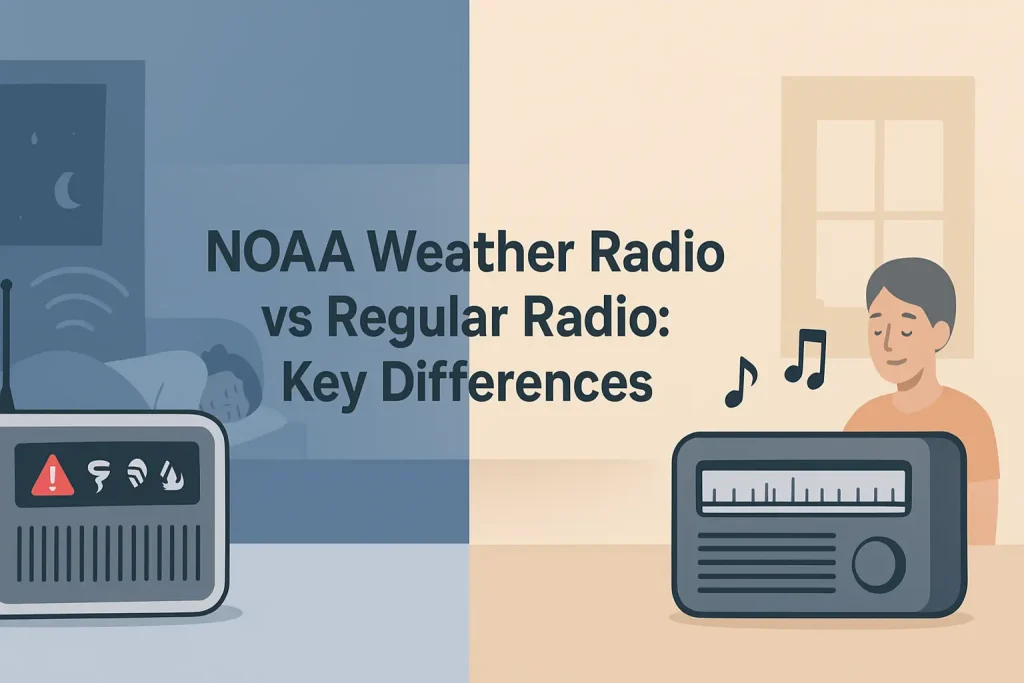
A standard AM/FM broadcast radio is physically incapable of receiving NOAA Weather Radio. The tuning range of a typical FM radio stops at 108 MHz, while NOAA broadcasts sit at 162.400 to 162.550 MHz, well outside the broadcast band. A dedicated weather radio contains a crystal-controlled receiver locked to those seven specific frequencies, plus the S.A.M.E. decoder chip that remains silent until it detects a matching alert.
Beyond frequency coverage, the functional difference is the alert standby mode. A regular radio requires you to be listening at the right moment. A weather radio in standby mode is always on but muted: it monitors the frequency for the 1050 Hz alert tone and the digital S.A.M.E. header, then automatically turns on the speaker when a matching alert arrives. This silent monitoring mode is the reason a weather radio can sit on your nightstand for six months, never making a sound, and then instantly wake the household when a tornado warning is issued for your county at 2:47 AM.
If you are still relying on a weather app on your phone, our detailed breakdown of how NOAA weather radio compares to regular broadcast radio and cellular alerts explains exactly where cellular notification fails in a wide-area power outage.
S.A.M.E. Technology: The Alert Filtering Engine Inside Your Weather Radio
S.A.M.E. technology is the difference between a radio that wakes you for every single alert in a 50-county region and one that triggers only for the specific counties you care about. Without S.A.M.E., the radio unmutes for all alerts within reception range, which during an active severe weather outbreak can mean 12 or more activations in a single night for events nowhere near your location.
The S.A.M.E. system works by encoding a digital header at the very start of each alert broadcast. This header contains the six-digit FIPS code for the affected area, the alert event type (such as Tornado Warning or Flash Flood Warning), its valid time period, and the issuing NWS office identifier. Your weather radio stores a list of up to 50 county codes you program into it, and when a S.A.M.E. data burst arrives, the radio’s decoder chip compares the incoming county code to your stored list. A match triggers the speaker; a non-match is ignored. Learning how to find the correct six-digit code for your specific location is covered step-by-step in our guide on looking up your NOAA weather radio county code with the official FIPS database.
What Are the Actual S.A.M.E. Event Codes a Weather Radio Can Trigger?
A S.A.M.E.-capable radio responds to over 80 distinct event types, not just the handful you might expect. The most frequent activations are Tornado Warning, Severe Thunderstorm Warning, and Flash Flood Warning. But the system also carries Hurricane Warning, Hazardous Materials Warning, Civil Emergency Message, National Information Center statements, and even AMBER Alert activation codes for child abduction emergencies. A full list of every S.A.M.E. event code supported by the national network is available in our comprehensive reference of NOAA FIPS and S.A.M.E. event codes for weather radio alert programming.
How Many NOAA Weather Radio Frequencies Are There, and Which One Do You Use?
The NOAA Weather Radio network operates on exactly seven designated VHF frequencies between 162.400 and 162.550 MHz. These are channels WX1 through WX7 on most weather radio receivers, with the standard center frequencies being 162.400, 162.425, 162.450, 162.475, 162.500, 162.525, and 162.550 MHz. Your specific receiver should tune to the one frequency that carries the strongest signal from the nearest NWR transmitter covering your county.
Selecting the correct frequency is not a matter of picking channel 1 by default. Each transmitter site uses a single assigned frequency, and adjacent transmitters are intentionally assigned different frequencies to prevent interference. The easiest method for finding your correct frequency is using the NOAA Weather Radio station locator tool to enter your county name and get back your designated transmitter frequency instantly. For a complete, printable list of all seven frequencies and their typical channel number assignments on common radio models, see our complete NOAA weather radio frequency reference with the full table of NOAA weather radio broadcast frequencies and channel assignments for every US region.
What Are the Core Components of a Complete NOAA Weather Radio Setup?
A fully functional emergency weather radio station consists of three things: the receiver itself, a reliable power source, and a correctly tuned antenna. The receiver must be a S.A.M.E.-capable model, otherwise it will alert for every county in reception range instead of just yours. The power source must include both a primary AC connection and a backup battery system that automatically takes over when the power fails; most desktop weather radios use six AA alkaline batteries for backup power lasting 24 to 48 hours. The antenna must be positioned where it can actually receive VHF signals: near a window, not buried in a basement, not surrounded by metal framing.
Additional components that improve reliability include an external antenna jack for connecting a rooftop or attic-mounted VHF antenna that pulls in a stronger signal than the built-in telescopic rod, and a public alert-certified external strobe or bed shaker for alerting people who are deaf or hard of hearing. The Midland WR400 desktop weather radio includes all of these features in a single unit, with S.A.M.E. programming, battery backup, and an external alert output jack.
Which NOAA Weather Radio Model Should You Buy for Reliable Emergency Alerting?
The right weather radio for you depends almost entirely on how you plan to power it and where it will sit. A desktop model like the Midland WR400 or WR120 sits on a nightstand, plugs into AC power, and uses AA batteries for backup. A portable model like the Midland ER310 includes a hand crank and solar panel for recharging its internal lithium-ion battery when AC power is not available. For vehicle use, a mobile scanner that covers the 162 MHz band can pull in NOAA weather radio while on the road.
Your decision should prioritize three features above all others: S.A.M.E. capability, a battery backup that lasts at minimum 24 hours, and an external antenna option for use in weak signal areas. Without S.A.M.E., you will be awakened for every alert in a multi-county region. Without battery backup, the radio is a paperweight the moment the power goes out. Without a good antenna position, even the best radio cannot receive the signal it was designed to catch. Our in-depth guide to the complete operating principles behind NOAA weather radio receivers walks through every technical specification you need to evaluate before buying.
What Is the Effective Range of a NOAA Weather Radio Signal in Real-World Conditions?
The official coverage design standard for the NWR network is a 40-mile radius from each transmitter, but that number assumes an outdoor antenna with line of sight to the tower. In real-world conditions, a weather radio sitting on a wooden nightstand on the second floor of a suburban house receives the signal reliably within 25 to 35 miles of the transmitter. The same radio placed in a basement with concrete walls loses the signal completely at 10 miles or less. The signal loss happens because VHF radio waves at 162 MHz cannot penetrate concrete, steel framing, or dense earth: the radio’s receiver sees noise instead of the broadcast, and the alert never triggers.
You can fix this by relocating the radio to a window, or by connecting an external antenna mounted higher up. A simple telescopic antenna placed near a second-story window often gains back enough signal to restore reliable alerting. For locations more than 30 miles from the nearest transmitter or in heavily obstructed areas, a rooftop-mounted VHF antenna with a feed line to the radio is the standard solution. Use the NOAA weather radio station locator tool to find your nearest broadcast tower by county before you assume the radio is broken; if you are 45 miles out with a basement placement, the problem is your location, not the receiver.
How Do You Program a NOAA Weather Radio with Your County’s S.A.M.E. Code?
Programming a S.A.M.E. weather radio with your specific county code takes less than five minutes and makes the difference between a radio that sleeps through a tornado warning or one that alerts you specifically. First, find your six-digit FIPS county code using the NOAA county code lookup tool. Second, press the Menu button on your radio and navigate to the S.A.M.E. programming option. Third, select an empty memory slot and enter the six-digit code using the keypad. Fourth, save the entry and repeat for any additional counties you want to monitor. Finally, set the radio to Alert or Standby mode, and test the reception by pressing the Weather button to confirm you hear the broadcast voice.
This process is identical across most Midland, Uniden, and Sangean weather radio models, though the specific button labels may vary slightly between brands. You can store multiple county codes, which is useful if you live near a county line and want alerts for both your home county and the adjacent county where you work. For a complete walkthrough of the S.A.M.E. code lookup and programming process, including where to find the official FIPS database, see our step-by-step guide on programming NOAA FIPS codes into your weather radio for county-level alert filtering.
Why Does My Weather Radio Activate for Alerts That Are Not Relevant to My Area?
Your weather radio is triggering for distant counties because it is either not S.A.M.E.-capable, or the S.A.M.E. codes are not programmed correctly. A radio without S.A.M.E., or with S.A.M.E. left unprogrammed, defaults to receiving all alerts for all counties within signal range. This is the default behavior out of the box for most weather radios, and it is the reason users describe being woken for severe thunderstorm warnings three counties away.
The fix is to ensure your radio has S.A.M.E. capability, then enter the correct six-digit FIPS code for your specific county and enable the S.A.M.E. filtering function. Some radios call this mode “Alert” or “S.A.M.E. Standby” rather than “All Counties” or “Any Alert.” Confirm the radio is set to the filtered mode, not the all-inclusive mode, and then test it using the weekly test broadcast your local NWS office sends every Wednesday between 10 AM and noon.
Can a NOAA Weather Radio Receive Alerts for Marine Weather and Coastal Waters?
Yes, NOAA Weather Radio broadcasts marine weather warnings including Coastal Flood Warnings, Storm Surge Warnings, and Marine Weather Statements for coastal waters. A standard weather radio receives these alerts exactly as it receives land-based warnings, because the same transmitter broadcasts all alert categories within its coverage area. The S.A.M.E. codes for marine zones use the same six-digit FIPS format with a different zone designation number, so you program the marine zone code the same way you program a county code.
For boaters and maritime operators, a dedicated marine VHF radio with weather alert capability is often a better choice than a standalone desktop weather radio. Marine VHF radios like the Standard Horizon HX890 receive NOAA weather broadcasts on the same frequencies and automatically switch to the weather channel when a marine warning is issued for your area. This integration means you do not need two separate devices on a boat; a single marine VHF radio handles both communication and weather alert reception.
What Happens During a Required Monthly Test of the NOAA Weather Radio System?
Every NWS forecast office transmits a Required Monthly Test (RMT) of the entire alerting system, typically on a Wednesday between 11 AM and noon local time. The RMT sends the 1050 Hz attention tone followed by a S.A.M.E. header and a brief voice message stating that this is a test of the warning system. Your radio, if properly programmed, will activate its alarm and play the test message, confirming that the entire alert chain from the NWS office to your receiver is working.
If your radio does not activate during the RMT, you have either a S.A.M.E. programming error, a signal reception problem, or the radio is set to the wrong frequency. Use the test as a monthly opportunity to verify that your radio is in working order, your batteries are still charged, and your antenna position has not changed. The weekly test is a less intrusive option that many offices also broadcast every Wednesday, but the monthly test is the full-system end-to-end verification.
Is a NOAA Weather Radio the Same as an Emergency Alert System Receiver?
A NOAA Weather Radio is a specific type of Emergency Alert System (EAS) receiver that operates on the VHF public warning band, but it is not the only EAS receiver. The broader EAS network includes alerts distributed over AM/FM broadcast stations, television stations, cable systems, and satellite radio, while NOAA Weather Radio is the dedicated radio-only path for the same EAS alerts. A weather radio with S.A.M.E. capability receives EAS alerts that are distributed over the NOAA transmitter network, and it can also trigger for non-weather EAS activations like AMBER Alerts and civil emergency messages.
The advantage of a dedicated weather radio over a general EAS receiver is that the weather radio sits in silent standby waiting for an alert, while an EAS receiver built into a television or car radio requires you to be actively watching or listening at the moment the alert is broadcast. For emergency preparedness, a dedicated weather radio is the primary alerting device because it is always on, always monitoring, and always ready to activate.
How Do NOAA Weather Radio Alerts Work During a Power Outage or Internet Failure?
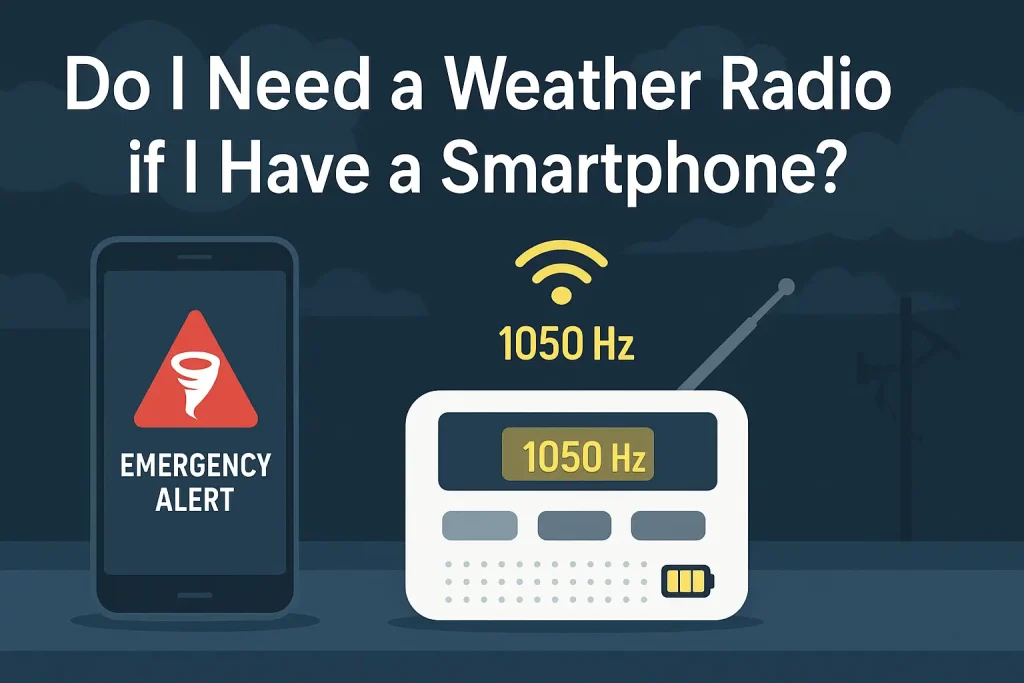
A NOAA Weather Radio operates independently of the power grid and internet infrastructure when equipped with battery backup. During a widespread power outage, the NWR transmitter sites have backup generators and battery banks that keep them on the air; the radio in your home runs on its internal AA batteries or rechargeable battery pack until AC power returns. This is the critical advantage over smartphone weather apps, which require both a charged phone, an active cell tower, and a working internet connection: all three fail simultaneously during a major disaster.
The radio continues receiving alerts throughout the power outage as long as the batteries hold out, which is why the standard recommendation is to keep at least 48 hours of backup battery power available for your weather radio. Hand-crank and solar-powered portable radios extend this runtime indefinitely, which is why the Midland ER310 hand-crank emergency weather radio is a recommended secondary unit for extended outage scenarios where battery replacement is not possible.
Can I Use a Baofeng UV-5R or Other Ham Radio to Receive NOAA Weather Broadcasts?
A Baofeng UV-5R and most other VHF/UHF amateur radios can receive NOAA weather broadcasts on the 162 MHz band as a secondary function, but they cannot decode S.A.M.E. alerts or automatically unmute for warnings. You can manually tune to the NOAA frequency and listen to the continuous weather broadcast voice, which is useful for situational awareness while hiking or during a storm. But the radio will not wake you up for a tornado warning at 3 AM because it lacks the S.A.M.E. decoder chip and the alert standby circuitry that a dedicated weather radio includes.
Using a ham radio for weather monitoring is a supplement to a dedicated weather radio, not a replacement. The Baofeng or similar radio lets you hear the forecast audio on demand, which is useful for checking conditions before heading out, but a dedicated S.A.M.E. weather radio is the only device that will automatically alert you to an emergency in your specific location. If you are looking for a radio that combines two-way communication with automatic weather alerting, a GMRS radio with weather scan like the Midland GXT1000VP4 offers both functions in one unit.
What Is the Difference Between a Weather Alert Radio and a Weather Band Radio?
A weather alert radio contains the S.A.M.E. decoder and the automatic alert standby circuitry that unmutes the speaker when a warning is issued. A weather band radio simply tunes to the 162 MHz frequencies so you can manually listen to the broadcast, but it will not alert you automatically. Many portable AM/FM radios now include a weather band setting, but if the package does not say “weather alert” or “S.A.M.E.,” the radio is a listen-only device that will not wake you for emergencies.
The practical difference is that a weather band radio must be turned on and actively monitored by a person, while a weather alert radio sits in silent standby and activates itself. For emergency preparedness, the alert function is the only feature that matters. A weather band radio without alert capability is like a smoke detector that only works when you are looking at it: it misses the entire point of the device, which is to alert you when you are not paying attention.
How Often Are NOAA Weather Radio Alerts Broadcast, and What Triggers Them?
NOAA Weather Radio broadcasts continuous weather information 24 hours a day, with the routine forecast cycle repeating every 3 to 6 hours depending on the local NWS office. Alerts are inserted into this continuous broadcast stream whenever a warning is issued, which during an active severe weather outbreak can mean an alert every few minutes, while during calm weather the station may go days without an alert activation. The broadcast voice you hear between alerts is the routine weather forecast, updated regularly, which is why you can also use your weather radio as a general weather information source by pressing the listen button.
The alert system triggers based on NWS warning issuance criteria, which means the meteorologists at the forecast office determine when to issue a warning, and the automation system immediately encodes it as a S.A.M.E. alert and sends it over the transmitter. There is no human delay between the warning decision and the broadcast: once the meteorologist hits “send,” the alert tone and data header transmit within seconds.
What Are NOAA Weather Radio Broadcasts Used For Beyond Emergency Warnings?
Beyond the life-saving alert function, NOAA Weather Radio broadcasts serve as a general-purpose weather information source that is used by farmers checking frost conditions, pilots getting aviation weather briefings, boaters reviewing marine forecasts, and outdoor workers planning their day around weather conditions. The routine broadcast cycle includes hourly weather observations, regional weather synopses, short-term forecasts, and climate summaries. During winter storm season, the broadcasts carry detailed snow accumulation forecasts and travel condition advisories. Our dedicated guide to using weather radio alerts to prepare for winter storms and ice events shows how the system integrates with seasonal emergency planning.
For non-emergency users, the weather radio functions as a no-cost, no-subscription, continuous weather information feed that does not require a smartphone, an app, or an internet connection. Hunters, fishermen, hikers, and campers use weather radios to check conditions before and during outdoor activities in areas with no cell service.
How Is NOAA Weather Radio All Hazards Represented in Media and Public Awareness?
NOAA Weather Radio appears frequently in disaster preparedness media, including television weather specials and public service announcements that demonstrate the alert activation sequence. The system is also prominently featured in storm-related movies and TV shows where the weather radio serves as the dramatic early warning device that alerts characters to an approaching tornado or hurricane. Our exploration of how weather radios are used in movies and television for dramatic emergency alert scenes shows how the technology has become embedded in public awareness through media representation, which reinforces its real-world role as the primary emergency alerting device for American households.
Where Should You Place a NOAA Weather Radio for the Best Signal Reception?
The best location for a weather radio is near a window, on an upper floor, away from concrete walls and metal framing. A second-story window placement with the telescopic antenna extended typically provides the strongest signal reception for suburban homes. Basements are the worst location for VHF reception: concrete and earth block the signal, and a radio in a basement will miss alerts that a radio on the first floor receives clearly.
If you must keep the radio in a location with poor reception, connect an external antenna that you can route to a window or attic. Most desktop weather radios include a standard 3.5mm external antenna jack that accepts a basic VHF telescopic antenna or a coaxial feed line from a rooftop installation. A simple wire antenna extended to a window improves reception dramatically without requiring a permanent rooftop installation.
The Final Word on NOAA Weather Radio All Hazards
NOAA Weather Radio All Hazards is the only nationally deployed, federally maintained, radio-based emergency alert system that reaches 95 percent of the US population and automatically wakes you for life-threatening events in your specific county. A smartphone weather app fails when cell towers go down. An AM/FM radio fails when you are not listening. A weather radio with S.A.M.E. capability and battery backup sits in silent standby for months, then activates instantly the moment a tornado warning, flash flood warning, or hazardous materials alert is issued for your location.
If you do not yet own a S.A.M.E.-capable weather radio with battery backup, that is your next step. Program your county’s six-digit FIPS code, set the radio to alert standby mode, and place it near a window where it can receive the signal. Then run the next Required Monthly Test to confirm the entire chain works. A working NOAA Weather Radio is the cheapest, most reliable insurance against the moment when the sirens go off and you have seconds to act.
| Photo | TOP RATED WALKIE TALKIES | Price |
|---|---|---|
 | Retevis RT628 Kids Walkie Talkies, Toys Gifts for 4-12 Year Old Girl Boy | Kids Camping Essentials Outdoor Toys, Birthday Gift, 22CH, VOX, Keypad Lock, Durable, Easy to Use Walkie Talkies for Kids | Check Price On Amazon |
 | Cobra ACXT545 Weather-Resistant Walkie Talkies, Rechargeable, 22 Channels | Long Range 28-Mile Two-Way Radio Set (2-Pack) | Check Price On Amazon |
 | Retevis RT388 Kids Walkie Talkies, Outdoor Toys for Kids Camping Essentials | 4-12 Year Old Boy Birthday Gift, 22 CH VOX Flashlight Clear Sound, Kids Walkie Talkies 2 Pack for Camping Hiking Adventure | Check Price On Amazon |
 | Cobra RX680 Walkie Talkies (2-Pack), IP54 Water Resistant Design | Rugged & Splashproof Two Way Radios Long Range, 60 Pre-Programmed Channels, Weather Alerts | Check Price On Amazon |
 | Retevis RT22 Walkie Talkies Long Range Rechargeable with Earpiece (2 Pack) | Slim & Lightweight 2 Way Radio For Camping & Hiking, Pocket-Friendly Antenna, Ready to Use, 10-Hour Battery, USB-C Charging | Check Price On Amazon |
 | Midland GXT1000VP4 GMRS Two-Way Radios with Headsets, Black, 2 Pack | 50 Channels, 142 Privacy Codes, Up to 36 Mile Long Range, JIS4 Water Resistant, NOAA Weather Alert, Rechargeable NiMH | Check Price On Amazon |
 | Retevis RT628 Walkie Talkies for Kids,Toys Gifts for 6-12 Years Old Boys Girls,Long Range 2 Way Radio 22CH VOX,Birthday Gift,Family Walkie Talkie for Camping Hiking Indoor Outdoor | Check Price On Amazon |