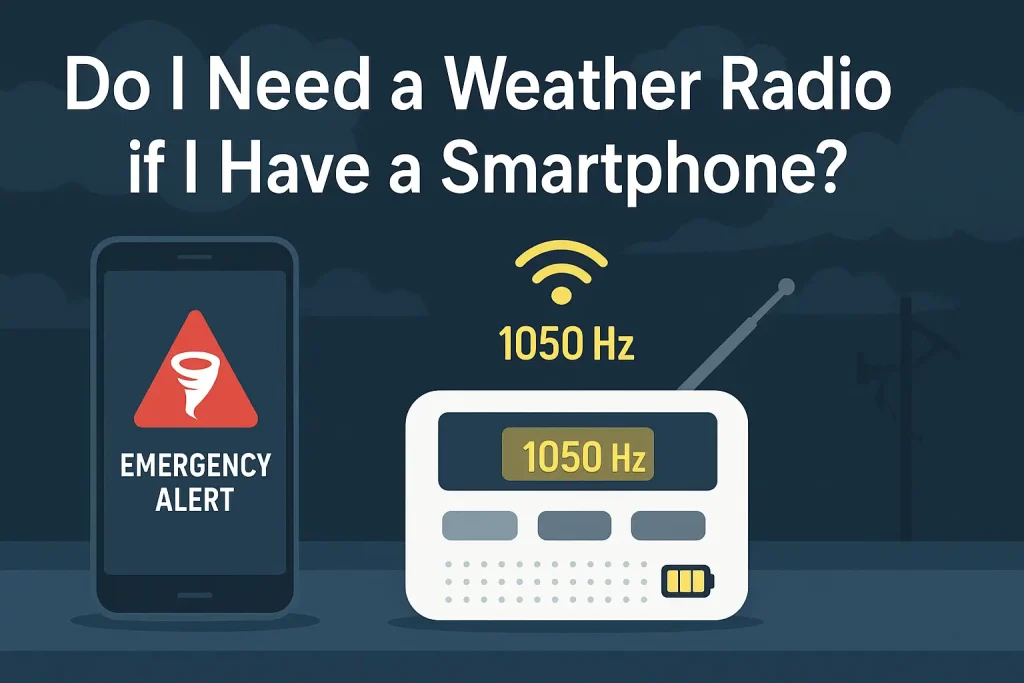
That FM/AM radio on your kitchen counter will play music all day, but it will not wake you at 2 a.m. when a tornado warning hits your county. A NOAA weather radio does exactly that: it stays silent until the National Weather Service activates the alert tone, then broadcasts life-saving information specific to your location.
The difference between a NOAA weather radio and a regular radio comes down to frequencies, standby technology, and alert filtering. A regular radio tunes AM (530-1710 kHz) and FM (88-108 MHz) broadcast bands for entertainment, while a NOAA weather radio locks onto seven dedicated VHF frequencies between 162.400 and 162.550 MHz reserved exclusively for government weather broadcasts.
| Photo | Popular Portable Walkie Talkies | Price |
|---|---|---|
 | SKIWARRIOR Multifunctional Smart Wireless Ski Goggles with Walkie-Talkie, Anti-Fog Zeiss Lens, Music & Call Function (Cylindrical Blue) | Check Price On Amazon |
 | SINORISE Super Mini Walkie Talkies, Two-Way Radios, 3 Pack | Check Price On Amazon |
 | KOSPET Tank M4C Smart Watch Rugged, Dual-Band GPS, 5ATM & IP69K Waterproof | Check Price On Amazon |
 | Retevis RT15 Walkie Talkies 3 Pack, Birthday Gift, Outdoor Adventure Kit | Check Price On Amazon |
 | Rechargeable Walkie Talkies Toys for Kids: DIY Astronaut Walkie Talkies for Boys Christmas Birthday Gifts for 3 4 5 6 7 8 9 10 Boy Walkie Talkie Outdoor Hiking Toy 2 Way Radio Camping Outdoor Game | Check Price On Amazon |
By the Numbers
NOAA Weather Radio vs Regular Radio – Key Specifications
Sources: NOAA National Weather Service, FCC Part 15 and Part 73 broadcast regulations
What Is a NOAA Weather Radio and How Does It Differ from Regular Radio?
A NOAA weather radio is a specialized VHF receiver designed to pick up seven frequencies between 162.400 and 162.550 MHz, where the National Weather Service broadcasts continuous weather information 24 hours a day. Unlike a regular AM/FM radio that you actively tune to hear music or talk programming, a weather radio operates in silent standby mode until an Emergency Alert System (EAS) tone triggers it to wake and broadcast.
The Midland WR400 desktop weather radio exemplifies this difference: it monitors NOAA frequencies silently and only activates its speaker or external alarm when the National Weather Service issues an alert coded for your specific county. A regular radio cannot perform this standby-and-trigger function regardless of its quality or price.
This happens because NOAA weather radios contain a dedicated alert decoder chip that listens for the 1050 Hz EAS attention tone broadcast before every emergency message. Regular AM/FM radios lack this decoder entirely. When the tone is received, the weather radio activates its speaker, display, and often an external alert output like a strobe light or bed shaker for accessibility during sleep.
For a deeper understanding of how the NOAA Weather Radio network operates as a federally managed system of transmitters covering the entire United States, read our complete guide to what NOAA Weather Radio is and how the network functions.
How NOAA Weather Radio Frequencies Differ from AM/FM Broadcast Bands
NOAA weather radio occupies seven VHF frequencies between 162.400 and 162.550 MHz, a band reserved by the FCC exclusively for federal government weather broadcasts. Regular AM radio occupies 530-1710 kHz, while FM broadcast radio occupies 88-108 MHz: completely separate spectrum allocations with entirely different propagation characteristics and regulatory frameworks under FCC Part 73.
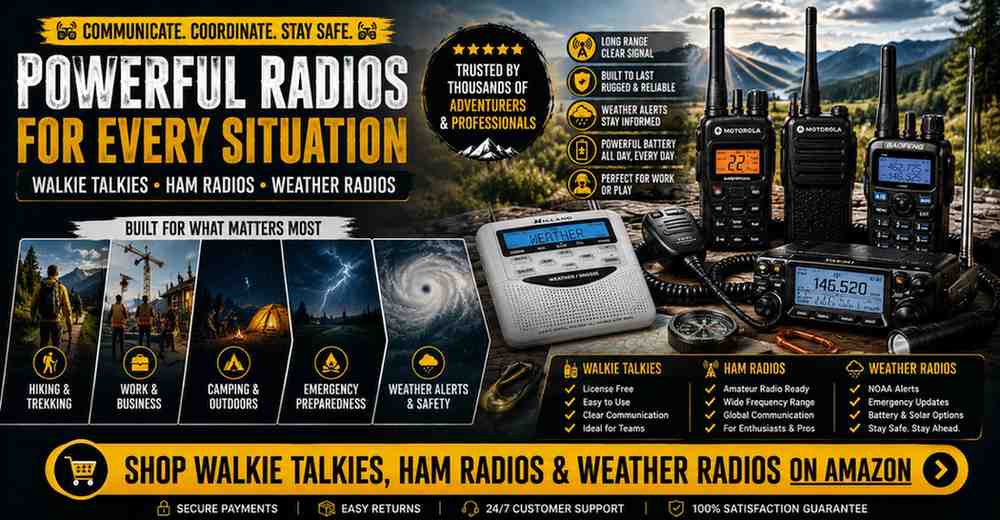
VHF frequencies in the 162 MHz range travel primarily by line of sight from the transmitter tower, which is why NOAA placed over 1,000 transmitters across the country to cover 95% of the US population within a 40-mile radius of each station. FM broadcast stations at 88-108 MHz propagate similarly but are optimized for music fidelity with 200 kHz channel spacing, while NOAA channels use narrow 25 kHz deviation optimized for voice clarity.
The seven NOAA frequencies are standardized nationwide: 162.400 (WX1), 162.425 (WX2), 162.450 (WX3), 162.475 (WX4), 162.500 (WX5), 162.525 (WX6), and 162.550 (WX7). Most portable NOAA weather radios scan all seven channels and lock onto the strongest signal automatically.
If you need to identify exactly which frequency serves your location, our complete list of NOAA weather radio frequencies by channel designation maps every available frequency to its channel name and coverage range. You can also use the NOAA weather radio station locator tool to find the nearest transmitter.
What Makes S.A.M.E. Technology Essential for Targeted Weather Alerts?
S.A.M.E. (Specific Area Message Encoding) is the technology inside modern weather radios that filters alerts by county using a six-digit FIPS (Federal Information Processing Standards) code. A regular radio plays every alert for every location, but a S.A.M.E.-equipped weather radio like the Midland WR120 wakes only when your programmed county code matches the alert’s encoded location.
This filtering matters because NOAA transmitters broadcast alerts for up to 30 surrounding counties simultaneously. Without S.A.M.E. filtering, your weather radio would wake you for every tornado warning, flash flood watch, and severe thunderstorm warning across half the state, even when none of those alerts apply to your location.
A S.A.M.E. weather radio lets you program up to 50 county codes (on the Midland WR400) or 25 codes (on the Midland WR120), so you can monitor your home county, your workplace county, your children’s school county, and your vacation destination simultaneously. The radio compares each incoming alert’s FIPS header to your programmed list, activates only for matches, and ignores everything else.
For a detailed walkthrough of how FIPS codes work with county-level alert targeting and why partial-county alerting exists, our guide on partial county alerting with S.A.M.E. technology explains the reasoning behind sub-county alert filtering and how to program codes correctly.
NOAA Weather Radio vs Regular Radio: Feature-by-Feature Comparison
Use the table below to decide whether a dedicated NOAA weather radio or a regular AM/FM radio meets your emergency preparedness requirements.
Product Comparison
NOAA Weather Radio vs Regular AM/FM Radio – Side by Side
Key specifications compared. Source: NOAA NWR, FCC Part 15 and Part 73.
| Specification | NOAA Weather Radio | Regular AM/FM Radio |
|---|---|---|
| Frequency bands | 7 VHF channels: 162.400-162.550 MHz | AM: 530-1710 kHz; FM: 88-108 MHz |
| Alert standby mode | Yes: silent monitoring with auto-activation | No: must be manually turned on and tuned |
| S.A.M.E. county filtering | Available on mid-to-premium models | Not available |
| EAS tone detection | 1050 Hz decoder built in | None |
| Power backup options | Battery backup standard; hand-crank and solar on portable models | Batteries on portable models only; no alert-specific backup design |
| Broadcast content | Weather forecasts, warnings, watches, hazard info 24/7 | Music, talk, news; weather only during scheduled reports |
| FCC license required | No: receive-only device | No: receive-only device |
| Our verdict | Best for emergency preparedness and automated alerts | Best for entertainment; inadequate for emergency alerting |
NOAA weather radio specifications per NOAA NWR documentation. Regular radio specifications per FCC Part 15 and Part 73 broadcast service rules.
Can a Regular Radio Receive NOAA Weather Radio Broadcasts?
No. A standard AM/FM radio cannot receive NOAA weather radio broadcasts because it lacks the VHF receiver circuitry tuned to 162.400-162.550 MHz. FM broadcast radios stop at 108 MHz, well below the NOAA band, and AM radios operate on an entirely different modulation type (amplitude modulation) at frequencies three orders of magnitude lower.
Some specialty radios include a “weather band” (WB) setting alongside AM and FM. These are not regular radios. They contain a separate VHF receiver circuit and dedicated NOAA channel preset buttons. The Uniden BC365CRS scanner with weather band, for example, scans NOAA channels separately from its AM/FM and public safety scanner functions.
This means the $15 clock radio on your nightstand provides zero weather alert protection, even during a tornado warning. If you want automated NOAA alerts, you must purchase a device with a dedicated weather band receiver and alert decoder, as explained in our detailed explanation of how NOAA weather radio receivers process alerts.
How the Emergency Alert System (EAS) Works with Weather Radios
The Emergency Alert System uses a digitally encoded data burst followed by a 1050 Hz attention tone to activate NOAA weather radios and other EAS-equipped receivers. When the National Weather Service issues a warning, the local NWR transmitter sends the EAS header containing the alert type, affected county FIPS codes, and duration, followed by the attention tone that triggers your radio’s alarm.
This only occurs when your radio is tuned to a NOAA frequency and the alert’s FIPS code matches your programmed county. If either condition is not met, the radio remains silent, and you miss the warning. The fix is verifying you have the correct NOAA channel for your area and programming at least your home county FIPS code into the radio.
Regular AM/FM stations also participate in the EAS system by law under FCC Part 11, but they relay only presidential-level alerts and do not provide the continuous standby monitoring that a weather radio offers. Broadcast stations also go off the air during power outages far more frequently than NOAA transmitters, which have generator backup at every major site.
Battery Backup and Power Options for Reliable Alert Reception
NOAA weather radios are designed with multi-source power options specifically for emergency scenarios where AC power fails. A desktop model like the Midland WR400 runs on AC power with a 4x AA battery backup that automatically takes over during outages and lasts approximately 6 hours of continuous alert monitoring.
Portable weather radios like the hand-crank and solar weather radios add human-powered cranking and photovoltaic panels, giving you indefinite off-grid operation. Regular AM/FM portable radios offer battery power but lack alert-specific design: you must manually turn them on and tune to a station that may or may not be broadcasting weather information at that moment.
If your weather radio keeps beeping when no storm is nearby, the issue often relates to low battery voltage or power supply noise triggering false alert detection. Our troubleshooting guide for weather radio beeping problems covers the most common causes and step-by-step fixes. For more serious issues, check weather radio troubleshooting steps for complete signal or power failures.
Which Radio Type Should You Choose for Emergency Preparedness?
Choose a dedicated NOAA weather radio with S.A.M.E. technology if you want automated, location-specific alerts that will wake you during overnight emergencies. Choose a regular AM/FM radio if you only need entertainment or casual news listening and do not depend on automated emergency notification.
For most households, the best approach is having both: a S.A.M.E.-equipped NOAA weather radio stationed in the bedroom for automated overnight alerts, plus a portable AM/FM radio for news and information during extended power outages when you are already awake and monitoring conditions.
Emergency management professionals and FEMA recommend every home have at least one NOAA weather radio as part of a basic emergency kit, positioned where it can wake sleeping occupants. A regular radio does not fulfill this recommendation because it cannot activate itself in response to an incoming alert.
Common Misconceptions About NOAA Weather Radios
One widespread misconception is that a weather radio and a regular radio are interchangeable for emergency purposes. They serve fundamentally different functions: weather radios are automated alert receivers, while regular radios are manually operated entertainment devices with no alert capability.
Another common error is assuming a weather band feature on a car stereo or boombox provides the same protection as a dedicated weather radio. Weather band receivers can play NOAA broadcasts when you manually tune to them, but they lack the standby alert circuit and EAS tone decoder that automatically activates a dedicated weather radio during an emergency.
A third misconception is that smartphone weather apps replace NOAA weather radios. Cell networks fail during major disasters due to tower damage and network congestion. A S.A.M.E. weather radio with battery backup continues receiving alerts directly from NOAA transmitters even when cellular and internet infrastructure is completely down.
What Is the Difference Between a NOAA Weather Radio and an Emergency Crank Radio?
A NOAA weather radio is defined by its receiver and alert technology (S.A.M.E. filtering, EAS tone detection, 1050 Hz decoder), while an emergency crank radio is defined by its power source (hand crank, solar panel, built-in rechargeable battery). Many emergency crank radios include a weather band receiver, but not all weather radios include a hand crank.
The combination emergency crank radios with NOAA alert on the market combine both features, giving you the automated alert capability of a weather radio with the off-grid power independence of a crank and solar charging system.
When evaluating any emergency radio, confirm whether it has true S.A.M.E. alert filtering or simply a weather band tuner without automated alert activation. The packaging may say “weather radio” even when the device lacks EAS tone detection, which means it cannot wake you automatically when warnings are issued.
Can I Use a Baofeng UV-5R to Receive NOAA Weather Radio?
Yes, the Baofeng UV-5R dual-band handheld transceiver can receive NOAA weather radio frequencies between 162.400 and 162.550 MHz because its VHF receiver covers 136-174 MHz, which includes the NOAA band. However, the UV-5R is not a weather radio: it lacks S.A.M.E. technology, has no EAS tone decoder, and cannot sit in a standby alert mode that automatically activates for warnings.
To hear NOAA broadcasts on a UV-5R, you must manually tune to the correct frequency and leave the radio powered on with the volume up. The radio will not wake itself or trigger an alarm when an alert is issued. This makes it useful for checking weather conditions manually but useless as an automated emergency alert receiver while you sleep.
Why Does My Weather Radio Alert for Counties 100 Miles Away?
Your weather radio alerts for distant counties because you have not programmed S.A.M.E. codes, or you programmed codes incorrectly, or your radio does not have S.A.M.E. capability at all. Without S.A.M.E. filtering, the radio activates for every alert the nearest NOAA transmitter broadcasts, which may include 20 to 30 surrounding counties across a 100-mile radius.
NOAA transmitters are designed for wide coverage, often reaching 40-60 miles depending on terrain and tower height. A single transmitter may serve portions of three states, broadcasting alerts for every county in its coverage footprint. The fix is finding your county FIPS code using the complete NOAA FIPS codes reference for weather radio programming and entering it into your radio’s S.A.M.E. memory slots.
Do I Need an FCC License to Operate a NOAA Weather Radio?
No. NOAA weather radios are receive-only devices, and no FCC license is required for receiving any radio signal in the United States under current FCC regulations. This applies equally to basic weather band radios, S.A.M.E.-equipped desktop weather radios, and combination scanner/weather radios.
The license-free status of weather radios differs significantly from two-way radio services like GMRS, which requires a $35 FCC license covering your immediate family for 10 years, or amateur radio, which requires passing a Technician license exam. A weather radio transmits nothing, so no license applies.
How Do I Program S.A.M.E. Codes into My Midland Weather Radio?
Press the “MENU” button on your Midland weather radio, scroll to “S.A.M.E. SET,” select an empty slot, and enter the six-digit FIPS code for your county using the keypad. The radio stores up to 50 codes on the WR400 model and 25 on the WR120, with each code corresponding to one county or marine zone.
You can find your county FIPS code by visiting the NOAA NWR website and selecting your state and county from the dropdown menu. Write down the six-digit code (the leading zero matters for states with single-digit FIPS prefixes) and enter it exactly as shown. After programming all desired codes, set the radio to “S.A.M.E. ON” or “ALERT ON” mode to enable filtered alerting.
Can a Scanner Radio Replace a Dedicated NOAA Weather Radio?
A scanner radio can monitor NOAA weather frequencies and may include weather alert features, but it cannot fully replace a dedicated weather radio for automated alerting. Scanners like the Uniden Bearcat scanner series typically offer a weather priority mode that periodically checks NOAA channels during scanning, but this is not the same as the continuous silent monitoring with EAS tone detection found in a dedicated weather radio.
The key difference is that a scanner’s weather alert function interrupts scanning only when the scanner detects a carrier signal on the weather frequency, not when a specific EAS alert tone triggers. This means the scanner may not activate for alerts that use the 1050 Hz tone at lower modulation levels. A dedicated NOAA weather radio is purpose-built to detect that exact tone reliably.
Why Does My Weather Radio Keep Beeping When No Storm Is Nearby?
Intermittent beeping on a weather radio typically indicates one of three problems: the weekly or monthly test alert is triggering the radio (these are scheduled by each NWS office and may occur when you are not aware of them), the battery backup voltage has dropped below the alert threshold, or the radio is receiving fringe signals from two NOAA transmitters simultaneously and misinterpreting signal interference as an alert.
To diagnose, check if the beeping coincides with the scheduled weekly test (every Wednesday between 10 a.m. and noon local time for most NWS offices). If the beeping is random, replace the backup batteries and verify the AC adapter is securely connected. If the problem persists, your radio may be picking up a distant NOAA transmitter on the same frequency, and switching to an alternate NOAA channel for your area may resolve it.
How Often Does NOAA Update Weather Radio Broadcasts?
NOAA weather radio broadcasts are continuous 24/7, with routine weather information cycling every 3 to 5 minutes. Forecast updates are issued at least every 6 hours for the standard zone forecast, while hazardous weather watches and warnings are inserted immediately upon issuance by the local NWS forecast office, interrupting the routine cycle.
During active severe weather, the broadcast cycle shortens dramatically, with updates sometimes occurring every 1 to 2 minutes as radar imagery evolves and new warnings are issued. This is one reason a weather radio with battery backup is essential: during a tornado outbreak, the continuous stream of updated warnings and storm tracks requires your radio to stay powered through potential AC outages.
Will a Weather Radio Work During a Complete Power Outage?
Yes, if your weather radio has fresh batteries installed, or a hand-crank/solar charging option, it will continue receiving NOAA broadcasts during a power outage. NOAA NWR transmitters have backup generators at every major site that automatically engage within seconds of commercial power loss, ensuring the broadcast signal remains on the air throughout the emergency.
This dual resilience (your battery-powered receiver plus NOAA’s generator-backed transmitters) makes the NOAA weather radio one of the most reliable communication tools available during disasters. Cellular networks, internet connections, and television broadcasts routinely fail during major weather events, but the NOAA NWR system is engineered specifically to survive them.
Do Marine VHF Radios Receive NOAA Weather Broadcasts?
Yes, virtually all modern fixed-mount and handheld marine VHF radios include NOAA weather channel reception as a standard feature. Marine radios like the Standard Horizon HX890 handheld VHF include dedicated weather channel buttons and often feature weather alert modes that monitor NOAA frequencies in the background while the radio is tuned to marine channels.
However, most marine VHF radios lack S.A.M.E. county filtering because marine weather alerts are organized by marine forecast zones using different geographic identifiers than land-based FIPS codes. The marine radio will alert for all marine warnings within the transmitter’s coverage area, which is actually appropriate for boaters who may move between forecast zones during a voyage.
Is a S.A.M.E. Weather Radio Worth the Extra Cost Over a Basic Model?
For most users, yes. A basic weather radio without S.A.M.E. will activate for every alert across a 40-60 mile radius, which may include 30 counties. This leads to frequent false alarms that condition occupants to ignore the alert, defeating the purpose of having a weather radio at all. A S.A.M.E.-equipped weather radio like the Midland WR120 costs approximately $10-20 more than a non-S.A.M.E. model but eliminates alert fatigue by filtering out irrelevant warnings.
The cost difference between a basic weather band radio ($20-30) and an entry-level S.A.M.E. model ($35-50) is negligible compared to the practical benefit of receiving only relevant alerts. FEMA and the National Weather Service both recommend S.A.M.E.-equipped radios specifically to reduce false alarm rates and increase the likelihood that residents respond appropriately to genuine threats.
How Do I Find the Correct NOAA Weather Radio Frequency for My Location?
Visit the NOAA Weather Radio website and enter your city, state, or ZIP code into the station locator tool. The tool returns the frequency (one of the seven standard channels from 162.400 to 162.550 MHz), the transmitter’s call sign, its approximate distance and direction from your location, and the counties and marine zones it covers.
Once you have the correct frequency, tune your weather radio to that channel and listen for the automated voice broadcast. If you hear static or no signal, try the next closest transmitter on a different frequency. Terrain obstructions between you and the transmitter can block VHF signals, so the closest transmitter geographically is not always the strongest signal at your exact location.
Can Two-Way Radios Like FRS or GMRS Units Receive NOAA Weather?
Some GMRS and FRS combination radios include NOAA weather channel reception as an added feature, but this is not universal. Radios like the Midland GXT1000 GMRS two-way radios include a weather scan mode that checks NOAA channels and can be set to alert when the EAS tone is detected, effectively combining a two-way radio and a basic weather alert receiver in one device.
However, the weather alert function on two-way radios is typically more limited than a dedicated weather radio. Most two-way radio weather modes do not support S.A.M.E. county filtering and require the radio to be powered on with sufficient battery, which drains faster than a dedicated weather radio designed for days of standby monitoring on a single set of batteries.
What Is the Range of a NOAA Weather Radio Transmitter?
NOAA weather radio transmitters typically cover a 40-mile radius under normal conditions, though effective range varies from 25 to 60 miles depending on transmitter power (typically 300 to 1,000 watts), antenna height above average terrain, and local topography. Signals travel by line of sight in the VHF band, so mountains, dense urban structures, and deep valleys can create dead zones well within the nominal coverage radius.
Indoor reception inside concrete or steel-framed buildings can reduce effective range by 50% or more compared to outdoor reception with a clear path to the transmitter. Positioning your weather radio near a window facing the transmitter direction and keeping the antenna fully extended significantly improves indoor reception reliability.
The choice between a NOAA weather radio and a regular radio is ultimately about one question: do you need automated emergency alerts that wake you when danger approaches, or do you only need manual access to entertainment and news? For emergency preparedness, the NOAA weather radio is the only device designed to deliver location-specific, automatically activated warnings when seconds matter. A regular radio serves an entirely different purpose. Every household should have at least one S.A.M.E.-equipped NOAA weather radio with fresh battery backup installed, positioned where it can wake sleeping occupants overnight, and programmed with the correct county FIPS codes and NOAA frequency for your specific location.
| Photo | TOP RATED WALKIE TALKIES | Price |
|---|---|---|
 | Retevis RT628 Kids Walkie Talkies, Toys Gifts for 4-12 Year Old Girl Boy | Check Price On Amazon |
 | Cobra ACXT545 Weather-Resistant Walkie Talkies, Rechargeable, 22 Channels | Check Price On Amazon |
 | Retevis RT388 Kids Walkie Talkies, Outdoor Toys for Kids Camping Essentials | Check Price On Amazon |
 | Cobra RX680 Walkie Talkies (2-Pack), IP54 Water Resistant Design | Check Price On Amazon |
 | Retevis RT22 Walkie Talkies Long Range Rechargeable with Earpiece (2 Pack) | Check Price On Amazon |
 | Midland GXT1000VP4 GMRS Two-Way Radios with Headsets, Black, 2 Pack | Check Price On Amazon |
 | Retevis RT628 Walkie Talkies for Kids,Toys Gifts for 6-12 Years Old Boys Girls,Long Range 2 Way Radio 22CH VOX,Birthday Gift,Family Walkie Talkie for Camping Hiking Indoor Outdoor | Check Price On Amazon |