NOAA Weather Radio did not start as the nationwide alert system millions of Americans rely on today. It began as a single experimental broadcast from a transmitter in New York City, designed for a narrow audience of marine pilots and farmers who needed reliable weather forecasts. The system that now covers 95% of the US population with over 1,000 transmitters started with one engineer’s conviction that weather information could save lives if delivered fast enough.
The following statistics anchor the scale of what NOAA Weather Radio has become since those first experimental transmissions.
| Photo | Popular Portable Walkie Talkies | Price |
|---|---|---|
 | SKIWARRIOR Multifunctional Smart Wireless Ski Goggles with Walkie-Talkie, Anti-Fog Zeiss Lens, Music & Call Function (Cylindrical Blue) | Check Price On Amazon |
 | SINORISE Super Mini Walkie Talkies, Two-Way Radios, 3 Pack | Up to 12 Hours Battery Life, for Baseball Coaches, Restaurants, Retail Stores, Hospitals, Outdoor Sports & Travel | Check Price On Amazon |
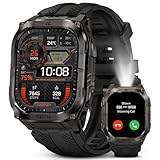 | KOSPET Tank M4C Smart Watch Rugged, Dual-Band GPS, 5ATM & IP69K Waterproof | 1.96" AMOLED Display, 170+ Sport Modes, Built-in LED Flashlight/Walkie-Talkie, Heart Rate/Sleep Monitor for Android & iPhone | Check Price On Amazon |
 | Retevis RT15 Walkie Talkies 3 Pack, Birthday Gift, Outdoor Adventure Kit | Durable, Lightweight, VOX, Key Lock, Mini Walkie Talkies for Adults, School Family Outdoor Travel Camping Hiking | Check Price On Amazon |
 | Rechargeable Walkie Talkies Toys for Kids: DIY Astronaut Walkie Talkies for Boys Christmas Birthday Gifts for 3 4 5 6 7 8 9 10 Boy Walkie Talkie Outdoor Hiking Toy 2 Way Radio Camping Outdoor Game | Check Price On Amazon |
By the Numbers
NOAA Weather Radio – Key Network Specifications
Sources: NOAA NWR documentation, National Weather Service technical publications
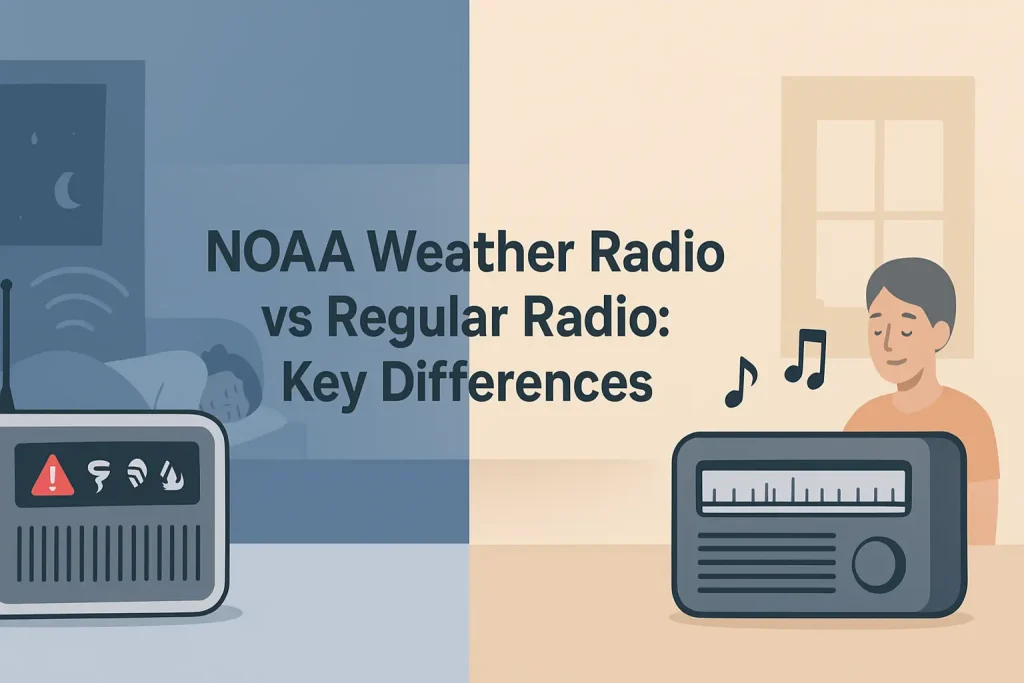
A NOAA weather radio is a dedicated receiver that picks up continuous weather broadcasts on seven VHF frequencies (162.400 to 162.550 MHz) from the National Weather Service. Unlike AM/FM radios that carry music or talk shows, these devices stay silent until an alert tone triggers them, which is why they are the backbone of emergency preparedness in millions of American homes.
If you are new to the technology, our guide on what NOAA Weather Radio actually does and which models suit different needs covers the fundamentals before diving into the history.
What Is NOAA Weather Radio and Why Was It Created?
NOAA Weather Radio All Hazards (NWR) is a government-operated network of VHF FM radio transmitters that broadcasts continuous weather information, forecasts, and emergency alerts 24 hours a day. The National Weather Service (NWS), a division of the National Oceanic and Atmospheric Administration (NOAA), runs the entire system from regional forecast offices scattered across the country.
NWR was created to solve a deadly problem. Weather forecasts existed, but they were stuck inside National Weather Service offices, available only by telephone or during scheduled AM radio broadcasts. If a tornado formed at 2:00 AM, there was no mechanism to wake people up and tell them to take shelter.
The core mission was simple and remains unchanged: deliver weather watches and warnings directly from the forecaster to the public without waiting for a radio DJ or a television news producer to relay the message. This direct path from the NWS meteorologist to the NOAA weather radio receiver in your bedroom cuts the alert delivery time to under 10 seconds for many warning types.
The Origins: How Did NOAA Weather Radio Begin?
The origin of NOAA Weather Radio traces back to a single experimental station operated by the U.S. Weather Bureau, the predecessor organization to the National Weather Service. That first station broadcast from the top of the Whitehall Building in Manhattan, New York City, using a 2-watt transmitter connected to a rooftop antenna on the VHF band.
The station carried the callsign KWO35 and transmitted on 162.55 MHz, a frequency that would later become one of the seven standard NWR channels. The audience was tiny: mostly harbor pilots, tugboat operators, and farmers within a few miles of Lower Manhattan who owned VHF receivers capable of tuning the experimental frequency.
Two forecasters at the New York Weather Bureau office, recognizing that printed bulletins and telephone call-in services were too slow for rapidly changing conditions, pushed the concept forward. They recorded a short weather forecast on a looped magnetic tape cartridge and fed it into the transmitter. The broadcast repeated every few minutes, updated as conditions changed.
This happened because the Weather Bureau had already been exploring ways to use radio for disseminating aviation weather information to pilots. The experimental VHF broadcast was a natural extension of work the Bureau had done with AM radio stations and teletype circuits for decades. The condition for success was a dedicated frequency, a reliable tape loop system, and enough receiver owners who knew the station existed.
If the tape loop failed or the transmitter lost power, the result was dead air: no updates, no warnings. The fix was manual intervention by a forecaster who would re-record the loop or switch to a backup tape. There was no automated failover in those early years.
The experimental success in New York proved that direct VHF weather broadcasting worked. Within a few years, the concept spread to other coastal cities where marine weather was critical to commercial fishing and shipping. The service was initially called ESSA Weather Radio, named after the Environmental Science Services Administration, which housed the Weather Bureau before NOAA was created.
What Were the Major Milestones in NOAA Weather Radio History?
The evolution from a single experimental transmitter to a nationwide alert network happened in distinct phases, each driven by a specific operational need or a disaster that exposed gaps in the existing warning infrastructure. Understanding the timeline helps explain why certain features, such as S.A.M.E. technology and the 1050 Hz warning alarm tone, were added when they were.
The chart below visualizes the relative scale of each expansion phase based on transmitter count and population coverage at each stage of network development.
The first major expansion came when the network, then called ESSA Weather Radio, extended beyond New York to coastal cities including New Orleans, Galveston, and Seattle. Marine weather drove the demand. Commercial fishing fleets and port authorities needed forecast updates that did not depend on scheduled AM radio broadcasts or telephone calls to the Weather Bureau office.
A critical turning point arrived when the system name changed from ESSA Weather Radio to NOAA Weather Radio following the creation of the National Oceanic and Atmospheric Administration. This organizational restructuring brought all federal weather services under one agency and gave the radio network the institutional backing it needed to expand inland.
The next phase targeted population centers regardless of coastal proximity. The National Weather Service installed transmitters in the Midwest and Great Plains, regions where tornado outbreaks had repeatedly demonstrated the deadly gap between a warning issued at the forecast office and the public actually receiving it. After a catastrophic tornado outbreak, public and political pressure pushed funding for inland transmitter expansion through Congress.
The most transformative technical milestone was the introduction of Specific Area Message Encoding (S.A.M.E.) technology, which allowed individual radios to filter alerts by county. Before S.A.M.E., every weather radio in transmitter range would alarm for every alert, regardless of location. A tornado warning two counties away would wake you at 3:00 AM just as urgently as one headed directly for your neighborhood.
The addition of the All-Hazards designation expanded the network’s mission beyond weather to include chemical spills, nuclear incidents, AMBER alerts, and terrorist attack notifications. This integration with the Emergency Alert System (EAS) made NWR a single point of access for every type of civil emergency the federal government could declare.
The modern network now includes over 1,000 transmitters covering all 50 states, Puerto Rico, the US Virgin Islands, and US territories in the Pacific. Each transmitter is connected to a NWS forecast office that can initiate an alert in under 10 seconds from the moment a warning decision is made.
How Did S.A.M.E. Technology Change NOAA Weather Radio?
S.A.M.E. (Specific Area Message Encoding) technology transformed NOAA Weather Radio from a blunt instrument that alerted everyone within transmitter range into a surgical tool that alerts only the specific counties affected by a warning. The technology encodes a digital burst at the beginning of each alert message that contains the six-digit FIPS code for the affected geographic area.
A radio equipped with S.A.M.E. decoding reads that digital header, compares it to the codes the user has programmed into memory, and decides whether to sound the alarm or remain silent. This filtering happens because each county in the United States carries a unique six-digit Federal Information Processing Standards (FIPS) code that the NWS includes in the alert data stream for every warning it issues.
Before S.A.M.E. became standard, the only filtering option was to turn the radio off and risk missing a genuine threat. The condition that made S.A.M.E. practical was the availability of inexpensive microcontrollers in consumer electronics, which allowed manufacturers to build decoder chips into weather radios without raising the retail price beyond what households would pay.
If a user programs the wrong FIPS code or fails to program any codes at all, the radio defaults to sounding an alert for every warning within transmitter range. The fix is straightforward: find the correct six-digit FIPS code for your county on the NWS website and enter it into the radio’s S.A.M.E. memory slots. Most modern S.A.M.E. weather radios hold between 25 and 50 programmable county codes.
For a deeper comparison of alert encoding standards, our article on how S.A.M.E. digital encoding compares to Wireless Emergency Alerts on your phone breaks down the technical differences and real-world reliability of each system.
How Did NOAA Weather Radio Become Part of the Emergency Alert System?
NOAA Weather Radio became the backbone of the Emergency Alert System (EAS) because it was the only federally operated broadcast network that reached into homes without requiring the owner to turn anything on. Unlike television or AM/FM radio, a weather radio in standby mode monitors the signal continuously and activates only when an alert tone triggers it.
The EAS integration works through a daisy-chain architecture. The NWS issues a warning, which goes out on the NWR transmitter network with a S.A.M.E. header and a 1050 Hz attention tone. Other EAS participants, including commercial radio and television stations, monitor designated NWR stations as one of their required EAS input sources and rebroadcast the alert through their own systems.
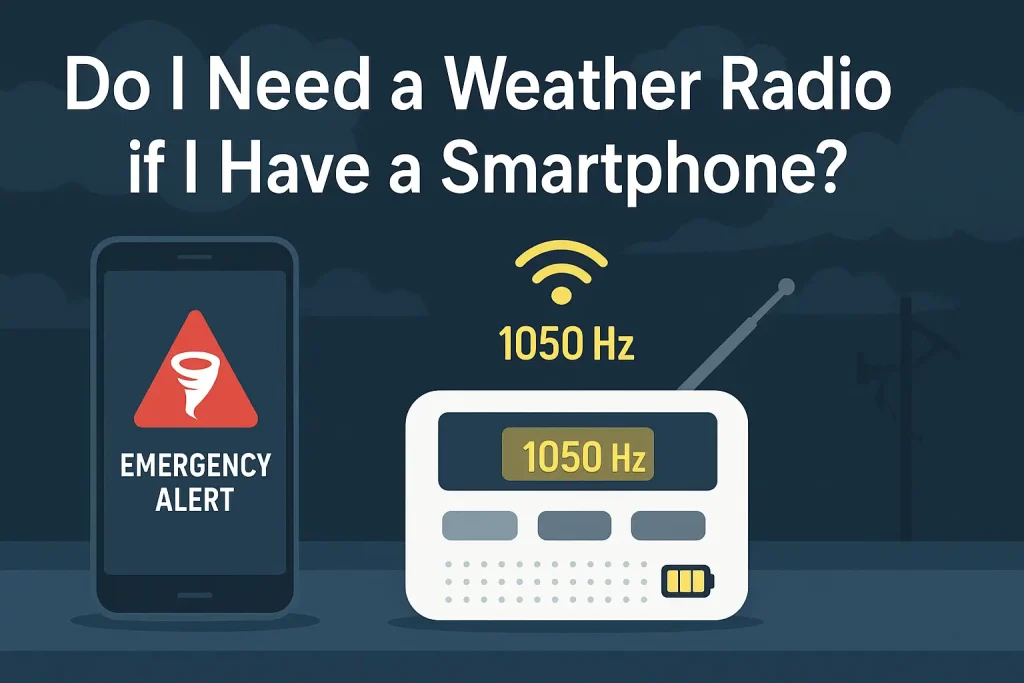
The technical mechanism behind this integration is a specific audio tone (1050 Hz) that precedes every alert message. This tone, standardized across the entire EAS network, triggers any EAS decoder listening to that frequency. The condition that makes the system reliable is redundancy: every NWR transmitter is monitored by multiple EAS participant stations, so if one monitoring receiver fails, another station in the chain still picks up the alert.
If the 1050 Hz tone fails to transmit or the monitoring station’s decoder misses it, the alert may not propagate through the EAS network beyond the NWR transmitter’s immediate range. The fix is weekly and monthly testing of the entire EAS chain, which the FCC requires of all participating broadcast stations. These tests verify that the tone triggers decoders correctly and that the audio quality of the relayed alert message is intelligible.
How the NOAA Weather Radio Network Expanded Across the United States
The expansion of NWR transmitters followed a pattern driven by disaster and demand. Coastal cities with active ports received the first stations because marine weather directly affected commerce and safety on the water. Inland expansion happened when major tornado outbreaks and flood events demonstrated that rural communities had no reliable way to receive warnings at night.
Each new transmitter required a site with reliable power, a tower or tall structure for the antenna, a dedicated phone line or microwave link back to the parent NWS forecast office, and a frequency assignment that would not interfere with existing NWR stations in adjacent coverage areas. The seven frequencies (162.400, 162.425, 162.450, 162.475, 162.500, 162.525, and 162.550 MHz) are reused across the country with sufficient geographic separation to prevent co-channel interference.
You can see the complete frequency allocations and which channels serve which regions in our detailed NOAA weather radio frequency list organized by state and coverage area.
The technical explanation for why NWR operates on VHF near 162 MHz involves radio propagation physics. VHF signals in the 162 MHz range travel primarily by line of sight and bend slightly over the horizon, giving each transmitter an effective radius of approximately 40 miles over flat terrain. This band sits above most man-made electrical noise, below the frequencies where atmospheric absorption becomes significant, and within a range where receiver components are inexpensive to manufacture.
Today, the network covers approximately 95% of the US population, with intentional gaps only in the most remote and sparsely populated regions of Alaska and the intermountain West. Some of those gaps are filled by online streaming services that rebroadcast NOAA Weather Radio audio over the internet for locations outside transmitter range.
How Does NOAA Weather Radio Work Technically?
NOAA Weather Radio operates as a continuous-duty VHF FM broadcast system. Each transmitter runs 24 hours a day at power levels ranging from 300 watts to 1,000 watts, depending on the required coverage area and local terrain. The signal uses narrow-band FM modulation with a deviation of plus or minus 5 kHz, which is narrower than commercial FM broadcast (plus or minus 75 kHz).
This narrower modulation means the audio quality is optimized for voice intelligibility rather than music fidelity, which is exactly what emergency announcements require. The narrower signal also allows the seven NWR channels to fit within a 150 kHz segment of the VHF band without adjacent-channel interference.
The technical chain works like this. A NWS meteorologist composes a warning message on a computer console, which encodes the S.A.M.E. digital header, generates the 1050 Hz alert tone, and routes the audio through a dedicated telephone circuit or IP link to the transmitter site. At the transmitter, the audio modulates the VHF carrier, which radiates from an omnidirectional antenna mounted on a tower typically 30 to 100 meters above ground level.
For a complete breakdown of the signal path and receiver operation, our guide on how NOAA Weather Radio signals are transmitted, encoded, and decoded by consumer receivers explains each stage with specific frequency and modulation data.
Quick Reference: Key NOAA Weather Radio Terms
NWR: NOAA Weather Radio All Hazards, the nationwide network of VHF transmitters broadcasting continuous weather information.
S.A.M.E.: Specific Area Message Encoding, a digital protocol that allows weather radios to filter alerts by county using six-digit FIPS codes.
FIPS Code: A six-digit Federal Information Processing Standards code that uniquely identifies each US county for alert filtering purposes.
1050 Hz Tone: The audio attention tone that precedes every NWR alert and triggers EAS decoders in monitoring stations.
VHF Band: The Very High Frequency range (30-300 MHz) where NWR broadcasts at 162.400-162.550 MHz.
EAS: The Emergency Alert System, a national public warning system that distributes alerts through broadcast stations, of which NWR is a primary input source.
Watches vs Warnings: A watch means conditions are favorable for severe weather. A warning means severe weather is occurring or imminent and immediate action is required.
All Hazards: The expanded mission of NWR beyond weather to include chemical spills, nuclear incidents, AMBER alerts, and terrorist attack notifications.
NWS Forecast Office: The regional National Weather Service facility where meteorologists issue forecasts and warnings and control the local NWR transmitters.
Standby Mode: The operational state where a weather radio monitors the NWR signal silently and activates only when a S.A.M.E. alert or 1050 Hz tone is received.
What Radio Equipment Do You Need to Receive NOAA Weather Radio?
You need a VHF FM receiver capable of tuning the 162.400-162.550 MHz range with narrow-band FM demodulation. Dedicated desktop NOAA weather radios with S.A.M.E. decoding provide the most complete alert filtering, but even an inexpensive portable weather radio without S.A.M.E. will broadcast all alerts within range.
Key Specifications:
– Frequency range: 162.400-162.550 MHz (7 channels)
– Alert decoding: S.A.M.E. digital header with programmable FIPS codes
– Alert types: 25 categories including tornado, severe thunderstorm, flash flood, hurricane, and civil emergency
– Power: AC with battery backup (typically 6x AA alkaline) for operation during outages
– Audio output: Minimum 0.5W speaker for clear voice in a bedroom-sized room
Many FRS and GMRS walkie-talkies also include NOAA weather radio reception as a secondary feature, accessed through a dedicated WX button on the keypad. These combination devices let you communicate with your group on FRS channels while monitoring weather alerts on the NWR frequencies.
If you own a weather radio and want to verify it is receiving correctly, follow the step-by-step testing procedure in our guide on how to confirm your NOAA weather radio is receiving alerts properly using the weekly test broadcast.
How Has NOAA Weather Radio Adapted to Modern Technology?
NOAA Weather Radio has adapted to modern technology primarily through the integration of S.A.M.E. digital encoding, internet audio streaming of all transmitter feeds, and the addition of non-weather All-Hazards alert categories that make the system relevant to homeland security and public safety beyond its original weather mission. The core VHF broadcast technology remains unchanged because it works during the exact conditions when newer networks fail.
Cellular networks collapse during mass emergencies because of congestion and infrastructure damage. The internet requires functional last-mile connections that hurricanes and ice storms routinely destroy. A VHF radio signal from a transmitter 40 miles away, powered by a generator and connected to the NWS forecast office by a dedicated microwave link, continues broadcasting through conditions that disable every IP-based alert system.
The most significant modern adaptation has been the NWS decision to make NWR audio streams available on the internet through third-party aggregators and direct NOAA streaming servers. This extends the reach of NWR to locations outside transmitter coverage, including office buildings, underground facilities, and remote areas of Alaska served only by satellite internet. However, NOAA explicitly warns that internet streaming is a supplement to a dedicated VHF weather radio, not a replacement, because the internet connection may not survive the emergency the alert is warning about.
Why Does NOAA Weather Radio Still Matter in the Smartphone Era?
NOAA Weather Radio still matters because it is the only public alert delivery system in the United States that combines 24-hour continuous operation, no dependency on third-party networks, automatic activation from standby, and county-level geographic filtering into a single receiver that you can purchase for under $40. Smartphones offer Wireless Emergency Alerts (WEA), but WEA messages travel through the same cellular network that will be overloaded or damaged during the emergency.
The two systems complement each other rather than compete. A detailed comparison of the alert encoding and delivery mechanisms is available in our deep dive into how S.A.M.E. technology differs from other alert encoding methods used across the warning infrastructure.
A NOAA weather radio with fresh backup batteries and correctly programmed S.A.M.E. codes will wake you for a tornado warning even if your phone is dead, your internet is out, and your power has been off for hours. That is not a hypothetical scenario: it describes the conditions during the first hour of every major hurricane landfall and every nocturnal tornado outbreak in the rural Southeast.
What Are the Most Common Mistakes People Make with NOAA Weather Radios?
The most common mistake is programming the wrong S.A.M.E. code or failing to program any codes, which leaves the radio in a default state where it alerts for every warning across the entire transmitter coverage area. A transmitter near a major city can cover a dozen or more counties, and hearing alerts for counties 50 miles away trains people to ignore the alarm.
Look up your exact county FIPS code on the NWS website and enter it into the radio’s S.A.M.E. memory. Most S.A.M.E.-capable desktop weather radios like the Midland WR400 include a numeric keypad for direct FIPS code entry, while portable models may require stepping through menus.
Another frequent mistake is relying solely on AC power without installing backup batteries or failing to replace the backup batteries annually. When severe weather strikes, power outages are almost guaranteed. A weather radio plugged into the wall with dead or missing backup batteries becomes a silent paperweight exactly when you need it most. Check your backup batteries every six months and replace them annually, even if they test fine on a multimeter.
Is It Legal to Rebroadcast NOAA Weather Radio Audio?
Yes, NOAA Weather Radio broadcasts are in the public domain and may be rebroadcast by anyone without permission or licensing. This is why you see NWR audio streams on weather websites, mobile apps, and even some amateur radio repeaters that retransmit the local NWR frequency as a community service.
The NWS actively encourages rebroadcasting because it extends the reach of the warning system. The only restriction is that rebroadcasters must not alter the content of the alert message or give the impression that the NWS endorses a commercial product. If you operate an amateur radio repeater and want to retransmit your local NWR station, coordinate with your NWS forecast office to ensure the audio quality of the relayed stream meets their standards for clarity and reliability.
How Is NOAA Weather Radio Funded and Maintained?
NOAA Weather Radio is funded through the federal budget of the National Oceanic and Atmospheric Administration, which falls under the Department of Commerce. The NWS allocates funds for transmitter installation, maintenance, equipment replacement, and the dedicated telecommunications links that connect each transmitter to its parent forecast office.
Local communities sometimes contribute tower space, site access, or backup power infrastructure, but the core operational funding comes from Congress through the annual NOAA appropriations process. This federal funding model means the network is not dependent on advertising revenue, subscription fees, or commercial sponsorship, which is why the broadcasts contain only weather information and emergency alerts with no commercial interruptions.
Can You Listen to NOAA Weather Radio Outside the United States?
You cannot receive NOAA Weather Radio transmitters outside the United States and its territories because the signal range of each transmitter is limited to approximately 40 miles by line-of-sight VHF propagation. The NWR network does not use shortwave frequencies that would carry signals across international borders.
However, several other countries operate similar dedicated weather radio services. Canada has the Weatheradio Canada network, which uses the same seven VHF frequencies (162.400-162.550 MHz) and compatible S.A.M.E. encoding. This cross-border compatibility means a weather radio purchased in the United States will function in Canada if you program Canadian FIPS codes. Other countries with comparable services include Australia (Bureau of Meteorology weather radio), Japan (JMA radiofax and voice broadcasts), and several European nations with VHF marine weather broadcasts.
How Often Are NOAA Weather Radio Transmitters Tested?
NOAA Weather Radio transmitters broadcast a Required Weekly Test (RWT) every Wednesday between 10:00 AM and 12:00 PM local time, though individual NWS offices may choose a specific time within that window. This test verifies that the transmitter, the telecommunications link, and the S.A.M.E. encoding system are all functioning correctly.
The weekly test uses a specific S.A.M.E. event code (RWT) that most weather radios handle differently than a real warning: the radio may flash its lights or produce a shorter alert tone rather than sounding the full alarm. If your radio does not activate during the weekly test, check your S.A.M.E. code programming and antenna placement before assuming the transmitter or radio has failed.
What S.A.M.E. Alert Categories Exist Beyond Weather?
Beyond weather alerts, S.A.M.E. encoding supports civil emergency categories that cover hazardous material spills, nuclear power plant incidents, dam failures, AMBER alerts for abducted children, and national-level emergency declarations. The 25 alert categories in the S.A.M.E. standard are grouped into weather, environmental, and civil classifications.
Some categories, such as the Hazardous Materials Warning (HMW) and Radiological Hazard Warning (RHW), are rarely activated but exist in the protocol for use by authorized civil authorities. When a chemical spill occurs near a community, the local emergency manager can request that the NWS issue a Hazardous Materials Warning through the NWR network, which will trigger any S.A.M.E.-equipped weather radio programmed for the affected county.
Why Do Some NOAA Weather Radio Transmitters Sound Different?
Some NWR transmitters sound different because the audio processing chain varies between transmitter models and generations. Older transmitters may use analog phone lines with noticeable background hiss, while newer installations use digital IP links with cleaner audio. The voice you hear on the broadcast is typically a computerized text-to-speech system called “TOM” (later upgraded to “PAUL”), which converts the text of NWS forecasts and warnings into synthetic speech.
The voice quality differences between transmitter sites do not affect the S.A.M.E. data or the 1050 Hz alert tone, which are digitally generated and consistent across the entire network. If you notice a transmitter that sounds unusually distorted or unreadable, report it to the NWS forecast office that manages that transmitter. They can diagnose audio chain problems remotely and dispatch maintenance if the quality degrades below operational standards.
How Can You Receive NOAA Weather Radio on a Ham Radio?
Nearly all VHF/UHF amateur radio transceivers and handhelds include extended receive coverage that spans the 162.400-162.550 MHz NOAA weather radio band. On a Baofeng UV-5R, Yaesu FT-70DR, or Icom ID-51A, you can manually tune any of the seven NWR frequencies or store them in memory channels for quick access.
The procedure is the same as programming any other receive frequency: enter the frequency (e.g., 162.550 MHz), set the mode to narrow FM (NFM) if your radio supports it, and save it to a memory channel. Many ham radio operators assign the local NWR frequency to a dedicated memory bank so it is accessible with a single button press during severe weather events. A Nagoya NA-771 replacement antenna improves VHF reception on handheld ham radios, which also benefits NOAA weather radio reception in fringe coverage areas.
What Happens When a NOAA Weather Radio Transmitter Fails?
When a NWR transmitter fails, the NWS forecast office that manages it receives an automated alarm through the monitoring system that continuously checks the transmitted signal. The forecast office can switch to a backup transmitter at the same site or at an alternate location, though not all sites have full redundant systems installed.
If a transmitter goes off the air completely, the NWS issues a public notice through its website and social media channels, and neighboring NWR transmitters may temporarily increase their power output to cover some of the gap. The condition that determines recovery time is whether the failure involves the transmitter itself (a few hours to swap in a spare unit), the tower or antenna (a day or longer if climbing crews are needed), or the telecommunications link (which can range from minutes for an IP reroute to days for a severed fiber line).
The most important action you can take in case of a transmitter outage is to verify that your radio can receive at least one backup NWR frequency from a neighboring transmitter. If your primary NWR channel goes silent, scan the other six frequencies to find the strongest alternative signal. This proactive step takes under a minute and gives you an immediate fallback before severe weather develops.
The history of NOAA Weather Radio is ultimately a story of engineers and meteorologists closing the gap between a warning being issued and the public receiving it. From a 2-watt experimental transmitter on a Manhattan rooftop to a thousand-station network covering 95% of Americans, every expansion and every technical improvement (S.A.M.E. encoding, All-Hazards integration, internet streaming) was driven by the same core mission that started the first broadcast: get the warning to the person in time for them to act.
If you do not yet own a weather radio with S.A.M.E. capability and fresh backup batteries, that is your next step. The network is operating right now, 24 hours a day, on seven frequencies your local electronics store’s $30 weather radio can receive. Program your county code, test it on a Wednesday, and you become part of a chain of preparedness that traces back to two forecasters in New York City who believed a radio broadcast could save lives.
| Photo | TOP RATED WALKIE TALKIES | Price |
|---|---|---|
 | Retevis RT628 Kids Walkie Talkies, Toys Gifts for 4-12 Year Old Girl Boy | Kids Camping Essentials Outdoor Toys, Birthday Gift, 22CH, VOX, Keypad Lock, Durable, Easy to Use Walkie Talkies for Kids | Check Price On Amazon |
 | Cobra ACXT545 Weather-Resistant Walkie Talkies, Rechargeable, 22 Channels | Long Range 28-Mile Two-Way Radio Set (2-Pack) | Check Price On Amazon |
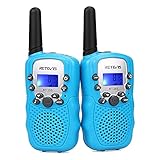 | Retevis RT388 Kids Walkie Talkies, Outdoor Toys for Kids Camping Essentials | 4-12 Year Old Boy Birthday Gift, 22 CH VOX Flashlight Clear Sound, Kids Walkie Talkies 2 Pack for Camping Hiking Adventure | Check Price On Amazon |
 | Cobra RX680 Walkie Talkies (2-Pack), IP54 Water Resistant Design | Rugged & Splashproof Two Way Radios Long Range, 60 Pre-Programmed Channels, Weather Alerts | Check Price On Amazon |
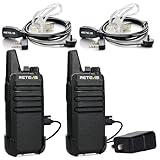 | Retevis RT22 Walkie Talkies Long Range Rechargeable with Earpiece (2 Pack) | Slim & Lightweight 2 Way Radio For Camping & Hiking, Pocket-Friendly Antenna, Ready to Use, 10-Hour Battery, USB-C Charging | Check Price On Amazon |
 | Midland GXT1000VP4 GMRS Two-Way Radios with Headsets, Black, 2 Pack | 50 Channels, 142 Privacy Codes, Up to 36 Mile Long Range, JIS4 Water Resistant, NOAA Weather Alert, Rechargeable NiMH | Check Price On Amazon |
 | Retevis RT628 Walkie Talkies for Kids,Toys Gifts for 6-12 Years Old Boys Girls,Long Range 2 Way Radio 22CH VOX,Birthday Gift,Family Walkie Talkie for Camping Hiking Indoor Outdoor | Check Price On Amazon |