A NOAA weather radio sitting silent on your kitchen counter is not just another electronic gadget collecting dust. It is a direct line to the National Weather Service broadcast network that could wake you at 3 a.m. when a tornado touches down in your county while your smartphone stays silent on the nightstand.
NOAA Weather Radio works through a nationwide network of over 1,000 VHF FM transmitters broadcasting continuous weather information and emergency alerts on seven dedicated frequencies. The system reaches approximately 95% of the U.S. population within 40 miles of a transmitter, using S.A.M.E. technology to target alerts to specific counties rather than blanketing entire regions.
| Photo | Popular Portable Walkie Talkies | Price |
|---|---|---|
 | SKIWARRIOR Multifunctional Smart Wireless Ski Goggles with Walkie-Talkie, Anti-Fog Zeiss Lens, Music & Call Function (Cylindrical Blue) | Check Price On Amazon |
 | SINORISE Super Mini Walkie Talkies, Two-Way Radios, 3 Pack | Check Price On Amazon |
 | KOSPET Tank M4C Smart Watch Rugged, Dual-Band GPS, 5ATM & IP69K Waterproof | Check Price On Amazon |
 | Retevis RT15 Walkie Talkies 3 Pack, Birthday Gift, Outdoor Adventure Kit | Check Price On Amazon |
 | Rechargeable Walkie Talkies Toys for Kids: DIY Astronaut Walkie Talkies for Boys Christmas Birthday Gifts for 3 4 5 6 7 8 9 10 Boy Walkie Talkie Outdoor Hiking Toy 2 Way Radio Camping Outdoor Game | Check Price On Amazon |
By the Numbers
NOAA Weather Radio System – Key Specifications
Sources: NOAA NWR documentation, FCC Part 15, National Weather Service transmitter data
What Is NOAA Weather Radio and How Does It Broadcast Alerts?
NOAA Weather Radio All Hazards (NWR) is a nationwide VHF radio broadcast network operated by the National Oceanic and Atmospheric Administration. It transmits continuous weather forecasts, watches, warnings, and emergency alert information 24 hours a day directly from National Weather Service forecast offices.
Unlike commercial AM or FM radio stations that require you to tune in at specific times, NWR broadcasts nonstop on seven dedicated frequencies in the VHF public service band (162.400 to 162.550 MHz). This happens because the FCC allocated these specific frequencies exclusively for government weather broadcasting under Part 15 rules, ensuring no commercial interference disrupts emergency alerts.
The broadcast chain starts at 122 local NWS Weather Forecast Offices. When meteorologists issue a warning, the alert is encoded using Specific Area Message Encoding (S.A.M.E.) and sent to the nearest NWR transmitter site, which broadcasts it on one of the seven assigned frequencies to NOAA weather alert radios within range. A Midland WR400 weather radio receives this signal, decodes the S.A.M.E. data, and triggers its alarm if the alert matches the county codes you programmed.
This condition only occurs when your weather radio is tuned to the correct local NWR frequency with adequate signal strength. If your radio is on the wrong channel or positioned where the VHF signal cannot reach (like a basement with concrete walls), the result is missed alerts regardless of how close a transmitter is. Understanding how the NOAA weather radio broadcast network delivers alerts from the forecast office to your radio helps you choose the right equipment and placement for reliable emergency notifications.
The Seven NOAA Weather Radio Frequencies Explained
NOAA Weather Radio uses seven specific VHF frequencies between 162.400 MHz and 162.550 MHz, spaced 25 kHz apart. Each NWR transmitter in the nationwide network operates on exactly one of these seven channels, assigned to minimize interference between neighboring transmitters covering adjacent areas.

These frequencies occupy the VHF high band just above the commercial FM broadcast spectrum (88-108 MHz) and below the VHF television bands. Most dedicated weather radios automatically scan all seven channels to find the strongest signal in your area, while multi-band scanners and some two-way radios with weather band receive capability allow manual channel selection.
The seven channels are designated WX1 through WX7 by most radio manufacturers. The actual frequency for each channel is fixed nationwide, which means a weather radio purchased in California works identically in Florida without reprogramming frequencies. You just need to find which channel your local NWR office uses.
Below is a visual breakdown of the complete NOAA Weather Radio frequency allocation. Use this chart to identify your local channel and understand how the frequencies relate to one another.
How S.A.M.E. Technology Filters Alerts for Your Specific County
S.A.M.E. (Specific Area Message Encoding) is the digital protocol that tells your weather radio which alerts to sound and which to ignore. Without S.A.M.E., your radio would alarm for every warning in the entire broadcast coverage area, including counties 40 miles away that may not affect you at all.
Each S.A.M.E. alert contains a 6-digit FIPS (Federal Information Processing Standard) county code embedded in the broadcast signal as a burst of digital data at the start of every alert message. Your weather radio listens for this digital header and only activates its alarm when the FIPS code matches one of the counties you programmed into the radio’s memory. For detailed guidance on finding your specific code, see our step-by-step guide to locating your weather radio county code.
This happens because the NWS forecast office encodes the alert with the FIPS codes for every affected county before it reaches the transmitter. A S.A.M.E.-capable weather radio like the Midland WR400 can store up to 50 county codes in memory, allowing you to monitor your home county plus neighboring counties or locations where family members live.
The S.A.M.E. protocol also includes an event code that identifies the specific alert type (tornado warning, severe thunderstorm watch, flash flood warning, etc.). This lets advanced weather radios filter by alert severity as well as location. If you program only Tornado Warnings and Flash Flood Warnings, your radio stays silent for lesser alerts like a Dense Fog Advisory. Our complete guide to S.A.M.E. weather radio technology explains every event code and how to customize your alert settings.
How the Emergency Alert System Connects to NOAA Weather Radio
The Emergency Alert System (EAS) and NOAA Weather Radio are not separate systems. They are interconnected layers of the same national public warning infrastructure. NWR serves as the primary distribution pathway for weather-related EAS alerts, and EAS serves as the relay mechanism that pushes NWR warnings onto commercial broadcast stations.
When the National Weather Service issues a Tornado Warning, the alert travels simultaneously through two paths: directly to NWR transmitters for broadcast on the seven weather radio frequencies, and into the EAS network where it is relayed to participating AM/FM radio stations, television broadcasters, cable systems, and satellite providers. This dual-path architecture ensures redundancy. If one path fails, the other still delivers the warning.
The EAS uses the same S.A.M.E. digital encoding protocol as NWR, which means the alert data structure is identical whether you receive it from a dedicated weather radio or from an EAS-equipped commercial broadcast receiver. For a deeper understanding of these alert codes, our reference on EAS event codes used in weather radio alerts covers every code category and what triggers each one.
This interconnection is the reason a weather radio alarm sometimes sounds seconds before the same warning appears on television or a smartphone. The NWR broadcast path has fewer relay points than the EAS-to-commercial-broadcast chain, resulting in lower latency from issuance to reception.
What Types of Alerts Does NOAA Weather Radio Broadcast?
NOAA Weather Radio broadcasts over 25 distinct alert event types covering weather hazards, natural disasters, environmental emergencies, and civil threats. These range from the familiar (Tornado Warning, Severe Thunderstorm Warning, Flash Flood Warning) to the less common but equally critical (Hazardous Materials Warning, Civil Emergency Message, AMBER Alert, and National Information Center messages).
The alert types fall into several categories. Meteorological warnings include tornado, severe thunderstorm, flash flood, hurricane, and winter storm alerts. Hydrological warnings cover river flooding, coastal flooding, and tsunami threats. Non-weather emergency messages include 911 outages, nuclear power plant incidents, terrorist attacks, and chemical spills. Each alert type has a unique three-letter S.A.M.E. event code that your weather radio uses to determine whether to activate.
Not every weather radio responds to all 25 alert types. Budget models may trigger only for the highest-priority warnings like tornadoes and flash floods, while advanced S.A.M.E. radios with programmable alert filtering let you select exactly which alert types sound the alarm. The Uniden Bearcat series scanners can also receive NWR alerts alongside other public safety frequencies, giving you broader situational awareness.
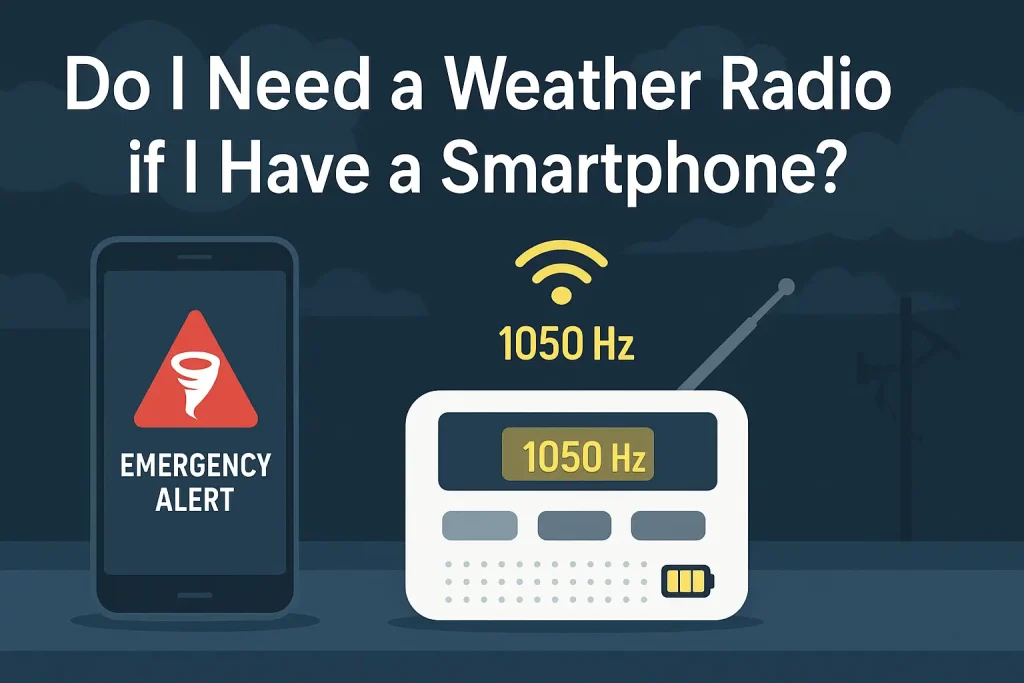
The alert priority system within NWR ensures that life-threatening warnings override routine broadcasts. If your radio is playing the standard weather forecast audio loop and a tornado warning is issued, the S.A.M.E. header immediately interrupts the broadcast with a 1050 Hz attention tone followed by the alert message. This audio priority mechanism is built into the NWR broadcast protocol at the transmitter level.
Seasonal Guide
NOAA Weather Radio Alert Activity – Month-by-Month Guide
When to expect which alert types and what maintenance to perform each month
Lower alert frequency
How a Weather Radio Receives and Decodes the Signal
A weather radio is fundamentally a VHF FM receiver permanently tuned to the 162.400 to 162.550 MHz band. Inside every weather radio, an antenna captures the FM signal, a tuner isolates the specific frequency, and a demodulator extracts the audio and S.A.M.E. data from the carrier wave.
The radio’s squelch circuit keeps the speaker silent during normal standby. When a S.A.M.E. alert header arrives, the decoder chip reads the 1050 Hz attention tone and the digital FIPS data burst that follows. If the county code matches a programmed location, the radio opens the squelch gate and activates the alarm speaker. The alert audio message then plays through at full volume regardless of the radio’s volume knob setting.
Most desktop weather radios with battery backup keep the receiver circuit powered continuously so they remain in standby 24/7. Portable models and hand-crank emergency weather radios typically require manual activation. The Sangean CL-100 weather radio combines continuous standby reception with AM/FM broadcast capability, making it a versatile all-in-one emergency information receiver.
This reception process only works when the radio has a clear line-of-sight path to the nearest NWR transmitter. VHF signals in the 162 MHz range cannot penetrate concrete, steel, or dense earth. If your radio sits in a basement or interior room of a steel-framed building, the result is no reception regardless of the radio’s quality. Position your weather radio near an exterior window on the side of your home closest to the nearest NWR transmitter tower for the most reliable alert reception.
NOAA Weather Radio Coverage: How Far Does the Signal Reach?
NOAA Weather Radio transmitters broadcast at effective radiated power levels from 300 watts to 1,000 watts depending on the terrain and population density of the coverage area. In flat terrain with minimal obstructions, a 1,000-watt NWR transmitter reliably reaches 40 miles. In mountainous regions, coverage may drop to 10 to 15 miles behind ridgelines.
The 95% population coverage figure cited by NOAA means that 95 out of 100 Americans live within the nominal 40-mile coverage radius of at least one NWR transmitter. Actual reception at your specific location depends on your distance from the nearest tower, the terrain between you and that tower, the construction materials of your building, and the sensitivity of your radio’s receiver.
VHF signals in the 162 MHz band travel primarily by line of sight. They do not follow the curvature of the earth like lower-frequency AM signals. This means that hills, mountains, and large buildings between you and the transmitter site create radio shadows where the signal is weak or absent entirely. If you live in a valley with no direct line of sight to the nearest NWR transmitter, you may need an outdoor antenna mounted high enough to clear the obstructing terrain.
Use the table below to estimate your likely reception quality based on distance and terrain from the nearest NWR transmitter.
Range Reference
NOAA Weather Radio Reception by Distance and Terrain
Estimated reception quality based on NWR transmitter power and terrain type. Source: NOAA NWR coverage maps, VHF propagation characteristics.
| Distance from transmitter | Flat open terrain | Rolling hills | Mountain valleys | Dense urban |
|---|---|---|---|---|
| 0 to 15 miles | Excellent (full quieting) | Very good (minor static) | Good to fair (some dead spots) | Good (building dependent) |
| 15 to 25 miles | Very good (slight static) | Fair (most common scenario) | Poor to fair (intermittent) | Fair (near window only) |
| 25 to 40 miles | Fair (noticeable static) | Poor (unreliable, outdoor antenna needed) | Very poor to none | Poor to none |
| Over 40 miles | Poor (outdoor antenna required) | Unlikely without elevated antenna | No reception expected | No reception expected |
Estimates assume standard weather radio with built-in whip antenna at ground-floor window height. An outdoor VHF antenna mounted at rooftop height can improve reception by 1-2 categories. Source: VHF propagation principles, NOAA NWR coverage documentation.
NOAA Weather Radio vs Regular Radio: What Makes Them Different?
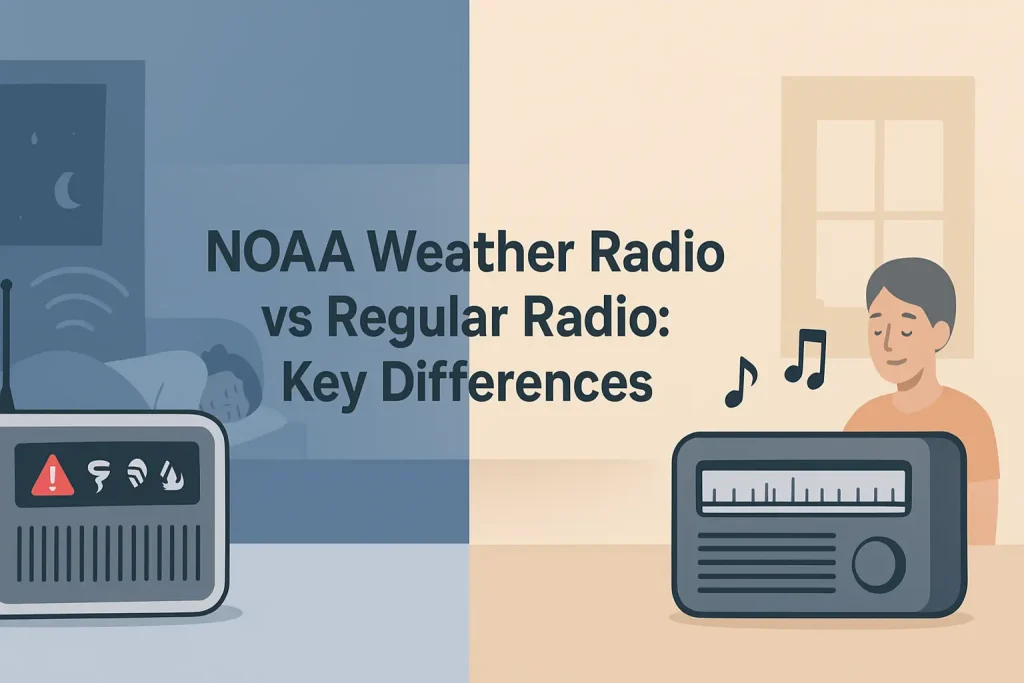
A NOAA weather radio is not just another FM radio with one extra band. It is a purpose-built alert receiver designed to stay silent until a life-threatening S.A.M.E.-encoded message arrives on a dedicated government frequency.
Regular AM/FM radios receive entertainment broadcasts on completely different frequency bands (AM: 530-1700 kHz, FM: 88-108 MHz). They cannot receive the 162.400-162.550 MHz NOAA band at all unless specifically equipped with a weather band receiver. Even then, a standard radio without S.A.M.E. decoding capability cannot filter alerts by county, and it cannot automatically activate its speaker when an alert broadcasts.
The comparison extends beyond frequency coverage to functionality. Our detailed comparison of weather radios versus standard radio receivers covers the full technical and practical differences, including standby power consumption, alert tone decoders, and why a dedicated weather radio remains the only reliable option for unattended emergency alert monitoring.
A portable AM/FM/weather radio combination unit can serve double duty for entertainment and weather monitoring, but only if it includes S.A.M.E. decoding. Without S.A.M.E., you get the same unfiltered audio broadcast as any other weather band receiver with no ability to wake you for your specific county’s warnings.
How to Program a NOAA Weather Radio for Your Location
Programming a S.A.M.E. weather radio starts with finding your county’s 6-digit FIPS code. You can look this up on the NWS website or through your radio’s manual, which often includes a printed list of codes by state. Each digit in the FIPS code narrows the geographic targeting: the first two digits identify the state, and the last four identify the specific county or parish.
Once you have your FIPS code, enter it into the radio using the keypad or menu system. Most Midland desktop weather radios allow you to store multiple county codes (typically 15 to 50 depending on the model). After programming the codes, test the radio by pressing the “Weather” or “Test” button to confirm you receive the local NWR broadcast clearly.
If the broadcast comes through with static or is inaudible, try repositioning the radio near a different window or extending the antenna fully. If you still cannot get clear reception, you may be in a coverage gap. Our guide to NOAA weather radio frequency assignments helps you identify alternative transmitters that may serve your location from a different direction or on a different channel.
If your weather radio stops responding or behaves unexpectedly after programming, consult our instructions for resetting Midland weather radios to factory defaults. A reset clears corrupted S.A.M.E. entries and restores normal alert functionality.
Weather Radio vs Smartphone Alerts: Which Is More Reliable?
A dedicated NOAA weather radio receives alerts directly from the NWR transmitter network with no dependency on cellular towers, internet connectivity, or third-party servers. Smartphone weather alerts rely on cell towers, data networks, and app push notification infrastructure that can fail during the same severe weather events that generate the alerts.
The latency difference is significant. NWR alerts reach your weather radio within seconds of issuance because the signal path is direct: NWS forecast office to transmitter to your radio. Smartphone alerts travel through multiple servers, wireless carriers, and app platforms, introducing delays that can range from 30 seconds to several minutes. During a tornado warning with a 10-minute lead time, those seconds matter.
Cellular networks also fail during widespread emergencies when towers lose power or become overloaded with traffic. Our comparison of weather radio reliability versus smart speaker and smartphone emergency alerts explains why the dedicated radio path remains the gold standard for life-saving warnings. A hand-crank weather radio with solar charging and battery backup operates indefinitely without grid power, cell service, or internet access.
The Technology Behind NWR: What Makes the Broadcast System Work
The NWR broadcast infrastructure operates as a highly redundant digital and analog hybrid system. Each transmitter site receives its feed via satellite link, landline, or microwave relay from the parent NWS forecast office. The audio feed carries both the continuous weather broadcast cycle and the embedded S.A.M.E. digital data bursts that trigger weather radio alarms.
At the transmitter, the combined audio and S.A.M.E. data stream modulates an FM carrier at one of the seven assigned frequencies. The transmitter amplifies this modulated signal to the authorized effective radiated power (typically 300 to 1,000 watts) and broadcasts it through an omnidirectional antenna mounted on a tower, often shared with other public safety radio systems.
This happens because the FCC authorized NOAA to use these seven frequencies as a nationwide exclusive allocation. No other service may transmit on 162.400 to 162.550 MHz, which eliminates interference that could corrupt a S.A.M.E. alert header or mask the 1050 Hz attention tone. The 25 kHz channel spacing between adjacent frequencies ensures that transmitters on WX1 and WX2 in the same region cannot bleed into each other’s coverage areas.
If any component in this chain fails (the satellite link drops, the transmitter loses power, or the antenna sustains damage), the result is a coverage gap where weather radios receive no signal. The NWS monitors transmitter health remotely and dispatches technicians to restore service, but in remote areas a repair may take days. This is why having a backup alert source (such as a portable scanner with weather band capability) provides redundancy. The complete overview of what NOAA Weather Radio is and how it serves the public covers the full system architecture in greater detail.
Quick Reference: Key NOAA Weather Radio Terms
Quick Reference
NOAA Weather Radio – Key Terms Defined
Essential terminology used throughout this guide
NWR: NOAA Weather Radio All Hazards, the nationwide VHF broadcast network operated by the National Weather Service.
S.A.M.E.: Specific Area Message Encoding, the digital protocol that encodes county-level location data and alert type codes into the NWR broadcast signal.
FIPS Code: A 6-digit Federal Information Processing Standard code that uniquely identifies each US county for S.A.M.E. alert targeting.
1050 Hz Tone: The attention signal that precedes every S.A.M.E. alert and triggers weather radios to unmute their speakers.
EAS: Emergency Alert System, the nationwide public warning network that relays NWR alerts to commercial broadcast stations.
WX1-WX7: Manufacturer channel designations for the seven NOAA weather radio frequencies (162.400-162.550 MHz).
VHF: Very High Frequency radio band (30-300 MHz) where NOAA weather radio operates.
FM Carrier: Frequency Modulation, the method by which audio and S.A.M.E. data are transmitted on the NOAA weather radio frequencies.
Squelch: A circuit that mutes the radio speaker when no valid signal is present, keeping the radio silent between alerts.
Can I Use a Two-Way Radio to Receive NOAA Weather Radio?
Many FRS and GMRS two-way radios include a weather band receive function that lets you listen to NOAA Weather Radio broadcasts on the seven NWR frequencies. These radios receive NWR audio but do not decode S.A.M.E. alert headers, so they cannot automatically activate for warnings the way a dedicated weather radio does.
The weather band function on a Motorola Talkabout two-way radio or Midland GXT1000 GMRS radio lets you manually tune to the strongest NWR channel in your area to hear the continuous weather broadcast. This is useful for checking forecasts while hiking or camping, but it is not a substitute for a dedicated S.A.M.E. weather radio that monitors alerts unattended.
This limitation exists because two-way radio weather band receivers lack the S.A.M.E. decoder chip and the alert-wake circuit present in dedicated weather radios. If you are sleeping and a tornado warning is issued, a two-way radio tuned to the weather band will play the alert audio, but only if the volume is turned up and the radio is not in battery-save mode.
Why Does My Weather Radio Alarm for Counties Far Away From Me?
Your weather radio alarms for distant counties because you have not programmed S.A.M.E. county codes into it, or you programmed codes incorrectly. Without S.A.M.E. filtering, the radio treats every alert on the broadcast channel as relevant and sounds its alarm for warnings across the entire transmitter coverage area, which may span 10 to 20 counties.
The fix is straightforward. Look up your county’s specific 6-digit FIPS code using the NWS website or the code list in your radio’s manual. Enter this code into the radio’s S.A.M.E. programming menu, then enable S.A.M.E. filtering (often labeled “SAME” or “Alert Filter” in the settings). After this, the radio ignores alerts for any county not matching your programmed codes.
Some weather radios have a separate setting to enable or disable S.A.M.E. filtering globally. If you programmed the correct codes but still receive alerts for other counties, check that S.A.M.E. filtering is actually turned on in the radio’s alert settings menu. On Midland WR120 radios, the “SAME” indicator must appear on the display for filtering to be active. A weather radio with simple S.A.M.E. programming makes this process less error-prone.
What Is the 1050 Hz Tone and Why Does My Radio Make That Sound?
The 1050 Hz attention tone is the loud, distinctive burst of sound that plays immediately before every NOAA Weather Radio alert message. It serves two purposes: it wakes the S.A.M.E. decoder circuit in standby weather radios and alerts anyone actively listening that an emergency message follows.
This tone is part of the NWR broadcast standard specified by NOAA. The transmitter sends the 1050 Hz tone for eight to ten seconds at the start of every S.A.M.E.-encoded alert. Weather radios monitor for this specific frequency tone on the received audio signal. When the radio detects 1050 Hz, it wakes from standby, activates the speaker at full volume, and prepares to decode the S.A.M.E. data header that immediately follows.
You cannot disable the 1050 Hz tone on a standards-compliant weather radio because it is the alert trigger mechanism itself. Some advanced radios let you adjust the alert volume separately from the broadcast volume, but the tone always plays. The tone frequency of 1050 Hz was chosen because it is within the range of human hearing that remains audible even with age-related hearing loss, typically between 1000 and 2000 Hz.
Do I Need a License to Own or Use a NOAA Weather Radio?
No. NOAA Weather Radio receivers require no FCC license to own, operate, or use anywhere in the United States. Weather radios are receive-only devices. They do not transmit, so they fall under FCC Part 15 rules for unintentional radiators rather than the licensed radio service rules in Parts 80, 87, 90, 95, or 97.
This is the fundamental legal distinction between weather radios and two-way radios. A weather radio only receives signals broadcast by government-operated NWR transmitters. It cannot interfere with other radio services because it emits no radio frequency energy beyond the minimal unintentional radiation from its internal oscillator circuits, which is regulated under Part 15 at levels too low to cause interference.
By contrast, GMRS radios require a $35 FCC license because they transmit on frequencies shared with other services. FRS radios require no license because they operate at lower power (2 watts maximum) on channels that the FCC has designated for unlicensed use under Part 95. A weather radio sits entirely outside this regulatory framework because it never transmits.
How Often Does NOAA Test the Weather Radio System?
NOAA conducts a Required Weekly Test (RWT) of the NWR system every Wednesday between 10 a.m. and noon local time, weather permitting. This test verifies that the S.A.M.E. encoding system, transmitter chain, and alert dissemination network are functioning correctly from the forecast office to your radio.
The weekly test broadcasts a S.A.M.E. header with the event code RWT (Required Weekly Test) followed by a short test message. Your weather radio should recognize the RWT code and respond according to its settings. Most radios light an indicator or sound a brief acknowledgment tone without activating the full alarm sequence. If your radio has not triggered for several weeks, the lack of a Wednesday test activation may indicate a reception or programming problem.
The NWS postpones the weekly test if severe weather is occurring or forecast in the coverage area. This policy prevents test messages from being confused with actual warnings during active weather events. If you do not hear a test for two or three consecutive Wednesdays with clear weather, reposition your radio or verify your S.A.M.E. programming.
Can I Listen to NOAA Weather Radio Online Instead of Buying a Radio?
Yes, NOAA provides live audio streams of most NWR transmitters through the NWS website and various third-party streaming services. These internet streams deliver the same continuous weather broadcast audio that over-the-air radios receive. However, internet streaming cannot replicate the S.A.M.E. alert-wake function that makes a dedicated weather radio valuable.
An internet stream of your local NWR channel lets you hear the forecast and any alert audio that broadcasts while you are actively listening. But your computer or smartphone does not decode the S.A.M.E. data header, cannot filter by county, and will not wake from sleep mode or activate its speaker when an alert arrives. You must be actively using the device and have the stream playing to hear anything.
During severe weather events that cause power outages or overload cellular networks, internet-based weather radio streams become unavailable at exactly the moment you need them most. A battery-powered weather radio with S.A.M.E. alert capability operates independently of grid power, internet connectivity, and cellular service. Use internet streams as a supplement for checking forecasts, not as a replacement for a dedicated alert receiver.
What Is the Difference Between a Watch and a Warning on Weather Radio?
A watch means conditions are favorable for the hazard to develop. A warning means the hazard is occurring or imminent and you should take protective action immediately. NOAA Weather Radio uses distinct S.A.M.E. event codes for each, and your radio’s response (alert tone pattern, display message, and voice announcement) differs between the two categories.
The distinction is critical because the appropriate response differs. A Tornado Watch covering 20 counties may last six hours and requires you to stay informed and prepared. A Tornado Warning typically covers one to three counties for 30 to 45 minutes and requires you to seek shelter immediately. Weather radios with selective alert programming let you choose whether watches trigger the alarm or only appear as silent display messages, while most users configure warnings to always activate the full alert sequence.
This distinction applies across all NWR alert categories: Severe Thunderstorm Watch versus Warning, Flash Flood Watch versus Warning, Hurricane Watch versus Warning, and Winter Storm Watch versus Warning. The S.A.M.E. event codes for watches use different three-letter identifiers than the corresponding warnings, letting your radio apply different alert rules to each.
How Long Do NOAA Weather Radio Batteries Last During an Outage?
Alkaline AA batteries in a weather radio operating in standby mode (monitoring for alerts but with the speaker off) last approximately 40 to 72 hours depending on the radio model and battery quality. If the radio activates frequently for alerts and plays audio at full volume, battery life drops to 8 to 15 hours of continuous alert playback.
The key variable is standby current draw. Most desktop weather radios consume 20 to 50 milliamps in standby mode waiting for a S.A.M.E. alert header. At this current, a set of four fresh alkaline AA batteries (approximately 2,500 mAh capacity) lasts roughly 50 to 60 hours. Lithium AA batteries extend this to 80 to 100 hours due to their higher energy density and better low-temperature performance.
During extended power outages after hurricanes or ice storms, replace your weather radio’s batteries every 48 hours even if the radio has not activated frequently. Keep a supply of at least 16 AA batteries dedicated to your weather radio. A solar and hand-crank powered weather radio eliminates battery anxiety entirely by letting you recharge through built-in solar panels or a hand crank generator during prolonged outages.
Why Does My Weather Radio Lose Reception at Night?
VHF radio signals in the 162 MHz band can experience a phenomenon called tropospheric ducting at night, where temperature inversions in the atmosphere bend signals downward beyond the normal line-of-sight horizon. This can cause distant NWR transmitters on the same channel to interfere with your local transmitter, creating static or signal dropout.
This is a known characteristic of VHF propagation, not a defect in your radio. During daytime, the sun heats the ground and creates atmospheric mixing that keeps VHF signals confined to their normal coverage area. After sunset, cooling air near the ground can create a temperature inversion layer that acts like a waveguide, ducting signals from transmitters 100 to 300 miles away into your receiver.
If your weather radio has an option to manually select a specific NWR channel rather than auto-scanning, locking it to your local transmitter’s channel reduces the impact of nighttime ducting. An outdoor directional antenna pointed at your nearest NWR transmitter also helps reject distant co-channel signals arriving from other directions.
Can I Connect an Outdoor Antenna to My Weather Radio for Better Reception?
Yes, most desktop weather radios have an external antenna connector (typically an F-type or RCA jack) labeled “EXT ANT” or “External Antenna.” Connecting an outdoor VHF antenna improves reception significantly, especially if you live more than 20 miles from the nearest NWR transmitter or in a valley with obstructed line of sight.
A basic outdoor VHF scanner antenna mounted at rooftop height adds 10 to 15 dB of signal gain compared to the built-in telescopic whip antenna, which translates to roughly double the usable reception range. The antenna does not need to be NWR-specific. Any VHF antenna covering 150 to 170 MHz works well on the 162.400 to 162.550 MHz weather band.
Use 50-ohm coaxial cable (RG-58 or RG-8X) between the antenna and your weather radio. Keep the cable run as short as practical because signal loss increases with cable length at VHF frequencies. A VHF outdoor scanner antenna with an F-type connector and 50 feet of RG-58 cable costs less than $40 and often makes the difference between no reception and clear reception in fringe coverage areas.
NOAA Weather Radio represents one of the most reliable public warning systems ever deployed. It operates on dedicated frequencies, uses county-level S.A.M.E. targeting, and functions independently of cellular networks and internet infrastructure. Understanding how the seven NWR channels carry alerts from 122 forecast offices through 1,000 transmitters to your weather radio helps you configure your equipment correctly for your specific location and risk profile.
Choose a S.A.M.E.-capable weather radio with battery backup. Program your county FIPS codes. Test reception every Wednesday during the weekly test. Keep fresh batteries available. If you do these four things, your weather radio will wake you when a tornado touches down in your county, whether or not your cell phone receives the same warning in time.
| Photo | TOP RATED WALKIE TALKIES | Price |
|---|---|---|
 | Retevis RT628 Kids Walkie Talkies, Toys Gifts for 4-12 Year Old Girl Boy | Check Price On Amazon |
 | Cobra ACXT545 Weather-Resistant Walkie Talkies, Rechargeable, 22 Channels | Check Price On Amazon |
 | Retevis RT388 Kids Walkie Talkies, Outdoor Toys for Kids Camping Essentials | Check Price On Amazon |
 | Cobra RX680 Walkie Talkies (2-Pack), IP54 Water Resistant Design | Check Price On Amazon |
 | Retevis RT22 Walkie Talkies Long Range Rechargeable with Earpiece (2 Pack) | Check Price On Amazon |
 | Midland GXT1000VP4 GMRS JIS4 Two-Way Radio, Black,2 Pack | Check Price On Amazon |
 | Retevis RT628 Walkie Talkies for Kids,Toys Gifts for 6-12 Years Old Boys Girls,Long Range 2 Way Radio 22CH VOX,Birthday Gift,Family Walkie Talkie for Camping Hiking Indoor Outdoor | Check Price On Amazon |