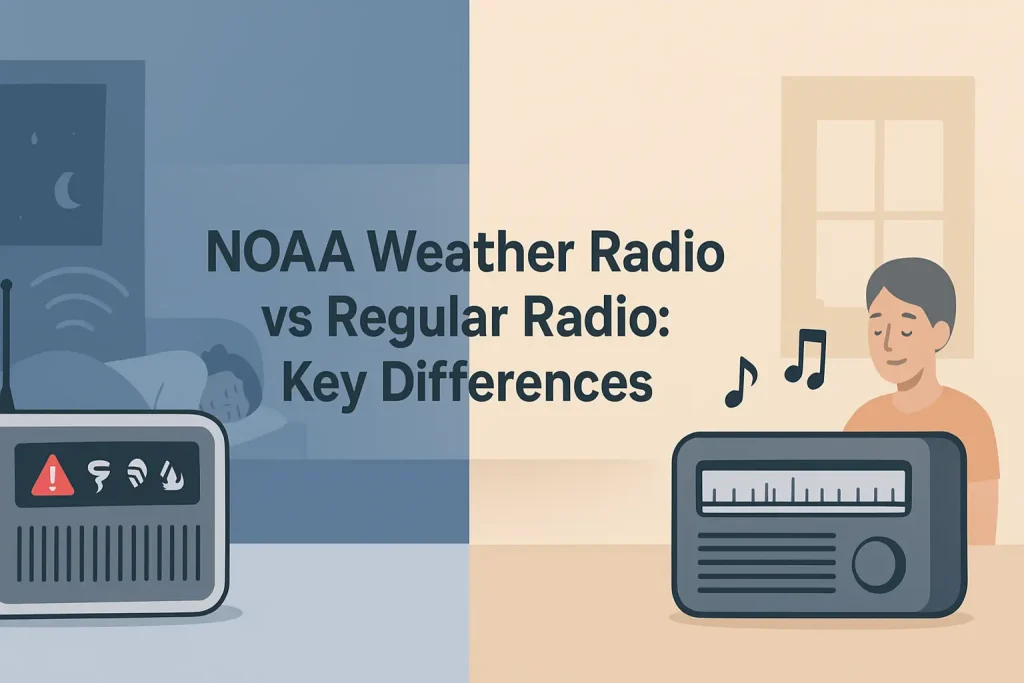
Your Midland weather radio stopped responding to button presses, locked up on the wrong alert county, or started behaving strangely after a power outage. A factory reset clears every custom setting and returns the radio to the state it left the factory in. This guide covers every Midland weather radio model with a reset procedure, including the WR120B, WR300, WR400, ER310, and HH54VP2.
Before you reset, understand what you will lose. Every programmed S.A.M.E. (Specific Area Message Encoding) county code, alert type filter, and alarm time gets erased. You will need to reprogram your 6-digit FIPS county codes after the reset is complete.
| Photo | Popular Portable Walkie Talkies | Price |
|---|---|---|
 | SKIWARRIOR Multifunctional Smart Wireless Ski Goggles with Walkie-Talkie, Anti-Fog Zeiss Lens, Music & Call Function (Cylindrical Blue) | Check Price On Amazon |
 | SINORISE Super Mini Walkie Talkies, Two-Way Radios, 3 Pack | Check Price On Amazon |
 | KOSPET Tank M4C Smart Watch Rugged, Dual-Band GPS, 5ATM & IP69K Waterproof | Check Price On Amazon |
 | Retevis RT15 Walkie Talkies 3 Pack, Birthday Gift, Outdoor Adventure Kit | Check Price On Amazon |
 | Rechargeable Walkie Talkies Toys for Kids: DIY Astronaut Walkie Talkies for Boys Christmas Birthday Gifts for 3 4 5 6 7 8 9 10 Boy Walkie Talkie Outdoor Hiking Toy 2 Way Radio Camping Outdoor Game | Check Price On Amazon |
By the Numbers
Midland Weather Radio Reset – Key Facts
Sources: Midland Radio product documentation, NOAA NWR technical specifications, FCC Part 15.
What Does a Factory Reset Actually Do to a Midland Weather Radio?
A factory reset on a Midland weather radio erases all user-programmed data and restores the radio’s firmware settings to their original defaults. This includes S.A.M.E. county codes, alert type filters, alarm clock times, squelch level, display backlight settings, and any channel lock selections.
After a reset, the radio defaults to receiving all 25 S.A.M.E. alert event types for all counties served by the strongest NOAA transmitter in range, broadcasting on one of the seven dedicated NOAA frequencies between 162.400 and 162.550 MHz.
A reset does not damage the radio or delete firmware. It is equivalent to a soft restore on a phone. Every function returns to working condition with default settings active.
The most common reasons to perform a reset include: the radio is locked up and unresponsive, it is alerting for the wrong county, a previous owner programmed it incorrectly, or the unit started producing false alarms after a power surge.
Quick Reference
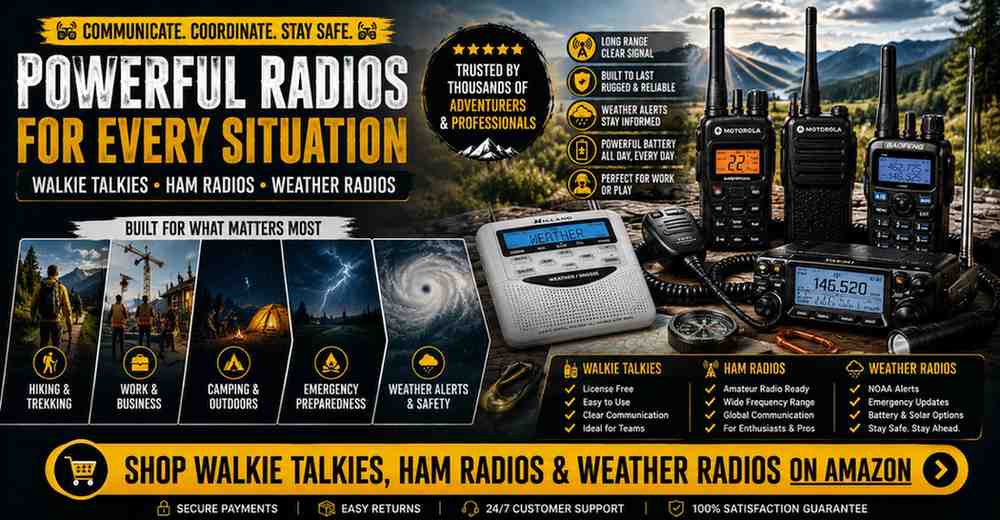
Key Terms for Midland Weather Radio Reset
Definitions for terms used throughout this guide.
S.A.M.E. (Specific Area Message Encoding): A digital coding system built into NOAA weather alerts that lets your radio filter alerts by county. Only warnings for your programmed county trigger the alarm.
FIPS code: A 6-digit Federal Information Processing Standard number that identifies a specific U.S. county. This is what you enter into your Midland radio to enable S.A.M.E. county filtering.
Factory reset: A procedure that erases all user settings and restores the radio to its original out-of-box defaults.
NWR (NOAA Weather Radio All Hazards): The national network of radio stations broadcasting continuous weather and emergency alerts on seven VHF frequencies between 162.400 and 162.550 MHz.
Alert type filter: A setting that tells your radio which of the 25 S.A.M.E. event types (tornado warning, flash flood warning, etc.) should trigger the alarm.
Squelch: A circuit that silences the radio speaker when no signal is present. A reset returns squelch to the factory default level.
WX channels: The seven dedicated NOAA weather broadcast channels (WX1 through WX7) corresponding to the seven NWR frequencies.
Lockup: A state where the radio stops responding to button presses, usually caused by a firmware glitch or corrupted settings. A reset resolves most lockups.
EAS (Emergency Alert System): The national public warning system that NOAA weather radios participate in. S.A.M.E. is the encoding standard used within EAS for geographic targeting.
Alarm memory: The stored county codes and alert type selections that the radio uses to decide whether to sound an alarm. A reset clears this memory entirely.
The step-by-step process below walks through the reset procedure for every current and recent Midland weather radio model. Find your model number on the label on the back of the unit before continuing.
How to Reset the Midland WR120B and WR120EZ to Factory Settings
The Midland WR120B and WR120EZ use the same reset procedure. Both models store up to 25 S.A.M.E. alert types and one county code in memory. A reset clears both stored values.
Key Specifications (Midland WR120B):
- Frequencies monitored: 162.400, 162.425, 162.450, 162.475, 162.500, 162.525, 162.550 MHz
- S.A.M.E. alert event types: 25
- County code storage: 1 FIPS location code
- Power: AC adapter with 3x AA battery backup
Follow these steps exactly. Button order matters on these models.
Step-by-Step Guide
How to Factory Reset the Midland WR120B and WR120EZ
7 steps · Estimated time: 2 minutes
Power off the radio completely
Press and hold the Power button until the display goes blank. Do not just mute the unit. The radio must be fully powered down before you start the reset sequence.
Remove the batteries from the backup battery compartment
Open the battery compartment on the back of the unit and remove all three AA batteries. Leaving batteries installed while resetting can prevent the memory from clearing fully.
Unplug the AC power adapter
Pull the power cord from the back of the radio. With both AC and battery power removed, the radio’s volatile memory begins to discharge. Wait a full 30 seconds before proceeding.
Press and hold the “Alert” button
With the radio still unplugged and batteries still out, press and hold the Alert button on the front panel. Keep it held down through the next step.
Reconnect AC power while holding the Alert button
Plug the AC adapter back in while you are still holding the Alert button. The display will flash briefly and the radio will chime or beep once to confirm the reset has been initiated.
Release the Alert button after the beep
Once you hear the confirmation beep or see the display flash, release the Alert button. The radio will restart and display its default startup screen. All custom settings have now been cleared.
Reinstall the AA batteries and reprogram your S.A.M.E. county code
Insert three fresh AA batteries into the backup compartment. Then enter your 6-digit FIPS county code to restore county-level alert filtering. Without this step, the radio will alert for every county in your NOAA transmitter’s broadcast area.
The WR120B reset is complete once the radio shows its default channel display and resumes scanning across all seven NOAA frequencies. Reprogram your FIPS county code before the next storm season arrives.
How to Reset the Midland WR300 to Factory Settings
The Midland WR300 has a dedicated reset button recessed into the bottom or back panel. You will need a paperclip or a thin ballpoint pen tip to press it. This model stores up to 25 S.A.M.E. alert event types and up to 5 FIPS county codes, all of which are wiped during a reset.
Key Specifications (Midland WR300):
- Frequencies: 162.400 to 162.550 MHz (7 NOAA channels)
- S.A.M.E. county code storage: up to 5 FIPS codes
- S.A.M.E. alert event types: 25
- Power: AC adapter with 3x AA battery backup
Step-by-Step Guide
How to Factory Reset the Midland WR300
4 steps · Estimated time: 1 minute
Locate the recessed reset button
Turn the radio over and look for a small hole labeled “RESET” on the bottom or rear panel. It is approximately 1.5mm in diameter and is recessed to prevent accidental activation.
Keep the radio powered on
Unlike the WR120B, the WR300 reset requires the radio to be powered on and connected to AC power. Do not power it off before pressing the reset button.
Insert paperclip and press the reset button for 3 seconds
Insert the tip of a straightened paperclip into the reset hole and press firmly for 3 full seconds. The display will go blank and then restart automatically. A short beep confirms the reset.
Reprogram your S.A.M.E. county codes after restart
Once the radio restarts, all five county code slots are empty. Use the programming menu to re-enter your 6-digit FIPS codes. The radio needs at least one county code to filter alerts to your specific area.
The WR300 recessed reset button is the fastest approach among all Midland models. Once the display shows the default channel and the radio starts scanning, the reset is complete.
How to Reset the Midland WR400 to Factory Settings
The Midland WR400 is the most feature-rich desktop weather radio Midland produces. It stores up to 50 S.A.M.E. county codes and monitors all 25 alert event types, with a color-coded alarm light system. A factory reset clears all 50 county code slots, all alarm time settings, and all alert type filter selections.
Key Specifications (Midland WR400):
- Frequencies: 162.400 to 162.550 MHz (7 NOAA channels, WX1 through WX7)
- S.A.M.E. county code storage: up to 50 FIPS codes
- S.A.M.E. alert event types: 25
- Color alert system: 3 color-coded LED alerts (red for warnings, orange for watches, yellow for advisories)
- Power: AC adapter with 6x AA battery backup
Step-by-Step Guide
How to Factory Reset the Midland WR400
5 steps · Estimated time: 2 minutes
Press and hold the “Menu” button for 5 seconds
With the radio powered on and plugged in, press and hold the Menu button on the front panel for a full 5 seconds. The display will show “RESET” or “CLR ALL” depending on your firmware version.
Confirm the reset prompt using the “+” or “Enter” button
When the reset confirmation prompt appears, press the “+” button (or the Enter button on units that have one) to confirm. Pressing any other button at this stage cancels the reset without making any changes.
Wait for the display to restart
The radio will go dark for approximately 3 seconds and then restart with the factory default display. All 50 county code slots, all alarm times, and all alert type filter selections are now cleared.
Remove and reinstall batteries to complete memory clear
After the display restarts, open the battery compartment and remove all six AA batteries for 10 seconds, then reinstall them. This clears any residual data stored in battery-backed memory registers that the menu reset may not reach.
Reprogram county codes and alert type preferences
Enter your primary 6-digit FIPS county code through the programming menu. The WR400 supports up to 50 county slots, so you can add adjacent counties if your location sits near a county border. Then restore your preferred alert type filter selections.
The WR400 is the only Midland desktop weather radio with a menu-driven reset option. You do not need a paperclip or a power cycle sequence. After reprogramming your county codes and alert types, the color-coded LED system functions immediately.
How to Reset the Midland ER310 Emergency Crank Radio to Factory Settings
The Midland ER310 combines a NOAA weather radio receiver with AM/FM tuning, a hand-crank generator, solar charging, and a USB power bank output. The reset procedure is different from the desktop WR-series models because the ER310 uses a different circuit board architecture with lithium-ion battery management.
Key Specifications (Midland ER310):
- Weather frequencies: 162.400 to 162.550 MHz (7 NOAA channels)
- Additional bands: AM (520-1710 kHz) and FM (87.5-108 MHz)
- S.A.M.E. alert filtering: yes, county-level
- Power sources: built-in 2000 mAh lithium-ion battery, hand crank, solar panel, micro-USB input
- Battery backup capacity: 2000 mAh (also outputs to charge external devices)
Step-by-Step Guide
How to Factory Reset the Midland ER310 Crank Radio
4 steps · Estimated time: 2 minutes
Power on the ER310
Press the Power button to turn the unit on. The ER310 must be powered on and not connected to an external USB charging source during the reset sequence.
Switch to NOAA Weather Radio mode
Use the Band button to cycle through modes until the display shows “WX” for NOAA Weather Radio. The reset procedure only initiates from WX mode on the ER310.
Press and hold the “Alert” button for 8 seconds
While in WX mode, press and hold the Alert button for a full 8 seconds. The display will briefly flash all segments and then return to the default WX1 channel display. A single beep confirms the reset completed successfully.
Reprogram your S.A.M.E. county code
Access the programming menu by pressing and holding the Alert button for 3 seconds (a shorter hold than the reset sequence). Navigate to the SAME CODE option and enter your 6-digit FIPS code to restore county-specific alert filtering.
If the ER310 reset does not complete on the first attempt, try unplugging the USB charging cable, waiting 15 seconds, and repeating the sequence. The USB charging circuit can interrupt the reset on this model when active.
How to Reset the Midland HH54VP2 Portable Weather Radio to Factory Settings
The Midland HH54VP2 is a handheld portable weather radio with S.A.M.E. alert filtering. It runs on 3x AA batteries and has no AC power option. Because it has no AC power adapter, the reset procedure relies entirely on a button combination and a full battery removal.
Key Specifications (Midland HH54VP2):
- Frequencies: 162.400 to 162.550 MHz (7 NOAA channels)
- S.A.M.E. alert filtering: yes, county-level
- Power: 3x AA batteries only
- Flashlight: built-in LED flashlight on top panel
Step-by-Step Guide
How to Factory Reset the Midland HH54VP2 Portable Weather Radio
4 steps · Estimated time: 1 minute
Remove all three AA batteries
Open the battery compartment on the back of the HH54VP2 and remove all three AA batteries. Wait a full 60 seconds to allow the internal capacitors to discharge completely. This is longer than other Midland models because the HH54VP2 has no AC discharge path.
Press and hold the Power button for 5 seconds while batteries are out
With all batteries removed, press and hold the Power button for 5 seconds. This drains any remaining charge from the radio’s internal memory circuit. Release the button before inserting fresh batteries.
Insert fresh AA batteries and power on
Install three fresh AA batteries and press the Power button. The radio will start up on the default factory channel (WX1, which corresponds to 162.550 MHz) with no county codes stored in memory.
Program your S.A.M.E. county code
Hold the Alert button for 3 seconds to enter the S.A.M.E. programming menu. Enter your 6-digit FIPS county code using the channel up and down buttons. The HH54VP2 stores one county code slot only.
Use fresh AA alkaline batteries rather than partially depleted ones when completing the HH54VP2 reset. Low voltage batteries cause programming glitches on this model more often than on AC-powered desktop models.
Before vs After: What Changes When You Reset a Midland Weather Radio
Understanding exactly what changes after a reset helps you prioritize what to reprogram first. The table below shows every setting category and its state before and after a factory reset.
Use the table below to identify which settings need to be re-entered after the reset is complete.
Quick Reference
Midland Weather Radio Settings Before and After Factory Reset
Source: Midland Radio product documentation and user manuals.
| Setting | Before Reset (Custom) | After Reset (Default) |
|---|---|---|
| S.A.M.E. county codes | Custom FIPS codes programmed | All slots cleared (alerts all counties) |
| Alert event type filter | User-selected types active | All 25 alert types re-enabled |
| NOAA channel selection | Locked to specific channel | Scans all 7 channels (WX1-WX7) |
| Alarm clock time | Custom time set | Alarm cleared |
| Display backlight level | Custom brightness | Factory default brightness |
| Alert volume level | Custom volume | Factory default (mid-level) |
| Radio functionality | May be locked or glitching | Fully restored and operational |
Results
What Changes When You Reset vs Leave a Midland Weather Radio as Is
Impact of resetting a misconfigured or locked Midland weather radio
Before Reset
- ✗Alerting for wrong county or entire state broadcast area
- ✗Unresponsive to button presses (locked up firmware state)
- ✗False alarms triggering for non-relevant alert event types
- ✗Previous owner’s county codes active for a different region
After Reset
- ✓All buttons responsive, display functioning normally
- ✓Ready to accept your correct FIPS county code
- ✓All 25 S.A.M.E. alert event types active and filtering correctly
- ✓Scanning all 7 NOAA frequencies to find the strongest signal
A factory reset takes under 2 minutes and restores full radio functionality. Reprogramming your county code is the only required step after the reset is complete.
How to Find Your FIPS S.A.M.E. County Code After a Reset
After a factory reset, your Midland weather radio will alert for every county within range of your nearest NOAA transmitter. This is the default state, and it will wake you at 3 a.m. for flash flood warnings in counties 60 miles away. You need your 6-digit FIPS county code to restore county-level filtering.
NOAA publishes the complete FIPS code database through the National Weather Service website at weather.gov/nwr. You can also find your code through the SAME code lookup tool at the Midland Radio website. Your code is a 6-digit number where the first digit is always 0 for the United States, the next two digits are your state FIPS code, and the last three digits identify your specific county.
For example, Cook County, Illinois uses FIPS code 017031. The “0” prefix is required. The “17” is the Illinois state code. The “031” identifies Cook County specifically within Illinois.
If you live near a county line, program codes for both counties. The WR400 supports up to 50 county codes, the WR300 supports 5, and the WR120B and HH54VP2 each support 1. For a detailed look at how S.A.M.E. technology works and why county-level coding matters, see our guide on how the S.A.M.E. alert system filters emergency broadcasts by location.
Programming the wrong county code is one of the most common post-reset mistakes. Double-check the 6-digit code against the official NOAA list before entering it.
Troubleshooting: What to Do When the Reset Does Not Work
A factory reset fails to complete for three main reasons: insufficient power during the reset sequence, incorrect button timing, or a hardware fault that a software reset cannot fix. Each has a specific solution.
The Display Does Not Flash or Beep During the Reset Sequence
This means the radio did not receive the correct button input combination. On the WR120B, the most common cause is releasing the Alert button too early during the AC reconnect step. The button must remain held from the moment before power is reconnected until the beep sounds.
Try again and hold the button for at least 5 seconds after the power comes back on. Count to five slowly before releasing.
The Radio Resets but Immediately Locks Up Again
If the radio appears to reset and then freezes again within a few seconds, the fault is likely in battery-backed memory that did not clear during the software reset. Remove all power sources (AC and batteries simultaneously) and leave the radio fully unpowered for 5 full minutes before attempting the reset again.
On the WR400 specifically, this also occurs when a corrupted firmware state has written to a protected memory register. Contact Midland Radio customer support if the 5-minute unpowered discharge does not resolve it.
The Radio Resets but Will Not Accept S.A.M.E. County Code Programming
This is almost always caused by entering the FIPS code without the leading zero. Every valid U.S. FIPS code begins with “0” as the first digit. If you enter only five digits (omitting the leading zero), the radio will show an error or silently reject the input and revert to alerting all counties.
Count the digits: a valid entry is exactly 6 characters long, starting with 0. Confirm your code against the NOAA FIPS database before re-entering it.
The Reset Works but the Radio Now Shows the Wrong Channel as Default
After a factory reset, all Midland weather radios default to scanning mode across all 7 NOAA channels (WX1 through WX7). If the display shows a specific channel rather than a scan indicator, the radio has locked onto the strongest available NOAA signal in your area. This is correct behavior. The channel displayed is WX1 through WX7, corresponding to frequencies 162.550 MHz down to 162.400 MHz.
You do not need to fix this. The radio is operating correctly and monitoring the right frequency for your region. To learn more about which NOAA frequencies are strongest in your area and how to identify them, see our full breakdown of all seven NOAA weather radio broadcast frequencies and their regional coverage areas.
How to Reprogram a Midland Weather Radio After a Factory Reset
Reprogramming a Midland weather radio after a reset takes approximately 5 minutes. The three most critical settings to restore are your FIPS county code, your alert event type filter, and your alert volume. Everything else is preference.
Step 1: Enter S.A.M.E. Programming Mode
Press and hold the Alert or S.A.M.E. button for 3 seconds (on models without a dedicated S.A.M.E. button, hold the Menu button). The display will show “SAME” or “LOC” to indicate you are in county code programming mode.
Use the channel up and down buttons to navigate to the first digit entry field. Enter each digit of your 6-digit FIPS code individually.
Step 2: Set Alert Event Type Filters
After saving your county code, navigate to the Alert Type menu (labeled “EVENT” or “ALERT TYPE” depending on model). The factory default has all 25 S.A.M.E. event types active. Most users leave all types active. If you want to disable non-critical advisories (such as special weather statements that do not involve severe weather), deselect those specific codes.
At minimum, keep these event types active: Tornado Warning, Tornado Watch, Severe Thunderstorm Warning, Flash Flood Warning, Hurricane Warning, and Extreme Wind Warning.
Step 3: Set Alert Volume
Navigate to the volume setting and set alert volume to maximum or near-maximum. Many users reduce the volume after a false alarm, then miss a real tornado warning because the alert is too quiet to wake them from sleep. Factory default volume is a medium setting that may not be audible in a bedroom with the door closed.
The comprehensive walkthrough on using every feature of a weather radio after initial setup (including programming tips for multiple county households) is covered in our guide on properly setting up and operating a NOAA weather alert radio for the first time.
Model-Specific Reset Reference for Every Current Midland Weather Radio
Use the table below to identify the correct reset method for your specific Midland model.
Quick Reference
Midland Weather Radio Factory Reset Methods by Model
Source: Midland Radio product user manuals and support documentation.
| Model | Reset Method | Power State During Reset | County Code Slots | Time to Complete |
|---|---|---|---|---|
| WR120B / WR120EZ | Hold Alert during AC reconnect | Off (power off + batteries out) | 1 | 2 min |
| WR300 | Recessed reset button (paperclip, 3 sec) | On (AC power connected) | 5 | 1 min |
| WR400 | Hold Menu 5 sec, confirm with + button | On (AC power connected) | 50 | 2 min |
| ER310 (crank/solar) | Hold Alert 8 sec in WX mode | On (battery power, USB unplugged) | 1 | 2 min |
| HH54VP2 (portable) | Remove batteries 60 sec + hold Power 5 sec | Off (batteries removed) | 1 | 2 min |
| ER200 / ER210 | Remove battery + hold Power 5 sec | Off (battery removed) | 1 | 2 min |
County code slot counts and reset procedures sourced from Midland Radio product user manuals. Verify your specific model against the manual shipped with the unit.
When to Reset vs When to Replace the Batteries
A factory reset and a battery replacement solve different problems. Confusing them wastes time and can leave you with a radio that still does not work correctly.
Reset your Midland weather radio when: the radio is locked up and buttons do not respond, the radio is alerting for the wrong county, a previous owner programmed incorrect settings, or the radio started producing random false alarms after a power surge or lightning strike.
Replace the backup batteries when: the radio displays a low battery indicator, the alert volume is weak despite the volume setting being at maximum, the display dims or flickers during an alert, or the radio loses its programmed settings every time you unplug it from AC power (which means the backup batteries are dead and cannot maintain memory during power outages).
If your Midland weather radio keeps losing its county code settings every time the power flickers, the backup batteries need replacement, not a reset. Dead backup batteries are the most common reason a weather radio appears to “forget” its programming. Our guide on replacing backup batteries in a NOAA weather radio to prevent settings loss during outages covers the correct battery type and installation for every Midland model.
Use the table below to determine the right course of action for your specific problem.
Troubleshooting Reference
Factory Reset vs Battery Replacement: Which Problem Needs Which Fix
Use this table to match your symptom to the correct solution before starting any procedure.
| Symptom | Factory Reset | Battery Replacement |
|---|---|---|
| Radio buttons do not respond | YES | No |
| Alerting for wrong county | YES | No |
| Settings disappear after every power outage | No | YES |
| Display shows low battery indicator | No | YES |
| Random false alarms after power surge | YES | No |
| Alert volume weak even at max setting | No | YES |
| Received from previous owner with unknown programming | YES | YES (fresh batteries recommended) |
The fastest way to confirm which problem you have is to unplug the radio from AC power and check whether it holds its settings for 10 minutes on battery alone. If it loses settings immediately, the backup batteries are dead and that is the actual problem, not a firmware glitch.
Does Resetting a Midland Weather Radio Affect NOAA Reception Quality?
A factory reset does not change the radio’s RF (radio frequency) receiver hardware or antenna performance. The NOAA frequencies between 162.400 and 162.550 MHz are received by the antenna and analog circuitry in the radio, which are not affected by software settings or memory state.
Reception quality depends on antenna position, distance from your nearest NOAA transmitter, and physical obstructions between the radio and the transmitter. None of these factors change during a reset.
After a reset, the radio scans all 7 NOAA channels and automatically locks onto the strongest available signal. This is actually better behavior than a radio locked to a specific channel that may not carry the strongest signal in your area. If you were previously locked to WX2 (162.400 MHz) but WX1 (162.550 MHz) is actually stronger in your location, the post-reset scan will find it automatically.
If you are experiencing poor NOAA reception and thought a reset would fix it, the problem is almost certainly antenna placement or transmitter distance. Move the radio to a window or exterior wall and try an elevated position before concluding the radio has a hardware fault. For more on the seven NOAA frequencies and how to identify which ones serve your area, our detailed guide on the seven NOAA weather radio broadcast frequencies and which one reaches your county explains the coverage pattern for each transmitter frequency.
Is There a Difference Between a Factory Reset and a Hard Reset on a Midland Weather Radio?
On Midland weather radios, “factory reset” and “hard reset” refer to the same procedure. Both terms describe the process of erasing all user settings and restoring the radio to its original out-of-box defaults. Midland’s product documentation uses “factory default” in most model manuals.
The term “soft reset” on a Midland weather radio means powering the unit off and on without clearing memory. A soft reset can resolve temporary display freezes. A factory reset is required for persistent lockups, corrupted settings, and post-surge false alarms.
There is no separate “master reset” or “deep reset” on any current Midland weather radio model. If the standard factory reset procedure does not resolve your issue, the next step is to contact Midland Radio support directly or send the unit in for warranty service.
What Is NOAA Weather Radio and Why Does It Matter After a Reset?
NOAA Weather Radio All Hazards (NWR) is a nationwide network of radio stations broadcasting continuous weather forecasts, warnings, and emergency alerts 24 hours a day across all seven VHF frequencies between 162.400 and 162.550 MHz. The network covers approximately 95% of the U.S. population within reception range of a transmitter, according to NOAA NWR documentation.
The reason a factory reset matters in this context is that NWR broadcasts cover large geographic areas. A single NOAA transmitter may serve 40 or more counties. Without S.A.M.E. county code programming, a reset Midland radio will alert you for every warning across that entire broadcast area, not just your county.
This is why reprogramming your FIPS county code immediately after a reset is not optional. An unprogrammed weather radio operating in a metro area may generate dozens of overnight alerts per week for adjacent counties during severe weather season. For a complete explanation of how the NOAA weather radio network operates and which alert types it broadcasts, see our overview of how NOAA Weather Radio All Hazards works and what alert types it broadcasts.
Frequently Asked Questions About Resetting a Midland Weather Radio
Will a factory reset fix a Midland weather radio that keeps going off for the wrong county?
Yes. A Midland weather radio alerting for the wrong county means incorrect FIPS county codes are stored in memory. A factory reset clears all stored codes, and reprogramming with your correct 6-digit FIPS code (available from the NOAA NWR website at weather.gov/nwr) restores proper county-level filtering. The fix takes under 5 minutes total.
If the radio continues to alert for wrong counties after you reprogram your FIPS code, verify that you entered the correct code with the leading zero. A 5-digit entry without the leading zero is one of the most common post-reset programming errors.
Do I lose my warranty by performing a factory reset on a Midland weather radio?
No. A factory reset is a user-accessible procedure explicitly documented in Midland Radio’s product manuals. Performing a factory reset does not void your warranty. Midland Radio’s limited warranty covers manufacturing defects for a period from the date of purchase. User-initiated resets are not a warranty-voiding action under the terms of that warranty.
If your radio stops functioning after a factory reset and cannot be restored to working condition through the troubleshooting steps in this guide, contact Midland Radio support at midlandusa.com or 816-241-8500. Have your model number (from the label on the back) and purchase date ready.
Why does my Midland WR400 show “RESET” greyed out in the menu?
The “RESET” option appearing greyed out or inactive in the WR400 menu usually means the radio is currently in an active alert state or the alert lock function is enabled. Press the Silence or Alert button once to clear any active alert condition, then attempt to access the reset menu again.
If the option remains greyed out, try the battery-and-power-cycle method: unplug AC power, remove all six AA batteries simultaneously, wait 5 minutes, reinstall batteries, reconnect AC power, and attempt the menu reset again. This forces a full memory discharge that can unlock greyed-out menu options.
Can I reset only the S.A.M.E. county codes without resetting everything else?
Yes on the WR400 and WR300. Both models allow you to clear individual county code slots through the S.A.M.E. programming menu without performing a full factory reset. Navigate to the S.A.M.E. code menu, select the specific slot you want to clear, and use the delete or clear function to remove that individual code.
The WR120B and HH54VP2 do not support partial memory clearing because they only store one county code slot. Clearing the single stored code on these models requires navigating to the S.A.M.E. programming menu and selecting “CLR” or overwriting it with your new code directly.
Why did my Midland weather radio lose its settings when the power went out?
A Midland weather radio loses its S.A.M.E. settings during a power outage when the backup batteries are dead or missing. The radio stores its programming in battery-backed memory. Without functioning backup batteries, that memory loses power the moment the AC adapter disconnects and all settings reset to factory defaults.
This is not a firmware glitch and a factory reset will not fix it. Replace the backup batteries with fresh AA alkaline or lithium batteries. Lithium AA batteries (such as Energizer Ultimate Lithium) have a longer shelf life than alkaline and are the better choice for backup power in an emergency device.
Does a factory reset on a Midland ER310 delete the FM radio presets as well?
Yes. A factory reset on the Midland ER310 clears all user settings including FM station presets, AM station presets, NOAA channel lock, S.A.M.E. county codes, and alarm times. The ER310’s reset is a complete memory clear affecting all three receiver modes (WX, FM, and AM).
If you use the ER310 primarily as an FM radio and want to preserve your station presets, write them down before performing the reset. FM station frequencies for your area can also be found at radio-locator.com if you forget them after the reset.
Can I reset a Midland weather radio without the original manual?
Yes. Midland Radio publishes PDF versions of all current and discontinued product manuals at midlandusa.com. Navigate to the Support section, enter your model number, and download the manual. The reset procedure is documented in the “Troubleshooting” or “Setup” section of every manual.
The reset procedures in this guide cover every current Midland weather radio model. Match your model number (printed on the label on the back of the unit) to the correct section above.
Is the Midland WR120B the same as the WR120EZ?
The WR120B and WR120EZ use the same core circuit board, the same NOAA receiver, and the same S.A.M.E. decoder. The primary difference is the interface: the WR120EZ was designed with larger buttons and a simplified programming sequence intended for users who find the WR120B menu difficult to navigate.
Both models store one FIPS county code, monitor all 25 S.A.M.E. alert event types, and use the identical factory reset procedure documented in this guide. Parts, power adapters, and backup batteries are interchangeable between the two units.
Why does my Midland weather radio alert at full volume but the S.A.M.E. code is programmed correctly?
A correctly programmed S.A.M.E. county code alerts only when NOAA broadcasts a warning for your specific county. If the radio is alerting loudly for events that do not affect your county, the FIPS code in memory does not match your actual county. Verify the code by counting all 6 digits and confirming the leading zero is present.
A second cause is that you are near a county border and the NOAA transmitter serving your area also covers adjacent counties. In this case, the radio is correctly receiving real alerts for other counties on the same broadcast. Program only your specific county’s FIPS code and confirm you have not accidentally added an adjacent county’s code as a second entry.
What happens if I perform a factory reset during an active weather alert?
Performing a factory reset during an active NOAA weather alert interrupts the current alert broadcast on your speaker. The reset clears the alert memory and restores factory defaults. When the reset completes and the radio restarts, it will immediately resume scanning NOAA frequencies and will catch any ongoing or new alert broadcasts within a few seconds of restart.
A reset during an active alert does not damage the radio. However, you will miss the specific alert content that was playing during the reset. If there is an active severe weather warning in your area, wait for the alert to complete before initiating a factory reset when possible.
Does the Midland WR400 have a different reset procedure than older WR400 units?
Midland revised the WR400 firmware in units sold after a certain production date. Earlier units require a paperclip-style recessed reset button (located on the bottom panel) rather than the menu-driven reset described in this guide. Check your unit’s bottom panel for a small hole labeled “RESET.” If the hole is present, use the paperclip method (press and hold for 3 seconds while the unit is powered on) instead of the Menu hold sequence.
If you are unsure which firmware version your WR400 has, try the menu-driven reset first. If “RESET” does not appear as an option after holding Menu for 5 seconds, check the bottom panel for the recessed reset button.
After your Midland weather radio is successfully reset and reprogrammed, it will monitor all seven NOAA frequencies between 162.400 and 162.550 MHz and alert you only for the specific counties you have programmed using the 6-digit FIPS S.A.M.E. code system.
The single most important post-reset step is entering your FIPS county code before the next severe weather event. An unprogrammed Midland radio is a functional radio that will alarm for every county in your NOAA transmitter’s broadcast area. A correctly programmed one wakes you only when the threat is real and local. For a deeper understanding of how the S.A.M.E. technology that drives that county-level filtering actually works, our guide on the mechanics of S.A.M.E. encoding and how weather radios decode county-level alerts covers the full system from signal to alarm.
| Photo | TOP RATED WALKIE TALKIES | Price |
|---|---|---|
 | Retevis RT628 Kids Walkie Talkies, Toys Gifts for 4-12 Year Old Girl Boy | Check Price On Amazon |
 | Cobra ACXT545 Weather-Resistant Walkie Talkies, Rechargeable, 22 Channels | Check Price On Amazon |
 | Retevis RT388 Kids Walkie Talkies, Outdoor Toys for Kids Camping Essentials | Check Price On Amazon |
 | Cobra RX680 Walkie Talkies (2-Pack), IP54 Water Resistant Design | Check Price On Amazon |
 | Retevis RT22 Walkie Talkies Long Range Rechargeable with Earpiece (2 Pack) | Check Price On Amazon |
 | Midland GXT1000VP4 GMRS Two-Way Radios with Headsets, Black, 2 Pack | Check Price On Amazon |
 | Retevis RT628 Walkie Talkies for Kids,Toys Gifts for 6-12 Years Old Boys Girls,Long Range 2 Way Radio 22CH VOX,Birthday Gift,Family Walkie Talkie for Camping Hiking Indoor Outdoor | Check Price On Amazon |