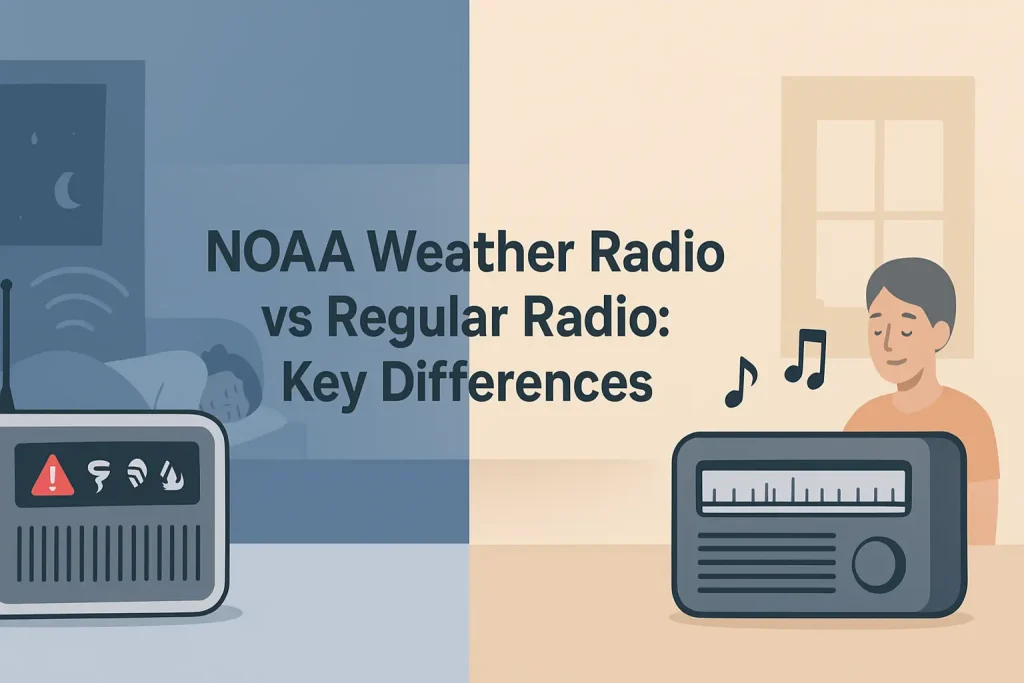
Your weather radio is beeping at 3 a.m. for a county three states away. That is not a malfunction. That is a weather radio without S.A.M.E. (Specific Area Message Encoding) filtering turned on, alerting you to every broadcast on the NOAA network instead of just the alerts for your location. The fix takes under five minutes once you know which setting to change.
Most people assume a beeping weather radio means the radio is broken or picking up interference. In almost every case, the real cause is one of three things: no S.A.M.E. code programmed, the wrong alert types enabled, or the radio receiving a legitimate NOAA test broadcast that was not expected.
| Photo | Popular Portable Walkie Talkies | Price |
|---|---|---|
 | SKIWARRIOR Multifunctional Smart Wireless Ski Goggles with Walkie-Talkie, Anti-Fog Zeiss Lens, Music & Call Function (Cylindrical Blue) | Check Price On Amazon |
 | SINORISE Super Mini Walkie Talkies, Two-Way Radios, 3 Pack | Check Price On Amazon |
 | KOSPET Tank M4C Smart Watch Rugged, Dual-Band GPS, 5ATM & IP69K Waterproof | Check Price On Amazon |
 | Retevis RT15 Walkie Talkies 3 Pack, Birthday Gift, Outdoor Adventure Kit | Check Price On Amazon |
 | Rechargeable Walkie Talkies Toys for Kids: DIY Astronaut Walkie Talkies for Boys Christmas Birthday Gifts for 3 4 5 6 7 8 9 10 Boy Walkie Talkie Outdoor Hiking Toy 2 Way Radio Camping Outdoor Game | Check Price On Amazon |
This guide covers every reason a weather radio beeps when it should not, and the exact steps to stop each one.
Why Does My Weather Radio Keep Beeping at Night?
A weather radio beeps at night because NOAA broadcasts alerts and required weekly tests around the clock, and a radio without S.A.M.E. location filtering will alarm for every single one of them regardless of where you live. NOAA Weather Radio All Hazards (NWR) operates 24 hours a day on seven dedicated VHF frequencies between 162.400 MHz and 162.550 MHz, and each transmitter covers a broadcast area that may include dozens of counties.
Without a programmed S.A.M.E. code (a six-digit FIPS location code tied to your specific county), your radio treats every alert in the entire broadcast footprint as relevant to you. A Tornado Warning issued for a county 200 miles away triggers your alarm just as loudly as one issued for your street.
NOAA also conducts required weekly tests every Wednesday between 11 a.m. and noon local time, and monthly tests on the first Wednesday of each month. If your radio is set to alert on all event types, those tests will trigger your alarm too.
There are five distinct causes of unwanted beeping, and each has a different fix. Understanding which cause applies to your situation is the fastest path to a quiet radio that still works when a real emergency happens.
The single most effective action you can take right now is to program your county’s six-digit FIPS S.A.M.E. code into your radio.
By the Numbers
Weather Radio False Alerts: Key Facts and Specifications
Sources: NOAA National Weather Service, FCC EAS documentation, FEMA IPAWS technical specifications.
What Is S.A.M.E. and Why Does It Stop False Alerts?
S.A.M.E. (Specific Area Message Encoding) is the digital header system built into NOAA Weather Radio broadcasts that allows a receiver to identify which geographic areas an alert applies to before triggering an alarm. Every NOAA alert transmission includes a S.A.M.E. header containing a six-digit FIPS (Federal Information Processing Standards) code that identifies the state and county the alert covers. A weather radio with S.A.M.E. decoding capability reads that header and only sounds the alarm if the code matches one you have pre-programmed into the radio.
Without a programmed S.A.M.E. code, the radio ignores the header entirely and alarms on every alert it receives, regardless of location. According to NOAA NWR technical documentation, a single transmitter can cover up to 40 miles in radius, meaning one antenna may broadcast alerts for 20 or more counties simultaneously.
Programming your county’s FIPS code reduces your alarm triggers to only the alerts that apply to your location. For most users in non-coastal, non-tornado-corridor areas, this reduces unwanted nighttime alarms by 80 to 90 percent immediately.
S.A.M.E. is a type of selective calling system. It works with the radio’s internal decoder to compare incoming digital headers against stored location codes. If the codes do not match, the radio stays silent. If they match, the alarm sounds and the broadcast plays.
A Midland WR400 NOAA weather radio supports up to 50 programmable S.A.M.E. location codes, which means you can cover your home county, your workplace county, and nearby counties where family members live, all from one radio.
Key Specifications for S.A.M.E.-equipped weather radios:
- FIPS code format: 6 digits (2-digit state code + 3-digit county code + 1-digit subdivision)
- Maximum programmable S.A.M.E. codes: 1 (entry models) to 50 (Midland WR400, Uniden BC365CRS)
- S.A.M.E. alert types decodable: 25 or more named EAS event codes per unit
- Broadcast frequency range: 162.400 to 162.550 MHz (7 channels)
Programming S.A.M.E. codes correctly is the single most important step to stopping false alerts while keeping your radio fully functional for real emergencies.
How to Find Your County’s S.A.M.E. Code
Your county’s six-digit FIPS S.A.M.E. code is available directly from the NOAA Weather Radio website at weather.gov/nwr. Navigate to the “S.A.M.E.” section and use the county lookup tool to find the exact code for your location. You can also find it by searching “FIPS code [your county name] [your state]” directly on the NOAA site.
The FIPS code structure is consistent across all US counties. The first two digits identify the state, the next three digits identify the county within that state, and the final digit is always 0 for the full county (subdivisions use digits 1 through 9).
For example, Los Angeles County, California has the FIPS code 006037-0, which you would enter as 006037 on most radio keypads. Cook County, Illinois is 017031. Harris County, Texas is 048201.
Write down your FIPS code before starting the programming process. You will need to enter it digit by digit using the radio’s keypad or menu system, and having it on paper prevents entry errors that cause the wrong counties to receive alerts.
If you live near a county border, consider programming both your home county and the adjacent county. Many severe weather events originate in adjacent counties before crossing into yours, and having both codes programmed gives you slightly earlier warning.
The NOAA county lookup tool is the only authoritative source for FIPS codes. Do not rely on third-party websites, as some carry outdated codes from county boundary changes.
Step-by-Step: How to Program S.A.M.E. Codes to Stop False Alerts
The steps below walk through the S.A.M.E. programming process. The exact button names vary by model, but the sequence is consistent across Midland, Uniden, and Sangean weather radios. Check your owner’s manual if a specific button name does not match.
Here is the process for stopping false alerts by programming your county’s FIPS code:
Step-by-Step Guide
How to Program S.A.M.E. Codes on a NOAA Weather Radio
7 steps · Estimated time: 5 minutes · Works on Midland, Uniden, and Sangean S.A.M.E. radios
Look up your six-digit FIPS S.A.M.E. code
Go to weather.gov/nwr and use the county lookup tool. Write down the exact six-digit code before touching the radio. Entry errors are the most common reason S.A.M.E. programming fails to stop unwanted alerts.
Press the Program or Menu button on your radio
On most Midland radios, this is labeled “PROG” or “MENU.” On Uniden models, look for a “SAME” button. The display will show a programming mode indicator, usually “PROG” or a flashing county code entry screen.
Select “County” or “Location” from the programming menu
Navigate to the S.A.M.E. location entry screen. On radios with state-then-county step menus (like the Midland WR120B), you first scroll to your state, then scroll to your county name. On numeric-entry radios, you type the six-digit FIPS code directly.
Enter your six-digit FIPS code using the keypad or scroll wheel
Enter each digit carefully. If your radio uses a scroll-and-select method, navigate to each digit and press select before moving to the next. Confirm the full six-digit code appears correctly on the display before saving.
Save the code and confirm it stored correctly
Press the confirm or save button (usually labeled “OK,” “Enter,” or “Prog” again). Navigate back to the location entry screen and verify your code appears in the stored list. If the display shows the code you entered, the programming was successful.
Set the alert filter to “SAME Only” or equivalent
Find the alert mode setting in your radio’s menu. Change it from “All Alerts” to “SAME Only,” “Programmed Counties Only,” or the equivalent label on your model. This activates the location filter you just programmed and tells the radio to ignore alerts for counties not in your stored list.
Test with the next scheduled NOAA weekly test broadcast
NOAA conducts required weekly tests every Wednesday between 11 a.m. and noon local time. If your radio remains silent during the next weekly test broadcast for a county that is not yours, the S.A.M.E. filter is working correctly.
After completing these steps, your radio should alarm only for alerts issued specifically for the counties you programmed.
What Alert Types Can You Turn Off Without Losing Important Warnings?
A properly S.A.M.E.-filtered weather radio can still generate unwanted alerts if you have enabled every alert event type in the radio’s settings. NOAA transmits more than 25 named EAS (Emergency Alert System) event codes, and not all of them are relevant to every household. You can disable specific alert types without reducing your protection against severe weather threats.
According to NOAA EAS documentation, the following alert types trigger radio alarms but are commonly disabled by users who want to reduce nighttime interruptions without sacrificing life-safety coverage:
- Administrative Message (ADM): Routine NOAA operational messages not related to public safety.
- Hazardous Weather Outlook (HWO): Forecast discussion messages, not immediate warnings. These can be safely disabled if you monitor forecasts through other means.
- Special Weather Statement (SPS): Informational updates that do not meet warning criteria. Lower urgency than a Watch or Warning.
- Test messages (RWT, RMT): Required Weekly Test and Required Monthly Test broadcasts. You can disable alarm triggering for test messages on most S.A.M.E. radios while still receiving actual alerts.
- Local Statement (LST): Non-emergency local information messages from NWS offices.
Alert types you should always keep enabled include Tornado Warning (TOR), Tornado Watch (TOA), Flash Flood Warning (FFW), Severe Thunderstorm Warning (SVR), Hurricane Warning (HUW), and Civil Emergency Message (CEM). These are the events where receiving the alarm immediately can be the difference between life and death.
The Uniden BC365CRS weather radio lets you individually toggle each of the 25 EAS event types on or off through its programming menu, giving you complete control over which alert types trigger the alarm sound. Most entry-level models only allow “All” or “None” for non-S.A.M.E. alert type filtering.
The safest approach for most households is to enable all warning-level alerts (Warning, Watch, Emergency) and disable informational-level alerts (Outlook, Statement, Administrative Message, Test).
Adjusting alert types in combination with S.A.M.E. county filtering gives you the most targeted alert profile possible without building any gap in your severe weather coverage.
To learn more about how S.A.M.E. alert types interact with your radio’s filtering system, the complete breakdown of how S.A.M.E. encoding works in a weather radio covers every event code category in detail.
Is Your Weather Radio Beeping Because of a Legitimate NOAA Test?
NOAA conducts two types of required broadcast tests on the NWR system that will trigger alarms on radios set to receive test alerts: the Required Weekly Test (RWT) every Wednesday between 11 a.m. and noon local time, and the Required Monthly Test (RMT) on the first Wednesday of each month. If your radio alarms on Wednesday morning but shows “TEST” on the display, the radio is working exactly as designed and the fix is to disable test alert types in the programming menu.
The RMT (Required Monthly Test) transmits a full EAS header and audio tone sequence that is indistinguishable to the radio from a real emergency broadcast. This is the test most commonly mistaken for a false alarm, because it sounds exactly like the real activation tone sequence.
You can disable alarm activation for test messages on most S.A.M.E.-capable radios without affecting any real alert. In the alert type programming menu, look for “RWT” (Required Weekly Test) and “RMT” (Required Monthly Test) and set both to “off” or “no alarm.”
On older radios without individual alert type control, the only options are “All Alerts” (which includes tests) or disabling NOAA reception entirely. If your radio does not allow test message filtering, upgrading to a current S.A.M.E. model is the most practical solution.
The Sangean CL-100 tabletop weather radio supports individual alert type toggling including test message suppression while maintaining alarm activation for all warning-level alerts.
Disabling test alert alarms does not affect your radio’s ability to receive real emergency broadcasts. The radio continues to monitor the NOAA frequency and will activate for any genuine alert that matches your programmed S.A.M.E. codes.
Why Is My Weather Radio Beeping Even with S.A.M.E. Programmed?
A weather radio that continues beeping after S.A.M.E. codes are programmed is almost always set to “All Alerts” mode instead of “S.A.M.E. Only” mode, or the FIPS code was entered incorrectly. Programming the code without switching the filter mode to “S.A.M.E. Only” has no effect. The radio stores the code but continues alerting on everything until you explicitly change the alert mode setting.
These are the four most common reasons a weather radio beeps even after S.A.M.E. setup:
- Filter mode left on “All Alerts”: The S.A.M.E. code is stored but the radio is not in “S.A.M.E. Only” mode. Go back into the programming menu and change the alert mode from “All” to “S.A.M.E.” or “Programmed Only.”
- Wrong FIPS code entered: A single digit error means the radio is filtering for a county that is not yours, and your actual county’s alerts still pass through. Verify your code at weather.gov/nwr and re-enter it.
- Test alert types still enabled: The radio is correctly filtering location codes but still alarms for RWT and RMT test broadcasts. Disable test message types as described in the previous section.
- Alert tone set to activate on Watches and Outlooks: Some radios default to alarming for Watch-level and Outlook-level events in addition to Warning-level events. Adjust the alert type list to suppress lower-priority event types.
The programming process must be completed in two stages to work: first, enter the FIPS code, and second, change the filter mode. Completing only one stage leaves the radio unfiltered.
If you are unsure whether your radio supports individual S.A.M.E. filtering, check the model number against the NOAA-approved receiver list at weather.gov/nwr. Only radios with the NOAA Weather Radio logo and S.A.M.E. designation in their product name have full location filtering capability.
For a detailed walkthrough of the programming steps specific to the Midland WR120B, the hands-on review of the Midland WR120B’s S.A.M.E. programming interface covers common entry errors and how to verify your settings are active.
Can a Low Battery Cause a Weather Radio to Beep Continuously?
Yes. Most weather radios have a dedicated low-battery alert tone that is distinct from an emergency alarm, but many users confuse the two, especially at night. A low-battery warning on a weather radio typically sounds as a series of short beeps repeating at regular intervals, without any voice broadcast following the tones. A genuine NOAA alert plays the characteristic two-tone EAS attention signal followed by a voice message.
Weather radios that run on AC power with battery backup begin their low-battery warning when the backup batteries drop below the threshold needed to sustain operation during a power outage. This can happen even when the radio appears to be running normally from AC power, because the batteries are not being used for primary power.
The fix is straightforward: replace the backup batteries. Most desktop weather radios use three to six AA or AAA alkaline batteries for backup power. According to manufacturer documentation for models like the Midland WR300 and Uniden BC365CRS, backup batteries should be replaced every 12 to 18 months even if the radio has not used them, because alkaline batteries self-discharge slowly over time.
Using fresh alkaline AA batteries from a trusted brand rather than old stock or generic cells prevents premature low-battery warnings and ensures the radio can sustain operation for the full manufacturer-rated backup duration.
For a complete guide on which battery types work best in NOAA weather radios and how often to replace them, the weather radio battery replacement guide with model-specific battery types and intervals covers AC-backup models, hand-crank radios, and solar-charged portable units.
After replacing batteries, hold down the radio’s reset button for three seconds if available, or power-cycle the unit to clear the low-battery alert flag from the display.
Does Electrical Interference Cause a Weather Radio to False Alert?
Electrical interference does not trigger a weather radio’s S.A.M.E. alarm. The NOAA EAS system uses a specific digital header format before every alert, and a properly functioning S.A.M.E. decoder only activates the alarm when it decodes a valid EAS header containing a matching FIPS code. Random electrical noise does not replicate the EAS digital header structure, so it cannot trigger a genuine alarm activation.
What interference can cause is audio artifacts, static bursts, or partial audio playback on the NOAA monitoring frequency that some users interpret as alarm-like sounds. This is different from an actual alarm activation. If the alarm LED light is not illuminated and the display does not show an active alert code, the radio is not in alarm mode.
Interference can also cause the radio to lose its programmed NOAA channel and drop to a weaker or more distant transmitter. This can result in the radio receiving more out-of-area alerts than expected if the stronger distant signal carries alerts for different counties. The fix is to manually lock the radio to the correct NOAA channel for your area rather than using automatic channel scan.
You can find the strongest NOAA transmitter frequency for your location using the NOAA transmitter coverage map at weather.gov/nwr. Enter your zip code to see which of the seven frequencies (WX1 through WX7, corresponding to 162.400 through 162.550 MHz) provides the best signal at your address.
Locking your radio to the correct channel and placing it away from large appliances, LED dimmers, and switching power supplies reduces the likelihood of signal disruption that causes audio artifacts.
How to Silence a Weather Radio Without Disabling Emergency Alerts
You can silence an active weather radio alert without disabling future emergency coverage by pressing the radio’s dedicated alarm silence or snooze button, which acknowledges the current alert and mutes the tone while keeping the radio active for incoming transmissions. This is different from powering off the radio or resetting it, which may require reprogramming to restore full alert capability.
On most Midland, Uniden, and Sangean weather radios, a single press of the “Alert” or “Snooze” button silences the current alarm tone. The display continues showing the active alert information, and the radio remains in active monitoring mode to receive new alerts.
Do not press the power button to silence an alarm. Powering off the radio during an active alert will stop the current broadcast, but on some older models it also clears the alert memory and may affect the S.A.M.E. filter settings stored in volatile memory.
If you want the radio to monitor continuously but not sound any alarm tones unless you are awake to respond to them, most S.A.M.E. radios include a “Voice Only” or “Alert Light Only” mode that activates a visible LED alert indicator without sounding the audible alarm. This is useful for light-sleeping households or shared sleeping areas where the alarm tone would cause unnecessary disruption.
The Midland WR300 weather alert radio includes a dedicated “Alarm Only,” “Voice Only,” and “Alarm and Voice” mode selector, giving you full control over how the radio responds to an incoming alert without compromising its monitoring function.
Silencing an alert correctly keeps your protection intact while allowing you to return to sleep without disruption during a low-priority alert that does not require immediate action.
Which Weather Radios Give You the Most Control Over False Alerts?
The weather radios with the most individual alert type control are mid-range and premium S.A.M.E. models from Midland and Uniden. Entry-level radios (typically under $30) often support only a single S.A.M.E. location code and limited alert type filtering. Mid-range radios ($40 to $80) support multiple location codes and individual event type toggles. Premium models ($80 and above) add features like voice alert identification, display readout of the active alert text, and phone jack outputs for alerting hearing-impaired users.
Use the table below to compare the alert control capabilities of the most widely available S.A.M.E. weather radios.
| Model | S.A.M.E. Codes | Alert Types Selectable | Test Alert Disable | Price Range |
|---|---|---|---|---|
| Midland WR120B | 25 | Limited | No | $25-35 |
| Midland WR300 | 25 | Full (25 types) | Yes | $45-60 |
| Midland WR400 | 50 | Full (25 types) | Yes | $55-75 |
| Uniden BC365CRS | 23 | Full (25 types) | Yes | $40-55 |
| Sangean CL-100 | 25 | Full (25 types) | Yes | $50-70 |
| Eton FRX5-BT | 1 | Limited | No | $50-70 |
The Midland WR400 with 50-code S.A.M.E. capacity is the best choice for households near multiple county borders or anyone who wants the most granular control over which alerts trigger an alarm. For single-county households, the Uniden BC365CRS or Midland WR300 provide full alert type filtering at a lower price point.
The most common mistake when buying a weather radio is purchasing an entry-level model that supports only “All Alerts” or “No Alerts,” then assuming S.A.M.E. means the radio filters by county automatically. S.A.M.E. filtering only works when the radio explicitly supports programmable county codes and has an “S.A.M.E. Only” alert mode.
If you are considering a first weather radio purchase, the beginner’s guide to setting up and using a NOAA weather radio walks through all the initial setup steps including channel selection, S.A.M.E. programming, and alert type configuration.
Quick Reference: Weather Radio Alert Terminology
Key Terms Used in This Guide
S.A.M.E. (Specific Area Message Encoding): A digital header system in NOAA broadcasts that identifies which geographic county an alert applies to. A radio with S.A.M.E. capability only alarms when the broadcast county matches your stored FIPS code.
FIPS code: A six-digit Federal Information Processing Standards code that uniquely identifies every US county. Used as the S.A.M.E. location code in weather radio programming.
EAS (Emergency Alert System): The federal alert distribution system that NOAA Weather Radio uses to deliver warnings. The distinctive two-tone attention signal you hear before a broadcast is the EAS activation tone.
NWR (NOAA Weather Radio All Hazards): The nationwide network of over 1,000 radio stations broadcasting on seven VHF frequencies between 162.400 and 162.550 MHz. Covers 95% of the US population.
RWT (Required Weekly Test): A standardized NOAA test broadcast transmitted every Wednesday between 11 a.m. and noon local time. Can be disabled from triggering alarms on most S.A.M.E. radios.
RMT (Required Monthly Test): A full-activation test broadcast on the first Wednesday of each month. Sounds identical to a real emergency alert. Can be disabled on mid-range and premium S.A.M.E. radios.
Warning: An alert indicating a hazardous weather event is occurring or imminent. Highest priority. Should never be disabled.
Watch: An alert indicating conditions are favorable for a hazardous event. Moderate priority. Should remain enabled in most configurations.
Outlook or Statement: Informational messages without immediate threat. Can be safely disabled to reduce alert volume.
CEM (Civil Emergency Message): An alert for non-weather emergencies including hazardous materials incidents or other public safety events. Should remain enabled.
AMBER Alert: A child abduction emergency alert transmitted over the NOAA NWR system. Will trigger weather radio alarms on radios with AMBER Alert event type enabled.
What to Do If Your Weather Radio Keeps Beeping After All Settings Are Corrected
If you have programmed a valid FIPS S.A.M.E. code, switched the radio to “S.A.M.E. Only” mode, disabled test alert types, and replaced the backup batteries, but the radio continues beeping, the most likely remaining cause is a legitimate emergency alert for your county that you may be dismissing as a false alarm. Before assuming the radio is malfunctioning, check the display for the active alert event code and the county FIPS code shown in the display readout.
AMBER Alerts transmitted through the NWR system are a common source of unexpected alarms that users do not anticipate. The NOAA NWR network carries AMBER Alerts in addition to weather events, and they use the same EAS activation tone. If you want to disable AMBER Alert activation on your radio, look for “CAE” (Child Abduction Emergency) in the alert type list and set it to “off.” This is a personal decision and is not recommended for households with children.
If the display is blank and the radio is beeping with no alert code shown, you are likely dealing with a hardware issue rather than a programming issue. Try the following reset sequence:
- Unplug the radio from AC power.
- Remove all backup batteries.
- Hold the power button for 10 seconds with no power connected.
- Reinsert batteries and reconnect AC power.
- Reprogram all S.A.M.E. codes and alert type settings from scratch.
If the beeping resumes after a full factory reset and fresh programming, the radio’s S.A.M.E. decoder chip or alert memory may have failed. Most weather radio manufacturers offer a one-year warranty, and models like the Midland WR400 and Uniden Bearcat weather alert radios include manufacturer support lines that can walk you through hardware diagnostics.
A weather radio that beeps with a blank display after a full reset is a candidate for replacement rather than continued troubleshooting, particularly if it is more than five years old.
How Do NOAA Weather Radio Frequencies Affect Alert Reception?
NOAA broadcasts on seven VHF frequencies (162.400, 162.425, 162.450, 162.475, 162.500, 162.525, and 162.550 MHz), and your location determines which frequency carries the strongest signal. Receiving alerts on a weaker or more distant transmitter can result in both missed alerts and unexpected out-of-area alerts, because the weaker local signal may be overridden by a stronger distant transmitter during atmospheric conditions like temperature inversions.
Temperature inversions, which occur most often at night and in the early morning, can cause VHF signals to propagate much farther than normal. This means a weather radio scanning for the strongest NOAA signal overnight may lock onto a transmitter 200 miles away instead of the local one, receiving that transmitter’s county alerts until conditions normalize.
Locking your radio to the specific NOAA channel serving your area (rather than using automatic scan) prevents this from happening. Use the NOAA transmitter lookup at weather.gov/nwr to find the channel and transmitter name for your zip code, then manually set that channel as the fixed monitoring frequency in your radio’s settings.
The seven NOAA frequencies and their standard designations are:
- WX1: 162.550 MHz
- WX2: 162.400 MHz
- WX3: 162.475 MHz
- WX4: 162.425 MHz
- WX5: 162.450 MHz
- WX6: 162.500 MHz
- WX7: 162.525 MHz
For a complete reference on NOAA weather radio frequencies, transmitter locations, and which channels serve specific US regions, the NOAA weather radio frequency guide with state-by-state channel assignments lists the primary frequency for every major metro area in the country.
Manually locking to the correct local NOAA channel eliminates one of the least-known causes of unexpected out-of-area alerts.
Here is how a correctly configured weather radio compares to one with default factory settings:
Results
Weather Radio Alert Behavior Before and After Correct S.A.M.E. Configuration
Impact of programming a FIPS county code, selecting S.A.M.E. Only mode, and disabling test broadcasts
Factory Default (Unconfigured)
- ✗Alarms for every county in the entire NWR transmitter footprint (up to 20+ counties)
- ✗Alarms for Required Weekly Tests every Wednesday 11 a.m. to noon
- ✗Alarms for informational messages including Hazardous Weather Outlooks and Local Statements
- ✗May switch to distant transmitter during nighttime temperature inversions
After Correct Configuration
- ✓Alarms only for the 1 to 3 counties you have programmed via six-digit FIPS code
- ✓Test broadcasts (RWT, RMT) silenced without affecting real alert reception
- ✓Informational alert types disabled, Warning and Watch types fully active
- ✓Fixed to local NOAA channel, preventing overnight transmitter drift
A correctly configured S.A.M.E. radio reduces unwanted alarm activations by 80 to 90 percent while maintaining full coverage for all Warning and Watch-level events in your county.
The difference between a factory-default radio and a correctly configured one is the difference between a device that wakes you up four nights a week and one that wakes you up only when a tornado is heading toward your neighborhood.
To understand the full scope of what NOAA Weather Radio is and how the NWR network is structured, the introduction to NOAA Weather Radio All Hazards and how the broadcast network operates explains the transmitter infrastructure, coverage areas, and the difference between the seven VHF channels.
Does a Weather Radio Need to Be On 24/7 to Catch Alerts?
Yes, a NOAA weather radio must remain powered on and in monitoring mode to receive alerts. NOAA does not push alerts to radios on demand the way a cellular system pushes text notifications. The radio passively monitors the NOAA frequency continuously and activates only when it receives an EAS header matching your programmed FIPS code. If the radio is off when an alert broadcasts, it receives nothing.
This is why weather radios consume standby power around the clock. A properly configured S.A.M.E. radio draws minimal power in standby (typically under 3 watts for desktop AC-powered models), making continuous operation practical and inexpensive.
For portable weather radios used during camping or power outages, the monitoring mode current draw varies significantly by model. A Midland ER310 emergency weather radio draws approximately 50 milliamps in NOAA monitoring mode on battery power, which translates to roughly 40 to 60 hours of continuous monitoring from its 2000 mAh internal battery before needing a recharge via USB or solar panel.
Radios with a “standby alert only” mode (which keeps the S.A.M.E. decoder active while powering down the display and speaker amplifier) can extend battery runtime significantly compared to full-on mode during extended monitoring periods without power access.
The radio must remain on. There is no alert delivery mechanism in the NOAA NWR system that works with a powered-off receiver.
Should You Use a Weather Radio App Instead of a Dedicated Radio?
A smartphone weather alert app is not a replacement for a dedicated NOAA weather radio for emergency preparedness purposes. Smartphone alerts depend on cellular network availability, and cellular networks are among the first infrastructure elements to fail or become congested during major weather emergencies when towers lose power or are overwhelmed by simultaneous call volume. A dedicated NOAA weather radio receives broadcasts directly from VHF transmitters that operate independently of cellular networks and internet infrastructure.
NOAA transmitters are designed to operate on backup generator power during grid outages, which is exactly when you need them most. A Wireless Emergency Alert (WEA) message sent to your phone requires the cellular tower to be operational, the phone to have battery charge, and the carrier network to be uncongested. A NOAA weather radio on battery backup has none of those dependencies.
The practical scenario where this matters: a tornado warning is issued at 2 a.m. Your cellular tower is overloaded with calls and texts from 50,000 people in the same county. Your phone’s WEA message is delayed by 45 seconds to 3 minutes. Your dedicated weather radio, monitoring 162.550 MHz continuously with your county’s FIPS code programmed, alarms the moment the NOAA transmitter broadcasts the alert, before the cell network reaches you.
Use both systems if possible. A dedicated weather radio is the primary alert device and the smartphone app is the backup, not the reverse.
For a full comparison of NOAA weather radio vs smartphone alert systems with specific latency data, the comprehensive overview of what NOAA Weather Radio is and why dedicated receivers outperform cellular alerts during grid-down emergencies covers the infrastructure differences in detail.
How Many S.A.M.E. Codes Should You Program?
Program a minimum of one S.A.M.E. code (your home county) and a maximum based on your radio’s capacity. For most households, programming two to three counties provides the best balance of early warning coverage without reintroducing false alerts. Program your home county as the primary code. Add the county immediately upwind of your location (typically to your west or southwest in the continental US) for early warning on incoming storm systems. Add any county where you regularly work or spend significant time if it differs from your home county.
Do not program all adjacent counties by default. Every additional county you add expands the geographic area that can trigger your alarm, which partially defeats the purpose of S.A.M.E. filtering. The goal is targeted coverage, not blanket coverage.
For households in coastal areas, add your home county plus the adjacent coastal county that serves as the primary landfall zone for hurricanes or tropical storms in your region. NOAA issues Hurricane Warnings for coastal counties first, and having that county programmed gives you earlier notification before the storm reaches your inland location.
The Midland WR400 and higher-end Uniden weather alert models that support 23 to 50 programmable S.A.M.E. codes are primarily useful for emergency managers, amateur radio operators running neighborhood nets, or emergency preparedness organizations that need to monitor alerts for large geographic regions. For a typical household, three to five codes is the practical maximum before the filtering benefit diminishes.
The correct number of S.A.M.E. codes is the smallest number that gives you actionable early warning for every realistic threat to your location.
Why Does My Weather Radio Alarm for Alerts That Have Nothing to Do with Weather?
NOAA Weather Radio All Hazards broadcasts non-weather emergency alerts in addition to weather events. The “All Hazards” designation in the NWR system name means the network is used as the primary broadcast channel for any civil emergency message that federal, state, or local authorities determine requires immediate public notification. These include hazardous materials spills, nuclear power plant incidents, child abduction emergencies (AMBER Alerts), 911 telephone outages, dam failures, and national security-level civil emergency messages.
According to NOAA NWR documentation, the following non-weather EAS event types are routinely broadcast over the weather radio network:
- CAE (Child Abduction Emergency / AMBER Alert): Issued for child abduction events. Uses the same EAS activation tone as a severe weather warning.
- CEM (Civil Emergency Message): Issued for public safety emergencies not related to weather, including hazardous materials incidents and major accidents.
- HMW (Hazardous Materials Warning): Issued for chemical spills or releases requiring public shelter or evacuation.
- NUW (Nuclear Power Plant Warning): Issued for incidents at nuclear facilities requiring protective action.
- 911 (Telephone Outage Emergency): Issued when 911 service is unavailable in an area and alternative emergency contact methods need to be communicated.
If you receive an alarm that displays “CEM” or “CAE” on your weather radio screen, that is a legitimate non-weather emergency alert. The radio is functioning correctly.
You can disable individual non-weather alert types in the event type programming menu of most S.A.M.E. radios, but disabling CEM or HMW is not recommended since those alerts can require immediate protective action (sheltering, evacuation) even when the weather is calm.
AMBER Alerts are the most commonly disabled non-weather alert type, particularly in households without children where the alert does not prompt any protective action by the recipient. The decision to disable AMBER Alert alarms on a weather radio is personal and does not affect any other alert type.
What Should You Do If Your Weather Radio Alarms but You Cannot Hear the Voice Broadcast?
If your weather radio alarms and the display shows an active alert code but you cannot hear the voice broadcast, the most likely cause is a weak signal from the NOAA transmitter, which is sufficient to transmit the digital S.A.M.E. header (triggering the alarm) but not strong enough to deliver clean audio. This is especially common with desktop radios positioned near metal objects, inside concrete walls, or in basements that attenuate VHF signals.
The fix is to reposition the radio’s antenna for better reception. Most desktop weather radios use a telescoping whip antenna. Extend it to its full length and orient it vertically. Moving the radio to a window or exterior wall-facing location typically improves signal quality significantly.
If repositioning does not resolve the audio issue, verify that the radio’s volume is not set to minimum or muted. Some radios have a physical volume wheel that can be inadvertently turned to zero, which produces a silent alarm with no audio. The alarm tone itself is generated internally by the radio (not received from NOAA), so the alarm sounds regardless of received signal quality or volume setting in many models.
A radio that consistently alarms without audible voice broadcasts despite adequate signal strength may have a failing speaker or audio amplifier. Replace the unit if this occurs, as a weather radio with inaudible voice broadcasts cannot deliver the content of the alert message, only the tone.
The Midland WR120B weather radio includes a 3.5mm audio output jack for connecting an external speaker, which is useful in basements or rooms where the built-in speaker does not project clearly.
Can You Program a Weather Radio Without the Manual?
You can program most S.A.M.E. weather radios without the physical manual by downloading the PDF manual from the manufacturer’s website using the model number printed on the radio’s label. Midland manuals are available at midlandusa.com. Uniden manuals are at uniden.com/support. Sangean manuals are at sangean.com.
The programming sequence for S.A.M.E. codes follows one of two standard approaches across all major brands. The first approach (used by Midland WR-series radios) uses a two-step state-then-county scroll selection from a built-in county database. The second approach (used by Uniden and some Sangean models) requires direct numeric entry of the six-digit FIPS code using the keypad.
If you have a Midland radio and cannot find the manual, the state-county scroll method works as follows: press “PROG,” scroll with the up/down arrows to your state abbreviation and press select, then scroll to your county name and press select again. The six-digit FIPS code is looked up internally. You do not need to know the numeric code for Midland scroll-select models.
For numeric-entry radios from Uniden or Sangean, you must have the six-digit FIPS code ready before starting. Retrieve it from weather.gov/nwr before beginning the programming sequence.
Programming a weather radio correctly the first time without the manual takes approximately 10 minutes for most users.
Is Your Weather Radio Actually Broken or Just Misconfigured?
Ninety-five percent of weather radios that “keep beeping” are not broken. They are correctly receiving NOAA broadcasts and alarming on them exactly as designed, without the location filtering that prevents irrelevant alerts from triggering the alarm. A broken weather radio typically fails silently (stops receiving or stops alarming) rather than alarming too frequently.
The distinction is important because many people replace a functioning radio out of frustration with constant beeping, only to have the replacement behave identically because the factory default settings are the same.
A weather radio is malfunctioning if it does any of the following: alarms without displaying any alert event code on the screen, alarms when the radio is not within range of any NOAA transmitter (confirmed by checking the NOAA coverage map), alarms after all S.A.M.E. codes have been cleared and the radio is reset to factory defaults, or fails to receive any audio or display content during a confirmed NOAA broadcast.
Before concluding your radio is defective, complete the full configuration process: program a valid FIPS code, switch to S.A.M.E. Only mode, disable test broadcast types, replace backup batteries, and lock to the correct local NOAA channel. If the radio continues generating unexpected alarms after all five steps are complete, contact the manufacturer’s support line for hardware diagnostics.
Most weather radios that are properly configured provide years of reliable service without false alarms. The frustration users experience is almost always a setup issue, not a hardware failure.
Frequently Asked Questions
Why does my weather radio beep three times and then go silent?
Three short beeps followed by silence on a NOAA weather radio typically indicates that the radio received an EAS S.A.M.E. header for an event in a county that does not match your programmed FIPS codes. The radio decoded the incoming alert header, checked it against your stored location codes, found no match, and suppressed the full alarm while generating an acknowledgment tone. This is the S.A.M.E. filter working correctly, not a malfunction.
Some weather radio models use different short-beep patterns for different system events. Consult your manual’s “alert indicator” or “tone guide” section to confirm what three-beep sequences mean on your specific model. On Midland WR-series radios, the three-beep acknowledgment tone is normal behavior when S.A.M.E. filtering is active and an out-of-area alert is rejected.
Will my weather radio alert me for a tornado warning if I am asleep?
Yes. A NOAA weather radio in alarm mode with your county’s FIPS S.A.M.E. code programmed will sound the alarm for a Tornado Warning (TOR event code) at any hour of the day or night, regardless of whether you are asleep. The alarm activates automatically when the incoming EAS header matches your stored location code and the event type is enabled. You do not need to be awake or interact with the radio for it to alarm.
This is the primary life-safety function of a dedicated weather radio over smartphone alerts. The radio alarm activates from standby without any interaction required, and the EAS attention tone (a two-tone 1050 Hz and 853 Hz signal) is specifically designed to wake sleeping individuals. Keep the volume set to at least 50 percent and position the radio within earshot of your bedroom for overnight protection.
What is the difference between a weather radio Watch alert and a Warning alert?
A Watch means weather conditions are favorable for a hazardous event to develop in your area within the next several hours. A Warning means a hazardous event is confirmed occurring or is imminent, typically within the next 30 to 60 minutes. A Warning requires immediate protective action. A Watch means you should monitor the situation and prepare to take action if conditions worsen.
For nighttime alarm filtering, most experienced weather radio users keep Warning-level alerts active and consider disabling Watch-level alerts for low-risk event types (such as Wind Advisory or Freeze Watch) while keeping Tornado Watch and Severe Thunderstorm Watch active. The correct configuration depends on your geographic location and the specific hazards most common in your region.
Can I use my weather radio to monitor NOAA broadcasts without the alarm function enabled?
Yes. Most S.A.M.E. weather radios have a “Voice Only” or “Monitor” mode that plays the NOAA broadcast audio continuously without activating the alarm for incoming alerts. In this mode, the radio functions as an audio receiver for the NOAA weather broadcast but will not sound the alert tone or light the alarm indicator. This is useful for monitoring current weather conditions during the day when you want continuous weather information without alarm interruptions.
For overnight use, revert to alarm mode so the radio can wake you for nighttime severe weather events. Running the radio in monitor-only mode overnight defeats the primary emergency alerting function. The step-by-step guide to switching between monitoring and alarm modes on common weather radio models covers the mode selection process for Midland, Uniden, and Sangean units.
Does programming the wrong FIPS code make my radio stop alerting for real emergencies?
Yes. If you program a FIPS code for the wrong county and switch to S.A.M.E. Only mode, your radio will alert for emergencies in that wrong county and ignore emergencies in your actual county. This is the most consequential programming error you can make. A radio alerting for emergencies 300 miles away while staying silent during a tornado in your neighborhood provides zero protection.
Verify your FIPS code against the NOAA county lookup at weather.gov/nwr before programming. After programming, note the county name that appears in the radio’s stored location list and confirm it matches your actual home county. Do not enter codes from memory or third-party lists, as some are outdated.
My weather radio alarms every Wednesday morning. Is that normal?
Yes. NOAA conducts a Required Weekly Test (RWT) every Wednesday between 11 a.m. and noon local time. If your radio alarms on Wednesday mornings, it is receiving the RWT broadcast and responding to it correctly. This is not a false alarm in the technical sense. The broadcast is a real NOAA transmission. Your radio is simply not filtering it out.
To stop Wednesday morning alarms from the RWT, go into your radio’s alert type programming menu and set “RWT” (Required Weekly Test) to “off” or “no alarm.” This tells the radio not to activate the audible alarm for test broadcasts while continuing to alarm for all actual emergency events. On most mid-range S.A.M.E. radios, this setting is in the same menu where you enable or disable individual EAS event types.
Can I use a portable hand-crank weather radio as my primary alert radio?
A portable hand-crank weather radio can serve as your primary alert radio, but it requires specific configuration to function reliably for overnight alerting. Most hand-crank radios (such as the Midland ER310 or Eton FRX5-BT) include a rechargeable internal battery that powers continuous NOAA monitoring for 40 to 60 hours per charge. The radio must be kept charged and set to alarm mode to provide overnight alert coverage comparable to an AC-powered desktop radio.
The limitation of portable hand-crank radios as primary alert devices is that many entry-level models support only one S.A.M.E. location code (or none) and limited individual alert type control. If you choose a portable radio as your primary unit, select a model that explicitly supports S.A.M.E. with multiple programmable county codes. The Kaito KA500 emergency weather radio and Midland ER310 are among the portable models that support full S.A.M.E. functionality.
Why does my weather radio alarm for a county I did not program?
A weather radio that alarms for an unprogrammed county is almost certainly set to “All Alerts” mode rather than “S.A.M.E. Only” mode. Entering a FIPS code does not automatically activate the location filter. You must explicitly change the alert mode from “All” to “S.A.M.E.” in a separate step in the programming menu. Without that mode change, the radio stores your code but continues alarming on all broadcasts regardless of county.
The second possible cause is that the radio is locked to a NOAA channel that covers a different geographic area than your local channel. If your radio auto-scanned to a distant transmitter and locked onto it, the S.A.M.E. headers it decodes will contain FIPS codes for that transmitter’s coverage area. Lock your radio to the correct local NOAA channel and reprogram your FIPS code.
Do I need a weather radio if I already receive NOAA alerts on my phone?
Wireless Emergency Alerts (WEA) on your smartphone and NOAA weather radio serve overlapping but not identical functions. Your smartphone WEA system depends on cellular tower availability, carrier network capacity, and phone battery charge. A dedicated weather radio depends only on VHF signal reception and its own power source. During major weather emergencies, cellular networks frequently experience congestion or outage precisely when WEA alerts are most needed.
FEMA and the National Weather Service both recommend a dedicated weather radio as the primary residential alert system, with WEA as a supplemental alert mechanism. A battery-backed weather radio continues operating during power outages, cellular outages, and internet disruptions. A smartphone alert system fails when any single link in its dependency chain is unavailable.
How do I know which NOAA frequency to use for my location?
The correct NOAA frequency for your location is the one with the strongest signal from the transmitter covering your county. Use the interactive transmitter map at weather.gov/nwr to enter your zip code and find the transmitter name, frequency, and call sign serving your area. The seven NOAA frequencies are 162.400, 162.425, 162.450, 162.475, 162.500, 162.525, and 162.550 MHz, designated WX2 through WX7 and WX1 respectively.
After identifying your local frequency, manually program that channel as the fixed monitoring channel in your radio’s settings. This prevents the radio from switching to a stronger distant transmitter during overnight temperature inversions and ensures your S.A.M.E. FIPS code matches the county coverage area of the transmitter you are monitoring.
Is there a way to test that my S.A.M.E. codes are programmed correctly without waiting for a real alert?
The most reliable test is to note the date of the next Required Weekly Test (RWT) for NOAA, which occurs every Wednesday between 11 a.m. and noon local time. With S.A.M.E. correctly programmed to your county and the alert mode set to “S.A.M.E. Only,” your radio should remain silent during Wednesday’s RWT unless the test is explicitly designated for your county. If the radio alarms silently or fails to alarm on a confirmed Wednesday test period, your S.A.M.E. settings are working as expected.
Some weather radios include a manual test function that triggers the alarm tone independently of NOAA reception, but this only tests the alarm hardware, not the S.A.M.E. decoder. To verify the full chain from NOAA reception through S.A.M.E. decoding to alarm activation, the Wednesday test broadcast is the most practical confirmation method for home users.
Programming a weather radio correctly is a one-time task that takes under 10 minutes. A correctly configured radio running on fresh batteries and locked to your local NOAA channel will provide reliable, location-specific emergency alerts for years without generating unnecessary alarms. Program your county’s FIPS S.A.M.E. code, switch to S.A.M.E. Only mode, disable test and informational alert types, and replace the backup batteries. Those four steps resolve the false alert problem in the vast majority of cases.
| Photo | TOP RATED WALKIE TALKIES | Price |
|---|---|---|
 | Retevis RT628 Kids Walkie Talkies, Toys Gifts for 4-12 Year Old Girl Boy | Check Price On Amazon |
 | Cobra ACXT545 Weather-Resistant Walkie Talkies, Rechargeable, 22 Channels | Check Price On Amazon |
 | Retevis RT388 Kids Walkie Talkies, Outdoor Toys for Kids Camping Essentials | Check Price On Amazon |
 | Cobra RX680 Walkie Talkies (2-Pack), IP54 Water Resistant Design | Check Price On Amazon |
 | Retevis RT22 Walkie Talkies Long Range Rechargeable with Earpiece (2 Pack) | Check Price On Amazon |
 | Midland GXT1000VP4 GMRS JIS4 Two-Way Radio, Black,2 Pack | Check Price On Amazon |
 | Retevis RT628 Walkie Talkies for Kids,Toys Gifts for 6-12 Years Old Boys Girls,Long Range 2 Way Radio 22CH VOX,Birthday Gift,Family Walkie Talkie for Camping Hiking Indoor Outdoor | Check Price On Amazon |