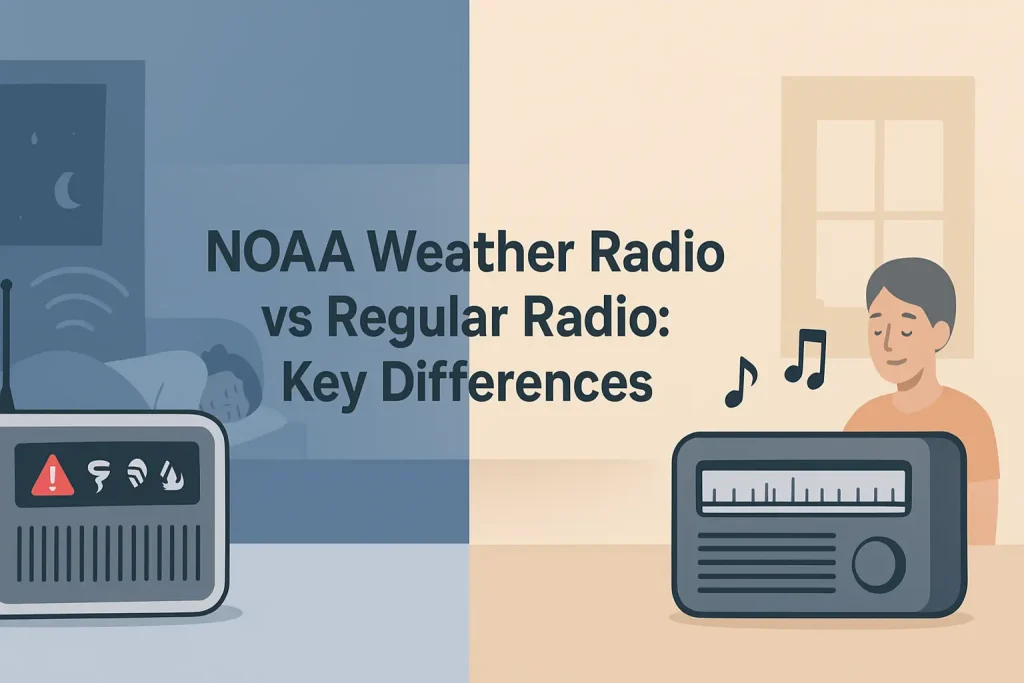
Your phone already has a weather app, but a weather app will not wake you up at 2 a.m. when a tornado warning is issued for your county. NOAA Weather Radio All Hazards broadcasts continuous alerts on seven dedicated frequencies between 162.400 and 162.550 MHz, and the best NOAA weather radio apps for Android pull those same broadcasts directly to your phone, complete with S.A.M.E. (Specific Area Message Encoding) filtering so you only hear alerts for your exact location.
This guide covers the top Android apps that receive or replicate NOAA weather radio alerts, how S.A.M.E. code filtering works, what separates a reliable alert app from one that fails during an actual emergency, and how these apps compare to a dedicated hardware weather radio.
| Photo | Popular Portable Walkie Talkies | Price |
|---|---|---|
 | SKIWARRIOR Multifunctional Smart Wireless Ski Goggles with Walkie-Talkie, Anti-Fog Zeiss Lens, Music & Call Function (Cylindrical Blue) | Check Price On Amazon |
 | SINORISE Super Mini Walkie Talkies, Two-Way Radios, 3 Pack | Up to 12 Hours Battery Life, for Baseball Coaches, Restaurants, Retail Stores, Hospitals, Outdoor Sports & Travel | Check Price On Amazon |
 | KOSPET Tank M4C Smart Watch Rugged, Dual-Band GPS, 5ATM & IP69K Waterproof | 1.96" AMOLED Display, 170+ Sport Modes, Built-in LED Flashlight/Walkie-Talkie, Heart Rate/Sleep Monitor for Android & iPhone | Check Price On Amazon |
 | Retevis RT15 Walkie Talkies 3 Pack, Birthday Gift, Outdoor Adventure Kit | Durable, Lightweight, VOX, Key Lock, Mini Walkie Talkies for Adults, School Family Outdoor Travel Camping Hiking | Check Price On Amazon |
 | Rechargeable Walkie Talkies Toys for Kids: DIY Astronaut Walkie Talkies for Boys Christmas Birthday Gifts for 3 4 5 6 7 8 9 10 Boy Walkie Talkie Outdoor Hiking Toy 2 Way Radio Camping Outdoor Game | Check Price On Amazon |
By the Numbers
NOAA Weather Radio Apps for Android – Key Facts and Coverage Data
Sources: NOAA National Weather Service NWR documentation, FCC Part 95, FEMA IPAWS technical specifications.
What Is a NOAA Weather Radio App and How Does It Work on Android?
A NOAA weather radio app for Android receives, decodes, or replicates the alert broadcasts transmitted by the NOAA National Weather Service across 1,000+ ground-based transmitters. The two main approaches are internet-streamed audio (the app relays the live NWR audio feed over Wi-Fi or cellular data) and push-notification alert apps (the app decodes NOAA CAP alerts from the IPAWS feed and sends a local notification to your phone).
The distinction matters during emergencies. Internet-streamed apps require a live data connection, which may fail if cell towers are overloaded after a major storm. Push-notification apps that use the IPAWS (Integrated Public Alert and Warning System) feed are faster to alert but do not deliver the full NWR audio broadcast. Understanding how the NOAA weather radio broadcast system is structured helps you choose which app type fits your preparedness plan.
S.A.M.E. filtering is the feature that separates a useful alert app from one that wakes you up for every warning in a three-state region. S.A.M.E. uses a six-digit FIPS (Federal Information Processing Standard) code to identify specific counties. A properly configured app with your county’s FIPS code will only alert you for warnings that include your location.
Key Specifications for NOAA NWR Alert Architecture:
- Broadcast frequencies: 162.400, 162.425, 162.450, 162.475, 162.500, 162.525, and 162.550 MHz (VHF narrowband FM)
- S.A.M.E. code format: six-digit FIPS code (state + county designation)
- Alert origination standard: IPAWS (Integrated Public Alert and Warning System), operated by FEMA
- Audio encoding: 1050 Hz attention tone followed by S.A.M.E. header, then voice broadcast
- CAP (Common Alerting Protocol) version: CAP 1.2, used by apps pulling the NWS digital feed
The right app type depends on whether you prioritize audio fidelity (streaming apps) or speed and battery efficiency (push-notification apps). Most serious users install one of each type.

The Best NOAA Weather Radio Apps for Android: Top Picks Compared
The five most reliable NOAA weather radio apps for Android are Weather Alert USA, MyRadar, NWS Wireless Emergency Alerts (built-in Android system), Prepared by FEMA, and the Midland Weather Radio companion app. Each serves a different use case, and no single app is the right choice for every user.
The table below helps you choose based on alert delivery method, S.A.M.E. filtering capability, and whether the app works without a cellular data connection.
Use the table below to pick the app that matches your primary need: speed of alert delivery, audio broadcast access, or offline capability.
| App Name | Alert Method | S.A.M.E. Filter | Live NWR Audio | Works Offline | Cost |
|---|---|---|---|---|---|
| Weather Alert USA | Push (IPAWS/CAP) | Yes (county FIPS) | No | No | Free / $2.99 Pro |
| MyRadar Weather Radar | Push + Radar | Yes (location-based) | No | No | Free / $9.99/yr Pro |
| Android WEA (Built-in) | Cell Broadcast | Auto (tower-based) | No | Yes (cell signal only) | Free (built-in) |
| Prepared by FEMA | Push (IPAWS) | Yes (county) | No | No | Free |
| NWS Weather App (Official) | Push (NWS CAP) | Yes (zone-based) | No | No | Free |
| Weather Radio (iSpy) | Streaming Audio | Yes (frequency/station) | Yes | No | Free / $1.99 Pro |
No Android app replaces a dedicated hardware weather radio for situations where cell service and internet access fail simultaneously. Every app in the table above requires either cellular data or Wi-Fi to deliver alerts.
Weather Alert USA: The Best Overall NOAA Alert App for Android
Weather Alert USA delivers NOAA National Weather Service alerts via the IPAWS CAP 1.2 feed with county-level S.A.M.E. filtering, push notifications, and a customizable alert severity threshold. It covers all 25+ NWS event types including Tornado Warning, Flash Flood Warning, Severe Thunderstorm Warning, Hurricane Warning, Winter Storm Warning, and AMBER Alert.
The app lets you set your home county using a six-digit FIPS code or by selecting your state and county from a dropdown menu. Once configured, it only pushes alerts for the specific counties you have saved, which mirrors exactly how a hardware weather radio with S.A.M.E. decoding operates.
Key Specifications for Weather Alert USA (Android):
- Alert source: NOAA NWS IPAWS CAP 1.2 feed (same data source as EAS broadcasters)
- S.A.M.E. filtering: county-level FIPS code selection, up to 5 saved locations in free version
- Alert types covered: all 25+ NWS event categories including life-safety and non-weather emergencies
- Notification: push alert with audible alarm, screen wake on locked device
- Offline capability: none (requires active internet connection)
- Cost: free (basic), $2.99 one-time for Pro (unlimited locations, no ads)
The Pro version is worth the $2.99 if you monitor alerts for multiple counties, such as a home county and a workplace county in a different jurisdiction. The free version covers one primary location adequately for most users.
MyRadar Weather Radar: Best for Visual Storm Tracking Plus Alerts
MyRadar combines NEXRAD radar imagery with NWS push alerts, giving Android users both a visual storm-tracking map and county-level warning notifications in a single app. The alert layer overlays NWS warning polygons directly on the radar map, so you can see exactly where a Tornado Warning or Flash Flood Warning is in relation to your position in real time.
MyRadar pulls alert data from the NWS API, not the raw IPAWS feed, which means alert delivery can lag by 30 to 90 seconds behind apps that connect directly to the IPAWS CAP stream. For tornado-level emergencies where every second matters, that latency difference is worth knowing.
Key Specifications for MyRadar (Android):
- Radar data: NEXRAD Level 3, updated approximately every 2-5 minutes
- Alert source: NWS public API (not direct IPAWS CAP feed)
- S.A.M.E. filtering: automatic location-based filtering using GPS coordinates
- Additional data layers: lightning strikes, wind speed, hurricane tracks, air quality
- Cost: free (with ads), $9.99/year Pro (no ads, additional data layers)
MyRadar is the right choice if you want to track storms visually and understand what is approaching rather than just receiving a text notification. It is not the right choice if you need the fastest possible alert delivery during a tornado emergency.
How Android’s Built-In Wireless Emergency Alerts Work for NOAA Warnings
Android’s Wireless Emergency Alerts (WEA) system is built into every US Android phone and requires no app installation. WEA delivers Extreme and Severe weather alerts via cell broadcast technology, which transmits alerts simultaneously to all phones connected to cell towers in the affected geographic area. No internet connection is required because the alert travels on the cellular control channel, not the data channel.
This happens because cell broadcast technology uses a dedicated channel in the cellular network infrastructure that operates independently of voice and data traffic. The system was designed under FEMA’s IPAWS program specifically to work when networks are congested after a disaster. This only works when your phone has an active connection to at least one cell tower in the warning area.
If no cell towers are reachable, WEA will not deliver the alert. Fix this by pairing WEA with a dedicated NOAA weather radio with S.A.M.E. technology for locations with poor cellular coverage.
WEA delivers three alert levels: Extreme Alerts (Tornado Warning, Extreme Wind Warning, Flash Flood Emergency), Severe Alerts (Severe Thunderstorm Warning, Flood Warning), and AMBER Alerts. Presidential Alerts (national emergency notifications) cannot be disabled. Extreme and Severe alerts can be disabled in Android Settings, but disabling weather alerts is strongly discouraged by FEMA and the NWS.
WEA does not deliver the full NOAA audio broadcast, cannot be configured for specific county FIPS codes, and provides no audio playback of the NWS broadcast voice message. It is a last-resort backup, not a replacement for a configured weather alert app.
Prepared by FEMA: Best Free Official App for Multi-Hazard Emergency Alerts
The FEMA Prepared app is a free, official government app that delivers NOAA weather alerts, AMBER Alerts, and Presidential Alerts via the IPAWS feed with county-level location targeting. It also includes a shelter finder, a disaster checklist, and FEMA emergency preparedness guides, making it one of the most complete free emergency apps available for Android.
The app’s alert delivery speed is comparable to Weather Alert USA because both pull from the same IPAWS CAP 1.2 feed. The difference is that Prepared by FEMA covers non-weather IPAWS alerts (Civil Emergency Messages, Hazardous Materials Warnings, Nuclear Power Plant alerts) that some weather-specific apps filter out.
Key Specifications for Prepared by FEMA (Android):
- Alert source: FEMA IPAWS CAP 1.2 feed (direct government source)
- Coverage: all IPAWS alert types (weather, AMBER, civil emergency, hazmat, nuclear)
- S.A.M.E. filtering: county-level location targeting, up to 5 saved locations
- Additional features: shelter locator, disaster checklist, disaster recovery resources
- Cost: free, no premium tier, no ads
Prepared by FEMA is the best choice for users who want a single official app covering all hazard types, not just weather alerts. It is particularly useful for emergency preparedness households monitoring for chemical plant incidents, flooding, or other non-weather civil emergencies.
Weather Radio Apps That Stream Live NOAA Audio on Android
Streaming apps that play live NOAA NWR audio give Android users the same experience as tuning a hardware weather radio to 162.400-162.550 MHz, except the audio travels over the internet rather than through a radio receiver. The iSpy Weather Radio app and the WeatherRadio app both aggregate live audio streams from NOAA NWR transmitters and let you select your nearest station by state, frequency, or geographic location.
Live audio streaming apps are valuable for one specific use case: monitoring the continuous NWR broadcast during an evolving severe weather situation. A push-alert app tells you a warning has been issued. A live audio stream tells you the full NWR broadcast, including the meteorologist’s detailed description of storm motion, affected areas, and expected arrival time.
These apps require a continuous internet connection and consume significantly more battery than push-notification apps (roughly 150-300 mAh per hour of streaming versus under 10 mAh per hour for a background push app). Run a streaming app only when you are actively monitoring a developing storm, not as an always-on background service.
To find which NOAA NWR frequency covers your county, use the NWS transmitter database. A complete reference of all broadcast frequencies by region is available in our guide to every NOAA weather radio broadcast frequency and which stations serve each region.
Key Specifications for iSpy Weather Radio (Android):
- Stream source: NOAA NWR audio relayed via internet (not direct RF reception)
- Station selection: by state, frequency (162.400-162.550 MHz), or map location
- Alert notifications: no push alerts (audio monitoring only)
- Battery impact: approximately 150-300 mAh per hour during active streaming
- Cost: free (with ads), $1.99 Pro (no ads, background streaming)
Pair a live-stream app with a push-notification app so you get immediate alerts while also having the ability to tune in for detailed NWR audio when conditions deteriorate.
The following widget helps you pick the right app type based on your primary use case and situation.
Interactive Tool
Which NOAA Weather Radio App Is Right for Your Android?
Answer 2 questions to get a tailored app recommendation based on your situation and needs.
How to Set Up S.A.M.E. County Filtering in a NOAA Alert App on Android
S.A.M.E. county filtering in a NOAA alert app requires entering your county’s six-digit FIPS code in the app’s location settings. Without this step, the app will alert you for every NWS warning issued for your entire state or multi-state region, which produces false alarms that cause users to disable notifications entirely.
S.A.M.E. works because each NWS warning is tagged with one or more FIPS codes identifying the affected counties. The app compares the incoming alert’s FIPS tags against your saved codes and only triggers a notification if there is a match. This only functions correctly when you have entered the exact six-digit FIPS code for your county, not just your city or zip code.
If you enter an incorrect FIPS code, the result is silence during an actual emergency for your county. Fix this by verifying your code against the official FEMA FIPS county code list at ready.gov or the NOAA NWR documentation page before saving it in the app.
- Look up your county’s FIPS code. The six-digit FIPS code format is: two digits for state + three digits for county. For example, Harris County, Texas is 048201. Find your code at the FEMA IPAWS documentation page or the US Census FIPS reference.
- Open the app’s alert settings. In Weather Alert USA, tap the menu icon, then “Alert Locations,” then “Add Location.” In Prepared by FEMA, go to “My Locations” and select your county from the state/county dropdown.
- Enter or select your county FIPS code. Some apps accept direct FIPS code entry. Others use a state-then-county dropdown that maps automatically to the correct FIPS code. Verify the county name displayed matches your intended location.
- Set your alert severity threshold. Decide whether you want Extreme alerts only (Tornado Warning, Flash Flood Emergency) or also Severe alerts (Severe Thunderstorm Warning, Flood Watch). Watches are issued hours before events and are informational. Warnings are imminent. Most users keep both active.
- Test the notification. Some apps include a test alert function. If yours does not, verify the app has notification permissions in Android Settings and that battery optimization is disabled for the app so it can wake your screen during an alert.
- Add secondary counties. If you regularly travel to a workplace or family location in a different county, add those FIPS codes as secondary alert locations. Weather Alert USA Pro and Prepared by FEMA both support multiple saved locations.
Disabling battery optimization for your weather alert app is the single most important setup step Android users miss. Android’s battery optimization will put the app to sleep after it has been idle in the background, which can delay or prevent alert delivery during the exact moment you need it most.
NOAA Weather Radio App vs Dedicated Hardware Weather Radio: Which One Do You Need?
A NOAA weather radio app and a dedicated hardware weather radio serve different roles in emergency preparedness, and the most reliable setup uses both. An Android app is convenient, always with you, and free. A hardware weather radio like the Midland WR400 or Uniden BC365CRS receives the NOAA NWR signal at 162.400-162.550 MHz directly, with no internet or cell service required.
The critical failure mode for Android apps is infrastructure dependency. During a major tornado outbreak or hurricane landfall, cell towers in the affected area can become overloaded within minutes, degrading or eliminating data connections precisely when alerts matter most. A dedicated weather radio receiving VHF RF signals at 162.400-162.550 MHz operates independently of that infrastructure entirely.
Use the table below to decide whether an app, a hardware radio, or both fits your situation.
| Factor | NOAA App (Android) | Hardware Weather Radio |
|---|---|---|
| Works without internet | No (except WEA cell broadcast) | Yes |
| Works during power outage | Only if phone is charged | Yes (battery backup) |
| S.A.M.E. county filtering | Yes (app-configured FIPS) | Yes (hardware FIPS codes) |
| Live NWR audio broadcast | Streaming apps only | Yes (continuous RF reception) |
| Alert speed | 30-120 seconds (network-dependent) | Under 5 seconds (direct RF) |
| Portable (travels with you) | Yes | Only portable models |
| Cost | Free to $9.99/year | $25-$80 hardware cost |
| Best for | Daily alerts, travel, urban use | Home, severe weather zones, rural |
For households in tornado-prone or hurricane-prone regions, a dedicated hardware weather radio is not optional. It is the final layer of alert infrastructure that operates when all other systems have failed. Our detailed comparison of dedicated weather radios versus smartphone Wireless Emergency Alerts covers the specific scenarios where each system outperforms the other.
Why Android Weather Alert Apps Sometimes Fail to Deliver Alerts
The three most common reasons a NOAA weather alert app fails to deliver a notification on Android are battery optimization suppression, missing notification permissions, and network congestion during the actual emergency the app is supposed to warn about. Understanding each failure mode is necessary for configuring an app that actually wakes you up at 2 a.m.
Battery optimization is the most common and least obvious failure mode. Android’s Doze mode and App Standby features kill background processes for apps that have not been used recently to extend battery life. This causes the alert app’s background process to stop receiving incoming push notifications from the IPAWS server. The fix is to open Android Settings, go to Battery, find your weather alert app, and set it to “Unrestricted” or “Don’t optimize.”
Notification channel permissions changed significantly in Android 13 and later. Apps must request explicit notification permission from the user at installation, and many users decline this during setup without understanding what they are blocking. Go to Android Settings, then Apps, then your weather alert app, then Notifications, and verify all notification channels are enabled, including the high-priority or emergency alert channel specifically.
Network congestion during a major severe weather event is a structural limitation, not a configuration problem. When a tornado warning is issued for a densely populated metro area, millions of phones simultaneously request push notifications from the same infrastructure. Delivery can be delayed by 60-300 seconds during peak congestion, which is why the Android WEA cell broadcast system (which bypasses the internet entirely) was designed as a parallel delivery path.
If your app consistently fails to deliver alerts in testing, verify these four settings: battery optimization disabled, notification permission granted for all channels, background app refresh enabled, and the app excluded from Android’s adaptive battery restrictions. All four must be correct simultaneously for reliable 24/7 alert delivery.
Best NOAA Weather Radio Apps for Android Camping and Off-Grid Use
NOAA weather radio apps are less reliable for camping and off-grid use specifically because they depend on cellular data, which is unavailable in most backcountry and remote camping locations. In those environments, a portable hand-crank NOAA weather radio that receives the 162.400-162.550 MHz VHF signal directly is the only reliable option.
For car camping, dispersed camping near developed campgrounds, or overlanding routes within cellular range, Weather Alert USA and Android WEA both function adequately when you have a 3G or better data signal. The practical threshold is whether your phone shows any data bars at the campsite. If it does, push-notification apps work. If it does not, no app will deliver the alert.
A Midland ER310 emergency hand-crank weather radio receives all seven NOAA NWR frequencies, runs on 3x AA batteries or hand crank, and includes S.A.M.E. county alert filtering. It weighs 12.8 oz and fits in a backpack side pocket, making it the standard portable weather radio recommendation for serious outdoor preparedness.
Key Specifications for Midland ER310:
- NOAA NWR frequencies received: all 7 (162.400-162.550 MHz)
- S.A.M.E. alert filtering: yes, programmable county FIPS codes
- Power sources: 3x AA batteries, hand crank (charges internal 1000 mAh Li-ion battery), USB-C input
- Battery life: approximately 8 hours continuous NWR monitoring on AA batteries at low volume
- Additional features: AM/FM, USB-A phone charging output (1000 mAh), 5-LED flashlight, SOS strobe
- Weight: 12.8 oz (362 g)
- Street price: approximately $50-65
For backcountry situations beyond NWR transmitter range (generally more than 40 miles from the nearest transmitter), no weather radio or app receives NWR signals. At that distance, a satellite messenger device with weather forecast capability is the appropriate tool.
NOAA Weather Radio App Coverage: What Happens When You Are Between Transmitters?
NOAA NWR transmitters broadcast at 300 watts ERP (Effective Radiated Power) on VHF frequencies between 162.400 and 162.550 MHz, with a typical ground-level coverage radius of 25-40 miles per transmitter. In areas between transmitters, hardware weather radios may receive a weak or no signal, but internet-based apps are unaffected by RF coverage gaps because they pull data from the IPAWS CAP feed over the internet.
This is the one scenario where an Android app outperforms a hardware weather radio. If you live in a rural area between two NWR transmitters and receive marginal RF signal, a push-notification app drawing from the IPAWS feed delivers alerts for your county regardless of your distance from any physical transmitter. The alert data comes from the internet, not from the RF broadcast.
To verify whether your address falls within NWR transmitter coverage range, search the NOAA NWS transmitter database at weather.gov/nwr, which lists every transmitter’s location, broadcast frequency, ERP, and counties served. Our guide to NOAA weather radio transmitter stations organized by state includes coverage maps and which counties each station serves.
For households in a coverage gap with a weak RF signal, a directional antenna can significantly improve hardware radio reception. A simple indoor whip antenna extension or an outdoor mounted VHF antenna tuned to 162.400-162.550 MHz can extend usable reception range by 10-20 miles in flat terrain.
How NOAA Weather Radio Apps Compare to Emergency Notification Systems (ENS)
NOAA weather radio apps and Emergency Notification Systems (ENS) like county emergency text alerts, Nixle, and local CodeRED systems are parallel infrastructure with different data sources and alert types. NWS-sourced apps (Weather Alert USA, NWS app, Prepared by FEMA) deliver federally issued NWS warnings through the IPAWS CAP feed. ENS platforms deliver locally issued notices from county emergency management offices, which may include evacuation orders, shelter-in-place notices, and local non-NWS emergency information not carried in the IPAWS weather feed.
Neither system replaces the other. An NWS Tornado Warning is issued by the National Weather Service and distributed through IPAWS to all connected alert apps simultaneously. An evacuation order for a specific neighborhood during a flood event is issued by a county or municipal emergency manager and distributed through ENS platforms, not NWS channels. A complete emergency alert setup uses both.
For a detailed breakdown of how these systems differ in authority, speed, and geographic precision, our comparison of weather radio alerts versus emergency notification systems covers every scenario where one system outperforms the other.
Quick Reference: NOAA Weather Radio App Key Terms
The following terms appear throughout this guide and in the apps covered. Each is defined in plain language for first-time users.
- NOAA NWR (NOAA Weather Radio All Hazards): A national network of over 1,000 VHF radio transmitters broadcasting continuous NWS weather information and alerts on seven frequencies between 162.400 and 162.550 MHz.
- S.A.M.E. (Specific Area Message Encoding): A digital code embedded in each NWR alert broadcast that identifies the affected counties by their six-digit FIPS code, allowing receivers and apps to filter alerts to only your location.
- FIPS code: Federal Information Processing Standard code. A six-digit number identifying each US county (two digits for state, three for county). Required for S.A.M.E. filtering in both hardware radios and apps.
- IPAWS (Integrated Public Alert and Warning System): The FEMA-operated national alerting infrastructure that aggregates all federal, state, and local alerts (including NWS warnings, AMBER Alerts, and Presidential Alerts) and distributes them to connected systems including apps and WEA.
- CAP (Common Alerting Protocol): The standardized XML-based data format used by IPAWS to distribute alerts. Apps that pull CAP 1.2 data directly from IPAWS receive alerts from the same source as broadcasters and EAS receivers.
- WEA (Wireless Emergency Alerts): The cell broadcast alert system built into all US Android phones. Delivers Extreme and Severe NWS alerts via the cellular control channel without requiring a data connection or an installed app.
- EAS (Emergency Alert System): The broadcast-based national alert system that interrupts TV and AM/FM radio programming to deliver emergency alerts. NWR is the dedicated weather alert component of the broader EAS infrastructure.
- NWS Alert Zone: A geographic zone (smaller than a county in many states) used by the NWS to specify exactly which areas a warning affects. Some apps filter by NWS zone rather than county FIPS, which is more precise for warnings that affect only part of a county.
- CAP Alert Types: The 25+ event categories defined by the NWS within the CAP standard, including Tornado Warning, Severe Thunderstorm Warning, Flash Flood Warning, Flash Flood Emergency, Hurricane Warning, Winter Storm Warning, and AMBER Alert.
- Battery optimization (Android Doze mode): An Android system feature that suspends background app activity to save battery. Must be disabled for weather alert apps or they may fail to deliver alerts while the phone is idle.
- Push notification: An alert delivered to your phone from a remote server over the internet. Push-based weather alert apps require an active data connection to receive alerts.
- Cell broadcast: A one-to-many messaging technology in cellular networks. WEA uses cell broadcast to deliver alerts to all phones in a geographic cell area simultaneously, without requiring a data connection.
The Best Free NOAA Weather Alert App for Android: Our Recommendation
The best free NOAA weather alert app for Android is Weather Alert USA, followed by the official NWS Weather App as a close second. Weather Alert USA connects directly to the IPAWS CAP 1.2 feed, supports county-level FIPS filtering, wakes the device screen on critical alerts, and covers all 25+ NWS event types at no cost. It outperforms the official NWS app on alert delivery speed and the Prepared by FEMA app on weather-specific configuration options.
The official NWS Weather App (available at apps.weather.gov) is the best choice for users who want the most authoritative source with no third-party intermediary. It pulls data directly from NWS servers, includes forecast data alongside alerts, and is maintained by the federal agency that issues the warnings. It does not support unlimited saved locations in the free version, which is a limitation for users monitoring multiple counties.
For iOS users or households with mixed Android and iPhone devices, our parallel guide covers the best NOAA weather radio apps available for iPhone and iPad, including which apps are available on both platforms and which are Android-exclusive or iOS-exclusive.
The Pro upgrade for Weather Alert USA ($2.99 one-time) is worth it specifically if you monitor more than two county locations or want to remove ads from an app you rely on for life-safety alerts. It is not necessary for single-location users.
How to Use an Android Phone as a Backup NOAA Weather Radio
Configuring an Android phone as a reliable backup NOAA weather radio requires four steps: installing a direct-IPAWS alert app, disabling battery optimization for that app, enabling all high-priority notification channels, and verifying the correct county FIPS code is saved in the app’s location settings.
A bedside charging dock that keeps your phone plugged in overnight eliminates the battery concern entirely and ensures the alert app has full power when you need it most at night.
Set your phone’s Do Not Disturb mode to allow notifications from your weather alert app and from emergency alerts specifically. On most Android devices, go to Settings, then Notifications, then Do Not Disturb, then Exceptions, and add your weather alert app to the always-allowed list. This ensures the alert wakes you even when DND is active.
Volume matters more than most users realize. Your phone’s notification volume must be at maximum for a weather alert to wake you from sleep in a typical bedroom. Test this by asking a family member to trigger a test alert (or use the app’s built-in test function) while your phone is on the nightstand at your normal sleep volume setting. If you cannot hear it clearly from 10 feet away, increase the volume or move the phone closer.
An Android phone as a weather radio backup is reliable in urban and suburban environments with stable Wi-Fi or LTE coverage. It is not reliable as a sole alert source in rural locations, areas with frequent power outages that affect both the phone and the router, or situations where cell network congestion is expected (major storm landfall, large-scale disaster events).
Do NOAA Weather Radio Apps Work Without Wi-Fi or Cell Data?
Most NOAA weather radio apps for Android do not work without Wi-Fi or cellular data because they deliver alerts via internet push notifications from IPAWS or NWS servers. The only exception is Android’s built-in Wireless Emergency Alerts (WEA) system, which uses the cellular control channel and works without a data connection as long as any cell signal is present.
WEA covers Extreme and Severe NWS alerts without data, but does not deliver Watch-level notices, non-weather IPAWS alerts, or the full NWR audio broadcast. It is a meaningful backup layer but not a complete replacement for a data-connected app or a hardware weather radio.
The most reliable no-internet alert solution remains a dedicated hardware weather radio receiving the 162.400-162.550 MHz NWR broadcast directly by RF. The Sangean CL-100 weather radio and the Uniden BC365CRS both receive all seven NWR frequencies with S.A.M.E. county filtering and operate independently of any network infrastructure.
Can a NOAA Weather Radio App Alert You for Specific Counties Only?
Yes, the best NOAA weather radio apps for Android support county-level S.A.M.E. filtering using six-digit FIPS codes, which means you receive alerts only for the counties you specify. Weather Alert USA, Prepared by FEMA, and the official NWS Weather App all support this feature at no cost. Without county filtering enabled, most apps alert you for every NWS warning issued for your entire state, which makes the alert system useless within a few days due to alert fatigue.
County-level filtering in apps works identically to S.A.M.E. filtering in hardware weather radios. The NWS embeds FIPS county codes in every CAP alert message. The app compares the alert’s FIPS tags to your saved codes and only triggers a notification on a match. Enter your county’s six-digit FIPS code in the app settings before your first storm season for this to function correctly.
What Alert Types Do NOAA Weather Apps Cover on Android?
NOAA weather radio apps for Android that pull from the IPAWS CAP 1.2 feed cover all 25+ NWS event types. The life-safety critical categories are Tornado Warning, Tornado Emergency, Severe Thunderstorm Warning, Flash Flood Warning, Flash Flood Emergency, Hurricane Warning, Extreme Wind Warning, Tsunami Warning, and Winter Storm Warning. Apps also cover non-life-threatening events including Wind Advisory, Freeze Warning, Heat Advisory, and Dense Fog Advisory.
Apps connected to the full IPAWS feed (not just the NWS weather feed) also deliver AMBER Alerts, Civil Emergency Messages, Hazardous Materials Warnings, Nuclear Power Plant Warnings, and Presidential Alerts. Prepared by FEMA covers all IPAWS categories. Weather Alert USA and the NWS Weather App cover NWS weather event types only and do not deliver AMBER or civil emergency notifications.
Most apps let you select which alert types trigger push notifications and which are silently logged. Configure Tornado Warning, Tornado Emergency, and Flash Flood Emergency as always-audible, screen-waking alerts. Set Watch and Advisory-level events to silent or badge-only notifications to avoid alert fatigue during routine weather events.
Is a NOAA Weather Radio App Enough for Emergency Preparedness?
A NOAA weather radio app alone is not sufficient for serious emergency preparedness because every app in the category depends on internet or cellular infrastructure that may fail during the exact emergency you are preparing for. A hardware weather radio receiving the 162.400-162.550 MHz NWR broadcast directly by RF, combined with a push-notification Android app, is the minimum two-layer alert system recommended by FEMA for households in high-risk weather zones.
FEMA’s individual preparedness guidelines specifically recommend a battery-powered or hand-crank NOAA weather radio as a core household emergency supply. An Android app supplements that hardware but does not replace it. The Midland WR400 at approximately $40-50 is the most commonly recommended desktop NOAA weather radio for home use, covering all seven NWR frequencies with programmable S.A.M.E. filtering for up to 25 event types.
Our full breakdown of how dedicated weather radios and smartphone alert systems compare during real emergencies covers the specific infrastructure failure scenarios where hardware radios outperform every app-based solution.
Why Does My NOAA Weather Alert App Not Wake My Phone During Alerts?
The most common cause is Android’s battery optimization (Doze mode), which suspends background app processes and blocks incoming push notifications when the phone has been idle for more than a few minutes. Go to Android Settings, then Battery, then Battery Optimization (or App Battery Usage on some Android versions), find your weather alert app, and set it to “Unrestricted” or “Not optimized.” This is the fix for approximately 70% of failed alert delivery cases on Android.
The second most common cause is notification channel settings. Android 13 and later requires apps to request explicit notification permission. Open Android Settings, go to Apps, select your weather alert app, tap Notifications, and verify that every notification channel is enabled, particularly any channel labeled “Emergency,” “Critical,” or “High Priority.” Some apps create a separate high-priority channel specifically for life-safety alerts that is not enabled by default.
What Is the Difference Between a NOAA Weather App and a Weather Radio App?
A standard weather app (The Weather Channel, AccuWeather, Weather Underground) provides forecasts, radar, and general weather data but does not deliver real-time NWS alert push notifications with S.A.M.E. county filtering in the same way a dedicated NOAA alert app does. Standard weather apps typically show warnings on a map after you open the app, but do not reliably wake your phone with an audible alarm in the middle of the night.
A NOAA weather radio app (Weather Alert USA, NWS Weather App, Prepared by FEMA) is specifically designed to receive IPAWS CAP alerts, filter them by county FIPS code, and deliver an immediate audible push notification that wakes a sleeping phone. The distinction is the same as the difference between checking the news for weather versus having a dedicated NOAA weather radio on your nightstand. Both contain weather information, but only one is designed to alert you immediately when a life-threatening event is imminent.
Can I Use a NOAA Weather Radio App Instead of Buying a Hardware Radio?
You can use a NOAA weather radio app as your primary alert system if you live in an urban or suburban area with reliable Wi-Fi, your phone stays plugged in overnight, and you configure battery optimization correctly. In those conditions, apps like Weather Alert USA and Prepared by FEMA deliver IPAWS CAP alerts within 30-120 seconds of issuance, which is adequate for most weather emergencies.
You should not rely solely on an app if you live in a rural area with marginal cell coverage, if your power goes out regularly during storms (which kills your router and Wi-Fi), or if you live in a high-risk tornado zone where seconds matter. In those situations, a dedicated hardware weather radio receiving the NWR signal directly is not optional. A dedicated NOAA weather radio with battery backup costs $25-50 and operates completely independently of the internet, your cell carrier, and your home power grid.
Do NOAA Weather Apps Work in Canada or Other Countries?
NOAA weather radio apps designed for the US IPAWS and NWS alert system do not cover Canada, Mexico, or other countries because those regions use different alert infrastructure. Canada uses the Meteorological Service of Canada’s NAAD (National Alert Aggregation and Dissemination) system, which is compatible with the same CAP standard but on different servers and with different geographic coding. Canadian Android users need apps specifically designed for the NAAD feed, such as the government-issued Alert Ready app.
US NOAA weather radio broadcasts on 162.400-162.550 MHz cover US territories only. The NWR broadcast signal does not extend into Canada or Mexico, and no hardware NOAA weather radio will receive weather alerts for non-US locations regardless of its sensitivity.
How Do I Find the Right NOAA Weather Radio Frequency for My Area?
The NOAA NWR system broadcasts on seven VHF frequencies: 162.400, 162.425, 162.450, 162.475, 162.500, 162.525, and 162.550 MHz. Each transmitter uses one of these seven frequencies. To find which frequency covers your county, search the NWS transmitter locator at weather.gov/nwr and enter your state and county. The result shows the nearest transmitter, its broadcast frequency, its ERP (typically 300-1000 watts), and all counties in its coverage area.
Most streaming weather radio apps for Android let you select a station by state or by frequency directly. Enter the frequency from the NWS database to ensure you are streaming the correct transmitter for your county rather than a distant station that may not broadcast alerts for your specific location. A complete frequency reference organized by region is available in our guide covering all seven NOAA broadcast frequencies and which counties each transmitter serves.
The right combination of a properly configured Android alert app, disabled battery optimization, and a backup hardware weather radio gives you the most reliable weather alert coverage available without professional emergency management equipment. Install Weather Alert USA today, configure your county FIPS code, disable battery optimization for the app, and add a dedicated NOAA hardware weather radio to your home for the layer that works when your phone cannot.
| Photo | TOP RATED WALKIE TALKIES | Price |
|---|---|---|
 | Retevis RT628 Kids Walkie Talkies, Toys Gifts for 4-12 Year Old Girl Boy | Kids Camping Essentials Outdoor Toys, Birthday Gift, 22CH, VOX, Keypad Lock, Durable, Easy to Use Walkie Talkies for Kids | Check Price On Amazon |
 | Cobra ACXT545 Weather-Resistant Walkie Talkies, Rechargeable, 22 Channels | Long Range 28-Mile Two-Way Radio Set (2-Pack) | Check Price On Amazon |
 | Retevis RT388 Kids Walkie Talkies, Outdoor Toys for Kids Camping Essentials | 4-12 Year Old Boy Birthday Gift, 22 CH VOX Flashlight Clear Sound, Kids Walkie Talkies 2 Pack for Camping Hiking Adventure | Check Price On Amazon |
 | Cobra RX680 Walkie Talkies (2-Pack), IP54 Water Resistant Design | Rugged & Splashproof Two Way Radios Long Range, 60 Pre-Programmed Channels, Weather Alerts | Check Price On Amazon |
 | Retevis RT22 Walkie Talkies Long Range Rechargeable with Earpiece (2 Pack) | Slim & Lightweight 2 Way Radio For Camping & Hiking, Pocket-Friendly Antenna, Ready to Use, 10-Hour Battery, USB-C Charging | Check Price On Amazon |
 | Midland GXT1000VP4 GMRS Two-Way Radios with Headsets, Black, 2 Pack | 50 Channels, 142 Privacy Codes, Up to 36 Mile Long Range, JIS4 Water Resistant, NOAA Weather Alert, Rechargeable NiMH | Check Price On Amazon |
 | Retevis RT628 Walkie Talkies for Kids,Toys Gifts for 6-12 Years Old Boys Girls,Long Range 2 Way Radio 22CH VOX,Birthday Gift,Family Walkie Talkie for Camping Hiking Indoor Outdoor | Check Price On Amazon |