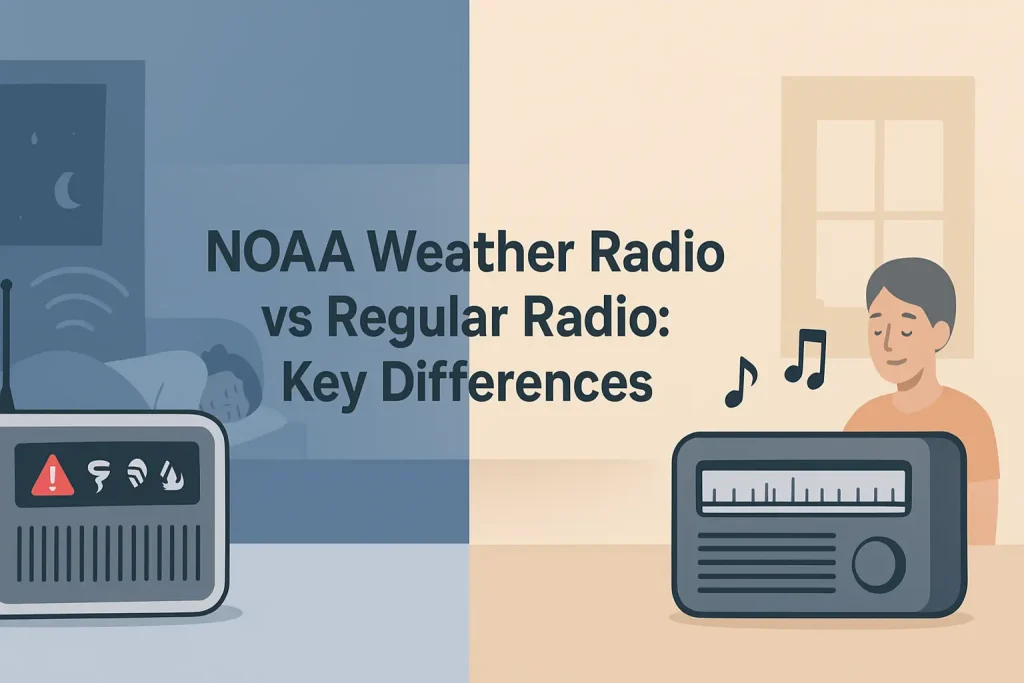
A NOAA weather radio app costs nothing to download and works on a phone you already carry. A dedicated physical weather radio costs $30 to $80 and sits on a shelf doing one job. The question is not which option is cheaper. The question is which one actually wakes you up at 3 a.m. when a tornado warning is issued for your county.
This guide covers both options across every dimension that matters for emergency preparedness: alert reliability, power dependency, S.A.M.E. filtering, cellular network dependence, and real-world performance during the storms when you need alerts most.
| Photo | Popular Portable Walkie Talkies | Price |
|---|---|---|
 | SKIWARRIOR Multifunctional Smart Wireless Ski Goggles with Walkie-Talkie, Anti-Fog Zeiss Lens, Music & Call Function (Cylindrical Blue) | Check Price On Amazon |
 | SINORISE Super Mini Walkie Talkies, Two-Way Radios, 3 Pack | Up to 12 Hours Battery Life, for Baseball Coaches, Restaurants, Retail Stores, Hospitals, Outdoor Sports & Travel | Check Price On Amazon |
 | KOSPET Tank M4C Smart Watch Rugged, Dual-Band GPS, 5ATM & IP69K Waterproof | 1.96" AMOLED Display, 170+ Sport Modes, Built-in LED Flashlight/Walkie-Talkie, Heart Rate/Sleep Monitor for Android & iPhone | Check Price On Amazon |
 | Retevis RT15 Walkie Talkies 3 Pack, Birthday Gift, Outdoor Adventure Kit | Durable, Lightweight, VOX, Key Lock, Mini Walkie Talkies for Adults, School Family Outdoor Travel Camping Hiking | Check Price On Amazon |
 | Rechargeable Walkie Talkies Toys for Kids: DIY Astronaut Walkie Talkies for Boys Christmas Birthday Gifts for 3 4 5 6 7 8 9 10 Boy Walkie Talkie Outdoor Hiking Toy 2 Way Radio Camping Outdoor Game | Check Price On Amazon |
By the Numbers
NOAA Weather Radio App vs Physical Radio: Key Facts
Sources: NOAA National Weather Service, FCC, FEMA IPAWS documentation.
What Is the Real Difference Between a NOAA Weather Radio App and a Physical Radio?
A NOAA weather radio app receives alerts through your cellular data connection and delivers them as push notifications or audio alerts on your smartphone. A physical NOAA weather radio receives the same alerts by tuning directly to one of the seven NOAA broadcast frequencies between 162.400 and 162.550 MHz, completely independent of the internet or cellular networks.
Both systems pull from the same NOAA National Weather Service alert data. The difference is the delivery path, and that delivery path is exactly what fails during the most dangerous storms.
Physical weather radios receive a dedicated VHF signal broadcast continuously, 24 hours a day, from over 1,000 NOAA transmitters across the United States. According to NOAA documentation, this network covers approximately 95% of the US population within a 40-mile radius of a transmitter.
Apps depend on cellular towers, which lose power or become overloaded during major weather events. A physical radio does not care whether the cell network is working. It only needs power and line-of-sight to a NOAA transmitter.
The single most important distinction is independence from infrastructure. Physical radios work when the grid is down (with battery backup), when cell towers are congested, and when your smartphone battery is dead. Apps work when everything else is also working.
How Do NOAA Weather Radio Apps Work, and What Are Their Limitations?
NOAA weather radio apps work by receiving alert data through the Integrated Public Alert and Warning System (IPAWS), the same federal infrastructure that powers Wireless Emergency Alerts (WEA) on your phone. Apps like dedicated weather alert apps for iPhone can deliver push notifications for specific counties, allow S.A.M.E.-style geographic filtering, and even play the same alert tones you hear on a physical radio.
The alert speed is generally fast, often within 60 to 90 seconds of a National Weather Service issuance. For routine severe weather monitoring during daylight hours when your phone is charged, apps perform reliably.
The limitations become critical in emergency scenarios. Cellular towers are among the first pieces of infrastructure to fail or become unusable during major storm events. The Federal Communications Commission has documented repeated cases of cellular network congestion and tower damage during hurricanes, tornadoes, and ice storms, reducing or eliminating cellular service in the affected areas.
Apps also depend on your phone battery. A smartphone in active use with screen on and background apps running may last 4 to 8 hours without a charge. A dedicated physical weather radio on battery backup can run for 20 to 40 hours on a set of AA alkaline batteries, depending on the model and alert activity.
Another limitation is silent mode and do-not-disturb settings. Many users keep their phones silenced overnight. Unless the app specifically overrides silent mode (a feature some apps support but many users never configure), nighttime alerts will not wake you.
If you are evaluating the best available app options for iOS devices, our guide to the top-rated weather alert apps for iPhone users covers alert speed, geographic filtering, and silent mode override capabilities across the leading options.
The core limitation of every app is this: it is only as reliable as the cellular network, the phone battery, and the user’s notification settings at the moment an alert fires.
How Does a Physical NOAA Weather Radio Work, and What Are Its Advantages?
A physical NOAA weather radio is a dedicated VHF receiver tuned to one or more of the seven NOAA broadcast frequencies: 162.400, 162.425, 162.450, 162.475, 162.500, 162.525, and 162.550 MHz. The radio monitors the broadcast continuously and activates its alarm when a Specific Area Message Encoding (S.A.M.E.) alert tone is detected for your programmed location.
S.A.M.E. technology is the feature that separates a useful weather radio from an annoying one. Without S.A.M.E., a physical radio alarms for every alert broadcast from the transmitter, which may cover dozens of counties. With S.A.M.E. programmed to your 6-digit FIPS county code, the radio only alarms for alerts issued for your specific county or the surrounding counties you choose.
The Midland WR400 weather radio is one of the most widely recommended physical radios for home use.
Key Specifications:
- Frequencies monitored: 162.400 to 162.550 MHz (all 7 NOAA channels)
- S.A.M.E. alert event types recognized: 25
- Programmable S.A.M.E. location codes: up to 50
- Power: AC adapter with 6x AA battery backup
- Alert output: alarm tone, voice broadcast, and flashing strobe
The primary advantage of a physical radio is its independence from cellular networks and the internet. The NOAA broadcast signal is a direct VHF transmission, not routed through any digital network that can fail under load. During Hurricane Katrina, Hurricane Harvey, and the 2011 Joplin tornado, cellular networks in affected areas were severely degraded or unusable. Physical NOAA weather radios continued functioning as long as they had power.
Physical radios also address the nighttime alert problem definitively. A dedicated radio with the alarm set to maximum volume will wake most people through a closed bedroom door. The alert tone used by NOAA, the 1050 Hz Attention Signal, is specifically designed to penetrate ambient noise and sleep. You do not need to configure it to override a do-not-disturb setting because it is not a notification. It is a physical alarm.
The Uniden BC365CRS weather radio offers clock-radio functionality alongside full S.A.M.E. alert capabilities, making it practical as both a bedside clock and an always-on emergency receiver.
Physical radios do have limitations. They require proximity to a NOAA transmitter, which is not a problem for 95% of the US population but can be an issue in very rural or mountainous areas where signal strength is weak. They also require you to be near the radio when an alert fires, unlike a phone that travels with you.
For a full explanation of how the NOAA broadcast network is structured and what it covers, our guide to how the NOAA weather radio network broadcasts alerts explains the transmitter infrastructure, alert types, and S.A.M.E. encoding system in detail.
A physical radio is the more reliable option for home emergency preparedness, specifically because it operates independently of the infrastructure most likely to fail in the emergency it is designed to warn you about.
Here is a side-by-side look at how the two options compare across the dimensions that matter most for emergency use.
Use the table below to decide which option better matches your specific emergency preparedness needs and living situation.
Product Comparison
NOAA Weather Radio App vs Physical Radio: Side by Side
Key factors compared. Sources: NOAA NWR documentation, FCC, FEMA IPAWS, manufacturer specifications.
| Factor | NOAA Weather Radio App | Physical Weather Radio |
|---|---|---|
| Alert delivery path | Cellular data / internet | Direct VHF broadcast (162.400-162.550 MHz) |
| Works without cell service | No | Yes |
| Works during power outage | Only while phone has battery | Yes, with AA battery backup (20-40 hrs) |
| Nighttime alert reliability | Depends on silent mode settings | Consistent; physical alarm tone always activates |
| S.A.M.E. county filtering | Yes (app-dependent) | Yes (6-digit FIPS code) |
| Portable (travels with you) | Yes | Only with portable/handheld model |
| Upfront cost | Free to $5 (app purchase) | $30-$80 (dedicated radio) |
| Alert speed after NWS issuance | 60-90 seconds (network dependent) | Near-immediate (broadcast direct) |
| Best for | On-the-go monitoring, supplemental alerts | Home emergency preparedness, primary alert system |
App alert speed varies by carrier and network conditions. Physical radio battery life estimate based on 20-40 hours at low alert activity with fresh alkaline AA batteries. S.A.M.E. filtering available on mid-range and higher physical radio models.
The table makes the core trade-off clear: apps offer portability and zero upfront cost, while physical radios offer infrastructure independence and consistent nighttime performance.
What Are the Pros and Cons of NOAA Weather Radio Apps?
NOAA weather radio apps offer genuine advantages that a physical radio cannot match in certain scenarios, particularly when you are away from home. The same cellular connection that makes apps unreliable during infrastructure failures also makes them the only practical way to receive location-aware alerts when you are traveling, commuting, or working outside your home county.
Most modern weather alert apps support GPS-based location tracking, which means the app automatically adjusts its S.A.M.E.-equivalent filtering to your current county as you move. A physical radio programmed to your home county will not alert you when a tornado warning is issued for the county you are driving through 200 miles away.
Pros of NOAA Weather Radio Apps:
- Zero to minimal cost (most quality apps are free or under $5)
- Always with you on a device you already carry
- GPS-aware geographic filtering that updates as you travel
- Visual alert display with map overlays showing affected areas
- Customizable alert types (filter out marine alerts if you live inland)
- No additional hardware to purchase, power, or maintain
- Access to full NWS text forecasts, radar, and storm tracking
Cons of NOAA Weather Radio Apps:
- Completely dependent on cellular data or Wi-Fi connectivity
- Fails when cellular towers are damaged, overloaded, or lose power during major events
- Relies on phone battery, which depletes faster during severe weather when you need it most
- Silent mode, do-not-disturb, and battery saver settings can block alerts
- App requires initial setup and correct permission configuration to function at all
- Push notification delays can occur during peak cellular network load
- No physical alarm tone to wake heavy sleepers; alert volume limited by phone speaker
The silent mode problem deserves specific emphasis. The iPhone Focus mode, Android Do Not Disturb, and similar features on most smartphones will suppress app notifications unless the user specifically configures a weather alert exception. Wireless Emergency Alerts (WEA) sent by FEMA bypass silent mode by default, but app-generated NOAA alerts do not. Many users discover this failure mode only after missing an alert.
For context on how app-delivered alerts compare to the wireless emergency alert system built into every phone, our comparison of dedicated weather radios versus the wireless emergency alert system covers the technical differences in alert coverage, timing, and reliability.
Apps are a strong supplemental tool, but their dependency on three separate systems (cellular network, phone battery, and correct notification settings) makes them unreliable as a primary alert system for home emergency preparedness.
What Are the Pros and Cons of Physical NOAA Weather Radios?
A physical NOAA weather radio receives the 162 MHz VHF broadcast directly from NOAA transmitters without passing through any internet infrastructure, cellular carrier, or app server. This direct broadcast architecture is why physical radios are recommended by FEMA, the American Red Cross, and state emergency management agencies as the primary home alert device for severe weather preparedness.
This happens because VHF radio signals propagate line-of-sight from the transmitter tower, independent of whether the internet is functioning or whether cellular towers are operational. The NOAA transmitter itself runs on backup power and is designed to continue broadcasting through the same storms it is warning about.
The Sangean CL-100 weather radio is a well-regarded mid-range option with full S.A.M.E. support and battery backup capability.
Key Specifications:
- Frequencies: 162.400 to 162.550 MHz (all 7 NOAA channels)
- S.A.M.E. alert types supported: 25
- Power: AC with battery backup (6x AA)
- Alert memory: programmable county codes
- Audio output: built-in speaker with dedicated alarm volume control
Pros of Physical NOAA Weather Radios:
- Operates completely independent of cellular networks and internet
- Battery backup (typically 20-40 hours on fresh alkaline AA batteries) provides coverage during power outages
- Physical alarm tone activates regardless of any mute, silent, or do-not-disturb setting
- S.A.M.E. filtering by 6-digit FIPS county code reduces false alarms to your specific area
- Dedicated device means you never miss an alert because your phone battery died
- Alert tone (1050 Hz NOAA Attention Signal) designed specifically to wake sleeping occupants
- Some models include strobe light output for hearing-impaired users
- No app configuration, no permissions, no silent-mode exceptions to manage
Cons of Physical NOAA Weather Radios:
- Upfront cost of $30 to $80 for a quality S.A.M.E.-capable model
- Fixed location; does not follow you when you leave home
- Requires proximity to a NOAA transmitter (weak in remote or mountainous areas)
- S.A.M.E. programming requires manual entry of 6-digit FIPS code (one-time setup, but slightly technical)
- Battery backup must be maintained with fresh batteries (replace annually before storm season)
- Basic models without S.A.M.E. will alarm for every county in the transmitter’s broadcast area
- No visual storm tracking, radar, or map integration
The FIPS county code programming step stops many users from getting full value from their physical radio. Without it, the radio broadcasts all alerts for the entire transmitter coverage area, which may include 20 or more counties. A radio without S.A.M.E. programmed correctly will alarm so frequently for non-local events that users often turn it off entirely.
To find the correct NOAA transmitter frequency and FIPS code for your county, our guide to NOAA weather radio stations organized by state lists the transmitter frequencies and coverage areas for every state.
A physical weather radio is the correct primary alert device for home emergency preparedness, provided it is programmed with the correct S.A.M.E. county code and maintained with fresh batteries before each storm season.
The following widget helps you decide which option (or combination) fits your specific situation based on your use case and preparedness priorities.
Interactive Tool
App or Physical Radio: Which Option Fits Your Situation?
Answer 2 questions to get a recommendation matched to your use case and preparedness needs.
Which Option Is More Reliable During Actual Severe Weather Events?
Physical NOAA weather radios are more reliable during the severe weather events they are designed to warn about. This is not an opinion. It is an architecture fact: the NOAA VHF broadcast on 162 MHz does not pass through cellular towers, internet servers, or app notification systems, all of which are subject to failure during major events.
FEMA’s post-event reports on major hurricane and tornado events consistently document cellular network degradation as a primary communication failure point. During Hurricane Harvey in 2017, widespread cellular outages across Houston lasted hours to days in the most affected areas. Physical weather radios continued operating on battery backup throughout.
The condition under which a physical radio fails is narrow: you must be within range of a functioning NOAA transmitter, and you must have power (either AC or battery backup). NOAA transmitters themselves run on backup generator power and are hardened against severe weather. According to NOAA documentation, transmitter uptime during major weather events exceeds 99% nationally.
Apps fail under a much wider range of conditions: cell tower damage, network congestion from everyone calling and texting simultaneously, phone battery depletion, incorrect notification settings, and app server failures. Each of these conditions becomes more likely, not less, during a major weather emergency.
For the most critical use case (nighttime alerts for sleeping occupants during a tornado warning), a physical radio with battery backup and S.A.M.E. programmed to your county is more reliable than any app-based system by a significant margin.
The only scenario where an app outperforms a physical radio on reliability is when you are away from home and traveling through areas with functioning cellular coverage. In that scenario, a GPS-aware app is the only option that provides location-relevant alerts, because a physical radio at home cannot alert you when you are 300 miles away.
Reliability during actual emergencies favors the physical radio for home use and the app for mobile use, making the combination of both the most complete preparedness approach.
What Does S.A.M.E. Technology Mean for Both Options, and Why Does It Matter?
S.A.M.E. stands for Specific Area Message Encoding, a digital header system embedded in NOAA weather radio broadcasts that identifies which geographic areas an alert applies to using a 6-digit FIPS (Federal Information Processing Standards) county code. Without S.A.M.E. filtering, a weather radio or app alerts you to every event broadcast by your NOAA transmitter, which may cover 10 to 30 counties.
This matters because alert fatigue is the primary reason people turn off their weather radios and disable their weather apps. A physical radio without S.A.M.E. programmed correctly will alarm at 2 a.m. for a Flood Warning in a county 80 miles away that is entirely irrelevant to your location. Most users who report their weather radio as “too noisy” are using it without S.A.M.E. county filtering.
On physical radios, S.A.M.E. is implemented by programming your specific 6-digit FIPS county code into the radio’s memory. The radio then only activates its alarm when the incoming broadcast’s S.A.M.E. header matches your programmed code. You can typically program up to 5 to 50 codes depending on the model, allowing you to monitor adjacent counties as well.
On weather apps, S.A.M.E.-equivalent filtering is handled through location settings. The best apps allow you to specify exact counties and select which event types to receive (Tornado Warnings only, versus all severe weather events, versus all NOAA alert categories). The depth of this filtering varies significantly by app.
To find the exact 6-digit FIPS S.A.M.E. code for your county and the correct NOAA broadcast frequency for your area, our guide to all seven NOAA weather radio broadcast frequencies and how to choose yours covers frequency selection and S.A.M.E. code lookup by region.
Both options support geographic alert filtering. The difference is that on a physical radio, S.A.M.E. filtering works even when every other system has failed, because it is built into the radio’s hardware receiver and the NOAA broadcast itself.
How Do the Costs Compare Between Apps and Physical Radios Over Time?
The upfront cost difference is real: a quality weather app costs $0 to $5, while a quality S.A.M.E.-capable physical weather radio costs $30 to $80. Over a three-to-five-year ownership period, however, the total cost of ownership is closer than the upfront numbers suggest.
Physical radios require annual battery replacement to maintain backup power. A set of 6 AA alkaline batteries costs $4 to $8 per year. Over five years, that adds $20 to $40 to the total cost of the radio. Some models use rechargeable batteries, which eliminate this recurring cost.
The Midland ER310 emergency radio combines NOAA weather radio reception with hand-crank and solar charging, eliminating battery replacement costs entirely for backup power purposes.
Apps appear to cost nothing beyond the purchase price, but there are hidden costs. A weather app running in the background with location services enabled consumes measurable battery and data. More significantly, a phone that functions as your primary weather alert device requires more frequent charging and may drive earlier phone replacement due to battery cycle wear.
Use the table below to compare the five-year cost of ownership for each option.
Cost Reference
App vs Physical Radio: Five-Year Cost of Ownership
Estimated costs based on current market pricing. Prices verified at time of publication.
| Cost Item | Weather App | Physical Radio |
|---|---|---|
| Upfront hardware cost | $0 (uses existing phone) | $30-$80 |
| App purchase | $0-$5 (one-time) | None |
| Annual battery replacement | None (but phone charges more) | $4-$8/year (6x AA) |
| Subscription fees | $0-$30/year (some premium apps) | None |
| 5-year total (low estimate) | $0 | $50 ($40 radio + $10 batteries) |
| 5-year total (high estimate) | $155 ($5 app + $30/yr subscription) | $120 ($80 radio + $8/yr batteries) |
App cost assumes free or low-cost app with no subscription. Physical radio cost assumes mid-range S.A.M.E.-capable model with annual battery replacement. Hand-crank or solar models eliminate battery replacement costs.
Over five years, the cost difference between a quality physical radio and a free weather app is modest, and the physical radio provides infrastructure-independent performance that no free app can match.
Should You Use Both a NOAA Weather Radio App and a Physical Radio?
Using both a NOAA weather radio app and a physical radio is the approach recommended by FEMA for household emergency preparedness, and it is the correct answer for most people. The two systems cover different failure modes and different use cases, making them genuinely complementary rather than redundant.
A physical radio at home covers nighttime alerts when your phone is silenced, during cellular outages, and during power failures with battery backup. An app on your phone covers location-aware alerts when you are away from home, driving through different counties, or traveling to areas outside your programmed S.A.M.E. county codes.
The combined setup requires a one-time investment of $30 to $80 for the physical radio, a free or low-cost app on a phone you already carry, and annual replacement of AA batteries before storm season. The total cost is comparable to a single visit to a hardware store.
If you can only choose one, the physical radio is the higher-priority purchase for home preparedness. The scenarios where an app fails (power outage, cell tower damage, phone battery dead, wrong notification settings) are all more likely during the same severe weather events when you most need alerts.
If you are evaluating how a dedicated weather radio compares to the outdoor alert system you may already have installed, our comparison of indoor sirens versus dedicated weather radios for home alert coverage covers the specific situations where each system outperforms the other.
The practical recommendation is: physical radio at home, app on your phone, and treat them as a system rather than alternatives.
Quick Reference: Key Terms Used in This Guide
S.A.M.E. (Specific Area Message Encoding): A digital header embedded in NOAA weather radio broadcasts that identifies the affected geographic area using a 6-digit FIPS county code. Physical radios use this code to alarm only for your county.
FIPS Code: A 6-digit Federal Information Processing Standards code that identifies a specific US county. You program this code into your physical weather radio to filter alerts to your location only.
NWR (NOAA Weather Radio All Hazards): The national network of over 1,000 NOAA transmitters broadcasting weather alerts continuously on seven VHF frequencies between 162.400 and 162.550 MHz.
IPAWS (Integrated Public Alert and Warning System): The federal infrastructure operated by FEMA that distributes alert data to multiple systems including weather apps, wireless emergency alerts, and EAS broadcasts.
WEA (Wireless Emergency Alert): Government-issued emergency alerts sent directly to cellular phones via the cellular broadcast system. These bypass silent mode but are separate from NOAA weather radio app alerts.
EAS (Emergency Alert System): The national public warning system that distributes alerts through broadcast radio, television, cable, and satellite. NOAA weather radio is a primary EAS distribution channel.
VHF (Very High Frequency): The radio frequency band from 30 to 300 MHz. NOAA weather radio broadcasts on the VHF high band at 162.400 to 162.550 MHz.
1050 Hz Attention Signal: The specific audio tone NOAA uses to precede weather alert broadcasts. This frequency is chosen because it effectively penetrates ambient noise and activates sleeping individuals.
Battery Backup: AA or rechargeable battery power that keeps a physical radio operating during a power outage. Most dedicated weather radios provide 20 to 40 hours of backup power on fresh alkaline batteries.
Push Notification: An app-generated alert delivered through the cellular network to your phone’s notification system. Unlike WEA, push notifications can be blocked by silent mode and do-not-disturb settings.
Does a NOAA Weather Radio App Work Without Cell Service?
A NOAA weather radio app does not work without cellular data or Wi-Fi connectivity. All app-based alert delivery, including push notifications from NOAA-affiliated apps, depends on an active internet connection to receive data from NOAA servers or IPAWS. If your cellular connection drops, the app receives no new alert data until connectivity is restored.
This is the fundamental difference from a physical weather radio. A physical radio receives the NOAA VHF broadcast directly on 162 MHz, with no internet or cellular infrastructure in the signal path.
Wireless Emergency Alerts (WEA) sent by government authorities do bypass the data network and use the cellular broadcast channel, but these are not generated by weather apps. They are sent by FEMA and NOAA directly through the cellular system and arrive even without a data connection, as long as you have basic cellular signal.
Can a Weather App Replace a Physical NOAA Weather Radio for Emergency Preparedness?
A weather app cannot fully replace a physical NOAA weather radio for home emergency preparedness. Apps fail under exactly the conditions that define major severe weather emergencies: cellular network overload, tower damage from the storm, phone battery depletion, and power outages that prevent recharging.
A physical radio with battery backup continues operating through all of these failure conditions because it receives the direct NOAA VHF broadcast on 162 MHz, which does not pass through any of the infrastructure points that fail during emergencies.
Apps do replace the physical radio for one specific use case: mobile monitoring while traveling. A GPS-aware app provides county-specific alerts as you move between locations, which a fixed physical radio cannot do. For that purpose, an app is not just adequate but superior to the physical option.
What Happens to App Alerts When Cell Towers Go Down During a Storm?
When cell towers go down during a storm, app-based weather alerts stop delivering. The app on your phone has no way to receive new alert data because the pathway (cellular data network) that carries alerts from NOAA servers to your device is severed. Any alerts issued after the towers fail will not reach you until connectivity is restored.
This failure mode is well-documented. The FCC has reported that in major hurricane events, up to 40% of cell sites in the affected area can become non-operational due to power loss, physical damage, or network congestion. The cell congestion problem compounds the outage problem. Even towers that remain powered may be unusable because thousands of people are trying to call and transmit data simultaneously.
A physical NOAA weather radio is immune to this failure because the NOAA transmitter broadcasts the VHF signal directly from towers designed to operate through the same storms they are warning about, with hardened backup power systems.
Do NOAA Weather Radio Apps Override Silent Mode and Do Not Disturb?
Most NOAA weather radio apps do not automatically override silent mode or Do Not Disturb on iPhones and Android devices. This is a critical distinction from Wireless Emergency Alerts (WEA), which are designed to override silent mode by default on compliant devices. App push notifications follow the standard notification permission system and are blocked by silent mode unless specifically configured otherwise.
Some apps offer a setting to override silent mode for high-priority alerts (Tornado Warnings, Flash Flood Emergencies), but this feature must be manually enabled by the user and may not work consistently across all operating system versions. On iOS, Critical Alerts permission must be explicitly granted by the user, and not all weather apps have access to this permission level from Apple.
A physical weather radio has no silent mode. Its alarm tone activates at the hardware level when a matching S.A.M.E. alert is received, regardless of any software setting on any other device. For overnight alert reliability, this is a decisive advantage of the physical radio.
How Do I Program S.A.M.E. Codes on a Physical Weather Radio?
Programming S.A.M.E. codes on a physical weather radio requires three steps: finding your 6-digit FIPS county code, entering the radio’s programming mode, and entering the code using the keypad. The process takes about 5 minutes and needs to be done only once unless you move or want to add adjacent counties.
Step 1: Find your FIPS code. The NOAA NWS website provides a county lookup tool where you enter your state and county to retrieve the 6-digit FIPS code. The code format is a 2-digit state code followed by a 3-digit county code (for example, 012057 for Fayette County, Alabama).
Step 2: Enter programming mode on your radio. Most models use a dedicated “Program” or “SAME” button. Hold it for 2 to 3 seconds until the display shows a programming prompt.
Step 3: Enter the 6-digit code using the channel or numeric buttons. Confirm entry when prompted. Repeat for any adjacent counties you want to monitor (most radios accept 5 to 50 programmed codes).
If your radio does not have a numeric keypad (some basic models require cycling through digits with channel up/down buttons), the process takes longer but uses the same three-step logic. Consult your radio’s manual for the exact button sequence, as it varies by manufacturer.
Is a Portable Hand-Crank Weather Radio Better Than an App for Camping or Emergency Go-Bags?
A portable hand-crank weather radio is more reliable than an app for camping and emergency go-bag use because it operates without cellular coverage and without any external power source. In backcountry environments, cellular coverage is often absent entirely, making app-based alerts non-functional. A hand-crank radio generates its own power from mechanical energy and receives the NOAA VHF broadcast directly.
The Midland ER310 emergency hand-crank radio receives all 7 NOAA weather frequencies, runs on hand-crank, solar, AAA batteries, or USB charging, and includes a built-in flashlight and SOS beacon.
Key Specifications:
- NOAA frequencies: 162.400 to 162.550 MHz (all 7 channels)
- Power options: hand crank, solar panel, 3x AAA batteries, micro-USB
- Additional features: LED flashlight, SOS beacon, phone charging port
- Weight: approximately 9.6 oz
For camping, an app is the wrong primary tool. It requires cellular coverage that rural and backcountry areas often lack. A portable weather radio is the correct choice, and hand-crank models eliminate battery dependency entirely.
What Alert Types Do NOAA Weather Radios Cover That Apps Might Miss?
NOAA weather radios and apps both receive alerts from the same NOAA National Weather Service event catalog, which includes over 70 named event types. However, the specific events that trigger push notifications on apps depend on the app’s configuration and the alert event codes the developer chose to include. Physical radios with S.A.M.E. support cover all 25 primary S.A.M.E. event codes by default.
S.A.M.E. event categories received by physical weather radios include: Tornado Warning, Tornado Watch, Severe Thunderstorm Warning, Flash Flood Warning, Flash Flood Watch, Hurricane Warning, Hurricane Watch, Extreme Wind Warning, Storm Surge Warning, Tsunami Warning, Winter Storm Warning, Blizzard Warning, Ice Storm Warning, Hazardous Materials Warning, Civil Emergency Message, Law Enforcement Warning, Nuclear Power Plant Warning, Radiological Hazard Warning, Evacuation Immediate, Shelter In Place Warning, 911 Telephone Outage, AMBER Alert, Child Abduction Emergency, Local Area Emergency, and National Information Center.
Most weather apps default to notifying only for the highest-severity events (Tornado Warnings, Severe Thunderstorm Warnings, Flash Flood Warnings). Hazardous materials warnings, radiological hazard warnings, and civil emergency messages are frequently absent from default app alert configurations. Users who want comprehensive coverage must manually enable all event types in the app’s settings.
Physical radios alert for all programmed event types automatically, including non-weather emergencies like AMBER Alerts and hazardous materials warnings, without any additional configuration beyond the initial S.A.M.E. county code entry.
How Long Do Physical Weather Radio Batteries Last During an Extended Power Outage?
A physical weather radio on AA alkaline battery backup typically lasts 20 to 40 hours of continuous standby operation during a power outage, depending on the model, battery quality, and alert activity. Models that activate the speaker only when an alert fires (standby mode) use dramatically less battery power than radios playing continuous broadcast audio.
Fresh Energizer or Duracell AA alkaline batteries provide the most reliable backup performance. Rechargeable NiMH batteries provide slightly less total capacity (typically 2000 to 2500 mAh per cell versus 2850 to 3000 mAh for alkaline) but are a valid option if replaced before storm season.
Battery life drops significantly if the radio is set to play continuous NOAA audio rather than standby alarm mode. In continuous audio mode, most radios consume 4 to 6x more power, reducing battery life to 4 to 8 hours on the same set of batteries.
The correct operating mode for emergency preparedness is standby or alarm-only mode, where the radio monitors silently and activates only when a matching S.A.M.E. alert is received. This maximizes battery life and eliminates background noise while maintaining full alert capability.
Replace backup batteries annually, before the start of storm season in your region. Old batteries lose capacity even without use, and a partially depleted battery set provides significantly less than the rated backup duration.
Are Free Weather Apps as Good as Paid Apps for NOAA Alert Delivery?
Free weather apps deliver NOAA alerts with comparable speed and accuracy to most paid apps, because both categories draw from the same IPAWS and NOAA data sources. Alert delivery speed is primarily determined by the app’s server infrastructure and the cellular network, not the app’s price.
The differences between free and paid apps are in features beyond basic alert delivery: ad-free experience, advanced radar overlays, multi-location monitoring, storm tracking tools, and in some cases more granular alert filtering. For pure NOAA alert notification purposes, well-reviewed free apps (such as the official FEMA app or Weather Underground’s free tier) perform equivalently to paid alternatives.
The more important distinction is between apps that support silent-mode override for Critical Alerts and those that do not, which is not consistently correlated with price. Check the specific app’s permissions and notification settings rather than assuming a paid app handles overnight alerts correctly.
Can I Use a Combination of Both Systems for Full Coverage?
Using both a physical weather radio and a weather app provides the most complete alert coverage available to a household. The two systems are genuinely complementary: the physical radio covers nighttime alerts, power outages, and cellular failures at home, while the app covers location-aware alerts when you are away from home and cellular service is available.
This combination approach is explicitly recommended by FEMA’s emergency preparedness guidelines. It costs $30 to $80 for the physical radio (a one-time purchase), $0 to $5 for a quality app, and $4 to $8 per year for battery replacement. The total is less than a single tank of gasoline for most households.
Set up the combination correctly: program the physical radio with your 6-digit FIPS S.A.M.E. county code, place it in the bedroom or central hallway, set it to alarm-only mode, and replace the batteries each spring. Configure the app with your home county as a saved location, enable all severe weather event types, and if available, enable the Critical Alert or silent-mode override permission.
For a complete picture of how these alert systems fit within the broader landscape of home emergency communication options, our overview of how weather radios compare to wireless emergency alerts for home preparedness covers the federal alert infrastructure that powers all of these systems.
The combination of both systems is not overkill. It is the correct redundant approach for any household in a region with tornado, hurricane, or severe thunderstorm exposure.
A physical NOAA weather radio on battery backup, programmed with your county’s S.A.M.E. code, is the most reliable single alert device for home emergency preparedness. It costs $30 to $80, requires one-time setup, and operates completely independent of the infrastructure most likely to fail during the emergencies it warns about. A weather app on your phone is the right supplemental tool for location-aware alerts when you are mobile. Use both, treat them as a system, and replace the backup batteries every spring before storm season begins.
| Photo | TOP RATED WALKIE TALKIES | Price |
|---|---|---|
 | Retevis RT628 Kids Walkie Talkies, Toys Gifts for 4-12 Year Old Girl Boy | Kids Camping Essentials Outdoor Toys, Birthday Gift, 22CH, VOX, Keypad Lock, Durable, Easy to Use Walkie Talkies for Kids | Check Price On Amazon |
 | Cobra ACXT545 Weather-Resistant Walkie Talkies, Rechargeable, 22 Channels | Long Range 28-Mile Two-Way Radio Set (2-Pack) | Check Price On Amazon |
 | Retevis RT388 Kids Walkie Talkies, Outdoor Toys for Kids Camping Essentials | 4-12 Year Old Boy Birthday Gift, 22 CH VOX Flashlight Clear Sound, Kids Walkie Talkies 2 Pack for Camping Hiking Adventure | Check Price On Amazon |
 | Cobra RX680 Walkie Talkies (2-Pack), IP54 Water Resistant Design | Rugged & Splashproof Two Way Radios Long Range, 60 Pre-Programmed Channels, Weather Alerts | Check Price On Amazon |
 | Retevis RT22 Walkie Talkies Long Range Rechargeable with Earpiece (2 Pack) | Slim & Lightweight 2 Way Radio For Camping & Hiking, Pocket-Friendly Antenna, Ready to Use, 10-Hour Battery, USB-C Charging | Check Price On Amazon |
 | Midland GXT1000VP4 GMRS Two-Way Radios with Headsets, Black, 2 Pack | 50 Channels, 142 Privacy Codes, Up to 36 Mile Long Range, JIS4 Water Resistant, NOAA Weather Alert, Rechargeable NiMH | Check Price On Amazon |
 | Retevis RT628 Walkie Talkies for Kids,Toys Gifts for 6-12 Years Old Boys Girls,Long Range 2 Way Radio 22CH VOX,Birthday Gift,Family Walkie Talkie for Camping Hiking Indoor Outdoor | Check Price On Amazon |