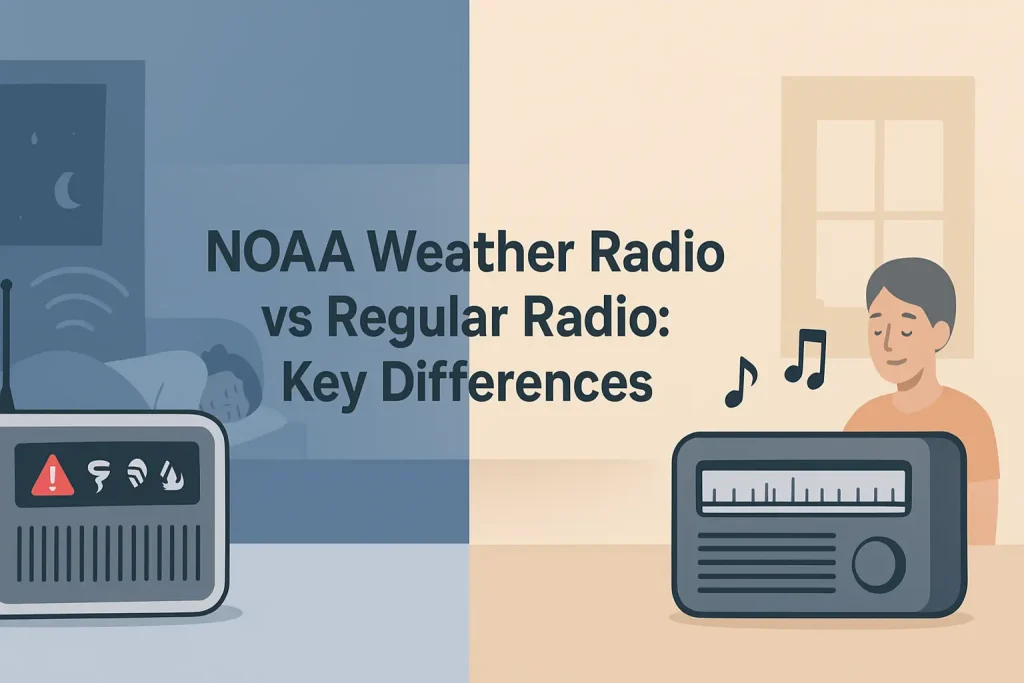
Most weather radio apps and streaming sites give you a live NOAA broadcast feed from the nearest transmitter, but knowing which ones actually stay connected during severe weather separates the useful tools from the ones that buffer when you need them most. NOAA Weather Radio All Hazards broadcasts 24 hours a day on seven dedicated frequencies between 162.400 and 162.550 MHz, covering roughly 95% of the US population within 40 miles of a transmitter. When your physical weather radio is out of reach, a reliable internet stream of that same broadcast can keep you informed at home, at work, or on the road.
This guide covers the best websites and apps for streaming internet weather radio, how they compare on reliability and features, and what to look for when choosing a service that actually delivers alerts when severe weather strikes.
| Photo | Popular Portable Walkie Talkies | Price |
|---|---|---|
 | SKIWARRIOR Multifunctional Smart Wireless Ski Goggles with Walkie-Talkie, Anti-Fog Zeiss Lens, Music & Call Function (Cylindrical Blue) | Check Price On Amazon |
 | SINORISE Super Mini Walkie Talkies, Two-Way Radios, 3 Pack | Up to 12 Hours Battery Life, for Baseball Coaches, Restaurants, Retail Stores, Hospitals, Outdoor Sports & Travel | Check Price On Amazon |
 | KOSPET Tank M4C Smart Watch Rugged, Dual-Band GPS, 5ATM & IP69K Waterproof | 1.96" AMOLED Display, 170+ Sport Modes, Built-in LED Flashlight/Walkie-Talkie, Heart Rate/Sleep Monitor for Android & iPhone | Check Price On Amazon |
 | Retevis RT15 Walkie Talkies 3 Pack, Birthday Gift, Outdoor Adventure Kit | Durable, Lightweight, VOX, Key Lock, Mini Walkie Talkies for Adults, School Family Outdoor Travel Camping Hiking | Check Price On Amazon |
 | Rechargeable Walkie Talkies Toys for Kids: DIY Astronaut Walkie Talkies for Boys Christmas Birthday Gifts for 3 4 5 6 7 8 9 10 Boy Walkie Talkie Outdoor Hiking Toy 2 Way Radio Camping Outdoor Game | Check Price On Amazon |
What Is Internet Weather Radio Streaming and How Does It Work?
Internet weather radio streaming delivers the live audio feed from a NOAA Weather Radio All Hazards (NWR) transmitter over the internet, so you can hear the same broadcast a physical weather radio receives on frequencies like 162.550 MHz (WX1) or 162.400 MHz (WX2). The stream originates at a NOAA transmitter site, gets captured by a receiver connected to the internet, and is rebroadcast in real time through a web player or mobile app.
This matters because internet streams give you access to any transmitter in the country, not just the one closest to your antenna. A person traveling through an unfamiliar region, monitoring a family member’s county from a different state, or working in a building that blocks RF signals can tune to a specific transmitter and hear the same Specific Area Message Encoding (SAME) coded alerts a local weather radio would receive.
The underlying broadcast comes from the National Weather Service (NWS), which operates over 1,000 transmitters covering all 50 states, adjacent coastal waters, Puerto Rico, the US Virgin Islands, and American Samoa, according to NOAA NWR documentation. Each transmitter broadcasts on one of seven frequencies: 162.400, 162.425, 162.450, 162.475, 162.500, 162.525, and 162.550 MHz.
Internet streams do have one important limitation compared to a dedicated hardware receiver. A physical NOAA weather alert radio with SAME technology can wake you from sleep with a loud alarm tone even when your phone is silenced. Most streaming apps require the app to be open or the phone screen to be active to trigger an alert sound. Understanding this distinction helps you decide when a stream is the right tool and when a dedicated receiver is the better choice.
Internet weather radio streaming is best understood as a complement to a dedicated receiver, not a full replacement for one.
Best Websites for Streaming NOAA Weather Radio Live
The most reliable websites for streaming live NOAA weather radio audio connect directly to receiver feeds maintained by radio hobbyists, emergency management agencies, and universities, giving you continuous access to the broadcast your county’s transmitter is putting out right now. Quality varies significantly between sites, and some aggregate dozens of transmitter feeds while others focus on a single region.
RadioReference.com Audio Streaming
RadioReference.com hosts one of the largest community-maintained databases of live radio audio streams in North America, including hundreds of NOAA weather radio transmitter feeds organized by state and county. Feeds are contributed by volunteers who connect a scanner or dedicated receiver to their internet connection and rebroadcast the audio through the RadioReference streaming infrastructure.
To find a weather radio feed, navigate to the Audio section, select your state, and filter by the “Weather” category. Most feeds are labeled with the transmitter call sign (for example, KHB35 in Omaha, Nebraska, broadcasts on 162.400 MHz) so you can match the feed to the transmitter closest to your area of interest.
Feed reliability depends on individual contributors, which means a specific transmitter feed may occasionally go offline if the volunteer’s hardware goes down. RadioReference itself does not host backup feeds, so availability is not guaranteed for every location. For major metro areas, multiple feeds usually exist, giving you redundancy.
Weather.gov Audio Streams
The National Weather Service provides direct links to audio streams for many NWR transmitters on the official weather.gov website. These streams are hosted by individual NWS forecast offices and tend to be the highest-quality source for a given transmitter because they originate from official NWS infrastructure rather than a volunteer receiver.
Coverage is not universal through this channel. Not every NWS office provides a public audio stream, so the weather.gov option works well for areas where the local forecast office has made a feed available but leaves gaps in rural or lightly staffed regions.
Broadcastify.com
Broadcastify (owned by RadioReference.com) operates the largest network of live public safety and weather radio streams in the US. The weather radio section includes feeds from most major metro areas and many rural counties, with listener counts and uptime statistics visible on each feed’s page so you can quickly assess whether a feed is currently active.
A free account gives you access to most feeds with occasional buffering limits during high-traffic events like active tornado outbreaks, when tens of thousands of listeners may simultaneously tune in. A premium subscription removes those limits and provides 30-day audio archives, which is useful for reviewing what a transmitter broadcast during a past severe weather event.
The Broadcastify platform is also accessible through scanner radio apps on iOS and Android, discussed in the apps section below.
NOAA Weather Radio on TuneIn
TuneIn Radio aggregates a selection of NOAA weather radio streams alongside its commercial broadcast radio catalog. The weather radio feeds available through TuneIn are generally sourced from the same Broadcastify contributor network, so audio quality and reliability are comparable. TuneIn’s advantage is a cleaner interface that requires no account and works on smart TVs, Amazon Echo devices, and home audio systems that support TuneIn natively.
Coverage through TuneIn is less comprehensive than Broadcastify directly, with fewer rural transmitter feeds available. For major metropolitan areas, TuneIn is a convenient no-friction option for casual monitoring.
NOAA Weather Radio All Hazards Official Site
NOAA’s official NWR site at weather.gov/nwr provides a transmitter map, coverage areas, and links to available audio streams by state. This is the authoritative source for identifying which transmitter covers your county, what frequency it broadcasts on, and what SAME county FIPS codes correspond to your area. It does not host a universal streaming player, but it provides the reference data you need to find the right feed on Broadcastify or RadioReference.
The best approach for most users is to start at the NOAA NWR site to identify your transmitter, then find that specific transmitter’s feed on Broadcastify for continuous streaming access.
Best Apps for Streaming Internet Weather Radio
Mobile apps for internet weather radio streaming range from simple audio players that stream a single NOAA feed to full-featured tools that combine live audio with push notification alerts, SAME code filtering, and radar integration. The right app depends on whether you want passive background audio or active alerting that notifies you without keeping the app open.
Scanner Radio (iOS and Android)
Scanner Radio, developed by Gordon Edwards, is one of the most widely used apps for streaming live radio audio on mobile devices and draws directly from the Broadcastify feed network. The app includes a dedicated weather radio category that lets you search for feeds by state, county, or transmitter call sign. Feed quality indicators show listener counts and uptime, helping you choose an active, well-maintained stream.
Key Specifications:
- Feed network: Broadcastify (RadioReference.com)
- Platform: iOS and Android
- Weather radio filter: Yes, searchable by state and county
- Background audio: Yes (screen can be off)
- Push alerts for active incidents: Available in premium version
- Cost: Free with ads; premium version available
Scanner Radio supports background audio playback, meaning the stream continues when you switch to another app or lock your phone. This is a significant advantage over browser-based streaming, which typically pauses when the screen goes dark. The premium version of Scanner Radio removes ads and adds push notifications when feeds report active incidents.
Broadcastify App (iOS and Android)
The official Broadcastify app mirrors the web platform’s feed catalog in a mobile interface optimized for continuous streaming. It provides the same uptime and listener count data visible on the desktop site, with a favorites system that lets you save your county’s weather radio feed for one-tap access.
The Broadcastify app handles high-traffic events better than the free web player, with server infrastructure designed for large simultaneous listener counts during active severe weather. For users who regularly monitor NOAA weather radio during tornado season or hurricane season, bookmarking the relevant transmitter feed in the app is a practical preparation step.
Weather Radio by Elform (iOS)
Weather Radio by Elform is an iOS-specific app that focuses exclusively on NOAA weather radio streaming rather than the broader public safety scanner market. The app allows you to select your county, automatically identifies the nearest NWR transmitter, and streams the appropriate feed. It also provides text-based alert notifications derived from the NWS alert feed, so you can see a summary of what is being broadcast even when audio is not playing.
Key Specifications:
- Platform: iOS only
- Automatic transmitter selection: Yes, by county
- Background audio streaming: Yes
- Text alert overlay: Yes
- SAME filtering equivalent: County-based selection
- Cost: Paid app (one-time purchase)
The automatic county-to-transmitter matching makes this app particularly useful for users who do not want to manually identify call signs or browse a feed directory. It is the closest experience to a dedicated hardware weather radio available in app form for iPhone users. For a deeper look at the best options specifically for iPhone, the top-rated NOAA weather radio apps for iPhone covers additional options with detailed comparisons.
NOAA Weather Radio by Wil Selby (Android)
This Android app streams NOAA weather radio audio while also parsing the digital SAME alert codes embedded in the broadcast, displaying the alert type, affected area, and expiration time on screen. The SAME (Specific Area Message Encoding) system uses a digital header before each alert that identifies the event type and the FIPS county codes for the affected area.
The app’s ability to decode SAME headers means it can display text information about an alert even if you do not hear the audio announcement, which is useful in noisy environments. It does not replace a dedicated hardware SAME receiver for overnight alerting but adds a layer of information useful during active monitoring.
MyRadar Weather Radar (iOS and Android)
MyRadar is primarily a radar visualization app, but its NOAA weather radio integration streams live NWR audio alongside real-time radar. The combination of audio broadcast and radar overlay is particularly useful during active severe weather when you want to correlate what the forecaster is saying with what the radar is showing.
The weather radio audio in MyRadar draws from NWS text alert feeds and synthesized voice rather than a live transmitter stream in some configurations, which means it may not carry the identical audio of your local forecast office. Verify whether a specific region uses live transmitter audio or synthesized alerts before relying on it as your primary monitoring source.
iHeartRadio and TuneIn (iOS and Android)
Both iHeartRadio and TuneIn carry NOAA weather radio streams from the Broadcastify contributor network in their catalog. These apps are best suited for users who already use them for music or podcast listening and want to add a weather radio feed without installing a dedicated app. Neither app provides SAME code decoding or county-specific alert filtering, so they function as passive audio monitoring tools rather than active alerting systems.
For users who primarily want to keep a NOAA feed running in the background during a storm watch without any specialized features, TuneIn and iHeartRadio provide a low-friction option on smart TVs, Echo devices, and home audio systems in addition to mobile.
How Internet Weather Radio Compares to a Dedicated Hardware Receiver
Internet weather radio streaming and a dedicated hardware NOAA receiver solve different problems, and understanding which gap each fills helps you decide whether an app is a sufficient tool or a backup to a physical radio you should own. The critical difference is alerting behavior when you are not actively watching your phone.
A dedicated Midland WR400 weather radio or comparable SAME-capable receiver monitors the NWR broadcast continuously on its programmed frequency, decodes incoming SAME headers in real time, and triggers a loud alarm tone when an alert matches your programmed county codes, even when the radio is in standby mode with the speaker silent. It does this with no internet connection, no app running, and no phone screen on.
No currently available streaming app reliably replicates this overnight alerting behavior. Mobile operating systems on both iOS and Android restrict background processes to conserve battery, which means a weather radio app that is not in the foreground may not process an incoming alert header or trigger a sound. Some apps use push notifications from a separate NWS alert feed as a workaround, but push notifications depend on a functioning internet connection and a server sending the notification, introducing potential delays compared to the near-real-time SAME decode in a hardware receiver.
Use the table below to compare internet streaming apps against a dedicated SAME receiver across the dimensions that matter most for severe weather alerting.
| Feature | Streaming App | Dedicated SAME Receiver |
|---|---|---|
| Works without internet | No | Yes |
| Overnight standby alerting | Unreliable | Yes |
| SAME county filtering | Some apps | Yes |
| Access to any US transmitter | Yes | Local only |
| Works during power outage | Depends on cellular | Yes (battery backup) |
| Alert tone loud enough to wake from sleep | No | Yes (90+ dB alarm) |
| Requires ongoing subscription | Sometimes | No (one-time cost) |
| Text display of alert details | Some apps | Some models |
| Typical cost | Free to $10/year | $30 to $100 |
A dedicated hardware receiver is the correct primary tool for overnight alerting, and an internet streaming app is the correct tool for daytime monitoring, travel, and accessing transmitters outside your local RF coverage area.
Here is a quick-reference breakdown of how the top streaming options compare on the features readers ask about most.
Quick Reference
Internet Weather Radio Streaming Sites and Apps – Feature Comparison
Key features compared across top streaming options. Source: platform documentation and NOAA NWR.
| Platform | Type | Feed Source | Background Audio | County Filter | Cost |
|---|---|---|---|---|---|
| Broadcastify | Web + App | Volunteer receivers | Yes (app) | Manual selection | Free / Premium |
| RadioReference | Web | Volunteer receivers | No | Manual selection | Free / Premium |
| Scanner Radio App | iOS / Android | Broadcastify | Yes | Manual selection | Free / Premium |
| Weather Radio (Elform) | iOS | NWR transmitter | Yes | Auto by county | Paid (one-time) |
| NOAA WR (Selby) | Android | NWR transmitter | Yes | SAME decode | Free |
| TuneIn | Web + App | Broadcastify | Yes | No | Free / Premium |
| MyRadar | iOS / Android | NWS text + synth | Partial | NWS zone based | Free / Premium |
Features verified at time of publication. App capabilities may change with software updates. Always test background audio behavior on your specific device and OS version.
What to Look for When Choosing an Internet Weather Radio Streaming Service
The most important factor when evaluating any internet weather radio streaming option is feed reliability during active severe weather, not during calm conditions. Volunteer-maintained feeds can drop offline exactly when listener demand peaks, and a stream that works fine during a routine morning forecast may buffer or disconnect during a tornado outbreak when thousands of users connect simultaneously.
Feed Source and Uptime Reliability
Feeds sourced directly from NWS forecast office infrastructure tend to be more stable than volunteer-contributed feeds because they are maintained by professional staff with server redundancy. The trade-off is coverage: official NWS streams exist only where the local forecast office has published one, leaving many counties without an official source.
Volunteer feeds on Broadcastify and RadioReference show listener counts and uptime percentages on each feed’s information page. A feed showing 95% or higher uptime over the past 30 days is a reasonable indicator of reliable long-term service. Feeds below 80% uptime should be treated as supplemental sources rather than primary monitors.
Background Audio and Alerting Behavior
Any app you intend to use for active storm monitoring must support continuous background audio playback when the screen is locked. Test this explicitly by starting a NOAA feed, locking your phone, and confirming audio continues playing after 10 minutes. Some apps pause background audio after a set idle period to comply with battery management settings, which makes them useless as monitoring tools.
If you want push-notification alerting for your specific county without keeping the app open, confirm whether the app uses actual SAME decode from the live audio stream or a separate NWS API alert feed. SAME decode from the live audio is faster but requires the app to process audio in the background. NWS API push notifications are more battery-efficient but introduce a server-side delay that can range from under a minute to several minutes depending on NWS processing load.
County-Level SAME Filtering
SAME (Specific Area Message Encoding) filtering in a hardware receiver uses 6-digit FIPS county codes to trigger alerts only for your specific area. Most streaming apps do not decode SAME headers from the live audio; instead, they either play the full unfiltered broadcast or use NWS text alert feeds filtered by county. The Uniden BC365CRS weather radio is an example of a hardware receiver with SAME programming for up to 25 location codes, providing a level of filtering that most apps do not replicate in pure streaming mode.
If county-level filtering matters to you and no available app provides it through SAME decode, selecting a transmitter that primarily covers your county on Broadcastify achieves a practical equivalent: you are listening to the feed that already broadcasts the alerts most relevant to your area.
Audio Quality and Latency
Most NWR streams are encoded at low bit rates because the source audio is voice-only mono broadcast. 32 kbps or lower is standard and sufficient for speech intelligibility. Higher bit rates do not improve the underlying broadcast quality since the transmitter audio itself is narrowband. Latency (the delay between the live broadcast and the stream you hear) is typically 5-30 seconds on most internet streams due to buffering, which means a streaming app is not a real-time monitoring tool for applications where immediate awareness matters.
This latency is acceptable for general weather monitoring but means an internet stream should not be your only source in extreme scenarios where seconds matter, such as a confirmed tornado in your immediate area. A physical Sangean CL-100 table-top weather alert radio receives the RF signal directly and has no streaming latency beyond the broadcast itself.
The combination of a reliable hardware receiver at home and a well-chosen streaming app for travel and daytime monitoring gives you NOAA weather radio coverage in nearly every situation.
How to Find the Right NOAA Transmitter Feed for Your Location
Finding the specific NWR transmitter feed for your county takes about three steps, and doing it before severe weather season means you have the right feed bookmarked when you need it rather than searching under stress. NOAA assigns each transmitter a unique call sign (such as WWG20, KJY44, or WNG663) that you use to locate the feed on streaming platforms.
Step 1: Identify Your Transmitter on the NOAA NWR Site
Go to weather.gov/nwr and use the transmitter search to find the station serving your county. Enter your state and county to see the transmitter name, call sign, frequency (one of the seven NWR frequencies between 162.400 and 162.550 MHz), and broadcast area. Note the call sign, as this is what you search for on Broadcastify and RadioReference.
For a comprehensive visual reference of transmitter locations and which counties each one covers, the interactive map of NOAA weather radio transmitter coverage areas shows broadcast footprints by transmitter, which is especially useful if you are near a county boundary served by two different stations.
Step 2: Search for the Feed on Broadcastify
On Broadcastify.com, use the search function to enter your transmitter’s call sign or your county name with the term “weather.” Most active transmitter feeds include the call sign in their title. Click the feed to see its uptime statistics and recent listener counts before adding it to your favorites.
If no feed exists for your specific transmitter, search for adjacent counties. NWR transmitters have large coverage footprints, and a transmitter in a neighboring county will broadcast many of the same alerts for your area, especially for severe weather events covering multiple counties.
Step 3: Test the Feed and Save It
Start the feed and listen for at least 60 seconds to confirm it is broadcasting live NOAA audio rather than dead air or a looping recording. Active transmitters broadcast a continuous loop of local forecasts, updated multiple times per day, so you should hear weather-specific content within a few minutes. Save the feed to your favorites in the Broadcastify app or bookmark the web page URL so you can access it in one tap without searching.
Test background audio playback on your phone immediately after saving the feed, before you need it during an actual event. Each of the seven NWR broadcast frequencies serves a slightly different geographic footprint, so knowing your exact transmitter and its call sign eliminates ambiguity when multiple feeds appear for your region. For a full breakdown of NWR frequencies and which transmitters use each one, the complete guide to NOAA weather radio broadcast frequencies and their geographic coverage explains how the seven-frequency system is allocated across transmitter sites.
Internet Weather Radio for Travel and Monitoring Remote Locations
One of the strongest use cases for internet weather radio streaming is monitoring a location you are not physically present at, or staying connected to local weather information while traveling through an unfamiliar region. A hardware receiver only captures the transmitter nearest to its antenna; internet streaming removes that geographic constraint entirely.
A family member traveling from Chicago to Dallas can stream the NWR transmitter serving each metro area they pass through by searching for the relevant feed on Broadcastify as they travel. Emergency managers monitoring conditions in multiple counties can have several transmitter feeds open simultaneously in separate browser tabs. A property owner with a vacation home can monitor the weather radio for that county from home without installing additional hardware at the remote location.
This geographic flexibility also makes internet weather radio streaming useful for maritime and outdoor recreation planning. Before a hiking trip in a national forest, you can identify which NWR transmitter covers that area, listen to its current forecast, and determine what severe weather watch or warning conditions are in effect before you lose cellular coverage on the trail. The Midland ER310 hand-crank emergency weather radio is a dedicated hardware option for areas without internet access, covering all seven NWR frequencies with a built-in SAME receiver that does not depend on cellular data.
Internet streaming and dedicated hardware serve complementary geographic roles: streaming excels at access from anywhere with internet, while hardware excels at reliable alerting in the specific location where it is placed.
Limitations and Reliability Concerns with Internet Weather Radio Streaming
Internet weather radio streaming has four reliability limitations that make it unsuitable as a sole emergency communication tool, and recognizing each one helps you build a system where streaming and hardware cover each other’s gaps.
The first limitation is internet dependency. Severe weather events frequently cause power outages that knock out home broadband routers before the worst of the storm arrives. Cellular data networks become congested during major weather events as thousands of users simultaneously access weather information, which can cause streaming apps to buffer or disconnect precisely when you most need continuous audio. A portable hand-crank solar weather radio operates entirely on RF reception with no internet dependency, making it the appropriate backup when both power and cellular fail.
The second limitation is stream availability. Volunteer-maintained feeds may be offline for maintenance, hardware failure, or because the volunteer has discontinued their feed. Unlike the NWR transmitter itself, which NOAA maintains and monitors 24 hours a day, a Broadcastify feed depends on one person’s receiver and internet connection remaining operational.
The third limitation is alert timeliness. As noted in the audio latency discussion, streaming introduces a 5-30 second delay between the live broadcast and what you hear. This is negligible for general monitoring but means you should not rely solely on a streaming app for last-second tornado warnings in your immediate area.
The fourth limitation is SAME filtering incompleteness. Most streaming apps broadcast the full transmitter audio without filtering by your county’s SAME codes. This means you hear every alert for the transmitter’s entire coverage area, which may include multiple counties and dozens of alerts during active severe weather. If alert fatigue from too many notifications is a concern, a dedicated hardware receiver with SAME programming is the more appropriate tool. To understand exactly how SAME filtering works and how it compares to wireless emergency alerts sent to your phone, the detailed breakdown of weather radio SAME alerts versus wireless emergency alerts on your phone covers the timing, specificity, and reliability differences between the two systems.
Treating internet weather radio streaming as a highly useful supplement rather than a replacement for a dedicated hardware receiver is the practical conclusion from these limitations.
Setting Up a Reliable Internet Weather Radio Monitoring System
A reliable internet weather radio monitoring setup combines a primary hardware receiver for overnight alerting, a streaming app for daytime and travel monitoring, and a backup feed source for when your primary stream goes down. Building this three-layer system takes less than 30 minutes and covers the realistic failure scenarios you will encounter.
Layer 1: Primary Hardware Receiver
Install a dedicated SAME-capable weather radio at home, programmed with the FIPS codes for your county and any adjacent counties you want to monitor. The Midland WR120B weather alert radio is a compact, affordable SAME receiver that programs up to 25 county codes, runs on AC power with a 3-AA battery backup, and sounds a 90-decibel alarm for Tornado Warnings and other high-priority alerts regardless of time of day.
Place the hardware receiver in your bedroom, where its alarm will wake you if a nighttime tornado warning is issued for your county. This is the alerting function no streaming app currently replicates with equal reliability.
Layer 2: Primary Streaming App
Install Scanner Radio or the Broadcastify app on your phone and save the feed for your local NWR transmitter as a favorite. Use this feed for daytime monitoring during storm watches, while traveling, and in any location where your hardware receiver is not present. Test background audio playback on your specific phone model to confirm it continues when the screen locks.
Layer 3: Backup Stream Source
Identify a second transmitter feed on RadioReference or Broadcastify for an adjacent county or the same transmitter accessed through a different volunteer feed. Save this as a secondary favorite. If your primary feed goes down during an active weather event, switching to the backup takes less than 10 seconds in the app.
The three-layer approach means you have a hardware alarm at home, a streaming app for all other situations, and a backup feed when the primary stream fails. For a state-by-state directory of active NWR transmitters and their frequencies, the complete listing of NOAA weather radio stations organized by state provides transmitter call signs, frequencies, and broadcast areas for every state, which is the reference you need to identify your Layer 2 backup feed.
Internet Weather Radio for Emergency Preparedness Planning
Emergency preparedness plans that include a communication component should address both the primary alerting method and the backup for when that primary fails. Internet weather radio streaming fits naturally into a preparedness communication plan as the mobile and travel-accessible component, with a hardware receiver handling home-based overnight alerting.
FEMA’s emergency preparedness guidance recommends a battery-powered or hand-crank weather radio as a core component of every household emergency kit because it provides weather alert access during power outages when internet-dependent devices may fail. The FEMA-recommended hand-crank weather radio for emergency kits typically includes AM/FM reception, a flashlight, and USB charging output for phones, combining multiple emergency functions in one device.
For households with members who travel frequently or split time between locations, assigning a specific streaming app and saved feed for each regularly visited location ensures that weather monitoring does not lapse during travel. A family member staying at a college dorm in a different state can save the NWR feed for that city’s transmitter and monitor it during severe weather season the same way they would at home.
Including internet weather radio streaming in your emergency plan also means documenting which app and feed you use in your written preparedness materials, so all household members can access the same information source during an event without relying on one person’s phone. For a foundational understanding of how the NWR system works before building your streaming setup, the overview of how NOAA weather radio works and what it covers explains the transmitter network, broadcast content, alert types, and SAME encoding system in accessible terms.
A complete emergency communication plan treats internet streaming and dedicated hardware as a system, not as competing alternatives.
Frequently Asked Questions About Internet Weather Radio Streaming
Can I stream NOAA weather radio for free?
Yes. Broadcastify.com, RadioReference.com, and the official weather.gov audio pages offer free access to NOAA weather radio streams without an account or subscription. Scanner Radio and the Broadcastify app on iOS and Android also provide free streaming with basic features. Premium subscriptions on Broadcastify remove buffering limits and add 30-day audio archives, but free access covers continuous live streaming for most users.
The free tier on Broadcastify imposes a brief delay before a stream starts on first connection and may throttle high-traffic feeds during major weather events. For severe weather season monitoring, a premium subscription costs approximately $30 per year and removes those restrictions.
Is internet weather radio streaming the same as the broadcast a physical weather radio receives?
Yes, with one important difference. Internet streams carry the same audio content as the RF broadcast on frequencies like 162.550 MHz (WX1) or 162.425 MHz (WX3), because the stream originates from a receiver tuned to the live transmitter. The content is identical. The difference is that internet streams introduce a 5-30 second audio delay due to buffering, and they do not carry the digital SAME header signals that hardware receivers use to decode alert codes and trigger alarm tones automatically.
A physical weather radio receiving the 162.400-162.550 MHz RF signal directly decodes SAME headers in real time, which is why it can trigger a loud alarm while in standby mode. A streaming app receives audio only, not the digital SAME encoding embedded in the RF signal.
Which NOAA weather radio streaming app is best for Android?
NOAA Weather Radio by Wil Selby is the most feature-complete free option for Android, offering live NWR audio streaming alongside SAME header decoding that displays the alert type and affected FIPS county codes on screen. Scanner Radio is the best option for users who want access to multiple transmitter feeds by county with background audio playback. Both apps are free on the Google Play Store.
If push notifications for NWS alerts without keeping an audio stream running are your priority, the NWS app (the official National Weather Service app) provides county-level text alerts faster than most streaming apps decode them from audio, though it does not stream live NOAA audio.
Why does my weather radio app keep buffering during storms?
Buffering during active severe weather events is almost always caused by server overload on the volunteer feed you are using, not a problem with your internet connection. When a tornado warning is issued for a major metro area, tens of thousands of users may simultaneously connect to the same Broadcastify feed, exceeding the capacity of the volunteer’s upstream bandwidth or the Broadcastify server allocation for free-tier listeners.
The fix is to switch to a backup feed from a different volunteer receiver covering the same or adjacent transmitter, or to upgrade to a Broadcastify premium subscription that prioritizes your connection during high-traffic events. You can also reduce buffering by lowering the stream quality in the app settings if a low-bitrate option is available.
Can I stream NOAA weather radio from a specific state while I am in a different state?
Yes. This geographic flexibility is the primary advantage of internet streaming over a hardware receiver. On Broadcastify or RadioReference, search by state and county to find feeds from any location in the country. Select the feed for your destination or target area and stream it directly, regardless of your physical location.
This is particularly useful for monitoring severe weather affecting family members in another state, tracking conditions at a travel destination before departure, or maintaining situational awareness for a property or business in a remote location. No additional equipment or account setup is needed beyond the basic free access available on Broadcastify.
Do streaming weather radio apps provide SAME-level county filtering?
Most do not. SAME (Specific Area Message Encoding) filtering in a hardware receiver uses 6-digit FIPS codes to trigger alerts only for programmed counties by decoding a digital header embedded in the RF broadcast. Most streaming apps play the full unfiltered transmitter audio, which includes alerts for all counties in the transmitter’s broadcast area, typically 20-40 counties per transmitter.
Apps that do provide county-level filtering, such as Weather Radio by Elform for iOS, achieve it by connecting to a separate NWS text alert API filtered by county rather than decoding SAME headers from the audio stream. This approach provides filtered text notifications but still streams unfiltered audio. A dedicated SAME receiver programmed with your county’s FIPS code remains the most precise local-filtering solution available.
What is the difference between Broadcastify and RadioReference for weather radio streaming?
RadioReference.com is the parent platform that hosts a comprehensive database of radio frequency information, scanner programming resources, and community-contributed feed listings. Broadcastify is the streaming infrastructure subsidiary of RadioReference that actually hosts and delivers the audio feeds contributed by volunteers. When you stream a feed on Broadcastify, the feed listing and transmitter metadata come from the RadioReference database.
For practical purposes, most users access both through the Broadcastify interface because it provides uptime statistics, listener counts, and a cleaner streaming player. RadioReference is more useful as a research tool for identifying transmitter frequencies, FIPS codes, and coverage areas before searching for a specific feed.
Can I listen to weather radio on an Amazon Echo or smart speaker?
Yes, through TuneIn. Most Amazon Echo devices support TuneIn natively, and NOAA weather radio feeds are available in TuneIn’s catalog for major metro areas. Say “Alexa, play NOAA weather radio” and TuneIn will attempt to find a feed for your region. Feed availability through Alexa is less comprehensive than on the Broadcastify website directly, and not every county has a TuneIn-accessible feed.
For smart speakers using Google Assistant, TuneIn is also supported and provides the same feed access. A voice-enabled smart speaker is a convenient way to stream weather radio audio in common areas of your home without a separate app or device, though it shares the same internet-dependency limitation as all streaming options.
Is it legal to rebroadcast NOAA weather radio audio over the internet?
NOAA weather radio broadcasts are a product of the federal government and are not subject to copyright protection under 17 U.S.C. Section 105, which excludes works of the US government from copyright. Rebroadcasting the audio stream over the internet is therefore not a copyright violation. Volunteer contributors on Broadcastify and RadioReference operate within this legal framework.
The practical constraints on rebroadcasting are technical rather than legal: internet service provider terms of service may limit high-bandwidth continuous streaming servers on residential connections, and the quality of the rebroadcast depends entirely on the volunteer’s hardware and connection stability. Commercial redistribution of the feed with advertising may raise separate questions depending on platform terms, but casual community-based rebroadcasting of NOAA weather radio audio has been the established practice on platforms like Broadcastify for many years without legal challenge.
How do I find the NOAA weather radio frequency for my county?
Visit weather.gov/nwr and use the station search to enter your state and county. The result shows your transmitter’s call sign, broadcast frequency (one of 162.400, 162.425, 162.450, 162.475, 162.500, 162.525, or 162.550 MHz), and coverage area. For a searchable reference organized by state with all seven NWR frequencies and their corresponding transmitter sites, the guide covering NWR broadcast frequencies and how each is allocated across the transmitter network provides a structured reference for quickly identifying your correct monitoring frequency.
Knowing your exact frequency is useful when setting up a hardware receiver and when verifying that a Broadcastify feed is actually streaming from your intended transmitter rather than one on an adjacent frequency.
Do I need a premium Broadcastify subscription for weather radio streaming?
No. Free Broadcastify access is sufficient for most weather radio monitoring needs. The free tier provides continuous live streaming of all available weather radio feeds with occasional connection delays on first load and potential buffering during high-traffic events like active tornado outbreaks. The premium subscription, priced at approximately $30 per year, removes those buffering limits, prioritizes your connection during high-demand events, and adds a 30-day audio archive that lets you replay past broadcasts.
For users who monitor weather radio primarily during severe weather season and live in tornado-prone or hurricane-prone areas where high-traffic buffering is a realistic concern, the premium subscription is worth the cost. For users in lower-risk areas who monitor weather radio casually, the free tier is fully adequate.
What is the seven-digit tone I sometimes hear at the start of a NOAA weather radio alert?
The tones at the start of a NOAA weather radio alert are the 1050 Hz attention tone followed by the digital SAME header. The SAME header is a burst of digital FSK (frequency-shift keying) data transmitted at 520.83 baud that encodes the event type (such as TOR for Tornado Warning or SVR for Severe Thunderstorm Warning), the FIPS codes of affected counties, the valid time period, and the originating NWS office. Hardware SAME receivers decode this digital header to determine whether the alert matches their programmed counties before sounding an alarm.
Internet streams carry the audio of this SAME header tone, which is why you hear the distinctive digital burst before alerts, but most streaming apps do not have the software to decode the embedded SAME data from the audio. Apps like NOAA Weather Radio by Wil Selby for Android are exceptions that do decode SAME headers from the stream audio and display the alert details on screen.
Getting the Most from Internet Weather Radio Streaming
NOAA Weather Radio All Hazards broadcasts on seven frequencies between 162.400 and 162.550 MHz with coverage reaching 95% of the US population, and internet streaming makes that same broadcast accessible from any device with a data connection, anywhere in the country. Broadcastify and RadioReference provide the most comprehensive feed catalogs, while dedicated apps like Scanner Radio and Weather Radio by Elform add background audio and county-level alerting that passive web streams cannot match.
The most reliable severe weather communication system combines a dedicated SAME hardware receiver at home for overnight alerting with a well-configured streaming app for daytime and travel monitoring. Set up your primary transmitter feed before severe weather season, identify a backup feed from an adjacent county, and test background audio playback on your specific phone before you need these tools under pressure.
For users who are new to NOAA weather radio and want to understand the full NWR system before choosing streaming tools, the foundational explanation of what NOAA weather radio is and how the broadcast network operates covers transmitter infrastructure, alert types, SAME encoding, and EAS integration in one complete reference.
| Photo | TOP RATED WALKIE TALKIES | Price |
|---|---|---|
 | Retevis RT628 Kids Walkie Talkies, Toys Gifts for 4-12 Year Old Girl Boy | Kids Camping Essentials Outdoor Toys, Birthday Gift, 22CH, VOX, Keypad Lock, Durable, Easy to Use Walkie Talkies for Kids | Check Price On Amazon |
 | Cobra ACXT545 Weather-Resistant Walkie Talkies, Rechargeable, 22 Channels | Long Range 28-Mile Two-Way Radio Set (2-Pack) | Check Price On Amazon |
 | Retevis RT388 Kids Walkie Talkies, Outdoor Toys for Kids Camping Essentials | 4-12 Year Old Boy Birthday Gift, 22 CH VOX Flashlight Clear Sound, Kids Walkie Talkies 2 Pack for Camping Hiking Adventure | Check Price On Amazon |
 | Cobra RX680 Walkie Talkies (2-Pack), IP54 Water Resistant Design | Rugged & Splashproof Two Way Radios Long Range, 60 Pre-Programmed Channels, Weather Alerts | Check Price On Amazon |
 | Retevis RT22 Walkie Talkies Long Range Rechargeable with Earpiece (2 Pack) | Slim & Lightweight 2 Way Radio For Camping & Hiking, Pocket-Friendly Antenna, Ready to Use, 10-Hour Battery, USB-C Charging | Check Price On Amazon |
 | Midland GXT1000VP4 GMRS Two-Way Radios with Headsets, Black, 2 Pack | 50 Channels, 142 Privacy Codes, Up to 36 Mile Long Range, JIS4 Water Resistant, NOAA Weather Alert, Rechargeable NiMH | Check Price On Amazon |
 | Retevis RT628 Walkie Talkies for Kids,Toys Gifts for 6-12 Years Old Boys Girls,Long Range 2 Way Radio 22CH VOX,Birthday Gift,Family Walkie Talkie for Camping Hiking Indoor Outdoor | Check Price On Amazon |