SiriusXM Weather is on Channel 128 for the dedicated 24/7 weather broadcast. The service also broadcasts regional weather updates on Channels 121 through 127, each covering a specific geographic zone across the United States and Canada.
This guide covers every weather channel on SiriusXM, what each one broadcasts, how to access them on different receivers, and how SiriusXM weather compares to other alert systems you may already rely on.
| Photo | Popular Portable Walkie Talkies | Price |
|---|---|---|
 | SKIWARRIOR Multifunctional Smart Wireless Ski Goggles with Walkie-Talkie, Anti-Fog Zeiss Lens, Music & Call Function (Cylindrical Blue) | Check Price On Amazon |
 | SINORISE Super Mini Walkie Talkies, Two-Way Radios, 3 Pack | Up to 12 Hours Battery Life, for Baseball Coaches, Restaurants, Retail Stores, Hospitals, Outdoor Sports & Travel | Check Price On Amazon |
 | KOSPET Tank M4C Smart Watch Rugged, Dual-Band GPS, 5ATM & IP69K Waterproof | 1.96" AMOLED Display, 170+ Sport Modes, Built-in LED Flashlight/Walkie-Talkie, Heart Rate/Sleep Monitor for Android & iPhone | Check Price On Amazon |
 | Retevis RT15 Walkie Talkies 3 Pack, Birthday Gift, Outdoor Adventure Kit | Durable, Lightweight, VOX, Key Lock, Mini Walkie Talkies for Adults, School Family Outdoor Travel Camping Hiking | Check Price On Amazon |
 | Rechargeable Walkie Talkies Toys for Kids: DIY Astronaut Walkie Talkies for Boys Christmas Birthday Gifts for 3 4 5 6 7 8 9 10 Boy Walkie Talkie Outdoor Hiking Toy 2 Way Radio Camping Outdoor Game | Check Price On Amazon |
What Channel Is Weather on SiriusXM?
SiriusXM broadcasts dedicated weather programming on Channel 128 (SiriusXM Weather), which delivers continuous national weather updates 24 hours a day, 7 days a week. This channel is separate from the regional weather channels (121-127) and provides broader coverage including national forecasts, severe weather outlooks, and marine weather.
The regional weather channels, Channels 121 through 127, each cover a specific geographic region and broadcast localized forecasts updated multiple times per hour. These regional feeds are produced in partnership with AccuWeather and The Weather Channel.
Complete SiriusXM Weather Channel List
Use the table below to identify the correct SiriusXM weather channel for your location and listening need.
| Channel | Channel Name | Coverage Area | Update Frequency | Best For |
|---|---|---|---|---|
| 121 | AccuWeather Northeast | ME, NH, VT, MA, RI, CT, NY, NJ, PA, DE, MD | Every 15-30 min | Northeast US travelers |
| 122 | AccuWeather Southeast | VA, WV, KY, TN, NC, SC, GA, FL, AL, MS | Every 15-30 min | Southeast US travelers |
| 123 | AccuWeather Midwest | OH, IN, MI, IL, WI, MN, IA, MO, ND, SD, NE, KS | Every 15-30 min | Midwest US travelers |
| 124 | AccuWeather South Central | TX, OK, AR, LA | Every 15-30 min | South Central US travelers |
| 125 | AccuWeather West | MT, WY, CO, NM, ID, UT, AZ, NV, WA, OR, CA | Every 15-30 min | Western US travelers |
| 126 | AccuWeather Canada | All Canadian provinces and territories | Every 15-30 min | Canadian travelers |
| 127 | AccuWeather Marine | Coastal waters, offshore zones, Great Lakes | Every 15-30 min | Boaters and marine operators |
| 128 | SiriusXM Weather (National) | Full United States national coverage | Continuous 24/7 | Road trips, national overview |
Channel numbers are accurate for standard SiriusXM satellite radio receivers. App and online streaming channel numbers may differ slightly by platform. Verify with your specific receiver or the SiriusXM app channel guide.
Channel 128 is the best starting point for most listeners because it covers the entire continental United States in a single broadcast. Switch to your regional channel (121-127) when you want a forecast specific to your current location.
What Does SiriusXM Weather Broadcast on Each Channel?
SiriusXM weather channels broadcast a rotating loop of current conditions, short-range forecasts (24-48 hours), and extended outlooks (up to 7 days) for the coverage area of that channel. Channel 128 adds national severe weather outlooks, travel forecast summaries, and aviation weather briefings not found on the regional channels.
The regional AccuWeather channels (121-126) are produced by AccuWeather meteorologists and updated multiple times per hour. During active severe weather events, these channels switch to continuous live coverage without reverting to the standard loop.
What Channel 128 Covers That Regional Channels Do Not
Channel 128 includes national storm system tracking, tropical weather outlooks during hurricane season, and ski and mountain weather summaries not broadcast on the regional feeds. It also carries aviation surface analysis briefings, which are useful for pilots monitoring weather from a cockpit or FBO.
The national channel does not provide city-specific hourly forecasts. For that level of detail, the regional AccuWeather channels provide more localized information broken down by metro area and highway corridor.
What Channel 127 Covers for Marine Listeners
Channel 127 (AccuWeather Marine) broadcasts coastal forecasts for the Atlantic, Pacific, and Gulf Coast offshore zones, along with Great Lakes weather for freshwater boaters. It includes wave height forecasts (in feet), wind speed and direction (in knots), and visibility reports for coastal waterways.
Marine listeners should know that Channel 127 is a broadcast-only service and does not replace a VHF marine radio for distress calls and Coast Guard communication. VHF Channel 16 (156.800 MHz) remains the mandatory monitoring frequency for marine vessels under FCC Part 80 rules, regardless of what weather source you use.
How to Find SiriusXM Weather Channels on Different Receivers
SiriusXM weather channels are accessible on satellite radio receivers, the SiriusXM app, and select connected vehicle infotainment systems. The method for locating them differs slightly across platforms, but the channel numbers (121-128) remain consistent across standard satellite receivers.
On a factory-installed vehicle satellite radio unit, enter the channel number directly on the radio’s keypad or dial, or use the channel category browse function and navigate to the “Weather” category. Most factory head units list SiriusXM weather under a dedicated weather or news/talk category.
How to Access SiriusXM Weather on the SiriusXM App
Open the SiriusXM app, tap the “Browse” icon, then select “News and Issues” or use the search bar and type “Weather” to locate the weather channels. The app displays the same channel numbers (121-128) as satellite receivers, though the app interface may group them under a single “Weather” tile rather than showing individual channel numbers on the main screen.
App access requires an active SiriusXM subscription that includes the weather channels. The All Access plan includes full weather channel access. The Select plan may have limited weather channel availability depending on your subscription tier, so verify your plan at siriusxm.com before assuming all channels are available.
How to Access SiriusXM Weather on a Portable Satellite Radio
Portable SiriusXM satellite radio receivers like the Onyx EZR or LYNX access weather channels the same way as vehicle units. Use the channel up/down buttons to navigate to the 120s range, or enter the channel number directly if your receiver has a keypad.
Portable receivers require a clear view of the southern sky for the satellite signal. In dense urban canyons or underground parking structures, the signal can drop. Most portable units buffer the broadcast briefly to reduce interruptions during short signal breaks.
How to Access SiriusXM Weather Through Amazon Alexa and Smart Speakers
Say “Alexa, play SiriusXM Channel 128” to access the national weather channel through an Amazon Echo device linked to your SiriusXM account. Regional channels work the same way: “Alexa, play SiriusXM Channel 123” for Midwest weather.
This method requires the SiriusXM skill to be enabled in the Alexa app and your SiriusXM account linked under “Settings.” The audio quality through smart speakers is limited to the broadcast bitrate of the satellite feed, which is optimized for voice content rather than high-fidelity audio.
Does SiriusXM Weather Include Severe Weather Alerts?
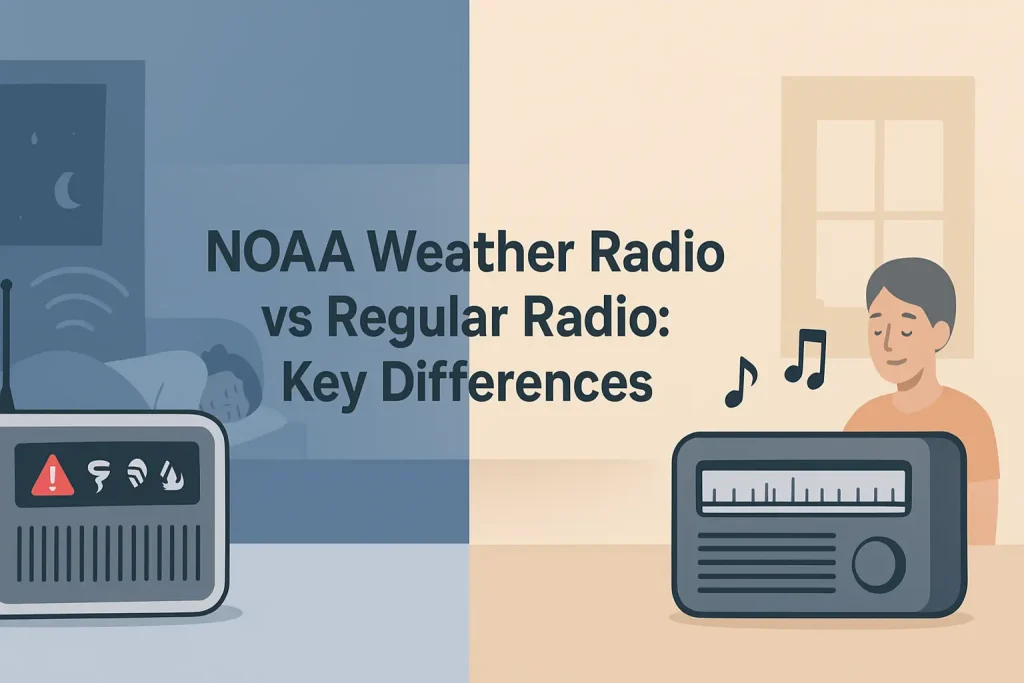
SiriusXM weather channels broadcast severe weather watches and warnings issued by the National Weather Service (NWS), but they do not automatically interrupt other SiriusXM channels with an alert tone the way a NOAA weather alert radio with S.A.M.E. technology does. You must be actively listening to a weather channel (121-128) to hear the severe weather content as it airs.
The absence of an automatic interrupt function is the most important limitation to understand about SiriusXM weather for emergency preparedness. A dedicated NOAA weather radio with S.A.M.E. (Specific Area Message Encoding) technology monitors all seven NOAA broadcast frequencies (162.400 to 162.550 MHz) and sounds an alert tone specifically for your county, even when the radio is in standby mode. SiriusXM does not replicate this function.
SiriusXM Weather vs NOAA Weather Radio for Emergency Alerts
Use the table below to compare SiriusXM weather channels against a dedicated NOAA weather alert radio for the two most common emergency preparedness use cases.
| Feature | SiriusXM Weather (Ch. 121-128) | NOAA Weather Radio with S.A.M.E. |
|---|---|---|
| Automatic alert interrupt | No | Yes (alert tone + message) |
| County-specific alerts | No (regional broadcast only) | Yes (6-digit FIPS S.A.M.E. code) |
| Works while you sleep | No (must be actively listening) | Yes (standby alert mode) |
| Works without power grid | No (requires internet or satellite signal) | Yes (battery or hand-crank backup) |
| Works during cellular outage | Yes (satellite-based) | Yes (dedicated RF broadcast, 162 MHz) |
| Subscription required | Yes ($10.99-$21.99/month) | No (free broadcast) |
| Marine and aviation weather | Yes (Ch. 127, Ch. 128) | Limited (coastal NWS products only) |
| Extended 7-day forecast | Yes | No (short-range focus) |
NOAA Weather Radio broadcasts on seven frequencies: 162.400, 162.425, 162.450, 162.475, 162.500, 162.525, and 162.550 MHz. Source: NOAA National Weather Service, NWR Technical Documentation.
SiriusXM weather is excellent for travel forecasting and continuous in-vehicle awareness. A dedicated NOAA weather radio is the correct tool for overnight emergency alerting and county-specific severe weather notification at home.
Here is the SiriusXM weather channel comparison widget that shows where the two systems each have an advantage at a glance.
Product Comparison
SiriusXM Weather vs NOAA Weather Radio – Side by Side
Key capabilities compared for emergency preparedness and travel use. Source: NOAA NWR Technical Documentation, SiriusXM channel guide.
| Capability | SiriusXM (Ch. 121-128) | NOAA Weather Radio |
|---|---|---|
| Standby alert at night | No | Yes |
| 7-day extended forecast | Yes | No |
| Operates during power outage | Partial (car receiver only) | Yes (battery backup) |
| Marine and offshore weather | Yes (Ch. 127) | Coastal zones only |
| Monthly cost | $10.99-$21.99 | Free (no subscription) |
| Best use case | Road trips and in-vehicle travel | Home emergency preparedness |
NOAA Weather Radio broadcasts on 162.400-162.550 MHz. S.A.M.E. technology (Specific Area Message Encoding) filters alerts by 6-digit FIPS county code. Source: NOAA National Weather Service.
Which SiriusXM Weather Channel Should You Use?
Use Channel 128 when you need a national weather overview, are driving across multiple regions, or want continuous background weather awareness without switching channels. Use your regional channel (121-126) when you want localized forecasts for the area you are currently in or driving toward.
The regional channels are more practical for daily commuters and local trip planning. Channel 128 is more useful for long-haul drivers, truckers, and road-trip travelers who cover multiple regional zones in a single drive.
Best Channel for Truckers and Long-Distance Drivers
Long-distance truckers and cross-country drivers get the most value from Channel 128 because it follows storm systems across regional boundaries. A driver heading from Chicago to Dallas may pass through the coverage areas of Channel 123 (Midwest), Channel 124 (South Central), and encounter severe weather that originates in Channel 122 (Southeast). Channel 128 tracks all of it in a single broadcast without requiring manual channel changes.
Some truckers supplement Channel 128 with a portable NOAA weather alert radio in the cab for overnight rest stops when the SiriusXM receiver is off. The NOAA radio monitors 162.400 to 162.550 MHz continuously and sounds an alert for tornado warnings or flash flood emergencies, even when the trucker is asleep.
Best Channel for Boaters
Use Channel 127 (AccuWeather Marine) for coastal and offshore boating. It provides dedicated marine zone forecasts that include wave heights, wind direction and speed in knots, and small craft advisory status. This level of marine-specific detail is not available on the general national channel (128).
For offshore passages and blue-water cruising, Channel 127 should be treated as a supplemental source alongside a fixed-mount VHF marine radio tuned to NOAA Weather Radio channels (WX1 through WX7) and monitored on VHF Channel 16 (156.800 MHz) for Coast Guard safety broadcasts.
Best Channel for Aviation Use
Pilots using SiriusXM weather through a panel-mounted aviation datalink system (such as the Garmin GDC 82 or a compatible aviation SiriusXM receiver) receive graphical weather data (NEXRAD radar, METARs, TAFs, PIREPs, AIRMETs) displayed directly on a moving map. This is separate from the audio weather channels and is specifically designed for cockpit use under SiriusXM Aviation Weather service.
For audio weather while airborne, Channel 128 provides the broadest coverage. Note that SiriusXM audio weather channels are not an approved substitute for an official weather briefing from the Aviation Weather Center (aviationweather.gov) or Flight Service (1-800-WX-BRIEF) under FAA regulations.
How to Set Up SiriusXM Weather Channels as Presets
Saving SiriusXM weather channels as presets on your receiver ensures you can access them instantly during active severe weather without scrolling through the channel guide. The preset setup process takes less than 30 seconds on most receivers.
The exact button sequence varies by receiver model, but the general approach is the same across most factory-installed and aftermarket satellite radio units.
How to Set a Preset on a Factory Vehicle Receiver
Navigate to Channel 128 (or your preferred weather channel) using the channel dial or keypad. Hold down one of the preset buttons (P1 through P6, or the numbered preset buttons on your head unit) for 2-3 seconds until you hear a confirmation beep or the preset number changes on the display. The channel is now saved to that preset.
Repeat this for Channel 127 (marine) if you travel near coastal areas, and for your regional AccuWeather channel. Having three weather channels on preset positions P1, P2, and P3 gives you immediate access during any severe weather situation without taking your eyes off the road for more than a glance.
How to Save Weather Channels as Favorites in the SiriusXM App
Open the SiriusXM app, navigate to the weather channel you want to save, tap the heart icon (on iOS) or the star icon (on Android) to add it to your Favorites list. Favorites appear at the top of your “My SiriusXM” screen for one-tap access.
The app also lets you set a wake-up alarm to a specific channel, including weather channels. Set Channel 128 as your alarm channel if you want to wake up to the current national weather forecast rather than music.
Does SiriusXM Weather Work Outside the United States?
SiriusXM satellite weather coverage is limited to the continental United States, Alaska, Hawaii, and Canada. Outside these coverage areas, the satellite signal from the SiriusXM constellation does not reach the receiver, and the weather broadcast is unavailable. Channel 126 (AccuWeather Canada) covers all Canadian provinces and territories.
In Mexico and the Caribbean, SiriusXM satellite reception drops significantly within 50-100 miles south of the US border and is unreliable for extended travel in those regions. The SiriusXM streaming app can substitute satellite reception in areas with cellular or Wi-Fi coverage, but this requires an active internet connection and counts against cellular data usage.
SiriusXM Weather Coverage in Canada
Channel 126 provides AccuWeather forecasts for all Canadian provinces including Quebec, Ontario, British Columbia, and the Prairie provinces. The channel broadcasts in English. Francophone listeners in Quebec may find that provincial weather information from Environment and Climate Change Canada (weather.gc.ca) provides more localized French-language content for specific municipalities.
Canadian listeners interested in the national Weatheradio Canada broadcast system, which operates on the same seven NOAA frequencies (162.400 to 162.550 MHz) and covers most of the Canadian population, can learn more about how that system works and compares to SiriusXM in our complete guide to the Weatheradio Canada broadcast network.
SiriusXM Weather and Data Plans: What Is Included
The audio weather channels (121-128) are included in all SiriusXM subscription tiers that include news and information programming. As of current published SiriusXM plan information, the Select, All Access, and Streaming plans all include access to the weather audio channels.
SiriusXM Aviation Weather, which delivers graphical NEXRAD radar and decoded METARs to cockpit datalink systems, is a separate aviation-specific subscription not included in standard consumer SiriusXM plans. Aviation weather datalink pricing is separate and provided directly through compatible avionics manufacturers.
SiriusXM Marine Weather Data Service
SiriusXM also offers a dedicated marine weather data service for boats equipped with compatible chartplotters and navigation systems. This service (marketed as SiriusXM Marine) delivers graphical radar overlays, wave height forecasts, and lightning detection data to devices like Garmin chartplotters and Simrad systems.
The SiriusXM Marine data service is separate from the audio Channel 127 broadcast. It requires a dedicated SiriusXM marine weather antenna and receiver module connected to your chartplotter, plus a separate marine weather subscription.
How Accurate Is SiriusXM Weather?
SiriusXM weather channels source their forecast data from AccuWeather (Channels 121-126) and from National Weather Service (NWS) products rebroadcast on Channel 128. AccuWeather forecast accuracy for 24-hour temperature forecasts averages within 3 degrees Fahrenheit and within 4 hours for precipitation timing, according to AccuWeather’s published verification data.
The accuracy of SiriusXM weather is functionally identical to the accuracy of AccuWeather and NWS forecasts themselves, since SiriusXM is a broadcast delivery mechanism rather than an independent forecasting organization. The limiting factor is the update frequency (every 15-30 minutes on regional channels) rather than the forecast model quality.
When SiriusXM Weather Lags Behind Real-Time Conditions
A 15-30 minute update cycle means SiriusXM weather can lag behind rapidly changing conditions during fast-moving severe weather. A tornado warning issued by the NWS is broadcast on NOAA Weather Radio (162.400-162.550 MHz) within seconds of issuance. The same warning may not appear in the next SiriusXM weather broadcast loop for up to 20-25 minutes if the update cycle has just completed.
This update lag is the core reason emergency management professionals recommend a dedicated NOAA weather radio with S.A.M.E. alert capability for home emergency preparedness, in addition to any subscription-based weather service. NOAA Weather Radio All Hazards (NWR) is a direct broadcast of NWS warning products at the moment of issuance, with no update cycle delay.
SiriusXM Weather vs Wireless Emergency Alerts on Your Phone
Wireless Emergency Alerts (WEA) are automatically pushed to cell phones by FEMA’s IPAWS (Integrated Public Alert and Warning System) for Tornado Warnings, Flash Flood Warnings, Extreme Wind Warnings, and Presidential Alerts. These alerts require no subscription and no active app. SiriusXM weather requires an active subscription and active listening.
WEA alerts are geographically targeted to the cell towers serving your current location, which means your phone receives the alert only if you are within the warned polygon, not for the entire region. SiriusXM weather broadcasts cover entire multi-state regions and do not automatically target your exact location. Both systems have strengths the other lacks, and they are best used together rather than as substitutes. For a detailed comparison of how wireless alerts compare to dedicated weather radio receivers, our analysis of weather radios versus smartphone emergency notification systems covers the reliability differences during power outages and cellular network congestion.
Do You Need a Special Antenna for SiriusXM Weather?
SiriusXM satellite radio uses a dedicated SiriusXM antenna that receives the satellite signal from the SiriusXM constellation operating in the S-band frequency range (2.332-2.345 GHz). This antenna is entirely separate from AM/FM radio antennas, NOAA weather radio antennas (which receive 162 MHz VHF signals), and Wi-Fi antennas.
Factory-installed satellite radio systems include an integrated antenna designed into the vehicle’s roof or glass. Aftermarket SiriusXM receivers include a small magnetic-mount antenna that attaches to the roof and connects to the receiver via a coaxial cable run through the door seal or window.
Can You Use a NOAA Weather Radio Antenna for SiriusXM?
No. NOAA weather radio operates on 162.400-162.550 MHz (VHF low band), while SiriusXM uses the S-band around 2.3 GHz. These frequency ranges are separated by more than 2,000 MHz, and no single antenna is designed to receive both. A NOAA weather radio antenna has no functional effect on SiriusXM reception, and vice versa.
Each system requires its own dedicated antenna. The NOAA weather radio antenna is typically a short whip or telescoping rod built into the receiver itself. The SiriusXM antenna is a small active antenna (powered through the coaxial cable) that must point toward the southern sky.
SiriusXM Weather for Emergency Preparedness Kits
SiriusXM satellite radio is not a reliable standalone emergency communication tool for home preparedness kits because it requires either a vehicle receiver (dependent on the car’s power) or the streaming app (dependent on cellular or internet infrastructure). Both can fail during major emergencies that knock out power grids and cell towers simultaneously.
A complete home emergency communication kit should include a hand-crank solar NOAA weather radio that operates on battery, solar power, or manual crank with no dependence on grid power or cellular infrastructure. SiriusXM weather is a strong supplemental tool for daily weather awareness and road travel, not a substitute for a no-dependency emergency receiver.
The Federal Emergency Management Agency (FEMA) and the American Red Cross both recommend a NOAA weather radio as a core component of every household emergency kit, specifically because it operates independently of the power grid and cellular networks. SiriusXM is not listed in FEMA emergency kit guidance.
Building a Complete Weather Monitoring Stack
The most robust weather monitoring setup uses three complementary systems: SiriusXM weather (Channels 121-128) for in-vehicle extended forecasts, a S.A.M.E.-capable NOAA weather alert radio for overnight home alerts, and Wireless Emergency Alerts on your phone as a mobile backup.
This three-layer approach ensures you are covered regardless of which infrastructure fails first. NOAA Weather Radio All Hazards broadcasts on a standalone RF infrastructure that has no dependency on SiriusXM satellites, cell towers, or internet connectivity, making it the most resilient of the three.
For a deeper understanding of how the NOAA Weather Radio All Hazards network operates, including transmitter coverage, frequency assignments, and S.A.M.E. code programming, our full explanation of how NOAA Weather Radio works and what it broadcasts covers the technical architecture of the system.
Frequently Asked Questions About SiriusXM Weather Channels
What channel number is weather on SiriusXM?
SiriusXM weather is on Channel 128 for national coverage, and on Channels 121 through 127 for regional AccuWeather forecasts. Channel 127 is dedicated to marine and coastal weather. Channel 126 covers Canada. Channels 121 through 125 each cover a specific US geographic region.
All eight weather channels are included in standard SiriusXM subscriptions that include news and information programming. Enter the channel number directly on your receiver keypad, or browse under the “Weather” or “News” category in the SiriusXM app.
Is SiriusXM weather the same as NOAA Weather Radio?
SiriusXM weather and NOAA Weather Radio are entirely different systems. SiriusXM is a subscription-based satellite broadcast using AccuWeather and National Weather Service data, delivered via S-band satellite signal (2.332-2.345 GHz). NOAA Weather Radio All Hazards (NWR) is a free government broadcast transmitted on seven VHF frequencies between 162.400 and 162.550 MHz.
The most critical functional difference is automatic alerting. NOAA Weather Radio with S.A.M.E. technology sounds an alarm in standby mode for your specific county when a tornado warning or flash flood warning is issued. SiriusXM has no automatic alert interrupt and requires you to be actively listening to a weather channel to hear severe weather content.
Does SiriusXM weather work if my cell service is out?
SiriusXM satellite radio reception (through a dedicated receiver and antenna) does not depend on cellular service. The satellite signal from the SiriusXM constellation is independent of cellular towers and internet infrastructure. A vehicle-mounted or portable SiriusXM receiver continues to receive Channels 121-128 during cellular outages as long as the antenna has a clear view of the southern sky.
The SiriusXM streaming app, however, requires a cellular or Wi-Fi data connection. App-based access to weather channels fails during cellular outages. A hardware receiver is the only SiriusXM option that functions independently of cellular infrastructure.
Can I get SiriusXM weather alerts pushed to my phone like wireless emergency alerts?
SiriusXM does not push automatic weather alerts to your phone in the way that FEMA’s Wireless Emergency Alert (WEA) system does. WEA alerts are broadcast to all cell phones in a geographic area by local cell towers at no cost and require no app or subscription. SiriusXM weather requires active listening on a subscribed account.
The SiriusXM app does not include a background severe weather notification feature that interrupts other audio or sends push notifications for tornado warnings. For automatic phone-based severe weather alerts, enable WEA notifications in your phone’s settings under Emergency Alerts, which requires no subscription and no app installation.
Why is my SiriusXM weather channel not working?
The most common causes of SiriusXM weather channel failure are antenna signal loss (no clear view of the southern sky), an expired or lapsed subscription, or a receiver that needs a signal refresh. A solid obstruction such as a parking garage roof, dense foliage overhead, or a metal sunroof with a tinted UV coating can block the S-band satellite signal entirely.
To refresh your receiver signal, drive to an open area with a clear sky view and tune to any SiriusXM channel. If the signal returns, the issue was positional obstruction. If the signal does not return in an open area, call SiriusXM at 1-888-539-7474 to check your subscription status and request a remote receiver refresh signal.
What is the difference between Channel 128 and the regional weather channels?
Channel 128 broadcasts a national weather overview produced by the SiriusXM weather team, covering national storm systems, travel forecasts, and extended outlooks for the full continental United States. The regional channels (121-126) are produced by AccuWeather meteorologists and provide city-level forecasts, highway corridor updates, and metro-area conditions for specific geographic regions.
For daily local weather, a regional channel gives you more specific information than Channel 128. For cross-country travel or national storm tracking, Channel 128 provides broader context across regional boundaries without requiring manual channel switching as you drive.
Does SiriusXM have weather for Alaska and Hawaii?
SiriusXM satellite coverage includes Alaska and Hawaii, but dedicated regional weather channels for Alaska and Hawaii are not listed in the standard channel lineup (121-127). Channel 128 (national) provides some Alaska and Hawaii content during significant weather events. Local NWS forecasts for Alaska (weather.gov/afg) and Hawaii (weather.gov/hfo) provide more detailed coverage than the SiriusXM regional channel structure offers for those states.
Alaskan and Hawaiian SiriusXM subscribers relying on weather information for emergency preparedness should supplement Channel 128 with a NOAA weather radio programmed to local NWS office transmitters. NOAA operates transmitters across Alaska and Hawaii on the standard WX frequencies (162.400-162.550 MHz).
Is the weather on SiriusXM Channel 128 live or pre-recorded?
SiriusXM weather channels broadcast a combination of live updates and pre-recorded forecast loops. During active severe weather, meteorologists provide live coverage. During periods of routine weather, the broadcast cycles through a regularly updated pre-recorded forecast loop refreshed every 15-30 minutes. Channel 128 is more likely to carry live content during major national weather events than the regional channels.
The pre-recorded nature of the standard loops means that a forecast broadcast at 6:00 PM may still be playing at 6:25 PM. If a tornado warning is issued at 6:05 PM, that warning will not appear on the SiriusXM weather loop until the next scheduled update cycle, which can be up to 20-25 minutes later.
Can I listen to SiriusXM weather without a subscription during a free trial?
Yes. New vehicles equipped with factory-installed SiriusXM radios typically include a complimentary trial period (usually 3-6 months) that includes full access to all channels, including weather Channels 121-128. Used vehicles may retain an active trial or subscription from the previous owner, which can be verified by tuning to any SiriusXM channel and checking whether it plays without a subscription prompt.
After the trial period, weather channels require a paid subscription. SiriusXM offers online-only streaming packages starting around $10.99 per month that include weather channel access through the app. Satellite receiver plans (required for hardware receivers) start at a higher price tier.
How does SiriusXM weather compare to a CB radio weather channel?
CB radio (Citizens Band, operating on 27 MHz under FCC Part 95D) does not have a dedicated weather channel. CB radio is a two-way communication service between users, not a broadcast weather service. The comparison some listeners make is between SiriusXM weather and the weather alert feature available on some CB radio models, which is actually a built-in NOAA weather radio receiver operating on 162 MHz, not related to the CB frequencies.
CB radios with NOAA weather alert capability receive the same NOAA Weather Radio broadcasts as standalone weather radios. This is entirely separate from SiriusXM and requires no subscription. For truckers who want both CB communication and weather monitoring in one unit, a CB radio with integrated NOAA weather alert is a practical combination. Our review of the top CB radios with built-in NOAA weather alert features covers the leading models with real-world alert performance data.
Do I need a separate SiriusXM subscription for weather, or is it included?
SiriusXM weather channels (121-128) are included in standard SiriusXM subscription plans without a separate add-on fee. There is no “weather package” that must be purchased separately for the audio weather channels. The aviation graphical weather datalink service and the marine graphical weather data service are separate subscription products that carry their own fees beyond a standard consumer SiriusXM plan.
Verify your specific plan includes news and information channels at siriusxm.com/plans or by calling SiriusXM at 1-888-539-7474, since introductory pricing plans occasionally exclude specific channel categories during promotional periods.
What ham radio frequencies carry weather information?
Amateur radio operators can monitor NOAA weather radio broadcasts directly on 162.400-162.550 MHz using any VHF-capable amateur radio transceiver such as the Baofeng UV-5R or Yaesu FT-70DR. These frequencies fall outside the amateur bands and are receive-only for licensed amateurs. Transmitting on NOAA frequencies is prohibited under FCC rules.
Ham radio operators also use specific local and national frequencies for weather spotting and SKYWARN net activations coordinated by the National Weather Service. Our guide on which ham radio frequencies are used for weather reporting and SKYWARN nets covers the local repeater coordination process and how to find your regional SKYWARN net frequency.
Why does my SiriusXM weather channel say “channel unavailable” even though I have a subscription?
A “channel unavailable” message on a weather channel most commonly means the receiver has lost authorization from the SiriusXM satellite signal, even if other channels work. This can happen after a battery disconnect, a software update to the head unit, or a receiver reset that cleared stored authorization data. The fix is to request a remote refresh signal from SiriusXM, which re-authorizes your receiver over the air.
Call SiriusXM at 1-888-539-7474, provide your Radio ID (displayed by tuning to Channel 0 on most receivers), and request a signal refresh. The refresh takes 5-15 minutes to propagate. Park in an open area with clear sky visibility during the refresh process.
Conclusion
SiriusXM weather is on Channel 128 for national coverage, with regional forecasts on Channels 121 through 127 and dedicated marine weather on Channel 127. These channels deliver AccuWeather and NWS forecast data continuously and are included in standard SiriusXM subscriptions at no additional cost.
For in-vehicle travel awareness and extended 7-day forecasts, SiriusXM weather is a reliable and convenient tool. For overnight severe weather alerting at home, a dedicated NOAA weather radio with S.A.M.E. technology remains the more reliable system because it monitors 162.400-162.550 MHz continuously and triggers an alert for your specific county without any subscription or active listening required.
Save Channel 128 and your regional AccuWeather channel as presets on your receiver today, and pair them with a S.A.M.E. NOAA weather alert radio at home for complete weather monitoring coverage across every scenario.
| Photo | TOP RATED WALKIE TALKIES | Price |
|---|---|---|
 | Retevis RT628 Kids Walkie Talkies, Toys Gifts for 4-12 Year Old Girl Boy | Kids Camping Essentials Outdoor Toys, Birthday Gift, 22CH, VOX, Keypad Lock, Durable, Easy to Use Walkie Talkies for Kids | Check Price On Amazon |
 | Cobra ACXT545 Weather-Resistant Walkie Talkies, Rechargeable, 22 Channels | Long Range 28-Mile Two-Way Radio Set (2-Pack) | Check Price On Amazon |
 | Retevis RT388 Kids Walkie Talkies, Outdoor Toys for Kids Camping Essentials | 4-12 Year Old Boy Birthday Gift, 22 CH VOX Flashlight Clear Sound, Kids Walkie Talkies 2 Pack for Camping Hiking Adventure | Check Price On Amazon |
 | Cobra RX680 Walkie Talkies (2-Pack), IP54 Water Resistant Design | Rugged & Splashproof Two Way Radios Long Range, 60 Pre-Programmed Channels, Weather Alerts | Check Price On Amazon |
 | Retevis RT22 Walkie Talkies Long Range Rechargeable with Earpiece (2 Pack) | Slim & Lightweight 2 Way Radio For Camping & Hiking, Pocket-Friendly Antenna, Ready to Use, 10-Hour Battery, USB-C Charging | Check Price On Amazon |
 | Midland GXT1000VP4 GMRS Two-Way Radios with Headsets, Black, 2 Pack | 50 Channels, 142 Privacy Codes, Up to 36 Mile Long Range, JIS4 Water Resistant, NOAA Weather Alert, Rechargeable NiMH | Check Price On Amazon |
 | Retevis RT628 Walkie Talkies for Kids,Toys Gifts for 6-12 Years Old Boys Girls,Long Range 2 Way Radio 22CH VOX,Birthday Gift,Family Walkie Talkie for Camping Hiking Indoor Outdoor | Check Price On Amazon |