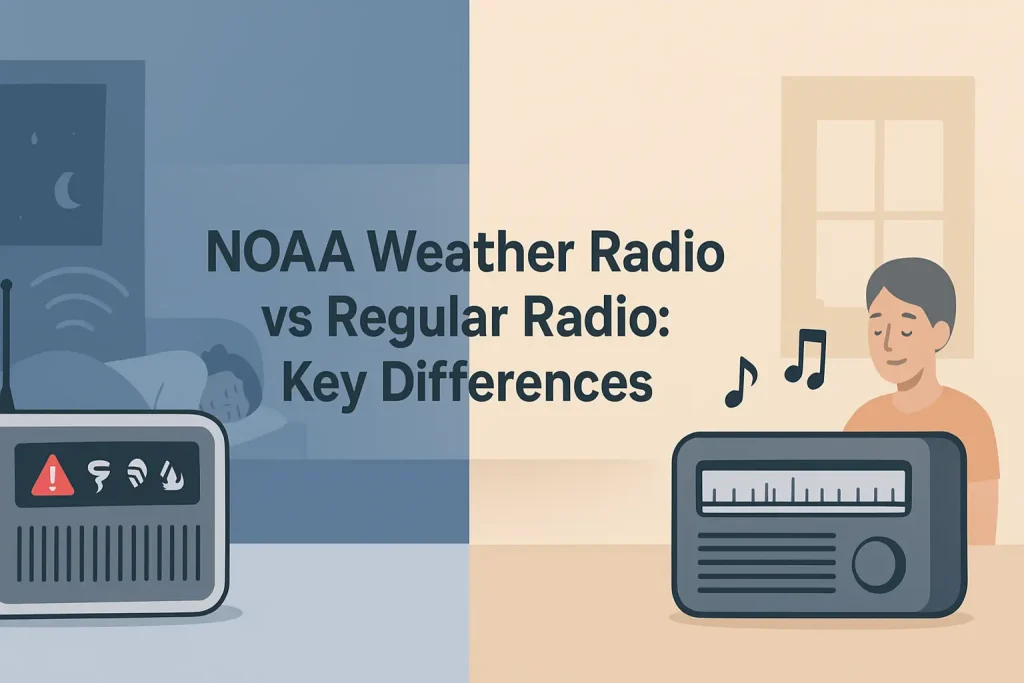
A weather radio is not optional gear for hunters. It is the difference between making it back to camp and getting caught in a fast-moving thunderstorm with no warning. NOAA broadcasts alerts 24 hours a day on seven dedicated frequencies between 162.400 and 162.550 MHz, but most hunters never hear them because they leave their weather radio at home.
This guide covers how to choose, program, and use a portable NOAA weather radio in the field, which alert types matter most during hunting season, and how to pair your weather radio with a two-way radio setup for complete backcountry safety.
| Photo | Popular Portable Walkie Talkies | Price |
|---|---|---|
 | SKIWARRIOR Multifunctional Smart Wireless Ski Goggles with Walkie-Talkie, Anti-Fog Zeiss Lens, Music & Call Function (Cylindrical Blue) | Check Price On Amazon |
 | SINORISE Super Mini Walkie Talkies, Two-Way Radios, 3 Pack | Check Price On Amazon |
 | KOSPET Tank M4C Smart Watch Rugged, Dual-Band GPS, 5ATM & IP69K Waterproof | Check Price On Amazon |
 | Retevis RT15 Walkie Talkies 3 Pack, Birthday Gift, Outdoor Adventure Kit | Check Price On Amazon |
 | Rechargeable Walkie Talkies Toys for Kids: DIY Astronaut Walkie Talkies for Boys Christmas Birthday Gifts for 3 4 5 6 7 8 9 10 Boy Walkie Talkie Outdoor Hiking Toy 2 Way Radio Camping Outdoor Game | Check Price On Amazon |
Why Hunters Need a Dedicated Weather Radio, Not Just a Smartphone
A dedicated NOAA weather radio receives alerts on 162.400 to 162.550 MHz even when you have zero cellular service. Smartphones depend entirely on cell tower coverage, which fails in the same remote terrain where hunters spend the most time.
According to NOAA’s National Weather Service, the NWR (NOAA Weather Radio All Hazards) network covers approximately 95% of the US population within 40 miles of a transmitter. That coverage is based on radio frequency propagation, not cellular infrastructure.
Cellular dead zones and radio dead zones do not overlap perfectly. A ridge that blocks your 4G signal may still receive a 162.550 MHz NWR broadcast from a transmitter 30 miles away.
The EAS (Emergency Alert System) tone that precedes a NOAA broadcast is a distinctive two-tone signal that cuts through ambient noise. It is designed to wake a sleeping person. Your phone’s push notification is not.
S.A.M.E. technology (Specific Area Message Encoding) lets you program your weather radio to alert only for your specific county using a 6-digit FIPS code. Without S.A.M.E., the radio alerts you for every county served by that transmitter, which can mean dozens of irrelevant alerts per day.
A Midland WR400 weather radio with S.A.M.E. programming costs under $50 and stores up to 50 county codes. That is the single most cost-effective safety upgrade a hunter can make.
The bottom line: a dedicated weather radio with S.A.M.E. technology gives hunters real-time alerts in terrain where no cellular signal exists, and it does so on a frequency band that is never congested or throttled.
How NOAA Weather Radio Works in the Field: Frequencies, Transmitters, and Range
NOAA broadcasts on seven VHF frequencies: 162.400, 162.425, 162.450, 162.475, 162.500, 162.525, and 162.550 MHz. Each transmitter covers a specific geographic area, and your radio locks onto whichever signal is strongest at your location.
NWR transmitters operate at power levels between 300 watts and 1,000 watts ERP (effective radiated power), according to NOAA’s NWR transmitter technical specifications. At 1,000 watts ERP, a single transmitter can cover an area with a radius of 40 or more miles under line-of-sight conditions.
In mountainous or heavily forested terrain, that range drops significantly. A transmitter that reaches 40 miles across flat farmland may only reach 10 to 15 miles into a valley surrounded by ridges.
This happens because VHF signals (30 to 300 MHz) travel primarily by line-of-sight propagation. The signal travels in a straight line and does not follow the curvature of the earth or bend around terrain obstacles the way lower-frequency AM broadcast signals do.
This only occurs when the transmitter and receiver have no solid terrain blocking the direct path between them. A ridge, a canyon wall, or a dense stand of timber all attenuate the signal.
If terrain blocks your primary NWR frequency, the result is a weak or absent signal and missed alerts. Fix it by scanning all seven NOAA frequencies manually to find which transmitter has the best signal from your specific location.
Most weather radios scan all seven WX channels automatically and lock onto the strongest signal. The Uniden BC365CRS weather radio performs this auto-scan on power-up, which makes it practical for hunters moving between different areas of a hunting unit.
Key Specifications (Uniden BC365CRS):
- Frequencies: 162.400 to 162.550 MHz (all 7 NOAA channels)
- S.A.M.E. alert types: 60+
- Alert memory: programmable county-specific codes
- Power: AC adapter or 3x AA battery backup
- Alarm output: external siren jack
Understanding which transmitter covers your hunting area before the season starts is one of the most practical preparation steps a hunter can take. The NOAA NWR transmitter map at weather.gov shows exact transmitter locations and their broadcast frequencies by state.
Which Weather Alerts Matter Most During Hunting Season
The NWR system broadcasts more than 60 distinct alert types using S.A.M.E. event codes. For hunters, six alert categories carry the highest immediate risk: Tornado Warning (TOR), Severe Thunderstorm Warning (SVR), Flash Flood Warning (FFW), High Wind Warning (HWW), Winter Storm Warning (WSW), and Blizzard Warning (BZW).
A Tornado Warning means a tornado has been detected by radar or confirmed by a spotter. It requires immediate shelter. In an open field or in a tree stand, there is no safe position.
A Severe Thunderstorm Warning is issued by the National Weather Service when a storm produces winds of 58 mph or higher, or hail of 1 inch in diameter or larger. Hunters in tree stands are directly exposed to both hazards.
Flash Flood Warnings (FFW) are particularly dangerous for hunters in canyon terrain, river bottoms, and low-lying swamp areas. Water levels in these environments can rise faster than a person can move to high ground.
High Wind Warnings (HWW) are issued when sustained winds of 40 mph or greater, or gusts of 58 mph or greater, are expected. At those wind speeds, trees fall and branches become projectiles. Hunters in elevated tree stands are in serious danger during any HWW event.
Winter Storm Warnings (WSW) and Blizzard Warnings (BZW) affect hunters in northern states from October through April. A blizzard is defined by the National Weather Service as sustained winds or frequent gusts of 35 mph or higher with considerable falling or blowing snow reducing visibility to less than a quarter mile for at least three hours.
According to FEMA’s emergency preparedness guidelines, hunters and outdoor recreationists represent a disproportionate share of weather-related fatalities precisely because they are far from shelter when conditions deteriorate. The NWR alert system is specifically designed to provide advance warning before conditions become life-threatening.
Use the table below to match alert type to the appropriate hunter response.
| Alert Type | S.A.M.E. Code | Trigger Threshold | Hunter Risk Level | Immediate Action |
|---|---|---|---|---|
| Tornado Warning | TOR | Confirmed tornado | Extreme | Abandon stand, seek low ground |
| Severe Thunderstorm Warning | SVR | 58+ mph wind or 1″ hail | High | Exit tree stand immediately |
| Flash Flood Warning | FFW | Flooding imminent or occurring | High (low terrain) | Move to high ground immediately |
| High Wind Warning | HWW | 40+ mph sustained or 58 mph gusts | High (elevated stands) | Descend from tree stands |
| Winter Storm Warning | WSW | Heavy snow, ice, or blizzard conditions | Moderate to High | Begin exit before conditions arrive |
| Blizzard Warning | BZW | 35+ mph wind, visibility under 1/4 mile | Extreme | Shelter in place or evacuate early |
| Severe Thunderstorm Watch | SEW | Conditions favorable for severe storms | Moderate | Monitor continuously, plan exit route |
Knowing which alerts require immediate action versus continued monitoring is the practical skill that separates a weather radio user from a weather radio owner.
How to Choose the Right Weather Radio for Hunting: Portability, Battery Life, and S.A.M.E. Programming
The most important feature for hunters is battery-powered operation with at least 20 hours of standby life on AA or AAA alkaline batteries. A weather radio that only runs on AC power is useless in the field.
The second critical feature is S.A.M.E. technology. Without S.A.M.E. (Specific Area Message Encoding), your radio will alert you for every county covered by the transmitter. In some states, a single NWR transmitter covers 10 to 15 counties.
Portable vs Desktop Weather Radios for Field Use
Portable weather radios designed for outdoor use weigh between 4 and 8 ounces and run on 2 to 3 AA batteries for 20 to 40 hours of standby monitoring. Desktop weather radios offer louder speakers and more programming memory, but they require a power outlet.
For hunters, a portable model that fits in a jacket pocket is the only practical choice. The Midland WR120 portable weather radio runs on 3 AA batteries and includes S.A.M.E. programming with 25 county-specific alert types.
Battery Life and Power Options for Extended Hunts
A weather radio in standby mode (monitoring but not alarming) consumes very little current. Most portable models draw less than 30 milliamps in standby, which translates to 20 to 50 hours of operation on a fresh set of alkaline AA batteries.
Hand-crank weather radios add an emergency power option for multi-day hunts. A hand-crank solar weather radio with a 2,000 mAh internal battery provides approximately 8 to 12 hours of operation from a full solar charge, or roughly 1 to 2 minutes of operation per minute of cranking.
For week-long backcountry hunts, carry a set of lithium AA batteries instead of alkaline. Lithium AA batteries maintain full voltage output down to -40 degrees Fahrenheit, while alkaline batteries lose up to 50% of their capacity at 32 degrees Fahrenheit.
S.A.M.E. Programming: How to Set Your County Code Before You Hunt
S.A.M.E. codes are 6-digit FIPS (Federal Information Processing Standards) codes assigned to each US county. You program your specific county code into the weather radio so it only activates the alarm for alerts in your location.
Find your county’s FIPS code at weather.gov/nwr or in the printed guide that comes with any S.A.M.E.-capable radio. The code format is always a 6-digit number: a 2-digit state code followed by a 3-digit county code, padded to 6 digits total (for example, 049037 for Forsyth County, North Carolina).
Program the county code for both your hunting area and your home county if they are different. Many S.A.M.E. radios store between 5 and 25 location codes simultaneously, which lets one radio cover a multi-county hunt without reprogramming.
Setting your S.A.M.E. code before you leave home, rather than in the field, is the single most important setup step for a hunting weather radio.
Top Portable Weather Radios for Hunters: Compared by Battery Life, Durability, and S.A.M.E. Features
The best portable weather radio for hunters combines long battery life on standard AA or AAA cells, a loud alarm that cuts through wind noise, and full S.A.M.E. programming capability. These five models represent the strongest options across different price points and use cases.
Use the table below to compare key specifications before choosing the model that fits your hunting style and season length.
| Model | Power Source | Standby Life | S.A.M.E. Codes | Alert Types | Price Range |
|---|---|---|---|---|---|
| Midland WR120B | 3x AA batteries | 30+ hrs | 25 codes | 25 | $25-35 |
| Uniden BC365CRS | 3x AA + AC | 20+ hrs | 25 codes | 60+ | $35-50 |
| Sangean CL-100 | 4x AA + AC | 40+ hrs | 25 codes | 60+ | $50-70 |
| Midland ER310 | Solar/crank/USB/AA | Varies by source | 25 codes | 25 | $55-75 |
| Reecom R-1630 | 9V + AC | 24+ hrs | Multiple | 60+ | $60-80 |
| Kaito KA500 | Solar/crank/USB/AA | Varies by source | Included | 25+ | $50-65 |
For most deer and turkey hunters doing day hunts within a single county, the Midland WR120B at $25 to $35 delivers everything needed. For elk and backcountry hunters spending multiple nights in the field, the Midland ER310 multi-power emergency radio with solar and hand-crank backup is the more practical choice.
Here is the weather radio price comparison chart that shows where each model sits relative to the others at a glance.
Price Comparison
Portable Weather Radios for Hunters – Price Comparison by Model
Street price, sorted lowest to highest. Prices verified at time of publication.
~$30
~$43
~$58
~$65
~$70
~$60
Single-unit price at major retailers. Multi-power models (solar/crank) cost more but eliminate battery dependency on extended backcountry hunts.
Pairing Your Weather Radio with a Two-Way Radio: Building a Complete Field Communication System
A weather radio tells you when to leave. A two-way radio lets you coordinate with your hunting party when you do. These are two separate functions, and no single radio does both equally well.
NOAA weather radios receive only. They have no transmit capability. A two-way radio operates in the 462 to 467 MHz range (FRS and GMRS) or the 151 to 154 MHz range (MURS), completely separate from the 162 MHz NWR band.
The practical hunting communication kit is a dedicated weather radio for monitoring, plus a pair of FRS or GMRS walkie-talkies for party coordination. These two devices fit in a jacket pocket together and cost less than $100 total for a reliable setup.
FRS vs GMRS for Hunting Party Communication
FRS (Family Radio Service) radios require no license, transmit at a maximum of 2 watts on channels 1 through 7 (and 0.5 watts on channels 8 through 14), and operate on 22 channels between 462.5625 and 467.7125 MHz under FCC Part 95E. GMRS (General Mobile Radio Service) radios require a $35 FCC license (10-year family license, no exam required) and transmit at up to 5 watts for handheld units.
In dense timber, the difference between 0.5 watts (FRS channels 8-14) and 5 watts (GMRS) is roughly 0.3 miles versus 1.5 miles of effective range. That gap matters when your hunting partner is on the other side of a ridge.
According to FCC Part 95E, FRS and GMRS radios share the same 22 channels. An FRS radio and a GMRS radio on the same channel can communicate with each other, but the FRS radio is limited to 2 watts maximum while the GMRS radio can transmit at full licensed power.
Use the table below to decide which service fits your hunting group’s communication needs.
| Specification | FRS | GMRS |
|---|---|---|
| FCC license required | No | Yes ($35, 10-year family) |
| Max power (handheld) | 2W (ch 1-7), 0.5W (ch 8-14) | 5W handheld, 50W mobile |
| Frequency range | 462.5625-467.7125 MHz | 462.5625-467.7125 MHz |
| Channels | 22 shared | 22 shared + 8 GMRS-only repeater |
| Repeater access | No | Yes |
| Effective range (dense timber) | 0.3-0.8 mile | 0.8-2 miles |
| FCC Part | Part 95E | Part 95E |
| Best for hunters | Small groups, close terrain | Large units, thick cover, multi-day |
For most hunting parties of 2 to 4 people hunting within a mile of each other, a set of FRS radios with no license requirement is the simplest and most cost-effective solution. For western hunters covering large mountain units, GMRS at 5 watts with a $35 family license is the right call.
CTCSS Tones and Privacy Codes for Hunting Parties
CTCSS (Continuous Tone-Coded Squelch System) tones are sub-audible signals below 300 Hz that prevent your radio’s speaker from opening unless the received signal carries a matching tone. This keeps your radio silent when other hunters on the same channel transmit without your tone programmed.
Setting the same CTCSS tone on all radios in your hunting party ensures your speaker only activates when one of your group calls. The Midland GXT1000VP4 GMRS radio includes 142 privacy codes (CTCSS and DCS combined) and 22 channels, which gives a hunting party enough unique combinations to avoid overlapping with other groups in the same area.
A critical clarification: CTCSS tones do not prevent other people from hearing you when you transmit. They only prevent your speaker from opening when others transmit on the same channel. Anyone with a scanner or a radio set to open squelch will hear every word you say.
How to Use a Weather Radio Safely from a Tree Stand
A weather radio in a tree stand must be set to alarm mode (not monitor mode) so it activates automatically when an alert is broadcast for your county. Monitor mode requires you to actively listen, which is impractical during a hunt.
In alarm mode, the radio is silent until a NOAA alert is issued for a S.A.M.E.-matched county. The EAS alert tone triggers automatically, even from a radio clipped to your pack or hung in your stand.
The EAS alert tone operates at approximately 1,050 Hz. Testing by NOAA’s Emergency Alert System technical committee confirms this frequency is selected specifically for its ability to wake sleeping people and cut through ambient noise above 65 dB.
Managing Alert Volume in the Field Without Spooking Game
A weather radio alarm at full volume (typically 85 to 95 dB on most portable models) will end your hunt the moment it activates. Most S.A.M.E. radios include a volume control that also affects the alert alarm.
One practical solution is to set alert volume to 30 to 40% of maximum on a weather radio stored in a pack. At that volume, you will hear the alarm from 10 to 15 feet away (normal tree stand height) in quiet conditions. You will still receive the alert with time to act.
A second option is an earphone-equipped weather radio with a 3.5mm audio jack. Running a single earbud from your weather radio lets you monitor alerts silently without broadcasting to every deer in a 200-yard radius.
The Sangean CL-100 and several Midland portable models include a 3.5mm headphone jack alongside their speaker alarm. This feature is worth specifically checking for when purchasing a hunting weather radio.
Lightning Safety Protocol for Tree Stand Hunters
Lightning is the most immediate weather threat for hunters in elevated tree stands. The National Lightning Safety Council reports that tree-related lightning strikes account for a significant percentage of outdoor lightning fatalities. A person in a metal tree stand attached to a tree is in a high-risk position during any thunderstorm.
A Severe Thunderstorm Warning (SVR) requires immediate descent from any tree stand. Do not wait until you see lightning. The warning is issued when severe weather is imminent, which typically means 30 to 60 minutes of lead time before the storm arrives at your location.
A Severe Thunderstorm Watch (SEW) means conditions are favorable for storms to develop. A watch is the signal to climb down from your stand, stow your gear, and identify shelter options before a warning is issued.
Once on the ground during an active lightning threat, move at least 100 feet from the base of any tree. Crouch low with feet together, minimizing your contact with the ground to reduce step potential from ground current.
Weather Radio Coverage Gaps in Hunting Terrain: What to Do When the Signal Is Weak
Not every hunting area has reliable NWR coverage. Mountain valleys, deep canyons, and areas more than 40 miles from the nearest NWR transmitter may receive weak or no signal on any of the seven NOAA frequencies. Knowing this before the season starts prevents false confidence in a radio that cannot actually reach you.
This happens because VHF signals require line-of-sight propagation between the transmitter and receiver. A 1,000-watt NWR transmitter on a mountain summit may cover 60 miles in every direction across flat terrain, but its signal may not penetrate 2 miles into a valley 500 feet below the ridge line.
How to Test NWR Coverage at Your Hunting Area
Test NWR reception at your specific hunting location before the season starts, not the morning of opening day. Take your weather radio to the area during a pre-season scouting trip and check signal strength on all seven WX channels.
Most weather radios display a signal strength indicator or produce audio squelch noise when a signal is present. Scan through WX1 (162.550 MHz) to WX7 (162.400 MHz) manually and note which channel provides the clearest audio.
If reception is poor on all seven channels, check the NOAA NWR coverage map at weather.gov/nwr to identify the nearest transmitter. A directional antenna upgrade can sometimes recover a marginal signal.
Backup Alert Systems When NWR Coverage Is Absent
When NWR coverage is genuinely absent from your hunting area, three backup options provide partial weather alert capability: a satellite communicator with weather forecast service, a PLB (Personal Locator Beacon) with weather message service, or a pre-hunt weather briefing combined with a defined turn-back protocol.
A Garmin inReach Mini satellite communicator receives weather forecasts via the Iridium satellite network regardless of cellular or NWR coverage. Subscription plans start at approximately $15 per month for basic weather and messaging service.
The inReach does not receive real-time NOAA EAS alerts. It receives weather forecasts issued at scheduled intervals, typically every 4 to 12 hours depending on subscription tier. This is a useful supplement but not a direct replacement for NWR’s real-time alert capability.
A pre-hunt weather briefing from the National Weather Service forecast office (available at weather.gov or via phone) combined with a defined protocol (“if any cloud formation develops to the west before noon, we all exit by 1:00 PM”) is a legitimate and effective safety strategy in areas without NWR coverage.
If you hunt in an area with known coverage gaps, our detailed breakdown of multi-power weather radios that use both solar and hand-crank charging covers models with enhanced receiver sensitivity that can sometimes recover a marginal NWR signal in terrain where standard portables fail.
Seasonal Weather Hazards by Hunting Season: A Month-by-Month Risk Guide
Weather risk for hunters changes dramatically with the calendar. Each major hunting season in North America carries a distinct set of dominant weather hazards that determine which NOAA alert types to prioritize in your S.A.M.E. programming.
Understanding which hazard is most likely in your season and your region lets you focus your weather monitoring on the alerts that actually matter, rather than treating every weather radio alarm as equally urgent.
Here is the month-by-month weather hazard guide that maps each hunting season to its primary NOAA alert risk.
Seasonal Guide
Hunter Weather Radio Alert Calendar – Month-by-Month Hazard and Action Guide
Primary NOAA alert types by month and dominant hunting season. Source: NOAA National Weather Service seasonal climatology.
Lower activity or off-peak hunting period
November carries the highest combined risk for hunters because it overlaps peak deer rifle season with the onset of winter storm and blizzard conditions across the northern half of the country. Hunters in Minnesota, Wisconsin, Michigan, Montana, Wyoming, and the Dakotas should treat the November WSW and BZW codes as their highest-priority S.A.M.E. alert categories.
How to Program a Weather Radio for Hunting Season: Step-by-Step Setup Guide
Programming a weather radio with S.A.M.E. codes before your hunt takes less than 10 minutes and requires only your radio, its manual, and your county’s 6-digit FIPS code. Do this at home, not in the field.
The following steps apply to the Midland WR120B, WR400, and most other S.A.M.E.-capable portable weather radios. Button labels may vary by model but the programming sequence is nearly identical across brands.
- Find your FIPS code. Go to weather.gov/nwr, select your state, and locate your county in the dropdown. The site displays the 6-digit S.A.M.E. code. Write it down.
- Power on the radio. Press the power button. The radio defaults to scanning all seven WX channels for the strongest signal.
- Enter programming mode. Press and hold the S.A.M.E. or PROGRAM button for 3 to 5 seconds until the display shows “FIPS” or “COUNTY” entry mode.
- Enter your FIPS code. Use the up/down or channel buttons to enter each digit. Confirm each digit with the SET or SELECT button. Enter all 6 digits in sequence.
- Select alert types. After entering the FIPS code, most radios allow you to select which alert types trigger the alarm. For hunters, enable at minimum: TOR (Tornado Warning), SVR (Severe Thunderstorm Warning), FFW (Flash Flood Warning), HWW (High Wind Warning), WSW (Winter Storm Warning), and BZW (Blizzard Warning).
- Set the radio to ALARM mode. Toggle the mode switch from MONITOR to ALARM (sometimes labeled ALERT). In alarm mode, the speaker is silent until an alert is received. In monitor mode, the radio plays the continuous NWR broadcast.
- Test the alert function. Many weather radios include a TEST button that simulates an alert tone. Press TEST and confirm the alarm activates at your chosen volume setting.
- Install fresh batteries. Insert new lithium AA or alkaline AA batteries. Note the install date on a piece of tape affixed to the battery compartment. Replace batteries at the start of each hunting season regardless of remaining charge.
After completing setup, the radio requires no further interaction in the field. It monitors the NWR frequency silently in alarm mode and activates automatically when your programmed county receives an alert.
Common Weather Radio Mistakes Hunters Make (and How to Fix Them)
The most expensive weather radio on the market provides zero protection if it is set up incorrectly or left at home. These are the six most common mistakes hunters make with weather radios, based on the exact failure modes that the S.A.M.E. system was designed to prevent.
Leaving the Radio in Monitor Mode Instead of Alarm Mode
A radio in monitor mode plays the continuous NWR weather broadcast audibly, which is useful at a fixed camp but impractical in the field. A hunter in a tree stand monitoring a continuous weather broadcast will spook every deer within 300 yards.
Set your radio to alarm mode before entering the field. The radio will be completely silent until a S.A.M.E.-matched alert is broadcast for your county.
Forgetting to Program the County S.A.M.E. Code
A weather radio without a S.A.M.E. code programmed will alarm for every alert issued for every county served by that NWR transmitter. In some states, a single transmitter covers 10 to 15 counties, producing dozens of irrelevant alerts per day.
Hunters who experience false alarms and then turn off their weather radios in frustration are making a serious safety error. The fix is a one-time S.A.M.E. programming step before the season starts.
Using Alkaline Batteries at Sub-Freezing Temperatures
Alkaline AA batteries lose up to 50% of their rated capacity at 32 degrees Fahrenheit (0 degrees Celsius) and up to 80% at 0 degrees Fahrenheit (-18 degrees Celsius). A radio that runs for 30 hours on alkaline batteries at 70 degrees Fahrenheit may run for only 6 hours at 10 degrees Fahrenheit.
Replace alkaline batteries with lithium AA batteries for any hunt where temperatures below freezing are expected. Lithium AA batteries (such as Energizer Ultimate Lithium) maintain full voltage output down to -40 degrees Fahrenheit and weigh 33% less than alkaline equivalents.
Hunting Outside the Programmed County Without Updating the Code
A S.A.M.E. code is county-specific. If you drive 45 minutes to hunt in a different county from your home county, your weather radio is programmed for the wrong location. It will not alarm for warnings in the county where you are actually hunting.
Check your county code every time you hunt in a new location. The programming process takes less than 2 minutes on any S.A.M.E.-capable radio.
Relying on a Weather Radio Without Testing NWR Reception at the Hunting Area
NWR coverage varies by terrain. A weather radio that receives a strong signal in your driveway may receive nothing from inside a mountain valley 30 miles from the nearest NWR transmitter.
Test reception at your hunting location during a pre-season scouting trip. Scan all seven WX channels and confirm audio clarity before trusting the radio to protect you during the season.
Not Having a Group Communication Plan When the Alert Fires
A weather radio tells you a warning has been issued. It does not tell you where your hunting partners are or how to coordinate an exit. A weather alert without a pre-arranged communication plan can result in one person evacuating while others remain unaware of the danger.
Establish a group protocol before every hunt: which walkie-talkie channel you will use, where the meeting point is if contact cannot be established, and what the trigger alert types are that require immediate exit versus continued monitoring.
Two-Way Radio Range Expectations in Hunting Terrain: Honest Numbers
The range figures printed on walkie-talkie packaging are calculated assuming flat, open terrain with no obstructions at high altitude. They have no relationship to what you will experience in a forest, on a hillside, or in a valley.
According to FCC Part 95E, FRS handheld radios are limited to 2 watts maximum on channels 1 through 7. In a real-world hunting scenario with dense hardwood forest between two radios, expect 0.3 to 0.8 miles of reliable communication at 2 watts.
Use the table below to set honest range expectations before your hunt based on your radio’s power output and your terrain type.
| Power / Terrain | Open field | Light timber | Dense hardwood | Mountain valley |
|---|---|---|---|---|
| 0.5W FRS (ch 8-14) | 0.5-1 mi | 0.2-0.5 mi | 0.1-0.3 mi | 0.1-0.2 mi |
| 2W FRS (ch 1-7) | 2-3 mi | 0.5-1.5 mi (typical hunting) | 0.3-0.8 mi | 0.2-0.5 mi |
| 5W GMRS handheld | 3-5 mi | 1-2.5 mi | 0.8-2 mi | 0.3-1 mi |
| 50W GMRS mobile | 15-25 mi | 5-12 mi | 3-7 mi | 1-4 mi |
Estimates assume antenna at waist height, no repeater. Actual range varies with antenna height, terrain profile, and atmospheric conditions. Source: FCC Part 95E power limits; field data from RadioReference.com community testing.
For hunting parties that frequently lose contact in dense cover, the Midland GXT1000VP4 GMRS radio pair at 5 watts more than doubles the effective range compared to a standard 2-watt FRS radio in the same terrain. The $35 GMRS family license that enables full 5-watt operation covers your spouse, children, and anyone living in your household for 10 years.
IP Ratings and Durability: Choosing a Weather Radio That Survives Hunting Conditions
A portable weather radio used for hunting needs to survive rain, morning dew, mud, and occasional drops. Most consumer weather radios carry no IP rating at all, which means the manufacturer has not tested them for water or dust resistance.
IP ratings (Ingress Protection ratings, defined by IEC standard 60529) use a two-digit system: the first digit rates solid particle protection (0 to 6), and the second digit rates liquid protection (0 to 9). An IP67 rating means dust-tight (6) and submersible to 1 meter for 30 minutes (7).
Most hunting weather radios fall into one of three practical durability tiers:
- No IP rating (splash only): Adequate for dry weather use. Light rain is tolerable if the radio is kept in a pack. Examples: Midland WR120B, Uniden BC365CRS.
- IPX4 (splash-resistant from any direction): Suitable for hunting in rain without a pack cover. The radio can get wet but should not be submerged. Examples: some Kaito portable models.
- IP67 (fully submersible to 1 meter): Suitable for waterfowl hunting, wade fishing crossovers, and hunting in heavy rain. Rare in dedicated weather radios but common in GMRS walkie-talkies such as the Motorola T600 IP67-rated GMRS radio, which also includes a weather alert receiver.
The Motorola T600 bridges the gap between weather radio and walkie-talkie by including a NOAA weather alert receiver alongside its GMRS transmit capability. It is not a full S.A.M.E.-programmable weather radio, but for waterfowl hunters who need both weather monitoring and two-way communication in a single waterproof unit, it is a practical compromise.
Key Specifications (Motorola T600):
- IP rating: IP67 (submersible to 1 meter for 30 minutes)
- Radio service: GMRS (FCC license required)
- Max power: 5W (FCC Part 95E)
- Channels: 22 (FRS/GMRS shared) + NOAA WX receive
- Battery life: approximately 17 hours at 5/5/90 duty cycle
- Price: $80 to $100 per pair
For dedicated weather monitoring in hunting conditions, choose a radio with at least splash resistance and store it in an outer jacket pocket rather than a pack to ensure the alarm is audible. A radio buried at the bottom of a dry bag defeats its own purpose.
Advanced Weather Radio Techniques for Serious Hunters
Beyond basic S.A.M.E. programming, several advanced techniques improve the reliability and usefulness of a weather radio system for hunters who spend extended time in the field.
Programming Multiple County Codes for Multi-Day Hunts
When a hunt covers terrain in two or more counties (common in western elk units and large deer management units), program a S.A.M.E. code for each county into the radio’s memory. Most S.A.M.E. radios store between 5 and 25 county codes simultaneously.
The radio will activate its alarm if any of the stored counties receive a matching alert. Programming three adjacent county codes in a large hunting unit ensures you receive warnings for the entire area you plan to cover, not just the county where you camped the first night.
Using a State Code Instead of a County Code
Each state has its own S.A.M.E. code (a 6-digit code ending in 000, such as 048000 for Texas). Programming the state code causes the radio to alarm for any alert broadcast statewide or to undesignated areas within the state. This is appropriate when hunting in an area where the county boundaries are unclear or when hunting on national forest land that crosses multiple counties.
The tradeoff is more alerts, including many that are not relevant to your specific location. Use the state code only as a backup when county-level programming is not practical.
Integrating Weather Radio Alerts into Your Hunt Communication Protocol
Establish a clear protocol with your hunting party before the season: what alert type on the weather radio triggers an immediate exit, what triggers a “hold and monitor” response, and what radio channel on the walkie-talkies you use to coordinate during a weather event.
A practical protocol for a 3-person deer hunting party might look like this: a Tornado Warning (TOR) or Severe Thunderstorm Warning (SVR) triggers an immediate exit from tree stands and a radio call on GMRS Channel 1 to confirm all party members are moving. A Severe Thunderstorm Watch (SEW) triggers a 30-minute countdown after which all hunters exit if no all-clear is received.
Hunting parties that fail to establish this protocol in advance often experience confusion and delayed exits when an alert fires, because each person interprets the urgency level differently without a shared reference.
If you hunt with family members and want to build a broader emergency communication plan that extends beyond the field, the resources at our guide to setting up a home and field emergency communication system cover the full framework including alert categories, two-way radio coordination, and shelter-in-place protocols.
Frequently Asked Questions About Weather Radio for Hunters
Do I need a separate weather radio if my walkie-talkie has a weather channel?
A walkie-talkie with a weather channel can receive NOAA broadcasts on 162.400 to 162.550 MHz, but most walkie-talkies cannot decode S.A.M.E. data or trigger an automatic alarm for a specific county. Without S.A.M.E. decoding, the radio will not alarm automatically when a warning is issued for your area while the radio sits silently in monitor mode.
Dedicated weather radios with S.A.M.E. technology (such as the Midland WR120B or Sangean CL-100) cost $25 to $70 and provide county-specific automatic alerting that no standard walkie-talkie weather channel can match. For hunting safety, a dedicated weather radio is the correct tool, and a walkie-talkie weather channel is a useful supplement only when the dedicated radio is unavailable.
What is the difference between a Tornado Watch and a Tornado Warning for hunters?
A Tornado Watch (S.A.M.E. code: TOA) means atmospheric conditions are favorable for tornado development. It is issued for a large geographic area and requires preparation and monitoring. A Tornado Warning (S.A.M.E. code: TOR) means a tornado has been confirmed by radar or a ground spotter and requires immediate action.
Hunters in tree stands should descend and identify shelter options when a Tornado Watch is issued for their county. A Tornado Warning requires immediate ground-level action: get off elevated stands, move away from isolated trees, and find the lowest possible ground position. Waiting in a tree stand during an active Tornado Warning is a life-threatening choice. For a detailed explanation of the difference between these two alert levels and how NOAA issues each one, see our breakdown of how weather watches and warnings differ and when each triggers an automatic radio alarm.
Can I use a GMRS radio to transmit on NOAA weather frequencies?
No. NOAA weather radio broadcasts on 162.400 to 162.550 MHz, which is in the VHF high band. GMRS operates on 462 to 467 MHz in the UHF band under FCC Part 95E. These are completely different frequency bands, and a standard GMRS radio cannot transmit on NOAA frequencies.
Transmitting on any NOAA weather radio frequency is illegal without authorization from NOAA. The NWR system is a receive-only system for the public. Attempting to transmit on 162.550 MHz from any radio would violate FCC rules and could interfere with emergency broadcasts reaching millions of people.
Why does my weather radio alarm for counties I did not program?
This is a common issue caused by entering the wrong FIPS format or by selecting a state-level code (which ends in 000) instead of a county-level code. Some radios also have a default “all counties” setting that activates when no S.A.M.E. code has been entered. Check your programmed codes in the radio’s memory and confirm each 6-digit code matches the specific county FIPS code at weather.gov/nwr.
A second cause is a malfunctioning or incomplete S.A.M.E. decoder. If the radio consistently alarms for the wrong counties despite correct programming, reset the radio to factory defaults and reprogram the FIPS codes from scratch. Contact the manufacturer if the problem persists after a factory reset.
How far can I be from a NOAA transmitter and still receive alerts?
NWR transmitters at 1,000 watts ERP can reach approximately 40 miles under line-of-sight conditions over flat terrain, according to NOAA’s NWR technical specifications. In mountainous or heavily forested terrain, reliable coverage may be limited to 10 to 20 miles depending on the terrain profile between the transmitter and your location.
Test reception at your specific hunting area before relying on it. The NOAA NWR coverage map at weather.gov/nwr shows transmitter locations and their frequency assignments by state. A high-gain external antenna (connected to a desktop weather radio at base camp) can extend effective range by 3 to 5 miles in marginal coverage areas.
Do I need a license to use a weather radio?
No license is required to receive NOAA weather radio broadcasts. The NWR system is a public emergency broadcast service, and any person may purchase and operate a weather radio receiver without any FCC authorization.
Licensing requirements apply only to transmitting radios. FRS walkie-talkies require no license to transmit under FCC Part 95E. GMRS walkie-talkies require a $35 FCC family license (no exam required) to transmit legally under Part 95E at power levels above 2 watts or on GMRS-exclusive channels.
Can I leave my weather radio on all night in a tent without draining the battery?
Yes. In alarm mode, a portable weather radio draws less than 30 milliamps in standby, which equates to approximately 20 to 50 hours of continuous monitoring on a fresh set of 3 AA alkaline batteries. Most hunters can run a portable weather radio in alarm mode for an entire multi-night hunt on a single set of batteries.
For hunts longer than 5 days, bring a second set of batteries or use lithium AA batteries, which provide 30 to 40% more capacity than alkaline at room temperature and maintain full performance at sub-freezing temperatures. The Energizer Ultimate Lithium AA batteries are rated to -40 degrees Fahrenheit, making them the correct choice for late-season hunts in cold climates.
What channel should my hunting party use on FRS or GMRS radios?
FRS and GMRS channels 1 through 7 (462.5625 to 462.7125 MHz) are the highest-power shared channels and offer the best range in forested terrain. Channel 1 (462.5625 MHz) is a common default but is also widely used by other parties, which can cause interference. Choosing a less-trafficked channel like Channel 6 (462.6875 MHz) or Channel 7 (462.7125 MHz) with a CTCSS privacy tone reduces unwanted interruptions.
Avoid FRS channels 8 through 14 (467.5625 to 467.7125 MHz) for hunting party communication. These channels are limited to 0.5 watts maximum by FCC Part 95E, which cuts effective range by more than half compared to channels 1 through 7 at 2 watts. Channels 15 through 22 are shared FRS/GMRS channels at 2 watts for FRS users and up to 5 watts for licensed GMRS users.
Why does my weather radio alarm sound but no voice message follows?
A weather radio that sounds the EAS alarm tone but then plays silence or a brief burst of digital noise is receiving a S.A.M.E. data burst without the following voice broadcast. The EAS tone and S.A.M.E. data header arrive first, followed by a voice message. If the voice message is absent, the signal may be too weak to decode the full broadcast, or the alert may be a test or administrative message without a voice component.
A monthly required monthly test (RMT) and weekly required test (RWT) are broadcast routinely by NWR transmitters. These tests trigger the EAS alert tone but typically include only a brief automated voice message confirming it is a test. If your radio alarms and then announces a test, the system is functioning correctly.
Can two hunters use different brand radios and still communicate on the same channel?
Yes. FRS and GMRS radios from different manufacturers communicate on any shared channel as long as both radios are on the same channel number and use the same CTCSS privacy code (or both have privacy codes disabled). FRS and GMRS use the same 22 shared frequencies, and interoperability across brands is a core feature of the FCC Part 95E standard.
A Midland GMRS radio on Channel 1 with CTCSS code 1 (67.0 Hz) will communicate with a Motorola FRS radio on Channel 1 with CTCSS code 1. The GMRS radio transmits at up to 5 watts while the FRS radio transmits at up to 2 watts, but both can hear and respond to each other on the same channel. Disable CTCSS tones on both radios if you need to communicate with a party whose code settings are unknown.
Is it legal to use a walkie-talkie during a hunt in all US states?
Federal FCC rules governing FRS and GMRS radio use apply nationwide and do not restrict hunting applications. However, some state wildlife agencies have regulations that restrict the use of electronic communication devices (including two-way radios) during certain hunting seasons or for specific purposes such as directing dogs or locating game from a distance.
Check your state’s hunting regulations before using walkie-talkies for game-finding activities. In most states, using two-way radios for hunter-to-hunter safety communication (weather coordination, position reporting, emergency calling) is unrestricted. Using radios to electronically assist in the taking of game may be restricted under state hunting laws that are separate from FCC rules.
What is the best way to carry a weather radio while hunting without making noise?
Store the weather radio in a zippered fleece or neoprene pouch in your outer jacket chest pocket with the alarm volume set to approximately 30% of maximum. At this volume level, the alarm is audible to you at close range but not loud enough to be heard by game at typical stand distances.
Avoid loose placement in a cargo pocket where the radio can rattle against calls, knives, or other hard objects. A padded neoprene radio case eliminates rattle noise and protects the radio from moisture and impact. Run a single 3.5mm earbud from the audio jack to receive alerts silently without any speaker activation if noise discipline is critical.
Building Your Complete Hunting Communication Kit
A complete hunting communication kit combines a dedicated NOAA weather radio, a pair of FRS or GMRS walkie-talkies, and a simple group protocol that defines how those two tools work together during a weather event.
The minimum effective kit for a two-person day hunt in moderate terrain is a Midland WR120B weather radio (under $35, S.A.M.E.-programmable, 3x AA batteries) plus a pair of Motorola T260 FRS radios (2 watts, 22 channels, no license required, under $50 for the pair). That is a complete, functional system for under $85 total.
For multi-day backcountry hunts, add a Midland ER310 multi-power emergency weather radio with solar and hand-crank charging, upgrade your two-way radios to a GMRS pair such as the Midland GXT1000VP4 at 5 watts, and obtain a $35 GMRS family license through the FCC’s online ULS (Universal Licensing System) portal at wireless.fcc.gov before the hunt. That system covers every hunt for the next 10 years without renewal expense during that period.
For hunters who want to understand the full spectrum of portable weather radio options across different outdoor use cases, our comprehensive weather radio selection guide covering portability, power options, and S.A.M.E. features covers every major category from compact AA-powered units to full-featured multi-band emergency radios.
The single most important action you can take today is to program your county’s S.A.M.E. FIPS code into a weather radio set to alarm mode and test the alarm before your next hunt. Everything else in this guide is an upgrade on top of that foundation.
Hunters who use NOAA weather radio correctly do not get caught in the field by severe weather. They leave before it arrives.
| Photo | TOP RATED WALKIE TALKIES | Price |
|---|---|---|
 | Retevis RT628 Kids Walkie Talkies, Toys Gifts for 4-12 Year Old Girl Boy | Check Price On Amazon |
 | Cobra ACXT545 Weather-Resistant Walkie Talkies, Rechargeable, 22 Channels | Check Price On Amazon |
 | Retevis RT388 Kids Walkie Talkies, Outdoor Toys for Kids Camping Essentials | Check Price On Amazon |
 | Cobra RX680 Walkie Talkies (2-Pack), IP54 Water Resistant Design | Check Price On Amazon |
 | Retevis RT22 Walkie Talkies Long Range Rechargeable with Earpiece (2 Pack) | Check Price On Amazon |
 | Midland GXT1000VP4 GMRS JIS4 Two-Way Radio, Black,2 Pack | Check Price On Amazon |
 | Retevis RT628 Walkie Talkies for Kids,Toys Gifts for 6-12 Years Old Boys Girls,Long Range 2 Way Radio 22CH VOX,Birthday Gift,Family Walkie Talkie for Camping Hiking Indoor Outdoor | Check Price On Amazon |