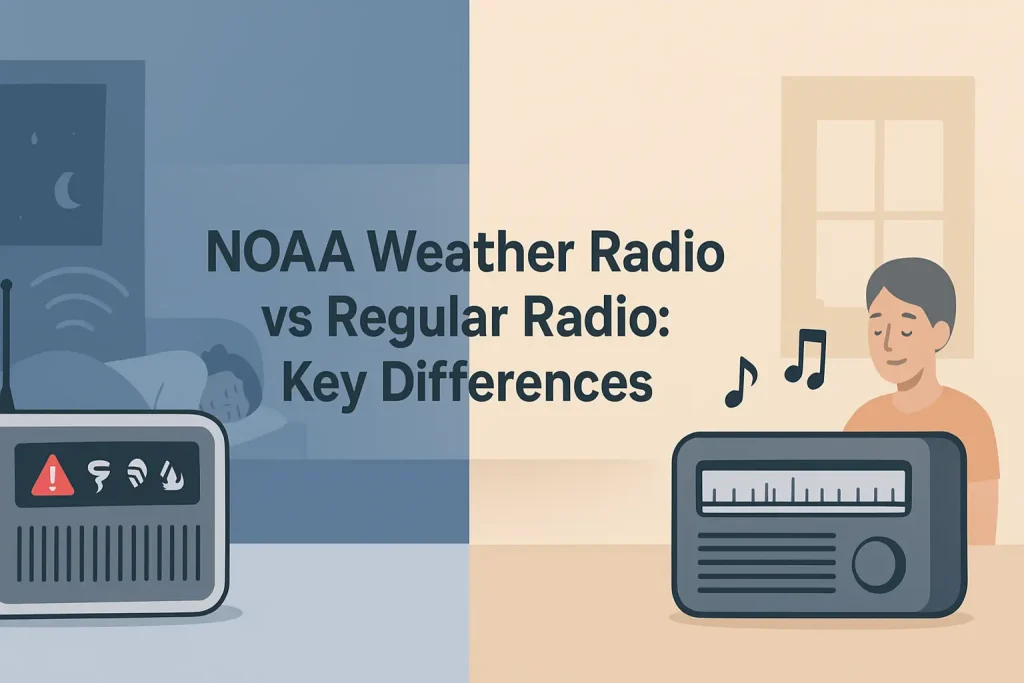
Most schools have fire drills down to a science. Weather emergencies are a different problem entirely. A fire alarm tells you exactly what is happening. A tornado warning arrives as a notification on someone’s phone, a siren outside, or nothing at all if the power is out and the internet is down. A dedicated NOAA weather alert radio receives broadcasts 24 hours a day on seven dedicated frequencies between 162.400 and 162.550 MHz, independent of cell service, internet, and commercial power. This guide explains how to integrate weather radio into a school emergency plan from the hardware selection through the drill protocol.
Why Schools Need a Dedicated Weather Radio System
A school weather radio system is not a backup for smartphones. It is the primary warning layer that works when every other system fails. NOAA Weather Radio All Hazards (NWR) broadcasts continuous weather updates and emergency alerts through a network of more than 1,000 transmitters covering approximately 95% of the US population, according to NOAA’s National Weather Service documentation.
| Photo | Popular Portable Walkie Talkies | Price |
|---|---|---|
 | SKIWARRIOR Multifunctional Smart Wireless Ski Goggles with Walkie-Talkie, Anti-Fog Zeiss Lens, Music & Call Function (Cylindrical Blue) | Check Price On Amazon |
 | SINORISE Super Mini Walkie Talkies, Two-Way Radios, 3 Pack | Check Price On Amazon |
 | KOSPET Tank M4C Smart Watch Rugged, Dual-Band GPS, 5ATM & IP69K Waterproof | Check Price On Amazon |
 | Retevis RT15 Walkie Talkies 3 Pack, Birthday Gift, Outdoor Adventure Kit | Check Price On Amazon |
 | Rechargeable Walkie Talkies Toys for Kids: DIY Astronaut Walkie Talkies for Boys Christmas Birthday Gifts for 3 4 5 6 7 8 9 10 Boy Walkie Talkie Outdoor Hiking Toy 2 Way Radio Camping Outdoor Game | Check Price On Amazon |
Cell phone alerts depend on carrier infrastructure. During a severe storm event, towers become overloaded within minutes of a widespread alert. School PA systems require a staff member to manually relay an alert they may not have received.
A weather radio with Specific Area Message Encoding (S.A.M.E.) technology receives alerts automatically and sounds an alarm without any human action required. S.A.M.E. technology filters alerts by a 6-digit Federal Information Processing Standards (FIPS) code, so the radio only activates for the specific county or counties the school administrator programs in advance.
Without S.A.M.E. filtering, a weather radio will alarm for every county in the broadcast area, which can cover 40 or more counties from a single NWR transmitter. That level of false activation trains staff to ignore the alarm.
The National Weather Service confirms that NWR transmitters broadcast on one of seven designated frequencies: 162.400, 162.425, 162.450, 162.475, 162.500, 162.525, and 162.550 MHz. Every school radio must be manually tuned to the transmitter serving the school’s county, not simply set to scan all seven.
Relying exclusively on mobile alerts or PA announcements creates a single point of failure for one of the highest-consequence decisions a school makes. A dedicated weather radio eliminates that failure point entirely.
Choosing the Right Weather Radio for a School Building
A school building requires a weather radio with a wired AC power source, a battery backup rated for at least 8 hours of standby operation, and a line-level or external speaker output capable of being heard across a large room. Consumer-grade portable weather radios designed for camping or bedside use are not suitable as primary alert devices in a school setting.
The Midland WR400 is one of the most widely used models in institutional settings.
Key Specifications:
- Frequencies: 162.400 to 162.550 MHz (all 7 NOAA channels)
- S.A.M.E. alert categories: 25
- Programmable S.A.M.E. codes: up to 50 location codes
- Power: AC adapter with 6x AA battery backup
- Alert output: audible alarm with backlit display
The Uniden BC365CRS includes a clock radio design with a dedicated weather alert mode and battery backup, making it functional as both a desk unit and an emergency receiver.
Key Specifications:
- Frequencies: 162.400 to 162.550 MHz (all 7 NOAA channels)
- S.A.M.E. programmable codes: yes
- Power: AC with battery backup
- Alert memory: programmable county codes
- Clock function: yes (dual alarm)
For gymnasiums, cafeterias, and other high-ambient-noise spaces, a standard consumer weather radio will not produce enough sound pressure to be heard over background noise. In these spaces, a radio with an external speaker jack should be connected to a powered speaker rated for at least 6 watts of audio output.
According to FEMA’s emergency communications guidance, every occupied building used as a public gathering space should maintain at least one functional weather alert receiver with battery backup at all times. For a school building with multiple wings, this means one primary unit at the administrative office and secondary units in areas of the building that are acoustically isolated from the PA system.
Do not purchase a weather radio without S.A.M.E. capability for any fixed school installation. Without S.A.M.E., the radio cannot be filtered to your specific county, and the alarm rate will undermine staff compliance with the alert protocol.

How to Program S.A.M.E. Codes for Your School’s County
S.A.M.E. programming is the single most important setup step for a school weather radio. An unprogrammed radio defaults to receiving all alerts from the transmitter’s entire coverage area, which may include 20 to 40 counties. Correct S.A.M.E. programming limits activation to alerts issued specifically for the school’s county or adjacent counties with mutual aid risk.
The FIPS S.A.M.E. code for any US county is a 6-digit number. The first digit is always 0 for county-level codes. The next two digits are the two-digit FIPS state code. The final three digits are the county code within that state.
Use the table below to understand the structure before beginning programming.
| Code Position | Digits | Meaning | Example (Cook County, IL) |
|---|---|---|---|
| Position 1 | 1 digit | Geographic code type (0 = county) | 0 |
| Positions 2-3 | 2 digits | FIPS state code | 17 (Illinois) |
| Positions 4-6 | 3 digits | FIPS county code | 031 (Cook County) |
| Full code | 6 digits | Complete S.A.M.E. county code | 017031 |
The National Weather Service maintains a complete searchable database of all US county S.A.M.E. codes at weather.gov/nwr/sam.html. Look up your school’s county code before touching the radio keypad.
Most school administrators also program the codes for one or two adjacent counties. This is especially important if your school is near a county line, or if the school district serves students who travel from neighboring counties. An alert issued for an adjacent county may reach your location within minutes.
Here is the step-by-step programming process for most S.A.M.E.-capable weather radios, including the Midland WR400 and Uniden BC365CRS.
- Locate the S.A.M.E. code for your county at weather.gov/nwr/sam.html. Write down the full 6-digit FIPS code before beginning.
- Tune the radio to the correct NWR frequency for your area. Use the NWR transmitter lookup at weather.gov/nwr/stations.html to find the specific frequency (one of the seven between 162.400 and 162.550 MHz) serving your county.
- Enter programming mode by pressing and holding the S.A.M.E. or “PROG” button for 3-5 seconds until the display shows a programming indicator. The exact button label varies by model; consult the manual if unclear.
- Enter the 6-digit FIPS code using the number keypad. Confirm the code displayed on screen matches your county before saving.
- Save the code by pressing the “ENTER” or confirmation button. Most radios allow 5 to 25 location codes to be stored simultaneously.
- Program adjacent county codes if applicable, using the same process for each additional FIPS code.
- Select the alert types the radio should respond to. For school settings, enable Tornado Warning, Tornado Watch, Severe Thunderstorm Warning, Flash Flood Warning, and Civil Emergency Message at minimum. Disable Frost Advisory and similar low-urgency alerts that could cause desensitization.
- Test the programming by pressing the test or “WEA Test” button. The radio should display your programmed county name and confirm the correct NWR frequency is locked in.
If the radio does not alarm during a subsequent weather event you expect it to cover, the most common cause is a mistyped FIPS code. Return to programming mode, delete the existing code, and re-enter it digit by digit while comparing against the NWR lookup page.
Correct S.A.M.E. programming is the difference between a weather radio that functions as a reliable alert system and one that either never alarms or alarms too often to be taken seriously.
The following widget shows how alert types compare across different school scenario priorities, giving administrators a quick reference for deciding which S.A.M.E. alert categories to enable.
EMERGENCY GUIDE
Weather Radio Alert Types for Schools – What to Enable and Why
Select your school’s primary weather threat region to see the recommended S.A.M.E. alert configuration. Source: NOAA NWR alert category list, FEMA school emergency planning guidance.
Placement Strategy: Where to Put Weather Radios in a School Building
A single weather radio in the main office does not constitute a school-wide alert system. NWR alerts are broadcast at a specific audio frequency and volume, and the audible alarm from one unit cannot penetrate the walls, doors, and distance separating a main office from a gymnasium 300 feet away.
FEMA’s Multi-Hazard Emergency Planning for Schools (IS-362.A) identifies acoustically isolated zones as a primary gap in most school emergency communication systems. A zone is acoustically isolated when a normal voice or alarm from a central location cannot be heard clearly at 75 feet or more from the source.
Use the placement framework below to identify how many units a school building requires.
| Location Type | Alert Method Needed | Recommended Equipment | Notes |
|---|---|---|---|
| Main office / administration | Primary NWR receiver | Midland WR400 or Uniden BC365CRS with AC power and battery backup | This unit triggers PA relay or staff radio notification |
| Gymnasium / auditorium | Standalone alert unit with powered speaker | Weather radio with external speaker output connected to 6W+ powered speaker | PA systems often do not reach these spaces during events |
| Cafeteria | Standalone alert unit | Sangean CL-100 or equivalent desktop unit | High ambient noise requires louder alarm output |
| Portable classrooms | Battery-powered portable unit per structure | Hand-crank emergency weather radio with S.A.M.E. | Portable classrooms are highest-risk structures in tornado and high-wind events |
| Basement / shelter room | Battery-only unit (no AC dependency) | Hand-crank or battery weather radio | Power may be out before or during shelter-in-place |
| Maintenance / grounds | GMRS or FRS two-way radio relay from main office | GMRS handheld radios for staff on campus grounds | Outdoor staff may be 500 feet or more from any building PA system |
Portable classrooms require special attention because they are the most structurally vulnerable buildings on most campuses during tornado and high-wind events. FEMA explicitly recommends that portable classroom occupants evacuate to a permanent structure during Tornado Warnings, rather than sheltering in place. This means every portable classroom needs its own weather radio to receive the alert and trigger that evacuation without waiting for a PA announcement from the main building.
Place weather radios at every acoustically isolated zone and every high-risk structure to ensure the alert reaches staff before it reaches local news.
Integrating the Weather Radio Alert into the School Emergency Action Plan
A weather radio that alarms without a predefined response protocol is just a noise-maker. The alert must be connected to a decision tree that every staff member understands and can execute without consulting anyone else in the building. FEMA’s IS-362.A framework defines this as the “trigger-to-action chain,” and it is the most commonly missing element in school weather emergency plans.
The trigger-to-action chain works because the NWR S.A.M.E. alert carries a specific event code that identifies the type of emergency. The radio’s alarm tone and displayed event code tell the first-responding staff member exactly which protocol to activate, with no ambiguity.
According to FEMA’s guidance on multi-hazard school emergency planning, every school emergency plan should assign three specific roles to weather radio response: the Monitor (the person physically near the weather radio), the Communicator (the person who relays the alert to the rest of the building), and the Coordinator (the administrator who makes shelter-in-place or evacuation decisions).
The Monitor and Communicator roles must be assigned to specific positions by title, not by individual name. Staff turnover means a plan that names “Mrs. Johnson” as the Monitor becomes nonfunctional the moment Mrs. Johnson is absent.
Use the table below to map S.A.M.E. event codes to specific school response protocols.
| S.A.M.E. Event Code | Alert Type | Urgency Level | Recommended School Response | Timeframe to Act |
|---|---|---|---|---|
| TOR | Tornado Warning | Immediate | Activate PA, move all occupants to designated shelter rooms immediately | Under 3 minutes |
| TOW | Tornado Watch | Elevated | Notify all staff, identify shelter room locations, monitor NWR continuously | Within 5 minutes of alert |
| SVR | Severe Thunderstorm Warning | Elevated | Cancel outdoor activities, move portable classroom students inside | Within 5 minutes of alert |
| FFW | Flash Flood Warning | Immediate | Move students in low-lying portable classrooms to upper floors or permanent structures | Under 5 minutes |
| HUW | Hurricane Warning | Immediate | Initiate district early dismissal or shelter protocol per local hurricane plan | Coordinate with district within 10 minutes |
| CEM | Civil Emergency Message | Immediate | Activate lockdown or shelter protocol per event type stated in the message | Immediate |
| WSW | Winter Storm Warning | Monitoring | Initiate early dismissal decision process with transportation coordinator | Within 15 minutes of alert |
Print this response matrix and post it at every weather radio installation in the building. The staff member physically nearest to the radio when it alarms should not have to search for protocol instructions.
Every staff member in the building needs to know which alert tone requires immediate action versus which requires notification. Without that universal training, the trigger-to-action chain breaks at the point where most time is lost: the first 60 seconds after the alarm sounds.
Using Two-Way Radios to Support Weather Emergency Communication in Schools
A weather radio tells you what the threat is. Two-way radios let you coordinate the response across a building or campus that spans more than one structure. In a school emergency, the 60-second window between the NWR alarm and the moment all staff need to know the alert type is the exact window where two-way radio communication matters most.
FRS (Family Radio Service) radios, operating on 22 channels between 462.5625 and 467.7125 MHz, require no FCC license and are available for under $40 per pair. According to FCC Part 95E, FRS radios are capped at 2 watts on channels 1-7 and 0.5 watts on channels 8-14. In a single-building school, this range is more than adequate for staff-to-staff communication during a weather event.
GMRS (General Mobile Radio Service) radios operate on the same frequency band but are licensed under FCC Part 95E and can transmit at up to 5 watts for handheld units. A single GMRS license from the FCC covers an entire immediate family, including immediate family members, for 10 years at a $35 fee. For schools, a GMRS license issued to the school district provides legal coverage for school staff operating GMRS radios on district property.
Use the table below to compare FRS and GMRS for school emergency communication applications.
| Specification | FRS | GMRS |
|---|---|---|
| FCC license required | No | Yes ($35, 10 years) |
| Max power output (handheld) | 2W (ch 1-7), 0.5W (ch 8-14) | 5W handheld, 50W mobile |
| Frequency range | 462.5625 to 467.7125 MHz | 462.5500 to 467.7250 MHz |
| Channels available | 22 shared with GMRS | 30 (including 8 GMRS-only repeater channels) |
| Repeater access | No | Yes |
| Effective range (single-story campus) | 0.5-1 mile | 1-3 miles |
| Fixed antenna allowed | No (handheld only) | Yes |
| Best school use case | Single-building campuses | Multi-building campuses, large grounds |
For most single-building schools, FRS radios like the Motorola T600 provide adequate coverage without requiring an FCC license. For school campuses with multiple buildings separated by more than 300 feet, GMRS radios operated under a district-level FCC license provide significantly better signal penetration and range.
CTCSS tones (Continuous Tone-Coded Squelch System), sometimes labeled as “privacy codes” on consumer radios, are sub-audible tones below 300 Hz that prevent the speaker from opening unless the received signal carries a matching tone. Setting a consistent CTCSS tone across all school emergency radios keeps the emergency channel clear of interference from other users on the same FRS or GMRS frequency in the area.
Assign one dedicated channel and CTCSS code combination to your school’s emergency communication team before the first event. Write that channel and code on a laminated card attached to each radio. Staff should not be searching for the correct channel during an active weather event.
Two-way radios extend the reach of the weather radio alert from the main office to every corner of the campus, turning a single alarm into a coordinated building-wide response.
Weather Radio Drill Protocols for Schools
A weather radio drill is not a test of the equipment. It is a test of whether every staff member in the building knows what to do in the first 90 seconds after the alarm sounds. The equipment will work as programmed. The variable is human response time and decision consistency under stress.
FEMA’s IS-362.A guidance recommends that schools conduct weather-specific emergency drills at least twice per year, timed to align with the onset of their primary severe weather season. For tornado-risk regions, this means one drill in late February or early March before peak season, and one in September for late-season storm events.
A compliant weather radio drill for schools follows this structure.
- Pre-drill briefing (5 minutes): Gather all staff, not just administrators, and review the specific alert type being drilled. Identify which S.A.M.E. event code corresponds to the drill scenario. Confirm the name of the Monitor, Communicator, and Coordinator for the drill. Do not announce the drill to students in advance.
- Trigger the alarm manually: Most weather radios include a “ALERT TEST” function that sounds the alarm tone without requiring a live NWR broadcast. Use this function to start the drill. Do not use the PA system to announce “this is a drill” before the alarm sounds.
- Time the response from first alarm to all-clear shelter-in-place: Use a stopwatch. FEMA recommends this window be under 3 minutes for tornado events. Record the actual time achieved.
- Execute the full response protocol: Staff move students to designated shelter rooms exactly as they would during a real event. Portable classroom teachers physically move students to the permanent building. Outdoor staff receive the alert via two-way radio and move to shelter. The Coordinator confirms all zones are accounted for.
- Account for all students and staff: Every room monitor reports to the Coordinator via two-way radio or physical check-in that their space is clear. Do not end the drill until every zone has reported.
- Post-drill debrief (10 minutes): Record any zone that exceeded 3 minutes to shelter. Identify which staff members were uncertain about protocol. Document equipment that did not function as expected, including two-way radio dead zones within the building. Log all findings in writing for the annual emergency plan review.
Post-drill documentation is not optional. The written record of each drill is the evidence a school provides to district safety officers, state emergency management agencies, and, in some states, insurance carriers that the emergency plan is actively maintained.
Run the drill at different times of day. A 10:00 AM drill does not test the same variables as a 2:45 PM drill when buses are arriving and half the staff is managing dismissal. The most dangerous moment for weather response failure is when the building is in a transitional state between activities.
Drills also reveal two-way radio dead zones that are invisible on paper. If a teacher in a portable classroom cannot hear the main office relay over the radio, that failure surfaces in a drill rather than in a real event. Document every dead zone and address it before the next drill.
Consistent, documented drills are what separate a school that responds to a weather event correctly from one that responds correctly only when conditions are ideal.
Battery Backup and Power Continuity for School Weather Radios
A weather radio that loses power when a severe storm knocks out electricity provides no protection at the moment it is needed most. Power outages and severe weather events are not independent occurrences. They are frequently simultaneous, and in tornado events, power failure often precedes the tornado’s arrival by several minutes as distribution lines in the storm’s path fail ahead of the funnel.
According to NOAA’s NWR operational documentation, NWR transmitters operate on backup generator power and continue broadcasting during widespread grid outages. The signal is available even when commercial power to the school is down. The school’s radio must be capable of receiving that signal on backup power to complete the communication chain.
Most AC-powered desktop weather radios like the Midland WR400 and Uniden BC365CRS include a battery backup compartment that accepts standard AA batteries. Six AA alkaline batteries provide approximately 8 to 12 hours of standby power in receive-and-alert mode, which is sufficient for most acute weather events.
For portable classroom installations and basement shelter rooms, a hand-crank solar weather radio eliminates the battery replacement variable entirely. The hand-crank mechanism generates enough power for several hours of receive operation after 3 to 5 minutes of cranking. Solar charging provides indefinite standby capability in a location with window exposure.
For a deeper look at hand-crank models that meet school backup power requirements, the complete guide to hand-crank emergency weather radios covers charging capacity, alarm output, and S.A.M.E. compatibility across the leading portable models.
Replace the backup batteries in every school weather radio at the beginning of each school year, regardless of whether the previous batteries have been depleted. Standard alkaline AA batteries have a shelf life of approximately 5 to 7 years, but in-device discharge from voltage regulation circuits in standby mode reduces their effective capacity to 2 to 3 years of reliable backup service.
The battery replacement should be documented on the same maintenance log as the quarterly alert test. A weather radio with dead backup batteries is functionally equivalent to no weather radio during a power-loss event.
For schools in regions prone to extended power outages from ice storms or hurricane events, a small uninterruptible power supply (UPS) connected to the main office weather radio provides 4 to 8 hours of clean AC power to the primary unit without requiring battery management. A 600VA UPS battery backup costs approximately $60 to $90 and eliminates the single most common weather radio failure mode in school settings.
Power continuity planning for the weather radio is as important as the programming itself: an unpowered radio and an untuned radio both produce the same outcome when the storm arrives.
Maintenance Schedule and Annual Compliance for School Weather Radio Systems
A weather radio system that is installed and then ignored degrades in reliability every year. SAME codes change when counties are reorganized. NWR transmitter frequencies occasionally shift. Batteries discharge. Staff who were trained on the system leave and are replaced by staff who were not. A maintenance schedule prevents these silent failures from becoming discovered failures during an actual event.
The following maintenance tasks should be assigned to a specific staff position by title and documented in the school’s written emergency plan.
| Task | Frequency | How to Perform | Documentation Required |
|---|---|---|---|
| Alert function test | Monthly | Press ALERT TEST button; confirm alarm sounds and display shows programmed county | Date, result, initials |
| NWR frequency verification | Quarterly | Confirm radio is tuned to correct frequency at weather.gov/nwr/stations.html | Date, frequency confirmed, initials |
| S.A.M.E. code verification | Annually (start of school year) | Verify programmed FIPS codes against current NWR database at weather.gov/nwr/sam.html | Codes confirmed, date, initials |
| Battery replacement | Annually (start of school year) | Replace all backup batteries regardless of depletion status | Battery brand, quantity, date, initials |
| Staff training verification | Annually | Confirm all new staff have received weather radio alert response training | Staff roster with training date signatures |
| Two-way radio channel audit | Annually | Verify all staff radios are programmed to the designated emergency channel and CTCSS code | Channel number, CTCSS code, date, initials |
| Full system drill | Twice per year | Trigger alarm, execute full response protocol, time to shelter-in-place, document findings | Drill report with response times and corrective actions |
The NWR Weekly Test broadcast, transmitted every Wednesday between 11:00 AM and noon local time according to the National Weather Service operational schedule, provides a free monthly functional test of the entire alert chain without requiring manual testing. Program the radio to respond to the Required Weekly Test (RWT) event code and confirm it activates correctly on the scheduled Wednesday.
Schools in states with formal emergency management planning requirements, including Texas, Florida, Oklahoma, and Kansas, are subject to state-level school safety audits that may require written documentation of weather radio maintenance and drill records. Contact your state’s Department of Education safety division for the specific documentation format required in your jurisdiction.
A maintained and documented weather radio system is a functional safety asset. An installed but unmaintained system is a liability that creates false confidence without delivering real protection.
Understanding NOAA Weather Radio Alert Types Relevant to Schools
Not every NWR alert requires the same school response. Understanding the difference between a Warning, a Watch, and an Advisory is the foundation of a calibrated response protocol that avoids both under-reaction and over-reaction. NOAA defines these terms precisely, and the definitions determine how much time a school has to act.
A Warning means the hazard is imminent or already occurring. It is issued when a trained spotter has confirmed the event or when radar indicates an event is underway. For tornado events, the average lead time between a Tornado Warning and funnel touchdown is approximately 13 minutes, according to NOAA Storm Prediction Center data.
A Watch means conditions are favorable for the hazard to develop, but it has not occurred yet. A Tornado Watch covers a large geographic area, often multiple counties, and may remain in effect for 4 to 8 hours. Schools receiving a Tornado Watch should prepare for possible shelter-in-place but should not execute the full response protocol.
An Advisory means conditions may cause inconvenience but are not considered a direct threat to life. A Winter Weather Advisory, for example, signals deteriorating travel conditions but does not require shelter-in-place. For schools, Advisories typically trigger early dismissal decisions rather than emergency protocols.
The table below summarizes the primary NWR alert types relevant to school emergency planning, their NOAA definitions, and the corresponding school response level.
| Alert Type | NOAA Definition | Typical Lead Time | School Response Level | Primary Season |
|---|---|---|---|---|
| Tornado Warning | Tornado confirmed by spotter or radar | Avg. 13 minutes | Immediate shelter-in-place | March through June |
| Tornado Watch | Conditions favorable for tornado development | 4 to 8 hours | Elevated monitoring, prep shelter | March through June |
| Severe Thunderstorm Warning | 58+ mph winds or 1-inch hail confirmed or radar-indicated | Avg. 18 minutes | Cancel outdoor activities, monitor | April through September |
| Flash Flood Warning | Flash flooding imminent or occurring | Under 30 minutes | Evacuate low-lying areas immediately | Year-round (peak spring) |
| Hurricane Warning | Hurricane conditions expected within 36 hours | 36 hours | Coordinate with district for dismissal or shelter | June through November |
| Winter Storm Warning | Significant snow, ice, or sleet expected within 12 hours | 12 to 24 hours | Initiate early dismissal decision process | November through March |
| Civil Emergency Message | Non-weather civil emergency (hazmat, infrastructure) | Variable | Activate per event type stated in message | Year-round |
For schools that want a deeper understanding of the difference between tornado warnings and watches as they affect school protocol timing, the detailed breakdown of how tornado warnings and watches differ in NWR broadcast format explains the specific language and tone patterns that distinguish the two alert types.
Training staff to recognize the specific alert type by both the alarm tone and the broadcast message reduces the 15 to 30 seconds of uncertainty that occurs when the radio alarms and no one is certain whether it is a Warning or a Watch. Those seconds are not recoverable in a 13-minute lead time scenario.
Compliance Considerations: Federal and State Requirements for School Weather Radios
The federal framework for school emergency planning does not mandate weather radios by name, but it establishes the performance standard that makes weather radio a de facto requirement. FEMA’s Comprehensive Preparedness Guide 101 (CPG 101) and the Department of Education’s Emergency Operations Plan (EOP) requirements both specify that schools must maintain a reliable, redundant alert reception capability that functions independently of commercial power and internet connectivity.
No technology other than a dedicated NWR receiver with battery backup satisfies this requirement at a cost below $100 per installation point. Smartphone-based alerting, social media monitoring, and commercial weather service subscriptions all depend on infrastructure that fails during the events they are designed to warn about.
At the state level, requirements vary significantly. The following states have codified specific weather radio or emergency communication technology requirements for schools in statute or administrative rule as of current legislative records:
- Oklahoma: The Oklahoma School Security Act requires all public schools to maintain a written multi-hazard emergency operations plan that includes weather alert procedures. The Oklahoma Department of Emergency Management provides a model EOP template that includes weather radio as a standard communication component.
- Texas: The Texas Education Code requires all school districts to adopt a multi-hazard emergency operations plan that is reviewed and updated annually. The Texas School Safety Center model EOP template includes weather radio integration as a standard element.
- Missouri: Missouri statute RSMo 160.515 requires all schools to conduct severe weather drills, and the Missouri Department of Elementary and Secondary Education’s guidance explicitly references weather radio as the trigger mechanism for those drills.
- Illinois: The Illinois School Code requires two tornado drills per year, with the Illinois Emergency Management Agency guidance recommending weather radio as the primary alert source for drill activation.
- Florida: The Florida Department of Education school safety requirements include hurricane preparedness plans that reference NWR monitoring as part of the warning reception protocol for coastal and inland schools.
Even in states where weather radio is not specifically mandated, schools that do not maintain a functional weather radio system face potential liability exposure when a weather event occurs and the argument can be made that a functioning system would have provided earlier warning than the method actually used.
Contact your state’s Department of Education emergency management division and your county Emergency Management Agency for the specific documentation format, drill frequency, and equipment standards required in your jurisdiction. Do not rely on federal guidance alone, because state-level requirements frequently exceed the federal baseline.
Maintaining compliance with both federal and state requirements is simpler when the weather radio system is documented from installation through each annual maintenance cycle, because that documentation chain is precisely what a compliance audit or post-event review will request.
Frequently Asked Questions About Weather Radio in Schools
What is the difference between a Tornado Watch and a Tornado Warning on a school weather radio?
A Tornado Warning means a tornado has been confirmed by a trained spotter or detected by Doppler radar and is imminent. It requires immediate shelter-in-place. A Tornado Watch means atmospheric conditions are favorable for tornado formation but no tornado has been confirmed, giving schools 4 to 8 hours to prepare without activating the full response protocol.
The two alerts carry different S.A.M.E. event codes: TOR for Tornado Warning and TOW for Tornado Watch. A weather radio with correct S.A.M.E. programming will sound an alarm for both, but staff trained to read the display will see different codes and respond accordingly. The NOAA average lead time for a Tornado Warning before funnel touchdown is approximately 13 minutes, which makes the distinction between Watch and Warning a life-safety decision, not a procedural one.
Can a school use smartphone alerts instead of a dedicated weather radio?
Smartphone Wireless Emergency Alerts (WEA) are not a reliable substitute for a dedicated NOAA weather radio in a school setting. WEA alerts depend on cellular infrastructure, which becomes overloaded during widespread severe weather events and can be delayed by 5 to 20 minutes compared to the NWR broadcast. A dedicated NWR receiver operating on 162.400 to 162.550 MHz broadcasts continuously without dependency on any third-party infrastructure, and continues to function during power outages when battery backup is installed.
FEMA’s school emergency planning guidance explicitly recommends redundant alert reception that does not rely on a single technology or infrastructure provider. Smartphone alerts satisfy one channel of that redundancy. They do not satisfy the requirement alone.
How many weather radios does a school building need?
A school building needs one weather radio per acoustically isolated zone, meaning any area where a normal alarm from the main office would not be clearly audible. For most schools, this means a minimum of three to five units: one at the main office, one in the gymnasium or auditorium, one in the cafeteria, and one per portable classroom structure. A basement shelter room also requires its own battery-only unit, since power may be out before shelter-in-place is activated.
The practical test is simple: stand at the farthest point of each building zone with someone activating the main office radio alarm, and determine whether the alarm is clearly audible. Any zone where it is not audible requires its own unit.
What S.A.M.E. codes should a school program into its weather radio?
A school should program the 6-digit FIPS S.A.M.E. code for the county in which the school is located, plus the codes for any adjacent counties from which weather events could reach the school within the typical NWR warning lead time. The National Weather Service S.A.M.E. code lookup is available at weather.gov/nwr/sam.html, where any US county’s FIPS code can be found by state and county name.
Do not program a state-wide code (which activates the radio for all counties in the state) for a permanent school installation. The resulting alarm frequency for non-local events will train staff to ignore alerts. Most school installations should program no more than three to five county codes.
Do school weather radios need to be replaced periodically?
Weather radios do not have a mandatory replacement interval established by NOAA or FEMA, but the S.A.M.E. decoder hardware in older units may not support all current NOAA alert event codes. Units manufactured before approximately 2006 may not receive the Wireless Emergency Alert (WEA) system codes added to the NWR broadcast format in subsequent years. Any unit that does not display recognizable event codes during a live alert test should be replaced.
Replace any unit that fails to alarm during the scheduled NWR Weekly Test broadcast (transmitted every Wednesday between 11 AM and noon local time). A weather radio that passes a manual ALERT TEST button press but fails to respond to the NWR broadcast has a receiver alignment or sensitivity problem that makes it unreliable for actual alerts.
Can a teacher in a portable classroom receive weather alerts without a PA system connection?
Yes. A portable classroom teacher needs a dedicated battery-powered S.A.M.E. weather radio installed in the portable classroom structure, independent of the main building’s PA system. This is especially critical because portable classrooms are the most structurally vulnerable buildings on most school campuses during tornado and high-wind events, and the FEMA recommendation for portable classroom occupants is to evacuate to a permanent structure rather than shelter in place.
A two-way radio assigned to the portable classroom teacher provides a second communication channel for receiving the main office relay and confirming evacuation completion. The combination of a local weather radio for initial alert and a two-way radio for coordination with the main office provides full communication redundancy for portable classroom occupants.
Is a GMRS license required for school staff two-way radios?
It depends on which radio service the school uses. FRS (Family Radio Service) radios operating under FCC Part 95E require no license and can be used by any school without prior FCC approval. GMRS (General Mobile Radio Service) radios, which transmit at up to 5 watts on handheld units and up to 50 watts for mobile units, require an FCC GMRS license costing $35 for a 10-year term.
A GMRS license can be issued to a school district or organization as a licensee, with all staff operating as authorized users under that license. For schools with large campuses or multiple buildings where FRS range at 0.5 to 2 watts is insufficient, a GMRS license is a cost-effective solution that provides significantly better signal penetration and range.
Why does the school weather radio alarm for counties that are not near the school?
A weather radio alarming for distant counties is almost always caused by incorrect or incomplete S.A.M.E. programming. If no S.A.M.E. county codes are programmed, the radio defaults to receiving all alerts from the NWR transmitter’s entire coverage area, which may include 20 to 40 counties. If a state-wide FIPS code is inadvertently programmed, the radio will alarm for every county in the state.
Enter programming mode and delete all existing S.A.M.E. codes. Look up the correct 6-digit FIPS code for the school’s county at weather.gov/nwr/sam.html, then re-enter only the codes for the school’s county and any immediately adjacent counties. After reprogramming, confirm the change by pressing ALERT TEST and verifying that only the programmed county names appear on the display.
What is the correct NWR frequency for a school to use?
NOAA Weather Radio All Hazards broadcasts on seven frequencies: 162.400, 162.425, 162.450, 162.475, 162.500, 162.525, and 162.550 MHz. Each NWR transmitter uses one of these seven frequencies, and the correct frequency for a school depends on which transmitter serves that county. The NWR transmitter lookup at weather.gov/nwr/stations.html allows any US location to find its nearest transmitter and its specific broadcast frequency.
Do not leave the radio in scan mode for a permanent school installation. Scanning all seven frequencies introduces a 2 to 5 second delay between the start of the broadcast and the radio locking onto the signal. For Tornado Warnings with a 13-minute average lead time, that delay is insignificant in isolation but is unacceptable in combination with other response delays. Lock the radio to the specific frequency serving the school’s county.
Can the weather radio alert be connected to the school’s PA system automatically?
Some weather radio models include a line-level audio output or dry contact relay output that can be wired into a school’s existing PA or intercom system. When the weather radio alarms, the relay contact closes, triggering an alert tone through every PA speaker in the building simultaneously without requiring a staff member to manually relay the alert. This integration is the most effective way to achieve building-wide simultaneous notification.
The Federal Signal weather alert relay systems and commercial NWR receiver units from manufacturers like Ritron and Alertus are designed specifically for institutional PA integration. Consult with your district’s facilities or IT department before attempting to wire a consumer weather radio directly into a PA system, as impedance mismatch can damage audio equipment.
What happens if the school weather radio fails to receive a live alert?
If the weather radio fails to alarm during a known active weather event, check four things in order: first, confirm the radio is tuned to the correct NWR frequency for your county using the NWR transmitter lookup. Second, confirm the S.A.M.E. county code is correctly programmed and matches the county in the actual alert. Third, confirm the alert type (event code) is enabled in the radio’s alert filter settings. Fourth, confirm backup batteries or AC power is functioning.
If all four checks pass and the radio still does not receive live alerts, the NWR transmitter serving your county may be offline. NOAA maintains a transmitter status page at weather.gov/nwr/stations.html that shows current operational status. If the transmitter is down, tune the radio to the next nearest transmitter frequency. Contact NOAA’s NWR program office if a transmitter outage persists for more than 24 hours.
How do we train new staff members on the school weather radio system?
New staff training on the weather radio system should cover four elements: how to identify the alarm tone as a weather radio alert versus other building alarms, how to read the event code displayed on the screen, which event codes require immediate action versus monitoring, and how to relay the alert via two-way radio or PA to the rest of the building. This training takes approximately 20 minutes and should be completed before a new staff member assumes unsupervised supervisory responsibility for a classroom or zone.
Document the training date and the staff member’s name in the weather radio maintenance log. For schools in states with annual emergency plan audit requirements, this documentation is part of the compliance record. A laminated quick-reference card posted at each weather radio unit serves as a refresher tool between formal training sessions. The card should show the event code, the response it requires, and the two-way radio channel to use for relay.
Schools looking for a broader framework for family and community weather radio preparedness that complements the in-school system will find the resources on choosing and programming weather radios for household emergency preparedness useful for informing parent communication about home alert continuity.
Building the Complete School Weather Radio Emergency System
A complete school weather radio emergency system has four components: correctly programmed NWR receivers at every acoustically isolated zone, a two-way radio network that covers the entire campus including outdoor staff and portable classrooms, a written trigger-to-action protocol that maps every S.A.M.E. event code to a specific school response, and a documented maintenance and drill schedule that keeps all three operational year after year.
None of these components is expensive. The Midland WR400 at approximately $45, FRS radios at under $40 per pair, and a $35 GMRS license from the FCC represent a total investment under $300 for a complete communication system covering most single-building schools. The ongoing cost is 20 minutes per month for testing and documentation.
For schools beginning to build their emergency communication system from a complete starting point, the comprehensive guide to weather radio for emergency preparedness covers the full framework from hardware selection through alert response protocols. For schools evaluating multiple weather radio models before purchasing, the weather radio buying guide with S.A.M.E. feature comparisons provides a structured specification comparison across the leading models in each price tier. For a ranked list of units that meet institutional installation requirements, the top-rated NOAA weather radios for home and institutional use covers the models most frequently recommended for school and public building installations.
The weather radio alarm does one thing: it gives you time you would not otherwise have. The drill protocol, the two-way radio network, and the maintenance schedule are what convert that time into a safe outcome for every student in the building.
| Photo | TOP RATED WALKIE TALKIES | Price |
|---|---|---|
 | Retevis RT628 Kids Walkie Talkies, Toys Gifts for 4-12 Year Old Girl Boy | Check Price On Amazon |
 | Cobra ACXT545 Weather-Resistant Walkie Talkies, Rechargeable, 22 Channels | Check Price On Amazon |
 | Retevis RT388 Kids Walkie Talkies, Outdoor Toys for Kids Camping Essentials | Check Price On Amazon |
 | Cobra RX680 Walkie Talkies (2-Pack), IP54 Water Resistant Design | Check Price On Amazon |
 | Retevis RT22 Walkie Talkies Long Range Rechargeable with Earpiece (2 Pack) | Check Price On Amazon |
 | Midland GXT1000VP4 GMRS Two-Way Radios with Headsets, Black, 2 Pack | Check Price On Amazon |
 | Retevis RT628 Walkie Talkies for Kids,Toys Gifts for 6-12 Years Old Boys Girls,Long Range 2 Way Radio 22CH VOX,Birthday Gift,Family Walkie Talkie for Camping Hiking Indoor Outdoor | Check Price On Amazon |