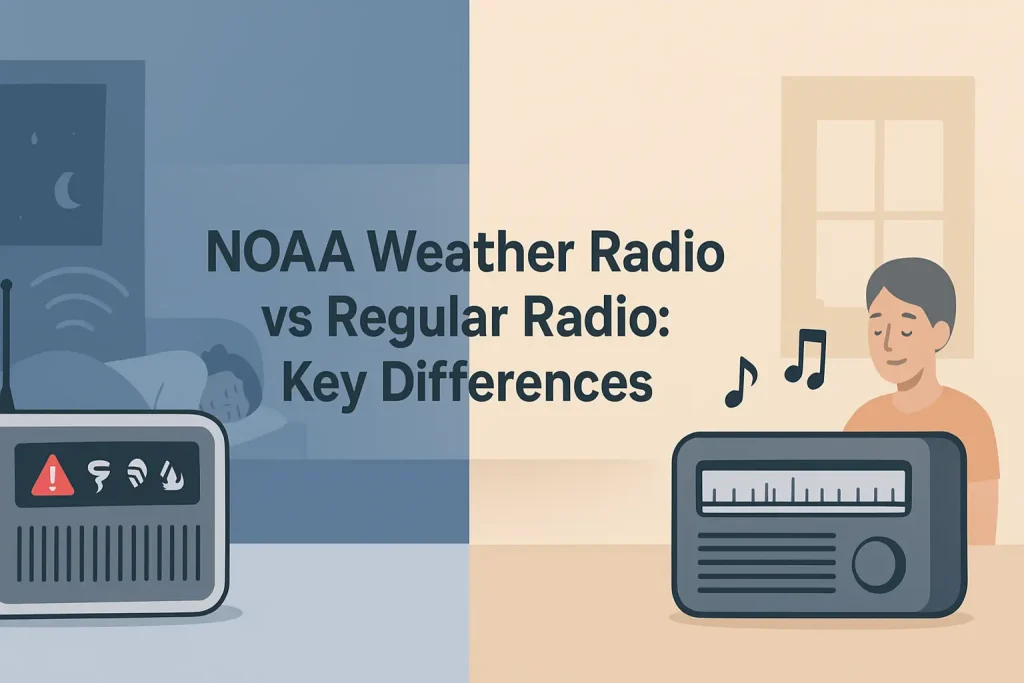
A weather radio without S.A.M.E. technology (Specific Area Message Encoding) will sound an alarm for every county in your state, not just yours. In an apartment, that means 2 a.m. alerts for tornadoes touching down 200 miles away. The right weather radio for apartment living is compact, quiet when it should be, and loud when it matters.
This guide covers portable and desktop NOAA weather radios sized for small spaces, with S.A.M.E. filtering, battery backup options, and placement strategies that work without a yard, a basement, or a dedicated emergency shelf.
| Photo | Popular Portable Walkie Talkies | Price |
|---|---|---|
 | SKIWARRIOR Multifunctional Smart Wireless Ski Goggles with Walkie-Talkie, Anti-Fog Zeiss Lens, Music & Call Function (Cylindrical Blue) | Check Price On Amazon |
 | SINORISE Super Mini Walkie Talkies, Two-Way Radios, 3 Pack | Check Price On Amazon |
 | KOSPET Tank M4C Smart Watch Rugged, Dual-Band GPS, 5ATM & IP69K Waterproof | Check Price On Amazon |
 | Retevis RT15 Walkie Talkies 3 Pack, Birthday Gift, Outdoor Adventure Kit | Check Price On Amazon |
 | Rechargeable Walkie Talkies Toys for Kids: DIY Astronaut Walkie Talkies for Boys Christmas Birthday Gifts for 3 4 5 6 7 8 9 10 Boy Walkie Talkie Outdoor Hiking Toy 2 Way Radio Camping Outdoor Game | Check Price On Amazon |
Why Apartment Dwellers Need a Dedicated Weather Radio
Your smartphone’s emergency alerts depend on cellular network availability. During a major storm, cell towers get overloaded or lose power entirely, and push notifications stop arriving. A NOAA weather alert radio receives broadcasts directly from the National Weather Service on seven dedicated VHF frequencies between 162.400 and 162.550 MHz, completely independent of the internet and cell infrastructure.
NOAA Weather Radio All Hazards (NWR) broadcasts 24 hours a day from over 1,000 transmitters, covering approximately 95% of the U.S. population within 40 miles of a transmitter, according to NOAA’s National Weather Service documentation. That signal reaches your apartment whether or not your phone has a bar of service.
Apartments create a specific challenge that houses do not: you cannot mount an outdoor antenna, you may be surrounded by concrete and steel that attenuate signals, and you share walls with neighbors who will hear your 3 a.m. alarm. The solution is not a louder radio. It is a smarter one, programmed to alert only for your county using S.A.M.E. codes.
The right weather radio for an apartment is one that sits on a nightstand or kitchen counter, filters alerts to your specific county, runs on both AC power and battery backup, and fits in a space smaller than a paperback book. Those radios exist and they cost between $30 and $80.
What Is S.A.M.E. Technology and Why It Matters in an Apartment
S.A.M.E. (Specific Area Message Encoding) is a digital coding system embedded in NOAA weather radio broadcasts that identifies the geographic area affected by each alert, down to the county level. A weather radio with S.A.M.E. decoding will only trigger its alarm when the broadcast matches a county code you have pre-programmed into the unit. Without S.A.M.E., every alert for every county in your broadcast area wakes you up.
According to NOAA’s NWR documentation, S.A.M.E. codes use a six-digit FIPS (Federal Information Processing Standards) format: a one-digit subdivisional code, a two-digit state code, and a three-digit county code. For example, the S.A.M.E. code for Cook County, Illinois is 017031. Most radios allow you to store between 5 and 50 location codes, letting you monitor your home county plus neighboring counties if you choose.
In an apartment, S.A.M.E. filtering is not a convenience feature. It is the difference between a radio your neighbors never hear and one that gets complaints filed with your building manager. A non-S.A.M.E. radio in a densely populated broadcast area might alarm 20 to 40 times per year for events in counties you never travel through.
S.A.M.E. also lets you filter by alert type. Most S.A.M.E.-capable radios let you select which event categories trigger the alarm: tornado warnings, flash flood warnings, severe thunderstorm warnings, and others. You can silence Civil Emergency Messages and AMBER Alerts during overnight hours if your county issues them frequently, while keeping life-threatening weather alerts fully active.
Programming your S.A.M.E. code takes about three minutes using the keypad on most models. Look up your county’s six-digit FIPS code at the NOAA weather radio SAME codes page, then enter it under your radio’s “Programming” or “SAME” menu. The right S.A.M.E. setting is the single most important configuration step for apartment use.
The Best Weather Radio Sizes for Small Apartments
Weather radios come in three physical form factors, and the right choice depends on where you plan to put it in your apartment. Desktop units are the most common and easiest to program. Portable hand-crank units add emergency power generation but are larger. Ultra-compact clock radios combine alarm functions with weather monitoring.
Desktop Weather Radios: The Most Practical Apartment Option
Desktop weather radios are typically 4 to 6 inches wide, 3 to 4 inches tall, and 2 to 3 inches deep. They plug into a standard wall outlet and switch automatically to battery backup when power is lost. Most have a digital display showing the current time, alert status, and programmed S.A.M.E. codes.
The Midland WR400 is one of the most recommended desktop models for apartment use. It programs up to 50 S.A.M.E. codes, supports 25 alert event types, runs on AC power with six AA batteries as backup, and measures roughly 5.1 x 3.3 x 1.9 inches.
Key Specifications (Midland WR400):
- Frequency: 162.400 to 162.550 MHz (all 7 NOAA WX channels)
- S.A.M.E. location codes: up to 50 programmable
- Alert event types: 25
- Power: AC adapter with 6x AA battery backup
- Dimensions: approximately 5.1 x 3.3 x 1.9 inches
The Uniden BC365CRS adds a digital alarm clock, FM radio, and a large backlit display to its weather monitoring function. It is a strong choice for a nightstand because it replaces two devices with one. Its S.A.M.E. programming holds up to 25 county codes.
Key Specifications (Uniden BC365CRS):
- Frequency: 162.400 to 162.550 MHz (7 NOAA WX channels)
- S.A.M.E. location codes: up to 25 programmable
- Additional functions: AM/FM radio, digital alarm clock
- Power: AC with battery backup
- Display: large backlit LCD
A desktop weather radio is the best default choice for most apartment dwellers because it requires no maintenance, stays on your shelf without taking up drawer space, and programs in minutes. Choose a desktop model first unless you have a specific need for portability or hand-crank power.
Portable and Hand-Crank Weather Radios for Apartments
Portable weather radios run on AA or AAA batteries, a USB power bank, or a built-in hand-crank generator. They are smaller than most desktop units and can move between your nightstand, your kitchen counter, and your go-bag without unplugging anything. The trade-off is that battery-only models require regular battery checks and the hand-crank units are physically larger.
The Midland ER310 is a compact hand-crank weather radio with solar charging, USB device charging, and S.A.M.E. alert filtering. It measures approximately 6.4 x 3.2 x 2 inches and fits in a medium-sized kitchen drawer. Its built-in 2,000 mAh battery charges via USB, solar panel, or hand crank.
Key Specifications (Midland ER310):
- Frequency: 162.400 to 162.550 MHz (7 NOAA WX channels)
- S.A.M.E.: yes, with alert type filtering
- Power: USB, solar, hand crank, built-in 2,000 mAh Li-ion battery
- Bonus features: USB device charging port, LED flashlight, SOS beacon
- Dimensions: approximately 6.4 x 3.2 x 2 inches
For apartment dwellers who want one device that doubles as an emergency kit item, the hand-crank portable is a smart choice. For those who just want reliable county-specific alerts on a nightstand, the smaller desktop unit is simpler and less expensive. If you want to understand all the options before buying, our complete breakdown of hand-crank power options and charge times covers every model tier in detail.
Weather Radio Alarm Clocks: Two Devices in One
Weather radio alarm clocks combine a standard digital clock, an AM/FM radio, and a full NOAA weather receiver in a single unit roughly the size of a paperback book. They are the most space-efficient option for an apartment bedroom because they eliminate a separate alarm clock from your nightstand entirely.
The Sangean CL-100 is a well-regarded weather radio clock with S.A.M.E. filtering, a large display, and a built-in alert LED that flashes during incoming broadcasts. It programs up to 25 county codes and distinguishes between alert types using color-coded LED indicators.
Key Specifications (Sangean CL-100):
- Frequency: 162.400 to 162.550 MHz (7 NOAA WX channels)
- S.A.M.E. location codes: up to 25 programmable
- Alert LED: tri-color (red for warnings, amber for watches, green for advisories)
- Power: AC with battery backup
- Clock functions: dual alarm, snooze, FM radio
The alarm clock combination unit is the best choice if you are trying to minimize objects on your nightstand. You get full weather alert capability without adding any new devices to a space that may already be crowded.
Where to Place Your Weather Radio in an Apartment
Placement in an apartment affects both signal reception and alert audibility. A weather radio buried in a closet or inside a cabinet with metal doors may lose signal on weaker NOAA transmitters. A radio on an external-wall windowsill typically gets the strongest signal of any indoor position.
Signal Reception in Concrete and Steel Buildings
NOAA weather radio broadcasts on VHF frequencies between 162.400 and 162.550 MHz. VHF signals penetrate most residential construction materials, including wood framing, drywall, and glass. They attenuate (weaken) significantly through reinforced concrete, steel framing, and metal-clad exterior walls, which are common in urban high-rise apartment buildings.
This happens because VHF signals at 162 MHz behave similarly to light: they pass through thin materials but reflect off or are absorbed by dense conductive materials like steel rebar in concrete. If your apartment is on an upper floor of a high-rise with poured concrete construction, your radio may receive a weaker signal than a unit in a wood-frame building at the same distance from the transmitter.
The fix is position: place your radio within three feet of a window that faces toward the transmitter. Most weather radios have a built-in telescoping antenna. Extend it fully and angle it vertically for best reception on 162 MHz. If you cannot identify which direction the transmitter is, try different windows and monitor the signal strength display on your radio while scanning all seven channels.
If your building produces consistent reception problems, an external antenna connected via the radio’s external antenna jack (present on most desktop models) dramatically improves signal strength. A simple weather radio external antenna placed near a window costs $15 to $30 and can solve signal loss in problematic buildings.
Alert Audibility Without Disturbing Neighbors
A weather radio alarm at full volume produces approximately 85 to 95 decibels, comparable to a smoke detector. In an apartment, this level at 3 a.m. will be audible through standard drywall partitions. Most modern weather radios include a volume control that can be set independently for alert alarms versus the broadcast audio.
Set your alert alarm volume to the minimum level at which it reliably wakes you. Conduct a test: set a manual alarm on the radio, close your bedroom door, and check whether you can hear it clearly. Adjust upward only as far as needed. This prevents unnecessary disturbance to neighbors while still delivering the alert when it matters.
Some models, including the Midland WR400, support a silent alert mode that flashes a strobe light and vibrates (via optional bed shaker accessory) without producing audible sound. This is useful in apartments where you are concerned about noise ordinances or thin walls. A bed shaker accessory connects to the radio’s alert output jack and physically vibrates under your mattress when an alert fires.
The Best Rooms for Your Weather Radio
The bedroom nightstand is the most effective placement for overnight alert reliability. You will be asleep when the most dangerous severe weather events occur, and a radio within arm’s reach at night provides the fastest possible response time. Set it to S.A.M.E. filtering so only your county triggers the alarm.
A kitchen counter near a window is the second best location if you spend significant daytime hours at home. It keeps the radio visible and audible during waking hours without requiring a separate alert for daytime events. Avoid placing it near a microwave, which can generate interference on nearby frequencies.
A living room bookshelf works if you keep the volume high enough to hear from the bedroom, but this approach relies on the sound traveling through one or more walls. It is a less reliable configuration for overnight alerts. Use this placement only as a secondary radio, not your primary one.
How to Program a Weather Radio for Apartment Use
Programming a weather radio for apartment use takes approximately five to ten minutes and requires only your county’s six-digit FIPS S.A.M.E. code. The code is available free at the NOAA weather radio SAME codes page, searchable by state and county. Once programmed, the radio requires no further adjustment unless you move to a different county.
Here is the step-by-step programming process for most S.A.M.E.-capable weather radios:
- Find your county’s six-digit FIPS S.A.M.E. code at the NOAA NWR SAME codes lookup page (search “NOAA SAME codes” plus your state name). Write it down before starting. Example: Cook County, Illinois is 017031.
- Power on the radio and press the “Program” or “SAME” button. On most Midland and Uniden models, this is labeled directly. On Sangean units, it is accessed through the main menu.
- Select your NOAA channel first if prompted. Your radio will scan all seven WX channels (162.400 to 162.550 MHz) automatically, or you can manually select the strongest one.
- Enter your six-digit FIPS code using the number keypad. Confirm the display shows the correct six digits before saving. Most radios allow you to store between 5 and 50 codes.
- Select your alert event types. Choose which alert categories activate the alarm. At minimum, enable: Tornado Warning, Severe Thunderstorm Warning, Flash Flood Warning, and Hurricane Warning. You can add or remove others based on your location’s risk profile.
- Set your alert volume. Test the alarm at the volume you have chosen to confirm it is audible from your bedroom with the door closed.
- Check battery backup status. Install fresh AA or AAA batteries (or charge the built-in battery, if applicable) before placing the radio in its permanent position.
According to NOAA’s NWR documentation, the radio will only alarm when it receives a broadcast containing your programmed FIPS code and one of your selected event types. All other broadcasts play silently through the speaker at normal volume if you have the radio on, or are ignored entirely if the radio is in standby alert mode.
Once your S.A.M.E. code and alert types are set, test the setup by switching the radio to “All” county mode temporarily and confirming it receives and displays broadcasts from your area. Then switch back to your programmed county code. The programming is complete when the radio returns to quiet standby and only activates for your specified events.
Here is a comparison of the most popular apartment-friendly weather radio models to help you choose the right fit for your space.
Price Comparison
Apartment-Friendly Weather Radios – Price Comparison by Model
Street price, sorted lowest to highest. Prices verified at time of publication.
~$30
~$40
~$50
~$60
~$65
~$80
Single-unit price. No FCC license is required to receive NOAA weather radio broadcasts. Prices represent typical street prices and may vary by retailer.
Battery Backup: What Happens When Your Apartment Loses Power
A weather radio that loses power during the storm it is supposed to warn you about is useless. Power outages most commonly occur at exactly the moment when weather alerts are most critical: during the severe storm event itself. Every apartment weather radio setup needs a reliable battery backup that activates automatically the moment AC power is interrupted.
Most desktop weather radios use 3 to 6 AA or AAA alkaline batteries as backup. At typical standby current draw (approximately 50 to 100 milliamps), a set of six AA alkaline batteries (approximately 2,700 mAh each) provides 60 to 100 hours of standby time. This is enough to last through most multi-day outages. Using Energizer Ultimate Lithium AA batteries instead of standard alkaline extends that backup window by approximately 20 to 30% and maintains performance in cold temperatures where alkaline batteries underperform.
Replace your battery backup once per year regardless of whether the batteries have been used. A battery sitting in a device for two years may have self-discharged to the point where it cannot sustain the radio during a 24-hour outage. The annual battery replacement is the most important maintenance task for apartment weather radio reliability.
If you choose a portable weather radio with a built-in rechargeable battery, connect it to a USB power bank as a secondary backup. A 10,000 mAh USB power bank can recharge a 2,000 mAh weather radio battery four to five times, providing several days of continuous operation without any grid power. Keep the power bank charged at 80% or above at all times.
The apartment-specific concern with battery backup is that renters are less likely than homeowners to have a backup generator. This makes the battery backup in your weather radio your primary power resilience for emergency communication. Treat it accordingly and test it by unplugging the radio once per year to confirm the battery backup activates immediately and holds the radio in alert standby mode.
Understanding the Difference Between a Tornado Watch and a Tornado Warning on Your Weather Radio
A tornado watch and a tornado warning trigger different S.A.M.E. event codes and should prompt different immediate responses. Confusing them is one of the most common and most dangerous mistakes apartment dwellers make with weather radios. The distinction is not about severity level; it is about the specific threat status and the correct action for each.
A tornado watch (S.A.M.E. event code: TOA) means atmospheric conditions in your area are favorable for tornado formation. A tornado watch covers a large geographic area, sometimes 50,000 square miles, and lasts 4 to 8 hours. The correct response is to monitor your weather radio closely and know your building’s shelter location in advance. You do not need to move to shelter immediately during a watch.
A tornado warning (S.A.M.E. event code: TOR) means a tornado has been detected by radar or confirmed by a trained spotter. A tornado warning is issued for a specific area, usually covering a county or portion of a county, and typically lasts 30 to 60 minutes. The correct response is to move immediately to your building’s interior shelter location: the lowest floor, an interior hallway, or a stairwell away from windows. In an apartment, this is not a drill.
For a detailed breakdown of how each alert code is issued, which geographic areas each covers, and the full list of S.A.M.E. event categories your radio can receive, our guide to understanding tornado watches versus warnings on your weather radio explains the National Weather Service issuance process for each.
Your S.A.M.E.-capable weather radio can be programmed to alarm for tornado warnings but remain silent (or alarm at a lower volume) for tornado watches, using the event type selection feature. Set this up during your initial programming to reduce alert fatigue while maintaining full alarm capability for the events that require immediate action.
Space-Saving Setup Ideas for Studio and Small Apartments
A studio apartment or small one-bedroom may have limited counter and shelf space. The most effective approach is to combine your weather radio function with something you already keep on your nightstand or kitchen counter, rather than adding a new footprint. The combination alarm clock radios described above accomplish this directly.
Nightstand Setup for Maximum Alert Speed
The nightstand is the most important placement for overnight tornado and severe storm alerts. Place the radio within reach of your dominant hand so you can silence the alarm, assess the broadcast, and begin moving to shelter within 30 seconds of waking. A nightstand unit should have its volume set low enough not to disturb neighbors but loud enough to wake you through a normal sleep cycle.
The Uniden BC365CRS is an ideal nightstand setup because it replaces a separate alarm clock with a single unit that handles both functions. Its large backlit display is readable in darkness without pressing any buttons, which matters at 3 a.m. when you are trying to determine whether you need to move immediately.
If you use a separate phone charger on your nightstand, position the weather radio on the opposite side so the two devices do not compete for the same electrical outlet. Most weather radios use a standard 5V DC adapter, which can share a multi-port USB wall charger if the radio accepts USB power input.
Kitchen Counter Setup for Daytime Monitoring
For daytime monitoring in a studio or open-plan apartment, the kitchen counter near a window offers both good signal reception and constant visibility. A compact desktop model like the Midland WR120B takes up approximately the same space as a standard coffee mug and plugs into any kitchen outlet.
Keep the radio out of the cooking zone: heat and steam from the stove can damage the electronics over time. A position near the refrigerator or at the far end of the counter from the stove provides adequate distance from cooking heat while remaining in the kitchen’s natural sight line.
The Go-Bag Position: When Your Radio Needs to Leave with You
Some apartment buildings have designated shelter locations in the basement or parking structure. If your emergency plan involves moving to a shelter location during severe weather, your weather radio should be portable enough to take with you. A hand-crank portable like the Midland ER310 fits this role well, while a desktop model does not.
If you keep a go-bag or emergency kit in your apartment, the portable weather radio is the correct choice for that bag. Desktop radios are best for in-place monitoring. Portable radios are best for evacuation or shelter-in-place scenarios where you may need to leave your unit. Our guide on building a weather radio setup for emergency preparedness at home covers which features matter most when your radio needs to function as part of a broader emergency kit.
Antenna Options for Poor Reception in High-Rise Apartments
High-rise apartments above the tenth floor often experience improved weather radio reception because they have fewer obstructions between the radio and the transmitter. However, all-steel or reinforced-concrete construction above ground floor can create signal attenuation even at elevation, particularly on the interior side of the building away from the transmitter direction.
The built-in telescoping antenna on most weather radios is approximately 20 to 30 inches when fully extended. This is optimized for the 162 MHz frequency range and is sufficient for most apartment locations within 40 miles of a NOAA transmitter. Extend it fully and position it vertically for maximum gain on VHF signals.
If your radio shows a weak signal indicator or fails to receive alerts on multiple WX channels, an external antenna improves reception significantly. Most desktop weather radios have a 3.5mm or BNC external antenna jack on the rear panel. A dedicated indoor VHF weather radio antenna placed on a windowsill and connected via a 10-foot cable allows you to position the antenna at the window while keeping the radio on your nightstand or counter.
This happens because the window glass and the exterior air beyond it create a direct path to the VHF signal from the NOAA transmitter. The cable loss from a 10-foot run is minimal (approximately 0.5 dBi at 162 MHz), while the gain from moving the antenna from inside the building to the window surface is typically 5 to 15 dB in problematic construction environments. The net result is dramatically improved signal consistency.
If you rent and cannot drill any holes, a magnetic-mount antenna designed for indoor glass placement uses suction cups to adhere to the window surface. No permanent installation is required and it leaves no marks on the glass when removed.
Alert Fatigue: Programming Your Radio to Alarm Less but Matter More
Alert fatigue is the single biggest reason apartment dwellers unplug or disable their weather radios. A non-S.A.M.E. radio in the Midwest can generate 60 to 100 alerts per year for events affecting the entire broadcast area. Most of those alerts are for counties the listener never visits. The solution is precise S.A.M.E. programming, not radio removal.
After entering your county’s FIPS code, refine your alert event list to match your location’s actual risk profile. An apartment in coastal Florida has different risk priorities than one in tornado alley. The table below shows the most common event categories and their relevance by region.
Use the table below to decide which S.A.M.E. alert categories to enable for your specific location and risk profile.
| S.A.M.E. Event Code | Alert Type | Midwest/Plains | Southeast/Gulf | Northeast/Mid-Atlantic | Recommended |
|---|---|---|---|---|---|
| TOR | Tornado Warning | High | Moderate | Low | Always ON |
| SVR | Severe Thunderstorm Warning | High | High | Moderate | Always ON |
| FFW | Flash Flood Warning | Moderate | High | High | Always ON |
| HUW | Hurricane Warning | Very Low | High | Moderate | ON if coastal |
| WSW | Winter Storm Warning | High | Very Low | High | Region-dependent |
| EVI | Evacuation Immediate | Moderate | High | Moderate | Always ON |
| HMW | Hazardous Materials Warning | Moderate | Moderate | Moderate | Always ON |
| CEM | Civil Emergency Message | Moderate | Moderate | Moderate | Optional |
S.A.M.E. event codes per NOAA NWR documentation. Risk levels are general regional patterns; actual risk varies by specific county. Always enable TOR, SVR, FFW, EVI, and HMW regardless of region.
After setting your event types, run through the first week with the radio fully active and note every alarm that sounds. If you receive alerts you consider low-priority for your location, revisit your event type list and deactivate those categories. This process typically settles into a final programming state after two to four weeks of real-world use.
A well-programmed S.A.M.E. weather radio in an average U.S. county should alarm between 5 and 20 times per year for genuinely relevant events. If you are getting more than that, your event type list is too broad or your county code is set to “all” rather than your specific FIPS code. Precise programming is what makes a weather radio a reliable apartment companion rather than an annoyance.
Weather Radio vs Smartphone Alerts: Why Apartments Need Both
Wireless Emergency Alerts (WEA) delivered via cell broadcast reach most smartphones automatically for Tornado Warnings and similar extreme weather events. These alerts work on the 4G LTE and 5G broadcast channel system, not the internet, so they are more resilient than regular data connectivity. They are not, however, equivalent to a dedicated weather radio in an apartment emergency scenario.
The critical difference is power dependency. Your smartphone requires a charged battery and a functioning cell tower within range. During a multi-day power outage following a major storm, your phone will drain within 24 to 48 hours without a charger. Your weather radio, running on six AA batteries, will monitor continuously for 60 to 100 hours without grid power, independently of cell infrastructure.
Cell networks also experience congestion during severe weather events as large numbers of people simultaneously attempt to make calls and send texts. According to FEMA’s Integrated Public Alert and Warning System (IPAWS) documentation, cell broadcast alerts (WEA) have separate priority capacity from voice and data traffic, but tower failures from storm damage can still eliminate coverage in affected areas. NOAA weather radio transmitters are hardened infrastructure with backup generators, designed to remain operational during the same storm events they are broadcasting alerts about.
The correct approach for apartment dwellers is to use both systems. Configure your weather radio as your primary overnight alert system and as your backup for power outage scenarios. Use your smartphone for daytime awareness and real-time map data from the National Weather Service app or similar platforms. Neither system alone is as reliable as both systems together.
Families in apartments with children have an additional reason to maintain a dedicated weather radio: children sleep more deeply than adults and may not wake to a smartphone alert in another room. A weather radio on the child’s nightstand, programmed with the same county code as the parent’s unit, ensures every member of the household receives the alert simultaneously. For more on setting up weather alert coverage for multiple people in a single residence, our guide to weather radio setups for households with children covers multi-room and multi-device configurations in detail.
Monthly and Annual Maintenance for Your Apartment Weather Radio
A weather radio requires minimal maintenance, but the few tasks that matter are genuinely critical. A radio with dead backup batteries or a misconfigured S.A.M.E. code provides false security: it sits on your nightstand and you believe you are protected, but you are not.
Monthly tasks take less than two minutes:
- Confirm the radio is powered on and displaying the correct channel and time.
- Verify the S.A.M.E. county code is still programmed (check the display or menu).
- Confirm the antenna is fully extended and positioned vertically.
- Check that the alert volume is set to your intended level.
Annual tasks take approximately 10 minutes:
- Replace all AA or AAA backup batteries with fresh ones, regardless of remaining capacity.
- Test the battery backup by unplugging the AC adapter and confirming the radio continues operating.
- Review and update your programmed S.A.M.E. county codes if you have moved or if NOAA has revised FIPS codes for your area.
- Review your programmed alert event types and adjust for any changes in your local risk profile.
- Verify that NOAA still broadcasts on your programmed channel at full strength by manually scanning all seven WX channels (162.400 to 162.550 MHz).
NOAA conducts weekly and monthly tests of the weather radio broadcast system. Wednesday morning test broadcasts (weekly) and monthly full-system tests are announced in advance and are broadcast on all seven WX channels. These tests are the most reliable way to confirm your radio is receiving and alarming correctly without waiting for an actual severe weather event. According to NOAA NWR documentation, the weekly test event code is RWT and the monthly test code is RMT. Both can be enabled in your S.A.M.E. programming specifically for testing purposes without affecting your normal alert configuration.
A properly maintained weather radio is a set-it-and-verify-occasionally device. The annual battery replacement and the monthly 90-second visual check are the only consistent time investments required to maintain full alert reliability.
What to Do When Your Weather Radio Alarms in an Apartment
Knowing your radio is programmed correctly is only half the preparedness equation. Knowing exactly what to do when it alarms at 2 a.m. is the other half. Apartment dwellers face a different set of shelter options than homeowners, and your response plan should account for your specific building’s layout before the alarm ever sounds.
When your radio alarms, do these things in this exact order:
- Listen to the broadcast. Do not silence the alarm and go back to sleep without first hearing the alert message. The broadcast identifies the event type, the affected area, and the expected duration. Your radio will announce the county code, the event type, and the NWS forecast office issuing the alert.
- Identify your shelter location in advance. For tornado warnings, move to the lowest floor of your building in an interior hallway or stairwell. Avoid windows, exterior walls, and elevators. If your building has a basement or parking garage below grade, use it. The interior stairwell of a concrete or masonry building offers the best protection available in a high-rise.
- Take your go-bag essentials. If your shelter location is outside your unit, take your phone (charged), your portable weather radio (if you have one), keys, medications, and identification. Move quickly. Do not stop to dress fully or gather non-essentials.
- Follow the broadcast instructions. NOAA broadcasts will include NWS guidance on whether to shelter in place or evacuate. Follow those instructions over any conflicting information from other sources until the all-clear broadcast is issued.
Identify your building’s shelter location before severe weather season begins each year. Walk the route from your unit to the shelter in daylight. Note any obstacles (heavy fire doors, corridors that end at exterior walls) and establish an alternative route. Rehearse the route with any family members or roommates in your unit so that a 3 a.m. alarm does not produce confusion about where to go.
For apartment dwellers in areas with both tornado and hurricane risk, the shelter response differs between event types. A tornado warning requires immediate interior shelter. A hurricane warning may require advance evacuation from your area, days before the storm arrives. Your weather radio will broadcast the specific response guidance for each event type, but your action plan should already account for both scenarios before the season starts. Our resource on integrating your weather radio into a full apartment emergency plan covers multi-hazard response frameworks in detail.
Using Your Weather Radio When Visiting or Camping Away from Home
A portable weather radio is not limited to apartment use. If you travel to a different county, you can reprogram your S.A.M.E. code to match the new location’s FIPS code in under two minutes. This makes a portable weather radio genuinely useful on camping trips, road trips, or visits to family in different regions.
Most portable weather radios, including the Midland ER310, store multiple county codes simultaneously. You can add your destination county code without deleting your home county code, then switch the active code when you arrive. NOAA transmitters cover approximately 95% of the continental U.S., with the best coverage in the densely populated regions of the Midwest, Southeast, and Northeast.
For outdoor and camping use specifically, the hand-crank or solar-charging portable radio is the only practical option. AC-powered desktop radios require a power outlet. The Midland ER310 and similar units are designed specifically for this dual-use scenario: nightstand weather monitoring at home and portable weather monitoring in the field. For outdoor-specific use cases and the best portable models for wilderness settings, our guide to portable weather radios for outdoor and backcountry use covers reception range, battery performance, and S.A.M.E. programming tips for rural transmitter coverage.
One caution for apartment dwellers who take their primary radio on trips: confirm the radio is reprogrammed back to your home county code when you return. A radio still programmed to a different state’s county code will miss alerts for your home location entirely until you correct it. Make reprogramming your home code part of your post-trip unpacking routine.
Frequently Asked Questions About Weather Radios for Apartment Dwellers
Do I need a license to use a NOAA weather radio in my apartment?
No license is required to receive NOAA weather radio broadcasts. NOAA weather radio is a receive-only service for all listeners. You do not transmit on the seven WX frequencies (162.400 to 162.550 MHz); you only receive broadcasts from NOAA’s transmitter network. Any person can purchase and use a weather radio receiver without FCC licensing of any kind.
What is the smallest weather radio available that still has S.A.M.E. technology?
The Midland WR120B is one of the smallest desktop units with full S.A.M.E. capability, measuring approximately 4.9 x 3.3 x 1.6 inches. It supports 25 alert event types and stores up to 25 county codes, with AC power and AA battery backup. For even smaller footprints, some portable hand-crank models are comparably sized but require battery management instead of continuous AC operation.
Can my weather radio pick up NOAA broadcasts from inside a basement apartment?
A basement apartment below grade significantly attenuates VHF signals at 162 MHz because soil and concrete above and around the unit block the signal path to the NOAA transmitter. The built-in antenna will often receive a weak or intermittent signal in this situation. The fix is an external antenna placed at or above grade level, connected to the radio via a coaxial cable run through a window opening or door gap. A 15 to 25-foot RG-58 coaxial cable extension with the appropriate connector for your radio model costs under $20 and typically solves basement reception problems entirely.
What is the difference between a weather radio watch alert and a weather radio warning alert?
A watch alert means conditions are favorable for a severe weather event to develop in your area. A warning alert means a severe weather event has been confirmed by radar or spotter report and is occurring or imminent in your specific county. The watch requires you to monitor conditions and prepare. The warning requires you to take shelter immediately. Your S.A.M.E.-capable radio can be programmed to alarm for both, or only for warnings if you want to reduce overnight alarms from watch-level events.
Why does my weather radio alarm for counties I do not live in?
Your radio is either programmed without a S.A.M.E. county code (set to “All” counties mode) or the FIPS code entered is incorrect. Access the programming menu and verify that your six-digit county FIPS code is entered and active. If the display shows “All” or “000000,” re-enter your correct county code. You can find your FIPS code at the NOAA weather radio SAME codes lookup page by selecting your state and county.
Can I use my weather radio as my only source of emergency alerts, or do I also need phone alerts enabled?
A NOAA weather radio is the most reliable single source of severe weather alerts because it broadcasts independently of cellular networks and the internet. That said, Wireless Emergency Alerts (WEA) on your smartphone deliver real-time geolocation-based alerts that update as a storm track shifts. The two systems complement each other: the weather radio provides redundant overnight coverage and operates during power outages, while your phone provides daytime mobility and dynamic location-based alerting. Disable neither; use both.
How do I know which of the seven NOAA weather radio channels is strongest in my apartment?
Put your radio in manual scan mode and step through all seven channels (162.400, 162.425, 162.450, 162.475, 162.500, 162.525, and 162.550 MHz). Most weather radios display a signal strength indicator or report a clear vs. weak signal status on each channel. Select the channel with the strongest signal as your primary. Some radios also have an automatic channel scan feature that locks onto the strongest channel automatically. Program your radio to that channel for consistent reception.
Do weather radios work during a power outage?
Yes, if your radio has battery backup installed and charged. Desktop weather radios automatically switch to AA or AAA battery power the moment AC power is interrupted. At typical standby current draw, six AA alkaline batteries provide 60 to 100 hours of backup operation. Built-in rechargeable batteries in portable models provide 20 to 40 hours of standby. Replace or recharge backup batteries annually to ensure they are ready when the outage occurs.
Is there a weather radio that also charges my phone during a power outage?
Yes. The Midland ER310 and similar multi-function portable radios include a USB output port that can charge external devices from the radio’s built-in battery. The ER310 has a 2,000 mAh internal battery, which provides approximately one full charge for a typical smartphone. For extended outages, pairing the radio with a separate high-capacity power bank is more practical than relying solely on the radio’s output capacity.
Can two weather radios in the same apartment be programmed to different county codes, for example if two roommates are from different counties?
Yes. Each weather radio is programmed independently and stores its own S.A.M.E. codes. Two radios in the same apartment can be set to entirely different county codes with no interaction between them. One radio will alarm for events in County A and the other for County B. Most S.A.M.E. radios also allow multiple county codes simultaneously within a single unit, so one radio can monitor both counties if needed.
What is the maximum distance a NOAA transmitter can reliably reach a weather radio?
NOAA weather radio transmitters broadcast at 300 watts on frequencies between 162.400 and 162.550 MHz, with most transmitters designed for a coverage radius of approximately 40 miles under normal conditions, according to NOAA NWR documentation. In flat terrain with no obstructions, reliable indoor reception extends to 40 to 60 miles from the transmitter. In urban high-rise areas with significant construction attenuation, reliable reception may drop to 20 to 30 miles. An external antenna positioned at a window restores effective range in most building types.
Why does my weather radio sound an alert but I cannot hear any voice broadcast?
This typically indicates that the radio is receiving the S.A.M.E. digital header tone (the data burst that triggers the alarm) but losing the subsequent voice broadcast due to a weak signal or interference. The alarm correctly fires based on the digital code. The voice message is transmitted on the same channel immediately after the header tone. Improve signal strength by repositioning the antenna closer to a window. If the problem persists, connect an external antenna to eliminate building attenuation as the cause.
Are weather radios required in apartments by building code?
No federal or state building code currently requires weather radios in residential apartment units. Some counties in high-tornado-risk areas have issued recommendations or guidelines for multi-unit buildings, but these are advisory rather than mandatory. The requirement decision rests with the individual renter. FEMA and NOAA both recommend weather radios in every residence, particularly for households in severe weather risk areas, but compliance is voluntary for private residents. Check your local county emergency management office for any region-specific guidance that applies to your area.
For a broader look at the full range of weather radio features available across all price points and how to match those features to your specific household situation, our complete weather radio features and buying criteria breakdown covers every specification category from S.A.M.E. code capacity to IP ratings to alert tone volume levels. If you want to compare the top-rated models side by side before purchasing, our ranked comparison of the highest-rated NOAA weather radios includes hands-on specification analysis across the current model lineup from Midland, Uniden, and Sangean.
A weather radio for an apartment does not need to be large, complicated, or expensive. A compact S.A.M.E.-capable desktop unit like the Midland WR400 or the Uniden BC365CRS, programmed with your county’s six-digit FIPS code and placed within reach of where you sleep, delivers everything you need: county-specific NOAA alerts independent of cell service, automatic battery backup during power outages, and alert filtering precise enough to silence the radio for 200 events per year while still alarming instantly for the one that matters. Set it up once, replace the batteries annually, and you have covered the most critical gap in apartment emergency preparedness that most renters leave open.
| Photo | TOP RATED WALKIE TALKIES | Price |
|---|---|---|
 | Retevis RT628 Kids Walkie Talkies, Toys Gifts for 4-12 Year Old Girl Boy | Check Price On Amazon |
 | Cobra ACXT545 Weather-Resistant Walkie Talkies, Rechargeable, 22 Channels | Check Price On Amazon |
 | Retevis RT388 Kids Walkie Talkies, Outdoor Toys for Kids Camping Essentials | Check Price On Amazon |
 | Cobra RX680 Walkie Talkies (2-Pack), IP54 Water Resistant Design | Check Price On Amazon |
 | Retevis RT22 Walkie Talkies Long Range Rechargeable with Earpiece (2 Pack) | Check Price On Amazon |
 | Midland GXT1000VP4 GMRS Two-Way Radios with Headsets, Black, 2 Pack | Check Price On Amazon |
 | Retevis RT628 Walkie Talkies for Kids,Toys Gifts for 6-12 Years Old Boys Girls,Long Range 2 Way Radio 22CH VOX,Birthday Gift,Family Walkie Talkie for Camping Hiking Indoor Outdoor | Check Price On Amazon |