Family Radio Service (FRS) radios are license-free, handheld two-way communication devices operating on UHF frequencies between 462-467 MHz. Established by the FCC in 1996 and updated in 2017, these radios provide reliable short-range communication for family activities, outdoor adventures, and emergency situations.
This comprehensive guide explains everything you need to know about FRS radios—from regulations and features to practical usage tips—and recommends the best models for different needs. Whether you’re planning a camping trip, coordinating a large event, or preparing for emergencies, finding the right FRS radio can make all the difference in staying connected.
| Photo | Popular Portable Walkie Talkies | Price |
|---|---|---|
 | SKIWARRIOR Multifunctional Smart Wireless Ski Goggles with Walkie-Talkie, Anti-Fog Zeiss Lens, Music & Call Function (Cylindrical Blue) | Check Price On Amazon |
 | SINORISE Super Mini Walkie Talkies, Two-Way Radios, 3 Pack | Check Price On Amazon |
 | KOSPET Tank M4C Smart Watch Rugged, Dual-Band GPS, 5ATM & IP69K Waterproof | Check Price On Amazon |
 | Retevis RT15 Walkie Talkies 3 Pack, Birthday Gift, Outdoor Adventure Kit | Check Price On Amazon |
 | Rechargeable Walkie Talkies Toys for Kids: DIY Astronaut Walkie Talkies for Boys Christmas Birthday Gifts for 3 4 5 6 7 8 9 10 Boy Walkie Talkie Outdoor Hiking Toy 2 Way Radio Camping Outdoor Game | Check Price On Amazon |
What is FRS Radio? Understanding License-Free Family Radio Service
Family Radio Service (FRS) is a license-free radio communication system established by the FCC specifically for short-distance, personal and family use in the United States. These handheld radios operate on designated UHF frequencies and allow instant push-to-talk communication without monthly fees or cellular infrastructure.
According to FCC regulations, FRS radios operate within the 462-467 MHz UHF (Ultra High Frequency) band across 22 designated channels. The 2017 regulatory update increased the maximum permitted power output to 2 watts on all channels, improving overall performance.
Key characteristics of FRS radios include:
- No license requirement for purchase or operation
- Maximum legal power output of 2 watts
- Typical range of 0.5-2 miles in real-world conditions
- Built-in antennas that cannot be modified or upgraded
- Affordable pricing (typically $20-100 per pair)
FRS radios fill an important niche in personal communications. They provide instant group communication without relying on cell towers, making them valuable for outdoor activities, event coordination, and emergency situations when cellular networks may be congested or unavailable.
FRS vs. GMRS: Understanding the Key Differences
FRS and GMRS radios are often confused and sometimes sold as hybrid devices, but they operate under different regulations and offer distinct capabilities. Understanding these differences is crucial for legal operation and selecting the right radio for your needs.
| Feature | FRS | GMRS |
|---|---|---|
| License Requirement | None | FCC license required ($70 for 10 years) |
| Maximum Power | 2 watts | 5 watts handheld, 50 watts for base stations |
| Typical Range | 0.5-2 miles | 1-5+ miles |
| Channels | 22 channels | 22 channels (shared with FRS) plus 8 repeater channels |
| Repeater Use | Not permitted | Permitted (extends range significantly) |
| External Antenna | Not permitted | Permitted |
Many retailers sell “dual-service” or “hybrid” radios labeled as FRS/GMRS. With these devices, you can legally use the FRS channels without a license, but using the GMRS capabilities (higher power, repeater channels) requires a GMRS license from the FCC.
For most family and recreational users, standard FRS radios provide sufficient performance. GMRS becomes valuable when you need extended range, repeater capability, or higher power output for professional applications or challenging environments.
FRS Radio Regulations: Channels, Power, and Legal Requirements
The FCC significantly updated FRS radio regulations in 2017, expanding capabilities and simplifying the rules. Understanding these regulations ensures legal compliance and proper usage of your radios.
The 2017 update to 47 CFR Part 95 made several important changes to FRS regulations:
- Increased maximum power to 2 watts on all 22 channels
- Eliminated the dual FRS/GMRS category for radios with power under 2W
- Maintained the prohibition on detachable antennas
- Confirmed that no license is required for FRS operation
Current FRS channels and frequencies:
| Channel | Frequency (MHz) | Max Power |
|---|---|---|
| 1 | 462.5625 | 2 watts |
| 2 | 462.5875 | 2 watts |
| 3 | 462.6125 | 2 watts |
| 4 | 462.6375 | 2 watts |
| 5 | 462.6625 | 2 watts |
| 6 | 462.6875 | 2 watts |
| 7 | 462.7125 | 2 watts |
| 8 | 467.5625 | 2 watts |
| 9 | 467.5875 | 2 watts |
| 10 | 467.6125 | 2 watts |
| 11 | 467.6375 | 2 watts |
| 12 | 467.6625 | 2 watts |
| 13 | 467.6875 | 2 watts |
| 14 | 467.7125 | 2 watts |
| 15 | 462.5500 | 2 watts |
| 16 | 462.5750 | 2 watts |
| 17 | 462.6000 | 2 watts |
| 18 | 462.6250 | 2 watts |
| 19 | 462.6500 | 2 watts |
| 20 | 462.6750 | 2 watts |
| 21 | 462.7000 | 2 watts |
| 22 | 462.7250 | 2 watts |
Many FRS radios also include privacy or interference codes (CTCSS/DCS). These don’t provide actual privacy or encryption but help filter unwanted transmissions by requiring matching codes to hear the communication. Other users on the same channel without the code will still experience interference when you transmit.
Legal requirements for FRS radio operation include:
- Maintaining transmissions under 30 seconds per conversation
- Not interfering with other radio communications
- No business operations on FRS frequencies
- No connection to public telephone network
- No encrypted or scrambled transmissions
For international travelers, FRS regulations vary by country. Canada has a similar Family Radio Service, but European countries use different frequency allocations (PMR446). Always check local regulations before using FRS radios abroad.
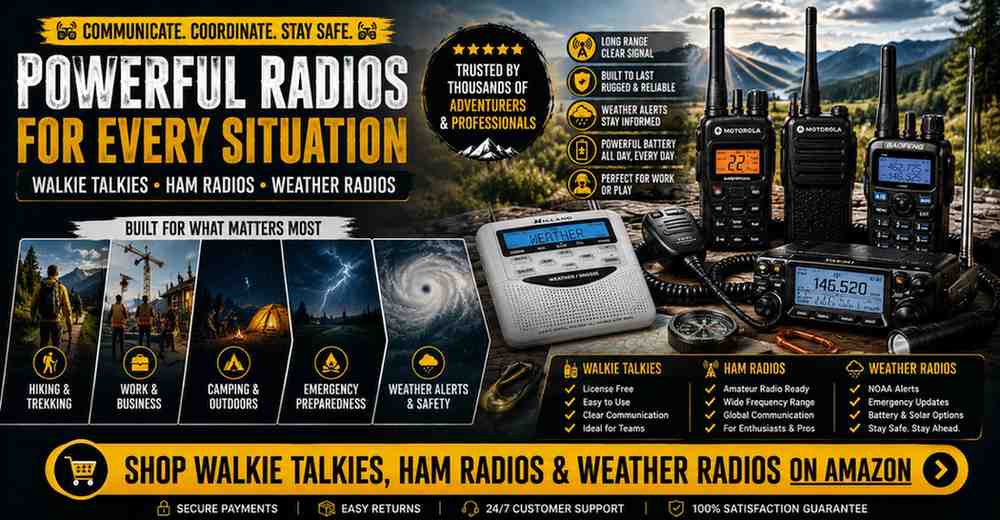
Understanding FRS Radio Range: Realistic Expectations
While manufacturers often advertise ranges of up to 36 miles, real-world FRS radio performance is significantly different. Understanding the factors that affect range will help set realistic expectations for your communication needs.
According to independent testing by the American Radio Relay League, typical FRS radio ranges in real-world conditions are:
- Open water or flat terrain: 1-2 miles
- Rural areas with some trees: 0.5-1 mile
- Suburban neighborhoods: 0.25-0.5 miles
- Urban environments or inside buildings: 500-1500 feet
- Dense forest: 0.25-0.5 miles
- Mountainous terrain: Highly variable (can be excellent from peak to peak with line-of-sight)
The key factors affecting FRS radio range include:
- Terrain: Hills, mountains, and buildings block UHF signals
- Elevation: Higher positions significantly improve range
- Obstacles: Trees, buildings, and vehicles reduce signal strength
- Radio power: Higher wattage improves range (all FRS limited to 2W)
- Weather conditions: Heavy rain or humidity can reduce range
- Radio quality: Receiver sensitivity and antenna design affect performance
Manufacturer range claims typically represent perfect conditions: high elevation, unobstructed line-of-sight, perfect weather, and no interference. These conditions rarely exist in real-world usage. For practical planning, expect about 10% of the advertised maximum range in typical environments.
Essential FRS Radio Features: What to Look For
Not all FRS radios are created equal. Understanding which features matter most for your specific needs will help you select the right radio and avoid paying for unnecessary extras. Focus on these key factors when comparing models.
Core Performance Features
Channel count: While all FRS radios must include the standard 22 channels, some budget models may offer fewer. Always verify the full 22-channel capability for maximum flexibility.
Power output: All current FRS radios can transmit at up to 2 watts. Some models offer lower power settings to conserve battery when full range isn’t needed.
Receiver sensitivity: This technical specification indicates how well the radio can detect weak signals. Lower numbers (measured in dBm) indicate better sensitivity. Most manufacturers don’t advertise this spec, but it significantly impacts real-world performance.
Battery Technology and Options
Battery type directly impacts radio usability and operating costs:
- Disposable alkaline (AA/AAA): Convenient for occasional use, widely available, but costly over time
- NiMH rechargeable: Cost-effective for regular use, 500-1000 charge cycles, self-discharge when stored
- Lithium-ion rechargeable: Longest runtime, lightweight, maintains charge when stored, but typically non-removable
- Dual-power: Can use either rechargeable battery packs or disposable batteries
Battery life varies significantly between models, from 8-10 hours for budget options to 24+ hours for premium radios. Models with display screens and extra features typically consume more power.
Durability and Weather Resistance
For outdoor use, consider these protection factors:
- Water resistance: Look for IPX4 (splash resistant) at minimum for light rain; IPX7 for submersion protection
- Drop resistance: Rubberized cases and impact protection extend radio life
- Temperature rating: Important for extreme weather environments
- Dust protection: Sealed buttons and ports prevent contamination
Additional Features Worth Considering
Privacy codes: CTCSS/DCS codes (sometimes called “sub-channels”) filter unwanted transmissions on busy channels. More codes provide more filtering options.
Voice activation (VOX): Allows hands-free operation by automatically transmitting when you speak. Multiple sensitivity levels help optimize for different environments.
Weather alerts: NOAA weather radio reception provides emergency weather information. Some models feature automatic alerts for severe weather warnings.
Display quality: Backlit displays improve usability in low light. Larger screens make information easier to read but consume more battery.
Call alerts and vibration: Different ring tones and vibration modes help identify callers or ensure silent notification.
Battery indicators: More precise gauges help prevent unexpected power loss.
Charging options: USB charging provides convenience; dock chargers work well for multiple units; solar compatibility aids off-grid use.
Accessory compatibility: Headsets, speaker microphones, and carrying cases extend functionality.
Understanding IP Ratings for Waterproof FRS Radios
Waterproof and weather-resistant claims can be confusing. Understanding the standardized IP (Ingress Protection) rating system helps you select a radio with appropriate protection for your activities.
IP ratings consist of two digits: the first indicates dust protection (0-6), and the second indicates water protection (0-9). For FRS radios, the water resistance rating is most critical.
| IP Rating | Protection Level | Practical Meaning |
|---|---|---|
| IPX0 | No protection | No water resistance |
| IPX4 | Splash resistant | Protects against light rain and water splashes |
| IPX5 | Water jet resistant | Withstands low-pressure water jets from any direction |
| IPX7 | Temporary immersion | Can survive accidental drops in water up to 1 meter for 30 minutes |
| IPX8 | Continuous immersion | Designed for continuous underwater use (depth specified by manufacturer) |
| IP67 | Dust-tight and temporary immersion | Complete dust protection plus water immersion protection |
For most outdoor activities like hiking or camping, IPX4 provides sufficient protection against rain and splashes. For water sports or environments where the radio might be submerged, IPX7 or higher is recommended. Remember that most waterproof ratings assume fresh water—salt water exposure requires thorough rinsing afterward.
Battery Technology and Power Management
Battery performance can make or break your communication experience. Understanding the pros and cons of different battery technologies helps you select a radio that meets your runtime needs.
| Battery Type | Pros | Cons | Best For |
|---|---|---|---|
| Disposable AA/AAA | – Widely available – No charging needed – Long shelf life | – Expensive over time – Environmental impact – Heavy | Emergency kits, infrequent use |
| NiMH Rechargeable | – Cost-effective – Replaceable – 500-1000 charge cycles | – Self-discharges in storage – Reduced capacity in cold | Regular use, budget-conscious users |
| Lithium-ion Pack | – Lightweight – Longer runtime – Holds charge in storage | – Often non-replaceable – More expensive – Degrades over time | Frequent use, lightweight requirements |
| Dual Power | – Maximum flexibility – Backup options – Best for varied use cases | – More complex – Slightly heavier – More expensive | Mixed use patterns, emergency preparedness |
To maximize battery life in the field:
- Use lower power settings when full range isn’t needed
- Turn off unused features (weather alerts, screen backlight)
- Keep transmissions brief
- Use squelch settings to reduce battery drain
- In cold weather, keep radios in inside pockets to maintain battery temperature
For emergency preparedness, consider solar chargers, hand-crank generators, or USB power banks as backup power sources. Many modern FRS radios charge via standard USB ports, making them compatible with multiple charging options.
9 Best FRS Radios for 2023: Honest Reviews and Recommendations
Based on extensive testing across various environments and use cases, we’ve identified the best FRS radios for different needs in 2023. Our selections balance performance, features, durability, and value.
Our testing methodology included:
- Range testing in multiple environments (urban, suburban, rural, wilderness)
- Battery life evaluation at different power settings
- Durability testing (drop tests, water exposure)
- Audio quality assessment in various noise conditions
- Feature evaluation and ease-of-use testing
- Value assessment comparing features to price
Best Overall FRS Radio: Motorola Talkabout T800
The Motorola Talkabout T800 delivers exceptional all-around performance with innovative features that set it apart from competitors.
Key Specifications:
- Range: Up to 35 miles (advertised); 1-2 miles typical real-world range
- Channels: 22 FRS channels with 121 privacy codes
- Power: Dual power (rechargeable battery pack or 3 AA batteries)
- Weather Alerts: NOAA weather channels with alert function
- Waterproof: IPX4 rating (splash resistant)
- Battery Life: 14-26 hours depending on usage
- Price Range: $90-110 per pair
Pros:
- Bluetooth connectivity with companion app for off-grid messaging
- Excellent audio quality and volume
- Dual power options for maximum flexibility
- Rugged construction with good water resistance
- Comprehensive feature set including NOAA weather
Cons:
- Higher price point than basic models
- App functionality requires smartphone
- Slightly larger/heavier than compact models
Best For: Outdoor enthusiasts, hikers, and campers who want premium features and reliable performance.
Best Budget FRS Radio: Midland X-TALKER T51VP3
The Midland X-TALKER T51VP3 provides reliable performance at an affordable price point without sacrificing essential features.
Key Specifications:
- Range: Up to 28 miles (advertised); 0.5-1.5 miles typical real-world range
- Channels: 22 FRS channels with 38 privacy codes
- Power: Dual power (rechargeable battery pack or 3 AAA batteries)
- Weather Alerts: NOAA weather channels
- Waterproof: IPX4 rating (splash resistant)
- Battery Life: 10-12 hours
- Price Range: $35-45 per pair
Pros:
- Excellent value for feature set
- Dual power options
- Compact and lightweight design
- Simple, intuitive controls
- Includes belt clips and charging accessories
Cons:
- Limited range compared to premium models
- Shorter battery life
- Basic display with limited information
Best For: Families, casual users, and budget-conscious buyers needing reliable short-range communication.
Best Premium FRS Radio: Motorola Talkabout T82 Extreme
The Motorola Talkabout T82 Extreme offers premium construction and advanced features for demanding users who need maximum reliability.
Key Specifications:
- Range: Up to 10 km/6.2 miles (advertised); 1.5-2.5 miles typical real-world range
- Channels: 22 FRS channels with 121 privacy codes
- Power: Dual power (rechargeable battery pack or 4 AA batteries)
- Weather Alerts: NOAA weather channels with alert function
- Waterproof: IPX7 rating (waterproof up to 1 meter for 30 minutes)
- Battery Life: 18-29 hours depending on usage
- Price Range: $115-130 per pair
Pros:
- Superior build quality and durability
- Full waterproofing for all-weather use
- Hidden display with backlight
- Exceptional battery life
- Vibration alert feature
- Includes earpieces and carrying case
Cons:
- Premium price point
- Slightly heavier than mid-range models
- More complex menu system
Best For: Serious outdoor enthusiasts, professional guides, and users in demanding environments.
Best for Families with Children: Retevis RT628 Kids Walkie Talkies
The Retevis RT628 balances child-friendly features with real FRS performance, making it ideal for family activities.
Key Specifications:
- Range: Up to 3 miles (advertised); 0.25-0.75 miles typical real-world range
- Channels: 22 FRS channels
- Power: 3 AAA batteries
- Waterproof: Not rated (splash resistant)
- Battery Life: 8-10 hours
- Price Range: $25-35 per pair
Pros:
- Simple, intuitive operation for children
- Durable construction that withstands drops
- Bright colors for visibility
- Built-in flashlight
- Belt clip and lanyard included
- Compatible with adult FRS radios
Cons:
- Limited range compared to adult models
- Basic feature set
- Not waterproof
Best For: Families with children ages 4-12 for camping, hiking, or neighborhood play.
Best for Outdoor Adventures: Cobra ACXT1035R FLT
The Cobra ACXT1035R FLT combines durability with specialized features for outdoor enthusiasts.
Key Specifications:
- Range: Up to 37 miles (advertised); 1-2.5 miles typical real-world range
- Channels: 22 FRS channels with 142 privacy codes
- Power: Rechargeable lithium-ion battery pack
- Weather Alerts: NOAA weather channels with alert function
- Waterproof: IPX7 rating (waterproof and floats)
- Battery Life: 18-23 hours
- Price Range: $80-100 per pair
Pros:
- Floats in water with floating design
- Built-in flashlight with SOS function
- Voice activation with 5 sensitivity levels
- VibrAlert for silent notification
- Rugged, rubberized grips
- Exceptional water protection
Cons:
- Non-removable battery pack
- Slightly bulkier than some models
- Complex menu system requires learning curve
Best For: Water sports enthusiasts, kayakers, rafters, and adventurers in wet environments.
Best Waterproof FRS Radio: Motorola Talkabout T600 H2O
The Motorola Talkabout T600 H2O excels in wet conditions with purpose-built features for water activities.
Key Specifications:
- Range: Up to 35 miles (advertised); 1-2 miles typical real-world range
- Channels: 22 FRS channels with 121 privacy codes
- Power: Dual power (rechargeable NiMH pack or 3 AA batteries)
- Weather Alerts: NOAA weather channels with alert function
- Waterproof: IP67 rating (waterproof, dust-proof, and floats)
- Battery Life: 14-23 hours depending on power source
- Price Range: $90-110 per pair
Pros:
- Floats with water-activated flashlight for retrieval
- Complete dustproof and waterproof protection
- Dual power options for flexibility
- Excellent audio quality, even when wet
- Emergency whistle built into belt clip
Cons:
- Higher price point
- Slightly larger size
- Complex feature set requires learning
Best For: Boaters, fishermen, kayakers, and users in extreme weather conditions.
Best for Emergency Preparedness: Midland ER310 Emergency Radio
The Midland ER310 combines FRS capabilities with comprehensive emergency features for disaster preparedness.
Key Specifications:
- Range: Up to 32 miles (advertised); 1-2 miles typical real-world range
- Channels: 22 FRS channels with 38 privacy codes
- Power: Multiple sources (2000mAh rechargeable battery, hand crank, solar panel, 6 AA batteries)
- Weather Alerts: NOAA weather channels with emergency alert function
- Waterproof: IPX4 rating (splash resistant)
- Battery Life: 32+ hours of radio use
- Price Range: $70-85 per unit
Pros:
- Multiple power sources for extended emergencies
- Built-in AM/FM radio receiver
- Ultrasonic dog whistle for search and rescue
- SOS emergency flashlight beacon
- USB device charging capability
- Exceptional battery life
Cons:
- Larger size than standard FRS radios
- Higher weight
- Not designed for one-handed operation
Best For: Emergency kits, disaster preparedness, and extended off-grid situations.
Best Battery Life FRS Radio: Cobra CXT1045R-FLT
The Cobra CXT1045R-FLT delivers exceptional runtime for extended trips and situations where charging isn’t available.
Key Specifications:
- Range: Up to 37 miles (advertised); 1-2 miles typical real-world range
- Channels: 22 FRS channels with 142 privacy codes
- Power: Rechargeable lithium polymer battery or 3 AA batteries
- Weather Alerts: NOAA weather channels with alert function
- Waterproof: IPX7 rating (waterproof and floats)
- Battery Life: 29-33 hours on rechargeable pack; up to 43 hours with AA batteries
- Price Range: $85-100 per pair
Pros:
- Exceptional battery life on all power sources
- Dual power flexibility
- Rewind-Say-Again feature records last 20 seconds of transmission
- Rubberized finish for grip
- Built-in NOAA weather receiver with alerts
Cons:
- Larger size due to battery capacity
- More expensive than basic models
- Slightly heavier than competitors
Best For: Extended camping trips, multi-day hikes, and situations where charging isn’t available.
Best Compact/Lightweight FRS Radio: Motorola Talkabout T402
The Motorola Talkabout T402 delivers reliable performance in a compact, lightweight package for those prioritizing portability.
Key Specifications:
- Range: Up to 35 miles (advertised); 0.75-1.5 miles typical real-world range
- Channels: 22 FRS channels with 121 privacy codes
- Power: Rechargeable NiMH battery pack or 3 AA batteries
- Weather Alerts: NOAA weather channels
- Waterproof: IPX4 rating (splash resistant)
- Battery Life: 10-18 hours depending on power source
- Size/Weight: 6.42″ x 2.13″ x 1.24″ / 6.9 oz (with battery)
- Price Range: $60-75 per pair
Pros:
- Compact size fits easily in pockets and small bags
- Lightweight design reduces fatigue during extended carrying
- Dual power options provide flexibility
- 20 call tones and VibraCall alert
- Good audio quality for size
Cons:
- Shorter battery life than larger models
- Smaller buttons may be difficult for some users
- Reduced range compared to larger units
Best For: Hikers, ultralight backpackers, and anyone prioritizing minimal size and weight.
Value vs. Premium: Are Expensive FRS Radios Worth It?
With FRS radio prices ranging from under $20 to over $100 per pair, it’s important to understand what you’re gaining—and what you’re not—as you move up the price spectrum.
Our testing reveals clear performance differences across price ranges:
| Price Range | Key Benefits | Limitations | Best For |
|---|---|---|---|
| $20-35 | – Basic FRS functionality – Affordable replacement – Simple operation | – Limited range – Basic durability – Fewer features – Shorter battery life | Casual users, children, neighborhood use |
| $40-60 | – Better range – Improved audio quality – NOAA weather – Basic water resistance | – Moderate battery life – Limited durability – Basic display | Families, occasional outdoor use, events |
| $70-90 | – Significantly better range – Dual power options – Weather alerts – Better durability – Advanced features | – Still limited by FRS regulations – Premium price | Regular outdoor users, camping, hiking, events |
| $90+ | – Maximum legal performance – Waterproofing – Advanced features – Longest battery life – Maximum durability | – Diminishing returns on range – Complexity – High cost | Serious outdoor enthusiasts, professional use, water activities |
The sweet spot for most users is in the $50-70 range, where you get significantly better performance than budget models without the premium price of top-tier radios. However, specialized needs like waterproofing, extreme durability, or maximum battery life may justify higher-priced models.
Key features that justify higher prices include waterproofing (IPX7+), dual power options, high-capacity batteries, advanced emergency features, and quality construction that withstands drops and rough handling. For most casual users, mid-range models provide the best balance of performance and value.
How to Use FRS Radios Effectively: Tips and Best Practices
Even the best FRS radio will underperform if not used correctly. These practical techniques and communication protocols will help you maximize range, clarity, and battery life in real-world situations.
Maximizing Range and Reception
- Position matters: Hold the radio vertically with the antenna pointing straight up for optimal signal.
- Elevate your position: Higher locations dramatically improve range. Move to hilltops or clearings when possible.
- Avoid interference sources: Buildings, vehicles, and dense foliage block signals. Step away from these obstacles when transmitting.
- Body blocking: Your body absorbs radio signals. Hold the radio away from your body, not against it.
- Match power levels: Coordinate power settings between radios to ensure balanced two-way communication.
- Use privacy codes consistently: Ensure all radios in your group use the same privacy code on the same channel.
- Consider atmospheric conditions: Humid or rainy conditions can reduce range. Adjust expectations accordingly.
Communication Techniques
- Press, pause, speak: Press the talk button, wait one second, then begin speaking to avoid cutting off your first words.
- Keep transmissions brief: Limit transmissions to 30 seconds or less to avoid timeouts and conserve battery.
- Speak clearly: Use normal volume, speak directly into the microphone, and enunciate clearly.
- Use standard phrases: “Over” indicates you’re finished speaking; “copy” confirms message receipt.
- Identify yourself: Begin transmissions with your name or designated call sign.
- Confirm important messages: Have recipients repeat critical information back to ensure understanding.
- Test before relying: Conduct range tests in your specific environment before depending on the radios.
Battery Conservation
- Use lower power settings: When communication distance is short, reduce power to extend battery life.
- Turn off when not in use: Power down during extended breaks rather than leaving radios on standby.
- Disable unnecessary features: Turn off screen backlighting, keypad tones, and vibration alerts when not needed.
- Adjust squelch settings: Proper squelch adjustment reduces battery drain from background noise.
- Limit scanning: Channel scanning consumes more power than staying on a single channel.
- Keep batteries warm: Cold temperatures reduce battery performance. Store radios in inside pockets in cold weather.
FRS Radio Communication Protocols for Groups
When communicating with multiple people, established protocols prevent confusion, ensure messages are received, and keep channels clear for important communications.
Establish these elements for effective group communication:
- Channel assignments: Designate a primary channel for the entire group and backup channels if interference occurs.
- Call signs: Assign simple, clear names or numbers to each user (avoid nicknames that sound similar).
- Check-in procedures: Establish regular check-in times and procedures, especially for separated groups.
- Emergency protocol: Define a specific procedure for emergency communications that everyone understands.
- Channel discipline: Keep communications brief and relevant; save casual conversation for in-person interaction.
Sample communication plan for family/group:
| Element | Details |
|---|---|
| Primary Channel | Channel 5, Privacy Code 17 |
| Backup Channel | Channel 9, Privacy Code 17 |
| Call Signs | Alpha – Dad/Leader Bravo – Mom/Adult 2 Charlie – Child 1 Delta – Child 2 Echo – Adult 3 |
| Check-in Schedule | Every hour on the hour |
| Emergency Call | “SOS, SOS, [Your Call Sign]” repeated 3 times |
| Standard Responses | “Copy” – Message received and understood “Repeat” – Please say again “Standing by” – Waiting for further communication |
For effective group communications:
- Conduct a radio check when first distributing radios
- Practice emergency procedures before they’re needed
- Keep messages clear, brief, and specific
- End each transmission with “over” to indicate you’re finished speaking
- Establish clear expectations for how often to check in
FRS Radio Troubleshooting: Solving Common Problems
Even quality FRS radios can experience issues in certain situations. These troubleshooting techniques address the most common problems users encounter.
Poor Reception or Limited Range
Problem: Radio range is significantly less than expected or communication is unclear.
Solutions:
- Check battery level – low batteries significantly reduce transmission power
- Reposition your antenna to vertical position
- Move to higher ground or away from obstacles
- Ensure both radios are on the same channel AND privacy code
- Check for interference sources (electronics, power lines, vehicles)
- Try a different channel – some may have less interference
- Verify all radios are set to the same power level
Battery Draining Quickly
Problem: Radio batteries discharge much faster than expected.
Solutions:
- Reduce power output setting if full power isn’t needed
- Turn off unused features (scanning, display backlight, weather alerts)
- Keep transmissions brief and minimize transmission time
- Adjust squelch settings to reduce constant scanning
- Check for extreme temperatures affecting battery performance
- For rechargeable batteries, ensure proper charging cycles
- Replace old batteries that no longer hold charge effectively
Unwanted Interference or Cross-talk
Problem: Picking up transmissions from other users or hearing static/noise.
Solutions:
- Change to a different channel
- Use privacy codes to filter unwanted transmissions
- Move away from potential interference sources
- Adjust squelch settings to filter background noise
- In busy areas, try channels above 8, which are often less congested
- Remember that privacy codes don’t provide actual privacy – they only filter reception
Water Damage Recovery
Problem: Radio has been exposed to water beyond its rated protection.
Solutions:
- Immediately remove batteries and battery compartment cover
- Shake out excess water and dry exterior with cloth
- Place in dry rice or with silica gel packets for 24-48 hours
- For salt water exposure, rinse briefly with fresh water first, then dry
- Do not use heat sources (hairdryers, ovens) to speed drying
- Allow to completely dry before reinstalling batteries and testing
Button or Functionality Issues
Problem: Buttons not responding, features not working, or display problems.
Solutions:
- Perform a power reset: Remove batteries for 2 minutes, then reinstall
- Check for dirt/debris in button mechanisms and clean carefully
- For stuck buttons, try compressed air to dislodge debris
- Check manual for reset procedures specific to your model
- For persistent problems, contact manufacturer – many offer 1-3 year warranties
FRS Radio FAQs: Your Questions Answered
Do I need a license to use FRS radios?
No. FRS (Family Radio Service) radios are license-free in the United States. Anyone can purchase and use them without obtaining a license or paying fees. This differs from GMRS radios, which require an FCC license.
What’s the actual range of FRS radios?
While manufacturers advertise ranges up to 36 miles, realistic FRS radio range in typical conditions is 0.5-2 miles. Open water or elevated positions might achieve 3-4 miles, while urban environments limit range to 0.25-0.5 miles. Terrain, obstacles, and weather significantly impact performance.
Are conversations on FRS radios private?
No. All FRS communications are unencrypted and can be heard by anyone on the same channel within range. Privacy codes (CTCSS/DCS) only filter incoming transmissions on your radio but don’t prevent others from hearing your transmissions. Never share sensitive information over FRS radio.
Are FRS radios waterproof?
Some models are waterproof, but many are only water-resistant. Check the IP rating: IPX4 means splash-resistant, IPX7 means waterproof to 1 meter for 30 minutes. Waterproof models typically cost more but are essential for water activities or rainy conditions.
Can different brands of FRS radios communicate with each other?
Yes. All FRS radios operate on standardized frequencies established by the FCC. Any FRS radio can communicate with any other FRS radio when set to the same channel and privacy code, regardless of brand or model.
Do FRS radios work in other countries?
FRS frequencies are specific to the United States and Canada. Other countries have different frequency allocations and regulations. European countries use PMR446 (similar but incompatible), while Australia uses UHF CB. Always check local regulations before using FRS radios internationally.
Can FRS radios communicate with CB radios or ham radios?
No. FRS radios operate on completely different frequency bands than CB (Citizens Band) or amateur (ham) radios. These radio services cannot intercommunicate without specialized equipment that most users don’t have.
How long do FRS radio batteries typically last?
Battery life varies significantly based on model and usage. Budget models typically provide 8-12 hours of use, mid-range models 12-20 hours, and premium models 20-30+ hours. Actual usage time depends on how much you transmit versus receive, as transmitting consumes substantially more power.
What does “privacy code” mean on FRS radios?
Privacy codes (also called CTCSS/DCS codes or sub-channels) are filtering systems that block unwanted transmissions from other users on the same channel. They don’t provide actual privacy but reduce interruptions from other radio users. All radios in your group must use the same channel AND privacy code to communicate.
Can I use FRS radios for business purposes?
Yes, the FCC allows FRS radios for business use. However, due to their limited range and features, they’re best suited for small-scale operations like retail stores, event coordination, or small worksites. Larger businesses typically need more powerful commercial radio systems.
Do FRS radios work during power outages or disasters?
Yes, FRS radios function independently of power grids and cellular networks, making them valuable emergency communication tools. Models with multiple power options (rechargeable batteries, disposable batteries, solar, hand-crank) provide the most flexibility during extended emergencies.
What’s the difference between channels and privacy codes?
Channels represent actual different frequencies the radio transmits on. Privacy codes subdivide a channel by adding a special tone that filters reception but doesn’t change the transmission frequency. You must match both channel AND privacy code to communicate with another radio.
Can I modify my FRS radio for better range?
No. Modifying FRS radios to increase power or add external antennas is illegal under FCC regulations and may result in fines. For increased range, consider licensed GMRS radios instead, which legally allow higher power and external antennas.
Do weather conditions affect FRS radio performance?
Yes. Heavy rain, fog, and high humidity can reduce effective range by 10-30%. Atmospheric conditions like temperature inversions occasionally increase range temporarily. Extreme cold significantly reduces battery performance, while extreme heat can affect electronic components.
What features should I prioritize for emergency preparedness?
For emergency use, prioritize: multiple power options (rechargeable, disposable, solar, hand-crank), NOAA weather alerts, water resistance, long battery life, and durability. Models with built-in flashlights, SOS signals, and USB charging capabilities provide additional emergency functionality.
Conclusion: Choosing the Right FRS Radio for Your Needs
Selecting the right FRS radio involves balancing your specific communication needs, usage environment, and budget considerations. The key factors to consider in your decision include:
- Usage environment: For water activities, waterproof models are worth the investment. For hiking or camping, focus on battery life and durability.
- Communication distance: All FRS radios have similar maximum ranges determined by physics and FCC regulations, but better models perform more consistently at the edges of their range.
- Group size: Larger groups benefit from models with more privacy codes and clearer audio to prevent confusion.
- Frequency of use: Occasional users can save with budget models, while frequent users should invest in better quality with longer durability.
- Emergency needs: If emergency preparedness is a priority, multi-power options and weather alerts are essential features.
Our top overall recommendations:
- Best overall value: Midland X-TALKER T51VP3 provides excellent performance at a reasonable price point.
- Best for outdoor adventures: Motorola Talkabout T800 or Cobra ACXT1035R FLT deliver premium features for serious users.
- Best for families: Retevis RT628 for children paired with an affordable adult model provides an excellent family communication system.
- Best for emergencies: Midland ER310 combines FRS capabilities with comprehensive emergency features.
Remember that effective radio usage techniques often matter more than having the most expensive model. Proper positioning, understanding range limitations, and establishing clear communication protocols will maximize the performance of any FRS radio you choose.
As communication technology continues to evolve, FRS radios remain valuable tools that provide reliable, instant communication without infrastructure—making them essential equipment for outdoor adventures, family activities, events, and emergency preparedness.
| Photo | TOP RATED WALKIE TALKIES | Price |
|---|---|---|
 | Retevis RT628 Kids Walkie Talkies, Toys Gifts for 4-12 Year Old Girl Boy | Check Price On Amazon |
 | Cobra ACXT545 Weather-Resistant Walkie Talkies, Rechargeable, 22 Channels | Check Price On Amazon |
 | Retevis RT388 Kids Walkie Talkies, Outdoor Toys for Kids Camping Essentials | Check Price On Amazon |
 | Cobra RX680 Walkie Talkies (2-Pack), IP54 Water Resistant Design | Check Price On Amazon |
 | Retevis RT22 Walkie Talkies Long Range Rechargeable with Earpiece (2 Pack) | Check Price On Amazon |
 | Midland GXT1000VP4 GMRS Two-Way Radios with Headsets, Black, 2 Pack | Check Price On Amazon |
 | Retevis RT628 Walkie Talkies for Kids,Toys Gifts for 6-12 Years Old Boys Girls,Long Range 2 Way Radio 22CH VOX,Birthday Gift,Family Walkie Talkie for Camping Hiking Indoor Outdoor | Check Price On Amazon |