Marine weather on the water changes fast. A squall that looks distant at noon can pin your vessel down by 1300 hours, and the difference between a controlled response and an emergency often comes down to whether you heard the National Weather Service broadcast 20 minutes earlier. NOAA Weather Radio All Hazards transmits continuous marine forecasts and storm warnings on seven dedicated VHF frequencies between 162.400 and 162.550 MHz, covering coastal waters, the Great Lakes, and major inland waterways 24 hours a day.
This guide covers dedicated marine weather radios, combination VHF marine transceivers with weather receive capability, S.A.M.E. alert technology, WX channel frequencies, Coast Guard communication protocols, MMSI registration, and the specific radios that perform reliably in saltwater environments.
| Photo | Popular Portable Walkie Talkies | Price |
|---|---|---|
 | SKIWARRIOR Multifunctional Smart Wireless Ski Goggles with Walkie-Talkie, Anti-Fog Zeiss Lens, Music & Call Function (Cylindrical Blue) | Check Price On Amazon |
 | SINORISE Super Mini Walkie Talkies, Two-Way Radios, 3 Pack | Check Price On Amazon |
 | KOSPET Tank M4C Smart Watch Rugged, Dual-Band GPS, 5ATM & IP69K Waterproof | Check Price On Amazon |
 | Retevis RT15 Walkie Talkies 3 Pack, Birthday Gift, Outdoor Adventure Kit | Check Price On Amazon |
 | Rechargeable Walkie Talkies Toys for Kids: DIY Astronaut Walkie Talkies for Boys Christmas Birthday Gifts for 3 4 5 6 7 8 9 10 Boy Walkie Talkie Outdoor Hiking Toy 2 Way Radio Camping Outdoor Game | Check Price On Amazon |
What Is Marine Weather Radio and Why Do Boaters Need a Dedicated Receiver?
Marine weather radio is the reception of NOAA Weather Radio All Hazards (NWR) broadcasts on the seven WX channels between 162.400 and 162.550 MHz, using either a standalone weather receiver or a VHF marine transceiver with built-in weather monitoring. According to NOAA, the NWR network operates more than 1,000 transmitters across the United States, covering 95% of the population and all coastal and inland waterways within 40 miles of a transmitter site.
A cellphone has no signal 3 miles offshore. A marine VHF radio and a dedicated weather receiver operate independently of cellular infrastructure, which means they work precisely when cellular networks fail or are out of range.
NOAA NWR broadcasts are not limited to storm warnings. The network transmits marine forecasts, coastal and offshore zone outlooks, high seas forecasts, tsunami warnings, and hazardous materials alerts that affect waterways. The broadcasts are produced by local National Weather Service forecast offices and updated every 1 to 6 hours depending on conditions.
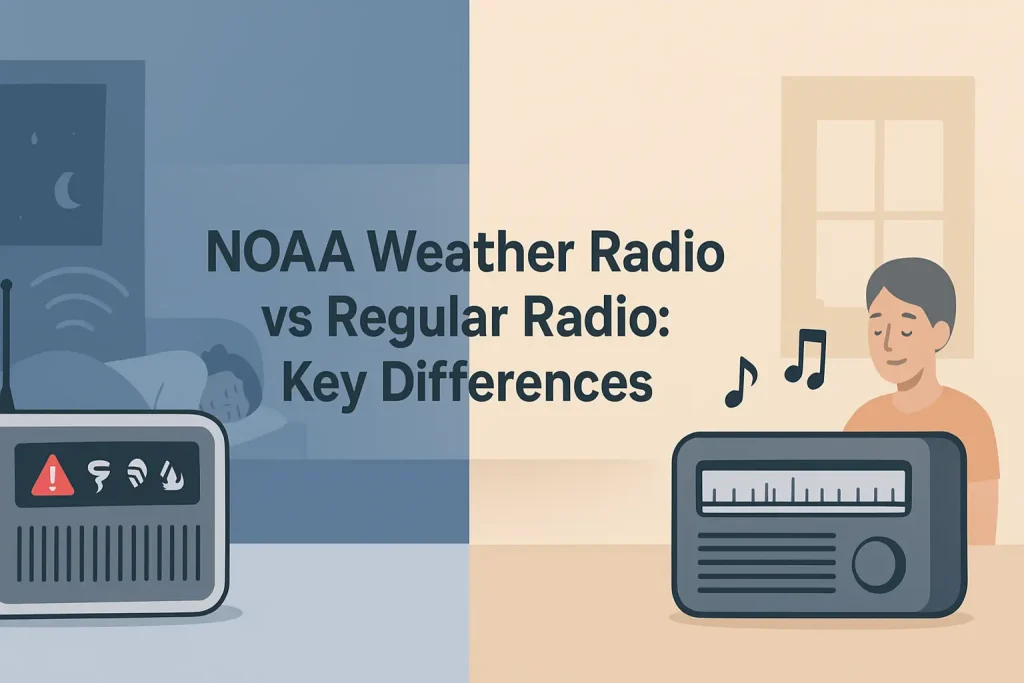
Standalone weather radios designed for marine use add S.A.M.E. (Specific Area Message Encoding) technology. S.A.M.E. lets you program the receiver to alert only for specific coastal or marine zones, so you are not woken at 0200 hours for a tornado warning 200 miles inland.
Every vessel operating on navigable US waters should carry at minimum a VHF marine radio with weather receive capability and ideally a dedicated NOAA weather alert receiver as a backup. The dedicated receiver draws very little current and can run on batteries, which matters when your primary radio is powering down to conserve the ship’s battery in an anchorage.
The single most important thing a marine weather radio does is wake you up. Active alert mode sounds an alarm when a watch, warning, or advisory is issued for your programmed zone, even when the radio’s speaker is set to low or the vessel is on night watch with reduced crew activity.
The Seven NOAA WX Channels: Frequencies, Coverage, and How to Find Your Best Signal
NOAA broadcasts on seven fixed frequencies designated WX1 through WX7. Each frequency is assigned to a specific transmitter or group of transmitters, and the strongest signal at your location is always the correct channel to monitor. According to NOAA’s NWR transmitter database, WX1 at 162.550 MHz is the most widely used frequency and is the default scan-start channel on most marine radios.
Understanding which frequency to monitor is not about memorizing a chart. It is about knowing how to use the scan function on your receiver to identify the channel with the strongest signal at your current position.
Use the table below to identify the seven NOAA WX frequencies and their designations.
| Channel | Frequency (MHz) | Primary Coverage Region | Notes |
|---|---|---|---|
| WX1 | 162.550 | Nationwide (most common) | Default scan channel on most radios |
| WX2 | 162.400 | Nationwide | Second most common frequency |
| WX3 | 162.475 | Nationwide | Common in Southeast and Gulf Coast |
| WX4 | 162.425 | Nationwide | Used in Pacific Northwest and Great Lakes |
| WX5 | 162.450 | Nationwide | Common in Gulf of Mexico region |
| WX6 | 162.500 | Nationwide | Active in Northeast coastal areas |
| WX7 | 162.525 | Nationwide | Used in Hawaii and Pacific Island territories |
Source: NOAA National Weather Service, NWR transmitter frequency assignments. Coverage varies by transmitter location and antenna height.
The reason signal quality varies by channel is that each frequency is assigned to a specific transmitter tower, and those towers are located at different distances from your position. A tower 15 miles away on WX3 will always outperform a tower 60 miles away on WX1, regardless of which frequency is labeled “primary.”
This only matters when you are close to the edge of a transmitter’s coverage area, which is common offshore. Use your receiver’s scan function to lock onto the strongest channel before departing, and update your monitored channel as you move along the coast.
If your signal drops to static on all channels, you are likely beyond the 40-mile coverage radius of the nearest transmitter. At that range, offshore mariners rely on satellite weather messengers or SSB (single sideband) radio for offshore forecast reception. The WX channel scan function on your radio is your first and fastest tool for finding the clearest broadcast signal at your current position.
S.A.M.E. Technology for Marine Use: Programming Coastal and Marine Zone Codes
S.A.M.E. (Specific Area Message Encoding) is a digital header embedded in NOAA weather radio broadcasts that identifies the geographic zone covered by each alert. A marine weather radio with S.A.M.E. capability reads this header and only triggers the alarm if the transmitted zone code matches one of the codes you have programmed into the radio. Without S.A.M.E., your receiver sounds an alarm for every alert broadcast by the transmitter, regardless of whether the warning applies to your location.
This distinction is critical for mariners. A single NOAA transmitter may cover 10 to 20 inland counties and 3 to 5 offshore marine zones. Without S.A.M.E. filtering, a thunderstorm warning for a county 150 miles from your marina triggers the same alarm as a hurricane watch for your coastal zone.
Marine zone S.A.M.E. codes follow the same 6-digit FIPS format as county codes but are assigned specifically to offshore and coastal forecast zones defined by the National Weather Service. The format is: two-digit state FIPS code plus four-digit zone number. For example, the code 055001 covers the coastal waters off the New Jersey coast from Sandy Hook to Little Egg Inlet.
The NOAA NWS publishes a complete list of marine zone S.A.M.E. codes organized by coastal region. You can look up your home port’s zone at weather.gov/nwr and program up to 25 codes into most mid-range weather receivers. The Midland WR400 weather radio accepts up to 50 S.A.M.E. codes, which is useful for vessels that transit multiple coastal zones across a season.
Key Specifications (Midland WR400):
- WX frequencies: 162.400 to 162.550 MHz (all 7 NOAA channels)
- S.A.M.E. alert types: 25 event types
- S.A.M.E. code capacity: 50 programmable location codes
- Power: AC adapter with 6x AA battery backup
- Alert output: Audible alarm plus LED strobe
Programming S.A.M.E. codes into a marine weather receiver requires four pieces of information: your NWS region, your coastal or inland zone designation, the 6-digit code for that zone, and the alert types you want to trigger an alarm. The NWS recommends programming both your home port zone and the zones for any planned transit route before departing.
If the alert code for your coastal zone is not listed in your radio’s manual, visit weather.gov/nwr, select your state, and download the zone code table for your region. S.A.M.E. code programming is the most important setup step for any marine weather receiver, and skipping it means you will receive every alert for the entire transmitter coverage area rather than only the alerts relevant to your position.
VHF Marine Radio vs Dedicated Weather Radio: Which One Do You Actually Need on Board?
Every recreational vessel and commercial boat operating in US waters under FCC Part 80 is required to maintain a watch on VHF Channel 16 (156.800 MHz), which is the international distress, safety, and calling frequency monitored by the US Coast Guard. A fixed-mount VHF marine transceiver serves dual duty: it receives WX channels for weather monitoring and transmits on Channel 16 for Coast Guard communication, vessel-to-vessel calls, and digital selective calling (DSC) distress alerts.
A dedicated weather radio cannot transmit. It receives WX broadcasts only and provides S.A.M.E. alert filtering, but it cannot contact the Coast Guard, issue a DSC distress call, or communicate with other vessels.
Use the table below to compare a fixed-mount VHF marine transceiver against a dedicated marine weather receiver across the capabilities that matter most to boaters.
| Capability | Fixed-Mount VHF Marine Radio | Dedicated Marine Weather Radio |
|---|---|---|
| WX channel reception | Yes (all 7 WX channels) | Yes (all 7 WX channels) |
| S.A.M.E. alert filtering | Some models only | Yes (standard feature) |
| Transmit capability | Yes (25W fixed / 6W handheld) | No |
| Channel 16 watch | Yes | No |
| DSC distress call | Yes (requires MMSI) | No |
| Battery backup operation | Handheld models only | Yes (AA batteries or built-in) |
| Power draw on standby | Higher (scanning all channels) | Very low (alert mode) |
| FCC license required | Yes (Ship Station License, FCC Part 80) | No (receive only) |
| Typical price range | $150 to $600 (fixed mount) | $35 to $120 |
Source: FCC Part 80 (Ship Station Rules), NOAA NWR technical documentation. Fixed-mount VHF power output per FCC Part 80, Section 80.215.
The correct answer for most vessels is both. A fixed-mount VHF marine transceiver is required for safety and Coast Guard communication on most vessels over 65 feet operating beyond inland waters. A dedicated weather receiver adds S.A.M.E. alert capability, low-power standby operation, and an independent backup if the primary radio loses power.
For day sailors and small powerboat operators who primarily navigate inshore, a handheld VHF marine radio with weather channels covers both functions in a single waterproof unit that you can take off the vessel and use on the dock, in the dinghy, or as a backup if the fixed-mount radio fails.
The bottom line is that a VHF marine transceiver gives you communication and weather in one unit, but a dedicated weather receiver gives you better S.A.M.E. filtering, lower power draw on overnight watch, and a true backup when the primary radio is unavailable.
Best Marine Weather Radios and VHF Handhelds for Boaters: Top Picks by Category
The best marine weather radio setup depends on vessel size, operating range, and whether you need transmit capability or receive-only monitoring. The models below cover the four most common scenarios: dedicated alert receivers for use at the dock or below decks, handheld VHF radios for small boat operators, mid-range fixed-mount transceivers with weather receive, and premium DSC-capable units for offshore passage-making.
Best Dedicated Marine Weather Receivers
The Uniden BC365CRS is a compact S.A.M.E. weather receiver designed for home and marine use, with a built-in clock, alarm, and AM/FM radio. It accepts up to 25 S.A.M.E. location codes and includes a battery backup tray for 6 AA cells.
Key Specifications (Uniden BC365CRS):
- WX frequencies: 162.400 to 162.550 MHz (7 channels)
- S.A.M.E. code capacity: 25 location codes
- S.A.M.E. event types: 60+ alert categories
- Power: AC adapter with 6x AA battery backup
- Alert output: Audible alarm with display
The Sangean CL-100 adds a tabletop form factor with a large backlit display and programmable wake-up alerts. It supports 25 S.A.M.E. codes and is a strong choice for a dedicated below-decks monitoring unit on a cruising vessel.
Best Handheld VHF Marine Radios with Weather
The Standard Horizon HX890 is the benchmark handheld VHF marine radio for serious recreational boaters. It transmits at 6 watts on VHF, receives all 7 NOAA WX channels, and includes a built-in GPS receiver for automatic DSC distress position reporting without a chartplotter connection.
Key Specifications (Standard Horizon HX890):
- Transmit power: 6W / 1W selectable (FCC Part 80)
- WX channels: All 7 NOAA frequencies
- DSC: Yes, with integrated GPS
- Waterproofing: JIS8 (submersible to 1.5 meters for 30 minutes)
- Battery life: Approximately 12 hours at 5/5/90 duty cycle
- Price range: $230 to $280
The Uniden MHS335BT adds Bluetooth for wireless connection to a smartphone GPS, enabling position-embedded DSC distress calls without a built-in GPS chip. It transmits at 6 watts and is rated IPX8 (submersible to 1.5 meters for 30 minutes).
Key Specifications (Uniden MHS335BT):
- Transmit power: 6W / 1W selectable
- Waterproofing: IPX8
- WX channels: All 7 NOAA frequencies
- DSC: Yes (requires MMSI registration)
- Bluetooth: Yes (for GPS position data from smartphone)
- Price range: $130 to $160
For budget-conscious small boat operators, the Midland Nautilus N3 transmits at 3 watts, receives all WX channels, and is rated IPX7 (submersible to 1 meter for 30 minutes) at a price point under $70.
Best Fixed-Mount VHF Marine Radios with Weather Receive
The Icom IC-M506 is a 25-watt fixed-mount VHF transceiver with Class D DSC, full NOAA WX channel receive, and AquaQuake speaker clearing technology that purges water from the speaker grille with a vibration burst. It is rated IPX7 and connects to external GPS for automatic position data in DSC distress calls.
Key Specifications (Icom IC-M506):
- Transmit power: 25W (FCC Part 80 maximum for fixed-mount)
- DSC class: Class D with AIS display capability
- WX channels: All 7 NOAA frequencies with weather alert function
- Waterproofing: IPX7
- GPS input: NMEA 0183 and NMEA 2000 compatible
- Price range: $350 to $450
The Standard Horizon GX2400 is a 25-watt fixed-mount unit with a built-in GPS receiver, Class D DSC, and a large 3.5-inch color display for vessel traffic and AIS target display. It receives all WX channels and supports NMEA 2000 network integration for chartplotter connectivity.
The right model for your vessel depends on whether you need the simplicity of a receive-only alert unit, the portability of a handheld transceiver, or the power and connectivity of a fixed-mount unit with DSC and GPS integration. For overnight anchoring and extended cruising, the combination of a fixed-mount 25-watt transceiver and a dedicated S.A.M.E. weather receiver below decks provides maximum redundancy.
Here is a widget showing NOAA WX channel signal strength by coastal region to help you identify the best monitoring channel for your operating area.
Interactive Tool
Find the Right Marine Weather Radio Setup for Your Vessel
Answer 2 questions to get a tailored marine weather radio recommendation.
DSC (Digital Selective Calling) and MMSI Registration: What Every Boater Needs to Know
Digital Selective Calling (DSC) is a digital protocol built into Class D VHF marine transceivers that transmits a distress alert on Channel 70 (156.525 MHz) containing your vessel’s MMSI (Maritime Mobile Service Identity) number and, if the radio has a GPS connection, your exact position. According to FCC Part 80, Section 80.1085, all VHF marine transceivers with DSC capability sold in the United States must be equipped with Class D DSC controllers. The US Coast Guard monitors Channel 70 continuously for DSC distress calls.
A DSC distress button press transmits your MMSI and GPS position to all Coast Guard stations and commercial vessels within VHF range simultaneously, which is far faster and more reliable than a voice Mayday call when you are incapacitated or your voice is inaudible over wind and sea noise.
An MMSI is a unique 9-digit identifier assigned to your vessel. In the United States, recreational boaters can register an MMSI for free through BoatUS (boatus.com/mmsi) or Sea Tow, which are authorized by the FCC to assign MMSI numbers for non-commercial vessels. The MMSI must be programmed into the DSC controller of your VHF radio before the DSC distress function will transmit your vessel’s identity.
This happens because the DSC system encodes your MMSI as a digital burst on 156.525 MHz before switching to voice on Channel 16. Without a programmed MMSI, your radio transmits an anonymous distress call that contains no vessel identification, which slows Coast Guard response time significantly. Program the MMSI into your radio immediately after registration and before the vessel leaves the dock.
This only works when the MMSI matches the registered vessel information in the FCC or BoatUS database. An MMSI registered to a different vessel, or an unregistered MMSI, generates a false alarm flag in Coast Guard systems and can result in an FCC enforcement contact. One MMSI is issued per vessel.
If your VHF radio is connected to a chartplotter via NMEA 0183 or NMEA 2000, the chartplotter’s GPS data feeds your position automatically into the DSC distress transmission. Without this connection, your radio must have a built-in GPS (like the Standard Horizon HX890) or the position data transmitted will be empty, which reduces the value of the DSC call to identification only.
Registering your MMSI and connecting your VHF radio to a GPS source are the two most important installation steps for any boater who wants DSC distress capability to work correctly when it matters.
Waterproofing Ratings for Marine Radios: IP Ratings and JIS Standards Explained
A marine radio rated IPX4 (splash resistant) and a radio rated IPX8 (submersible to 1.5 meters for 30 minutes) are not interchangeable for marine use. According to the IEC 60529 standard, the IP (Ingress Protection) rating system uses two digits: the first indicates dust protection (0 to 6), and the second indicates water protection (0 to 9K). A radio labeled “waterproof” without a specific IP rating carries no standardized protection guarantee and should not be relied upon in a marine environment.
The JIS (Japanese Industrial Standard) C 0920 waterproofing system is used by Standard Horizon, Icom, and other Japanese manufacturers for marine radio ratings. JIS7 is equivalent to IPX7 (submersible to 1 meter for 30 minutes), and JIS8 indicates submersion beyond 1 meter, with the specific depth and duration stated in the product documentation.
Use the table below to compare the water protection levels relevant to marine radio selection.
| Rating | Standard | Protection Level | Marine Suitability |
|---|---|---|---|
| IPX4 | IEC 60529 | Splash from any direction | Minimal — dock use only |
| IPX5 | IEC 60529 | Water jets from any direction | Acceptable for inshore use |
| IPX7 | IEC 60529 / JIS7 | Submersible to 1 meter for 30 min | Good for most recreational boating |
| IPX8 | IEC 60529 | Submersible beyond 1 meter (depth specified) | Recommended for offshore and sailing |
| JIS8 | JIS C 0920 | Submersible to 1.5 meters for 30 min (Standard Horizon) | Recommended for offshore and sailing |
| MIL-STD-810G | US Military | Immersion, shock, vibration, temperature | Best available for commercial and offshore use |
Source: IEC 60529 Ingress Protection standard, JIS C 0920 waterproofing standard, US MIL-STD-810G. Ratings based on new, undamaged units. Salt water exposure accelerates seal degradation over time.
Salt water is more corrosive than the fresh water used in IP rating tests. A radio rated IPX7 will survive an accidental dunking in fresh water and a brief submersion in salt water, but repeated salt water exposure without rinsing will degrade the rubber seals on the speaker, battery compartment, and connector covers within one to two seasons of regular offshore use.
Rinse all handheld marine radios with fresh water after every saltwater outing. Inspect the battery cover seal and connector covers for cracks at the start of each season. A cracked O-ring on a radio rated IPX8 provides no more protection than an unrated consumer radio, because the rating applies only to intact, undamaged seals. Choose IPX7 as your minimum for any radio used aboard a vessel underway.
FCC Part 80: Licensing Rules for Marine VHF Transceivers
Marine VHF transceivers that transmit are regulated under FCC Part 80 (Stations in the Maritime Services). A recreational vessel operating exclusively within US territorial waters does not require a ship station license for the VHF marine radio under FCC Part 80.953, which provides an exemption for recreational vessels not traveling to foreign ports. However, any vessel traveling internationally, any commercial vessel, and any vessel carrying passengers for hire must hold a valid Ship Station License from the FCC.
A Ship Station License is issued by the FCC for a specific vessel and covers all transmitters aboard, including the VHF marine radio, SSB transceiver, and EPIRB. The license application is filed through the FCC Universal Licensing System (ULS) at wireless.fcc.gov/uls, and the current application fee is $35 for a 10-year license term.
The operator of a licensed ship station also needs a Restricted Radiotelephone Operator Permit (RP) under FCC Part 13 if the vessel travels internationally or if the operator makes international radiotelephone calls. The RP is a lifetime permit with no examination requirement, available through the FCC ULS for a small application fee. Recreational operators who never leave domestic US waters and do not operate commercially are exempt from the operator permit requirement under FCC Part 80.953.
DSC distress capability requires an MMSI number, which is separate from the Ship Station License. The MMSI is obtained through BoatUS, Sea Tow, or directly through the FCC for commercial vessels, and is programmed into the radio’s DSC controller. FCC rules require that MMSI numbers be used only for the vessel to which they are registered and not transferred between vessels without re-registration.
Operating a marine VHF transmitter without the required Ship Station License on an internationally traveling or commercial vessel is a violation of FCC Part 80 and can result in fines starting at $10,000 per violation under FCC enforcement guidelines. The receive-only function of your VHF radio for weather monitoring does not require any license under any FCC rule.
How to Monitor Marine Weather Effectively: Operating Procedures for Offshore and Coastal Conditions
Effective marine weather monitoring is not passive. It requires a structured routine before departure, during the transit, and at anchor, with specific channels and update intervals matched to your operating range and the current weather pattern. The NWS Marine Forecast updates for coastal zones are issued every 6 hours under routine conditions, but NOAA NWR broadcasts continuous updates in real time when watches, warnings, or advisories are active.
The most important operating habit for any vessel is dual watch: monitoring Channel 16 for Coast Guard traffic and vessel-to-vessel calls while simultaneously scanning WX channels for active weather broadcasts. Most fixed-mount VHF transceivers support dual watch (also called priority scan) that alternates between Channel 16 and a selected working or WX channel every few seconds.
Pre-Departure Weather Check: What to Listen for Before You Leave the Dock
Before leaving the dock, tune your VHF marine radio or dedicated weather receiver to the strongest local WX channel and listen to the complete forecast cycle, which repeats every 4 to 6 minutes. The marine zone forecast includes current conditions, a 12-hour forecast, and a 24-hour outlook for your coastal zone. Do not leave on a day trip based on a partial listen of the broadcast.
The NWS marine forecast includes these specific elements: surface analysis, winds (direction and speed in knots), wave height (in feet), visibility, and any active watches, warnings, or advisories. A small craft advisory is issued when sustained winds of 21 to 33 knots (24 to 38 mph) or wave heights of 4 to 7 feet are forecast for the zone. A gale warning means sustained winds of 34 to 47 knots. A storm warning means 48 to 63 knots, and a hurricane warning means 64 knots or more.
If any watch, warning, or advisory is active for your planned operating zone, do not depart until you have a complete understanding of the affected area, the expected onset time, and the window of safe operation before conditions deteriorate.
Underway Weather Monitoring: Scan Intervals and Alert Response
While underway, set your VHF or dedicated weather receiver to WX scan mode so it monitors all seven NOAA channels and locks onto the strongest signal automatically as your position changes along the coast. On most Icom and Standard Horizon fixed-mount VHF radios, the weather alert function continues to monitor WX channels even when the radio is set to a working channel, and it interrupts normal operation with an audible alarm if a broadcast alert is detected.
When a weather alert interrupts your radio, note the event type (watch, warning, or advisory), the affected zone codes, and the expected onset time. If the alert covers your current or planned zone, immediately assess your distance to the nearest harbor of refuge, the time needed to reach it, and whether sea conditions allow safe transit. A tornado warning for an inland county does not affect you offshore. A marine thunderstorm watch for your specific coastal zone requires immediate action.
At Anchor Weather Monitoring: Overnight and Extended Stops
At anchor overnight, switch to a dedicated S.A.M.E. weather receiver set to alert mode for your anchorage zone. This allows the primary VHF transceiver to be placed on standby or reduced power to conserve the vessel’s battery bank, while the dedicated receiver draws less than 100 milliamps on standby and wakes you only for alerts relevant to your programmed zones.
Program your S.A.M.E. receiver with the zone code for your anchorage before sunset. The NWS zone code for any coastal anchorage is available at weather.gov/nwr using the zone lookup by state and county or coastal zone name. A single dedicated receiver with a fresh set of AA batteries can maintain alert watch for 3 to 5 days continuously.
Marine Weather Radio Versus Smartphone Apps: Why Boaters Cannot Rely on Cellular
Smartphone weather apps receive data over cellular networks, which lose coverage within 3 to 5 miles of the US coastline for most carriers and provide zero coverage beyond that range. NOAA NWR broadcasts on 162 MHz VHF reach 40 miles from the nearest transmitter without requiring any network infrastructure. A marine weather radio works at anchor in a remote cove, offshore in the Gulf Stream, and in a coastal inlet during a power outage when cell towers are down.
This happens because VHF radio propagation follows line-of-sight physics. The NOAA NWR transmitters are mounted at elevation on towers, which extends the 40-mile coverage radius beyond what a sea-level antenna can achieve with the same power output. Cellular towers are also elevated but are spaced for land coverage patterns, not ocean coverage, and carriers have no commercial incentive to extend coverage offshore.
Smartphone apps also have a fundamental safety limitation: they require the user to actively check them. A NOAA weather radio receiver with S.A.M.E. alert mode wakes you from sleep when a warning is issued for your zone. No smartphone weather app provides an equivalent always-on alert function that operates reliably without a cellular signal.
Satellite weather services (Garmin inReach, SPOT X, and PredictWind Offshore) provide position-independent weather data beyond VHF range and are the correct supplement for offshore passage-making where NOAA WX channels cannot reach. They do not replace the near-shore alert function of a dedicated NOAA weather receiver, because satellite weather subscriptions require manual request and do not push unsolicited storm warnings to your vessel the way an NWR receiver does.
The correct stack for coastal and offshore boating is: NOAA weather radio for near-shore alerts plus a satellite messenger or SSB radio for offshore weather data beyond VHF range. Smartphone apps are a useful secondary planning tool at the dock but should never be the primary weather information source underway.
If you are new to weather radio technology and want to understand how the same S.A.M.E. alert system works for inland emergency preparedness, our guide to setting up a weather radio for home and community emergency alerts covers the full S.A.M.E. programming process and alert type categories in detail.
Portable and Hand-Crank Weather Radios for Marine Use: Battery Backup and Power Independence
A portable hand-crank weather radio provides NOAA WX channel reception with zero dependence on ship’s power, shore power, or replaceable batteries. Hand-crank receivers charge an internal lithium-ion or NiMH battery pack through a built-in dynamo generator, typically delivering 1 minute of playback for every 1 to 2 minutes of cranking. Solar charging panels on combination hand-crank solar receivers add passive charging capability when the vessel is at anchor in sunlight.
For marine use, the critical feature of any portable weather radio is waterproofing. Most consumer hand-crank weather radios are rated IPX4 or IPX5 at best, which means they are splash-resistant but not suitable for use on deck in rough conditions or for storage in a wet locker. The Midland ER310 emergency crank weather radio is rated IPX4 and includes AM/FM, all 7 NOAA WX channels, USB charging output, and a built-in flashlight, making it a practical below-decks emergency radio for vessels of all sizes.
Key Specifications (Midland ER310):
- WX channels: All 7 NOAA frequencies (162.400 to 162.550 MHz)
- S.A.M.E.: Yes, with alert mode
- Power sources: Hand crank, solar panel, USB-C input, 3x AA battery backup
- Waterproofing: IPX4
- USB output: 1,000 mAh for device charging
- Price range: $55 to $75
A hand-crank weather radio is not a replacement for a VHF marine transceiver. It cannot transmit, cannot issue a DSC distress call, and cannot reach the Coast Guard. Its role on a vessel is as an independent power backup for weather monitoring when the ship’s electrical system has failed or is being conserved.
For cruisers who want to understand the full range of portable hand-crank receiver options and how to evaluate battery capacity versus crank efficiency, our complete guide to hand-crank weather radios for emergency power situations covers every major model and tests crank-to-runtime ratios across the category.
Offshore Communication Beyond VHF Range: SSB Radio and Satellite Options
VHF marine radio has a maximum effective range of 20 to 25 miles from vessel to vessel and up to 40 miles from vessel to a shore-mounted Coast Guard antenna at elevation. Beyond that range, offshore passage-makers use SSB (single sideband) HF radio transceivers operating between 1.6 and 30 MHz, which achieve hundreds to thousands of miles of range through skywave propagation. The Icom IC-M802 SSB marine transceiver covers 1.6 to 30 MHz and is the most widely installed SSB radio on offshore cruising vessels.
SSB radio requires an FCC Ship Station License (not just the recreational exemption that applies to VHF) and a Restricted Radiotelephone Operator Permit for the operator. SSB operation also requires a proper antenna installation, usually a backstay insulator or dedicated SSB whip antenna, and an RF ground plane for efficient HF operation at sea.
Weather data on SSB is received via two methods: voice broadcasts from USCG Radiofax stations on dedicated HF marine weather frequencies, and fax-format weather charts received on a laptop or dedicated chartplotter connected to the SSB receiver output. The USCG High Seas voice broadcasts are scheduled at specific times on assigned frequencies listed in the USCG Light List, with Atlantic and Pacific services covering all major offshore routes.
Satellite weather services provide an alternative for vessels that do not have SSB installed. Garmin inReach, SPOT X, and Iridium-based satellite communicators receive text-format weather data anywhere on the globe via satellite network subscription. They do not provide voice communication and are not a substitute for SSB in an emergency where voice contact with a rescue coordination center is needed.
For purely weather data, a Garmin inReach Mini satellite communicator provides position tracking, two-way text messaging, and weather forecast requests to the Garmin Weather service from anywhere on the ocean at a much lower cost and installation complexity than SSB. It cannot send voice distress calls, but it can send an SOS to GEOS international rescue coordination, which notifies the appropriate maritime rescue coordination center with your GPS position.
The right offshore communication stack depends on your passage range, crew size, and budget. VHF covers coastal and near-offshore communication. SSB covers offshore weather and voice communication beyond VHF range. Satellite covers global position reporting, emergency SOS, and weather data without requiring antenna installation or an HF tuner.
Marine Weather Alert Types: What Each NOAA NWS Warning Means for Boaters
NOAA NWR broadcasts more than 60 event types defined by the Emergency Alert System (EAS). For marine operators, the critical subset is the marine weather event hierarchy, which ranges from routine advisories through small craft advisories, gale warnings, storm warnings, and hurricane warnings. Each level corresponds to a specific sustained wind speed range and requires a different operational response.
The NWS issues marine weather products for three geographic zones: coastal waters (0 to 25 miles offshore), offshore waters (25 to 250 miles), and high seas (beyond 250 miles). Each zone receives its own forecast product, and the S.A.M.E. codes for these zones are distinct from the inland county codes used for tornado warnings and flash flood alerts.
Use the table below to identify each marine weather event type, its wind speed threshold, and the operational response it requires.
| Event Type | Wind Speed (Knots) | Wave Height | Required Action |
|---|---|---|---|
| Marine Weather Statement | Below advisory threshold | Routine | Monitor broadcasts |
| Small Craft Advisory | 21 to 33 knots | 4 to 7 feet | Small boats seek shelter or delay |
| Gale Warning | 34 to 47 knots | 8 to 14 feet | All recreational vessels seek port immediately |
| Storm Warning | 48 to 63 knots | 15 to 25 feet | Immediate shelter, secure vessel |
| Hurricane Watch | 64+ knots possible within 48 hours | Extreme | Begin hurricane preparations and haul-out planning |
| Hurricane Warning | 64+ knots expected within 36 hours | Extreme | Vessel secured ashore or in hurricane hole |
Source: NOAA National Weather Service Marine Products documentation, NWS Directive 10-301. Wind speeds are sustained, not gust speeds. Gust speeds may be 25 to 50% higher than sustained values.
A small craft advisory does not automatically mean conditions are dangerous for all vessels. A 40-foot offshore cruiser handles a small craft advisory as routine. A 16-foot open center console in the same conditions faces a genuine risk of swamping. Know your vessel’s sea state limits before departure, not after the advisory is issued.
The NWS also issues Hazardous Seas forecasts when wave heights are forecast to exceed 10 feet in areas where no wind warning criteria is met, which can happen when ocean swell from a distant storm combines with local wind waves. A vessel with a small craft advisory wind forecast but a Hazardous Seas forecast for 12-foot combined seas faces conditions more dangerous than the wind advisory alone would suggest.
For families and casual boaters who want to understand how the same NWS weather alert system applies to lake and river boating, our resource on weather radio setup and alert types for family outdoor activities explains the full EAS event hierarchy in plain language for non-technical readers.
Best Practices for Marine Weather Radio Maintenance and Testing
A marine VHF radio or weather receiver that has not been tested recently cannot be trusted in an emergency. The US Coast Guard recommends testing your DSC distress call function at the start of each season by calling your local Coast Guard station on Channel 16 to request a radio check before conducting a DSC test on Channel 70. The Coast Guard does not charge for radio checks, and they are the fastest way to confirm your radio is transmitting at full power and that your MMSI is correctly registered in the Coast Guard database.
Test the weather alert function of your S.A.M.E. receiver by waiting for the next scheduled NOAA weekly test broadcast. NOAA conducts a Required Weekly Test (RWT) every Wednesday between 11:00 AM and noon local time, which triggers the alert tone without issuing an actual emergency message. If your receiver’s S.A.M.E. alert function activates during the RWT for your programmed zone, the system is working correctly.
Inspect the antenna connection on your fixed-mount VHF at least twice per season. A corroded PL-259 connector at the back of the radio or a cracked coaxial cable running to the masthead antenna reduces transmit power and receive sensitivity without triggering any error indication on the radio. A corroded connection that shows 3 ohms of additional resistance can reduce your effective radiated power by 50%, which cuts your transmit range significantly. Use marine-grade RG-8X coaxial cable with silver-plated connectors for all VHF antenna runs to resist corrosion in the saltwater environment.
Replace the backup batteries in your dedicated weather receiver at the start of each season, regardless of how much power remains from the previous season. A battery that shows 80% charge on a battery tester may not deliver the sustained current needed to drive the alarm at full volume in a real emergency after several months of trickle discharge in storage. Use Energizer Ultimate Lithium AA batteries for weather radio backup power, as lithium primary cells retain capacity for up to 20 years in storage and perform reliably at the temperature extremes encountered on a vessel in both tropical and northern climates.
Seasonal maintenance, regular testing against the NOAA weekly test broadcast, and annual antenna inspection are the three habits that keep your marine weather monitoring system reliable when you actually need it.
Choosing the Right Marine Weather Radio: A Complete Buying Guide
The right marine weather radio purchase decision depends on four factors: your vessel size and operating range, whether you need transmit capability or receive-only monitoring, your vessel’s power system, and whether you need S.A.M.E. alert filtering for specific coastal zones. A $45 dedicated S.A.M.E. receiver is the right answer for a marina berth. A $280 handheld VHF with integrated GPS is the right answer for a solo sailor coastal cruising. A $400 fixed-mount 25-watt transceiver with Class D DSC is the right answer for a family cruiser doing offshore passages.
Step 1: Determine Whether You Need Transmit Capability
If your vessel operates on navigable US waters and you want to contact the Coast Guard, call a marina fuel dock, or communicate with other vessels, you need a VHF marine transceiver that transmits. A receive-only weather radio cannot do any of these things. Start with a VHF transceiver as your primary radio and add a dedicated weather receiver as a secondary unit if your budget allows.
Step 2: Choose Between Fixed-Mount and Handheld VHF
Fixed-mount VHF transceivers transmit at 25 watts, which provides maximum range in open water conditions. Handheld VHF transceivers are capped at 6 watts by FCC Part 80, which limits transmit range to approximately 5 to 8 miles vessel-to-vessel and 15 to 20 miles to a shore-based Coast Guard antenna. For vessels with a permanent installation, fixed-mount is always the better primary radio. Handheld units serve as essential backups and are the right primary choice for small open boats without a cabin.
Step 3: Evaluate DSC Capability and GPS Integration
Every VHF marine transceiver sold in the US includes Class D DSC under FCC Part 80 requirements. DSC is only useful, however, if your MMSI is programmed and your radio is connected to a GPS source. Budget VHF radios include DSC hardware but require an external GPS connection via NMEA 0183 for position data. Mid-range and premium handhelds like the Standard Horizon HX890 include a built-in GPS, which means the DSC distress button works with automatic position data even without a chartplotter connection.
Step 4: Assess Waterproofing for Your Operating Environment
Inshore powerboat and runabout operators need a minimum of IPX5 on any radio that will be used on deck. Sailors and offshore cruisers should not accept anything below IPX7 for a handheld radio used in a cockpit. Fixed-mount radios should be rated IPX7 at minimum, with IPX8 or JIS8 for units installed at the helm of a vessel that takes spray regularly.
Step 5: Confirm Battery Life for Your Typical Outing
Battery life on handheld VHF radios is rated at a 5/5/90 duty cycle (5% transmit, 5% receive, 90% standby). A radio rated at 12 hours at 5/5/90 will last a full day of inshore use. For overnight passages or multi-day cruises, carry a spare battery pack or ensure your handheld can charge from the vessel’s 12V system via USB or a dedicated drop-in rapid charging cradle.
For boaters who also camp ashore or hike coastal trails during a cruise, our guide to weather radio options for camping and hiking on coastal trails covers portable receiver choices that work in both marine and backcountry environments.
Step 6: Decide Whether to Add a Dedicated S.A.M.E. Weather Receiver
If your vessel has a fixed-mount VHF, consider adding a dedicated S.A.M.E. weather alert receiver for below-decks monitoring. The dedicated unit draws minimal current in standby, provides superior S.A.M.E. filtering compared to most VHF radios, and continues operating on battery backup if ship’s power fails. The cost is $35 to $80, which is a small investment for a second layer of weather alert redundancy on any vessel.
For a comprehensive comparison of all current weather radio models across every category from portable to desktop, our ranked comparison of the top weather radios currently available covers every price point with side-by-side S.A.M.E. code capacity, alert types, and battery backup performance. The full buyer’s guide at our weather radio selection guide with specs for every use case walks through every decision factor from frequency reception to battery chemistry in detail.
Frequently Asked Questions About Marine Weather Monitoring
What is the difference between Channel 16 and NOAA WX channels on a marine VHF radio?
Channel 16 (156.800 MHz) is the international VHF distress, safety, and calling frequency monitored by the US Coast Guard and all vessels under FCC Part 80. The seven NOAA WX channels (162.400 to 162.550 MHz) are receive-only broadcast frequencies that transmit NOAA weather forecasts and emergency alerts but cannot be used for two-way communication.
You transmit on Channel 16 to call the Coast Guard or other vessels. You receive on WX channels to hear weather forecasts and alerts. Some VHF radios support dual watch, which alternates between Channel 16 and a selected WX channel every few seconds so you monitor both simultaneously. A vessel underway should always maintain a watch on Channel 16 and scan WX channels for active weather alerts.
Do I need a license to use a handheld VHF marine radio on my boat?
Recreational vessels operating exclusively in US territorial waters are exempt from the Ship Station License requirement under FCC Part 80.953. No license is required for a recreational boater using a handheld or fixed-mount VHF marine radio for domestic US operations. Any vessel traveling to a foreign port (Canada, Mexico, Bahamas, or any international destination) must hold a valid FCC Ship Station License before departure, regardless of vessel size.
Commercial vessels and vessels carrying passengers for hire require a Ship Station License for all US operations. The license is issued per vessel through the FCC ULS at wireless.fcc.gov/uls for a $35 application fee covering a 10-year license term. The operator of an internationally traveling or commercially licensed vessel also needs a Restricted Radiotelephone Operator Permit under FCC Part 13.
What is an MMSI number and how do I get one for my boat?
An MMSI (Maritime Mobile Service Identity) is a unique 9-digit number that identifies your vessel in the DSC distress system on VHF Channel 70 (156.525 MHz). When you press the DSC distress button on a Class D VHF transceiver, the radio transmits your MMSI and GPS position to all nearby vessels and Coast Guard stations. US recreational boaters can register a free MMSI through BoatUS (boatus.com/mmsi) or Sea Tow, both of which are authorized by the FCC to assign MMSI numbers for non-commercial vessels.
After obtaining your MMSI, program it into your VHF radio’s DSC controller following the instructions in your radio’s manual. One MMSI is assigned per vessel and cannot be transferred to a different boat without re-registration. Commercial vessels obtain MMSI numbers directly through the FCC ULS as part of their Ship Station License application.
Why does my VHF marine radio show full signal strength but the NOAA weather broadcast is hard to hear?
The signal strength indicator on most marine VHF radios responds to any signal on the monitored frequency, including interference and noise. A full signal bar reading does not confirm the NOAA broadcast is being received clearly. You may be receiving multipath interference, where the signal bounces off the water surface and arrives at your antenna in phase cancellation with the direct signal, which degrades audio quality without affecting the signal strength meter.
Try switching to a different WX channel using your radio’s WX scan function. If the audio quality improves on a different channel, that transmitter is closer or better positioned relative to your antenna. If all WX channels are equally degraded, check your antenna connection for corrosion at the PL-259 connector. A corroded center pin on the antenna cable causes exactly this symptom: adequate signal strength indication with poor audio quality due to signal loss in the connection.
Can I use a consumer NOAA weather radio from a home electronics store on my boat?
Yes, a consumer S.A.M.E. weather receiver designed for home use will receive NOAA WX broadcasts on the water as long as you are within range of a transmitter. The functional limitation is waterproofing: most consumer weather radios are rated IPX0 (no water protection) and will be damaged by spray on deck or in a wet storage compartment. Use a consumer weather receiver only in an enclosed, dry cabin space, and keep it in a waterproof case when not in use.
A purpose-built marine weather receiver or a marine VHF with weather receive capability is the better choice for any vessel that takes spray or operates in rain, because the weather receiver needs to be accessible and operable in the conditions that trigger the alerts it is designed to receive. A consumer home weather radio locked in a dry bag below decks cannot alert you when you are at the helm in a squall.
What is the maximum range of a NOAA weather radio broadcast offshore?
NOAA NWR transmitters cover approximately 40 miles in all directions from the transmitter site under normal atmospheric conditions, according to NOAA NWR technical documentation. Transmitters are sited at elevation to maximize coverage, and the effective range over open water is generally greater than over land, because the water surface offers fewer obstructions to line-of-sight VHF propagation.
Beyond 40 miles offshore, WX channel signal quality degrades to unusable static for most receivers. Sporadic-E skip propagation occasionally carries NOAA broadcasts much farther than 40 miles, but this is an atmospheric phenomenon that cannot be relied upon for weather monitoring. Offshore passage-makers beyond 40 miles from the nearest transmitter must use SSB radio or satellite weather services for forecast reception.
How often does NOAA update the marine weather forecast on WX channels?
NOAA updates coastal zone marine forecasts every 6 hours under routine conditions, with updates issued at approximately 0000, 0600, 1200, and 1800 UTC from each National Weather Service forecast office responsible for the coastal zone. When a watch, warning, or advisory is active, the NWS may issue special marine warnings and update the forecast more frequently than the 6-hour routine cycle.
The WX channel broadcast cycle repeats every 4 to 6 minutes, cycling through the current forecast, a recorded voice synthesis of any active watches and warnings, and a synopsis of general weather pattern. Listen for a complete cycle before making a departure decision, because the active watch and warning segment often contains information not included in the routine forecast read.
What is the difference between a marine weather watch and a marine weather warning?
A watch means conditions favorable for a hazardous weather event are possible within 48 hours, but the development, timing, or track of the event is not yet certain enough to issue a warning. A warning means hazardous conditions are expected within 36 hours with high confidence, and the event’s development, timing, and impact area are sufficiently certain for specific operational guidance.
For boaters, a watch is a preparation signal: check your weather monitoring more frequently, confirm your vessel’s readiness, and begin assessing your options for shelter or route modification. A warning is an action signal: if the affected zone includes your operating area, begin transit to shelter, secure the vessel, or confirm your position relative to the predicted impact area. Never wait for a warning to begin preparing if a watch has been issued for your zone.
Can I program my marine VHF radio to scan WX channels automatically while also monitoring Channel 16?
Most fixed-mount and mid-range handheld VHF marine radios support a dual watch or priority scan function that alternates between Channel 16 and a second selected channel (which can be a WX channel) every 2 to 5 seconds. On Icom and Standard Horizon fixed-mount radios, the dual watch function is activated by pressing the dedicated dual watch button, which designates Channel 16 as the priority channel and the currently selected WX channel as the secondary channel.
The limitation of dual watch on a WX channel is that the weather broadcast is a continuous transmission. Your radio will interrupt the WX broadcast every few seconds to check Channel 16 for traffic, which means you may miss portions of the marine forecast audio. A dedicated weather receiver monitoring WX channels continuously is more reliable for forecast audio reception than a VHF radio in dual watch mode.
What is a DSC distress call and how is it different from a Mayday call on Channel 16?
A DSC distress call is a digital burst transmission on Channel 70 (156.525 MHz) that contains your MMSI number and, if connected to GPS, your exact position. It is sent by pressing and holding the dedicated DSC distress button on your VHF radio for 5 seconds. The Coast Guard and all Class D DSC-equipped vessels within range receive the digital alert instantly, with your vessel identity and position displayed on their DSC controller screens.
A Mayday call is a voice distress call on Channel 16 (156.800 MHz) that requires you to speak your vessel name, position, nature of distress, number of people aboard, and any other relevant information. DSC is faster, requires no voice communication, and transmits your GPS position precisely. A Mayday call relies on your ability to speak clearly and for the receiving party to hear and understand your transmitted voice. The correct procedure is to send a DSC distress call first, then switch to Channel 16 to deliver a verbal Mayday once you have confirmed the DSC transmission.
Why did my weather radio alert sound for a tornado warning when I am 10 miles offshore?
Your weather receiver is programmed with a county S.A.M.E. code rather than a marine zone S.A.M.E. code. Inland county codes and coastal marine zone codes are different 6-digit sequences in the NOAA S.A.M.E. system. A receiver programmed with a coastal county code will receive all alerts issued for that county, including inland weather events like tornado warnings, flash floods, and civil emergencies that have no relevance to your vessel on the water.
Reprogram your receiver with the marine zone S.A.M.E. code for your coastal operating area rather than the adjacent inland county code. Marine zone codes are available at weather.gov/nwr using the marine zone lookup by coastal region. Removing the inland county code and replacing it with the correct marine zone code will filter alerts to only those that affect your operating area on the water.
Do I need a separate antenna for my weather radio, or can I use the same antenna as my VHF marine radio?
A dedicated weather radio receiver uses a separate built-in antenna (typically a telescoping rod or internal ferrite rod) and cannot share the external antenna of your VHF transceiver. The frequencies are close (162 MHz for WX versus 156 to 174 MHz for VHF marine), but the antenna connector types, impedance matching, and receiver circuit designs are not compatible between a consumer weather radio and a marine VHF transceiver.
Your fixed-mount VHF transceiver and its masthead or stern-mount external antenna receive WX channels perfectly well, because those channels are within the receive bandwidth of any VHF marine antenna. The external antenna on your VHF transceiver provides better WX channel reception than the internal rod antenna of a standalone weather radio, which is one practical advantage of using your VHF radio for weather channel monitoring rather than a separate consumer receiver.
Is it legal to transmit on NOAA weather frequencies from my boat?
No. The seven NOAA WX frequencies (162.400 to 162.550 MHz) are allocated to federal government use for NOAA NWR broadcasts under FCC frequency allocation rules. Transmitting on any of these frequencies from a vessel or any other private station is a violation of FCC rules and could interfere with critical emergency weather broadcasts. These channels are receive-only for all non-government stations.
Any VHF marine transceiver sold in the US is designed to receive WX channels but block transmission on those frequencies. Attempting to modify a radio to transmit on WX frequencies would also violate FCC equipment authorization rules under Part 2 of the FCC rules. For marine communication, use only the authorized VHF marine channels (156.000 to 157.425 MHz and 161.500 to 162.025 MHz) for transmission.
Building Your Complete Marine Weather Monitoring System
A complete marine weather monitoring system is not a single device. It is a layered combination of a 25-watt fixed-mount VHF transceiver for coastal communication and weather receive, a handheld VHF with IPX7 or better waterproofing as a backup, a dedicated S.A.M.E. weather receiver programmed with your coastal zone codes for independent below-decks monitoring, and a registered MMSI programmed into the DSC controller of every VHF transceiver aboard.
For offshore passages, add an SSB transceiver or a satellite communicator for weather data beyond 40 miles from the nearest NOAA transmitter. Maintain your antenna connections, test your DSC function against the weekly NOAA RWT broadcast, and replace backup batteries at the start of each season.
The radio technology available to recreational mariners today provides better weather information and distress communication capability than most commercial vessels carried 30 years ago. Use it correctly, maintain it regularly, and your weather monitoring system will keep you informed and connected through every condition the ocean presents.
| Photo | TOP RATED WALKIE TALKIES | Price |
|---|---|---|
 | Retevis RT628 Kids Walkie Talkies, Toys Gifts for 4-12 Year Old Girl Boy | Check Price On Amazon |
 | Cobra ACXT545 Weather-Resistant Walkie Talkies, Rechargeable, 22 Channels | Check Price On Amazon |
 | Retevis RT388 Kids Walkie Talkies, Outdoor Toys for Kids Camping Essentials | Check Price On Amazon |
 | Cobra RX680 Walkie Talkies (2-Pack), IP54 Water Resistant Design | Check Price On Amazon |
 | Retevis RT22 Walkie Talkies Long Range Rechargeable with Earpiece (2 Pack) | Check Price On Amazon |
 | Midland GXT1000VP4 GMRS Two-Way Radios with Headsets, Black, 2 Pack | Check Price On Amazon |
 | Retevis RT628 Walkie Talkies for Kids,Toys Gifts for 6-12 Years Old Boys Girls,Long Range 2 Way Radio 22CH VOX,Birthday Gift,Family Walkie Talkie for Camping Hiking Indoor Outdoor | Check Price On Amazon |