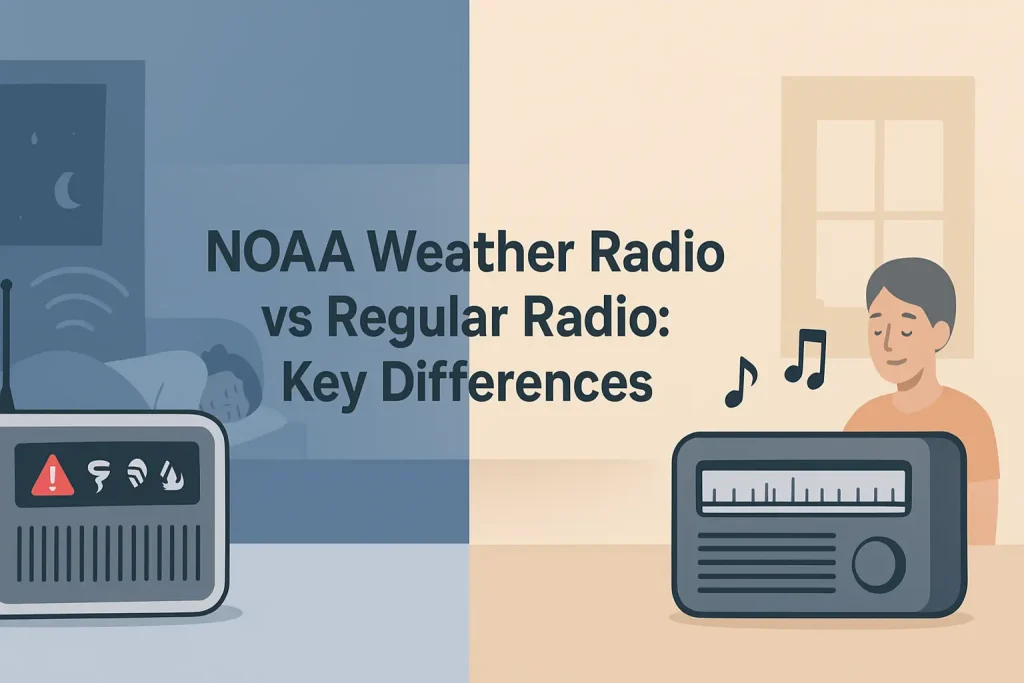
A weather radio without S.A.M.E. programming is a liability in an emergency operations center. It will sound an alert for every county in your state, every hour of the night, until someone silences it permanently. S.A.M.E. (Specific Area Message Encoding) technology lets you filter alerts down to your exact jurisdiction, your exact hazard types, and your exact response protocols. This guide covers professional S.A.M.E. setup, radio selection, FIPS code programming, and integration into emergency management workflows.
What Is S.A.M.E. Technology and Why Does It Matter for Emergency Managers?
S.A.M.E. is a digital header system embedded in every NOAA Weather Radio All Hazards (NWR) broadcast that encodes the geographic area, event type, and issuing office into the first seconds of every alert transmission. According to NOAA NWR technical documentation, the S.A.M.E. header is a 1050 Hz alert tone followed by a digital burst encoding a six-digit FIPS (Federal Information Processing Standards) location code, a three-character event code, and a purge time.
| Photo | Popular Portable Walkie Talkies | Price |
|---|---|---|
 | SKIWARRIOR Multifunctional Smart Wireless Ski Goggles with Walkie-Talkie, Anti-Fog Zeiss Lens, Music & Call Function (Cylindrical Blue) | Check Price On Amazon |
 | SINORISE Super Mini Walkie Talkies, Two-Way Radios, 3 Pack | Check Price On Amazon |
 | KOSPET Tank M4C Smart Watch Rugged, Dual-Band GPS, 5ATM & IP69K Waterproof | Check Price On Amazon |
 | Retevis RT15 Walkie Talkies 3 Pack, Birthday Gift, Outdoor Adventure Kit | Check Price On Amazon |
 | Rechargeable Walkie Talkies Toys for Kids: DIY Astronaut Walkie Talkies for Boys Christmas Birthday Gifts for 3 4 5 6 7 8 9 10 Boy Walkie Talkie Outdoor Hiking Toy 2 Way Radio Camping Outdoor Game | Check Price On Amazon |
A S.A.M.E.-capable receiver decodes this header before sounding its alarm. It only wakes up when the incoming alert matches the FIPS codes and event types you have pre-programmed into the radio. Without S.A.M.E., every NWR broadcast triggers the alert, regardless of whether it affects your jurisdiction.
For emergency managers, the practical consequence is significant. A county emergency operations center covering a single jurisdiction receives NWR alerts from transmitters whose coverage footprints may overlap two to six counties. Without S.A.M.E. filtering, every alert from every overlapping county activates the radio. With S.A.M.E. properly programmed, only alerts affecting your specific county or adjacent response zones trigger an audible alarm.
NOAA broadcasts on seven dedicated VHF frequencies: 162.400 MHz, 162.425 MHz, 162.450 MHz, 162.475 MHz, 162.500 MHz, 162.525 MHz, and 162.550 MHz. These seven channels, designated WX1 through WX7, operate 24 hours per day from more than 1,000 transmitters covering approximately 95% of the US population. Each transmitter covers a radius of roughly 40 miles under normal propagation conditions.
S.A.M.E. technology is the core feature that separates a professional emergency management receiver from a consumer weather radio. Programming it correctly is the single most important setup task you will perform.
Understanding FIPS Codes: The Foundation of Precise S.A.M.E. Programming
A FIPS code is a six-digit numeric identifier that specifies the exact geographic area an NWR alert applies to. The first two digits identify the state. The last three digits identify the county or equivalent jurisdiction within that state. The combination is unique nationwide, which means no two jurisdictions share the same six-digit FIPS code.
According to FEMA’s IPAWS (Integrated Public Alert and Warning System) documentation, FIPS codes for S.A.M.E. use follow the Federal Information Processing Standards Publication 6-4 geographic code format. The NOAA S.A.M.E. standard extends this with a leading digit: 0 indicates the entire state, while individual county codes use their standard FIPS identifiers.
For example, Cook County, Illinois uses FIPS code 017031. The “017” identifies Illinois, and “031” identifies Cook County within Illinois. If you program 017031 into your weather radio, it will only trigger for alerts specifically issued for Cook County.
Emergency managers frequently need to program multiple FIPS codes. A county emergency manager may want alerts for their own county plus all immediately adjacent counties to monitor mutual aid situations. A state emergency operations center may program a set of high-priority counties plus the statewide code (which uses “000” for the county portion) to receive all statewide alerts.
The NOAA SAME FIPS code database is publicly available at weather.gov and is updated when county boundaries or codes change. Always verify your FIPS codes against the current NOAA database before programming, not against a third-party list that may be outdated.
Most professional-grade weather radios support between 25 and 99 programmable S.A.M.E. location codes, giving emergency managers the flexibility to monitor complex multi-county response zones from a single receiver. Accurate FIPS code entry is the foundation of every other S.A.M.E. configuration decision you will make.
Professional Weather Radio Models Built for Emergency Management Use
Emergency management applications demand radios with large S.A.M.E. code banks, reliable alert logging, external antenna inputs, and alert outputs for integration with EOC notification systems. Consumer-grade weather radios from retail stores typically support 5 to 10 FIPS codes and lack the connectivity features required for professional deployment.
Use the table below to compare the professional and prosumer weather radio models most commonly deployed in emergency operations environments.
| Model | S.A.M.E. Codes | Alert Types | External Antenna | Alert Output | Price |
|---|---|---|---|---|---|
| Uniden BC365CRS | 25 | 60+ | No | Headphone jack | $40-55 |
| Midland WR400 | 50 | 25 | Yes (SMA) | 3.5mm alert out | $60-80 |
| Sangean CL-100 | 25 | 60+ | No | Headphone jack | $55-75 |
| Uniden SWR200 | 99 | 60+ | Yes (BNC) | Relay output | $120-160 |
| Midland WR300 | 25 | 25 | No | None | $30-45 |
| Whistler WS1040 | 50 | 60+ | Yes (BNC) | 3.5mm alert out | $80-110 |
Specifications sourced from manufacturer data sheets. Prices verified at time of publication. S.A.M.E. code bank size is the primary differentiator for multi-county emergency management deployment.
For a dedicated EOC deployment, the Uniden SWR200 is the strongest option in this class, with its 99-code S.A.M.E. bank, BNC external antenna input, and relay output for integration with automated notification systems. The relay output allows the radio to trigger external alarms, lighting systems, or logging equipment directly when a matching alert is received.
For budget-constrained deployments where a single-county coverage area is sufficient, the Midland WR400 offers 50-code capacity and an SMA external antenna port at a significantly lower price point than dedicated professional units.
The right model for your EOC depends on the number of jurisdictions you monitor, whether you need automated relay output for integrated alerting, and whether your facility has a dedicated antenna installation.
How to Program S.A.M.E. Codes on a Professional Weather Radio: Step by Step
S.A.M.E. programming requires entering the correct six-digit FIPS codes for every jurisdiction you want to monitor, selecting the alert event types you want to receive, and choosing the NWR channel with the strongest signal at your location. Incomplete programming is the most common reason an EOC weather radio fails to alert on a valid warning.
The following step-by-step guide covers the S.A.M.E. programming process applicable to most professional-grade receivers including the Midland WR400 and Uniden SWR200.
Step-by-Step Guide
How to Program S.A.M.E. Codes on a Professional Weather Radio
8 steps · Estimated time: 15 minutes · Requires: NOAA FIPS code list for your jurisdiction
Look up your FIPS codes at weather.gov/nwr
Go to weather.gov/nwr and use the SAME code lookup tool. Enter your state and county to retrieve the exact six-digit FIPS code for each jurisdiction you plan to monitor. Write down every code before touching the radio.
Identify the strongest NWR channel at your location
Manually scan all seven NWR frequencies (162.400 through 162.550 MHz) and note the channel with the clearest audio and strongest signal indicator. In most locations, the nearest transmitter determines the best channel, but terrain can cause a more distant transmitter to provide better signal.
Enter the MENU or PROGRAM mode on your radio
Press and hold the MENU, PROG, or SET button (varies by model) until the display enters programming mode. On the Midland WR400, press and hold MENU for 3 seconds until “SAME” appears on the display. On the Uniden SWR200, press MENU once and navigate to “SAME Location.”
Enter your primary county FIPS code
Use the numeric keypad to enter all six digits of your primary jurisdiction’s FIPS code. Confirm entry with the ENTER or SELECT button. The display should show the code you entered, not a county name (most radios do not store name lookups).
Add all additional jurisdiction FIPS codes
Navigate to the next available code slot and repeat Step 4 for each additional county or jurisdiction. For a county EOC monitoring its own county plus five adjacent counties, enter all six FIPS codes individually. Do not attempt to use a state-level code (ending in 000) as a substitute for individual county codes if you want precise filtering.
Select the alert event types to activate
Navigate to the alert type selection menu and enable every event type relevant to your jurisdiction. For a general-purpose EOC deployment, enable all alert types. If your agency has specific protocols for only certain hazard categories, enable only those to reduce nuisance alerts. Never disable Tornado Warning, Flash Flood Warning, or Civil Emergency Message codes.
Set the NWR receive channel
Navigate to the channel setting and select the WX channel number that provided the strongest signal in Step 2. Setting the radio to “all channels” or “auto scan” is acceptable for consumer use but not for professional deployment, as it introduces a 1-5 second scan delay before the S.A.M.E. header is captured on each alert.
Verify programming with a test alert
NOAA broadcasts a weekly S.A.M.E. test transmission on Wednesdays between 11:00 AM and noon local time in most regions. After programming, wait for this test to confirm your FIPS codes are triggering correctly. If the test does not activate your radio, recheck your FIPS codes against the NOAA database and verify your channel selection.
Accurate FIPS code entry, correct channel selection, and comprehensive event type activation are the three elements that determine whether a professional S.A.M.E. setup performs as intended during an actual emergency event.
S.A.M.E. Alert Event Codes: What Each Code Means for Emergency Response
Every NWR alert carries a three-character event code that identifies the hazard type. According to NOAA NWR documentation, there are more than 60 defined S.A.M.E. event codes, organized into warning, watch, advisory, statement, and administrative categories. Emergency managers need to understand which codes demand immediate action and which require monitoring only.
NOAA defines three priority tiers for S.A.M.E. event codes based on required response time and life-safety implications. The following table covers the event codes most relevant to EOC operations.
Use the table below to determine which S.A.M.E. event codes require immediate EOC activation versus monitoring posture.
| Event Code | Full Name | NWS Issuance | Priority | EOC Action |
|---|---|---|---|---|
| TOR | Tornado Warning | NWS local office | Immediate | Activate shelter protocols |
| SVR | Severe Thunderstorm Warning | NWS local office | Immediate | Monitor, prepare for escalation |
| FFW | Flash Flood Warning | NWS local office | Immediate | Road closure coordination |
| HUR | Hurricane Warning | NHC / NWS | Immediate | Evacuation order coordination |
| CEM | Civil Emergency Message | Local/state EM | High | Full EOC activation |
| HMW | Hazardous Materials Warning | Local EM / NWS | High | Shelter-in-place coordination |
| EWW | Extreme Wind Warning | NWS local office | High | Field crew recall |
| SVA | Severe Thunderstorm Watch | SPC / NWS | Monitor | Situational awareness |
| TOA | Tornado Watch | SPC / NWS | Monitor | Pre-position resources |
| RWT | Required Weekly Test | NOAA NWR | Test only | Verify radio function |
Event codes per NOAA NWR S.A.M.E. specification. SPC = Storm Prediction Center. NHC = National Hurricane Center. EOC action guidance is general; defer to your jurisdiction’s specific emergency operations plan.
The distinction between a warning (imminent threat) and a watch (conditions favorable for a threat) is built directly into the S.A.M.E. event code system. Programming your radio to alert on watch codes as well as warning codes gives your EOC more lead time for resource mobilization, at the cost of more frequent activations during active weather seasons.
External Antenna Installation for EOC Weather Radio Deployments
An external antenna connected to a dedicated weather radio receiver can increase received signal strength by 10 to 20 dB over the internal whip antenna, which translates to reliable reception at the edge of NWR transmitter coverage footprints and through building materials that attenuate the 162 MHz VHF signal. For an EOC located in a reinforced concrete structure, an external antenna is not optional. It is the difference between reliable alerting and intermittent reception.
NWR operates in the VHF High band between 162.400 and 162.550 MHz. Antennas designed for 150-175 MHz VHF perform optimally on these frequencies. A half-wave vertical dipole cut for 162.5 MHz (the center of the NWR band) has a resonant length of approximately 36.2 inches and provides 2.15 dBi of gain over an isotropic reference, which is the standard reference for antenna gain comparisons.
The Midland WR400 uses an SMA female connector for its external antenna port. The Uniden SWR200 uses a BNC female connector. Verify your radio’s antenna connector type before purchasing a cable or antenna to avoid needing an adapter.
For most EOC installations, a simple quarter-wave monopole mounted vertically on the roof or exterior wall of the facility provides adequate performance. A quarter-wave monopole for 162.5 MHz has a radiating element length of approximately 18.1 inches. This antenna requires a ground plane, which can be a metal mounting plate at least 12 inches in diameter, or the metal roof or wall panel itself.
For maximum signal capture, a dedicated VHF yagi antenna pointed toward the nearest NWR transmitter provides 6 to 10 dBi of directional gain. The NOAA NWR transmitter map at weather.gov/nwr shows the location of every transmitter, which allows you to determine the bearing from your facility for directional antenna aiming.
Use RG-8X or LMR-240 coaxial cable for runs under 50 feet. For runs over 50 feet, use LMR-400 to minimize signal loss at 162 MHz. Signal loss on RG-8X at 162 MHz is approximately 1.5 dB per 100 feet. Signal loss on LMR-400 at 162 MHz is approximately 0.7 dB per 100 feet. Excessive cable loss can negate the gain benefit of an external antenna if you use undersized coax on a long run.
An external antenna on a well-positioned EOC weather radio eliminates the single most common cause of missed alerts in facilities with metal roofing or reinforced concrete construction.
Integrating Weather Radio Alerts into EOC Notification Systems
A professional weather radio in an EOC should not function as a standalone device that only wakes up one person in one room. It should serve as an input signal to your facility’s broader notification architecture, triggering automated alerts to duty officers, activating visual warning systems, and logging receipt of every alert for documentation purposes. This integration requires a radio with a dedicated alert output port and a basic interface to your facility’s systems.
Weather radios with relay or alert output ports provide an electrical signal whenever a S.A.M.E. alert activates the alarm. This signal can be used to trigger a relay that controls external systems including strobe lights, PA system inputs, automated phone dialers, or computer-based logging systems. The Uniden SWR200 provides a dedicated relay output rated for this purpose. The Midland WR400 provides a 3.5mm alert output that can be fed into an audio-activated relay circuit.
For EOC facilities using a CAD (Computer-Aided Dispatch) or alerting platform, some integrators connect the weather radio alert output to an unused input on the facility’s general alerting panel. When the weather radio triggers, the panel logs the event and initiates the facility’s standard duty officer notification sequence.
A second integration point is the audio output. Recording the voice content of NWR alerts provides documentation of the exact warning text issued, which is useful for after-action reporting. A simple audio recording interface connected to the weather radio’s speaker output and running to a continuous-loop recorder captures this content automatically.
Battery backup is essential for any EOC weather radio installation. The primary power failure scenario in an EOC is exactly the scenario that produces the most critical weather alerts: a severe storm or tornado event that also takes out facility power. Every EOC weather radio should have either an internal battery backup (alkaline AA or rechargeable) or an external UPS (uninterruptible power supply) on the same circuit. FEMA’s Comprehensive Preparedness Guide 101 specifically identifies backup power for alerting systems as a critical EOC infrastructure requirement.
A properly integrated EOC weather radio is not a radio sitting on a desk. It is an input node in your facility’s alerting architecture, with relay outputs, battery backup, and logging capability fully connected and tested.
NWR Signal Coverage: How to Verify Reception Quality at Your EOC Location
NOAA operates more than 1,000 NWR transmitters at output power levels ranging from 300 watts to 1,000 watts ERP (effective radiated power), covering approximately 95% of the US population within 40 miles of a transmitter. The coverage maps on weather.gov/nwr show predicted coverage contours, but actual signal strength at a specific location depends on terrain, building construction, and antenna height. A predicted coverage contour does not guarantee usable signal inside a specific building.
The simplest way to verify signal quality at your EOC is to use your weather radio’s signal strength indicator while scanning each of the seven NWR channels. Most professional weather radios display signal strength as a bar graph or numerical value in their channel scan mode. The channel with the highest signal strength on this indicator is your primary channel for programming.
If signal strength is marginal on all channels inside your EOC building, the cause is almost always building attenuation at 162 MHz. Reinforced concrete attenuates VHF signals by 15 to 30 dB in severe cases. Metal roofing and low-emissivity glass provide 10 to 20 dB of attenuation. In these environments, no internal antenna will solve the problem. The only solution is an external antenna on the building exterior with a coaxial cable feed-through to the radio.
You can verify your NWR signal coverage area against the NOAA transmitter database by identifying the transmitter serving your county and checking its listed ERP, antenna height above average terrain (HAAT), and frequency. Higher HAAT values (transmitters on elevated sites) generally provide better coverage at ground level across the service area.
NOAA conducts weekly Required Weekly Test (RWT) transmissions on a schedule that varies by region but typically falls on Wednesdays between 11:00 AM and noon local time. A Required Monthly Test (RMT) is also conducted once per month, which includes an actual audio message. Both test types carry S.A.M.E. headers and will activate a properly programmed receiver. If your EOC radio does not activate on the RWT or RMT, your S.A.M.E. programming or signal reception has a problem that needs correction before the next actual event.
Documenting your NWR channel selection, signal strength reading, antenna configuration, and test reception log creates a verifiable record that your alerting system is functional, which is a requirement in many state emergency management program compliance audits.
Backup and Redundant Weather Alert Systems for Emergency Operations
A single NWR receiver is a single point of failure. Professional emergency management standards call for redundant alerting pathways to ensure that no single equipment failure, power outage, or signal propagation event prevents duty officers from receiving critical warnings. FEMA’s Emergency Management Institute and NIMS (National Incident Management System) documentation both address communication redundancy as a core EOC capability requirement.
The standard redundancy model for weather alerting in an EOC uses three independent pathways: a dedicated S.A.M.E. weather radio on the primary NWR channel with external antenna, a secondary weather radio on a backup NWR channel or portable unit with its own battery power, and an EAS (Emergency Alert System) monitor or integration with the county or state EAS network.
A hand-crank emergency weather radio with battery backup capability serves well as a secondary unit because it requires no external power source and can be relocated to any room in the facility if the primary installation becomes inaccessible. The Eton FRX5-BT and the Midland ER310 are examples of portable hand-crank units that support S.A.M.E. programming, making them viable secondary alerting devices rather than just consumer backup radios.
For jurisdictions that participate in the NOAA Weather-Ready Nation initiative, the NWS provides technical consultation on NWR receiver siting, antenna installation, and S.A.M.E. programming to help emergency management agencies optimize their alerting infrastructure. Contact your local NWS Weather Forecast Office for guidance specific to your coverage area.
The EAS network operates alongside NWR but uses a different distribution path. EAS alerts reach broadcasters via the Primary Entry Point (PEP) stations of the national EAS network, while NWR alerts come directly from NWS forecast offices. Monitoring both systems provides the broadest possible coverage for alerts that originate from different issuing authorities, including presidential-level national alerts that only distribute through EAS, not NWR.
A two-radio NWR deployment plus EAS monitoring gives an EOC three independent paths to receive life-safety alerts, which meets the redundancy standard for most state emergency management accreditation programs.
Common S.A.M.E. Programming Mistakes and How to Correct Them
The most damaging S.A.M.E. programming error is entering an incorrect FIPS code. A single transposed digit produces a code that either matches a different county or matches no valid jurisdiction, causing your radio to either alert for the wrong area or miss alerts for your actual jurisdiction entirely. This error is silent: the radio appears to be functioning normally, but it is filtering for the wrong location.
The second most common error is selecting the wrong NWR channel. If your radio is set to a channel whose transmitter footprint does not include your county, the S.A.M.E. headers encoded in that broadcast will carry FIPS codes for a different geographic region. Even with perfect FIPS programming, your radio will not alert because the broadcast it is receiving does not contain alerts for your jurisdiction. Always verify that the NWR channel you program is the channel whose transmitter actually serves your county, not just the channel with the strongest raw signal.
A third error is disabling alert event types to reduce nuisance activations without understanding the consequences. Some emergency management personnel disable watch-level alerts (TOA, SVA) to prevent overnight activations during active severe weather seasons. While this reduces false alarm fatigue, it also removes the advance warning time that watch alerts provide. The correct solution is to program watches to activate a quieter tone level or a visual-only alert, not to disable them entirely.
A fourth error is failing to update FIPS codes after a jurisdictional boundary change or code reassignment. FEMA and the Census Bureau occasionally reassign FIPS codes, particularly after county consolidations or name changes. The NOAA S.A.M.E. FIPS code list should be verified against the current database at least once per year and after any known jurisdictional reorganization in your region.
Running the weekly RWT verification on a documented schedule and logging the results catches all four of these errors before they cause a missed alert during an actual event.
Weather Radio Protocols for Field Teams and Deployed Emergency Personnel
Emergency management operations extend beyond the EOC to field teams, shelter managers, and deployed incident commanders who also need reliable weather alerting without access to a fixed NWR receiver installation. Portable and vehicle-mounted NWR-capable receivers fill this role, but field deployment introduces additional considerations around battery life, portability, and multi-hazard alert priorities.
For field teams operating in areas with uncertain NWR coverage, a portable weather radio designed for outdoor use in low-signal environments provides a more resilient option than relying on the field team leader’s smartphone for weather alerts. Smartphones depend on cellular network coverage, which degrades during major storm events. Dedicated NWR receivers function independently of cellular infrastructure.
The Midland ER310 and Uniden BC365CRS are both portable S.A.M.E.-capable receivers that can be programmed for specific jurisdictions before field deployment. Programming them in advance at the EOC ensures field teams are monitoring the correct FIPS codes for their deployment area without requiring personnel to understand S.A.M.E. programming themselves.
Key Specifications for the Midland ER310:
- S.A.M.E. code bank: 25 programmable location codes
- Power sources: AC adapter, rechargeable internal battery, hand crank, and 4x AA batteries
- Battery run time: approximately 12 hours on internal rechargeable battery at normal use
- NWR channels: all 7 (162.400-162.550 MHz)
- Alert output: built-in siren plus headphone jack
- IP rating: weather-resistant (not rated for submersion)
For vehicle-mounted field operations, a vehicle-mounted NWR scanner or a mobile radio with weather channel scanning capability provides hands-free monitoring. Many Motorola APX and Kenwood NX series mobile radios used in public safety communications include NWR weather alert scanning as a built-in feature, allowing field personnel to receive weather alerts on the same radio they use for incident communications without carrying a separate device.
Field radio protocols for weather alerting should specify: which FIPS codes are pre-programmed for each deployment zone, who has authority to relay weather alerts to field teams that may be in poor NWR coverage areas, and what action field teams take upon receipt of a Tornado Warning versus a Severe Thunderstorm Watch versus a Flash Flood Warning for their specific operating area.
Testing, Maintenance, and Compliance Documentation for EOC Weather Radios
An EOC weather radio that has not been tested recently is operationally unreliable regardless of how well it was originally programmed. Equipment failures, battery degradation, FIPS code database changes, and accidental setting changes all occur over time. A documented testing and maintenance schedule is the only way to ensure your alerting system is functional when needed.
NOAA’s weekly Required Weekly Test (RWT) transmission is the minimum testing baseline. Every EOC should log RWT activation results weekly, recording the date, time, channel, and whether the radio activated correctly. A radio that does not activate on the RWT requires immediate investigation and correction. Monthly Required Monthly Test (RMT) transmissions should also be logged, as the RMT carries a voice message in addition to the S.A.M.E. header, allowing you to verify audio output quality as well as alert triggering.
Battery backup should be tested quarterly by disconnecting primary AC power while the radio is in standby alert mode and verifying that the radio continues to function normally on battery power. Internal rechargeable batteries in weather radios typically retain full capacity for two to three years before degradation becomes noticeable. Alkaline AA backup batteries should be replaced annually regardless of measured voltage, as battery voltage under the load of an alert siren activation is significantly lower than open-circuit voltage.
For state and FEMA emergency management program compliance, maintain a written record of your weather radio asset inventory including model, serial number, S.A.M.E. codes programmed, NWR channel, antenna configuration, and backup power type. This documentation supports both internal quality assurance and external program audits. FEMA’s Threat and Hazard Identification and Risk Assessment (THIRA) process specifically references alerting system capability as a measurable EOC function.
Annual re-verification of all programmed FIPS codes against the current NOAA S.A.M.E. code database, combined with weekly RWT logging and quarterly battery testing, constitutes a defensible maintenance program for EOC weather radio systems.
If your jurisdiction participates in NWS Weather-Ready Nation Ambassador recognition, documented weather radio maintenance practices can contribute to your application’s communication preparedness documentation.
For emergency managers building a comprehensive weather radio alerting system integrated with broader emergency preparedness planning, the NWS Weather Forecast Office serving your county is the primary technical resource for transmitter coverage questions, FIPS code verification, and S.A.M.E. programming support.
Consistent documentation and scheduled testing transforms a weather radio from a passive device into a verified, auditable component of your EOC’s life-safety communication infrastructure.
When selecting equipment for a new EOC deployment or upgrading an existing installation, the complete weather radio selection guide covering S.A.M.E. capacity, antenna connectivity, and alert output features provides a structured framework for matching equipment specifications to operational requirements.
For facilities that need to review the full range of available models across price points and feature sets, the top-rated weather radios ranked by S.A.M.E. code capacity and professional features provides a current comparison of the options most relevant to emergency management applications.
Frequently Asked Questions About Weather Radio S.A.M.E. Setup for Emergency Managers
What is the maximum number of FIPS codes I can program into a single weather radio?
The maximum number of programmable S.A.M.E. FIPS codes varies by model. Consumer-grade radios typically support 5 to 10 codes. Professional and prosumer models support 25 to 99 codes. The Uniden SWR200 supports 99 codes, which is the highest capacity in widely available weather radios. For a state EOC monitoring dozens of counties, a single radio is insufficient and multiple units or a dedicated EAS monitor should be used instead.
Most county-level EOC deployments need between 6 and 12 FIPS codes: the home county plus adjacent counties plus any mutual aid zones. A 25-code capacity radio is adequate for this scenario. A 50-code radio gives significant margin for expanded monitoring during regional activations.
What is the difference between a S.A.M.E. weather radio and a standard NOAA weather radio?
A standard NOAA weather radio (also called an NWR receiver) receives all broadcasts on one or more of the seven NWR frequencies (162.400 through 162.550 MHz) and activates its alarm for every alert regardless of the affected geographic area. A S.A.M.E. weather radio includes a digital decoder that reads the S.A.M.E. header embedded in each NWR broadcast and only activates the alarm when the FIPS code in the header matches a code you have programmed into the radio.
For professional emergency management use, a non-S.A.M.E. weather radio is not operationally acceptable. It will produce false activations for every county covered by the same NWR transmitter, which degrades alarm credibility and creates alert fatigue. S.A.M.E. filtering is the baseline requirement for any professional deployment.
Can I program a statewide FIPS code to receive all alerts for my entire state?
Yes. NOAA S.A.M.E. defines a statewide code format using the two-digit state FIPS code followed by “000” for the county portion. For Illinois, the statewide code is 017000. Programming this code causes the radio to activate for any alert issued for any county in Illinois. This is appropriate for state-level EOCs that need broad situational awareness, but it will cause frequent activations in states with active weather patterns and is not recommended as the sole FIPS code for a county-level EOC that needs jurisdiction-specific alerting.
Why did my weather radio not activate during a tornado warning in my county?
There are four common causes. First, the FIPS code you programmed does not match the code used by the NWS office that issued the warning. Verify your code against the NOAA S.A.M.E. database at weather.gov/nwr, not a third-party source. Second, the NWR channel you selected does not carry alerts for your county. The channel whose transmitter footprint covers your area may be different from the channel with the strongest received signal. Third, the Tornado Warning (TOR) event code may have been disabled in your event type settings. Fourth, signal reception may have been insufficient to decode the S.A.M.E. header. If the signal is marginal, the digital header can fail to decode even when the voice broadcast is audible.
Do I need to reprogram my weather radio when I deploy it to a different county for a mutual aid response?
Yes, if the new deployment location falls outside the NWR transmitter footprint of the channel currently programmed in the radio, and yes, if you want alerts specific to the new jurisdiction rather than your home county. The fastest approach for mutual aid deployments is to pre-program a second FIPS code slot with the most likely mutual aid jurisdiction’s code before departure. For unplanned deployments to unfamiliar areas, look up the correct FIPS code at weather.gov/nwr and reprogram on arrival. The programming process takes approximately 5 minutes on most professional-grade receivers.
What is the difference between a Tornado Warning and a Tornado Watch in S.A.M.E. event codes?
A Tornado Warning (TOR) means a tornado has been detected by radar or confirmed by a spotter and is imminent or occurring in the specified area. It requires immediate protective action. A Tornado Watch (TOA) means atmospheric conditions are favorable for tornado development in the specified area during the watch period, typically several hours. The watch requires monitoring and pre-positioning, not immediate shelter. Both codes are transmitted via S.A.M.E. and both are worth programming your radio to receive, but they call for different EOC response postures.
For a detailed explanation of the distinction between warning and watch classifications across all NWS hazard types, the guide on understanding the operational difference between a tornado warning and a tornado watch alert covers the NWS issuance criteria and recommended emergency management responses for each.
Can I use a weather radio to issue alerts, or is it receive-only?
Weather radios are receive-only devices. Only NOAA Weather Radio All Hazards transmitters operated by the National Weather Service can broadcast on the seven NWR frequencies (162.400 through 162.550 MHz). Transmitting on these frequencies without authorization is a violation of FCC rules under Part 73 and Part 90, and NWR frequencies are specifically designated for federal government meteorological use. Emergency managers who need to originate alerts to the public use the EAS (Emergency Alert System) through their state or local EAS plan, not by transmitting on NWR frequencies.
How long does it take for an NWR alert to activate my weather radio after the NWS issues a warning?
The latency from NWS warning issuance to your weather radio alarm activation is typically under 60 seconds. The NWS transmits S.A.M.E. alerts within seconds of issuing a warning product, and the NWR broadcast infrastructure delivers the alert to the transmitter almost immediately. Your radio decodes the S.A.M.E. header and activates the alarm within one broadcast cycle of the alert beginning. NWR broadcasts each S.A.M.E. alert message three times consecutively to ensure reception through momentary signal interruptions.
Is it legal to use a weather radio scanner app on a smartphone instead of a dedicated NWR receiver in an EOC?
Using a smartphone app that streams NWR audio over the internet is legal but operationally inferior to a dedicated receiver for professional EOC use. Internet-streamed NWR audio depends on cellular data or Wi-Fi connectivity, both of which can fail during major storm events that simultaneously produce the most critical weather alerts. A dedicated NWR receiver operates independently of internet infrastructure and continues functioning when cellular networks are congested or damaged. FCC rules do not prohibit smartphone weather apps, but FEMA emergency management guidance consistently identifies dedicated NWR receivers as the standard for EOC alerting systems.
What happens if two NWR transmitters serve my county on different channels and each broadcasts different FIPS codes?
This situation occurs in areas where county boundaries fall near the overlap zone between two NWR transmitter coverage footprints. Both transmitters may issue alerts for your county using the same FIPS code, but their broadcasts will be on different NWR channels. The solution is to program your radio to scan all seven NWR channels rather than locking to a single channel, at the cost of a brief scan delay. Alternatively, install a second weather radio set to the second channel and program both units with your jurisdiction’s FIPS codes. The NOAA NWR transmitter map shows which transmitters serve your county and their assigned frequencies.
How often should I test my EOC weather radio’s S.A.M.E. programming?
NOAA broadcasts a Required Weekly Test (RWT) on a weekly schedule, typically Wednesdays between 11:00 AM and noon local time in most NWS service areas, though the exact day and time varies by transmitter. Every EOC should log RWT activations weekly. A Required Monthly Test (RMT) is broadcast once per month and includes a voice message component that allows you to verify audio output quality. If your radio does not activate on either test type, investigate immediately. Do not wait for an actual warning to discover a programming or reception problem.
Can I connect my EOC weather radio to a PA system to broadcast alerts throughout a building?
Yes. Most professional weather radios include a 3.5mm audio output jack or a dedicated line-level output that can be connected to an external amplifier or PA system input. The Midland WR400 provides a 3.5mm alert output that activates when a S.A.M.E. alert is received. The Uniden SWR200 provides a relay output rated for direct integration with facility systems. When connected to a PA system, the NWR alert audio (the 1050 Hz alarm tone followed by the voice message) will broadcast through the facility’s speakers automatically when a matching alert is received, without requiring manual intervention from a duty officer.
What is the Civil Emergency Message (CEM) S.A.M.E. event code and when is it used?
The Civil Emergency Message (CEM) code is a S.A.M.E. event type that allows local, tribal, state, and federal emergency management officials to originate non-meteorological emergency alerts through the NWR system. CEM alerts can cover hazardous materials incidents, radiological emergencies, infrastructure failures, and other civil emergencies that do not originate from the National Weather Service. CEM broadcasts require coordination with the local NWS Weather Forecast Office, which serves as the gateway to the NWR broadcast system. According to NOAA’s NWR Dissemination Policy, the NWS will broadcast CEM messages submitted by authorized government officials through established pre-event agreements.
Setting Up a Reliable NOAA Weather Radio System Starts with Correct S.A.M.E. Programming
A professional S.A.M.E. setup is not complicated, but it requires precise FIPS code entry, correct channel selection, comprehensive event type activation, and a documented testing schedule. Every element of the configuration matters: one wrong digit in a FIPS code silently disables alerting for your jurisdiction.
For emergency managers at the county or state level, the investment in a professional-grade receiver with at least 50 FIPS code slots, an external antenna port, and an alert output for system integration is justified by the operational reliability it provides over consumer-grade alternatives. Verify your programming against the NOAA S.A.M.E. database, log your weekly RWT results, and test your battery backup quarterly.
If you are building out a complete alerting architecture that includes portable units for field teams and secondary redundancy for your EOC, reviewing the full range of available options across use cases, from shelter managers to incident commanders in the field, gives you the framework to match each role to the right equipment. Start by confirming your primary EOC receiver’s FIPS codes are current, your NWR channel is locked to the transmitter serving your county, and your battery backup is functional.
| Photo | TOP RATED WALKIE TALKIES | Price |
|---|---|---|
 | Retevis RT628 Kids Walkie Talkies, Toys Gifts for 4-12 Year Old Girl Boy | Check Price On Amazon |
 | Cobra ACXT545 Weather-Resistant Walkie Talkies, Rechargeable, 22 Channels | Check Price On Amazon |
 | Retevis RT388 Kids Walkie Talkies, Outdoor Toys for Kids Camping Essentials | Check Price On Amazon |
 | Cobra RX680 Walkie Talkies (2-Pack), IP54 Water Resistant Design | Check Price On Amazon |
 | Retevis RT22 Walkie Talkies Long Range Rechargeable with Earpiece (2 Pack) | Check Price On Amazon |
 | Midland GXT1000VP4 GMRS JIS4 Two-Way Radio, Black,2 Pack | Check Price On Amazon |
 | Retevis RT628 Walkie Talkies for Kids,Toys Gifts for 6-12 Years Old Boys Girls,Long Range 2 Way Radio 22CH VOX,Birthday Gift,Family Walkie Talkie for Camping Hiking Indoor Outdoor | Check Price On Amazon |