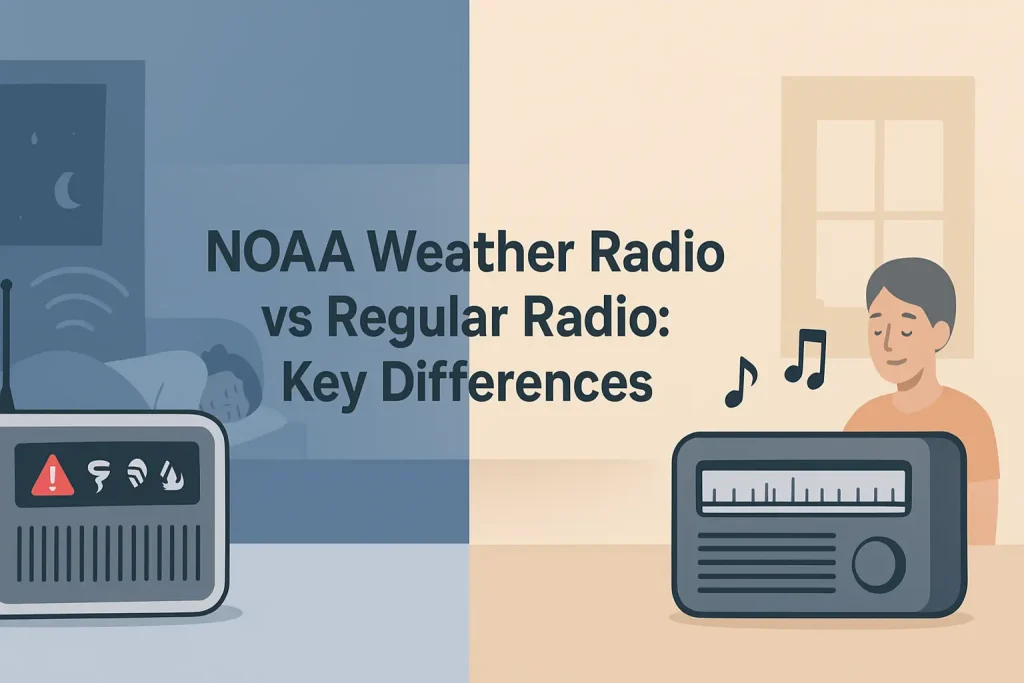
A weather radio without S.A.M.E. technology will alert you for every county in your state, not just yours. For farmers and rural residents who need to act fast on storm warnings, that distinction means the difference between a useful tool and an alarm you learn to ignore.
Why Farmers and Rural Communities Depend on Weather Radio More Than Anyone Else
Rural properties sit outside cellular coverage zones that urban emergency systems rely on. A NOAA weather alert radio with S.A.M.E. filtering receives broadcasts on seven dedicated frequencies between 162.400 and 162.550 MHz, 24 hours a day, without requiring cell signal, internet, or power grid connectivity.
| Photo | Popular Portable Walkie Talkies | Price |
|---|---|---|
 | SKIWARRIOR Multifunctional Smart Wireless Ski Goggles with Walkie-Talkie, Anti-Fog Zeiss Lens, Music & Call Function (Cylindrical Blue) | Check Price On Amazon |
 | SINORISE Super Mini Walkie Talkies, Two-Way Radios, 3 Pack | Check Price On Amazon |
 | KOSPET Tank M4C Smart Watch Rugged, Dual-Band GPS, 5ATM & IP69K Waterproof | Check Price On Amazon |
 | Retevis RT15 Walkie Talkies 3 Pack, Birthday Gift, Outdoor Adventure Kit | Check Price On Amazon |
 | Rechargeable Walkie Talkies Toys for Kids: DIY Astronaut Walkie Talkies for Boys Christmas Birthday Gifts for 3 4 5 6 7 8 9 10 Boy Walkie Talkie Outdoor Hiking Toy 2 Way Radio Camping Outdoor Game | Check Price On Amazon |
Farmers face specific risks that make real-time weather alerting a operational necessity. Livestock decisions, field equipment protection, grain drying operations, and worker safety all depend on knowing when severe weather is 30 minutes out, not 3 minutes out.
According to NOAA, the National Weather Radio All Hazards (NWR) network covers approximately 95% of the U.S. population within 40 miles of a transmitter. Rural areas at the edges of that 40-mile radius receive weaker signals, which is why antenna placement and receiver sensitivity matter more for farm and ranch installations than for suburban households.
This guide covers S.A.M.E. programming, receiver models suited for farm use, antenna solutions for low-signal rural areas, power backup strategies, and how weather radio integrates with two-way farm communication. Every recommendation accounts for the specific challenges of operating outside cellular coverage.
What Is NOAA Weather Radio All Hazards and How Does It Work for Rural Properties?
NOAA Weather Radio All Hazards broadcasts continuously on seven VHF frequencies between 162.400 MHz and 162.550 MHz. These are dedicated government channels, not shared with commercial broadcasts, and they carry official National Weather Service alerts, watches, warnings, and advisories issued for specific geographic areas.
The seven broadcast frequencies are: WX1 at 162.550 MHz, WX2 at 162.400 MHz, WX3 at 162.475 MHz, WX4 at 162.425 MHz, WX5 at 162.450 MHz, WX6 at 162.500 MHz, and WX7 at 162.525 MHz. Each transmitter site broadcasts on one frequency, and your receiver locks onto the strongest signal from the nearest transmitter.
According to NOAA’s NWR transmitter network documentation, individual transmitters typically cover a radius of 25 to 40 miles under normal atmospheric conditions. Rural properties at 30 or 35 miles from the nearest transmitter will receive weaker signals than properties 10 miles out, which makes external antenna use a practical necessity for reliable reception at farm distances.
S.A.M.E. technology (Specific Area Message Encoding) allows your receiver to filter alerts by county using a 6-digit FIPS (Federal Information Processing Standards) code. Without S.A.M.E., every alert broadcast within range activates your alarm, including alerts for counties 60 miles away. With S.A.M.E. programmed to your specific county code, only alerts affecting your area trigger the alarm.
The S.A.M.E. system encodes alerts with a digital header that your receiver decodes before opening the audio. This happens because the FIPS code is transmitted as a burst of digital data preceding the voice broadcast, and the receiver’s decoder chip compares that code against your stored codes before deciding whether to activate the alert tone and speaker.
If your S.A.M.E. code is programmed incorrectly, the result is either no alerts at all (wrong FIPS code) or alerts for the wrong counties (neighboring county code entered accidentally). Fix it by looking up your county’s exact 6-digit FIPS code through the NOAA S.A.M.E. code lookup at weather.gov, then reprogramming your receiver following the manufacturer’s keypad sequence.
A properly programmed S.A.M.E. weather radio is the most reliable single-county emergency alert tool available to rural residents without cellular coverage.
Which Weather Radio Models Work Best for Farm and Rural Use?
Farm and rural installations need receivers with strong sensitivity ratings, external antenna capability, battery backup, and alert memory capacity large enough to store multiple county codes for operations spanning county lines. The models that meet all four criteria cost between $40 and $90 at retail.
Midland WR400: Best Overall for Rural Farm Use
The Midland WR400 weather radio stores up to 50 S.A.M.E. location codes and supports 25 different alert types. It includes an external antenna jack, which is essential for weak-signal rural locations.
Key Specifications:
- Frequency coverage: 162.400 to 162.550 MHz (all 7 NOAA channels)
- S.A.M.E. alert types: 25 programmable event codes
- Alert memory: 50 S.A.M.E. county codes
- Power: AC adapter with 3x AA battery backup
- External antenna: 3.5mm mono jack included
- Price: approximately $55 to $70
The 50-code memory matters for farms that cross county lines or ranches operating in multiple counties. Programming alerts for the home county, the neighboring county to the west, and a third county covering leased fields is a common configuration for large agricultural operations.
Uniden BC365CRS: Best for High-Alert-Volume Environments
The Uniden BC365CRS weather radio combines a clock radio with NOAA S.A.M.E. alert capability. It receives all seven NOAA weather channels and includes a battery backup compartment for power outages.
Key Specifications:
- Frequency coverage: 162.400 to 162.550 MHz (7 channels)
- S.A.M.E. programmable: yes, with county-level filtering
- Power: AC with 3x AA battery backup
- External antenna: not included, internal antenna only
- Price: approximately $30 to $45
The lack of an external antenna jack limits this model to locations within strong signal range (under 20 miles from transmitter). It is a sound choice for a farmhouse situated close to a NWR transmitter but not for barns or equipment sheds at the property perimeter.
Midland ER310: Best Portable for Field and Barn Use
The Midland ER310 portable weather radio includes solar charging, a hand-crank generator, and a 2,600 mAh lithium battery. It receives all NOAA weather channels and includes a flashlight and USB phone charging output.
Key Specifications:
- Frequency coverage: NOAA WX1 through WX7
- Power: 2,600 mAh lithium battery, solar panel, hand crank, USB-C input
- Alert type: S.A.M.E. with county-level programming
- USB charging output: 1,000 mA for device charging
- Price: approximately $60 to $75
Portable receivers like the ER310 belong in equipment barns, grain storage facilities, and any outbuilding where workers spend extended time during active growing seasons. Mounting a fixed receiver in the main farmhouse and placing a portable unit in the primary work building gives complete coverage without running wiring between structures.
Sangean CL-100: Best for Extended Rural Coverage with External Antenna
The Sangean CL-100 weather radio is specifically designed for table-top installation with a dedicated external antenna terminal. Its sensitivity rating makes it one of the strongest performers at the edge of NOAA transmitter coverage.
Key Specifications:
- Frequency coverage: 162.400 to 162.550 MHz
- S.A.M.E.: programmable with alert type selection
- External antenna terminal: dedicated screw terminal for wire or outdoor antenna
- Power: AC with AA battery backup
- Price: approximately $50 to $65
For farms located 30 to 40 miles from the nearest NWR transmitter, pairing the Sangean CL-100 with an outdoor wire antenna or a dedicated VHF outdoor antenna cut for the 162 MHz band is the most reliable solution for maintaining consistent alert reception during severe weather events when signal propagation conditions change.
Matching your receiver model to your distance from the nearest NOAA transmitter is the single most important hardware decision for rural weather radio installation.
How to Find Your NOAA Transmitter and Check Signal Strength Before Buying
The nearest NOAA NWR transmitter to your property determines which receiver features you actually need. NOAA publishes a complete transmitter location database at weather.gov/nwr, where you can search by state to find the nearest station, its broadcast frequency, its output power (typically 300 to 1,000 watts ERP), and the counties it serves.
Transmitter output power ranges from 300 watts ERP at smaller relay stations to 1,000 watts ERP at primary transmitters. Higher power means reliable coverage at greater distances, but terrain between your property and the transmitter matters more than raw power output. A ridge, tree line, or hill between your farm and the transmitter can reduce signal strength more than 20 miles of flat ground would.
This happens because VHF signals in the 162 MHz range propagate primarily by line-of-sight. Signal energy does not bend around terrain obstacles. It attenuates sharply when a ridge or hill interrupts the direct path between transmitter and receiver.
If your property is within 20 miles of a transmitter with 1,000 watts ERP and no major terrain between you, any receiver with a built-in antenna will work reliably. If you are 25 to 40 miles out, or if there is elevated terrain between your farm and the transmitter, use a receiver with an external antenna jack and add an outdoor antenna mounted at roofline height or higher.
A simple test before purchasing: borrow a neighbor’s weather radio or use a handheld scanner that covers 162 MHz to check whether you can reliably receive the nearest NWR frequency inside your farmhouse and from your barn. If you get static or dropouts, your installation needs an outdoor antenna regardless of which receiver you purchase.
Knowing your exact distance and terrain situation before purchasing saves you from buying an underpowered receiver for your specific rural location.
How to Program S.A.M.E. Codes for Your County and Surrounding Area
S.A.M.E. FIPS codes are 6-digit numbers assigned to every U.S. county and parish. The format is a 1-digit state code followed by a 3-digit state FIPS code and a 3-digit county FIPS code, but weather radio receivers accept the full 6-digit string without requiring you to understand the structure. NOAA publishes the complete list at weather.gov/nwr/counties.
Programming your receiver typically follows this sequence, though exact button labels vary by model. Always verify your specific model’s procedure in the owner’s manual before starting.
- Look up your county FIPS code at weather.gov/nwr/counties. Write down the 6-digit code for every county you want to receive alerts from. For a farm spanning two counties, you need both codes.
- Enter programming mode on your receiver. Most models require holding the “SAME” or “PROG” button for 3 to 5 seconds until the display shows a flashing code entry field.
- Enter the first 6-digit FIPS code using the keypad. Confirm entry as indicated by your model (usually by pressing “ENTER” or “PROG” again).
- Add additional county codes if needed, repeating the entry step for each additional FIPS code. The Midland WR400 accepts up to 50 codes; most budget receivers accept 3 to 5 codes.
- Select alert types to monitor if your receiver supports individual alert type filtering. For farm use, enable Tornado Warning, Severe Thunderstorm Warning, Flash Flood Warning, High Wind Warning, and Civil Emergency. Disable non-relevant alerts like Coastal Flood Statements if your county code covers both inland and coastal broadcast areas.
- Test your programming by activating the receiver’s manual test mode. This triggers a simulated alert using your stored codes without waiting for a real NWR broadcast.
- Verify reception by monitoring the receiver for 24 to 48 hours to confirm it does not activate for out-of-area alerts and does respond during routine NWR weekly test broadcasts, which occur every Wednesday between 11 a.m. and noon local time.
If your receiver activates for alerts in counties you did not program, the most common cause is a statewide or regional emergency message that overrides county-level S.A.M.E. filtering. This is intentional and cannot be filtered out, as NOAA uses an “all counties” code (the final three digits set to 000) for statewide emergencies.
Correctly programmed S.A.M.E. codes reduce false alarm fatigue, which is the primary reason farmers and rural residents disable or ignore their weather radios over time.
What Alert Types Matter Most for Agricultural Operations?
NOAA NWR broadcasts more than 70 alert types, but agricultural operations depend on a specific subset that directly affect field work, livestock safety, and equipment decisions. Understanding which alerts to enable and which to filter out prevents alert fatigue without creating gaps in critical coverage.
Tornado Warning
A Tornado Warning means a tornado has been detected by radar or confirmed by a spotter. It is issued for a specific polygon of counties, typically covering an area of 20 to 40 square miles, and is the highest-priority alert for farm operations. All outdoor work should stop immediately when this alert activates.
Severe Thunderstorm Warning
A Severe Thunderstorm Warning is issued when a storm is producing or expected to produce winds of 58 mph or greater, hail of 1 inch diameter or larger, or both. For grain operations, a 58 mph wind event can overturn equipment, collapse temporary structures, and damage grain bins. This alert warrants immediate action to secure equipment and move workers indoors.
Flash Flood Warning
A Flash Flood Warning indicates flooding is occurring or imminent in the affected area. For farms with low-lying fields, creek crossings, or drainage infrastructure, this alert affects whether field equipment or vehicles are at risk from rising water. Rural roads flood before county emergency management can issue road closures, making the NWR alert the earliest reliable warning available.
High Wind Warning and Wind Advisory
A High Wind Warning is issued for sustained winds of 40 mph or greater, or gusts of 58 mph or greater. For agricultural operations, this affects grain handling (dust explosion risk during loading), chemical application (drift), and temporary structure integrity. A Wind Advisory (sustained 25 to 39 mph or gusts to 57 mph) is the lower threshold but still affects spray operations and equipment movement.
Freeze Warning and Frost Advisory
A Freeze Warning is issued when surface temperatures are forecast to drop to 32°F or below for at least 2 hours. For livestock operations, this triggers water line protection procedures. For crop operations, this is the alert that drives overnight decisions on irrigation, row covers, and harvesting schedules. NOAA issues these through the NWR system, and a S.A.M.E.-capable receiver will wake you during the night when this alert triggers.
Hazardous Materials Warning
Rural properties near highways, rail lines, and chemical storage facilities benefit from receiving Hazardous Materials Warnings. These alerts cover chemical spills, pipeline leaks, and industrial accidents that may require evacuation or shelter-in-place decisions affecting livestock management.
Use the table below to match alert type to the specific farm operations each one affects.
| Alert Type | Wind/Condition Threshold | Primary Farm Impact | Recommended Action | Enable for Farm Use |
|---|---|---|---|---|
| Tornado Warning | Confirmed rotation or debris | All outdoor operations, worker safety | Stop all work, seek shelter immediately | Yes |
| Severe Thunderstorm Warning | 58+ mph winds or 1″+ hail | Equipment, grain bins, structures | Secure equipment, move workers indoors | Yes |
| Flash Flood Warning | Flooding occurring or imminent | Low fields, road crossings, drainage | Move equipment to high ground | Yes |
| High Wind Warning | 40+ mph sustained, 58+ mph gusts | Spray operations, grain handling, structures | Halt spray, secure bins and covers | Yes |
| Freeze Warning | Surface temp 32°F or below for 2+ hrs | Crops, livestock water lines, irrigation | Protect water lines, activate frost mitigation | Yes |
| Wind Advisory | 25 to 39 mph sustained, up to 57 mph gusts | Chemical spray drift, light equipment | Halt pesticide application | Yes |
| Hazardous Materials Warning | Chemical release event | Worker safety, livestock shelter-in-place | Shelter workers and animals indoors | If near highway or rail |
| Special Marine Warning | 34+ knot winds on navigable water | Farm pond operations, irrigation pumping | Optional for inland farms | Optional |
Enabling only the alert types relevant to your specific operation prevents the alarm fatigue that causes farmers to disable their weather radio entirely during active growing seasons.
Antenna Solutions for Farms Beyond 25 Miles of a NOAA Transmitter
Rural properties at 25 to 40 miles from the nearest NWR transmitter need an external antenna to receive reliable S.A.M.E. alerts. The 162 MHz VHF band requires a receiving antenna cut to approximately 18 inches (a quarter-wave vertical for this frequency) mounted at the highest practical point on your property.
Three antenna solutions cover the range of rural installation needs, ordered by signal improvement and installation effort.
Indoor Wire Antenna (0 to 5 dBi improvement)
A 17.5-inch wire connected to your receiver’s external antenna jack and routed upward along a wall or window frame adds measurable gain over the receiver’s built-in stub antenna. Connect the wire to the 3.5mm external antenna jack using a short adapter, or use a bare 18-gauge wire pressed into the antenna terminal on receivers with a screw-type connection. This solution requires no outdoor installation and typically provides enough improvement for properties 20 to 28 miles from the transmitter.
Outdoor Vertical Antenna (3 to 5 dBi improvement)
A VHF outdoor vertical antenna mounted at roofline height, connected to the receiver via RG-6 or RG-58 coaxial cable with a 3.5mm adapter at the receiver end, provides the best reception for properties 25 to 40 miles out. Mount the antenna on a south-facing eave, chimney mount, or short mast pipe attached to the barn roof. The improvement from a roofline antenna over an indoor wire can be significant enough to move a property from intermittent reception to solid lock on the NWR frequency.
Yagi Directional Antenna (6 to 10 dBi improvement)
A Yagi directional antenna pointed at the NWR transmitter provides the highest gain but requires aiming. Use the NOAA transmitter location database to find the bearing from your property to the nearest transmitter, then mount and aim the Yagi in that direction. This is the correct solution for farms at 35 to 45 miles from the transmitter, particularly those with terrain obstacles between the property and the NWR station. A Yagi for 162 MHz needs 3 to 5 elements to provide useful directional gain in this band.
Regardless of antenna type, use the lowest practical length of coaxial cable run between the antenna and receiver. Signal loss in coaxial cable accumulates at roughly 3 to 6 dB per 100 feet for RG-58 at VHF frequencies. A longer run can cancel the gain benefit from a good antenna. Mount the receiver close to the antenna entry point or use lower-loss RG-6 cable for runs over 30 feet.
The right antenna choice depends on your distance from the nearest NWR transmitter and the terrain between your property and the transmitter station.
Power Backup Strategies: What Happens to Your Weather Radio When the Grid Goes Down
Severe weather events that trigger the most critical NOAA alerts are also the events most likely to knock out grid power. A weather radio that goes silent when the power fails at the moment a tornado warning is issued is worse than useless. Every weather radio installation on a farm or rural property needs a tested backup power plan.
Battery Backup (Built-In)
Most tabletop weather radios include a battery compartment for 3 to 6 AA or AAA batteries. These batteries activate automatically when AC power is interrupted. Alkaline AA batteries provide approximately 20 to 40 hours of standby reception, and significantly less if the alarm activates frequently. Check and replace built-in backup batteries at the start of each severe weather season and any time batteries have been in service for more than 12 months.
Rechargeable Lithium Battery Units
Portable weather radios like the Midland ER310 use integrated lithium batteries rated at 2,000 to 3,000 mAh. At standby reception mode, a 2,600 mAh battery provides 20 to 30 hours of operation. Charging from USB-C allows these units to be topped up from a vehicle 12V USB adapter or a high-capacity USB power bank rated at 20,000 mAh or more, which can recharge a weather radio battery three to five times.
Solar and Hand-Crank Combination Units
For outbuildings and locations without practical wiring access, a solar and hand-crank combination receiver eliminates dependence on both grid power and battery replacement. The solar panel trickle-charges the internal battery during daylight, and the hand crank provides emergency charging at roughly 1 to 2 minutes of operation per minute of cranking. If you want a deeper look at how these power options compare for off-grid agricultural settings, our breakdown of solar, crank, and battery weather radio power systems covers runtime data and failure scenarios for each type.
Uninterruptible Power Supply (UPS)
A small UPS battery backup unit rated at 300 to 500 VA keeps a tabletop weather radio (which draws 5 to 10 watts) running for 4 to 8 hours after grid failure. This is the best solution for a fixed receiver in the main farmhouse because it maintains continuous operation without battery replacement and automatically returns to grid charging when power is restored. A UPS also protects the receiver from power surges, which is a meaningful benefit during lightning storm events.
Testing your backup power at the start of each severe weather season, rather than during a storm event, is the single most important maintenance step for rural weather radio installations.
How Weather Radio Integrates with Two-Way Farm Communication
Weather radio is a receive-only system. It tells you what is coming but cannot coordinate your response across multiple workers or structures on a large property. Two-way radio fills that coordination gap. The most effective farm emergency communication systems combine a NOAA weather radio alert with a two-way radio network that can reach workers in fields, barns, and equipment cabs without cellular coverage.
FRS Radios for Farm Crew Coordination (Under 2W, No License)
FRS (Family Radio Service) radios operate on 22 channels in the 462 and 467 MHz band. They are capped at 2 watts by FCC Part 95E and require no license. In flat open farmland, 2-watt FRS radios achieve 1 to 3 miles of reliable range between workers on foot or in equipment cabs. They are the simplest and lowest-cost solution for farms with operations within 2 miles of the farmhouse.
GMRS Radios for Extended Farm Range (Up to 5W Handheld, 50W Mobile)
GMRS (General Mobile Radio Service) radios operate on overlapping FRS frequencies plus additional channels, with power limits up to 5 watts for handheld units and up to 50 watts for mobile or base station units. GMRS requires an FCC license at $35 for a 10-year family license (no exam required). At 5 watts, handheld GMRS units achieve 2 to 5 miles in open terrain. A 50-watt GMRS mobile radio in a tractor cab, connected to a rooftop antenna at 10 feet, achieves 8 to 15 miles across flat agricultural land.
Use the table below to compare FRS and GMRS for farm communication decisions.
| Feature | FRS | GMRS |
|---|---|---|
| FCC regulation | Part 95E | Part 95E |
| License required | No | Yes ($35 / 10 years) |
| Max power (handheld) | 2W | 5W |
| Max power (mobile/base) | Not permitted | 50W |
| Frequency range | 462 and 467 MHz | 462 and 467 MHz |
| Repeater access | No | Yes |
| Range (open terrain) | 1 to 3 miles | 2 to 15 miles |
| Best farm use case | Small crew, under 2 miles | Large property, vehicle-to-vehicle |
| Price range | $25 to $60 per pair | $50 to $200+ per unit |
For operations where workers are spread across sections of land, a GMRS handheld radio pair like the Midland GXT1000VP4 provides 5-watt output, 50 GMRS channels, and NOAA weather channel monitoring in the same unit, so workers in the field can receive weather alerts and communicate with the farmhouse simultaneously.
Dedicated Weather Channel Monitoring on Two-Way Radios
Many GMRS and FRS radios include a dedicated NOAA weather channel monitoring function. This allows field workers to manually tune to the nearest NWR frequency (162.400 to 162.550 MHz) and listen to live NOAA broadcasts on their handheld radio. This is not S.A.M.E.-filtered and does not provide automatic alerts, but it gives workers in the field direct access to NWR audio without requiring a separate dedicated weather receiver in every vehicle.
The most resilient farm communication plan pairs a fixed S.A.M.E. weather radio in the main farmhouse with GMRS handheld radios that include weather channel monitoring capability for all field workers.
Here is the seasonal planning guide for when to test, maintain, and rely most heavily on your farm weather radio system throughout the year.
Seasonal Guide
Farm Weather Radio – Month-by-Month Maintenance and Alert Calendar
What to check, test, or prepare each month for reliable NWR alert coverage on your property
Lower activity / Routine maintenance
Weather Radio Placement on the Farm: Where to Put Receivers for Maximum Coverage
A single receiver in the farmhouse does not cover workers in barns, equipment sheds, or fields at planting and harvest time. Effective weather radio coverage on a working farm requires at least two receiver locations and a plan for alerting workers who are not within earshot of either.
Primary Receiver: Farmhouse or Main Office
The primary receiver belongs in the most-occupied building, mounted within earshot of the sleeping area if the farm is residential. Tabletop models with 90 to 100 dB alarm output (measured at 3 feet) are loud enough to wake a sleeping occupant from an adjacent room. The Midland WR400 produces an 85 to 95 dB alarm tone. Mount it on a surface where the alarm speaker faces into the room, not toward a wall, to maximize audibility.
Secondary Receiver: Primary Work Building (Barn, Shop, or Grain Facility)
A portable weather radio or a secondary tabletop unit in the main work building ensures workers have direct alert access during the workday without relying on someone relaying a message from the farmhouse. A hand-crank unit mounted on a shelf near the entrance point of the barn covers this role without requiring an AC outlet. If you are looking for compact receivers built for outdoor and field conditions, our review of the best portable weather radios for outdoor and field use covers battery life and alert reliability in detail.
Mobile Coverage: Tractors, Combines, and Work Vehicles
Equipment cabs present the most challenging weather radio coverage problem on large farms. GMRS or FRS radios with weather channel monitoring capability allow operators to manually tune to the NWR frequency from a vehicle cab. For dedicated cab installation, a GMRS mobile radio mounted in the cab and connected to a rooftop antenna provides both crew communication and weather channel access without requiring a separate dedicated weather receiver in every piece of equipment.
Alert Relay: From Receiver to Field Workers
The most common gap in farm weather alerting is the interval between the farmhouse receiver activating and the alert reaching workers in a distant field. A two-way radio relay plan closes this gap. Designate one person at the farmhouse as the alert relay operator, and establish a protocol that any NWR alarm triggers an immediate radio call on a designated GMRS or FRS channel to all field workers. This protocol does not require technology beyond a weather radio and a pair of handheld radios, and it is more reliable than any app-based alert during severe weather that has already degraded cellular service.
The goal is zero dead zones in your alert coverage, from the moment the NWR alarm sounds to the moment every worker on your property knows to take shelter.
Common Weather Radio Problems on Farms and How to Fix Them
Rural weather radio installations fail for a small set of predictable reasons. Most problems trace to signal reception, programming errors, or battery backup failures, all of which are correctable without replacing hardware.
No Signal or Constant Static
If your receiver shows no signal or produces constant static, the first step is to manually scan all seven NWR frequencies (162.400 through 162.550 MHz) to find the strongest one in your location. Your receiver’s manual channel scan or automatic scan function will lock onto the strongest signal. If no frequency produces a clear signal, your location is likely at or beyond the edge of the nearest transmitter’s coverage, and an external antenna is required.
Receiver Activates for Wrong Counties
If your receiver alarms for counties far from your property, your S.A.M.E. codes are either programmed incorrectly or you have not enabled S.A.M.E. filtering at all (some receivers default to “all alerts” mode until you activate SAME filtering). Re-enter your county FIPS codes and confirm the S.A.M.E. filtering mode is switched on. If the receiver still activates for distant counties, the broadcast itself uses an “all counties” override code (0000 in the county field of the SAME header), which bypasses all individual county filtering for statewide emergencies. This is intentional and cannot be changed.
Weekly Test Broadcast Does Not Trigger Alert
NOAA broadcasts a Required Weekly Test (RWT) every Wednesday between 11 a.m. and noon local time. If your receiver does not respond to this test, either your S.A.M.E. codes exclude the test message or your receiver is not correctly receiving the NWR signal. Verify your FIPS codes are correct, check that the receiver is on the correct NWR frequency for your area, and confirm the “test alert” type is enabled in your receiver’s alert type settings if it offers individual alert type filtering.
Battery Backup Fails During Power Outage
If your receiver goes silent during a power outage, your backup batteries have either corroded, discharged, or were never installed. Remove and inspect the backup batteries annually. Battery corrosion (white or blue-green residue on terminals) is a common failure mode in receivers left on AC power for extended periods without battery checks. Clean corroded terminals with a cotton swab and white vinegar, dry thoroughly, and install fresh alkaline batteries. Lithium primary AA batteries last longer in long-term backup roles than alkaline and are worth the premium cost for weather radio backup applications.
Intermittent Signal Loss During Active Weather
Signal loss during the storms you most need alerts for is the most frustrating failure mode. This happens because severe weather (particularly thunderstorms and heavy precipitation) absorbs and scatters VHF signals, reducing received signal strength at the edge of the transmitter’s coverage area. The fix is an external antenna at roofline height, which raises your signal margin above the threshold where weather-induced attenuation causes dropout. A receiver that works reliably in clear weather but drops out during rain at a rural location needs a higher antenna, not a different receiver.
Resolving the specific failure mode affecting your installation is faster than replacing hardware and typically costs less than $20 in antenna materials.
Weather Radio for Specific Farm Types: Livestock, Crop, and Mixed Operations
Livestock Operations: Freeze Warnings and Lightning Risk
Livestock operations depend on overnight Freeze Warning alerts during late fall and early spring, when overnight temperatures can drop below 32°F without a daytime forecast indicating the risk. A weather radio in the farmhouse set to alarm for Freeze Warnings at any hour of the night allows producers to take action on water line protection and barn heating before pipes freeze or animals are stressed by cold. Lightning risk is equally important for livestock: the safest practice when a Severe Thunderstorm Warning activates is to move animals out of open fields and away from metal fence lines before the storm arrives.
Crop and Row Crop Operations: Spray Windows and Hail Risk
Row crop operations are sensitive to wind alerts because pesticide and herbicide application requires wind speeds below 10 mph to prevent drift. A Wind Advisory (sustained 25 mph or gusts to 57 mph) should halt all spray operations immediately. Hail risk from Severe Thunderstorm Warnings is equally critical: hail events of 1 inch diameter or larger cause visible crop damage at any growth stage and can total a field’s yield in minutes. A weather radio with a Severe Thunderstorm Warning alert active throughout the growing season provides the earliest possible warning for both threats.
Mixed Operations and Large Acreage: Multiple County Coverage
Large-acreage operations that span multiple counties need S.A.M.E. receivers with multi-code memory capacity. The Midland WR400’s 50-code capacity is more than sufficient for most multi-county operations. For a farm leasing ground across three counties, program all three county FIPS codes into the primary receiver and confirm that all three appear in the receiver’s stored code list after programming. Alert coverage for all leased counties is then automatic without any manual switching.
Matching your weather radio configuration to your specific operation type is what converts a generic emergency device into an active farm management tool.
How to Choose the Right Weather Radio for Rural Use: A Buying Framework
The right weather radio for a rural farm installation comes down to four factors: distance from the nearest NOAA transmitter, number of counties to monitor, power backup requirements, and whether the unit will be fixed or mobile. No single model is ideal for every farm situation, but the decision matrix is straightforward once you know your answers to those four questions.
Use the table below to match your situation to the correct receiver and antenna configuration.
| Distance from NWR Transmitter | Recommended Receiver | Antenna Needed | Power Backup | Best For |
|---|---|---|---|---|
| Under 20 miles | Uniden BC365CRS or Midland WR400 | Internal antenna sufficient | 3x AA alkaline backup | Farmhouse fixed installation |
| 20 to 30 miles | Midland WR400 or Sangean CL-100 | Indoor wire or low outdoor vertical | AA backup or UPS | Farmhouse or primary barn |
| 30 to 40 miles | Sangean CL-100 with external antenna jack | Outdoor roofline vertical required | UPS recommended | Edge-of-coverage rural farm |
| Over 40 miles or terrain obstruction | Sangean CL-100 with Yagi antenna | 3 to 5 element Yagi directed at transmitter | UPS or solar backup | Remote ranch or deep rural property |
| Field or mobile use | Midland ER310 portable | Internal antenna, position for best signal | 2,600 mAh lithium + solar + crank | Barn, equipment cab, field use |
| Multi-county operation | Midland WR400 (50-code memory) | Based on distance above | AA backup or UPS | Large-acreage farms spanning county lines |
For families making this purchase decision for the first time, our complete weather radio selection guide covering all receiver types and key features walks through S.A.M.E., power options, and antenna considerations in detail.
Matching receiver capability to your specific distance and terrain situation avoids the two most common purchase mistakes: buying a unit too basic for your location, or overbuilding with features you do not need.
Emergency Preparedness Beyond Weather Alerts: What Rural Families Should Have
Weather radio is one component of a complete rural emergency communication plan. Grid-down scenarios, wildfire evacuations, and extended severe weather events expose gaps in communication systems that rely entirely on cellular networks or single-point devices. A layered approach combines weather radio for incoming alerts, two-way radio for local coordination, and a backup power source that keeps both running when the grid fails.
The minimum recommended rural emergency communication kit for a farm household includes: one S.A.M.E. weather radio with battery backup, one pair of GMRS or FRS handheld radios for crew coordination, one portable hand-crank weather radio for the primary work building, and a power bank capable of charging mobile devices and radios for at least 48 hours. For a deeper look at building a complete emergency communication plan for rural households, our guide on emergency preparedness communication strategies for rural families covers alert systems, two-way radio protocols, and grid-down communication planning.
Families with children on the property benefit from a dedicated weather radio in the main living area separate from the farm operation equipment. The alarm output on a receiver like the Midland WR400 (85 to 95 dB) wakes sleeping children reliably. For families building this setup, our weather radio setup guide for household and family use covers placement, alarm volume, and programming for residential environments.
Rural households without cellular reliability need a communication plan that functions at zero signal, not one that depends on 4G coverage returning after a storm passes.
Frequently Asked Questions About Weather Radio for Farmers and Rural Communities
What is the best NOAA weather radio for a farm located more than 30 miles from the nearest transmitter?
The Sangean CL-100 paired with an outdoor VHF vertical antenna mounted at roofline height is the most reliable setup for farms 30 to 40 miles from a NOAA NWR transmitter. At that distance, a receiver’s built-in antenna will produce intermittent or no signal, especially during the atmospheric absorption that accompanies active weather. The Sangean CL-100 includes a dedicated external antenna terminal, and a simple quarter-wave vertical antenna cut to 18 inches for 162 MHz costs under $20 to build from hardware store components.
For distances beyond 40 miles or locations with terrain blocking the line-of-sight path to the transmitter, replace the vertical with a 3 to 5 element Yagi directional antenna aimed at the nearest NWR station. Use the NOAA transmitter location database at weather.gov/nwr to determine the bearing from your property to the transmitter, then mount and aim the Yagi at that bearing.
How do I find my county’s S.A.M.E. FIPS code for programming a weather radio?
NOAA publishes the complete list of S.A.M.E. FIPS codes at weather.gov/nwr/counties, organized by state. Each county has a unique 6-digit code. Find your state in the list, then locate your county name to retrieve the code. Write down the codes for every county you want to receive alerts from before starting the programming process on your receiver.
For farms spanning multiple counties, program all relevant county codes if your receiver’s memory allows it. The Midland WR400 stores up to 50 codes, which is sufficient for any multi-county agricultural operation. Budget receivers typically store 3 to 5 codes, which covers most single-farm operations with adjacent county coverage.
Can I use a GMRS radio to receive NOAA weather alerts in a tractor cab?
Yes. Many GMRS handheld and mobile radios include a dedicated weather channel function that allows you to manually tune to one of the seven NOAA NWR frequencies (162.400 to 162.550 MHz). This provides live audio from the nearest NWR transmitter. It does not provide automatic S.A.M.E. alerts, meaning the radio will not activate an alarm when a warning is broadcast. You must be actively listening to the weather channel to hear an alert.
For automatic alerting in a vehicle cab, a dedicated portable weather radio like the Midland ER310 (which does include S.A.M.E. alert functionality) is the correct solution. Place it on the cab dash and it will alarm automatically when a qualifying alert is broadcast for your programmed county codes, without requiring you to monitor it continuously.
Why does my weather radio alarm for counties I did not program?
NOAA uses an “all counties in state” override code (county field set to 000 in the S.A.M.E. header) for certain high-level emergencies including National Emergency Messages, Presidential Alerts, and statewide Civil Emergency Messages. These messages bypass individual county S.A.M.E. filtering by design. A weather radio that alarms for these messages even with specific county codes programmed is functioning correctly.
If your receiver alarms for specific individual counties you did not program, the most likely cause is that your S.A.M.E. mode is not fully activated (some receivers default to “receive all” mode), or a neighboring county’s FIPS code was entered accidentally during programming. Verify your stored codes match your intended counties exactly and confirm the S.A.M.E. filter mode is switched on in your receiver settings.
What is the difference between a Tornado Watch and a Tornado Warning on a weather radio?
A Tornado Watch means atmospheric conditions are favorable for tornado development in the watch area, typically covering multiple counties over a period of several hours. No tornado has been detected, but conditions support formation. A Tornado Warning means a tornado has been detected by Doppler radar or confirmed by a storm spotter and is occurring or imminent in the warned area, typically a specific polygon of land covering 20 to 60 square miles.
For farm operations, a Tornado Watch is a signal to monitor conditions, bring workers aware of the risk, and have a shelter plan ready. A Tornado Warning requires immediate action. All outdoor work stops and all workers move to the designated shelter location before the storm arrives. The warning-to-impact interval is typically 8 to 13 minutes based on NOAA lead time statistics, which is not enough time to complete a decision-making process after the alarm sounds.
Does a weather radio work without electricity or cell service?
Yes. NOAA weather radio broadcasts on dedicated VHF frequencies (162.400 to 162.550 MHz) that are entirely independent of cellular networks and the internet. A weather radio with battery backup continues to receive NWR broadcasts and activate S.A.M.E. alerts during power outages as long as the backup batteries have charge remaining. Portable units with integrated lithium batteries and solar or hand-crank charging capability operate indefinitely without any grid power.
This independence from cellular and internet infrastructure is the primary reason weather radio is the recommended alert method for rural areas. Cellular Emergency Alerts (WEA, delivered via LTE broadcast) require cell tower coverage to be received. In rural areas with limited tower density, WEA messages may not be received at all during normal conditions, and coverage degrades further when towers lose power during severe weather events.
How often should I replace the backup batteries in my weather radio?
Replace alkaline AA or AAA backup batteries in a tabletop weather radio at the start of each severe weather season, typically once per year in late winter or early spring. Alkaline batteries discharge slowly even without use, and batteries that have been in the compartment for 18 months or more may not provide reliable backup duration when needed. Remove old batteries rather than leaving them long-term in the compartment, as alkaline batteries corrode over time and can damage the battery contacts inside the receiver.
Lithium primary AA batteries (not rechargeable, single-use lithium) last significantly longer in backup applications than alkaline and are the better choice if you want to replace batteries less frequently. A set of lithium AA batteries in a backup compartment can remain usable for 5 to 7 years in cool, dry conditions.
Can I monitor multiple NOAA frequencies at the same time on one weather radio?
No. A weather radio receives one NWR frequency at a time. In “scan” mode, the receiver cycles through all seven NWR frequencies and locks onto the strongest signal. Once locked, it stays on that frequency. You cannot receive simultaneous broadcasts from two different NWR transmitters on different frequencies at the same time with a single receiver.
For properties located near a boundary between two transmitter coverage areas, the receiver will lock onto whichever frequency is strongest at your location. If that transmitter covers different counties than the one you need, use the manual channel lock function to select the specific NWR frequency that covers your county, rather than letting the receiver scan to the strongest signal automatically.
Is there a weather radio that can alert multiple buildings on a farm simultaneously?
No single weather radio unit can simultaneously activate alerts in multiple separate buildings. The standard approach for multi-building farm coverage is a dedicated receiver in each critical building, all programmed with the same S.A.M.E. county codes. A second approach is a primary receiver in the farmhouse paired with a GMRS radio relay protocol: when the primary receiver alarms, a designated operator immediately broadcasts an alert on the farm’s designated GMRS or FRS channel to notify workers in other buildings.
Some commercial alert systems integrate weather radio monitoring with external siren outputs or IP-based notification systems, but these require installation by an electronics professional and are typically used by larger commercial operations rather than individual farms. For most farms, two or three dedicated receivers covering the farmhouse, primary barn, and a portable unit for field use provides adequate coverage at a total hardware cost under $200.
What happens to weather radio alerts during a complete grid-down scenario lasting several days?
NOAA NWR transmitter sites are equipped with backup generator power and are designed to maintain continuous broadcast operation during extended grid outages. According to NOAA NWR technical documentation, NWR transmitters are considered critical infrastructure and receive priority in emergency generator fuel allocation. The NWR broadcast signal continues even when local grid power has been out for days.
Your weather radio’s ability to receive that signal depends entirely on your backup power supply. A portable unit with a 2,600 mAh lithium battery in standby mode lasts 20 to 30 hours. A tabletop unit on 3 AA alkaline batteries in standby mode lasts 20 to 40 hours. For multi-day grid outages, a solar-charging portable receiver or a UPS-powered tabletop receiver with a large-capacity battery is the correct solution. Our comparison of hand-crank weather radios for long-term off-grid emergency use covers runtime, charging efficiency, and model comparisons for extended-outage scenarios.
Do I need a separate FCC license to use a GMRS radio on a farm for crew communication?
Yes. GMRS (General Mobile Radio Service) requires an FCC license under FCC Part 95E. The license costs $35 and is valid for 10 years. It covers the licensee and all members of their immediate family. For a farm operation where the owner, family members, and hired employees all need radio access, note that employees who are not immediate family members are not covered under the licensee’s family license. For commercial farm operations with non-family employees, each employee using a GMRS radio needs to be covered under a license, which in practice often means the farm business applies for a GMRS license as an entity, or users shift to FRS radios (which require no license at all) for general crew communication.
FRS radios operate on the same 462 and 467 MHz channels as GMRS but are capped at 2 watts and cannot use repeaters. For most within-farm communication over distances under 2 to 3 miles in flat open terrain, FRS provides adequate range without the licensing complexity.
Why does my weather radio lose signal during the storms I need alerts for most?
Heavy rain, thunderstorm cell activity, and the atmospheric turbulence associated with severe weather absorb and scatter VHF signals in the 162 MHz range. This is exactly the meteorological condition that reduces received signal strength at locations near the edge of an NWR transmitter’s coverage area. A receiver that works reliably in clear weather but drops out during active weather events is experiencing signal margin failure: the received signal level is just above the receiver’s minimum threshold in good conditions but falls below it when weather-induced attenuation increases.
The fix is not a more sensitive receiver. It is a higher antenna that increases the received signal level enough to maintain a margin above the minimum threshold even during storm-related attenuation. Moving from an indoor built-in antenna to an outdoor roofline vertical antenna typically adds 5 to 10 dB of effective signal improvement, which is often sufficient to eliminate storm-related dropouts at distances up to 35 miles from the transmitter.
A weather radio installation that holds signal during active severe weather is the only configuration that provides reliable protection for a rural farm operation, and outdoor antenna height is the single most cost-effective improvement you can make to achieve it.
NOAA Weather Radio All Hazards broadcasts on seven dedicated VHF frequencies between 162.400 and 162.550 MHz, independent of cellular networks, and covers approximately 95% of the U.S. population within 40 miles of a transmitter. For farmers and rural residents operating outside reliable cellular coverage, a S.A.M.E.-capable receiver programmed to your county’s FIPS code is the most direct path to advance warning for the storms, freezes, and high winds that affect agricultural operations. Start by finding your nearest NWR transmitter at weather.gov/nwr, checking your distance, and selecting a receiver with external antenna capability if you are more than 20 miles out. Add a portable unit for your primary work building, establish a two-way radio relay plan for field workers, and test your backup batteries at the start of every severe weather season.
| Photo | TOP RATED WALKIE TALKIES | Price |
|---|---|---|
 | Retevis RT628 Kids Walkie Talkies, Toys Gifts for 4-12 Year Old Girl Boy | Check Price On Amazon |
 | Cobra ACXT545 Weather-Resistant Walkie Talkies, Rechargeable, 22 Channels | Check Price On Amazon |
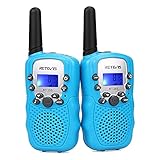 | Retevis RT388 Kids Walkie Talkies, Outdoor Toys for Kids Camping Essentials | Check Price On Amazon |
 | Cobra RX680 Walkie Talkies (2-Pack), IP54 Water Resistant Design | Check Price On Amazon |
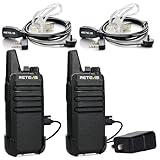 | Retevis RT22 Walkie Talkies Long Range Rechargeable with Earpiece (2 Pack) | Check Price On Amazon |
 | Midland GXT1000VP4 GMRS Two-Way Radios with Headsets, Black, 2 Pack | Check Price On Amazon |
 | Retevis RT628 Walkie Talkies for Kids,Toys Gifts for 6-12 Years Old Boys Girls,Long Range 2 Way Radio 22CH VOX,Birthday Gift,Family Walkie Talkie for Camping Hiking Indoor Outdoor | Check Price On Amazon |