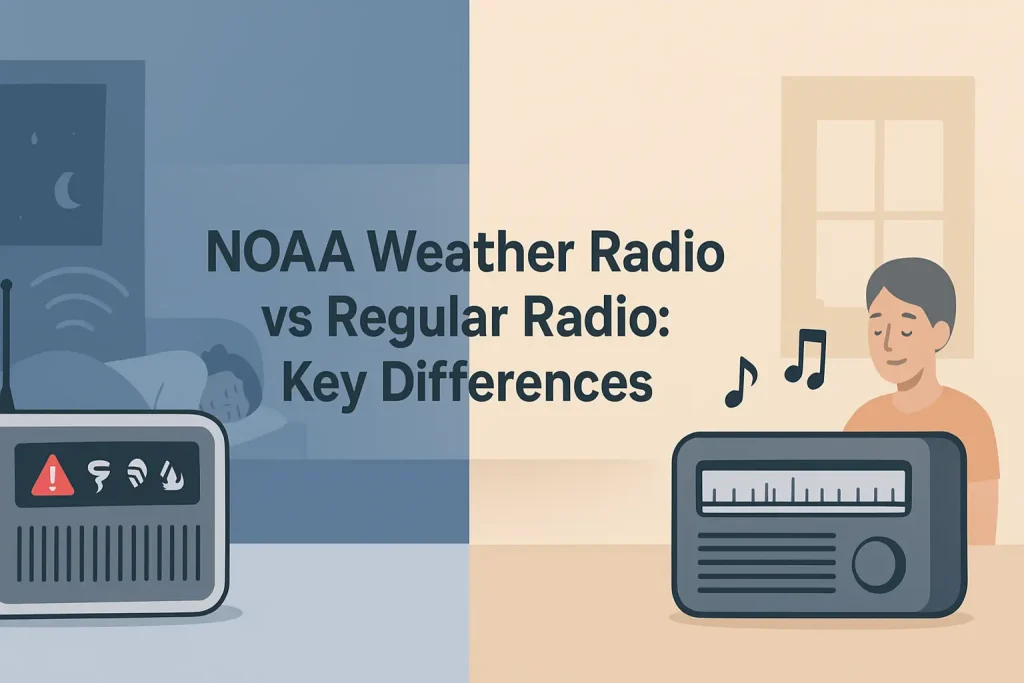
A weather radio without large buttons and a simple display is a safety hazard for older adults, not a tool. Seniors who cannot read small text or navigate complex menus during a midnight tornado warning are left unprotected precisely when the radio matters most. The good news is that several models are specifically designed with older users in mind, featuring oversized controls, loud speakers, and one-button alert activation that works even under stress.
Why Standard Weather Radios Often Fail Older Adults
Most weather radios are designed for general consumers, not for the specific challenges that come with aging eyes, hands, and hearing. Buttons are small, displays are dim, and programming S.A.M.E. codes (the 6-digit county codes that filter alerts to your specific area) can require navigating four or five menu levels.
| Photo | Popular Portable Walkie Talkies | Price |
|---|---|---|
 | SKIWARRIOR Multifunctional Smart Wireless Ski Goggles with Walkie-Talkie, Anti-Fog Zeiss Lens, Music & Call Function (Cylindrical Blue) | Check Price On Amazon |
 | SINORISE Super Mini Walkie Talkies, Two-Way Radios, 3 Pack | Check Price On Amazon |
 | KOSPET Tank M4C Smart Watch Rugged, Dual-Band GPS, 5ATM & IP69K Waterproof | Check Price On Amazon |
 | Retevis RT15 Walkie Talkies 3 Pack, Birthday Gift, Outdoor Adventure Kit | Check Price On Amazon |
 | Rechargeable Walkie Talkies Toys for Kids: DIY Astronaut Walkie Talkies for Boys Christmas Birthday Gifts for 3 4 5 6 7 8 9 10 Boy Walkie Talkie Outdoor Hiking Toy 2 Way Radio Camping Outdoor Game | Check Price On Amazon |
According to the National Institute on Aging, roughly 14% of adults over 70 have significant vision impairment, and more than one-third have measurable hearing loss. A weather radio that requires reading 8-point text on a backlit LCD display in the dark is effectively unusable for a large share of its intended emergency audience.
The problem compounds at night. NOAA broadcasts weather alerts 24 hours a day on seven dedicated frequencies between 162.400 and 162.550 MHz. Without S.A.M.E. technology, a radio will sound an alarm for every county in your broadcast area, not just yours, waking an older adult multiple times per night for alerts that do not apply to their location.
A weather radio designed for seniors must solve three specific problems: legible display, audible alert tone, and simple programming. Any model that fails on even one of these three points is the wrong choice regardless of its other features.
What Makes a Weather Radio Senior-Friendly: The Four Non-Negotiables
A senior-friendly weather radio must meet four criteria that are largely absent from the marketing copy on most product pages. These are not comfort preferences; they are functional requirements for reliable emergency use by older adults.
The first requirement is a loud speaker rated at 90 decibels or higher. Normal speech is around 60 dB. A smoke alarm is 85 dB. For a weather radio to wake a person with mild hearing loss through a closed bedroom door, it needs to reach at least 90 dB at the alarm setting. The Midland WR400 and the Uniden BC365CRS both reach this threshold.
The second requirement is a display with text at least 0.5 inches tall and high contrast between text and background. White text on a black or dark blue background is the most legible combination for low-vision users. Avoid models with gray text on gray backgrounds, which are common in the mid-range category.
The third requirement is S.A.M.E. alert filtering that can be programmed in five steps or fewer. S.A.M.E. stands for Specific Area Message Encoding. It allows the radio to receive only alerts issued for your specific county or counties, dramatically reducing false alarms. The Midland WR400 allows S.A.M.E. programming through a straightforward keypad sequence that most users complete in under three minutes.
The fourth requirement is a battery backup that activates automatically during power outages. Many severe weather events knock out power first. A radio that requires wall power only is useless exactly when it is most needed. Look for models that accept standard AA or AAA alkaline batteries as backup, so replacement batteries are available anywhere without special ordering.
Meeting all four of these requirements narrows the field considerably, which is actually helpful when choosing a radio for an older adult.
The Best Weather Radios for Seniors: Top Models Compared
Four models consistently earn the highest marks from emergency management professionals for senior usability. Each is evaluated below on the four non-negotiable criteria, plus price and ease of initial setup.
Here is a price comparison of the top senior-friendly weather radio models to help you set a budget before reading the detailed reviews.
Price Comparison
Senior-Friendly Weather Radios – Price Comparison by Model
Street price, sorted lowest to highest. Prices verified at time of publication.
$30
$40
$55
$70
$130
Single-unit price. Bed shaker accessory sold separately for the WR400. All models receive NOAA Weather Radio All Hazards on 162.400 to 162.550 MHz.
Midland WR400: Best Overall for Seniors
The Midland WR400 is the most consistently recommended weather radio for older adults by emergency management professionals. It receives all seven NOAA weather radio frequencies (162.400 to 162.550 MHz), supports S.A.M.E. programming for up to 50 county codes, and produces an alert tone loud enough to wake most adults with moderate hearing loss.
Key Specifications:
- Frequencies: 162.400 to 162.550 MHz (all 7 NOAA WX channels)
- S.A.M.E. alert types: 25 programmable event categories
- Alert memory: 50 programmable S.A.M.E. location codes
- Power: AC adapter with 3x AA battery backup
- Display: large backlit LCD with high-contrast text
- Price: approximately $55
The WR400 includes a strobe light output jack that accepts an optional bed shaker accessory (sold separately for around $25). This combination makes it functional for seniors with significant hearing loss, because the physical vibration wakes the user even when an audio alarm would not.
Programming the S.A.M.E. code on the WR400 requires entering your 6-digit FIPS county code using the keypad. Most users complete this in under three minutes using the printed guide included in the box. This is the simplest S.A.M.E. programming interface of any model in this price range.
Uniden BC365CRS: Best Budget Option with Clock Radio Features
The Uniden BC365CRS combines an AM/FM clock radio with a full NOAA weather alert receiver, making it familiar and comfortable for older adults who already use a bedside clock radio. The combination means they only need to learn one new device instead of adding a separate unit to their nightstand.
Key Specifications:
- Frequencies: 162.400 to 162.550 MHz (NOAA) plus AM 520 to 1710 kHz and FM 87.5 to 108 MHz
- S.A.M.E.: yes, programmable county-level filtering
- Alert tone: 90 dB at 1 meter
- Power: AC adapter with 6x AA battery backup
- Display: large LED clock display, weather alert indicator light
- Price: approximately $40
The main limitation of the BC365CRS is that its S.A.M.E. programming is slightly more involved than the WR400’s, requiring the user to scroll through event categories individually. For a caregiver setting it up once and leaving it, this is a non-issue. For a senior setting it up themselves, the WR400 is easier.
Sangean CL-100: Best for Strong NOAA Reception in Rural Areas
The Sangean CL-100 is designed for areas where NOAA transmitter coverage is weaker, typically rural locations more than 40 miles from the nearest transmitter. It includes a larger internal ferrite antenna than the Midland WR400, which improves reception in fringe-coverage zones.
Key Specifications:
- Frequencies: 162.400 to 162.550 MHz (7 NOAA WX channels)
- S.A.M.E.: yes, with 25 programmable alert event types
- Alert tone: loud audible alarm with flashing LED
- Power: AC adapter with 6x AA battery backup
- Display: large, high-contrast LCD
- Price: approximately $70
According to NOAA’s NWR transmitter coverage maps, approximately 95% of the US population lives within 40 miles of a transmitter. For the 5% who do not, the Sangean CL-100’s reception advantage is a meaningful difference that justifies the higher price.
Midland WR120B: Best Entry-Level Option for Seniors on a Fixed Income
The Midland WR120B is the most affordable model that still meets all four non-negotiable criteria. It receives all seven NOAA frequencies, includes S.A.M.E. programming for up to 25 event types, and produces a 90 dB alarm tone. At around $30, it is the appropriate starting point for seniors on a fixed income who need reliable protection without premium features.
Key Specifications:
- Frequencies: 162.400 to 162.550 MHz (all 7 NOAA WX channels)
- S.A.M.E.: yes, 25 programmable event types
- Alert tone: 90 dB alarm
- Power: AC adapter with 3x AA battery backup
- Display: backlit LCD
- Price: approximately $30
The WR120B does not include a strobe output or bed shaker jack, which makes it unsuitable for users with significant hearing loss. For seniors with normal or mild hearing loss, it is a fully capable choice at the lowest price point in this category.
Use the table below to compare all four models across the criteria that matter most for older adult users.
The Midland WR400 is the right default choice for most seniors because it meets all four non-negotiable criteria and includes the bed shaker output that no other model at this price point offers.
How to Set Up a Weather Radio for an Older Adult: Step by Step
Setting up a weather radio for a senior is a 15-minute task that a caregiver or family member can complete once, then leave the radio alone to run indefinitely. The most common mistake is skipping S.A.M.E. programming, which results in the radio alarming for the entire state broadcast area and being turned off in frustration within the first week.
According to NOAA’s National Weather Service documentation, a single NOAA transmitter can cover a radius of up to 40 miles, which often means the broadcast area covers 10 to 20 counties. Without S.A.M.E. filtering, every alert for every one of those counties triggers the alarm.
Step-by-Step Guide
How to Set Up a Midland WR400 Weather Radio for a Senior
6 steps · Estimated time: 15 minutes
Look up the 6-digit FIPS code for the senior’s county
Go to weather.gov/nwr and use the S.A.M.E. code lookup tool. Enter the state and county name to get the correct 6-digit code. Write it down before touching the radio.
Place the radio within 6 feet of an AC outlet and a flat surface
The bedside table is the ideal location. The radio needs a clear path to the ceiling (not inside a cabinet) for the internal antenna to receive the 162 MHz NOAA signal reliably.
Install 3 AA alkaline batteries before plugging in the AC adapter
Installing batteries first ensures the backup power is in place from the start. Use standard alkaline AA batteries, not rechargeable NiMH cells, as NiMH voltage can cause false low-battery warnings on some WR400 units.
Press and hold the S.A.M.E. button for 3 seconds to enter programming mode
The display will show “SAME 1” indicating the first location slot. Use the number keys to enter the 6-digit FIPS code you looked up in Step 1. Press SAME again to confirm.
Set the volume to its highest position and confirm the alert tone works
Press the TEST button to trigger a simulated alert. Confirm the alarm tone is clearly audible from the next room with the door closed. If not, reposition the radio on a hard surface rather than a padded fabric one, as padding absorbs speaker output significantly.
Label the radio with a single instruction card taped to the side
Write in large print: “When alarm sounds, press SNOOZE to silence, then listen to the voice message.” This removes the decision-making burden during a stressful 3 AM alert and prevents the radio from being unplugged in confusion.
Once programmed with the correct S.A.M.E. code, the radio requires no further interaction from the senior until it is time to replace the backup batteries, which should be done once a year as part of a regular check-in visit.
Weather Radios for Seniors with Hearing Loss: Special Considerations
A standard weather radio alarm is inaudible to approximately 15% of adults over 65 who have moderate to severe hearing loss, according to the National Institute on Deafness and Other Communication Disorders. For these users, an audio alarm alone is not a viable safety solution, and a radio with a bed shaker output is the only functional option.
A bed shaker accessory (also called a vibration alert or pillow shaker) connects to the 3.5mm output jack on compatible weather radios and places a vibrating disc under the pillow or mattress. When an alert triggers, the vibration wakes the sleeper even with hearing aids removed and through a sound-masking environment.
The Midland WR400 with a bed shaker accessory is the only combination under $100 that meets this need using off-the-shelf components. The bed shaker accessory itself costs around $25 from most electronics retailers and plugs directly into the WR400’s 3.5mm alert output jack.
Strobe light alerts are a second option for deaf users. The WR400’s 3.5mm jack can also trigger a lamp or strobe flasher designed for this purpose. Combined with the bed shaker, this creates a redundant alerting system that covers both tactile and visual channels simultaneously.
For seniors in assisted living facilities, it is worth confirming with facility management whether the facility has its own emergency alert system. Some facilities use centralized NOAA receivers that trigger building-wide alerts through intercoms or strobe systems, in which case a personal weather radio may provide redundancy rather than primary protection. A personal weather radio set to the resident’s specific county is still valuable because it provides the specific alert type and voice description that facility intercoms typically do not.
The right alerting combination depends on the senior’s specific hearing profile, and a caregiver who can test different alerting methods on a Saturday afternoon will provide far more reliable protection than one who selects a model based on online reviews alone.
Hand-Crank and Battery-Only Weather Radios for Seniors: When They Make Sense
A hand-crank weather radio is not the best primary choice for most seniors. Generating useful charge from a hand crank requires sustained cranking effort that many older adults with arthritis or limited hand strength cannot comfortably maintain. The typical hand-crank radio generates about 1 minute of playtime per 1 minute of cranking, which is a poor ratio for emergency use when the user may already be under physical and cognitive stress.
That said, hand-crank models have a specific legitimate use case for seniors: they serve as a backup or go-bag radio for evacuation scenarios where wall power and standard batteries may not be available. The Midland ER310 emergency crank radio includes both hand-crank and solar charging, plus a USB power bank output that can charge a cell phone. This makes it more useful as an evacuation kit item than as a daily bedside radio.
For seniors who want to explore hand-crank options in more detail, the complete guide to choosing a hand-crank emergency radio covers crank efficiency ratings, solar charging times, and which models are easiest to operate with limited hand strength.
The practical recommendation for most seniors is a two-radio approach: a plugged-in S.A.M.E. desktop model as the primary alert device, and a hand-crank or battery-only portable in an emergency kit near the door. The desktop model handles the 99% of use cases that occur at home; the portable handles the evacuation scenario.
Key Specifications for the Midland ER310 (evacuation kit use):
- Power: hand crank, solar panel, 3x AA batteries, micro-USB input
- Frequencies: 162.400 to 162.550 MHz (NOAA) plus AM/FM
- USB output: 1000 mAh power bank for phone charging
- S.A.M.E.: yes
- Price: approximately $60
Understanding NOAA Weather Radio Alert Types: What Seniors Need to Know
NOAA Weather Radio All Hazards (NWR) broadcasts more than 70 types of alerts, ranging from Tornado Warnings to AMBER Alerts to Hazardous Materials incidents. Not all of these alerts are equally relevant to a senior’s personal safety, and understanding the difference between alert categories helps set appropriate expectations for how often the radio will sound.
According to NOAA NWR documentation, alerts are divided into three response categories. Warning alerts require immediate action (Tornado Warning, Flash Flood Warning, Hurricane Warning). Watch alerts indicate conditions are developing and the user should prepare (Severe Thunderstorm Watch, Tornado Watch). Advisory and statement alerts provide information but do not require immediate action (Winter Weather Advisory, Special Weather Statement).
For most seniors, the relevant S.A.M.E. event codes to activate are Tornado Warning, Flash Flood Warning, Severe Thunderstorm Warning, and Hurricane Warning. Activating all 25 available event categories will result in the radio alarming for events like Dust Advisories and Freeze Warnings, which may not require any action from a homebound senior and can cause the radio to become associated with false urgency over time.
A caregiver setting up the radio should select only the events that genuinely require the senior to take immediate shelter or action. The WR400’s programming guide lists all 25 event codes with one-line descriptions. Selecting four to six high-priority events takes about five additional minutes during setup and dramatically improves the signal-to-noise ratio of alerts over the radio’s lifetime.
The distinction between a Warning (act now) and a Watch (prepare) is the single most important concept for a senior to understand about their weather radio. A laminated card with this explanation placed next to the radio removes any ambiguity at 3 AM when cognitive clarity may be reduced.
Where to Place a Weather Radio in a Senior’s Home
Placement determines whether a weather radio actually wakes a sleeping person during a nighttime alert. The most common placement mistake is keeping the radio in the kitchen or living room, where a closed bedroom door reduces the 90 dB alarm to approximately 65 to 70 dB at the sleeper’s location, which is insufficient to reliably wake a person with mild to moderate hearing loss.
The bedside table is the correct primary placement for a weather radio in a senior’s home. At a distance of 3 feet, a 90 dB alarm is genuinely loud and will wake most people from normal sleep. The radio should sit on a hard surface (wood or plastic) rather than a fabric surface, as fabric absorbs approximately 5 to 8 dB of speaker output at close range.
For seniors who spend significant daytime hours in a recliner or TV room, a second radio in that area is worthwhile if the budget allows. The Midland WR120B at approximately $30 is the appropriate choice for a secondary room radio where the full feature set of the WR400 is not needed.
Avoid placing any weather radio inside a cabinet, on a fabric-covered bookshelf, or within 12 inches of a television or computer monitor. CRT and LCD monitor electromagnetic fields can occasionally interfere with the 162 MHz reception on sensitive radio circuits, and cabinet enclosures reduce effective speaker volume by 10 to 15 dB at the listening position.
The radio must remain plugged in and turned on at all times. This point seems obvious but it is the single most common reason seniors do not receive alerts: the radio was turned off after an early-morning test alert caused confusion, or unplugged to make room for a phone charger. The instruction card recommended in the setup steps above should also include one line reading “Do not unplug or turn off.”
Weather Radios vs Smartphone Emergency Alerts for Seniors: Which Is More Reliable?
Smartphone Wireless Emergency Alerts (WEA) and NOAA weather radios alert the same event types but through fundamentally different infrastructure, with different failure modes that matter greatly for elderly users in high-risk weather regions. Understanding both systems helps caregivers make an informed decision rather than assuming one replaces the other.
WEA messages are transmitted through the cellular network using a technology called Cell Broadcast. They do not require the user to have their phone’s data connection active, but they do require the cellular network itself to be operational. When a severe weather event knocks out a cell tower or overloads the network with voice calls, WEA delivery is delayed or interrupted. According to FEMA’s IPAWS program documentation, WEA delivery time during major events averages 1 to 5 minutes from issuance, with outliers exceeding 15 minutes in network-congested events.
NOAA weather radio broadcasts on dedicated government frequencies (162.400 to 162.550 MHz) that are entirely independent of the cellular network. The broadcast reaches the radio within seconds of alert issuance and continues to function when cell towers are down. This is the infrastructure independence that makes a dedicated weather radio irreplaceable, not a preference.
There is also a usability gap for many seniors. A WEA alert on a smartphone requires the user to wake up, locate the phone, read the alert text, and interpret the action required. A weather radio alarm plus S.A.M.E. voice broadcast tells the user exactly what the threat is, where it is, and what to do, in plain spoken language, without any device navigation required.
The correct answer for most seniors in tornado, hurricane, or severe thunderstorm-prone regions is both systems, not one or the other. The weather radio provides the reliable, infrastructure-independent primary alert. The smartphone provides a secondary channel and additional information once the primary alert has been received and acted upon.
How to Explain a Weather Radio to an Older Adult Who Is Skeptical
Many seniors resist adding a new electronic device to their home, particularly one that may wake them during the night. This resistance is rational and should be addressed directly rather than dismissed. The most effective approach is specific rather than general: explain exactly what the radio does, when it will sound, and how they stop the alarm.
The core message to communicate is that the radio will only sound for severe weather events in their specific county, not for weather across the entire state. This is the single most effective framing because most seniors’ concern is being woken up repeatedly for irrelevant alerts. Explaining the S.A.M.E. county-level filtering in concrete terms removes this objection.
A practical demonstration works better than any explanation. Set up the radio, press the TEST button, and show the senior exactly what the alarm sounds like and how to silence it with the SNOOZE button. Walk through the scenario once in daylight: alarm sounds, press SNOOZE, listen to the voice message, decide whether to shelter. This rehearsal dramatically reduces confusion during an actual nighttime event.
For seniors who are resistant because they have lived through many storms without a weather radio, the relevant point is not that they survived without one before. The relevant point is that the average lead time for a tornado warning from NOAA is 13 minutes, according to NOAA’s National Weather Service, and that 13 minutes is only useful if the senior is awake and informed when the warning is issued. A weather radio at 3 AM is the only mechanism that reliably provides that information.
Framing the radio as a tool for independence rather than dependency is often the most effective approach with senior users. A weather radio means they can make their own decision about whether to go to the basement, rather than depending on a neighbor or family member to call them during an emergency.
Seasonal Weather Radio Maintenance for Seniors: A Year-Round Action Plan
A weather radio that has dead backup batteries provides no protection during a power outage. A radio on an incorrect frequency channel receives nothing. A radio with an outdated S.A.M.E. code (from a county redistricting or address change) may miss county-specific alerts. Preventing these failures requires a simple annual maintenance routine that a caregiver can complete in under 10 minutes per visit.
For families managing weather preparedness for elderly relatives, the complete weather radio emergency preparedness checklist covers seasonal maintenance schedules, battery replacement intervals, and how to verify S.A.M.E. code accuracy after any address or county change.
Seasonal Guide
Senior Weather Radio – Month-by-Month Maintenance and Alert Action Guide
What to check, test, or prepare each month for reliable NOAA alert reception. Source: NOAA NWR maintenance recommendations.
Monitor only, no maintenance action needed
The two most important maintenance actions are battery replacement in January and September, and a test of the alarm tone and S.A.M.E. code before the start of each major severe weather season. Everything else is monitoring, not maintenance.
Weather Radios for Seniors Living Alone: Extra Safety Considerations
A senior living alone faces a specific gap that a weather radio cannot fully close by itself: receiving an alert and knowing what to do are two different problems. The radio solves the first problem reliably. The second problem requires a pre-established action plan that the senior can execute independently at any hour, without needing to call anyone first.
The action plan should answer three questions with no ambiguity: Where do I go? (specific room, specific location within that room). What do I bring? (medications, phone, walking aid). How do I know the event is over? (wait for the all-clear tone on the weather radio). Writing these three answers on the same card attached to the radio removes decision fatigue during the most stressful moment of the event.
For families choosing a weather radio for an isolated rural senior, the reception question is more important than for urban seniors. NOAA operates 1,025 transmitters covering 95% of the US population, but the remaining 5% are disproportionately rural. A senior’s home more than 40 miles from the nearest NOAA transmitter needs a radio with a stronger antenna, which points to the Sangean CL-100 over the Midland WR400 in those specific geographic circumstances.
The detailed weather radio buying guide with coverage maps and reception tips includes a method for checking NOAA transmitter distance from any US address, which is the first step to determining whether enhanced reception is a real requirement for a specific senior’s location.
For seniors who travel seasonally between two homes, programming a second S.A.M.E. location code for the second county into the same radio eliminates the need to reprogram the device at each location. The Midland WR400 supports up to 50 stored location codes, making it easy to store both a winter and summer home county code simultaneously.
What to Do When a Weather Radio Alarm Sounds: A Plain-Language Guide for Seniors
The moment a weather radio alarm sounds is not the time to read the manual. The response protocol must be learned in advance, practiced at least once in daylight, and reduced to the fewest possible steps. The goal is a response that an older adult can execute correctly at 3 AM within 60 seconds of the alarm sounding.
Step one is to press SNOOZE to silence the alarm tone while the voice message plays. Do not press POWER or any other button. The SNOOZE function on most NOAA weather radios silences the alarm for 8 to 10 minutes while keeping the voice broadcast active, allowing the user to hear the full alert description.
Step two is to listen to the voice message for the event type (Tornado Warning vs Thunderstorm Watch) and the affected area. If the event type is a Warning (not a Watch), and if it includes the senior’s county, the response is to move to the designated shelter location immediately, without waiting for more information.
Step three is to take a phone, any prescribed medications that require timed dosing, and a walking aid if used. These three items should already be positioned near the sleeping area in what emergency management professionals call a “grab kit,” a small bag or container that can be picked up with one hand in the dark.
After reaching the shelter location, the senior should remain there until the weather radio sounds a second alert tone indicating the warning has been cancelled or expired, or until the all-clear is confirmed. Leaving the shelter early because it “seems fine outside” is the most common dangerous response to a tornado warning, according to National Weather Service emergency preparedness guidance.
Frequently Asked Questions About Weather Radios for Seniors
What is the loudest weather radio available for seniors with hearing loss?
The Midland WR400 produces a 90+ dB alarm tone and includes a 3.5mm jack for connecting a bed shaker accessory, making it the loudest and most flexible alert system available under $100 for seniors with hearing loss. For users with severe hearing loss, the combination of the WR400 plus a vibrating bed shaker alert device provides tactile alerting even when hearing aids are removed during sleep.
Standard weather radios range from 85 to 95 dB in alarm mode at 1 meter. At 90 dB, the alarm is comparable to a lawn mower heard at 50 feet. For users who sleep with a sound machine, earplugs, or in a room insulated from the rest of the home, 90 dB may still be insufficient at distance, making the bed shaker the more reliable solution than seeking a louder speaker.
Do seniors need to program anything on the weather radio, or does it work out of the box?
A weather radio works out of the box in the sense that it will receive NOAA broadcasts and sound an alarm for all alerts in its reception area, but without S.A.M.E. programming it will alarm for every county covered by the transmitter, which may be 10 to 20 counties. Programming the 6-digit FIPS code for the senior’s specific county is a one-time, 3-minute task that a caregiver should complete during initial setup.
After that initial programming, the senior never needs to interact with the settings again. The radio runs automatically, monitors 162.400 to 162.550 MHz continuously, and triggers only when a matching event and location code is broadcast. No ongoing programming or adjustment is required under normal circumstances.
What is the difference between a Tornado Warning and a Tornado Watch on a weather radio?
A Tornado Warning means a tornado has been confirmed by radar or a trained spotter and is occurring or imminent in the specified area. A Tornado Watch means atmospheric conditions are favorable for tornado development, but no tornado has been confirmed. The Warning requires immediate shelter action; the Watch means monitoring the situation and being ready to act.
NOAA weather radios broadcast both event types, and S.A.M.E.-equipped radios can be programmed to alarm for one but not the other. For seniors, it is generally appropriate to activate both Warning and Watch alerts, since the Watch-to-Warning transition can happen within minutes during fast-moving storms and the additional lead time from a Watch alert is valuable for older adults who move more slowly to shelter.
Can a weather radio be used in an apartment or senior living community?
Yes. A weather radio works in any location with NOAA transmitter coverage, including apartments, condominiums, and assisted living facilities. The radio only needs to be within range of a NOAA transmitter (within approximately 40 miles for most models) and placed in a location where the internal antenna has an unobstructed path. Apartments on interior floors of large concrete buildings may have reduced reception and may benefit from an external antenna connected via the radio’s external antenna jack, if available.
In assisted living facilities, check with management before assuming a personal radio is the primary alert system. Many facilities have central NOAA monitoring systems that trigger building-wide intercoms or strobe systems during alerts. A personal bedside radio still provides value as a redundant alert source and for hearing the specific voice description of what action to take, which centralized systems often do not provide.
How long do backup batteries last in a weather radio, and which type is best?
Standard alkaline AA batteries in a weather radio backup slot last approximately 12 to 24 hours of continuous operation once wall power is lost. In standby mode (monitoring only, no active playback), the same batteries may last significantly longer, up to several weeks at very low current draw. The key variable is whether the radio is playing audio continuously or just monitoring.
Use standard alkaline AA batteries from major brands (Duracell, Energizer) rather than rechargeable NiMH cells. NiMH cells deliver 1.2 volts fully charged versus 1.5 volts for alkaline, and the lower voltage can cause some weather radios to display false low-battery warnings or reduce alarm volume. Replace backup batteries every 6 months regardless of remaining charge, since batteries can leak and damage the battery compartment if left in place for extended periods.
Can a senior use one weather radio to cover two homes, such as a winter and summer residence?
Yes. The Midland WR400 stores up to 50 S.A.M.E. location codes in memory simultaneously. A caregiver can program both the winter residence county code and the summer residence county code into the same radio during initial setup. When the senior travels between locations, the radio automatically monitors alerts for both counties without requiring any reprogramming at each location.
The only limitation is that the radio must be within NOAA reception range at each location. If the summer home is more than 40 miles from the nearest transmitter, reception may be weaker, and the Sangean CL-100 with its stronger internal antenna may be a better choice for that secondary location.
Is a smartphone emergency alert enough, or does a senior really need a weather radio?
Wireless Emergency Alerts (WEA) on smartphones and NOAA weather radio alerts serve the same event types but through entirely different infrastructure. WEA depends on cellular network availability, which is often degraded during major weather events when towers are overloaded or knocked out. NOAA weather radio broadcasts on 162.400 to 162.550 MHz government frequencies that operate independently of the cellular network and continue functioning when cell service is down.
For seniors, there is a second practical issue: a WEA alert requires the user to wake up, locate the phone, read a text message, and interpret the action required. A weather radio alarm plus a spoken voice message delivers the alert type and affected area in plain language without any device navigation. For nighttime alerting specifically, the weather radio is more reliable and easier to act on than a smartphone WEA for the majority of older adults.
What happens if the weather radio alarm goes off and the senior does not know what to do?
If a senior does not know what to do when the alarm sounds, the radio has not failed, but the preparation has. The solution is a laminated instruction card attached to the radio that contains three lines in large print: “Press SNOOZE to silence the alarm. Listen to the message. If the message says WARNING, go to [specific room].” This card should be created during setup and physically attached to the side of the radio with double-sided tape or velcro.
A 15-minute practice session in daylight, where the caregiver presses the TEST button and walks the senior through the three-step response, is more effective than any amount of verbal explanation. Practicing once in daylight means the body knows what to do at 3 AM without requiring full cognitive alertness.
Are there weather radios designed specifically for seniors with large buttons and displays?
No major manufacturer markets a weather radio explicitly labeled for seniors. However, the Midland WR400 and Sangean CL-100 both meet the practical requirements for older adult usability through their large backlit displays, clearly labeled button layouts, and single-button alarm silencing via SNOOZE. The WR400 in particular has the simplest S.A.M.E. programming interface of any model in the under-$60 category.
When evaluating any model for a senior user, the practical test is to hold the radio at arm’s length and confirm the display text is readable at that distance without glasses. Button labels should be raised or printed in high-contrast text at least 0.25 inches tall. If a model fails either of these tests under normal indoor lighting conditions, it will fail in the dark during an alert event.
How do I find the correct S.A.M.E. code for the senior’s county?
The correct 6-digit FIPS S.A.M.E. code for any US county is available at weather.gov/nwr using the S.A.M.E. code lookup tool. Enter the state abbreviation and county name to retrieve the code. The FIPS code format is always 6 digits: a 2-digit state code followed by a 3-digit county code, with a leading zero for single-digit values.
For example, Travis County, Texas has the FIPS code 048453. The “04” is not a prefix; FIPS S.A.M.E. codes are sometimes listed as 6-digit strings with a leading zero in some state formats. When entering the code into the WR400 keypad, enter all 6 digits exactly as shown on the weather.gov lookup table. An incorrect code means the radio will not receive county-specific alerts even though it appears to be programmed correctly.
Can I use a weather radio as an AM/FM radio for daily listening?
Some combination models include AM/FM reception alongside NOAA weather monitoring. The Uniden BC365CRS, which costs approximately $40, functions as a full AM/FM clock radio and NOAA weather alert receiver simultaneously. The NOAA monitoring remains active in the background even when the radio is playing an FM station, and the weather alert will interrupt FM playback immediately when triggered.
Pure NOAA-only models like the Midland WR400 do not include AM/FM capability. For seniors who want one device on the nightstand rather than two, the BC365CRS is the appropriate choice. For seniors who prefer a simple, single-purpose device dedicated exclusively to weather alerting, the WR400 is the better option.
Do weather radios work during a power outage, or only when plugged in?
Weather radios with battery backup (AA or AAA alkaline cells installed in the backup compartment) continue to operate during a power outage automatically, without the user doing anything. When wall power is lost, the radio switches to battery power seamlessly and continues monitoring and alarming as normal. This automatic switchover is the critical feature that distinguishes a proper emergency radio from a regular electronic device.
The backup batteries must be installed and functional for this to work. A radio with an empty battery compartment behaves like a device with no backup: it goes silent when wall power fails. This is why battery replacement twice per year is the single most important maintenance action for a senior’s weather radio.
Choosing the Right Weather Radio Size and Style for a Senior’s Space
Weather radio form factor (tabletop, compact, or portable) affects both usability and placement. For bedside use, a tabletop model approximately 6 to 8 inches wide with a stable flat base is the easiest to interact with for older adults who may have tremor or limited dexterity. Compact models with smaller buttons and tighter layouts are harder to use under stress.
If you are weighing the physical dimensions and form factors across the full range of NOAA receivers, the guide to selecting the right weather radio size and form factor covers desktop, tabletop, and portable models with specific dimension measurements and placement recommendations for different room types.
For seniors who split time between a home and a cabin or who travel with caregivers, a compact portable model makes more sense than a full tabletop unit. The Midland WR120B is available in a compact form factor that fits in a travel bag while still meeting all four non-negotiable criteria for senior usability.
Families choosing a weather radio for an older relative should also consider the family weather radio setup guide, which covers how to configure a single radio to protect multiple household members across different rooms, including alerting strategies for multi-story homes where sound transmission between floors is limited.
The right weather radio for a senior is not the one with the most features or the highest price. It is the one they will leave plugged in, turned on, and programmed correctly in the place where it will wake them when it matters.
For families who want to review the full range of NOAA-certified models before making a final selection, the comprehensive review of top-rated NOAA weather radio models covers specifications, S.A.M.E. programming ease, and reception quality across more than a dozen current models at every price point.
A $55 Midland WR400 programmed to a senior’s specific county code, placed on their bedside table, with fresh backup batteries and a clear instruction card, provides more meaningful protection than any other single emergency preparedness purchase a family can make for an older adult living alone in a severe weather region.
| Photo | TOP RATED WALKIE TALKIES | Price |
|---|---|---|
 | Retevis RT628 Kids Walkie Talkies, Toys Gifts for 4-12 Year Old Girl Boy | Check Price On Amazon |
 | Cobra ACXT545 Weather-Resistant Walkie Talkies, Rechargeable, 22 Channels | Check Price On Amazon |
 | Retevis RT388 Kids Walkie Talkies, Outdoor Toys for Kids Camping Essentials | Check Price On Amazon |
 | Cobra RX680 Walkie Talkies (2-Pack), IP54 Water Resistant Design | Check Price On Amazon |
 | Retevis RT22 Walkie Talkies Long Range Rechargeable with Earpiece (2 Pack) | Check Price On Amazon |
 | Midland GXT1000VP4 GMRS Two-Way Radios with Headsets, Black, 2 Pack | Check Price On Amazon |
 | Retevis RT628 Walkie Talkies for Kids,Toys Gifts for 6-12 Years Old Boys Girls,Long Range 2 Way Radio 22CH VOX,Birthday Gift,Family Walkie Talkie for Camping Hiking Indoor Outdoor | Check Price On Amazon |