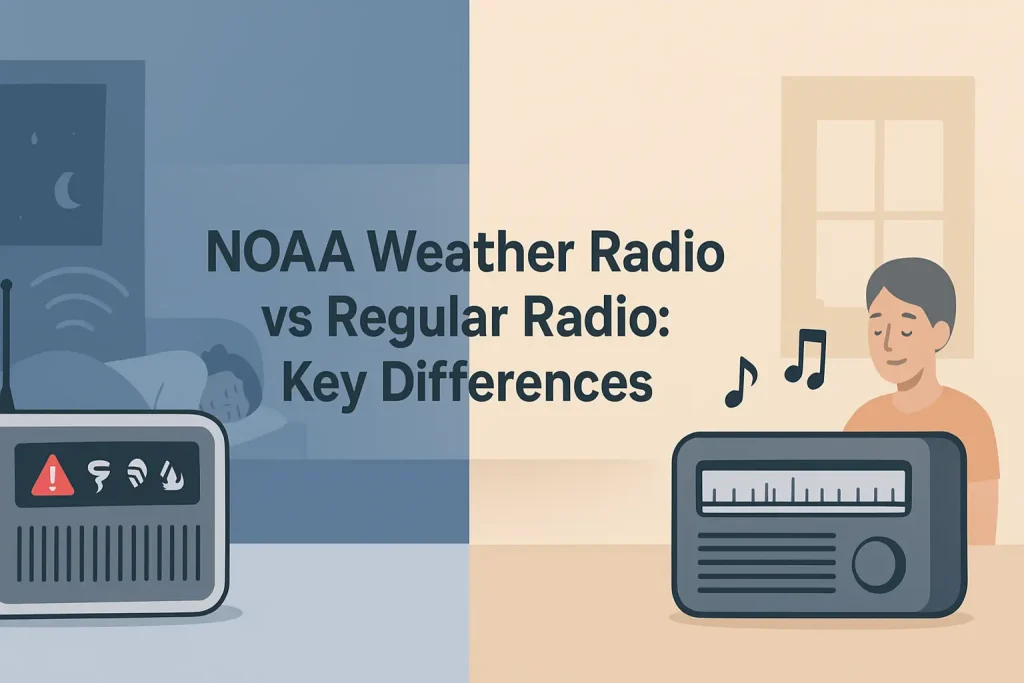
Most major retail stores carry at least one NOAA weather radio model on their shelves, but the selection varies widely depending on where you shop. A basic S.A.M.E.-capable weather radio (one that alerts you only for your specific county using a 6-digit FIPS location code) costs between $25 and $60 at most retailers.
Knowing which stores stock which models saves you a wasted trip. This guide covers every major retail chain, specialty store, and online option where you can find a certified NOAA Weather Radio All Hazards (NWR) receiver today.
| Photo | Popular Portable Walkie Talkies | Price |
|---|---|---|
 | SKIWARRIOR Multifunctional Smart Wireless Ski Goggles with Walkie-Talkie, Anti-Fog Zeiss Lens, Music & Call Function (Cylindrical Blue) | Check Price On Amazon |
 | SINORISE Super Mini Walkie Talkies, Two-Way Radios, 3 Pack | Check Price On Amazon |
 | KOSPET Tank M4C Smart Watch Rugged, Dual-Band GPS, 5ATM & IP69K Waterproof | Check Price On Amazon |
 | Retevis RT15 Walkie Talkies 3 Pack, Birthday Gift, Outdoor Adventure Kit | Check Price On Amazon |
 | Rechargeable Walkie Talkies Toys for Kids: DIY Astronaut Walkie Talkies for Boys Christmas Birthday Gifts for 3 4 5 6 7 8 9 10 Boy Walkie Talkie Outdoor Hiking Toy 2 Way Radio Camping Outdoor Game | Check Price On Amazon |
By the Numbers
NOAA Weather Radio All Hazards – Key Coverage and Specification Facts
Sources: NOAA National Weather Service, FCC Part 11 (EAS), FEMA IPAWS documentation
Before you drive to any store, it helps to know what you are actually looking for. Not every radio sold as a “weather radio” is a true NOAA NWR receiver with S.A.M.E. (Specific Area Message Encoding) capability.
A radio without S.A.M.E. will sound an alarm for every severe weather alert issued anywhere in your state, not just your county. That matters at 3 a.m. when a tornado warning is issued 200 miles away from you.
What Is a NOAA Weather Radio and Why Does the Store You Choose Matter?
A NOAA Weather Radio All Hazards receiver is a dedicated AM/FM-band-adjacent device that monitors one or more of the seven NWR broadcast frequencies (162.400, 162.425, 162.450, 162.475, 162.500, 162.525, and 162.550 MHz) continuously, 24 hours a day. The radio activates an alarm only when NOAA transmits a digital alert tone for your programmed location code.
The store you choose matters because not all retail locations carry the same models. A big-box electronics retailer might stock three or four dedicated weather radio models with full S.A.M.E. programming. A convenience store near a campground might sell a basic portable unit that receives the NWR frequencies but lacks county-level filtering entirely.
According to NOAA’s National Weather Service technical documentation, a certified NWR receiver must be capable of receiving all seven broadcast frequencies and responding to the digital 1050 Hz alert tone that precedes emergency broadcasts. S.A.M.E. decoding capability is an additional feature, not a legal requirement for the radio to be sold as a weather radio.
This is the gap that catches most buyers off guard at retail. Always look for “S.A.M.E.” or “SAME technology” on the box before purchasing.
The store choice also affects price. The same Midland WR400 model that sells for $49.99 at a camping supply retailer may be $54.99 at a pharmacy chain simply because of retail markup differences by channel.
Knowing which retail types stock which tiers of weather radios lets you match your budget and feature requirements to the right shopping destination before you leave home.
Which Big-Box Retail Stores Carry Weather Radios In-Store?
Walmart, Target, and Best Buy are the three most reliable sources for in-store weather radio purchases in the United States. All three typically stock at least two to four weather radio models in their electronics departments, though selection depth varies significantly by store size and location.
Walmart carries weather radios in its electronics section near portable radios and emergency preparedness supplies. Common models stocked include the Midland WR120B and the Uniden BC365CRS, both of which include S.A.M.E. county-level alert programming. Our full breakdown of weather radios available at Walmart covers current model availability and pricing by store tier.
Target stocks weather radios in its emergency preparedness and electronics sections. Selection at Target tends to be narrower than Walmart, often carrying one or two models in the $30-$50 range.
Best Buy carries a wider range of feature-rich models, including combination AM/FM/NOAA units and desk-mount alert radios with backup battery systems. Prices at Best Buy typically start around $35 and extend to $80 for models with digital displays and alarm clock integration.
Use the table below to compare what each big-box retailer typically carries by model tier and price range.
| Retailer | In-Stock Models (Typical) | Price Range | S.A.M.E. Available? | Section in Store |
|---|---|---|---|---|
| Walmart | Midland WR120B, Uniden BC365CRS | $25-$50 | Yes | Electronics / Emergency Prep |
| Target | Midland WR120B, Sangean CL-100 | $30-$55 | Yes | Electronics / Seasonal |
| Best Buy | Midland WR400, Uniden BC365CRS, Eton FR160 | $35-$80 | Yes | Portable Audio / Electronics |
| Costco | Seasonal; hand-crank combo units | $40-$70 | Sometimes | Emergency Preparedness (seasonal) |
| Sam’s Club | Seasonal; emergency kit bundles | $35-$65 | Sometimes | Electronics / Emergency Prep |
Costco and Sam’s Club are inconsistent sources for weather radios. They carry them seasonally (most reliably from April through September in tornado-prone regions) but may not stock them year-round.
If you need a weather radio today and your nearest Costco is the only convenient option, call ahead to confirm stock before making the trip.
Do Home Improvement Stores Like Home Depot and Lowe’s Carry Weather Radios?
Home Depot and Lowe’s both carry weather radios, though they stock them in a different section than most shoppers expect. You will typically find weather radios in the safety and security aisle or near the smoke detector and CO alarm displays, not in the electronics section.
Home Depot typically carries one or two models from Midland, most commonly the Midland WR120B, which receives all seven NOAA frequencies and includes S.A.M.E. county-level programming for up to 25 location codes. Prices at Home Depot typically run $5-$10 higher than Walmart for the same model.
Lowe’s follows a similar stocking pattern. The selection is usually limited to one or two entry-level S.A.M.E. weather radios, with occasional stock of combination models that include a flashlight or AM/FM radio alongside the NOAA receiver.
Both chains are more reliable sources during spring severe weather season (March through June) when they expand their emergency preparedness display space. Stock thins significantly in winter months in most regions.
The key advantage of buying from a home improvement store is convenience if you are already purchasing smoke detectors or emergency supplies. The key disadvantage is limited selection and a slightly higher retail markup than dedicated electronics stores.
If you need a feature-rich model with digital S.A.M.E. programming, a backlit display, and battery backup, home improvement stores are rarely your best option. They are most useful when you need a basic, reliable S.A.M.E. radio quickly and are already in the store for another purpose.
Can You Buy a Weather Radio at Pharmacies Like CVS, Walgreens, or Rite Aid?
CVS, Walgreens, and Rite Aid carry weather radios, but their selection is almost exclusively limited to entry-level models in the $20-$35 range. These are typically positioned in the seasonal hurricane/emergency preparedness section or near batteries and flashlights, and they appear most reliably in stores located in hurricane-prone or tornado-prone states.
Pharmacy-stocked weather radios tend to be basic AM/FM/NOAA combination portables from brands like Sangean or Eton. Many do not include S.A.M.E. technology. They receive NOAA frequencies and sound the 1050 Hz alert tone, but they cannot filter alerts by county code.
For many buyers, a pharmacy weather radio is better than no weather radio at all, particularly for a car emergency kit or a go-bag where portability matters more than alert filtering. But for a home installation where you want county-specific alerts that do not wake you for storms 150 miles away, a pharmacy model is the wrong choice.
Pharmacy stock is highly regional. A CVS in coastal Florida or a Walgreens in Oklahoma City is far more likely to carry weather radios year-round than a pharmacy in a lower-risk region. If you are unsure whether your local pharmacy carries them, the store’s website inventory check or a phone call will save you a trip.
The one consistent advantage of pharmacy channels is late-night and weekend availability. CVS and Walgreens stores with 24-hour locations can be a source of last resort when severe weather is approaching and every other retailer is closed.
Do Outdoor and Camping Stores Carry Weather Radios?
REI, Bass Pro Shops, Cabela’s, and Academy Sports and Outdoors are among the most reliable in-store sources for weather radios beyond basic big-box retailers. These stores typically carry a wider selection than pharmacies or home improvement stores, including hand-crank solar combination models designed for off-grid use.
REI stocks portable weather radios with hand-crank and solar charging capability, including models from Midland and Eton. The Eton FRX3+ emergency radio is a common REI carry item. It receives all seven NOAA frequencies, includes S.A.M.E. alert programming, and charges via hand crank, solar panel, or USB.
Key Specifications for the Eton FRX3+:
- NOAA frequencies: All 7 (162.400-162.550 MHz)
- S.A.M.E. capability: Yes, with county-level programming
- Power sources: Hand crank, solar, USB, and 3x AA batteries
- Additional features: AM/FM reception, LED flashlight, smartphone charging via USB
- Typical retail price at REI: $60-$75
Bass Pro Shops and Cabela’s carry weather radios in their emergency preparedness and safety sections. Selection typically includes both desktop S.A.M.E. alert models and portable hand-crank units. Prices are comparable to Best Buy, ranging from $35 to $80.
Academy Sports and Outdoors is a strong regional option in the South and Midwest, where severe weather threats are highest. Academy typically stocks Midland weather radios and hand-crank emergency radios at prices within $5-$10 of online pricing.
Outdoor stores have one significant advantage over general retailers: staff familiarity with the product. Sales staff at REI and Bass Pro Shops are more likely to know which models include S.A.M.E. technology and what the difference is between a basic NWR receiver and a full S.A.M.E.-programmable desktop unit.
Our detailed review of the Eton FRX3+ hand-crank emergency radio covers its S.A.M.E. programming process, real-world alert performance, and how it compares to dedicated desktop NWR receivers for home use.
What About Electronics Specialty Stores and Radio Shack Successors?
The original Radio Shack chain closed most of its US locations, but successor brands and independent radio specialty dealers remain relevant sources for weather radios. Stores like Fry’s Electronics (where still open), Micro Center, and independent amateur radio dealers carry a wider range of NWR-capable receivers than any general retailer.
Ham radio specialty stores are the most overlooked retail source for serious weather radio buyers. Amateur radio dealers like Ham Radio Outlet (with locations in 13 states) and R&L Electronics stock dedicated NWR receivers alongside amateur radio equipment. These stores carry upper-tier models from Uniden, Sangean, and combination scanner/weather radio units that pick up both NOAA frequencies and local public safety communications.
The Uniden Bearcat scanner with weather radio capability is a common item at ham radio dealers. It monitors NOAA NWR frequencies alongside local fire, police, and EMS frequencies simultaneously. This combination appeals to emergency preparedness buyers who want both NOAA alert monitoring and local public safety awareness.
The key limitation of specialty radio stores is geographic availability. They are concentrated in major metropolitan areas and are not a practical option for rural buyers or those in smaller cities.
For buyers near a Ham Radio Outlet location or a regional amateur radio dealer, the staff expertise and product depth make these stores the best in-person retail experience for weather radio purchases. Staff at these stores can explain S.A.M.E. code programming, recommend the right NWR transmitter frequency for your county, and explain the difference between analog and digital alert protocols without reading from the box.
Does Costco Carry Weather Radios and Is the Selection Worth It?
Costco carries weather radios, but availability is seasonal and inconsistent across locations. The most reliable window for finding weather radios at Costco is spring through early summer, when the chain expands its emergency preparedness seasonal section. In hurricane-prone states like Florida, Texas, and Louisiana, Costco locations are more likely to carry weather radios year-round.
Costco’s typical weather radio offering leans toward hand-crank emergency combo units rather than dedicated desktop NWR receivers. These combination units include AM/FM reception, a built-in LED flashlight, USB charging output for smartphones, and NOAA weather radio reception on all seven frequencies. S.A.M.E. capability varies by model year and specific SKU.
The Costco pricing advantage is real but modest for weather radios. A hand-crank combination model that retails for $60-$75 at REI may be $45-$55 at Costco when in season. The tradeoff is that you cannot choose your specific preferred model. You buy what Costco is stocking that quarter.
If your priority is getting the exact model you want (such as the Midland WR400 with 50 S.A.M.E. code storage and a digital display), Costco is an unreliable source. If your priority is value on an emergency combo radio and you are flexible on model, checking Costco in April or May is a reasonable strategy.
Sam’s Club follows the same seasonal pattern as Costco. Both warehouse clubs are best viewed as bonus options to check rather than primary shopping destinations for weather radios.
The most reliable in-person source for a specific weather radio model at a specific price point remains Walmart, Best Buy, or Amazon with in-store pickup where available.
Where Can You Buy a Weather Radio Near You Using Store Inventory Tools?
Every major retail chain now offers online inventory checking by zip code, which means you can confirm whether a specific weather radio model is in stock at your nearest store before leaving home. This is the single most efficient way to find a weather radio locally without driving to multiple stores.
Here is how to use each retailer’s inventory tool for weather radio searches:
- Walmart.com: Search “NOAA weather radio” or a specific model name. On the product page, click “Check store availability” and enter your zip code. Walmart’s inventory system is real-time and accurate within a few hours for most locations.
- Target.com: Search the model name. On the product page, select “Check stores near you.” Target’s inventory check also shows same-day pickup availability.
- BestBuy.com: Search the product. On the listing page, select “Check stores” to see which nearby locations carry the item in-stock. Best Buy’s system is highly accurate and updates within hours of purchases.
- HomeDepot.com: Search “weather radio” and filter by “Available at nearby store.” The system shows aisle and bay location within the store.
- Lowes.com: Same approach as Home Depot. Search the model or “weather radio” and use the “Find it in store” filter.
The inventory check step takes about two minutes and eliminates the risk of a wasted trip entirely. It is especially valuable during severe weather season when weather radios sell out quickly at stores closest to affected areas.
One caution: pharmacy chains (CVS, Walgreens) have less precise inventory systems. Their online tools show whether a product is carried at a location but are less reliable for real-time stock confirmation. A phone call to the specific store is more reliable for pharmacy chains.
Using store inventory tools before you leave home is the fastest route to finding a weather radio in-stock locally.
The tool below helps you match your specific weather radio needs to the store type most likely to have the right model in stock.
Interactive Tool
Find the Right Store for Your Weather Radio Purchase
Answer 2 questions to get a store recommendation matched to your needs.
Where to Buy a Weather Radio Online: Amazon, Direct Retailers, and What to Watch For
Amazon is the single largest retail source for NOAA weather radios in the United States, carrying every major brand and model tier at prices typically 10-20% lower than in-store retail. For most buyers who are not in an immediate severe weather situation, Amazon is the default best option for selection, price, and verified buyer reviews.
Our guide to the top-rated weather radios available on Amazon covers the best models at each price tier with S.A.M.E. programming notes and alert performance comparisons.
The Midland WR400 is one of the most consistently purchased S.A.M.E. weather radios on Amazon. It programs up to 50 location codes and includes a backlit digital display, AC adapter, and 3x AA battery backup.
Key Specifications for the Midland WR400:
- NOAA frequencies: All 7 (162.400-162.550 MHz)
- S.A.M.E. location codes: Up to 50
- Alert types monitored: 25
- Power: AC adapter with 3x AA battery backup
- Display: Backlit digital with alarm clock
- Typical Amazon price: $45-$55
When buying weather radios online, watch for three common issues:
- Listings without S.A.M.E. confirmation: Some listings use “NOAA weather radio” as a description but the unit only receives NWR frequencies without county-level alert filtering. Check the product specifications for “S.A.M.E.” or “SAME technology” explicitly before purchasing.
- Third-party sellers offering discontinued models: Weather radio models are updated every few years. A “new” listing from a third-party seller may be an old model year with outdated alert type support. Buy from Amazon directly or from the brand’s official storefront when possible.
- Incomplete alert type coverage: Older weather radio models monitored fewer than the current 25 NWR alert categories. Newer models include AMBER Alert, 911 Telephone Outage, and Hazardous Materials alert types that older units do not support. Check the alert type count in the specifications.
Beyond Amazon, direct retailer websites for Midland (midlandusa.com), Uniden (uniden.com), and Eton (etoncorp.com) sell their weather radio lines directly. Prices are typically comparable to Amazon, but shipping times can be slower and return policies vary.
For buyers in hurricane-prone regions who purchase weather radios annually as part of storm season preparation, subscribing to Amazon’s “Subscribe and Save” for battery replacements alongside a one-time weather radio purchase is a practical combined approach.
Which Weather Radio Models Are Most Widely Available In-Store?
The Midland WR120B is the most widely distributed weather radio in US retail stores. It is carried at Walmart, Target, Home Depot, Lowe’s, Best Buy, and most outdoor retailers simultaneously. The WR120B receives all seven NOAA NWR frequencies and includes S.A.M.E. programming for up to 25 location codes, making it a reliable baseline choice available almost anywhere.
Our full Midland WR120B review with S.A.M.E. programming walkthrough covers the complete setup process, alert performance in real-world conditions, and how it compares to the step-up WR400 model.
Use the table below to compare the most widely in-store-available weather radio models by key specifications and where to find them.
| Model | S.A.M.E. Codes | Alert Types | Backup Power | Price Range | Where to Find In-Store |
|---|---|---|---|---|---|
| Midland WR120B | 25 | 25 | 3x AA | $25-$35 | Walmart, Target, Home Depot, Lowe’s, Best Buy |
| Midland WR400 | 50 | 25 | 3x AA | $45-$55 | Best Buy, Bass Pro, REI (varies) |
| Uniden BC365CRS | 23 | 25 | 3x AA | $35-$50 | Walmart, Best Buy |
| Sangean CL-100 | 10 | 25 | 6x AA | $60-$70 | Best Buy, specialty retailers |
| Eton FRX3+ | Yes | 25 | Hand crank, solar, AA | $60-$75 | REI, Bass Pro, Academy Sports |
The Midland WR120B is the right choice for most buyers who need an in-store purchase today. It is available at more retail locations than any other model, includes full S.A.M.E. county-level programming, and costs under $35 at most chains.
Quick Reference: Key Weather Radio Terms You Will See In-Store and Online
Quick Reference: Weather Radio Terms
NOAA NWR: NOAA Weather Radio All Hazards, the federal broadcast network transmitting weather and emergency alerts 24 hours a day on seven dedicated VHF frequencies.
S.A.M.E.: Specific Area Message Encoding. A digital coding system that lets your radio activate alerts only for the counties you program, filtering out alerts for distant areas.
FIPS code: A 6-digit Federal Information Processing Standards code that identifies each US county. You enter this code into your weather radio to enable S.A.M.E. county-level filtering.
1050 Hz alert tone: The digital tone that precedes every NOAA NWR broadcast. A certified weather radio wakes from standby mode when it detects this tone on a monitored frequency.
EAS: Emergency Alert System. The federal public warning system that integrates NOAA NWR, broadcast television, radio, and wireless carrier alerts (WEA) into one coordinated network.
WX1-WX7: The seven NOAA NWR broadcast channel designations. WX1 = 162.550 MHz, WX2 = 162.400 MHz, WX3 = 162.475 MHz, WX4 = 162.425 MHz, WX5 = 162.450 MHz, WX6 = 162.500 MHz, WX7 = 162.525 MHz.
Battery backup: The secondary power source (typically AA or AAA batteries) that keeps your weather radio functional during a power outage. This is the most important feature for severe storm use.
Alert memory: The number of past alerts your radio stores in memory. Models with larger alert memory (50+) let you review what alerts were broadcast while you were away from home.
Hand-crank radio: A portable emergency radio that generates power via a manually cranked generator coil. Most hand-crank weather radios also charge via solar panel and USB, making them useful for off-grid and go-bag applications.
Alert type coverage: The number of distinct NWR alert categories a radio monitors. Current models cover 25 alert types, including tornado warnings, flash flood warnings, hurricane warnings, AMBER alerts, and civil emergency messages.
Does Weather Season Affect In-Store Availability Near You?
Yes, and the effect is significant. Weather radio in-store stock at major retail chains is directly correlated with regional severe weather threat cycles. Retailers in tornado-prone states (Oklahoma, Kansas, Texas, Missouri, Alabama) and hurricane-prone coastal states (Florida, Louisiana, North Carolina, Texas) increase their weather radio inventory from March through September.
In the Midwest and Southeast, the peak in-store availability window aligns with tornado season: March through early June. Retailers in these regions typically double their weather radio shelf space and add end-cap displays during this period. Stock can deplete quickly following a major severe weather event, as community buying surges after a nearby tornado or severe thunderstorm outbreak.
In Atlantic and Gulf coastal regions, hurricane season (June 1 through November 30) drives the primary stocking cycle. Retailers in Florida, Texas, Louisiana, and the Carolinas carry weather radios most reliably from May through October. Post-hurricane buying surges can clear store shelves within 48 hours of a storm warning.
In northern states with lower severe weather frequency, some retailers reduce weather radio shelf presence significantly in winter months. If you live in Minnesota, Wisconsin, or the upper Northeast and are shopping for a weather radio in January or February, online purchasing is more reliable than in-store availability at non-specialty retailers.
The practical implication: if you live in a high-risk weather region, buy your weather radio in the off-season (November through February) when demand is lower, shelf stock is stable, and you can take time to choose the right model without storm pressure. Waiting until a tornado watch is issued to go buy a weather radio is how people end up with a basic pharmacy portable instead of the S.A.M.E.-capable desktop model they actually needed.
For a complete guide to how seasonal weather patterns should influence your weather radio setup timing, our complete weather radio buying guide with seasonal preparation checklist covers the month-by-month action plan for different threat regions across the US.
What Should You Check Before Buying a Weather Radio At Any Store?
Before purchasing any weather radio in-store or online, check four things on the box or product listing to confirm you are getting a radio that will actually serve its emergency purpose. Skipping this check is how buyers end up with a $25 AM/FM portable that receives NOAA frequencies but cannot wake them during a nighttime tornado warning.
Check 1: Does the box say “S.A.M.E.” or “SAME technology”? A weather radio without S.A.M.E. decoding will alert you for every warning issued anywhere in your state. At night, this means alarms for storms 200 miles away. S.A.M.E. filters alerts to only your programmed county codes.
Check 2: Does it have battery backup? A weather radio that only runs on AC power is useless during a power outage, which is exactly when you need it most. Most S.A.M.E.-capable models include 3x AA battery backup. Confirm this on the box.
Check 3: How many S.A.M.E. location codes does it store? Entry-level models store 7-25 codes. If you travel frequently, have a vacation home, or want to monitor adjacent counties, choose a model with 25-50 code storage. The Midland WR400 stores 50 codes. The WR120B stores 25.
Check 4: Does it cover all 25 current NWR alert types? Older models support fewer alert types. The box should state “25 alert types” or list specific alerts including AMBER Alert and Hazardous Materials. Models that only list “weather alerts” may not support civil emergency or non-weather hazard broadcasts.
These four checks take about 60 seconds in-store and completely eliminate the risk of buying the wrong radio. A weather radio is one of those purchases where the difference between a $25 basic model and a $45 S.A.M.E.-capable model matters significantly in an actual emergency.
Our comprehensive review of the best weather radios across all price tiers ranks current models by S.A.M.E. code capacity, alert type coverage, backup power reliability, and overall emergency preparedness value.
Hand-Crank and Portable Weather Radios: Where to Find Them In-Store
Hand-crank weather radios are sold at a narrower set of stores than desktop S.A.M.E. alert models. REI, Bass Pro Shops, Cabela’s, Academy Sports, and Amazon are the most reliable sources. General retailers like Walmart and Target carry hand-crank portables seasonally but do not maintain consistent year-round inventory at most locations.
A hand-crank weather radio differs from a desktop NWR receiver in three important ways. It is designed to operate without any external power source. It includes multiple charging inputs (hand crank, solar panel, USB input). It is built as a portable go-bag or emergency kit item, not a permanent home installation.
The Midland ER310 emergency crank radio is one of the most widely stocked hand-crank models at outdoor retailers. It includes S.A.M.E. county-level alert programming, all seven NOAA NWR frequencies, a 2000 mAh internal battery rechargeable by USB or hand crank, a 130-lumen LED flashlight, and an ultrasonic dog whistle for search and rescue signaling.
Key Specifications for the Midland ER310:
- NOAA frequencies: All 7 (162.400-162.550 MHz)
- S.A.M.E. capability: Yes
- Internal battery: 2000 mAh, rechargeable via USB or hand crank
- Additional power: 3x AA battery backup
- Flashlight: 130-lumen LED
- Typical in-store price at outdoor retailers: $55-$70
Our dedicated guide to choosing and using hand-crank weather radios covers the trade-offs between hand-crank portables and desktop S.A.M.E. alert models, including which use cases favor each type and how to evaluate battery capacity for extended power outage scenarios.
For buyers who want a portable weather radio primarily for camping or hiking, the Eton FRX3+ and Midland ER310 are the best options consistently available in-store at outdoor retailers.
For buyers building a home emergency kit who also want portability, the Midland ER310 is the better choice because its 2000 mAh rechargeable battery holds a charge for 30+ hours of standby use, whereas crank-only models require manual energy input for every listening session.
Does Your Local Emergency Management Office Recommend Specific Weather Radios?
Many county and state emergency management offices publish lists of recommended NOAA weather radios for their region. These recommendations account for local NWR transmitter frequency, signal strength in low-coverage areas, and the specific severe weather threats most relevant to that region.
The Federal Emergency Management Agency (FEMA) and NOAA’s National Weather Service both recommend that every household own a weather radio with S.A.M.E. technology and battery backup as part of a basic emergency preparedness kit. This recommendation is documented in FEMA’s Emergency Supply List publication and the NOAA Weather-Ready Nation preparedness guidelines.
To find your county or state emergency management office’s specific weather radio recommendation, search “[your county name] emergency management weather radio” or visit your state emergency management agency website. Many offices also publish the specific NWR transmitter frequency strongest in your area, which is the frequency you should program as the primary channel on your new radio.
NOAA publishes a complete NWR transmitter location database at weather.gov/nwr, where you can enter your zip code and find the nearest transmitter station, its broadcast frequency, and its coverage area. This is the authoritative source for identifying which of the seven NWR frequencies will provide the strongest signal at your specific address.
Programming your weather radio to the strongest local NWR frequency reduces the chance of a missed alert caused by a weak signal triggering the squelch circuit incorrectly. This is a step that most buyers skip because the box does not explain it, but it takes less than two minutes and significantly improves alert reliability in fringe coverage areas.
Can You Buy a Weather Radio at a Dollar Store, Convenience Store, or Gas Station?
Dollar stores (Dollar Tree, Dollar General, Family Dollar) occasionally carry portable AM/FM/NOAA radios, but these are almost never true S.A.M.E.-capable weather alert radios. They are basic portable receivers that can tune to NOAA frequencies and will produce audio when a broadcast is active, but they do not wake from standby when an alert tone is detected and do not filter by county code.
A dollar store weather radio is technically better than no weather radio for situational awareness during daylight hours when you are awake and listening. It will not function as an overnight emergency alert system. It will not wake you when a tornado warning is issued at 2 a.m.
Convenience stores and gas stations near coastal or tornado-prone areas occasionally stock basic portable weather radios in the $15-$25 range during peak severe weather season. These are similar in capability to dollar store models: NWR frequency reception without S.A.M.E. decoding or standby alert activation.
The use case where these radios are genuinely appropriate: you are on a road trip, a severe weather system is developing in the area you are traveling through, and you need immediate weather information in your car without cellular data. A $15 portable NWR receiver in your glove compartment for this scenario is a reasonable purchase.
For home emergency preparedness, do not rely on a convenience store or dollar store weather radio as your primary alert system. The S.A.M.E.-capable models available at Walmart, Target, and Home Depot in the $25-$35 range are only marginally more expensive and provide fundamentally different emergency performance.
Is It Better to Buy a Weather Radio In-Store or Online?
For most buyers, online purchasing through Amazon offers a better selection, lower prices, and verified buyer reviews that help confirm S.A.M.E. programming ease and real-world alert performance. In-store purchasing makes sense in two specific situations: you need the radio today because severe weather is approaching, or you want to physically inspect the size, display quality, and control layout before buying.
In-store pricing is typically $3-$15 higher than Amazon for the same model. Best Buy is usually the closest to Amazon pricing of all physical retailers. Walmart is competitive on entry-level models but less so on mid-tier S.A.M.E. weather radios.
The verified buyer review ecosystem on Amazon is one of the most useful research tools for weather radios specifically. Buyers frequently describe exactly how the S.A.M.E. programming interface works, whether the alarm is loud enough to wake a heavy sleeper, and how the battery backup performed during an actual power outage. This user experience data is not available in-store.
One practical hybrid approach: research models on Amazon using verified reviews to identify your preferred model, then check whether your nearest Walmart or Best Buy has it in stock using their online inventory tool. If it is in stock at comparable pricing, buy it locally. If not, order from Amazon with Prime shipping.
This approach gives you the research depth of online purchasing with the immediacy of in-store pickup when it matters. It is the most efficient buying strategy for weather radios at any urgency level.
What Is the Difference Between a Weather Radio at Walmart vs Best Buy?
Walmart’s weather radio selection skews toward entry-level and mid-tier S.A.M.E. models in the $25-$50 range. Best Buy’s selection includes a wider range of feature-rich models, including larger-display digital alert radios with alarm clock integration, and occasionally combination scanner/weather radio units. Both chains stock the Midland WR120B, which is the reference model for comparing retail availability.
Pricing differences between Walmart and Best Buy for the same model are typically $3-$8 in Walmart’s favor. This gap is smaller than most buyers assume and is rarely the primary decision factor unless you are purchasing multiple units for a family preparedness kit.
The more meaningful difference is staff knowledge. Best Buy’s staff in the portable audio section are more likely to understand the difference between S.A.M.E. and non-S.A.M.E. weather radios and to know which models are currently in stock versus on order. Walmart’s electronics section staff have broader product responsibility and less specialized knowledge of weather radio specifications.
If you plan to ask in-store questions before purchasing, Best Buy is the better in-person retail experience for weather radios. If you already know which model you want and are comparing final prices, Walmart wins on entry-level models and the two chains are comparable on mid-tier S.A.M.E. radios.
For the most detailed current information on weather radio selection at Walmart specifically, including which models are stocked by store size and region, our dedicated guide to buying a weather radio at Walmart covers model availability, pricing, and in-store location tips by department.
Does the NWR Signal Reach Your Home Before You Buy?
This is the question most buyers skip entirely, and it matters more than which store you buy from. NOAA’s NWR transmitter network covers approximately 95% of the US population, but coverage within that 95% varies significantly by terrain, building construction, and distance from the nearest transmitter. A weather radio in a concrete basement or a rural property 60 miles from the nearest NWR transmitter may receive a weak or intermittent signal.
Before purchasing any weather radio, verify your address is within reliable NWR coverage using the NOAA NWR coverage map at weather.gov/nwr. Enter your zip code to identify the nearest transmitter, its broadcast frequency, and estimated coverage area. Properties at the edge of a transmitter’s coverage zone may receive only marginal signals on a standard indoor antenna.
If your property is in a marginal coverage area, two solutions exist. First, place the weather radio near an exterior wall or window facing the transmitter direction. Second, purchase a model with an external antenna jack (such as the Midland WR400) and connect a dedicated NWR antenna mounted outside or in an attic to improve signal reception. External antennas for NWR frequencies are available online for $15-$30 and can transform a marginal signal into a reliable one.
The signal coverage check takes two minutes at weather.gov/nwr and should be the first step before you decide whether to buy a $30 entry-level model or invest in a $50 model with external antenna capability.
If you are in a reliable coverage zone, any certified S.A.M.E.-capable weather radio from any of the stores listed in this guide will serve you well. Coverage adequacy, not retail source, is the most important factor in weather radio performance.
Are Weather Radios Sold at Grocery Stores or Hardware Stores?
Hardware stores beyond Home Depot and Lowe’s, including regional chains like Menards, Ace Hardware, and True Value, occasionally carry weather radios in their safety and electrical supply sections. Availability is inconsistent and varies heavily by region and store size. Menards locations in tornado-prone Midwest states are more likely to carry Midland weather radios than a small urban Ace Hardware store.
Grocery stores do not typically carry weather radios. The exception is large-format grocery and general merchandise hybrid stores like Meijer (Midwest), Fred Meyer (Pacific Northwest, owned by Kroger), and H-E-B (Texas), which carry limited electronics including weather radios in their general merchandise sections during peak severe weather season.
H-E-B in Texas is a notable example. Texas experiences frequent severe weather including tornadoes, hurricanes, and flash flooding. H-E-B stores throughout Texas maintain year-round weather radio inventory and expand their selection significantly before and during hurricane season. H-E-B frequently carries Midland and Uniden S.A.M.E. weather radios at prices competitive with Walmart.
Regional hardware chains vary widely. Menards in the Midwest and True Value locations in storm-prone areas are worth checking if they are more convenient than a big-box option. The most reliable confirmation method is always the store’s website inventory check or a phone call before driving.
What Is the Best Weather Radio to Buy Right Now?
The Midland WR400 is the best overall weather radio for most buyers. It stores 50 S.A.M.E. location codes, monitors all 25 NWR alert types, includes a backlit digital display with alarm clock functionality, and provides 3x AA battery backup. At $45-$55, it is the best balance of features and price in the dedicated desktop category.
For buyers who need a budget option available at the widest range of stores today, the Midland WR120B at $25-$35 is the right choice. It is available at Walmart, Target, Home Depot, Lowe’s, and Best Buy simultaneously and includes full S.A.M.E. programming for 25 location codes with 3x AA battery backup.
For a portable emergency kit or camping use, the Midland ER310 hand-crank emergency radio at $55-$70 is the most feature-complete option available at outdoor retailers. It includes S.A.M.E. programming, a 2000 mAh rechargeable battery, hand crank, solar charging, and USB output for charging other devices during an outage.
For buyers who want the highest-end dedicated desktop weather alert experience, the Sangean CL-100 at $60-$70 provides the largest backlit display, 6x AA battery backup, and the clearest audio of any model in this category. It is available at Best Buy and specialty electronics retailers.
Store availability for each recommended model:
- Midland WR120B ($25-$35): Walmart, Target, Home Depot, Lowe’s, Best Buy, Amazon
- Midland WR400 ($45-$55): Best Buy, Bass Pro Shops, Amazon (most reliable source)
- Midland ER310 ($55-$70): Bass Pro Shops, Academy Sports, REI, Amazon
- Eton FRX3+ ($60-$75): REI, Bass Pro Shops, Amazon
- Sangean CL-100 ($60-$70): Best Buy, specialty audio stores, Amazon
The right choice depends entirely on your use case: home desktop alert system, portable emergency kit, or camping and off-grid communication. Match the model to the use case first, then confirm availability at your nearest preferred store using their online inventory tool.
Do You Need to Register Your Weather Radio After Purchase?
You do not need to register a weather radio with NOAA or the FCC to use it legally. NOAA NWR is a receive-only broadcast service. Unlike GMRS radios (which require a $35 FCC license to transmit), a weather radio is a passive receiver and requires no registration, license, or activation of any kind.
Some manufacturers, including Midland and Uniden, offer optional product registration through their websites for warranty purposes. This is a manufacturer warranty registration, not a government requirement. Registering with the manufacturer typically extends your ability to process warranty claims and receive product update notifications, but it is entirely optional for legal use.
The only setup step required for a weather radio is programming your S.A.M.E. FIPS code. This is a 6-digit county identifier you enter into the radio using the keypad or menu system. NOAA publishes a complete FIPS code lookup tool at weather.gov/nwr where you can find the correct code for your county in under a minute.
Without a programmed S.A.M.E. FIPS code, your weather radio will alert for every warning issued across your entire state. With the correct FIPS code programmed, it alerts only for your county (and any additional counties you add). This 2-minute programming step is the single most important setup action after purchase.
Are There Any Weather Radios That Work Without Power or Batteries?
Yes. Hand-crank weather radios generate their own power through a manually operated generator coil. One minute of hand-cranking typically provides 10-20 minutes of listening time on most models, though this varies by model efficiency and crank speed. The Midland ER310 requires approximately 1-2 minutes of cranking for 10-15 minutes of radio operation.
The practical limitation of hand-crank power is that it is not suitable for continuous 24-hour standby monitoring, which is the primary use case for a home weather alert radio. A hand-crank model should always include a secondary power source (internal rechargeable battery, solar panel, or AA batteries) for standby alert duty.
Solar charging on portable weather radios is useful as a supplementary charging source but is not reliable as a sole power supply indoors or in low-light conditions. Most solar-charging weather radios require direct sunlight for effective charging, meaning an indoor window placement in winter months may provide insufficient solar input to maintain battery charge.
For a home installation where the radio must remain on continuous standby and alert you overnight, a desktop S.A.M.E. model with AC power and AA battery backup is more reliable than a hand-crank solar portable. The hand-crank portable is the right choice for a go-bag, emergency kit, camping, or any scenario where AC power is unavailable.
Can a Weather Radio Also Receive GMRS or FRS Walkie-Talkie Frequencies?
No. A dedicated NOAA weather radio operates exclusively on the seven NWR broadcast frequencies between 162.400 and 162.550 MHz. It cannot receive GMRS frequencies (462-467 MHz) or FRS walkie-talkie channels. These are completely different frequency bands requiring different receiver hardware.
The reverse is also true. A GMRS or FRS walkie-talkie cannot receive NOAA NWR broadcasts unless it specifically includes a built-in weather channel feature. Many mid-range and premium GMRS walkie-talkies with built-in weather channels include NWR reception as an add-on feature alongside their two-way radio capability. However, most of these do not include S.A.M.E. decoding. They receive and play NWR broadcasts but do not activate a standby alert for county-specific warnings.
A combination scanner radio (such as the Uniden Bearcat series) can monitor both NOAA NWR frequencies and GMRS/FRS frequencies simultaneously, but these are fundamentally scanner receivers, not dedicated weather alert radios. They provide excellent situational awareness but lack the dedicated S.A.M.E. alert activation reliability of a purpose-built NWR receiver.
For emergency preparedness, a dedicated S.A.M.E.-capable weather radio is always the better choice for overnight and standby alert monitoring than a walkie-talkie with a weather channel or a combination scanner.
What Is the Loudest Weather Radio Alarm Available?
The loudest weather radio alarms on dedicated NWR receivers typically reach 85-90 dB at one meter, which is sufficient to wake most adults from sleep in an adjacent room with a closed door. The alarm volume is a critical factor for overnight alert use and is surprisingly underspecified on most product boxes.
Among widely available models, the Midland WR400 and Uniden BC365CRS both produce alarms at approximately 85 dB, which is the standard for most S.A.M.E.-capable desktop radios in the $35-$55 range. The Sangean CL-100 produces a slightly louder alarm at approximately 88 dB due to its larger speaker driver.
For households with heavy sleepers or hearing loss considerations, placing the weather radio in the bedroom (rather than a common area) is a more reliable approach than relying on alarm volume alone. Some buyers use a second unit in the bedroom specifically for overnight alert monitoring alongside a primary unit in a common area.
Third-party bed shaker and strobe light accessories are available for NOAA weather radios with auxiliary output jacks. These are designed for deaf and hard-of-hearing users and connect to the radio’s alarm output to provide vibration and visual alerts during the NWR alarm sequence. The bed shaker weather radio alert accessories require a model with a dedicated auxiliary alarm output jack, which is present on the Midland WR400 and some Uniden models but not on most entry-level radios.
How Do You Program S.A.M.E. Codes on a Weather Radio After Buying It?
Programming S.A.M.E. FIPS codes on a weather radio takes 2-5 minutes and requires only the 6-digit FIPS code for your county, which you can find at weather.gov/nwr by entering your zip code. The process differs slightly by model but follows the same basic sequence on all major brands.
General S.A.M.E. programming steps for Midland WR120B and WR400 models:
- Power on the radio and locate the SAME or PROG button on the front panel.
- Press and hold the SAME button until the display shows “SAME” and a cursor appears for code entry.
- Enter your 6-digit FIPS code using the channel up/down buttons to scroll through digits. Press SAME again to advance to the next digit position.
- Confirm the full 6-digit code is displayed correctly on screen.
- Press SAME one final time to save the code. The radio returns to normal monitoring mode with your county code programmed.
- Repeat for additional counties if you want to monitor neighboring areas (up to the model’s maximum code storage limit).
- Test the programming by pressing the TEST button to confirm the radio triggers an alert sequence properly.
If your county receives an NWR alert and your radio does not activate, the most common cause is an incorrectly entered FIPS code. The second most common cause is that the radio is tuned to an NWR frequency with insufficient signal strength for your location. Verify the FIPS code against the NOAA lookup tool and confirm you are tuned to the nearest transmitter frequency for your address.
The S.A.M.E. programming process is the most important step after purchase. A weather radio monitoring the wrong county code provides no meaningful protection during a localized severe weather event.
What Happens If You Buy a Weather Radio and There Is No NWR Transmitter Near You?
If you live in a rural area more than 40-60 miles from the nearest NWR transmitter, you may receive a weak or intermittent signal on your standard indoor-antenna weather radio. NOAA’s NWR network covers approximately 95% of the US population, but the remaining 5% of geographic area (mostly remote rural regions) has limited or no NWR coverage.
Three solutions exist for marginal or no-coverage situations. First, connect an external antenna to your weather radio. Models with an external antenna jack (Midland WR400, Sangean CL-100) can use a dedicated NWR antenna mounted in an attic or on an exterior wall to dramatically improve signal reception in fringe areas. External NWR antennas cost $15-$30 online.
Second, check whether a different NWR frequency provides stronger coverage at your location. NOAA’s transmitters broadcast on different frequencies (WX1 through WX7) and adjacent transmitters in your region may not all use the same frequency. The NOAA NWR coverage map at weather.gov/nwr shows all transmitters near your address with their frequencies and coverage areas. Test all seven frequencies to find the strongest signal.
Third, for areas with no viable NWR signal at any frequency, consider a cellular-based Wireless Emergency Alert (WEA) system as a supplement. WEA alerts are broadcast to all compatible cellular devices in an alert area automatically. While WEA lacks the 24-hour standby monitoring and county-specific filtering of a S.A.M.E. weather radio, it provides a backup alert mechanism for areas without NWR coverage.
NOAA’s NWR network continues to expand transmitter coverage. Areas with marginal signal today may have improved coverage within a few years as NOAA adds transmitter sites in underserved regions.
Most buyers in major metropolitan and suburban areas do not need to worry about NWR coverage. Coverage is reliable within 40 miles of any major metropolitan transmitter. The coverage check is most relevant for rural properties, mountain communities, and remote coastal areas.
The fastest way to find the best weather radio for your specific coverage situation and budget is to use our side-by-side comparison of top-rated NOAA weather radios which includes notes on external antenna compatibility for each model reviewed.
A certified S.A.M.E.-capable NOAA weather radio with battery backup is available at Walmart, Target, Best Buy, Home Depot, Lowe’s, REI, Bass Pro Shops, and Amazon for $25-$75 depending on features. Use your retailer’s online inventory tool to confirm the Midland WR120B or WR400 is in stock at your nearest preferred store, program your 6-digit county FIPS code within five minutes of unboxing, and your home will have the same early warning capability used by emergency management professionals throughout the United States.
| Photo | TOP RATED WALKIE TALKIES | Price |
|---|---|---|
 | Retevis RT628 Kids Walkie Talkies, Toys Gifts for 4-12 Year Old Girl Boy | Check Price On Amazon |
 | Cobra ACXT545 Weather-Resistant Walkie Talkies, Rechargeable, 22 Channels | Check Price On Amazon |
 | Retevis RT388 Kids Walkie Talkies, Outdoor Toys for Kids Camping Essentials | Check Price On Amazon |
 | Cobra RX680 Walkie Talkies (2-Pack), IP54 Water Resistant Design | Check Price On Amazon |
 | Retevis RT22 Walkie Talkies Long Range Rechargeable with Earpiece (2 Pack) | Check Price On Amazon |
 | Midland GXT1000VP4 GMRS Two-Way Radios with Headsets, Black, 2 Pack | Check Price On Amazon |
 | Retevis RT628 Walkie Talkies for Kids,Toys Gifts for 6-12 Years Old Boys Girls,Long Range 2 Way Radio 22CH VOX,Birthday Gift,Family Walkie Talkie for Camping Hiking Indoor Outdoor | Check Price On Amazon |