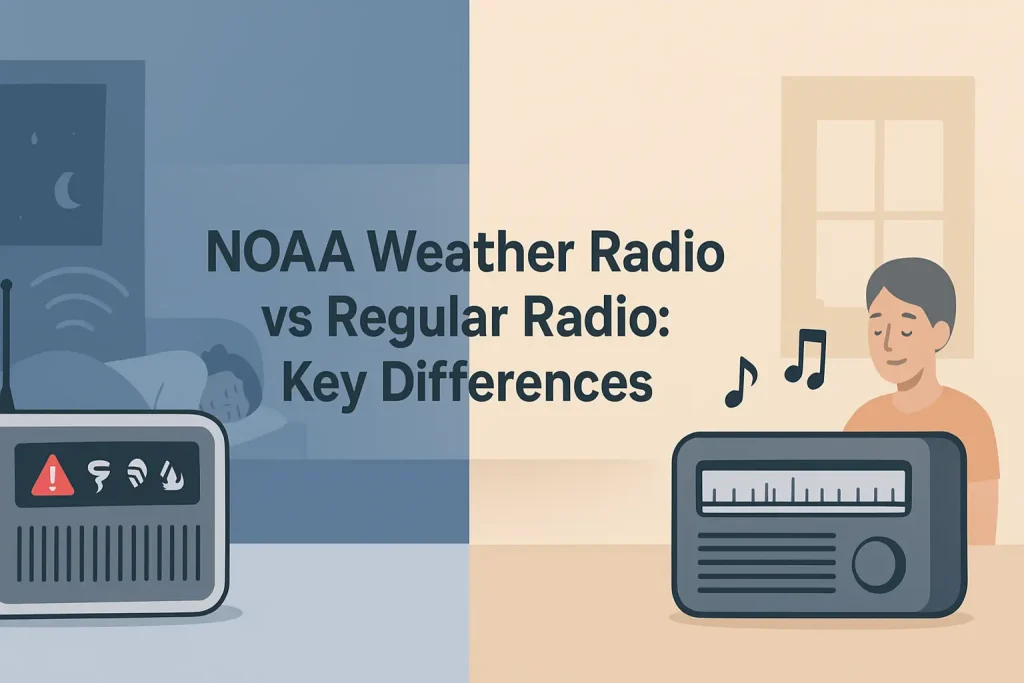
NOAA Weather Radio All Hazards broadcasts continuous warnings on seven dedicated frequencies between 162.400 and 162.550 MHz. A properly programmed weather alert radio receives these signals and sounds a loud siren before a tornado touches down.
Cellular networks often fail during severe thunderstorms when power grids go down and towers lose connectivity. A dedicated VHF receiver provides a direct link to the National Weather Service without relying on local infrastructure.
| Photo | Popular Portable Walkie Talkies | Price |
|---|---|---|
 | SKIWARRIOR Multifunctional Smart Wireless Ski Goggles with Walkie-Talkie, Anti-Fog Zeiss Lens, Music & Call Function (Cylindrical Blue) | Check Price On Amazon |
 | SINORISE Super Mini Walkie Talkies, Two-Way Radios, 3 Pack | Check Price On Amazon |
 | KOSPET Tank M4C Smart Watch Rugged, Dual-Band GPS, 5ATM & IP69K Waterproof | Check Price On Amazon |
 | Retevis RT15 Walkie Talkies 3 Pack, Birthday Gift, Outdoor Adventure Kit | Check Price On Amazon |
 | Rechargeable Walkie Talkies Toys for Kids: DIY Astronaut Walkie Talkies for Boys Christmas Birthday Gifts for 3 4 5 6 7 8 9 10 Boy Walkie Talkie Outdoor Hiking Toy 2 Way Radio Camping Outdoor Game | Check Price On Amazon |
By the Numbers
Weather Alert Radios – Key Specifications and Standards
Sources: NOAA NWR documentation, FCC Part 95
What Makes a Weather Alert Radio Essential for Tornadoes and Severe Thunderstorms?
Weather alert radios receive instant government broadcasts directly from the National Weather Service. You get a loud tone alert that wakes you up seconds after a severe thunderstorm or tornado warning is issued.
This happens because NOAA Weather Radio operates on dedicated VHF frequencies separate from commercial AM and FM stations. A scanner or standard broadcast receiver cannot decode the digital alert headers.
This only occurs when your radio has S.A.M.E. (Specific Area Message Encoding) decoding and proper power backup. The receiver stays silent until it matches a valid alert code.
If your radio lacks battery backup, the result is a dead receiver during a power outage. Fix it by keeping six AA batteries in your radio at all times.
According to NOAA documentation, over 95% of the US population lives within 40 miles of a NWR transmitter. A dedicated home NOAA weather receiver is your most reliable warning tool.

You need a dedicated receiver because weather alerts use a digital bursting tone that normal AM/FM radios ignore. This tone activates the siren and turns on the speaker for the voice warning.
How Does S.A.M.E. Technology Filter Weather Alerts?
S.A.M.E. technology uses a 6-digit FIPS code to filter alerts so you only hear warnings for your specific county. You program this code into your radio to prevent alert fatigue.
This happens because the NOAA broadcast includes a digital header before the audio alarm. The radio decodes this header and opens the speaker only if the code matches your programmed location.
If you program the wrong FIPS code, the result is missed alerts or alarms for the wrong county. Fix it by verifying your exact S.A.M.E. code through the NOAA website.
A weather radio without S.A.M.E. technology wakes you up for every county in your state. S.A.M.E. decoding lets you sleep through storms that miss your exact location by 20 miles.
The National Weather Service issues over 80 specific alert types via S.A.M.E. codes. You can filter these to only wake you for tornado warnings and ignore less critical alerts.
S.A.M.E. technology consists of a digital decoder chip, a memory bank for county codes, and the alert siren. Proper filtering prevents you from disabling the radio entirely after too many false alarms.
Top Weather Alert Radios for Severe Thunderstorms and Tornadoes
Desktop and portable weather receivers offer different combinations of alerting and power backup. You need a model that fits your specific survival plan.
Use the table below to choose between desktop and portable weather alert radios for your home or shelter.
| Model | Type | S.A.M.E. Codes | Power Backup | Price |
|---|---|---|---|---|
| Midland WR400 | Desktop | 50 | AA Batteries | $70 |
| Eton FRX3+ | Portable | Yes | Hand-crank/Solar | $50 |
| Midland WR120B | Desktop | 1 | AA Batteries | $30 |
| Midland HH54VP2 | Portable | Yes | Rechargeable | $60 |
The Midland WR400 weather radio is a top desktop choice for home use. It stores up to 50 S.A.M.E. location codes.
Key Specifications:
- Frequency: 162.400 MHz to 162.550 MHz (7 NOAA channels)
- S.A.M.E. alert types: 25+
- Power: AC adapter + AA battery backup
- Additional features: AM/FM clock radio with alarm
Check out our comprehensive WR120B review for a budget alternative. It programs a single S.A.M.E. code but provides the same critical alert siren.
The Eton FRX3+ weather radio provides a hand-crank and solar panel for off-grid use. Our full Eton FRX3+ review details its emergency features.
Key Specifications:
- Frequency: 162.400 MHz to 162.550 MHz
- Power: Hand-crank, solar panel, and AAA batteries
- Additional features: Built-in LED flashlight and smartphone charger
The Midland HH54VP2 portable weather radio is perfect for traveling. You can clip it to your belt during outdoor activities.
We also have a Jensen weather radio review covering budget desktop models. You can find more options in our list of top-rated weather radios for emergencies.
Quick Reference
Weather Radio Terminology
Key terms used in emergency alerting and weather radio setup.
NOAA Weather Radio (NWR): A nationwide network of radio stations broadcasting continuous weather information directly from the nearest National Weather Service office.
S.A.M.E.: Specific Area Message Encoding. A digital protocol that allows your radio to filter alerts so you only hear warnings for your programmed counties.
FIPS Code: A 6-digit Federal Information Processing Standards code used to program S.A.M.E. weather radios for specific counties.
VHF Band: Very High Frequency. The radio band where NOAA weather broadcasts operate between 162.400 and 162.550 MHz.
Alert Siren: The loud tone your weather radio plays before broadcasting a voice warning. The siren activates when a valid S.A.M.E. header is decoded.
Seasonal Guide
Weather Alert Radio – Month-by-Month Action Guide
What to check, test, or prepare each month for reliable emergency communication
Low activity
Which Type of Weather Alert Radio Is Best for Your Situation?
Desktop radios provide the loudest alarms and best antenna reception for permanent installations. They plug directly into your wall outlet and use batteries only as a backup.
Portable units offer hand-crank and solar power for when the grid fails. You can take them to a storm shelter or use them while camping.
If you live in a tornado-prone area, keep a desktop model in your bedroom and a portable model in your storm shelter. Multi-band weather receiver options combine both worlds by adding AM/FM and shortwave capabilities.
Desktop models usually feature external antenna ports. You can connect a roof-mounted VHF antenna to pull in distant NOAA transmitters up to 60 miles away.
Portable models prioritize versatility over raw reception range. Their built-in telescoping antennas work best within 20 miles of a transmitter.
How to Program Your Weather Radio for Local Alerts Step by Step
Programming your weather radio takes 5 minutes but saves you from midnight false alarms. You need your county FIPS code and a quiet moment to focus.
- Find your county FIPS code on the National Weather Service website. Enter your state and county to get the 6-digit code.
- Plug the radio into AC power and insert four AA backup batteries. Never rely solely on wall power for emergency alerts.
- Press the menu button and navigate to the S.A.M.E. setting. Select the option to program a single county or multiple counties.
- Enter your 6-digit FIPS code using the up and down arrows. Press enter to save the code to memory.
- Save the setting and set the radio to alert mode. The screen should show a standby icon or the word ALERT.
Test the radio during the weekly NOAA test broadcast. This usually happens on Wednesdays between 11 AM and noon local time.
Programming a Midland HH54VP follows a very similar process. You use the side buttons to enter the FIPS code instead of a front keypad.
Troubleshooting Common Weather Radio Problems
If your weather radio shows full signal but you hear no audio, the squelch setting might be locked. Turn the volume knob up past the halfway mark to break the squelch.
If your radio fails to alert during a known warning, your S.A.M.E. code is likely incorrect. Re-enter the FIPS code and ensure the alert siren is turned on.
A weak or garbled signal usually means poor antenna placement. Move the radio near a window facing the nearest NOAA transmitter.
If your radio emits a loud siren at 3 AM for a watch 50 miles away, adjust the alert filter. Program the radio to ignore watches and only alarm for warnings.
Can I use a regular AM/FM radio for weather alerts?
No, standard AM/FM radios cannot receive NOAA Weather Radio broadcasts. NOAA transmits on seven specific VHF frequencies between 162.400 and 162.550 MHz, which commercial radios cannot tune to.
A standard broadcast receiver also lacks the digital decoder needed to process S.A.M.E. alert headers. You will miss the automated siren that wakes you up during a tornado warning.
You need a dedicated VHF weather receiver to get the automatic alert siren. Local AM stations often relay severe weather warnings, but they rely on human operators who might be asleep.
Do weather alert radios work without wifi or cell service?
Yes, weather alert radios work entirely without wifi or cellular service. They receive signals directly from National Weather Service transmitters over VHF radio waves.
This makes them the most reliable warning tool during severe thunderstorms when cell towers lose power. Your radio acts as an independent receiver that only needs electricity or batteries.
Unlike smartphone alerts, a weather radio will still scream at you even if the local LTE tower is destroyed. You just need to keep fresh backup batteries installed.
What is a S.A.M.E. code and where do I find it?
A S.A.M.E. code is a 6-digit FIPS number that identifies your exact county for weather alert filtering. You find it by searching the NOAA Weather Radio county code database online.
The first digit designates your geographic region, and the next five digits identify your state and county. You enter this code into your weather radio to block alerts from other areas.
Without this code programmed, your radio will alert you for every county covered by your nearest transmitter. Programming the code prevents midnight wake-ups for storms 50 miles away.
Why does my weather radio go off for alerts in other counties?
Your weather radio goes off for other counties because it is programmed to receive all alerts instead of using S.A.M.E. filtering. You need to program your specific 6-digit FIPS code to stop this.
If you already programmed a code, check to see if you accidentally entered the wrong digits. One wrong number will cause the radio to match alerts for a completely different part of the state.
Your radio might also have multiple S.A.M.E. slots filled with neighboring counties. Delete the extra codes and leave only your home county active.
Are hand-crank weather radios reliable for long power outages?
Yes, hand-crank weather radios work well for long power outages because they generate their own electricity. Cranking the handle for one minute typically produces 10 to 15 minutes of radio reception.
The dynamo generator inside these radios charges an internal NiMH battery. Cranking provides enough power to listen to NOAA broadcasts and run the LED flashlight.
However, the hand crank is an emergency backup, not a primary power source. Keep fresh AAA batteries on hand to save your arms during a multi-day grid failure.
Do I need an FCC license to use a two-way radio during a tornado emergency?
You do not need an FCC license to use FRS walkie-talkies during a tornado emergency or at any other time. FRS radios operate on 462 MHz frequencies and are capped at 2 watts by FCC Part 95E.
GMRS radios allow up to 50 watts and repeater access but require a $35 FCC license. FCC rules include an emergency provision that allows anyone to use any frequency to save a life during a genuine emergency.
For standard family coordination after a storm, stick to FRS radios or get the GMRS license. You can use Midland GXT1000VP4 GMRS radios to coordinate with family members across a neighborhood.
Can I use a Baofeng UV-5R to listen to NOAA weather?
Yes, you can use a Baofeng UV-5R to listen to NOAA weather broadcasts. You simply program the seven NOAA frequencies (162.400 to 162.550 MHz) into the radio’s memory channels.
However, the Baofeng UV-5R lacks S.A.M.E. decoding and the automated alert siren functionality. It works as a weather receiver but will not automatically wake you up for a tornado warning.
You can scan the NOAA channels periodically, but a dedicated weather radio remains superior for hands-off alerting. The Baofeng UV-5R is best used as a two-way communication tool after the storm passes.
Weather alert radios provide the fastest tornado warnings available without relying on cellular infrastructure. Programming your S.A.M.E. code and keeping batteries fresh ensures you get the alert when seconds count.
Keep a desktop model in your bedroom and a Midland WR400 weather radio in your shelter for maximum redundancy. Check your NOAA receiver every Wednesday during the weekly test to guarantee it works when severe thunderstorms strike.
| Photo | TOP RATED WALKIE TALKIES | Price |
|---|---|---|
 | Retevis RT628 Kids Walkie Talkies, Toys Gifts for 4-12 Year Old Girl Boy | Check Price On Amazon |
 | Cobra ACXT545 Weather-Resistant Walkie Talkies, Rechargeable, 22 Channels | Check Price On Amazon |
 | Retevis RT388 Kids Walkie Talkies, Outdoor Toys for Kids Camping Essentials | Check Price On Amazon |
 | Cobra RX680 Walkie Talkies (2-Pack), IP54 Water Resistant Design | Check Price On Amazon |
 | Retevis RT22 Walkie Talkies Long Range Rechargeable with Earpiece (2 Pack) | Check Price On Amazon |
 | Midland GXT1000VP4 GMRS JIS4 Two-Way Radio, Black,2 Pack | Check Price On Amazon |
 | Retevis RT628 Walkie Talkies for Kids,Toys Gifts for 6-12 Years Old Boys Girls,Long Range 2 Way Radio 22CH VOX,Birthday Gift,Family Walkie Talkie for Camping Hiking Indoor Outdoor | Check Price On Amazon |