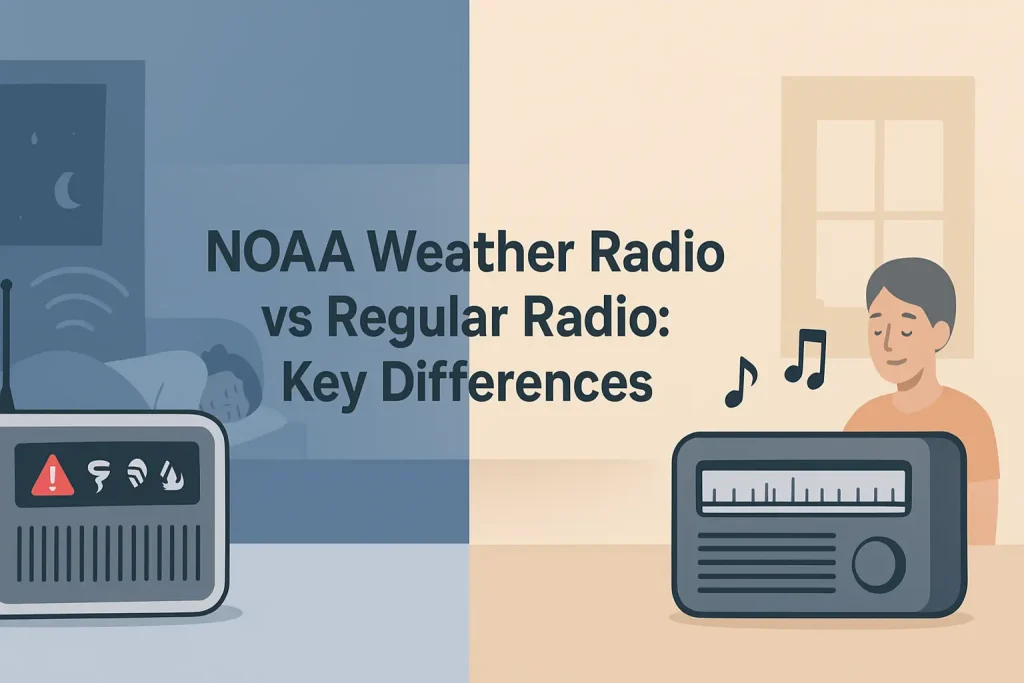
When the power grid fails during a severe storm, a battery-powered weather radio becomes your only reliable link to emergency alerts. The National Weather Service broadcasts 24 hours a day on seven dedicated frequencies between 162.400 and 162.550 MHz.
A radio relying solely on wall outlet power is useless during an evacuation or grid failure. Choosing the best battery-powered weather radio ensures you receive life-saving tornado warnings and flash flood alerts when the electricity is out.
| Photo | Popular Portable Walkie Talkies | Price |
|---|---|---|
 | SKIWARRIOR Multifunctional Smart Wireless Ski Goggles with Walkie-Talkie, Anti-Fog Zeiss Lens, Music & Call Function (Cylindrical Blue) | Check Price On Amazon |
 | SINORISE Super Mini Walkie Talkies, Two-Way Radios, 3 Pack | Check Price On Amazon |
 | KOSPET Tank M4C Smart Watch Rugged, Dual-Band GPS, 5ATM & IP69K Waterproof | Check Price On Amazon |
 | Retevis RT15 Walkie Talkies 3 Pack, Birthday Gift, Outdoor Adventure Kit | Check Price On Amazon |
 | Rechargeable Walkie Talkies Toys for Kids: DIY Astronaut Walkie Talkies for Boys Christmas Birthday Gifts for 3 4 5 6 7 8 9 10 Boy Walkie Talkie Outdoor Hiking Toy 2 Way Radio Camping Outdoor Game | Check Price On Amazon |
By the Numbers
Battery-Powered Weather Radio – Key Specifications and Standards
Sources: NOAA NWR documentation, FCC Part 95.
What Makes a Battery-Powered Weather Radio Essential for Emergency Communication?
A battery-powered weather radio is a type of emergency receiver that decodes public warning alerts from the National Oceanic and Atmospheric Administration. It differs from standard AM/FM radios because it receives specific NOAA frequencies and decodes S.A.M.E. (Specific Area Message Encoding) signals.
This happens because the NOAA transmitter network operates independently of local internet and cellular infrastructure. This only occurs when your radio has functioning batteries and the local NOAA transmitter is online.
If your batteries are dead, the result is a total loss of emergency alerts. You must fix this by keeping fresh alkaline batteries stored in your emergency kit at all times.
According to NOAA, the NWR network covers 98 percent of the United States population. A battery-powered receiver ensures you receive those broadcasts even if your home loses power for days.
How Do NOAA Weather Radio Broadcasts Reach Your Device Without an Outlet?
NOAA broadcasts originate from more than 1,000 transmitters across the country. Your battery-powered weather radio acts as a VHF receiver tuned to the 162 MHz weather band.

The radio works with the internal antenna to achieve reception of the 162.400 to 162.550 MHz signal. It consists of a receiver circuit, a S.A.M.E. decoder chip, a speaker, and a battery compartment.
This happens because VHF radio waves propagate effectively over terrain when transmitted at high power from tall towers. This only occurs when you are within 40 miles of the transmitter and environmental obstructions are minimal.
If you are outside the 40-mile range, the result is a weak signal or static alert tone. You can fix this by moving the radio near a window or attaching an external antenna.
You can learn more about selecting the right receiver in our guide to NOAA weather radios for home. A dedicated VHF receiver is superior to a smartphone app during a cell tower outage.
Top Battery-Powered Weather Radios for Reliable Off-Grid Alerts
The best battery-powered weather radios combine reliable VHF reception with efficient power consumption. They must also feature S.A.M.E. technology to prevent alert fatigue from neighboring counties.
The Midland WR400 is a desktop model that runs on AC power with a 4x AA battery backup. It allows you to program up to 50 different S.A.M.E. codes for highly localized alerts.
Key Specifications:
- Frequency: 162.400-162.550 MHz (7 NOAA channels)
- S.A.M.E. alert memory: 50 programmable location codes
- Power: AC adapter + 4x AA battery backup
- Alert types: 25 emergency alert types
- Programming: manual keypad S.A.M.E. entry
The Eton FRX3+ is a portable AM/FM/NOAA weather alert radio. It features a hand-crank dynamo and a solar panel to keep the internal rechargeable battery alive indefinitely.
Key Specifications:
- Frequency: 162.400-162.550 MHz (7 NOAA channels)
- Power: 2600 mAh rechargeable Li-ion battery, hand crank, solar panel
- Alert siren: 85 decibels
- Ports: USB output for charging mobile devices
- Display: Blue backlit LCD with clock
The Midland WR120B is a budget-friendly option that uses 4x AA batteries for backup power. It scans all seven NOAA channels automatically when an alert is detected.
For a detailed breakdown, read our comprehensive Midland WR120B review. This model is an excellent entry point for someone new to emergency preparedness.
Use the table below to compare standard battery-powered weather radio models for your specific emergency kit.
Product Comparison
Battery-Powered Weather Radios – At-a-Glance Specs Comparison
Key specs compared across top picks. Source: manufacturer data sheets, NOAA NWR coverage.
| Model | Power Source | S.A.M.E. Compatible | Battery Backup | Price Range |
|---|---|---|---|---|
| Midland WR400 | AC / AA | Yes (50 codes) | 4x AA | $60 – $70 |
| Eton FRX3+ | Solar / Crank / Li-ion | No | Internal 2600 mAh | $40 – $50 |
| Midland WR120B | AC / AA | Yes (25 codes) | 4x AA | $40 – $50 |
| Sangean CL-100 | AC / AA | Yes (20 codes) | 4x AA | $50 – $60 |
For additional options, check out our rankings of the best weather radios available today. Choosing the right device ensures you stay informed during severe weather.
Complete Buying Guide: How to Choose a Battery-Powered Weather Radio for Power Outages?
Selecting the right battery-powered weather radio requires understanding power consumption and alert filtering technology. You must evaluate battery chemistry, S.A.M.E. decoding capabilities, and physical durability.
Battery Chemistry: Alkaline AA vs Lithium vs Rechargeable Li-ion
Alkaline AA batteries are the standard backup power source for desktop weather radios. Lithium AA batteries offer a 10-year shelf life and perform better in extreme cold.
Rechargeable lithium-ion batteries power portable crank radios. A radio with a 2600 mAh battery provides roughly 12 hours of continuous weather broadcast listening.
This happens because lithium-ion cells have a higher energy density than standard alkaline cells. This only occurs when the internal charging circuit is properly maintained.
If you leave alkaline batteries in a radio for years, the result is battery leakage that destroys the contacts. You can fix this by replacing your backup batteries annually.
Alert Technology: S.A.M.E. Decoding for County-Specific Warnings
S.A.M.E. technology is a digital protocol that allows your weather radio to filter alerts by county. Without it, your radio will sound an 85-decibel siren for every alert in a 40-mile radius.
Programming the 6-digit FIPS code tells the radio to only alert for your specific geographic area. This prevents alert fatigue during severe weather seasons.
To learn how this works, read our explanation of what a S.A.M.E. weather radio does. It is the most critical feature for ensuring you wake up for actual local threats.
Durability and Portability for Evacuation Scenarios
An emergency radio must survive drops and exposure to rain during an evacuation. Look for an IP rating of IPX4 or higher for basic water resistance.
A portable model with a hand crank provides a backup power generation method. This ensures you can charge the radio even if your spare batteries are exhausted.
You can consult our complete weather radio buying guide for more evaluation criteria. A rugged design is essential for use outside the home.
How to Program S.A.M.E. Codes on Your Weather Radio: Step-by-Step Guide
Programming a S.A.M.E. code into your weather radio ensures you only receive alerts for your specific county. The process involves finding your FIPS code and entering it into the radio menu.
- Visit the NOAA Weather Radio website to look up your county’s 6-digit FIPS code.
- Press the “Menu” button on your weather radio to access the setup options.
- Use the up and down arrow buttons to navigate to “Set Location” or “S.A.M.E. Programming”.
- Enter your 6-digit FIPS code using the numeric keypad on the radio.
- Press “Select” or “Enter” to save the location code into the radio memory.
- Exit the menu and confirm the radio displays your specific county name.
If you encounter issues during setup, refer to the Midland weather radio manual for troubleshooting. Proper programming prevents false alerts and missed warnings.
Accurate S.A.M.E. programming is the most important step in setting up your emergency receiver.
Troubleshooting Common Battery-Powered Weather Radio Problems
Weather radios can experience signal reception issues and false alert triggers. Understanding the root cause helps you maintain a reliable emergency communication link.
A common problem is a weak or static-filled broadcast signal. This happens because the internal whip antenna is blocked by metal roofing or thick concrete walls.
This only occurs when the radio is placed in a basement or near heavy electronic interference. If the antenna cannot receive the 162 MHz signal, the result is a garbled weather broadcast.
Fix it by moving the radio to a window facing the nearest NOAA transmitter. You can also purchase an external weather radio antenna to boost reception.
Another issue is the radio alerting too frequently for distant storms. This is caused by not having a S.A.M.E. code programmed into the device.
Program your specific county FIPS code to silence alerts for neighboring areas. This ensures you only hear warnings that directly impact your location.
For more purchasing tips, see our guide on where to buy a weather radio locally or online. Quality antennas and proper programming solve most reception problems.
What Is the Difference Between a Battery-Powered Radio and a Hand-Crank Radio?
A battery-powered radio relies entirely on disposable or rechargeable cells for power. A hand-crank radio features a manual dynamo generator that charges an internal battery through physical rotation.
Hand-crank radios often include solar panels as an additional power source. This makes them ideal for extended grid-down scenarios where spare batteries are unavailable.
The Eton FRX3+ is an example of a hybrid radio that uses both batteries and a hand crank. Desktop models like the Midland WR400 rely primarily on disposable AA batteries for backup power.
If you want a portable multifunction option, explore our Eton FRX3+ review to see its dynamo capabilities. Hand-crank power is invaluable during multi-day power outages.
Can I Use Rechargeable AA Batteries in My NOAA Weather Radio?
You can use rechargeable NiMH AA batteries in most NOAA weather radios. However, they discharge slowly over time even when the radio is off.
A standard NiMH battery holds 1.2 volts compared to 1.5 volts in an alkaline battery. This lower voltage can sometimes cause the low-battery indicator to display prematurely on desktop models.
To avoid missing alerts, use low-self-discharge NiMH batteries (like Panasonic Eneloop). They retain their charge for years in storage.
Check the manufacturer specifications before installing rechargeable AA batteries in your specific radio. Using fresh alkaline cells is often safer for long-term standby power.
How Often Should I Replace the Backup Batteries in My Weather Radio?
You should replace the backup batteries in your weather radio once per year. A standard set of alkaline AA batteries will leak if left in a device for multiple years.
Battery leakage causes corrosion on the metal terminals inside the battery compartment. This prevents power from flowing from the wall adapter to the radio during an outage.
Set a reminder to swap your alkaline AA batteries during daylight saving time changes. This ensures your backup power source is always fresh and ready for an emergency.
Does S.A.M.E. Technology Work on Battery Power?
S.A.M.E. technology functions identically whether the radio is plugged into the wall or running on batteries. The S.A.M.E. decoder chip draws a minimal amount of current to monitor the 162 MHz frequency.
The decoder listens for the 1050 Hz attention signal followed by the digital FIPS code. When it detects your programmed code, it triggers the alert siren.
This process requires only a few milliamps of power during standby mode. Battery power is completely sufficient to maintain 24-hour alert monitoring.
Your weather radio will wake you up during a nighttime tornado warning even if the grid is down. A reliable set of backup batteries ensures this life-saving technology always works.
What Is the Range of a Portable NOAA Weather Radio?
A portable NOAA weather radio typically has a reception range of 30 to 40 miles from the nearest transmitter. This range assumes you are using the deployed whip antenna with minimal obstructions.
Terrain heavily impacts VHF signal propagation. Dense urban environments and mountainous regions will reduce the effective range to 15 miles or less.
Height above ground is the most critical factor for improving reception range. Holding the radio near a window on the second floor increases the signal clarity.
If you need extended range, an external antenna mounted on the roof will dramatically improve signal strength. VHF frequencies rely on line-of-sight propagation.
A battery-powered weather radio is a fundamental component of any emergency preparedness kit. It provides reliable access to NOAA alerts on the 162 MHz band when cell towers and internet connections fail.
Choose a model with S.A.M.E. technology and maintain fresh AA batteries to ensure you receive county-specific warnings. Store your radio in an accessible location so it is ready when the next severe storm strikes.
| Photo | TOP RATED WALKIE TALKIES | Price |
|---|---|---|
 | Retevis RT628 Kids Walkie Talkies, Toys Gifts for 4-12 Year Old Girl Boy | Check Price On Amazon |
 | Cobra ACXT545 Weather-Resistant Walkie Talkies, Rechargeable, 22 Channels | Check Price On Amazon |
 | Retevis RT388 Kids Walkie Talkies, Outdoor Toys for Kids Camping Essentials | Check Price On Amazon |
 | Cobra RX680 Walkie Talkies (2-Pack), IP54 Water Resistant Design | Check Price On Amazon |
 | Retevis RT22 Walkie Talkies Long Range Rechargeable with Earpiece (2 Pack) | Check Price On Amazon |
 | Midland GXT1000VP4 GMRS JIS4 Two-Way Radio, Black,2 Pack | Check Price On Amazon |
 | Retevis RT628 Walkie Talkies for Kids,Toys Gifts for 6-12 Years Old Boys Girls,Long Range 2 Way Radio 22CH VOX,Birthday Gift,Family Walkie Talkie for Camping Hiking Indoor Outdoor | Check Price On Amazon |