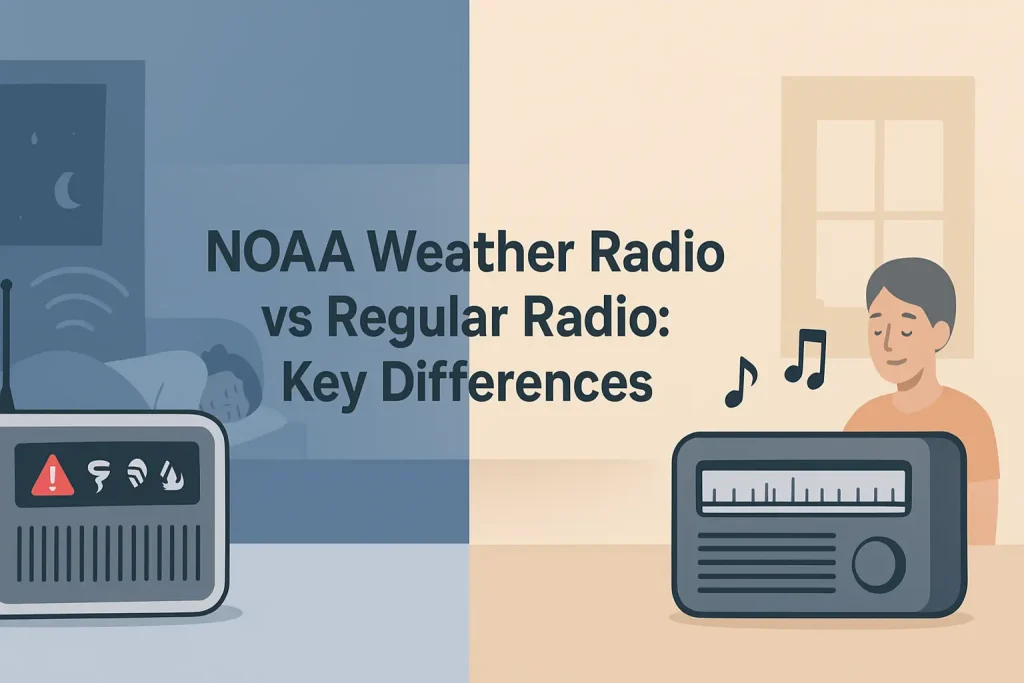
A weather radio with AM/FM reception sounds like a simple upgrade. In practice, the difference between a single-band NOAA receiver and a true multi-band radio matters most when the power goes out, the internet is down, and you need more than weather alerts. NOAA broadcasts on seven dedicated frequencies between 162.400 and 162.550 MHz, but AM and FM reception turns the same device into a full emergency information hub, giving you news, local bulletins, and community broadcasts when cellular networks are overloaded.
This guide compares the best weather radios that receive NOAA weather alerts alongside standard AM and FM broadcast bands, with honest assessments of S.A.M.E. alert filtering, battery backup, audio quality, and value at every price point.
| Photo | Popular Portable Walkie Talkies | Price |
|---|---|---|
 | SKIWARRIOR Multifunctional Smart Wireless Ski Goggles with Walkie-Talkie, Anti-Fog Zeiss Lens, Music & Call Function (Cylindrical Blue) | Check Price On Amazon |
 | SINORISE Super Mini Walkie Talkies, Two-Way Radios, 3 Pack | Check Price On Amazon |
 | KOSPET Tank M4C Smart Watch Rugged, Dual-Band GPS, 5ATM & IP69K Waterproof | Check Price On Amazon |
 | Retevis RT15 Walkie Talkies 3 Pack, Birthday Gift, Outdoor Adventure Kit | Check Price On Amazon |
 | Rechargeable Walkie Talkies Toys for Kids: DIY Astronaut Walkie Talkies for Boys Christmas Birthday Gifts for 3 4 5 6 7 8 9 10 Boy Walkie Talkie Outdoor Hiking Toy 2 Way Radio Camping Outdoor Game | Check Price On Amazon |
By the Numbers
Multi-Band Weather Radios: Key Specifications and Standards
Sources: NOAA National Weather Radio All Hazards documentation, FCC Part 95, manufacturer data sheets.
What Is a Multi-Band Weather Radio and Why Does AM/FM Matter?
A multi-band weather radio receives NOAA Weather Radio All Hazards (NWR) broadcasts on the seven WX frequencies (162.400, 162.425, 162.450, 162.475, 162.500, 162.525, and 162.550 MHz) while also tuning standard AM (520 to 1710 kHz) and FM (87.5 to 108 MHz) broadcast bands.
That combination matters because NOAA weather broadcasts are narrow-purpose alerts. They tell you a tornado warning is active for your county, but they do not tell you which roads are closed, where shelters are located, or when the event is over.
AM and FM radio fills that gap. Local news stations provide context, evacuation routes, and recovery information that NOAA transmitters never broadcast.
According to NOAA National Weather Radio All Hazards documentation, NWR transmitters cover approximately 95% of the US population within a 40-mile radius, but signal strength drops significantly inside concrete buildings or beyond that radius. An AM broadcast band receiver extends your information reach because AM signals travel much farther at night due to skywave propagation, sometimes hundreds of miles from the transmitter.
A multi-band radio is not simply a more expensive weather radio. It is a fundamentally different emergency tool because it keeps you informed before, during, and after the event that triggered your weather alert.
The section summary: choose a multi-band receiver if your emergency preparedness plan depends on post-event recovery information, not just initial alert notification.
How Does S.A.M.E. Technology Work in Multi-Band Models?
S.A.M.E. (Specific Area Message Encoding) is a digital header system that allows a weather radio to decode a 6-digit FIPS county code embedded in NOAA broadcasts and activate its alarm only for the counties you have programmed. Without S.A.M.E., the radio sounds an alarm for every county served by that transmitter, which can mean dozens of false wake-ups per week if you live near a transmitter covering multiple states.
This matters especially in multi-band radios because buyers often assume the AM/FM receiver justifies skipping S.A.M.E. filtering. That assumption is wrong.
According to NOAA NWR technical documentation, a single NWR transmitter may serve up to 40 counties in flat terrain. Without S.A.M.E. filtering, a radio covering that transmitter’s range will alert for all 40 counties, not just yours.
On multi-band models, S.A.M.E. decoding is handled by a dedicated chip that runs independently of the AM/FM receiver circuit. The radio can be set to FM for casual listening and still wake from standby with a full alarm tone when a NOAA S.A.M.E. alert triggers for your programmed county.
Most mid-range multi-band weather radios support programming between 5 and 25 S.A.M.E. location codes. Entry-level models like the Midland WR120B weather radio support up to 25 alert types across multiple FIPS codes, which is sufficient for most households within a single county.
The failure mode for S.A.M.E. on multi-band radios is a programming mismatch. If you enter the wrong FIPS code (a 6-digit number identifying your specific county), the radio will not alert for your actual location even though it receives the NOAA signal clearly.
Fix this by looking up your exact FIPS code at the NOAA NWR website before programming. For a deeper explanation of how S.A.M.E. encoding works at the signal level, our overview of how S.A.M.E. codes are structured and decoded walks through the technical process in plain language.
The section summary: S.A.M.E. filtering is as important in a multi-band radio as in a dedicated weather receiver, and a wrong FIPS code silences alerts for your county entirely.
Best Multi-Band Weather Radios with AM/FM: Top Picks Compared
The models below represent the strongest performers across budget, mid-range, and premium tiers. All receive the full 7 NOAA WX channels alongside standard AM and FM broadcast bands. Prices reflect typical street prices at time of publication.
Use the table below to identify which tier matches your needs before reading the full reviews.
| Model | Bands | S.A.M.E. Codes | Power Backup | Crank/Solar | Price |
|---|---|---|---|---|---|
| Midland WR400 | WX, AM, FM | 50 codes | 6x AA | No | $70-85 |
| Midland WR120B | WX, AM, FM | 25 types | 3x AA | No | $30-45 |
| Eton FRX3+ | WX, AM, FM | Basic alert | Built-in Li-ion | Yes (both) | $55-70 |
| Sangean CL-100 | WX, AM, FM | 23 alert types | 6x AA | No | $65-80 |
| Uniden BC365CRS | WX, AM, FM | 25 alert types | Battery backup | No | $40-55 |
| Kaito KA500 | WX, AM, FM, SW | Alert tone only | Built-in Li-ion | Yes (both) | $55-75 |
Midland WR400: Best Overall Multi-Band Weather Radio
The Midland WR400 weather radio is the strongest desktop multi-band model for households that want reliable NOAA alert filtering alongside full AM and FM broadcast reception.
It supports up to 50 programmable S.A.M.E. location codes, which is the highest capacity in this price range and allows a single unit to cover multiple counties for families that split time between locations.
Key Specifications:
- NOAA frequencies: all 7 WX channels (162.400 to 162.550 MHz)
- AM range: 520 to 1710 kHz
- FM range: 87.5 to 108 MHz
- S.A.M.E. codes: up to 50 programmable location codes
- Alert types: 25
- Battery backup: 6x AA alkaline
- Power: AC adapter primary, AA battery backup
- Display: backlit LCD with clock
The WR400 wakes from standby to broadcast NOAA alerts even while receiving AM or FM. The squelch on the AM tuner is tight enough to receive rural AM stations clearly in most suburban environments without significant static.
The one limitation is the lack of a hand-crank or solar charging option. If you lose AC power and exhaust your 6 AA batteries, the WR400 goes silent.
For programming instructions specific to Midland multi-band models, the step-by-step walkthrough in our guide on setting up Midland weather radio S.A.M.E. codes and alert tones covers the exact button sequences for the WR400 and related models.
Midland WR120B: Best Budget Multi-Band Weather Radio
The Midland WR120B weather radio is the most capable sub-$45 multi-band receiver available. It covers all 7 NOAA WX channels, AM, and FM, with S.A.M.E. filtering for up to 25 alert types.
The WR120B does not support 50 S.A.M.E. location codes like the WR400. However, for a single-location household programming one or two county FIPS codes, the difference is irrelevant.
Key Specifications:
- NOAA frequencies: all 7 WX channels
- AM and FM: standard broadcast ranges
- S.A.M.E. alert types: 25
- Battery backup: 3x AA alkaline
- Power: AC adapter primary
- Alert memory: retains last alert message
The audio output on the WR120B is adequate for a bedroom or kitchen but not loud enough for a large open living space. Place it in the room where you sleep for maximum effectiveness as a nighttime alert device.
A full breakdown of the WR120B’s specifications, programming quirks, and real-world alert performance is available in our detailed review of the Midland WR120B for households on a tight budget.
Eton FRX3+: Best Multi-Band Weather Radio with Hand-Crank and Solar
The Eton FRX3+ emergency weather radio is the best choice when extended power outages are your primary concern. It receives NOAA WX, AM, and FM, and adds both a hand-crank generator and a solar panel for recharging a built-in 2000 mAh lithium-ion battery.
The FRX3+ does not include S.A.M.E. county-level filtering. It alerts for all NOAA broadcasts on the monitored WX channel, regardless of which county the alert targets.
Key Specifications:
- NOAA frequencies: all 7 WX channels
- AM range: 520 to 1710 kHz
- FM range: 87.5 to 108 MHz
- S.A.M.E. filtering: not available (basic alert mode only)
- Battery: 2000 mAh built-in Li-ion
- Charging: hand-crank, solar panel, USB-in (micro-USB)
- USB-out: 1000 mAh phone charging port
- LED flashlight: integrated, 5 LED array
The crank generator produces approximately 1 minute of play time for every 1 minute of cranking at the recommended 120 RPM rate. Solar charging requires direct sunlight and takes several hours to meaningfully charge the battery from depleted.
The FRX3+ is the right choice for a go-bag or vehicle emergency kit, not a bedside alert radio. The absence of S.A.M.E. filtering makes it unsuitable as a primary home alert device in areas served by transmitters covering many counties.
Our full evaluation of this model including audio quality, crank durability, and field performance is in our hands-on assessment of the Eton FRX3+ for emergency preparedness kits.
Sangean CL-100: Best AM/FM Audio Quality in a Multi-Band Weather Radio
The Sangean CL-100 weather alert radio delivers the best AM and FM audio performance among tabletop multi-band models in the $65 to $80 range. Sangean’s tuner circuit produces noticeably less background hiss on FM than Midland models, which matters if you plan to use this radio for daily listening alongside its emergency function.
The CL-100 supports 23 S.A.M.E. alert types and allows county-level filtering through standard FIPS code programming.
Key Specifications:
- NOAA frequencies: all 7 WX channels
- AM range: 520 to 1710 kHz (with 9 kHz step option for international stations)
- FM range: 87.5 to 108 MHz (RDS display capable)
- S.A.M.E. alert types: 23
- Battery backup: 6x AA alkaline
- Power: AC adapter primary
- Memory: 10 AM presets, 10 FM presets, 7 WX presets
The 9 kHz AM step option is uncommon in this category and allows reception of international AM broadcast stations that use 9 kHz channel spacing instead of the US standard 10 kHz. This is useful in border regions of the US near Canada or Mexico.
The CL-100 does not include a hand-crank or solar option. Its primary advantage over the Midland WR400 is superior audio quality for daily FM and AM use, not emergency feature depth.
Uniden BC365CRS: Best Multi-Band Weather Radio with Clock Radio Features
The Uniden BC365CRS clock radio with weather alert combines AM, FM, and NOAA WX reception with a clock radio alarm function, making it a practical bedroom device that doubles as a weather alert receiver.
It supports 25 S.A.M.E. alert types and includes a battery backup for continued alert monitoring during power failures.
Key Specifications:
- NOAA frequencies: all 7 WX channels
- AM and FM: standard broadcast ranges
- S.A.M.E. alert types: 25
- Clock/alarm: dual alarm with radio wake function
- Battery backup: included (for time and alert continuity)
- Power: AC adapter primary
The BC365CRS is optimized for beside table placement. The display brightness is adjustable for nighttime use, and the alarm function activates at the set time even if the unit is in weather alert standby mode.
The AM tuner on the BC365CRS is adequate for strong local stations but shows more sensitivity to electrical interference than the Sangean CL-100 when placed near computers or other electronics.
Kaito KA500: Best Multi-Band Weather Radio with Shortwave Reception
The Kaito KA500 emergency radio adds shortwave reception (2.3 to 26.1 MHz) to the standard NOAA WX, AM, and FM multi-band combination. Shortwave reception allows the KA500 to receive international broadcasts, amateur radio HF transmissions, and some government and military broadcasts that do not appear on AM or FM.
The KA500 does not include S.A.M.E. county-level filtering. Like the Eton FRX3+, it alerts for all NOAA broadcasts on the monitored channel.
Key Specifications:
- NOAA frequencies: all 7 WX channels
- AM range: 520 to 1710 kHz
- FM range: 87.5 to 108 MHz
- Shortwave: 2.3 to 26.1 MHz (9 bands)
- S.A.M.E. filtering: not available
- Battery: built-in Li-ion (rechargeable)
- Charging: hand-crank, solar, USB-in, AA battery (5x)
- USB-out: phone charging port
- LED flashlight: integrated
Shortwave reception is genuinely useful in two scenarios: extended regional disasters where domestic broadcasting infrastructure fails, and international listeners who want a single emergency radio that also covers foreign news sources. For most households, shortwave is a capability they will never need but costs nothing extra at the KA500’s price point.
The KA500’s AM sensitivity on shortwave is better than its AM broadcast band sensitivity, which is a known trade-off on radios with wide-band front-end designs.
The section summary: the Midland WR400 is the strongest overall multi-band model for home use, the Eton FRX3+ wins when power outage survival is the primary concern, and the Kaito KA500 is the right choice when shortwave reception alongside NOAA alerts matters.
Here is a full price comparison to help you evaluate cost against features before committing to a model.
Price Comparison
Multi-Band Weather Radios with AM/FM: Price Comparison by Model
Street price, sorted lowest to highest. Prices verified at time of publication.
$30-45
$40-55
$55-70
$55-75
$65-80
$70-85
Single-unit price. No FCC license required for weather radio or AM/FM reception. Prices are estimates and may vary by retailer.
AM/FM Reception Quality: What Separates Good From Poor Multi-Band Radios
AM and FM reception quality in multi-band weather radios varies significantly because most manufacturers design these units primarily as weather alert devices and treat AM/FM as a secondary feature. The result is that some multi-band radios have AM tuners that are barely functional beyond strong local stations within 20 miles of the transmitter.
This happens because the AM receiver front-end in budget multi-band radios often lacks the ferrite bar antenna length and intermediate frequency (IF) filter selectivity found in dedicated AM radios. A short ferrite antenna captures less signal, and a wide IF filter admits more adjacent channel interference.
The condition where this becomes a problem is rural or semi-rural placement, where AM stations you rely on may be 40 to 80 miles away. In those situations, a dedicated weather radio with a poor AM tuner will produce significant static on daytime AM reception and may improve at night as AM skywave propagation kicks in.
If you fail to test AM reception on a distant station before purchasing, you risk discovering after a power outage that your only news source is too noisy to understand. Test any multi-band model on a daytime AM station at least 30 miles from your location before committing to it as your primary emergency radio.
FM reception quality is less variable across models because FM signal strength is less dependent on antenna size, but electrical interference from AC adapters and nearby electronics affects FM more than AM. The Sangean CL-100 uses a shielded tuner design that reduces interference pickup from the power supply, which is the main reason its FM audio is cleaner than most competitors.
Use the table below to compare AM and FM performance characteristics across the main multi-band models.
| Model | AM Sensitivity | FM Sensitivity | External Antenna | RDS Support |
|---|---|---|---|---|
| Sangean CL-100 | Excellent | Excellent | FM aux-in jack | Yes |
| Midland WR400 | Good | Good | No | No |
| Kaito KA500 | Very Good | Good | Aux wire antenna | No |
| Eton FRX3+ | Adequate | Good | No | No |
| Midland WR120B | Adequate | Adequate | No | No |
| Uniden BC365CRS | Adequate | Good | No | No |
The section summary: if AM reception quality for distant stations matters to your emergency plan, the Sangean CL-100 is the only multi-band weather radio in this group designed for serious AM performance.
Battery Backup and Off-Grid Power: Which Multi-Band Models Survive Extended Outages
Battery backup in multi-band weather radios comes in three forms: replaceable alkaline batteries (AA or AAA), a built-in rechargeable lithium-ion battery, or both. The backup type determines how long your radio works after AC power fails and whether you can recharge it without grid electricity.
This matters most in extended outages, which can last days to weeks after major hurricanes, winter ice storms, or earthquake damage to infrastructure.
Replaceable AA batteries offer the longest practical backup time because you can pre-stock additional batteries and swap them without any charging infrastructure. A radio running 6 AA alkaline batteries in receive-only mode (no active alert playback) typically operates for 40 to 80 hours depending on speaker volume and display brightness settings.
Built-in lithium-ion batteries, as found in the Eton FRX3+ (2000 mAh) and Kaito KA500, provide shorter total runtime before needing a recharge. However, they can be recharged via hand-crank or solar panel without any stored batteries.
The condition where a built-in Li-ion becomes a liability is a multi-day outage in winter when solar charging is minimal and crank charging is physically exhausting. One minute of cranking at the recommended speed produces approximately 1 minute of runtime, which is not sustainable as a primary power source for more than a few hours per day.
The failure mode is a radio with a depleted built-in battery and no solar availability. Fix it by pre-charging the built-in battery fully before storm season and keeping a USB power bank as a secondary charging source for radios with USB-in ports.
Use the table below to compare backup power specifications across models.
| Model | Backup Type | Estimated Backup Hours | Crank | Solar | USB-in Charge |
|---|---|---|---|---|---|
| Midland WR400 | 6x AA alkaline | 40-60 hrs | No | No | No |
| Sangean CL-100 | 6x AA alkaline | 40-60 hrs | No | No | No |
| Eton FRX3+ | 2000 mAh Li-ion | 12-16 hrs | Yes | Yes | Yes (micro-USB) |
| Kaito KA500 | Built-in Li-ion + 5x AA | 15-20 hrs Li-ion | Yes | Yes | Yes |
| Midland WR120B | 3x AA alkaline | 20-30 hrs | No | No | No |
| Uniden BC365CRS | Battery backup | Alert standby only | No | No | No |
The section summary: for outages beyond 24 hours, stock 6 AA lithium or alkaline batteries as spares alongside any multi-band radio that uses replaceable cells, and keep a USB power bank charged for radios with USB-in ports.
Pairing lithium batteries (not alkaline) with your AA-powered weather radio extends runtime by 30 to 50% in cold weather, where alkaline chemistry loses capacity rapidly. A set of Energizer Ultimate Lithium AA batteries maintains full capacity down to -40 degrees Fahrenheit, which matters in winter storm scenarios.
Which Multi-Band Weather Radio Should You Buy for Your Specific Situation?
The right multi-band weather radio depends on three factors: whether you prioritize S.A.M.E. county filtering, how long you need backup power without grid electricity, and whether AM/FM listening is a daily use case or purely an emergency backup.
Use the guide below to match your situation to the correct model.
You live in a single county and want the best home alert system with good AM/FM: The Midland WR400 is the correct choice. It offers the most S.A.M.E. location codes (50), solid AM and FM reception, and 6x AA backup.
You want reliable alerts on a tight budget: The Midland WR120B handles S.A.M.E. filtering for a single household location at half the price of the WR400. Audio quality is reduced but alert reliability is equivalent.
You are building a go-bag or vehicle emergency kit: The Eton FRX3+ is the correct choice because it operates off-grid indefinitely using crank and solar charging. Accept the trade-off: no S.A.M.E. filtering means more alerts, not fewer.
You want the best AM/FM audio for daily listening alongside emergency use: The Sangean CL-100 is the correct choice. Its tuner circuit outperforms every other model in this comparison for clean FM reception and distant AM reception.
You want shortwave reception in addition to NOAA WX, AM, and FM: The Kaito KA500 is the only model in this comparison with shortwave bands, crank and solar charging, and USB phone charging output.
You want a clock radio that also monitors weather alerts: The Uniden BC365CRS combines clock radio functionality with S.A.M.E. alert monitoring in a bedside form factor.
For a broader look at weather radio options across all categories and use cases, our full comparison of top-rated NOAA weather radio models covers portable, desktop, and combination units across every price tier.
The section summary: if you can only buy one multi-band weather radio for your home, the Midland WR400 is the most capable all-around model, and the Sangean CL-100 is the better choice if daily audio quality matters as much as emergency performance.
Quick Reference: Key Multi-Band Weather Radio Terms
NOAA Weather Radio All Hazards (NWR): The national network of radio stations broadcasting continuous weather information and emergency alerts on 7 dedicated VHF frequencies between 162.400 and 162.550 MHz.
S.A.M.E. (Specific Area Message Encoding): A digital encoding system embedded in NOAA broadcasts that allows a weather radio to alert only for counties you have programmed, rather than every county the transmitter serves.
FIPS code: A 6-digit Federal Information Processing Standard number that uniquely identifies your county. You enter this code when programming S.A.M.E. filtering on a weather radio.
WX channels: The 7 dedicated NOAA weather broadcast frequencies (WX1 through WX7), ranging from 162.400 to 162.550 MHz at 25 kHz spacing.
AM band: Amplitude modulation broadcast band, ranging from 520 to 1710 kHz in the US. AM signals travel farther at night due to skywave propagation from the ionosphere.
FM band: Frequency modulation broadcast band, ranging from 87.5 to 108 MHz in the US. FM provides higher audio fidelity than AM but is limited to line-of-sight range (typically 30 to 50 miles from the transmitter).
Shortwave (SW): Radio frequencies between 2.3 and 26.1 MHz used for international broadcasting and amateur radio HF communication. Some multi-band emergency radios include shortwave reception.
Ferrite bar antenna: The internal AM receiving antenna in portable radios, consisting of a rod of ferrite material wound with coils. Longer ferrite bars generally produce better AM sensitivity.
Li-ion battery: Lithium-ion rechargeable battery, used as built-in power in crank and solar radios. Typically provides 12 to 20 hours of receive-only operation before recharging is needed.
Alert standby mode: A low-power operating mode in which the radio monitors the programmed NOAA WX channel for S.A.M.E. alert headers while drawing minimal current from the battery backup.
RDS (Radio Data System): A digital protocol embedded in FM broadcasts that sends station name, song title, and other text data. Some AM/FM/WX receivers display RDS data on an LCD screen.
Skywave propagation: The phenomenon where AM broadcast signals (and shortwave signals) reflect off the ionosphere at night, allowing reception of stations hundreds of miles away that are inaudible during daylight hours.
What Types of Alerts Does a Multi-Band Weather Radio Receive?
A multi-band weather radio with S.A.M.E. decoding capability receives all 25 alert types broadcast by NOAA NWR, not just weather warnings. The alert system is part of the Emergency Alert System (EAS) and Integrated Public Alert and Warning System (IPAWS), which means a properly programmed S.A.M.E. weather radio functions as an all-hazards receiver, not just a storm warning device.
The 25 alert types include weather events (Tornado Warning, Severe Thunderstorm Warning, Flash Flood Warning, Hurricane Warning, Blizzard Warning, Ice Storm Warning, Extreme Wind Warning), non-weather civil emergencies (Hazardous Materials Warning, Civil Emergency Message, Evacuation Immediate), and national-level alerts (National Information Center, Earthquake Warning, Volcano Warning).
AMBER Alerts (child abduction emergencies) are also transmitted through NOAA NWR and decoded by S.A.M.E.-capable receivers. This is a capability many buyers do not know exists.
The condition where you receive irrelevant alerts is a radio without S.A.M.E. filtering or one programmed with the wrong FIPS code. Both result in the same failure: alerts for counties you do not live in, which conditions users to ignore the alarm, and the alarm eventually gets turned off, defeating the entire purpose of the device.
The fix is correct FIPS code programming for your specific county. NOAA publishes the full FIPS code list at the NWR website. For models that cover both a home and a vacation property in a different county, the Midland WR400’s 50-code capacity allows programming of multiple locations simultaneously.
The section summary: a properly programmed S.A.M.E. weather radio alerts for 25 types of emergencies beyond weather, making it a genuinely complete emergency alert device rather than just a storm radio.
How to Improve NOAA and AM/FM Reception on a Multi-Band Weather Radio
Reception on all three bands (NOAA WX, AM, and FM) can be improved without replacing the radio. The single most effective improvement for FM and NOAA WX reception is antenna positioning: raising the radio’s telescoping antenna to full extension and orienting it perpendicular to the direction of the transmitter.
This works because FM and NOAA WX signals (both VHF) are horizontally polarized. A vertically extended telescoping antenna receives both horizontal and vertical components, but the angle and position relative to the transmitter affects signal strength significantly in weak-signal locations.
For AM reception, rotating the radio’s physical body changes the orientation of the internal ferrite bar antenna, which is directional. Rotating 90 degrees from a null-signal position to peak signal can increase reception strength by 10 to 20 dB on weak stations.
Adding an external wire antenna to radios that include an FM auxiliary antenna jack (such as the Sangean CL-100) can extend FM and NOAA WX range. A simple 30-inch wire connected to the aux-in FM jack acts as a dipole and improves signal strength in areas with weak transmitter coverage.
For NOAA WX reception specifically, placing the radio near a window facing the direction of the nearest NWR transmitter improves signal quality. Concrete walls attenuate VHF signals (162 MHz range) by 10 to 20 dB, which can be the difference between clear reception and static in basement locations.
If you are unsure which NOAA WX transmitter serves your area, the NOAA NWR transmitter locator tool (available at the NOAA website) provides the nearest transmitter frequency, location, and estimated coverage area by ZIP code.
The section summary: orient the telescoping antenna perpendicular to the transmitter for FM and WX, rotate the radio body for peak AM reception, and place the unit near an exterior window for best NOAA alert reliability.
Common Mistakes to Avoid with Multi-Band Weather Radios
The most common mistake with multi-band weather radios is programming the state-level FIPS code instead of the county-level FIPS code. A state FIPS code causes the radio to alert for every county in the state, producing so many alerts that users disable the alarm function within weeks.
The second most common mistake is storing the radio without testing the battery backup. Most multi-band radios ship without batteries installed. Users plug the unit into AC power, program the channels, and assume the battery backup is functional. The backup does nothing without batteries, and discovering this during the first power outage is too late.
A third common error is placing the radio in a basement or interior room where VHF signals (162 MHz NOAA WX band) are severely attenuated. NOAA WX transmissions at 162 MHz lose 15 to 20 dB passing through a concrete wall, which can reduce a clear signal to static. The radio needs to be within range of the transmitter at the placement location, not just somewhere in the building.
A fourth mistake is relying on the AM/FM function without understanding that the AC power adapter causes electrical interference on AM. This interference (a 60 Hz hum and its harmonics) is worst on battery charger-type adapters and least problematic on linear regulated adapters. The Sangean CL-100 uses a shielded power supply to reduce this interference. Other models may require switching to battery power for clean AM reception in weak-signal areas.
A fifth mistake is purchasing a multi-band radio with a built-in non-replaceable battery for a home use case where power outages can last 3 to 7 days. A 2000 mAh built-in battery provides 12 to 16 hours of operation, not 72 hours. For home emergency use, a model with replaceable AA batteries and a supply of lithium AA cells provides significantly more reliable long-term backup.
For a guide to locating the best retail and online sources for weather radios at each price point, the resource on where to find weather radios at fair prices compares local and online purchasing options.
The section summary: install and test the battery backup before any storm season, use county-level FIPS codes only, and place the radio near an exterior window rather than in a basement or interior room.
Multi-Band vs Single-Band NOAA Weather Radios: Which Do You Actually Need?
A single-band NOAA weather radio (WX channels only) is the correct choice for one specific user: someone who needs the most reliable possible alert monitoring at the lowest price, with no interest in AM or FM broadcast reception. S.A.M.E.-capable dedicated weather radios start at $20 to $30 and provide the same alert filtering quality as multi-band models at twice the price.
A multi-band weather radio is the correct choice for everyone else, because the marginal cost of adding AM and FM to a NOAA receiver is typically $10 to $20, and the benefit during an extended emergency is significant.
Use the table below to decide between the two categories based on your primary use case.
| Factor | Single-Band NOAA Only | Multi-Band (WX + AM + FM) |
|---|---|---|
| Alert monitoring | Full NOAA WX (7 channels) | Full NOAA WX + AM + FM |
| Post-event information | NOAA only | Local news + NOAA |
| Night AM skywave range | Not available | Up to 500+ miles |
| Daily utility | Weather only | Music, news, talk radio |
| S.A.M.E. availability | Yes (most models) | Yes (most mid-range+) |
| Typical price range | $20-40 | $30-85 |
| Best for | Alert-only, lowest cost | Emergency + daily use |
The practical real-world difference shows up when the event your NOAA radio just warned you about takes out local cellular towers. At that point, your only sources of recovery information are AM and FM broadcasts. A single-band NOAA radio goes silent after the NOAA alert ends. A multi-band radio continues to provide news, shelter locations, and road closures via local AM and FM stations.
For a comprehensive breakdown of what to look for when choosing any weather radio, our complete weather radio selection guide covering all essential features walks through S.A.M.E., alert types, battery backup, and antenna options in detail.
The section summary: buy a multi-band model if you can spend $30 or more, because the AM and FM bands provide post-event information that a NOAA-only receiver cannot deliver.
The following tool helps narrow down the right multi-band model based on your two most important priorities as a buyer.
Interactive Tool
Find the Right Multi-Band Weather Radio for Your Situation
Answer 2 questions to get a tailored recommendation from the models compared in this guide.
Does a Multi-Band Weather Radio Need to Be Near a Window to Work Properly?
NOAA WX signals broadcast at 162.400 to 162.550 MHz (VHF range) lose 10 to 20 dB of signal strength passing through a single concrete or masonry wall. In a basement or interior room with multiple walls between the radio and the exterior, this attenuation can reduce a strong outdoor signal to marginal or unusable indoor reception.
In most wood-frame residential construction, signal attenuation per wall is lower (3 to 6 dB per typical wood and drywall partition), which means an interior bedroom placement is usually acceptable for NOAA WX reception in suburban single-family homes.
The practical test is simple: take your programmed weather radio to each candidate placement location and manually tune to the strongest WX channel for your area. If the audio is clear with no static at that location, the signal is sufficient. If static is present, move the radio closer to an exterior window or elevate the telescoping antenna to full extension.
AM and FM reception follows different rules. AM signals at 520 to 1710 kHz penetrate building materials far more easily than VHF because the longer wavelength diffracts around obstacles. FM at 87.5 to 108 MHz is between AM and NOAA WX in penetration, generally adequate in most interior locations with a fully extended telescoping antenna.
The section summary: place your multi-band weather radio near a window facing the nearest NOAA NWR transmitter for WX reception, and trust AM penetration in most interior locations without repositioning.
Are Multi-Band Weather Radios Suitable for Use in Vehicles or RVs?
Multi-band weather radios with DC power inputs (typically 12V DC vehicle adapters) are fully functional in vehicles and RVs. The Midland WR400 and several other tabletop models include a 12V DC adapter option, allowing operation from a vehicle battery or RV shore power without draining the AA battery backup.
However, most tabletop multi-band weather radios are designed for stationary placement, not for use while driving. The telescoping antenna must be extended for best reception, which is impractical in a moving vehicle. For vehicle use, a portable 12V-compatible weather radio with a compact antenna is more practical than a tabletop model.
For RV use at a fixed campsite, the tabletop models perform exactly as they do at home. Extend the telescoping antenna to full height and orient it vertically for best NOAA WX and FM reception. At campsite locations in rural areas, check the nearest NWR transmitter frequency using the NOAA NWR locator before departure, because campsite WX channel coverage may differ from your home area.
The section summary: tabletop multi-band weather radios work well in RVs at fixed campsites on DC power, but portable battery-operated models with compact antennas are more practical for use in moving vehicles.
How to Choose Between a Dedicated Weather Radio and a Multi-Band Model for Home Emergency Use
If you are choosing specifically for home emergency preparedness (not daily listening), the decision between a dedicated NOAA-only weather radio and a multi-band model comes down to how you expect to get information after an alert fires.
A dedicated NOAA weather radio (WX channels only) with S.A.M.E. filtering handles the alert function as well as any multi-band model. The alert chip performance is equivalent, and dedicated models from Midland and Uniden in the $20 to $35 range provide reliable county-level filtering with 25 alert types.
The gap shows after the alert. When a Tornado Warning for your county activates at 3 a.m. and you shelter in place, the NOAA broadcast gives you the warning and radar-interpreted information. But after the storm passes and you need to know if the highway is clear, if your area has a boil-water advisory, or where to find emergency services, NOAA does not broadcast that information. Local AM and FM stations do.
For a home that already has a dedicated weather radio and wants to add this post-event information capability, adding a multi-band model is the correct upgrade. For a home buying its first weather alert device, a multi-band model is worth the additional $10 to $25 over a single-band unit.
The best dedicated NOAA-only and multi-band models for home use are compared in our guide to choosing the right NOAA weather radio for home alert monitoring.
The section summary: for home emergency preparedness, a multi-band model provides the same NOAA alert capability as a dedicated unit while adding the AM and FM reception needed for post-event recovery information.
Can a Multi-Band Weather Radio Replace a Standard AM/FM Radio for Daily Listening?
A multi-band weather radio can replace a standard AM/FM radio for daily listening, but with trade-offs that vary by model. The Sangean CL-100 is the only model in this comparison designed for audiophile-level FM reception. Its tuner sensitivity and selectivity match dedicated AM/FM clock radios in the same price range.
Other models (Midland WR400, Eton FRX3+, Kaito KA500) have adequate AM and FM performance for casual listening but produce noticeably more background noise on weak FM stations and distant AM stations than a dedicated AM/FM receiver of equivalent price.
The practical test: if you live within 20 miles of most FM stations you listen to and within 50 miles of your primary AM news station, any multi-band weather radio will serve as a daily AM/FM replacement without quality issues. If you rely on stations beyond those distances or prefer high-fidelity FM audio, the Sangean CL-100 is the only multi-band model in this category worth comparing against a dedicated radio.
A secondary consideration is preset memory. Dedicated clock radios typically offer 20 to 40 AM and FM presets. Multi-band weather radios range from 0 manual presets (Midland WR120B requires manual tuning each time) to 20 presets (Sangean CL-100 offers 10 AM and 10 FM). For users who regularly switch between multiple stations, preset capacity affects daily usability significantly.
The section summary: the Sangean CL-100 is the only multi-band weather radio in this comparison that fully replaces a dedicated AM/FM receiver for daily listening without audio quality trade-offs.
Frequently Asked Questions
What is the difference between a weather radio with AM/FM and a standard emergency radio?
A weather radio with AM/FM includes a dedicated NOAA Weather Radio All Hazards (NWR) receiver tuned to the 7 WX frequencies (162.400 to 162.550 MHz) with S.A.M.E. county-level alert filtering, in addition to standard AM (520 to 1710 kHz) and FM (87.5 to 108 MHz) broadcast reception. A standard emergency radio may receive AM and FM but does not include the S.A.M.E. decoding chip required for county-specific NOAA alert filtering.
The key functional difference is automatic nighttime alerting. A multi-band weather radio with S.A.M.E. can sit in standby mode on AC or battery power and sound an alarm only for your specific county when NOAA broadcasts a warning, without any user action. A standard AM/FM emergency radio without S.A.M.E. cannot do this.
The practical consequence: a standard emergency radio requires a user to be awake and actively listening to hear a weather alert. A S.A.M.E.-equipped multi-band weather radio wakes you at 3 a.m. with a loud alarm when a tornado warning is issued for your county.
Can I use a multi-band weather radio without programming any S.A.M.E. codes?
Yes. All multi-band weather radios with S.A.M.E. capability also include an “all alerts” mode that triggers for every NOAA broadcast on the monitored WX channel, regardless of which county the alert targets. This mode requires no programming.
The trade-off is alert fatigue. A NOAA NWR transmitter may serve 20 to 40 counties in flat terrain. In all-alerts mode, the radio sounds for every watch, warning, and advisory issued for any of those counties, including counties hundreds of miles away. In severe weather seasons (tornado season in the South and Midwest runs from March through June), this can mean 5 to 15 alerts per week that have no relevance to your location.
The solution is programming your specific county FIPS code. The process takes less than 5 minutes on most models and reduces alerts to only those relevant to your location. The NOAA NWR website provides FIPS codes searchable by state and county.
Why does my weather radio pick up NOAA alerts but the AM reception is full of static?
AM static in a multi-band weather radio running on AC power is almost always caused by electrical interference from the AC adapter’s switching power supply. The adapter generates radio frequency interference (RFI) at harmonics of 60 Hz that fall within the AM broadcast band (520 to 1710 kHz) and couple directly into the radio’s AM front-end.
This only occurs when the radio is powered by AC. Switching to battery power (removing the AC adapter) eliminates this interference source and typically clears AM reception significantly. If battery operation produces clean AM audio, the adapter is the confirmed interference source.
The fix on AC power is to place the radio at least 6 feet from the adapter’s transformer, use a ferrite choke clamp on the AC adapter cable, or replace a switching-type adapter with a linear regulated adapter. The Sangean CL-100 addresses this at the design level with a shielded power supply, which is why its AC-powered AM performance is superior to other models in this comparison.
What is the difference between S.A.M.E. alert types and S.A.M.E. location codes?
S.A.M.E. alert types are the 25 categories of emergency events that NOAA NWR broadcasts, including Tornado Warning, Flash Flood Warning, Civil Emergency Message, and AMBER Alert. S.A.M.E. location codes are the 6-digit FIPS numbers that identify which county or counties the alert applies to.
These two parameters work independently. You program the radio with your county’s FIPS code (the location filter) and separately select which alert types you want to trigger the alarm. Some models allow you to activate all 25 alert types for your county, while others allow you to suppress specific alert types (such as Administrative Messages) that are informational rather than emergency warnings.
A radio with 50 S.A.M.E. location codes (Midland WR400) can monitor 50 different counties simultaneously for all programmed alert types. This is useful for households that split time between multiple locations or businesses with operations in multiple counties.
Do I need a license to own or operate a weather radio with AM/FM?
No FCC license is required to receive NOAA weather broadcasts, AM broadcasts, or FM broadcasts on a multi-band weather radio. Receive-only radios (radios that do not transmit) are completely unlicensed for consumer use. All models covered in this guide are receive-only devices.
FCC licensing only applies to transmitting devices. Two-way radios, amateur transceivers, GMRS handhelds, and marine VHF radios all require licensing for transmission, but a weather radio with AM/FM that only receives signals requires no license, registration, or FCC notification of any kind.
Will a multi-band weather radio alert me even when I am listening to FM?
Yes, on all mid-range and premium multi-band weather radios covered in this guide. When a S.A.M.E. alert for your programmed county is broadcast by NOAA, the radio’s alert monitoring circuit (which runs independently of the AM/FM tuner) detects the S.A.M.E. header, switches the audio output to the NOAA channel, and sounds the alarm tone at full volume regardless of which band you were listening to.
After the alert broadcasts, most models return to the previously selected AM or FM station automatically. Some models require a manual button press to return to the AM/FM band. Check the specific model’s user manual for the alert override and return-to-source behavior before purchasing if this matters to your use case.
What is the difference between AM skywave and FM propagation for emergency use?
AM skywave propagation occurs at night when the D layer of the ionosphere dissipates and AM signals (520 to 1710 kHz) reflect off the higher F layer, allowing reception from transmitters 500 to 1,500 miles away. FM signals (87.5 to 108 MHz) do not experience skywave propagation because VHF frequencies pass through the ionosphere rather than reflecting off it, limiting FM to ground wave propagation of 30 to 75 miles from the transmitter under normal conditions.
In emergency use, this means AM reception at night can reach regional news stations from neighboring states even when local FM transmitters are offline or destroyed. During major hurricanes that knock out local broadcast infrastructure, nighttime AM skywave has historically been the only broadcast radio source for affected areas relying on undamaged out-of-state transmitters.
The practical implication: a multi-band weather radio’s AM receiver is more valuable than its FM receiver in worst-case regional disaster scenarios, and AM sensitivity quality matters more than FM sensitivity when preparing for extended infrastructure failures.
Can I use a hand-crank weather radio as my only multi-band emergency radio?
A hand-crank multi-band weather radio (Eton FRX3+, Kaito KA500) can serve as your only emergency radio, but crank charging alone is insufficient as a primary power strategy for outages longer than 12 hours. Hand-cranking at 120 RPM for 1 minute produces approximately 1 minute of playback, which is a 1:1 ratio requiring continuous physical effort to maintain operation.
For a 72-hour outage with 8 hours of daily radio use, crank charging alone would require approximately 480 minutes (8 hours) of cranking per day, which is physically impractical. Solar charging adds meaningful power in clear conditions (approximately 2 to 4 additional runtime hours per day of direct sunlight) but is unreliable during overcast weather or winter.
The correct strategy for a crank/solar model is to pre-charge the built-in battery fully before storm season and keep a 10,000 mAh USB power bank charged as a secondary energy source for radios with USB-in ports. Crank charging is a last-resort backup, not a primary energy strategy.
Why does my multi-band weather radio sometimes miss NOAA alerts?
Missed NOAA alerts in a multi-band weather radio are caused by one of four conditions: the programmed FIPS code does not match the county where the alert was issued, the radio is tuned to the wrong WX channel for your area, S.A.M.E. filtering is active for a limited set of alert types that does not include the event that occurred, or signal strength at the radio’s location is insufficient to decode the S.A.M.E. header reliably.
The most common cause is FIPS code mismatch from a programming error. Verify your county FIPS code directly at the NOAA NWR website, not from a third-party source, as county boundary changes occasionally update FIPS assignments.
The second most common cause is the wrong WX channel selection. The strongest NOAA WX signal at your location may be on a different channel from the one you have programmed. Manually scan all 7 WX channels and select the one with the clearest, loudest audio. Then verify the transmitter serving that channel covers your county using the NOAA NWR transmitter location database.
Is a shortwave-capable multi-band weather radio worth the extra cost for emergency preparedness?
Shortwave reception (2.3 to 26.1 MHz) adds genuine value to a multi-band emergency radio in two specific scenarios: regional disasters that destroy local broadcast infrastructure and leave international shortwave stations as the only available news source, and households in border regions of the US near Canada or Mexico where foreign AM and FM stations may not be receivable but shortwave is.
For most households within 50 miles of a functioning local AM broadcast transmitter, shortwave adds cost and complexity without proportional emergency value. The Kaito KA500 costs roughly the same as the Eton FRX3+ while adding shortwave reception, making the cost argument for shortwave very small in that specific comparison.
The decision factor is not whether shortwave is ever useful. It is whether you have a specific scenario where local AM and FM stations are unavailable and an international shortwave source is your fallback. If that scenario is plausible for your location and risk profile, the Kaito KA500 is worth the marginal cost difference over a non-shortwave model.
How far away can a NOAA NWR transmitter be and still reliably trigger S.A.M.E. alerts?
NOAA NWR transmitters broadcast at 300 watts effective radiated power (ERP) on VHF frequencies (162.400 to 162.550 MHz) and are designed to provide reliable coverage within a 40-mile radius under normal atmospheric conditions. S.A.M.E. alert decoding requires a minimum signal-to-noise ratio for the digital header to be decoded correctly, typically requiring signal strength of at least 20 dB above the noise floor at the receiver.
Beyond 40 miles, signal strength drops below reliable S.A.M.E. decoding thresholds for most receivers, resulting in missed alerts even though the audio broadcast may still be audible with light static. An audible but noisy NOAA signal does not guarantee that S.A.M.E. headers are decoded correctly.
If you live beyond 40 miles from the nearest NWR transmitter, NOAA recommends using the relay transmitter network or verifying coverage with a signal strength test using your specific radio model at your specific location. Some high-sensitivity receivers (including the Sangean CL-100) decode S.A.M.E. reliably at slightly greater distances than budget models due to better front-end amplifier design.
What happens to my multi-band weather radio’s AM reception at night compared to daytime?
AM reception at night improves dramatically for distant stations due to skywave propagation, and simultaneously worsens for some local stations due to increased interference from those same distant stations. AM broadcasts (520 to 1710 kHz) at night propagate via reflection from the F layer of the ionosphere, allowing stations 500 to 1,500 miles away to be received at the same apparent signal strength as local daytime stations.
The result is that after sunset, your AM tuner may receive 10 to 30 stations on a frequency where only 1 local station was present during the day. This increased station density causes adjacent channel interference and co-channel interference, particularly in frequency ranges that are heavily used by large-power US stations (such as 50,000-watt clear-channel AM transmitters on frequencies like 1040 kHz, 1190 kHz, and 1210 kHz).
For emergency use, this nighttime AM advantage is significant: if your local AM news station is offline, you can receive major regional stations from neighboring states that broadcast on clear-channel frequencies with high power outputs. Tune to 740 kHz (KTRH Houston, 50,000 watts), 850 kHz (KOA Denver, 50,000 watts), or 1120 kHz (KMOX St. Louis, 50,000 watts) as examples of stations receivable across much of the continental US at night.
The section summary: nighttime AM reception on a multi-band weather radio is significantly stronger for distant stations than daytime reception, making the AM band your most resilient broadcast information source when local infrastructure is damaged.
A weather radio with AM/FM is not a more expensive version of a NOAA-only receiver. It is a different category of emergency tool that keeps working when the event your weather radio warned you about destroys the infrastructure you would otherwise rely on. The Midland WR400 is the strongest all-around choice for home use, the Sangean CL-100 is the right pick when AM/FM audio quality matters daily, and the Eton FRX3+ or Kaito KA500 belongs in any kit where off-grid power is a primary concern.
Start by programming the correct county FIPS code for your location, test your battery backup before each storm season, and position the radio near a window facing your nearest NOAA NWR transmitter. Those three steps determine whether your multi-band weather radio functions correctly when it matters most.
| Photo | TOP RATED WALKIE TALKIES | Price |
|---|---|---|
 | Retevis RT628 Kids Walkie Talkies, Toys Gifts for 4-12 Year Old Girl Boy | Check Price On Amazon |
 | Cobra ACXT545 Weather-Resistant Walkie Talkies, Rechargeable, 22 Channels | Check Price On Amazon |
 | Retevis RT388 Kids Walkie Talkies, Outdoor Toys for Kids Camping Essentials | Check Price On Amazon |
 | Cobra RX680 Walkie Talkies (2-Pack), IP54 Water Resistant Design | Check Price On Amazon |
 | Retevis RT22 Walkie Talkies Long Range Rechargeable with Earpiece (2 Pack) | Check Price On Amazon |
 | Midland GXT1000VP4 GMRS JIS4 Two-Way Radio, Black,2 Pack | Check Price On Amazon |
 | Retevis RT628 Walkie Talkies for Kids,Toys Gifts for 6-12 Years Old Boys Girls,Long Range 2 Way Radio 22CH VOX,Birthday Gift,Family Walkie Talkie for Camping Hiking Indoor Outdoor | Check Price On Amazon |