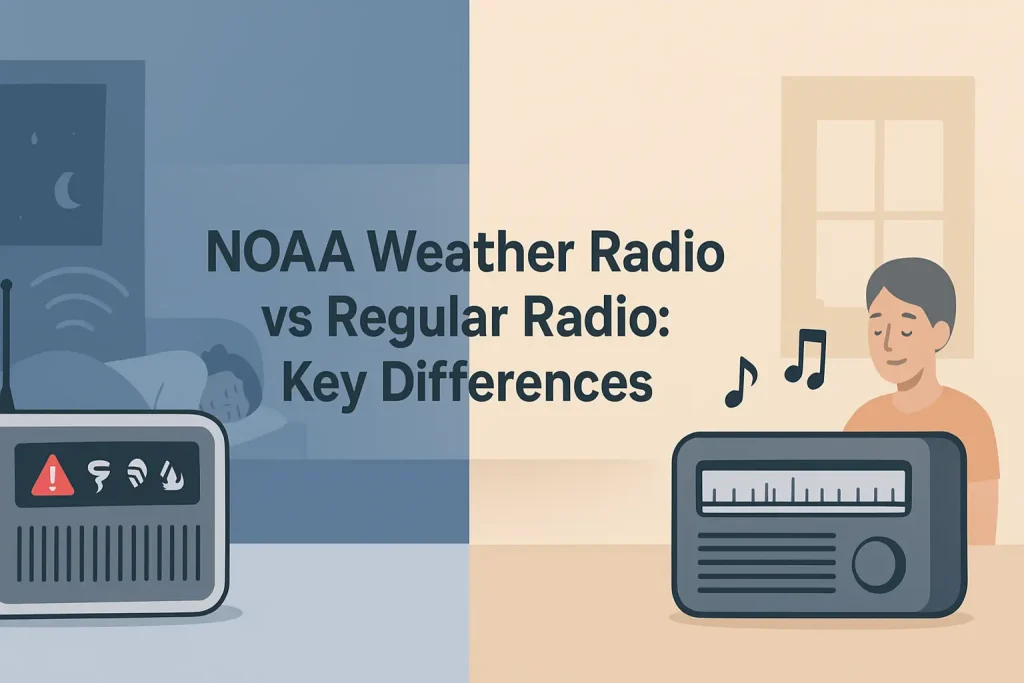
A tornado warning just came through on your weather radio. The alert is sounding, the voice is talking, and you are standing in your kitchen trying to figure out what to do next. The next 60 seconds matter more than anything else in this article.
NOAA Weather Radio All Hazards broadcasts on seven dedicated frequencies between 162.400 and 162.550 MHz, covering roughly 95% of the US population within 40 miles of a transmitter. But receiving the alert is only step one. What you do after the alert sounds determines whether your family is safe or scrambling.
| Photo | Popular Portable Walkie Talkies | Price |
|---|---|---|
 | SKIWARRIOR Multifunctional Smart Wireless Ski Goggles with Walkie-Talkie, Anti-Fog Zeiss Lens, Music & Call Function (Cylindrical Blue) | Check Price On Amazon |
 | SINORISE Super Mini Walkie Talkies, Two-Way Radios, 3 Pack | Check Price On Amazon |
 | KOSPET Tank M4C Smart Watch Rugged, Dual-Band GPS, 5ATM & IP69K Waterproof | Check Price On Amazon |
 | Retevis RT15 Walkie Talkies 3 Pack, Birthday Gift, Outdoor Adventure Kit | Check Price On Amazon |
 | Rechargeable Walkie Talkies Toys for Kids: DIY Astronaut Walkie Talkies for Boys Christmas Birthday Gifts for 3 4 5 6 7 8 9 10 Boy Walkie Talkie Outdoor Hiking Toy 2 Way Radio Camping Outdoor Game | Check Price On Amazon |
By the Numbers
Weather Radio for Tornadoes – Key Facts and Specifications
Sources: NOAA National Weather Service, FCC Part 95, FEMA IPAWS documentation
What Does a Tornado Alert on a Weather Radio Actually Mean?
A tornado alert on your NOAA weather radio is one of two things: a Tornado Warning or a Tornado Watch. These are not the same, and the action you take after each is completely different.
A Tornado Warning means a tornado has been detected by radar or confirmed by a trained spotter on the ground. It is in progress or imminent. You move to shelter immediately. A Tornado Watch means atmospheric conditions are favorable for tornado development. You stay alert and prepare, but you do not necessarily shelter yet.
NOAA broadcasts both alert types over the NWR (NOAA Weather Radio All Hazards) network using the EAS (Emergency Alert System) tone sequence. That distinctive two-tone attention signal (the 1050 Hz and 853 Hz warble) is the trigger that wakes a S.A.M.E.-enabled radio from standby.
A weather radio without S.A.M.E. technology (Specific Area Message Encoding) will sound for every alert issued anywhere in your broadcast area. That can mean alerts for counties 100 miles away from your home. A S.A.M.E.-capable radio like the Midland WR400 weather alert radio lets you program up to 50 six-digit FIPS county codes so the alarm only sounds for your location.
Key Specifications for the Midland WR400:
- Frequencies: 162.400 to 162.550 MHz (all 7 NOAA channels)
- S.A.M.E. alert types monitored: 25 distinct hazard categories
- Programmable S.A.M.E. codes: up to 50 county locations
- Power: AC adapter with 6x AA battery backup
- Alert output: siren, voice, and strobe (model-dependent)
For a deeper explanation of how the NWR network operates and what each alert category triggers, the full breakdown of how NOAA weather radio alerts are generated and transmitted covers the signal chain from the National Weather Service forecast office to your receiver.
The single most important distinction to memorize is this: a Warning means take cover now. A Watch means stay aware and be ready to move fast.
How to Respond When a Tornado Warning Sounds on Your Weather Radio
When a Tornado Warning alert fires on your weather radio, you have a narrow window to act. The average lead time between a tornado warning and a tornado strike is approximately 13 minutes, according to NOAA National Weather Service data. That is not much time if you are asleep, in the shower, or in a large building.
Follow these steps immediately after the alert sounds:
- Confirm the alert type. Listen to the voice broadcast for the first 10 seconds. The NWR voice (often called “Paul” or “Donna,” the NOAA synthesized voices) will state the event type, the affected counties, and the expiration time. A Warning requires immediate shelter. A Watch requires monitoring.
- Identify your shelter location. Move to an interior room on the lowest floor of the building. Avoid windows entirely. Bathrooms with interior plumbing walls, closets in the center of the building, and hallways away from exterior walls are the best options in most homes.
- Bring your weather radio with you. A portable hand-crank NOAA weather radio with battery backup is essential here. Tornado warnings can cancel, upgrade to Tornado Emergencies, or shift counties. You need the radio in your shelter location so you know when it is safe to come out.
- Protect your head and neck. Get under a sturdy table or mattress if available. Cover the back of your neck and head with your arms. Flying debris is the primary cause of tornado fatalities, not building collapse.
- Stay until the all-clear broadcast. Do not leave shelter based on the absence of sound or a break in the wind. Wait for an NWR broadcast confirming the Warning has expired or been cancelled. Tornadoes can pause, shift direction, or be followed immediately by a second funnel.
This sequence sounds simple, but most tornado injuries happen to people who shelter in the right place and then leave too early. The warning expiration time is broadcast on your weather radio. Use it.

Understanding the exact difference between a Watch and a Warning before an event happens is critical. The detailed comparison of tornado warning versus watch alerts and what each requires you to do is worth reading before severe weather season arrives in your region.
The correct response to a Tornado Warning is immediate shelter, radio in hand, head protected, and no movement until the NWR broadcast confirms the threat has passed.
What the Weather Radio Alert Sequence Sounds Like and How to Read It
A NOAA weather radio alert for a tornado begins with the EAS attention tone: a two-tone warble at 1050 Hz and 853 Hz transmitted for 8 to 25 seconds. This tone is what triggers the wake circuit in a S.A.M.E.-capable radio that is sitting on standby. It is followed immediately by the SAME header burst, which is a digital data stream encoding the event type, the affected FIPS county codes, the issuing office, and the message duration.
After the SAME header, the NWR synthesized voice reads the alert. The broadcast will state the event (Tornado Warning or Tornado Watch), the affected counties by name, the time of issue, the expiration time, and a brief description of the threat location. A Tornado Warning broadcast typically runs 60 to 90 seconds.
The alert ends with the EAS End-of-Message (EOM) tone, which is a three-burst signal indicating the broadcast is finished. Your radio will then return to standby mode, waiting for the next alert header.
Here is what a typical Tornado Warning broadcast sounds like, decoded:
- Event code in the SAME header: TOR (Tornado Warning)
- FIPS county code example: 031109 (Illinois, Champaign County)
- Originator code: NWS (National Weather Service)
- Purge time: The time the warning expires, stated in the voice broadcast
- Voice phrase to listen for: “A tornado warning is in effect for [county name] county until [time]”
If your radio sounds and you hear the words “Tornado Emergency” instead of “Tornado Warning,” that is a higher-tier event. A Tornado Emergency is issued when a confirmed, large, and potentially catastrophic tornado is directly threatening a populated area. The National Weather Service uses this designation sparingly. If you hear “Tornado Emergency,” move to the lowest interior room immediately without waiting for the voice broadcast to finish.
Radios that display the event code on a screen (such as the Uniden BC365CRS weather clock radio or the Sangean CL-100 weather radio) let you see the event type at a glance without needing to hear the voice broadcast. This matters at 3 a.m. when you are groggy and the voice synthesis is hard to parse quickly.
Learning the SAME header codes and EAS tone sequence before severe weather arrives means you will react faster and with more confidence when an alert sounds at an inconvenient time.
How to Program S.A.M.E. Codes So Your Radio Only Wakes You for Your County
A weather radio without S.A.M.E. programming will alarm for every county in the NWR broadcast area. In many regions, that broadcast footprint covers 5 to 15 counties. If you live in northern Cook County, Illinois, you do not need to be woken at 2 a.m. for a flash flood warning in Kankakee County 60 miles south. S.A.M.E. programming solves this by filtering alerts at the receiver level.
S.A.M.E. (Specific Area Message Encoding) uses six-digit FIPS (Federal Information Processing Standards) codes to identify geographic areas. Each county in the United States has a unique FIPS code. Your radio compares the FIPS codes in incoming SAME headers against the codes you have programmed. If there is no match, the radio stays silent.
Follow these steps to program your S.A.M.E. codes:
- Find your county FIPS code. Go to the NOAA Weather Radio SAME code page at weather.gov/nwr/counties. Enter your state and county to get the six-digit code. Write it down before you touch the radio.
- Enter programming mode. On most radios, this is a dedicated PROGRAM or SET button. On the Midland WR120B weather radio, hold the SNOOZE/PROG button for three seconds until the display shows “FIPS” and the first digit begins flashing.
- Enter the six-digit FIPS code. Use the number keys or up/down scroll buttons to set each digit. Confirm each digit before moving to the next position.
- Save and add additional counties if needed. Most S.A.M.E.-capable radios allow 3 to 50 stored codes. If you commute through adjacent counties, add those codes as secondary locations. The radio will alarm if any of your stored codes match an incoming alert.
- Test the programming. Many NWS forecast offices conduct weekly tests (typically Wednesday mornings) that transmit a Required Monthly Test (RMT) or Required Weekly Test (RWT). Let one of these pass and confirm your radio triggers. If it does not alarm during a test, recheck your FIPS code entry.
- Set your alert tone preference. Choose between siren, voice-only, or both. For overnight use, the siren mode with maximum volume is the correct setting. A voice-only alert at low volume may not wake a sleeping adult.
One common mistake is entering the state FIPS code (five digits ending in 000) instead of the county code. A state-level code will trigger alerts for the entire state. Always use the full six-digit county code.
For a complete walkthrough of programming your specific radio model including alarm settings, channel selection, and battery backup configuration, the step-by-step guide on setting up and programming a weather radio for the first time covers the most popular models in detail.
Correct S.A.M.E. programming means your radio stays silent for irrelevant alerts and sounds only when your county is directly threatened, which means you will actually respond to it instead of dismissing it as a false alarm.
Which Weather Radio Features Matter Most for Tornado Preparedness?
Not all weather radios perform equally during a tornado event. The features that determine whether a radio is adequate for tornado preparedness are S.A.M.E. decoding, alert tone volume, battery backup type, and display readability. Radios without all four of these are not adequate for overnight use in tornado-prone regions.
Here are the features ranked by importance for tornado response specifically:
S.A.M.E. Decoding (Non-Negotiable)
A weather radio without S.A.M.E. decoding capability is not suitable for overnight tornado alerting in any multi-county broadcast area. Without S.A.M.E. filtering, you will receive alerts for the entire NWR coverage footprint, which causes alarm fatigue and the habit of switching the radio to standby. A radio on standby will not alert you at 3 a.m. when a tornado warning is issued for your county.
Any radio under consideration should list S.A.M.E. (or SAME) technology explicitly in its specifications. The Midland WR400, the Uniden BC365CRS, and the Sangean CL-100 all include S.A.M.E. decoding as standard.
Alert Tone Volume (Minimum 90 dB for Bedroom Use)
A weather radio that produces less than 85 dB at one meter will not reliably wake a sleeping adult in a room with a door closed. The standard bedroom ambient noise floor is approximately 35 to 40 dB. Most sleepers require a sound level of 80 to 90 dB to wake reliably from deep sleep.
Look for radios that specify alarm output in dB or describe the alarm as a “siren alert” rather than a “tone alert.” The Midland WR400 produces an 85 dB alarm output. For households with heavy sleepers, a model with an external strobe or bed shaker connection (such as those compatible with the bed shaker alert accessory) provides a physical backup to the audio alarm.
Battery Backup Type and Duration
Tornadoes frequently knock out power before or during the event. A weather radio that loses power simultaneously with the tornado warning is useless. Battery backup is not optional. It is the entire point.
AA or AAA alkaline battery backup is the most reliable option because replacement batteries are available at any gas station or grocery store. Rechargeable internal lithium battery backup is convenient but fails if the radio has been sitting unused for months without being charged. A hand-crank solar emergency weather radio provides an additional power source that works even when batteries are dead and grid power is gone.
Display Readability and Event Code Visibility
A radio with a backlit display that shows the event code (TOR for Tornado Warning, SVR for Severe Thunderstorm Warning, FFW for Flash Flood Warning) allows you to confirm the alert type at a glance without waiting for the full voice broadcast. This is particularly valuable during nighttime alerts when processing the synthesized voice is slower.
Choosing the right radio before severe weather season is the decision that determines whether all the other steps in this guide actually work when you need them. The full comparison of top-rated weather radios tested for S.A.M.E. performance and alert reliability covers current models across multiple price points.
For tornado preparedness specifically, the minimum acceptable weather radio is one with S.A.M.E. decoding, at least 85 dB alarm output, and AA battery backup.
What to Do at Night When a Tornado Alert Wakes You Up
A tornado warning at 3 a.m. is the scenario most likely to result in injury, because the sleep-to-action transition takes time that a fast-moving tornado may not give you. The correct nighttime tornado response sequence is different from the daytime sequence in three important ways: you have less situational awareness, you have less time to gather supplies, and your shelter path may be obstructed in the dark.
Set up your nighttime tornado response before you go to sleep, not after the alert sounds:
- Position your weather radio on your nightstand with the alarm volume set to maximum. The radio should be within arm’s reach so you do not have to search for it in the dark after waking.
- Keep shoes next to your bed. Debris inside a damaged building includes broken glass and structural fragments. Moving through a damaged room barefoot is a preventable injury source.
- Know your shelter path without lights. Walk your shelter route in the dark at least once before tornado season. Know how many steps it is from your bed to the shelter room. Know which doors swing which way.
- Keep a flashlight and your weather radio together. A combination hand-crank flashlight and weather radio unit solves both needs in one device. Place it on the nightstand every night during tornado season.
- Do not stop to check your phone or look out the window. Both waste critical seconds. Your weather radio has already given you the only information you need: a warning is active for your county. Everything else can wait until you are in shelter.
One specific mistake people make at night is waiting to hear the tornado before moving. A tornado does not always produce the roaring freight-train sound described in safety guides. Rain-wrapped tornadoes, which are surrounded by heavy precipitation, can be completely silent at close range until they are directly overhead. The warning on your weather radio is the only reliable advance signal you will get.
Nighttime tornado preparedness is part of a broader emergency communication readiness plan. The complete guide to building a weather radio emergency preparedness kit for severe weather events includes checklists for supplies, shelter setup, and family communication plans.
The single most effective nighttime tornado preparation is the weather radio on the nightstand with maximum volume and correctly programmed S.A.M.E. codes, tested before the season starts.
How to Use a Weather Radio When You Are Away from Home During a Tornado Warning
A desktop weather radio at home does not protect you when you are in a vehicle, at a job site, camping, or at a venue without sirens. The NOAA NWR network broadcasts 24 hours a day regardless of your location. The limiting factor is whether you have a receiver with you that can decode and alert you to incoming warnings.
For mobile tornado preparedness, there are three hardware options:
Portable Battery-Powered NOAA Weather Radios
A compact portable weather radio with S.A.M.E. decoding and battery power covers most away-from-home scenarios. The Midland ER310 emergency weather radio operates on a built-in rechargeable battery, solar panel, and hand crank, making it suitable for camping, job sites, and vehicle go-bags.
Key Specifications for the Midland ER310:
- Power sources: rechargeable battery (2000 mAh), solar, hand crank, USB input
- Battery runtime: up to 40 hours on a full charge (receive-only mode)
- S.A.M.E.: yes, with programmable county codes
- Additional features: AM/FM, USB phone charging output, flashlight, SOS beacon
- Weight: approximately 10.6 oz
Vehicle-Based Monitoring
When driving in tornado-prone regions during severe weather season, a portable weather radio with car power adapter can monitor NWR frequencies continuously while you drive. Many modern vehicles receive weather radio frequencies on the AM/FM tuner, but without the EAS decoder chip, they will not automatically alert you. A dedicated portable unit with S.A.M.E. decoding is the correct solution for vehicle use.
Combination Handheld Two-Way Radios with WX Channels
Many GMRS and FRS handheld radios include weather-receive-only channels (WX1 through WX7) that tune to the NOAA NWR frequencies. These radios can monitor weather broadcasts but typically do not include S.A.M.E. decoding or automatic alerting. They are useful for monitoring conditions in the field but require you to manually tune to a WX channel and listen. They do not replace a dedicated S.A.M.E. weather radio for automatic overnight alerting.
If you are in a vehicle when a tornado warning is issued and no shelter structure is nearby, do not shelter under an overpass. This is a common and dangerous misconception. Overpasses concentrate wind speeds and provide no lateral protection from debris. Drive at a right angle to the tornado’s path to get out of its track, or abandon the vehicle and shelter in a low-lying ditch away from trees and power lines, covering your head and neck with your arms.
Having a portable weather radio in your vehicle or camping kit means the NOAA NWR alert system reaches you regardless of where the warning finds you.
What Happens After the Tornado Warning Expires on Your Weather Radio
When the Tornado Warning expiration time passes, your weather radio will not broadcast an all-clear announcement in most cases. The absence of a new alert does not mean conditions are safe. It means the official warning period has ended based on the forecast. Tornado damage, downed power lines, gas leaks, and structural hazards remain active threats after the warning expires.
Here is what to do when the warning expires or you see it cancelled on your radio display:
- Wait for confirmation on the NWR broadcast. Tune in and listen for the next scheduled weather statement from your local NWS office. The meteorologist will issue a post-event statement or a follow-up Severe Weather Statement confirming whether the tornado threat has ended.
- Check for a Tornado Watch still in effect. A Tornado Warning expiring does not cancel an active Tornado Watch. If a watch is still in effect, conditions remain favorable for tornado development. Stay alert and keep your radio on.
- Inspect your shelter area before exiting. Look upward before standing. If the ceiling is sagging or cracked, exit through a different path. Do not use elevators in multi-story structures after a tornado event until the building is inspected.
- Do not approach downed power lines. A downed power line is energized until the utility company de-energizes the circuit. Assume every downed line is live.
- Report damage to local emergency management. This helps NWS confirm whether a tornado touched down and refines future warning accuracy for your area.
Your weather radio continues to be useful after the immediate tornado threat ends. Keep it on and monitoring. The NWR network broadcasts post-event information, new watch statements, and ongoing hazard updates. A Tornado Warning ending does not mean severe weather is finished for the day.
After any tornado event, re-check that your S.A.M.E. codes are still programmed correctly and that your battery backup has not been depleted from the extended alert period. Replace or recharge batteries immediately so the radio is ready for the next event.
The post-warning period carries its own set of hazards. Staying on the NWR broadcast until the NWS officially ends the severe weather event for your county is the correct approach.
How Tornadoes Differ from Other Severe Weather Alerts on Your Weather Radio
Your S.A.M.E.-capable weather radio monitors 25 distinct alert categories transmitted over the NWR network. Tornado-specific alerts occupy two of those categories (Tornado Warning and Tornado Watch) but your radio will also activate for Severe Thunderstorm Warnings, Flash Flood Warnings, Hurricane Warnings, Winter Storm Warnings, and Civil Emergency Messages, among others. Understanding which alerts require immediate shelter versus which allow time to prepare is essential for appropriate response.
Use the table below to understand the response priority for the alerts most likely to accompany or precede tornado conditions.
| SAME Event Code | Alert Type | Response Priority | Required Action |
|---|---|---|---|
| TOR | Tornado Warning | Immediate | Shelter in lowest interior room now |
| TOA | Tornado Watch | High | Identify shelter, monitor continuously |
| SVR | Severe Thunderstorm Warning | High | Move indoors, avoid windows |
| SVA | Severe Thunderstorm Watch | Moderate | Stay alert, prepare shelter route |
| FFW | Flash Flood Warning | Immediate | Move to high ground, avoid low-lying roads |
| CEM | Civil Emergency Message | Immediate | Follow specific instructions in broadcast |
A Severe Thunderstorm Warning (SVR) can escalate to a Tornado Warning within minutes if the storm produces rotation. Do not dismiss a Severe Thunderstorm Warning as a minor event. The wall clouds and rotating updrafts that produce tornadoes form within severe thunderstorm environments. Treat an active SVR as a signal to identify your shelter path and prepare to move immediately if a TOR follows.
Flash floods are statistically deadlier than tornadoes in most years, according to NOAA National Weather Service fatality data. A Flash Flood Warning (FFW) on your weather radio requires a different response than a tornado warning, but it is equally urgent. Move away from streams, rivers, drainage channels, and low-elevation roads immediately.
Programming your weather radio to alert for Severe Thunderstorm Warnings in addition to Tornado Warnings gives you earlier advance notice that tornado-producing conditions are developing in your area. Most S.A.M.E.-capable radios allow you to select which alert types trigger the alarm. Enable at minimum: TOR, TOA, SVR, FFW, and CEM for tornado-prone regions.
Your weather radio is the fastest and most reliable alert source for all of these hazard types because it operates independently of cellular networks, which can become congested or damaged during major storm events.
How Weather Radios Perform in Basements, Shelters, and Interior Rooms
This is where many weather radio setups fail silently. A weather radio left in the kitchen will not transmit its alarm through a closed basement door with sufficient volume to wake someone sheltering below. The physics of the situation are straightforward: the 162 MHz VHF signal from the NWR transmitter penetrates the walls of your house easily. But the radio’s internal speaker does not penetrate a floor and a closed door at the same volume level.
This happens because sound pressure decreases at approximately 6 dB per doubling of distance in a free field, and building materials add additional attenuation of 15 to 30 dB depending on construction type. A radio producing 85 dB at one meter in the kitchen may produce only 45 to 55 dB at the bottom of a basement stairwell with a closed door, which is below the waking threshold for most sleeping adults.
The solution is straightforward: the weather radio must be in the shelter space with you, not in another room. This requires either a portable battery-powered radio or a wired alert system with a remote alarm unit in the basement or shelter room.
Options for reliable in-shelter alerting:
- Portable weather radio in the shelter room: The simplest solution. Keep a second dedicated portable radio in your basement or shelter room, programmed with your SAME codes and set to maximum volume. The Midland WR120B costs under $30 and serves this purpose effectively.
- Remote alert system with wired siren: Some weather radio models include an external alert output jack that can drive a remote siren or strobe unit in another room or floor. The Midland WR400 includes this capability.
- Multiple radios on the same SAME code: Two radios programmed identically in different parts of the house means the alert sounds regardless of where you are when it triggers.
One failure mode specific to basement sheltering is loss of NWR signal reception underground. The 162 MHz VHF signal generally penetrates one level of construction without significant attenuation. A basement with above-grade windows (common in walkout basements) typically receives adequate signal. A fully below-grade basement with reinforced concrete walls may not. Test your radio in your specific shelter location during a weekly NWR test broadcast to confirm reliable reception before you need it.
If your in-shelter radio does not receive a clear NWR signal, an external antenna extension can solve this in most cases. A simple wire antenna placed in an above-grade location and connected to the radio’s antenna jack via coaxial cable will improve signal penetration significantly. This is the same principle used in whole-house weather radio alert systems.
The radio must be in the shelter room with you and it must be receiving the NWR signal clearly. Test both conditions before severe weather season starts.
Tornado Season Timing and When to Keep Your Weather Radio on Alert Mode Year-Round
Tornado season varies significantly by region. The common perception that tornadoes are a spring phenomenon is partially accurate for the central United States, but incomplete. The Southeast experiences peak tornado activity in early spring and again in late fall. The Gulf Coast sees significant winter tornado activity. The northern plains and upper Midwest peak in June and July, which is later than many people expect. Alaska and Hawaii are the only states with essentially zero tornado climatology.
The widget below shows month-by-month weather radio alert priority for tornado-prone regions of the United States, based on NOAA storm data and NWS climatological records.
Seasonal Guide
Tornado Weather Radio Preparedness – Month-by-Month Action Guide
Alert activity levels and recommended actions by month. Source: NOAA Storm Prediction Center climatological tornado data.
Lower activity / Maintenance months
For residents of the Southeast United States (Alabama, Mississippi, Tennessee, Georgia, Arkansas), the year-round tornado risk is significantly higher than in Tornado Alley (Oklahoma, Kansas, Texas Panhandle). Dixie Alley tornadoes frequently occur at night and in December and January, when the tornado risk perception is lowest. Keeping the weather radio in overnight alert mode year-round is the correct approach for this region.
The January through March period in the Southeast sees frequent EF2 and EF3 tornadoes, many of which occur between midnight and 6 a.m. The National Weather Service data on nocturnal tornado fatalities shows that the majority of tornado deaths in the Southeast occur at night, precisely because nighttime tornadoes are less likely to be anticipated by residents who associate tornado risk with spring and summer afternoons.
The rule is simple: if you live in any of the 48 contiguous states east of the Rocky Mountains, your weather radio should be in overnight alert mode with maximum volume and correct SAME codes every night of the year, not just in April and May.
Quick Reference: Weather Radio and Tornado Alert Terminology
The following terms appear throughout this guide and in your weather radio documentation. Each definition applies specifically to NWR and NOAA emergency alerting, not to broadcast radio or other contexts.
NOAA Weather Radio All Hazards (NWR): A network of more than 1,025 radio stations broadcasting continuous weather and emergency information on seven VHF frequencies between 162.400 and 162.550 MHz. Operated by NOAA in partnership with the Federal Emergency Management Agency (FEMA).
S.A.M.E. (Specific Area Message Encoding): A digital protocol that encodes geographic and event information in the header of an NWR broadcast. Allows S.A.M.E.-capable receivers to filter alerts by county and by event type.
FIPS Code: Federal Information Processing Standards code. A six-digit number that uniquely identifies each county in the United States. Used in S.A.M.E. headers to specify which geographic areas are affected by an alert.
EAS (Emergency Alert System): The national public warning system coordinating emergency alerts across broadcast television, radio, cable, and NWR. The two-tone attention signal on your weather radio is the EAS attention tone (1050 Hz and 853 Hz).
Tornado Warning: Issued by NWS when a tornado has been detected by radar or confirmed by a spotter. Requires immediate protective action. SAME event code: TOR.
Tornado Watch: Issued by the NOAA Storm Prediction Center when atmospheric conditions are favorable for tornado formation. Requires alertness and preparation. SAME event code: TOA.
Tornado Emergency: An enhanced wording version of a Tornado Warning used when a confirmed, large, and dangerous tornado is directly threatening a populated area. Not a separate SAME code but uses TOR with enhanced language in the voice broadcast.
NWS (National Weather Service): The federal agency responsible for issuing weather warnings, watches, and advisories. Operates forecast offices (WFOs) that issue alerts for specific local areas. Each WFO transmits via nearby NWR stations.
WX Channel: One of seven NOAA weather radio receive-only frequencies (WX1 through WX7) available on many handheld radios, scanners, and FRS/GMRS units. WX channels do not transmit. They allow monitoring of NWR broadcasts but without S.A.M.E. alert decoding on most non-dedicated receivers.
Required Weekly Test (RWT): A brief weekly test of the NWR alert system, typically conducted on Wednesdays. Use this to verify your weather radio S.A.M.E. programming and alarm function without waiting for an actual weather event.
Required Monthly Test (RMT): A more comprehensive monthly test of the EAS and NWR systems, typically conducted on the first Wednesday of the month. Includes the full EAS attention tone sequence and a voice broadcast, allowing full system verification.
IPAWS (Integrated Public Alert and Warning System): FEMA’s national infrastructure that coordinates emergency alerts across NWR, Wireless Emergency Alerts (WEA), and the broadcast EAS. NWR is one component of the broader IPAWS architecture.
Common Mistakes People Make with Weather Radios During Tornado Season
The most common weather radio failure during a tornado event is not a hardware failure. It is a setup or behavioral failure that makes the hardware ineffective when it matters most.
Here are the mistakes that account for the majority of weather radio failures during actual tornado events:
Leaving the Radio on “All Hazards” Without SAME Filtering
Running a weather radio in all-hazards mode without S.A.M.E. county filtering means the alarm sounds for every alert in the broadcast area. After several nights of waking up for alerts in counties far from your location, most people switch the alarm mode off or reduce the volume to inaudible levels. The radio then fails silently when a tornado warning is issued for your county. Program your SAME codes the day you set up the radio, not later.
Not Testing the Radio Before Severe Weather Season
A weather radio that has not alarmed in three months may have exhausted its battery backup, lost its S.A.M.E. programming due to a power interruption, or developed a silent hardware fault. Test your radio during a Required Weekly Test broadcast (typically Wednesday mornings) at the start of each severe weather season. If the radio does not alarm during the test, troubleshoot immediately.
Keeping the Radio in One Room and Sleeping in Another
As described in the shelter reception section above, an 85 dB alarm in the kitchen does not reliably wake someone in a closed bedroom, and it definitely does not reach a basement shelter. The radio must be in the room where people sleep or shelter. This means either a second portable unit or a model with a remote alert output. A second battery-powered portable weather alert radio for the bedroom costs less than $25 and removes this failure point entirely.
Using Only a Phone for Weather Alerts
Wireless Emergency Alerts (WEA) sent to cell phones are a supplement to NWR, not a replacement. During major tornado events, cellular networks experience significant congestion as thousands of people simultaneously call family members and access weather apps. WEA delivery is not guaranteed when networks are overloaded. NWR operates on a separate VHF broadcast infrastructure that is not affected by cellular network congestion. The weather radio is more reliable, not less reliable, during the events where you need it most.
Not Programming Both Tornado Watch and Tornado Warning Alerts
Some users program their S.A.M.E. radio to alert only for Tornado Warnings (TOR) and disable Tornado Watch (TOA) alerts to reduce nighttime disturbances. This removes the early warning that a tornado watch provides. A watch gives you time to identify shelter, charge devices, confirm where family members are, and fill the bathtub as a water reserve. Disabling watch alerts to avoid inconvenience eliminates the preparation window. Enable both TOR and TOA in your alert settings.
Relying on Outdoor Sirens as the Primary Alert System
Outdoor warning sirens are designed to alert people who are outdoors. They are not designed to penetrate modern construction. A house with double-pane insulated windows, closed interior doors, central air conditioning running, and a television on can easily block outdoor siren sound to inaudible levels. The NOAA NWR network exists precisely because outdoor sirens have known limitations for indoor alerting. Your weather radio is the correct primary alert system for indoor use.
Each of these mistakes is preventable. The correct setup takes about 15 minutes once, at the beginning of each severe weather season, and eliminates every one of these failure modes.
Is a Weather Radio Still Necessary When You Have a Smartphone?
Wireless Emergency Alerts (WEA) delivered to smartphones are real and they do work for most tornado warnings. The question is not whether smartphones receive alerts. The question is whether smartphones are reliable enough to be your only alerting system during a severe weather event. They are not, for three specific reasons.
First, WEA delivery depends on cellular tower connectivity. Tornadoes frequently damage cell towers before and during the event. Second, cellular networks become congested during major weather events as thousands of people in the affected area simultaneously call family members, post on social media, and access weather apps. Congestion delays WEA message delivery. Third, a smartphone that is uncharged, on silent, in another room, or on Do Not Disturb will not alert you to a tornado warning regardless of how reliable the cellular network is.
The NOAA NWR network operates on a dedicated VHF broadcast infrastructure entirely separate from cellular and internet infrastructure. It does not depend on a network that other users are simultaneously accessing. It does not require your device to have battery charge above a minimum threshold. It does not have a silent or Do Not Disturb mode (unless you set one). A dedicated weather radio with S.A.M.E. decoding and battery backup is structurally more reliable than a smartphone for this specific use case.
The correct answer is to use both. WEA on your phone provides redundancy. NWR on a dedicated weather radio provides the baseline reliable system. Neither replaces the other.
One additional consideration is the NWR voice broadcast content. When a tornado warning sounds, the NWR voice broadcast tells you the specific counties affected, the time the warning expires, the location of the tornado relative to named towns, and the direction of movement. A WEA message on your phone tells you a tornado warning is in effect for your county. The NWR broadcast gives you significantly more actionable information for immediate decision-making.
The weather radio and the smartphone work together. The weather radio provides reliable alerting and detailed voice information. The smartphone provides WEA redundancy and access to radar apps for visual situational awareness. Use both together for the strongest possible tornado warning system in your home.
Frequently Asked Questions About Weather Radios and Tornado Alerts
Can a weather radio receive a tornado warning if the power goes out?
Yes, provided your weather radio has functional battery backup. The NOAA NWR transmitters are on emergency backup power and continue broadcasting during widespread power outages. Your receiver needs its own power source, either AA or AAA alkaline batteries, a built-in rechargeable battery, or a hand-crank generator, to receive the alert when your home power fails.
This is why battery backup is a non-negotiable feature for tornado preparedness. A weather radio plugged into wall power only becomes useless at the exact moment when you need it most, because tornadoes frequently knock out power grids in the storm’s path before the tornado itself arrives.
Replace or recharge your weather radio batteries at the start of each severe weather season. Do not wait for an alert to discover the batteries are dead.
What is the difference between WX1 on a walkie-talkie and a dedicated weather radio?
The WX channels (WX1 through WX7) on a walkie-talkie or GMRS radio tune to the NOAA NWR broadcast frequencies (162.400 to 162.550 MHz) and allow you to listen to weather broadcasts. However, standard FRS and GMRS radios do not contain a S.A.M.E. decoder chip, so they will not automatically alert you when a tornado warning is issued for your county. You must manually tune to a WX channel and listen.
A dedicated S.A.M.E. weather radio sits in standby mode and activates automatically when the NWR transmits an alert header matching your programmed FIPS county code. This automatic alerting capability is what makes a dedicated weather radio a reliable overnight tornado alert device. A walkie-talkie WX channel is useful for monitoring weather during outdoor activities, but it is not a substitute for a dedicated weather radio in a home alerting context.
How do I know which NOAA weather radio frequency to use in my area?
You do not select a specific frequency manually on most modern weather radios. A S.A.M.E.-capable radio scans all seven NWR frequencies (162.400, 162.425, 162.450, 162.475, 162.500, 162.525, and 162.550 MHz) and receives whichever signal is strongest at your location. You program your FIPS county code, and the radio filters by geography, not by frequency.
If you want to know which specific NWR transmitter serves your area and which frequency it uses, the NOAA Weather Radio station listing at weather.gov/nwr/stations allows you to search by state and shows the transmitter call sign, frequency, and coverage area for each station. This is useful for troubleshooting reception problems and for setting up an external antenna pointed toward the nearest transmitter.
Why does my weather radio alarm for counties far from my home even though I programmed my SAME codes?
The most common cause is an incorrect FIPS code entry. A state-level FIPS code (which ends in 000) causes the radio to alert for the entire state. Verify that your programmed code is the full six-digit county code, not the five-digit state code. You can check your county’s correct FIPS code at the NOAA SAME code lookup page at weather.gov/nwr/counties.
A second cause is that some weather radios reset their S.A.M.E. programming after a power interruption, reverting to all-hazards mode. If your radio lost power (even briefly) and you have not re-entered your codes since, the codes may be blank. Confirm your stored codes are still present in the radio’s memory by entering the programming menu and verifying each digit. Re-enter codes after any significant power outage.
Do I need a separate weather radio for each floor of my house?
Not necessarily, but you need the radio to be audible in every occupied sleeping area during a tornado warning. A single radio producing 85 dB in the kitchen will not reliably penetrate a closed bedroom door on an upper floor or a basement shelter room with a sound-attenuating door. Test the alarm volume in every sleeping area with the radio in its normal position and all doors in their normal nighttime configuration.
If you find the alarm is inaudible in any sleeping area, the most cost-effective solution is a second portable weather radio placed in or near that area. A basic S.A.M.E.-capable weather radio costs $20 to $40. That is a low cost relative to the consequence of a tornado warning going unheard in a bedroom where family members are sleeping.
Can I use one weather radio to alert multiple household members in different rooms?
One weather radio with a sufficiently loud alarm (90 dB or above) can alert an open-plan space reliably. For multi-room households, multi-floor homes, or homes with soundproofing between rooms, a single radio is generally inadequate. Options include multiple radios programmed with the same S.A.M.E. codes, a radio with a remote siren or strobe output connected to units in other rooms, or a whole-house alert system using multiple NWR receivers on a shared alert bus.
Households with deaf or hard-of-hearing members need a weather radio with a strobe light output and/or a bed shaker accessory. The visual alert provided by the strobe function is a separate sensory channel that does not depend on the alarm volume being sufficient to wake someone.
What does “Tornado Emergency” mean and is it different from a Tornado Warning?
A Tornado Emergency is an enhanced wording designation used by the NWS for confirmed, large, and potentially catastrophic tornadoes directly threatening densely populated areas. It uses the same SAME event code (TOR) as a standard Tornado Warning, so your weather radio activates the same way. The difference is in the voice broadcast language, which explicitly states “Tornado Emergency” and often includes phrases like “extremely dangerous situation” or “catastrophic damage expected.”
If you hear “Tornado Emergency” in the NWR voice broadcast, do not wait for the full broadcast to finish. Move to your lowest interior room immediately. A Tornado Emergency is the highest-tier tornado alert the NWS issues and indicates a confirmed significant tornado is directly in the path of a populated area. The NWS uses this designation rarely and only when the threat is confirmed and severe.
How far in advance does a weather radio typically alert before a tornado arrives?
The average lead time for a tornado warning (the time between the warning issuance and when the tornado affects the warned area) is approximately 13 minutes, according to NOAA National Weather Service average lead time statistics. Individual warnings vary from seconds in fast-moving situations to 30 or more minutes when rotation is detected well in advance by Doppler radar.
Thirteen minutes is enough time to move your household to shelter, bring your radio, put on shoes, and get under cover. It is not enough time to pack a bag, call relatives, or search for supplies that are not pre-staged. This is why pre-staging your shelter supplies (shoes, flashlight, portable radio, water bottle, phone charger) before severe weather season is not optional preparation. It is the difference between an adequate 13-minute response and an inadequate one.
Is a weather radio useful for tornado preparedness if I live in an apartment building?
Yes, but the shelter response is different than in a single-family home. In an apartment building, you cannot go to a basement unless the building has one that is accessible. The correct shelter location in most apartment buildings is an interior hallway on the lowest floor, away from windows and exterior walls. A bathroom in the center of the building is also acceptable if there are no exterior walls or windows.
A portable battery-powered weather radio is ideal for apartment use because you can bring it to your shelter location within the building. Program your FIPS county code and leave the radio on your nightstand in standby mode just as you would in a house. The alerting function is identical regardless of building type. What changes is the shelter location you move to after the alert sounds.
What should I do if my weather radio alarms but I cannot hear the voice broadcast clearly?
If the alarm sounds but the NWR voice is unclear or difficult to understand, there are two common causes. First, reception may be marginal at your location on the frequency your radio is receiving. Move the radio to a location with better reception (closer to a window on the side of the house facing the NWR transmitter) or extend the antenna fully. Second, the NWR synthesized voice (the NOAA weather voice system) can be difficult to parse at normal volume for some listeners, particularly older adults or people awakened from deep sleep.
For this reason, a weather radio with a display showing the event code (TOR, TOA, SVR) is more useful than a radio without a display. You can confirm the alert type visually without needing to successfully parse the synthesized voice. If your current radio lacks a display, consider upgrading to a model that shows the event code during an alarm.
Can heavy rain or thunderstorms interfere with my weather radio reception during the storm?
The 162 MHz VHF band used by NOAA NWR is relatively resistant to precipitation fade compared to lower-frequency AM broadcast radio. Rain, thunderstorms, and even lightning nearby generally do not cause significant signal loss on the NWR frequencies. The more common signal issue during severe weather is that the electromagnetic noise floor rises with nearby lightning, which can introduce static into the audio.
This static does not prevent the S.A.M.E. decoder from processing the digital header that triggers the alarm. The alarm will still activate correctly in nearly all cases. The static may affect the clarity of the voice broadcast that follows. In a severe storm scenario, this is a secondary concern. The alarm activating is what matters most. Move to shelter when the alarm sounds, then listen to the broadcast as best you can in your shelter location.
A weather radio with a strong internal antenna or an external antenna connection will provide better signal clarity during nearby electrical storms. The weather radio models with external antenna jacks allow connection to a dedicated VHF antenna installed in an optimal location for maximum signal strength.
Building Your Tornado Alert System Before the Next Severe Weather Event
A tornado warning gives you roughly 13 minutes. A correctly set up weather radio with S.A.M.E. programming, battery backup, and maximum alarm volume gives you all 13 of those minutes for movement and shelter. A radio with no SAME codes, dead batteries, or sitting in the wrong room gives you far less.
The setup takes 15 minutes. Program your FIPS county code, test the alarm during a Wednesday morning NWR test broadcast, place the radio in the room where you sleep, and confirm battery backup is functional. Those four steps, done once before severe weather season, are the entire difference between a weather radio that works and one that does not.
Start with the right hardware by reviewing the full comparison of S.A.M.E. weather radios compared by alert reliability and features, then set it up correctly using the step-by-step weather radio programming and setup guide.
| Photo | TOP RATED WALKIE TALKIES | Price |
|---|---|---|
 | Retevis RT628 Kids Walkie Talkies, Toys Gifts for 4-12 Year Old Girl Boy | Check Price On Amazon |
 | Cobra ACXT545 Weather-Resistant Walkie Talkies, Rechargeable, 22 Channels | Check Price On Amazon |
 | Retevis RT388 Kids Walkie Talkies, Outdoor Toys for Kids Camping Essentials | Check Price On Amazon |
 | Cobra RX680 Walkie Talkies (2-Pack), IP54 Water Resistant Design | Check Price On Amazon |
 | Retevis RT22 Walkie Talkies Long Range Rechargeable with Earpiece (2 Pack) | Check Price On Amazon |
 | Midland GXT1000VP4 GMRS JIS4 Two-Way Radio, Black,2 Pack | Check Price On Amazon |
 | Retevis RT628 Walkie Talkies for Kids,Toys Gifts for 6-12 Years Old Boys Girls,Long Range 2 Way Radio 22CH VOX,Birthday Gift,Family Walkie Talkie for Camping Hiking Indoor Outdoor | Check Price On Amazon |