A weather radio without S.A.M.E. technology will alert you for every county in your state during a winter storm, not just yours. That means a 3 a.m. alarm for a blizzard warning 200 miles away, while the storm bearing down on your neighborhood goes unnoticed because the battery died from constant false alerts.
NOAA Weather Radio All Hazards broadcasts continuously on seven dedicated frequencies between 162.400 and 162.550 MHz, covering roughly 95% of the U.S. population within 40 miles of a transmitter. For winter storms and blizzards specifically, the right radio, properly programmed, is the only warning system that works when cell towers are down, power is out, and roads are impassable.
| Photo | Popular Portable Walkie Talkies | Price |
|---|---|---|
 | SKIWARRIOR Multifunctional Smart Wireless Ski Goggles with Walkie-Talkie, Anti-Fog Zeiss Lens, Music & Call Function (Cylindrical Blue) | Check Price On Amazon |
 | SINORISE Super Mini Walkie Talkies, Two-Way Radios, 3 Pack | Check Price On Amazon |
 | KOSPET Tank M4C Smart Watch Rugged, Dual-Band GPS, 5ATM & IP69K Waterproof | Check Price On Amazon |
 | Retevis RT15 Walkie Talkies 3 Pack, Birthday Gift, Outdoor Adventure Kit | Check Price On Amazon |
 | Rechargeable Walkie Talkies Toys for Kids: DIY Astronaut Walkie Talkies for Boys Christmas Birthday Gifts for 3 4 5 6 7 8 9 10 Boy Walkie Talkie Outdoor Hiking Toy 2 Way Radio Camping Outdoor Game | Check Price On Amazon |
By the Numbers
Weather Radio for Winter Storms – Key Specifications and Standards
Sources: NOAA National Weather Service, FCC Part 95, FEMA IPAWS documentation
What Is a Weather Radio and Why Does It Matter for Winter Storms?
A weather radio is a dedicated receiver programmed to monitor NOAA Weather Radio All Hazards (NWR) broadcasts on VHF frequencies between 162.400 and 162.550 MHz, 24 hours a day, seven days a week. Unlike a smartphone push notification, it requires no cell signal, no Wi-Fi, and no battery-backed router to function.
For winter storms specifically, this independence is what makes the radio indispensable. Blizzards knock out cell towers, freeze power lines, and isolate households for days. The NOAA NWR network, operated by the National Oceanic and Atmospheric Administration, keeps broadcasting through all of it.
According to NOAA, the NWR system uses the Emergency Alert System (EAS) and the Integrated Public Alert and Warning System (IPAWS) to push hazard-specific messages to receivers. The system covers tornadoes, floods, and chemical spills, but winter weather messages, including Blizzard Warnings, Winter Storm Warnings, Ice Storm Warnings, Wind Chill Warnings, and Winter Weather Advisories, are among the most frequently issued alert types in northern and central states.
A weather radio is a type of emergency communication receiver. It consists of a VHF FM receiver tuned to 162 MHz, a S.A.M.E. decoder chip, an alert speaker or alarm output, and a power source, which typically combines an AC adapter with a battery or hand-crank backup. It works within the NOAA NWR network, receiving encoded digital headers that the S.A.M.E. chip decodes to determine whether the alert applies to your specific county.
The difference between a S.A.M.E.-equipped radio and a basic weather radio is the difference between a targeted warning and a state-wide noise generator. S.A.M.E. stands for Specific Area Message Encoding. It uses a 6-digit FIPS (Federal Information Processing Standards) code to identify your county or parish, so the radio only sounds an alarm when an alert applies to your area.
If you want to understand the full architecture of the NWR system before diving into winter-specific programming, the complete breakdown of how NOAA weather radio works and what it broadcasts covers every component in detail.
The most important thing to understand about weather radios for winter preparedness is this: the radio does nothing useful if it is not programmed with your FIPS code and kept on with fresh batteries before the storm arrives. Every section below is about making sure both conditions are met.
How NOAA Broadcasts Winter Storm Alerts: Frequencies, Signal Reach, and What Gets Transmitted
NOAA broadcasts on seven dedicated VHF frequencies: 162.400, 162.425, 162.450, 162.475, 162.500, 162.525, and 162.550 MHz. Each transmitter covers roughly a 40-mile radius at typical antenna heights. Your weather radio automatically scans all seven channels to lock onto the strongest signal in your area.
This happens because VHF FM signals in the 162 MHz range propagate via line-of-sight. Hills, buildings, and terrain features between you and the transmitter reduce signal strength. This only occurs when your radio is more than 40 miles from the nearest transmitter or when terrain blockage is significant. If your radio shows weak signal or static on all seven channels, reposition it near a window or add an external antenna.
NOAA weather radio transmitters broadcast at 300 watts of effective radiated power. According to NOAA NWR technical documentation, the network uses more than 1,000 transmitter stations across all 50 states, U.S. territories, and adjacent coastal waters. For most households in the continental U.S., at least one transmitter is within reliable range.
Winter storm alerts transmitted on NWR include the following S.A.M.E. event codes that are directly relevant to cold-weather emergencies:
- BZW — Blizzard Warning (sustained or frequent winds of 35+ mph with snow reducing visibility to under 0.25 miles for 3 or more hours)
- WSW — Winter Storm Warning (significant combination of snow, sleet, and freezing rain above advisory thresholds)
- WCW — Wind Chill Warning (wind chills dangerous enough to cause frostbite within 30 minutes)
- ISW — Ice Storm Warning (significant ice accumulation of 0.25 inch or more)
- LBW — Lake Effect Snow Warning (heavy lake-effect snow, typically 8+ inches in 12 hours)
- WSA — Winter Storm Watch (conditions favorable for a winter storm within 24-48 hours)
- WCA — Wind Chill Advisory (wind chills that are inconvenient or uncomfortable but not life-threatening)
- WSY — Winter Weather Advisory (light snow, freezing drizzle, or sleet causing hazardous conditions below warning thresholds)
The radio transmits these alerts as a digital EAS header, followed by an attention tone, followed by a spoken message from a NOAA meteorologist. The S.A.M.E. decoder in your radio reads the digital header in the first fraction of a second to determine whether the geographic area code in the message matches your programmed FIPS code. If it matches, the alarm sounds. If it does not match, the radio stays silent.
This is why county-level programming is not optional for winter storm preparedness. Blizzard Warnings issued for a county 150 miles north of you use a different FIPS code than your county. Without S.A.M.E. programming, both alerts trigger your alarm at 2 a.m. With correct programming, only the one that affects your household wakes you up.
The single most important step before winter storm season is confirming your weather radio is locked onto the correct transmitter frequency and programmed with the correct 6-digit FIPS code for your county.
What Features Should a Winter Storm Weather Radio Have?
A winter storm weather radio needs S.A.M.E. alert filtering, a battery backup capable of lasting at least 72 hours without AC power, and an alarm loud enough to wake a sleeping household. Every other feature is secondary to these three.
Winter storms often include extended power outages. The National Weather Service documented that the February 2021 Texas winter storm event left millions of households without power for days. A weather radio that depends entirely on AC power is useless once the grid goes down, which is exactly when blizzard conditions are most dangerous.
S.A.M.E. Alert Filtering
S.A.M.E. (Specific Area Message Encoding) lets you program one or more 6-digit FIPS codes so the radio only alarms for your selected counties. A radio without S.A.M.E. will sound an alarm for every alert issued anywhere in the broadcast area of the transmitter, which can cover multiple states at high-power transmitters. For winter weather, this creates alarm fatigue: you start sleeping through alerts, including the one warning you that your county is in the direct path of an ice storm.
Battery Backup Type and Duration
Weather radios use one of three backup power configurations. The first is rechargeable battery pack, which is built into the unit and charges when plugged in. The second is removable AA or AAA alkaline batteries installed separately. The third is a hand-crank generator that manually charges an internal battery.
For winter storm preparedness, the recommended configuration is a radio that accepts standard AA batteries as backup, not only a proprietary rechargeable pack. Rechargeable packs lose capacity over time and may not hold a charge after sitting unused for months. AA alkaline batteries, stored sealed and unused, retain reliable capacity for up to 10 years. In a blizzard scenario, replacing dead AA batteries is far easier than sourcing a replacement proprietary pack.
Alarm Volume and Alert Tone
A weather radio alarm needs to wake a sleeping adult through a closed bedroom door. Radios with a minimum 90-decibel alarm tone at 1 meter are appropriate for this purpose. The Midland WR400 weather radio produces an 85-90 dB alert tone and is widely recommended for household blizzard preparedness.
Display and Manual Channel Selection
A backlit LCD display showing the current channel, signal strength, and active alert type helps you verify the radio is functioning correctly before a storm arrives. Manual channel selection matters if the automatic scan locks onto a weaker transmitter. During winter storms, some transmitters may be partially obstructed by heavy precipitation. The ability to manually select the strongest channel for your location improves reliability.
Key Specifications for a Winter Storm Weather Radio:
- S.A.M.E. programmable alert codes: minimum 25 event codes
- FIPS code storage: at least 25 programmable county codes
- Battery backup: AA battery tray or hand-crank, minimum 72 hours standby
- Alarm tone: 85 dB minimum at 1 meter
- Channel coverage: all 7 NOAA NWR frequencies (162.400 to 162.550 MHz)
- Display: backlit LCD with channel and alert type indication
A weather radio with all of these features does not need to be expensive. The Uniden BC365CRS weather radio and the Sangean CL-100 weather radio both include S.A.M.E. decoding, battery backup, and alarm functionality in the $30 to $60 price range.
A reliable winter storm weather radio must combine S.A.M.E. county filtering with long-duration battery backup, because losing AC power and losing your only source of storm alerts at the same moment is the exact scenario the radio exists to prevent.
Best Weather Radios for Winter Storms: Top Models Compared
The best weather radios for winter storms balance S.A.M.E. filtering, battery backup duration, alarm reliability, and resistance to the cold itself. The following models represent the most commonly recommended options across the preparedness and emergency communication community.
Use the table below to identify which model matches your household’s winter storm preparedness priorities.
| Model | S.A.M.E. Codes | Battery Backup | Alarm (dB) | Hand Crank | Price (USD) | Best For |
|---|---|---|---|---|---|---|
| Midland WR400 | 50 codes | 6x AA | 90 dB | No | $50-65 | Home use, bedroom alert |
| Uniden BC365CRS | 25 codes | 3x AA | 85 dB | No | $30-40 | Budget, apartment use |
| Sangean CL-100 | 25 codes | 3x AA | 85 dB | No | $35-50 | Clear display, easy setup |
| Midland ER310 | 25 codes | 2000 mAh Li-ion + crank | 88 dB | Yes | $60-80 | Power outage, off-grid |
| Kaito KA500 | 7 NOAA channels | Solar + crank + 3x AA | 80 dB | Yes | $40-55 | Multi-power, portable |
| Midland WR120B | 25 codes | 3x AA | 85 dB | No | $25-35 | Entry-level, first radio |
The Midland WR400 programmable weather radio is the most fully featured desktop option for winter storm preparedness, storing up to 50 S.A.M.E. location codes. This matters for households near county borders, where alerts for two or three adjacent counties are all relevant during a blizzard.
The Midland ER310 emergency hand-crank weather radio is the preferred option when multi-day power outages are likely. Its 2000 mAh lithium-ion battery charges via USB, solar panel, or hand crank, giving it power independence that AA-only radios cannot match during extended blizzard conditions.
Key Specifications: Midland ER310
- Battery capacity: 2000 mAh lithium-ion internal
- Charge methods: USB, solar panel (top-mounted), manual hand crank
- NOAA channels: 7 (162.400 to 162.550 MHz)
- S.A.M.E. event codes: 25 programmable
- Additional features: AM/FM receiver, 250-lumen LED flashlight, USB phone charging port
The Kaito KA500 solar hand-crank weather radio does not include S.A.M.E. county filtering, which is a significant limitation for households in large broadcast areas. It receives all 7 NOAA channels and alerts on any transmission, making it better suited as a secondary radio than a primary winter storm alert device.
For most households, the correct choice is a dedicated desktop S.A.M.E. radio like the Midland WR400 as the primary unit, paired with a hand-crank radio like the Midland ER310 as a backup for extended power outages.
For a broader review of the top-rated models across all weather radio categories, the detailed analysis of which weather radios perform best across alert types and environments covers additional models with full specification comparisons.
How to Program a Weather Radio for Winter Storm Alerts: Step-by-Step
Programming a weather radio for winter storm alerts takes less than 10 minutes and requires only your county’s 6-digit FIPS code. The FIPS code is your county’s unique identifier in the NOAA S.A.M.E. system. Without it programmed correctly, your radio either alarms for the wrong area or never alarms at all.
You can find your FIPS code at the NOAA NWR SAME county codes page (weather.gov/nwr/counties) or by searching your county name in the FEMA IPAWS database. Every county in the U.S. has a unique 6-digit code. For example, Cook County, Illinois uses 017031. King County, Washington uses 053033.
The following steps apply to most S.A.M.E.-enabled weather radios, including the Midland WR400, Uniden BC365CRS, and Sangean CL-100. Specific button labels vary by model, but the programming sequence is standardized.
Here is a step-by-step guide to programming winter storm alerts on a S.A.M.E. weather radio.
- Find your FIPS code: Look up your county’s 6-digit FIPS code at weather.gov/nwr/counties before you touch the radio. Have it written down.
- Press the PROG or MENU button: On most radios, this enters programming mode. The display will show a prompt for county code entry.
- Enter your 6-digit FIPS code: Use the number keypad or up/down arrows to enter the digits one at a time. Confirm each digit as you go. A single wrong digit means the radio will miss alerts for your county.
- Add adjacent county codes if needed: If you live near a county line, or if the storm’s projected path covers multiple counties, add those FIPS codes as additional locations. The Midland WR400 stores up to 50 codes. Most other radios store 25.
- Select alert event types: Navigate to the event code menu. Activate at minimum: BZW (Blizzard Warning), WSW (Winter Storm Warning), WCW (Wind Chill Warning), ISW (Ice Storm Warning), WSA (Winter Storm Watch), and LBW (Lake Effect Snow Warning). Also activate EAN (Emergency Action Notification) and NIC (National Information Center) as these cover national-level emergencies.
- Set the alarm mode: Confirm the radio is in ALARM mode, not ALERT ONLY. In alarm mode, the radio sounds an audible tone when triggered. In alert-only mode, it may only activate the display without waking you.
- Test the programming: Most radios have a WEEKLY TEST feature. Trigger a manual test to confirm the alarm sounds and the display shows the correct county and alert type.
- Install fresh batteries: Even if the AC adapter is connected, install fresh AA batteries or charge the internal battery to 100%. This ensures the radio remains operational if power is lost during the storm.
One common programming error is entering a 5-digit FIPS code instead of a 6-digit code. Some older reference sources list 5-digit codes. The NOAA NWR S.A.M.E. system uses 6-digit codes with a leading zero for some states. For example, Alabama county codes begin with 01. If your radio rejects the code, confirm you are using the full 6-digit version from the current NOAA reference table.
For a complete walkthrough of the broader programming process, including how to select the correct transmitter frequency and interpret alert messages, the step-by-step guide to setting up and operating any weather radio model covers every detail from initial setup through advanced alert customization.
Correct S.A.M.E. programming is the single step that transforms a generic alert device into a targeted early warning system for your specific county.
Battery Backup and Power Failure: Keeping Your Weather Radio Running During a Blizzard
A blizzard that knocks out your power also eliminates the AC adapter that powers your weather radio. If the radio has no battery backup, it goes silent at exactly the moment you need it most. The power loss and the dangerous storm conditions are not sequential events; they happen simultaneously.
This happens because blizzard conditions generate ice load on power lines. Ice accumulation of even 0.5 inches can increase the weight on a power line by 500% or more, causing line failures across wide geographic areas. The U.S. Department of Energy has documented that winter weather events cause more widespread power outages than any other weather type in the continental U.S.
AA Alkaline Batteries vs. Rechargeable Internal Pack
Radios with removable AA battery trays offer a significant preparedness advantage over radios with only a built-in rechargeable pack. AA alkaline batteries in an unsealed package retain 80-90% of their capacity for up to 7 years in storage. You can stockpile them before winter storm season and have genuine confidence in their capacity.
Rechargeable lithium-ion packs in radios like the Midland ER310 are convenient for regular use but self-discharge over time. A pack at 100% charge in October may be at 70% charge by January if the radio was not plugged in. For winter storm preparedness, the habit of plugging the radio in and topping off the battery before each forecast storm removes this risk.
The Energizer AA alkaline batteries in bulk 36-pack are a practical pre-storm investment. Keep one full set in the radio and one spare set sealed in the package immediately next to the radio.
Hand-Crank and Solar Backup Options
Hand-crank radios like the Midland ER310 hand-crank emergency radio and the Kaito KA500 hand-crank solar emergency radio generate power mechanically. One minute of cranking typically provides 10-15 minutes of radio operation. This is not practical for continuous overnight monitoring but is useful for checking conditions on demand during a multi-day blizzard when all batteries have been exhausted.
Solar charging during a blizzard is largely ineffective. Heavy cloud cover and snow-covered panels reduce solar input to near zero in most winter storm scenarios. Solar should be treated as a bonus feature rather than a primary charging strategy for winter use.
Keeping the Radio Warm
Lithium-ion batteries lose significant capacity at low temperatures. A battery rated at 2000 mAh at 68 degrees Fahrenheit may deliver only 1400 mAh at 32 degrees Fahrenheit, representing a 30% reduction. If your home temperature drops below 50 degrees Fahrenheit during a heating outage, keep the weather radio in an interior room or insulated location to preserve battery performance.
Standard AA alkaline batteries are similarly affected by cold. Below 0 degrees Celsius, alkaline battery output can drop by 50% or more. Lithium primary (non-rechargeable) AA batteries, such as the Energizer Ultimate Lithium AA batteries, maintain consistent output down to -40 degrees Fahrenheit and are the recommended choice for weather radios in homes that may lose heat during winter storm events.
A weather radio that loses power during the worst part of a blizzard is not a weather radio — it is a piece of plastic. Investing in battery redundancy before the season starts is the only insurance that actually works.
Portable vs. Desktop Weather Radios for Winter Storm Use
A portable hand-crank weather radio and a desktop S.A.M.E. weather radio serve different purposes during a winter storm. They are not interchangeable, and choosing one over the other based on price alone leaves a gap in your winter preparedness.
A desktop weather radio, such as the Midland WR400 desktop weather alert radio, is designed to sit in your home, stay connected to AC power, and alert you automatically without any ongoing action on your part. It runs continuously in standby mode, monitoring all 7 NOAA channels and waking you only when a programmed alert is triggered for your county.
Key Specifications: Midland WR400
- NOAA channels: 7 (162.400 to 162.550 MHz)
- S.A.M.E. programmable codes: 50 location codes
- Alert event types: 25 programmable
- Alarm volume: approximately 90 dB at 1 meter
- Battery backup: 6x AA
- Additional outputs: external alert jack for strobe light or bed shaker (for hearing-impaired users)
A portable radio serves a different role. During an extended power outage, you may need to move around your home, check on a vehicle, or communicate with neighbors. A portable radio can travel with you. It can also function as a radio for a vehicle kit or a go-bag prepared for evacuation during severe winter conditions.
The best preparedness setup for winter storms is both. Place a desktop S.A.M.E. radio in the bedroom as your primary overnight alert system. Keep a portable hand-crank or battery-powered radio in a go-bag or emergency kit as your backup for extended outages and evacuation scenarios.
Use the table below to choose between desktop and portable based on your primary use case.
| Feature | Desktop S.A.M.E. Radio | Portable Hand-Crank Radio |
|---|---|---|
| Primary power | AC adapter (with battery backup) | Battery, crank, or solar |
| S.A.M.E. filtering | Yes (25-50 codes) | Often no (scan-only) |
| Overnight auto-alert | Yes | Varies by model |
| Portability | No | Yes |
| Multi-day outage use | Limited by AA battery life | Extended via crank/solar |
| Typical price range | $25-65 | $40-80 |
| Best winter storm role | Primary home alert | Backup and evacuation |
A desktop radio handles the monitoring role automatically. A portable radio handles the resilience role when the desktop radio runs out of power or you need to leave the house. Neither radio alone covers both scenarios.
The following widget can help you quickly identify which type of weather radio best fits your winter storm preparedness situation based on your specific needs.
Interactive Tool
Find the Right Weather Radio for Winter Storm Preparedness
Answer 2 questions to get a recommendation matched to your situation.
What Is the Difference Between a Blizzard Warning, Winter Storm Warning, and Winter Weather Advisory?
A Blizzard Warning is issued when sustained or frequent winds of 35 mph or greater are expected with snow reducing visibility to 0.25 miles or less for three or more consecutive hours. A Winter Storm Warning means dangerous winter conditions are expected but do not specifically meet the wind and visibility thresholds for a blizzard. A Winter Weather Advisory indicates conditions that are inconvenient and hazardous but fall below the severity threshold for a warning.
These distinctions matter for how you respond, not just how urgently you respond. A Blizzard Warning means travel will become impossible. A Winter Storm Warning means roads will become dangerous but may remain passable with preparation. A Winter Weather Advisory means conditions are slippery but most prepared travelers can manage with appropriate vehicles and speeds.
The National Weather Service also issues Winter Storm Watches (conditions possible within 24-48 hours), Wind Chill Warnings (dangerous wind chills capable of causing frostbite within 30 minutes of exposure), Ice Storm Warnings (significant ice accumulation of 0.25 inch or more expected), and Lake Effect Snow Warnings (heavy localized snowfall from lake-effect bands, typically 8 or more inches in 12 hours).
Each of these has its own S.A.M.E. event code in the NOAA system. Programming your weather radio to receive only Blizzard Warnings will cause it to miss an Ice Storm Warning, which can be equally dangerous. For complete winter storm coverage, program your radio to activate on all of the following S.A.M.E. event codes: BZW, WSW, WCW, ISW, LBW, WSA, and WSY.
For a detailed breakdown of watch versus warning language across all weather alert types, including how the S.A.M.E. system distinguishes each level, the explanation of how weather radio distinguishes between watches and warnings for life-threatening alerts provides the technical background.
Understanding the specific threshold that separates a Blizzard Warning from a Winter Storm Warning determines whether your response plan is shelter-in-place or last-chance evacuation, so programming your radio to catch all winter event codes is not optional.
Weather Radios vs. Smartphone Alerts During Blizzards: What Fails First
Wireless Emergency Alerts (WEA) pushed to smartphones cover the same geographic areas as NOAA weather radio alerts. But during major blizzards, the two systems fail in different ways, and they fail at different times. A smartphone depends on the cell network remaining operational. A weather radio depends on the NWR transmitter network, which is designed specifically for continuous operation during emergencies.
Cell towers fail during major winter storms for several reasons. Ice accumulation on tower equipment causes mechanical failures. Backup generators at cell sites run out of fuel after 24-48 hours of commercial power outage. High call volume during emergencies overloads networks, causing congestion that blocks alert delivery. And frozen ground makes tower maintenance and refueling logistically difficult in severe conditions.
The NOAA NWR transmitter network, by contrast, uses dedicated backup power systems designed for extended outages. NOAA NWR transmitters are required to maintain continuous operation during declared emergencies. The network specifically prioritizes alert continuity during winter weather events, which are among the longest-duration hazards the NWR system is designed to serve.
A smartphone also fails silently in preparedness scenarios: Do Not Disturb mode blocks WEA alerts. Low battery with no charging source means the phone is dead before the alert arrives. In-building signal penetration is reduced by metal construction, concrete walls, and heavy snow loading on structures. A weather radio requires none of these conditions to be met. It monitors passively, in standby, and alerts regardless of whether you are looking at it or it is plugged in.
The correct preparedness answer is not to choose between the two. Both systems should be active. But relying exclusively on WEA smartphone alerts during a multi-day blizzard is a strategy that has a documented history of failure at precisely the worst moments.
A weather radio is not a backup to your phone. In a blizzard, it is the primary system, and the phone is the backup.
How to Use a Weather Radio During an Active Winter Storm
Once a Blizzard Warning or Winter Storm Warning is issued and your weather radio has alerted you, how you respond to the alert information determines how useful the radio actually is. Most households install a weather radio correctly and then do not know what to do when it goes off at 2 a.m. in the middle of a storm.
When the alarm sounds, the radio will broadcast an attention tone followed by a spoken message from a NOAA meteorologist. The spoken message includes the specific hazard type, the affected counties, the timing of onset and expected duration, the expected snowfall or ice accumulation totals, wind speed and expected visibility, and the recommended action (shelter-in-place or evacuation).
Listen to the entire message before taking action. NOAA broadcasts are dense with specific information that changes what you do next. A Blizzard Warning with onset in 18 hours means you have time to complete pre-storm preparations. A Blizzard Warning with onset in 2 hours means your window for safe travel is closing immediately.
After the initial alert, keep the radio in monitoring mode. NOAA broadcasts updates to active warnings as conditions evolve. A Winter Storm Warning may be upgraded to a Blizzard Warning mid-storm if wind speeds increase. An Ice Storm Warning may be extended if precipitation continues longer than forecast. These updates come as new EAS messages, and your programmed S.A.M.E. radio will alert for each one.
If the radio sounds an alert but the spoken message is unclear due to static, manually scan to the next NOAA channel using the channel selection button. A different transmitter on a nearby frequency may provide a cleaner signal. In heavily forested or mountainous areas, signal quality can vary significantly between the 7 available NOAA channels.
For a complete guide to understanding the structure and content of NOAA weather radio broadcasts, including how to interpret different message types and what each alert category means for your response, the complete weather radio emergency preparedness protocol guide covers every alert scenario in detail.
The radio’s job is to wake you up and deliver the information. Your job is to have a pre-decided response plan for each alert type so you are not making decisions at 2 a.m. in a state of confusion.
Winter Storm Weather Radio Maintenance: What to Check Before and After the Season
A weather radio that has sat unused since last winter may have dead batteries, a lost FIPS code, or a failed alarm function. Checking the radio’s status before winter storm season arrives takes less than 15 minutes and is the most important maintenance task for this category of emergency equipment.
The seasonal timing guide below shows when each maintenance task should be completed throughout the year to keep your weather radio fully operational for winter storm season.
Seasonal Guide
Weather Radio for Winter Storms – Month-by-Month Maintenance and Alert Calendar
What to check, test, or prepare each month for reliable winter storm alerting. Highest-risk months shown in dark blue.
Lower risk / Standard monitoring
Pre-Season Checklist (October through November)
Test the alarm tone by triggering the manual test function. The alarm should be audible from a closed bedroom through a closed door. If it is not, check volume settings or replace the unit.
Verify the FIPS code is still stored. Many weather radios lose their S.A.M.E. programming during power interruptions or battery depletion. Navigate to the programming menu and confirm your county code appears. If the display shows no programmed codes, re-enter your 6-digit FIPS code.
Replace backup batteries with fresh lithium AA cells, particularly if the radio was last stocked with standard alkaline batteries more than one year ago. Lithium AAs are the recommended choice for cold-weather use because they maintain capacity at temperatures below freezing.
Post-Season Check (March through April)
After winter storm season ends, remove alkaline AA batteries from the battery tray if you will not be using the battery backup function until the following fall. Alkaline batteries left in devices can corrode battery contacts over the summer, rendering the radio’s backup function inoperable when needed the following winter. Lithium AAs can safely remain in the tray year-round without this risk.
Annual pre-season maintenance in October or November is the most effective single action you can take to ensure your weather radio is fully functional when winter storms arrive.
Quick Reference: Weather Radio Terms for Winter Storm Preparedness
The following terms appear throughout this guide. Each is defined here in plain language for reference.
- NOAA NWR (NOAA Weather Radio All Hazards): The U.S. government network of more than 1,000 VHF FM transmitters broadcasting weather and emergency alerts 24 hours a day on 7 dedicated frequencies between 162.400 and 162.550 MHz.
- S.A.M.E. (Specific Area Message Encoding): A digital encoding system in NOAA weather radio broadcasts that allows a receiver to filter alerts by county. The radio only sounds an alarm when the transmitted FIPS code matches a code programmed into the unit.
- FIPS code: A 6-digit Federal Information Processing Standards code that uniquely identifies each U.S. county or parish in the NOAA S.A.M.E. system. Required for county-specific alert programming.
- EAS (Emergency Alert System): The national public warning system used by NOAA, FEMA, and broadcasters to deliver emergency alerts. Weather radios receive EAS messages encoded in NOAA NWR broadcasts.
- IPAWS (Integrated Public Alert and Warning System): FEMA’s overarching alert infrastructure that connects EAS, wireless emergency alerts (WEA), NOAA NWR, and other public warning systems.
- Blizzard Warning: A NOAA NWR alert (S.A.M.E. code BZW) issued when sustained or frequent winds of 35 mph or more combine with snow reducing visibility to 0.25 miles or less for 3 or more hours.
- Winter Storm Warning: A NOAA NWR alert (S.A.M.E. code WSW) for dangerous winter conditions including significant snow, sleet, or freezing rain above advisory thresholds but not meeting blizzard criteria.
- WEA (Wireless Emergency Alert): Government-issued text-style alerts delivered to cell phones via the wireless carrier network. Functions independently of NOAA NWR but covers the same geographic areas.
- Hand-crank radio: A weather radio with a mechanical generator that produces electricity when the crank is rotated manually. Provides power independence during extended outages when batteries and AC power are unavailable.
- VHF (Very High Frequency): The radio frequency band from 30 to 300 MHz. NOAA weather radio broadcasts on VHF between 162.400 and 162.550 MHz. VHF signals are line-of-sight and have a typical reception range of 40 miles from the transmitter.
- Standby mode: The operating state of a weather radio when it is powered on, monitoring NOAA transmissions, and waiting for a S.A.M.E. alert to match a programmed code. The radio consumes minimal power in standby but is fully alert-capable.
- Attention tone: The two-tone audio signal broadcast by NOAA immediately before a spoken alert message. This is the sound that wakes you up. The S.A.M.E. digital header precedes the attention tone and triggers the alarm before the audio signal plays.
What to Include in a Winter Storm Emergency Kit Alongside Your Weather Radio
A weather radio is the early warning component of a winter storm emergency kit, not the entire kit. Once the radio alerts you to a Blizzard Warning, the response depends on what else you have prepared. Without the supporting supplies, the warning information has nowhere to go.
The following components work directly with your weather radio setup to create a complete winter storm preparedness system.
Backup Communication Devices
A weather radio receives information but cannot transmit it. If roads close and you need to communicate with family members across town, a pair of GMRS handheld radios like the Midland GXT1000 allows two-way communication without cell network dependency. GMRS radios operate at up to 5 watts in handheld form and require a $35 FCC Part 95 license that covers your entire immediate family for 10 years.
For shorter-range communication within your property or neighborhood, FRS walkie-talkies like the Motorola T600 require no license and operate at up to 2 watts on 22 channels between 462 and 467 MHz. FRS radios are sufficient for 0.5 to 1 mile of range in suburban environments, which covers most within-neighborhood communication during a storm.
Power for Devices
A high-capacity USB power bank like the Anker PowerCore 20000 charges smartphones, hand-crank radio internal batteries, and LED lights during extended outages. Charge it to 100% before forecast storms. Keep it physically near the weather radio so both are accessible from one location during an overnight emergency response.
Lighting
A high-output LED flashlight and a rechargeable LED headlamp allow hands-free navigation in a dark house during a nighttime blizzard alert. Headlamps are specifically more practical than handheld flashlights when you need both hands for dressing or preparing supplies in the dark.
Every item in a winter storm kit serves a specific function triggered by information from the weather radio. The radio is the decision input; the kit is the action output. Without both, preparedness is incomplete.
Does a Weather Radio Work Inside During a Blizzard?
A weather radio receives NOAA NWR signals on VHF frequencies between 162.400 and 162.550 MHz. VHF FM signals penetrate most residential construction materials well enough for indoor reception within 40 miles of a transmitter. Wood-frame, vinyl-siding, and brick construction typically have minimal effect on VHF reception at these frequencies.
Metal roofing, heavy concrete construction, and underground spaces can reduce signal strength. If your radio shows weak signal or produces static indoors, move it to a window-facing location or to an upper floor. Placing the radio near a window on the side of the house facing the nearest NOAA transmitter can improve signal strength significantly. In areas with very weak signal, an external antenna connected to the radio’s antenna jack will provide a meaningful improvement.
Heavy snow accumulation on a roof does not typically affect indoor VHF reception. Snow is largely transparent to VHF FM signals. Ice on windows and exterior walls similarly has no meaningful effect on signal penetration.
If the radio consistently shows poor signal on all 7 NOAA channels, the most likely cause is distance from the nearest transmitter (beyond 40 miles) or significant terrain blockage between your location and the transmitter. The NOAA NWR coverage map at weather.gov/nwr shows the location and coverage radius of every transmitter in the U.S. If you are in a coverage gap, a VHF external antenna for weather radio mounted outside or in an attic can extend effective reception range.
Can I Use a Weather Radio to Monitor Winter Storms While Traveling by Vehicle?
A portable weather radio monitoring NOAA NWR frequencies works in a vehicle, but signal continuity is a challenge when driving. NOAA transmitters cover roughly 40-mile radii. Driving through a large state during a winter storm means crossing multiple transmitter coverage areas, with brief gaps in reception between coverage zones.
The practical solution for vehicle winter storm monitoring is a portable weather radio that scans all 7 NOAA channels continuously and automatically locks onto the strongest signal as you move. Radios with automatic scanning maintain better signal continuity during vehicle travel than radios set to a fixed channel.
Some vehicles include a NOAA weather band receiver built into the AM/FM head unit. If your vehicle radio includes a WX band setting, it functions identically to a portable weather radio for reception purposes, though most factory vehicle radios lack S.A.M.E. county filtering. In a vehicle, any NOAA alert for the area you are currently traveling through is relevant, so the absence of S.A.M.E. filtering matters less for mobile use than for stationary home use.
A portable Midland ER310 emergency weather radio placed on the passenger seat with a 12V USB car charger connected provides continuous monitoring during winter road travel with no dependency on the vehicle’s built-in head unit.
Hearing-Impaired Winter Storm Alerting: Weather Radio Accessories for Accessibility
Standard weather radio alarm tones are ineffective as alerts for deaf or hard-of-hearing household members. The Midland WR400 and several other desktop S.A.M.E. radios include a 3.5mm external alert jack that outputs a trigger signal when an alert is received. This jack can drive a bed-shaker, a strobe light, or a combination device that provides tactile and visual notification without relying on sound.
A compatible bed-shaker alarm device connected to the weather radio alert jack places a vibrating pad under the mattress or pillow that activates when the radio triggers. This is the most effective solution for waking a hearing-impaired household member during a midnight Blizzard Warning. Bed-shaker devices compatible with standard 3.5mm alert jacks are available in the $20 to $40 price range.
Strobe alert lights connected to the same 3.5mm jack provide a visual alarm for household members who are awake but cannot hear the audio alert. Placing a strobe-connected unit in a bedroom and a standard alarm unit in a hallway covers both sleeping and waking scenarios for mixed households.
FEMA’s emergency preparedness guidelines specifically recommend multi-modal alerting for households with hearing-impaired members, citing the combination of weather radio external alert output with bed-shaker and strobe devices as the recommended configuration for severe weather preparedness.
What Happens to Weather Radio Alerts When NOAA Transmitters Go Offline During a Blizzard?
NOAA NWR transmitters are engineered for operational continuity during emergencies. According to NOAA NWR technical documentation, each transmitter maintains backup generator power capable of sustaining continuous broadcast for a minimum of 72 hours without commercial power. In practice, many transmitters have extended backup fuel reserves for longer-duration events.
When a primary transmitter goes offline, adjacent transmitters in the overlapping coverage network continue broadcasting. Because most U.S. locations are within range of multiple transmitters, complete loss of NWR coverage requires simultaneous failure of multiple transmitters, which is rare even in severe blizzard conditions.
If your weather radio loses signal during a storm, this is more likely caused by localized signal interference, ice on your radio’s antenna, or your radio failing to scan to a backup channel than by transmitter failure. Manually cycle through all 7 NOAA channels (162.400, 162.425, 162.450, 162.475, 162.500, 162.525, and 162.550 MHz) to find an active signal. At least one channel will typically show a usable signal if any transmitter within 40 miles of your location is operational.
In documented historic blizzards, including the 1993 Storm of the Century and the 2021 Texas winter storm, NOAA NWR continued broadcasting throughout the event while cellular networks experienced significant outages. This is not a coincidence. The NWR system was specifically designed to remain operational when other communication infrastructure fails.
Does NOAA Weather Radio Alert for Road Closures and Travel Bans During Blizzards?
NOAA weather radio broadcasts official weather warnings and watches issued by National Weather Service meteorologists. It does not broadcast state or county road closure orders, travel bans, or government-issued driving restrictions directly. Those decisions are made by state departments of transportation and local governments and are announced through separate channels.
However, NOAA NWR does broadcast Civil Emergency Messages (S.A.M.E. code CEM) and Law Enforcement Warning messages in coordination with emergency management agencies. In some states, travel bans and driving restrictions issued during declared blizzard emergencies are broadcast as Civil Emergency Messages over NOAA NWR. Whether your state and county use this feature depends on local emergency management protocols.
The primary source for real-time road closure and travel ban information during a blizzard is your state’s department of transportation website and emergency management agency. Your weather radio provides the meteorological warning; local government channels provide the official response directives.
How Far Can a NOAA Weather Radio Transmitter Signal Reach During a Winter Storm?
NOAA NWR transmitters broadcast at 300 watts of effective radiated power. Under normal atmospheric conditions, this produces reliable reception within approximately 40 miles of the transmitter for most receivers with standard built-in antennas. During winter storms, signal propagation characteristics in the VHF band between 162 and 163 MHz are largely unchanged by precipitation. Snow, sleet, and freezing rain have minimal attenuation effect on VHF FM signals.
This is because VHF signal attenuation from rain and snow is a function of wavelength relative to water droplet size. At 162 MHz, the wavelength is approximately 1.85 meters. Rain and snow droplets are many orders of magnitude smaller than this wavelength, producing negligible absorption or scattering. This distinguishes weather radio from higher-frequency services (above 10 GHz, used by some satellite systems) where precipitation attenuation is significant.
The practical range implication is that your weather radio’s signal quality during a blizzard should be nearly identical to its signal quality on a clear day. If your radio shows strong signal in fair weather, it will show the same strong signal during the storm. Conversely, if you are near the edge of a coverage area, the storm itself will not degrade your signal further. Terrain and antenna placement remain the dominant factors in reception quality at 162 MHz regardless of weather conditions.
Can a Weather Radio Be Used to Track a Blizzard’s Progress in Real Time?
NOAA NWR broadcasts continuous weather information including current conditions, updated forecasts, and alert amendments as a storm progresses. The broadcast cycle typically updates every few hours during active weather events, with special statement bulletins issued more frequently when conditions change rapidly. During an active Blizzard Warning, NOAA meteorologists issue hourly spotter reports and condition updates that are broadcast over NWR.
A weather radio set to the correct NOAA channel can be used as a continuous information stream during a blizzard, not just as a one-time alarm trigger. By keeping the radio volume at a low but audible level throughout the event, you receive updates on projected snowfall totals, updated wind speed estimates, visibility reports from local observation stations, and changes to the warning expiration time. This real-time information directly informs decisions about generator fuel, water storage, heating backup, and when it is safe to attempt travel.
The limitation is that NOAA NWR audio broadcasts are voice-only with no visual display of storm tracking data. For visual storm tracking, a combination of the weather radio audio feed for official alerts and a smartphone radar application (when cell service remains available) provides the most complete picture during an active blizzard.
Is a Weather Radio Required by Law for Homes or Businesses in High-Risk Winter Storm Areas?
No federal law requires private households or businesses to own a weather radio in the United States. There is no FEMA mandate, no NWS requirement, and no FCC rule requiring weather radio ownership at the residential level.
However, certain institutional and commercial contexts do involve regulatory requirements for weather alerting capability. Schools receiving federal weather safety grants under NOAA’s Weather-Ready Nation program may be required to maintain operational weather radios as a condition of funding. Some state and local emergency management regulations require weather alert capability in specific facility types, including correctional facilities, nursing homes, and hospitals, though the specific technology required varies by state.
For private households and businesses, weather radio ownership is voluntary. But voluntary is not the same as optional from a practical safety standpoint. FEMA’s emergency preparedness guidance for all hazards specifically recommends weather radio as a primary alert device. NOAA’s Winter Weather Safety Week materials identify a properly programmed S.A.M.E. weather radio as the most reliable single technology for overnight winter storm alerting.
What Is the Best Location to Place a Weather Radio in Your Home for Winter Storm Alerts?
The best location for a primary weather radio during winter storm season is a bedside table or nightstand in the bedroom of the heaviest sleeper in the household. Blizzard Warnings and Winter Storm Warnings are frequently issued during overnight hours when conditions are forecast to deteriorate by morning. The radio needs to be close enough to wake that person through sleep.
The second priority is signal quality. Place the radio on the side of the room facing the nearest NOAA transmitter if you know the transmitter’s direction, or near a window on an exterior wall. Avoid placing the radio behind large metal objects, inside cabinets, or near microwave ovens or other devices that generate RF interference in the VHF range.
If your household has multiple floors, signal quality is typically better on upper floors with less exterior wall mass between the antenna and the sky. A radio on the second floor of a wood-frame house almost always shows better signal strength than the same radio in a basement or ground-floor interior room.
For households with hearing-impaired members, the physical placement of the radio is secondary to the connection of the external alert jack to a bed-shaker placed under the mattress. The bed-shaker activation depends on the radio’s alert jack output, not on the radio’s audio volume or proximity to the sleeping person.
What Should You Do If Your Weather Radio Does Not Alert During a Winter Storm Warning for Your County?
If a Winter Storm Warning or Blizzard Warning is issued for your county and your weather radio does not alarm, the most likely cause is a FIPS code programming error. The radio will not alarm if the FIPS code stored in its memory does not match the geographic code embedded in the NOAA alert message. Verify your stored FIPS code against the current NOAA NWR county code reference at weather.gov/nwr/counties and re-enter the correct 6-digit code if there is a mismatch.
The second most likely cause is that the alert event code for the specific alert type (Winter Storm Warning = WSW, Blizzard Warning = BZW) is not activated in your radio’s event code settings. Navigate to the event code programming menu and confirm that WSW and BZW are set to alarm, not to alert-only or off.
A third possible cause is that the radio is set to alert only for the specific transmitter frequency it was initially programmed to, and the alert is being broadcast on a different transmitter or channel. Set the radio to scan mode to monitor all 7 NOAA channels simultaneously rather than locking to one frequency.
A fourth possible cause is a dead or depleted backup battery combined with a momentary AC power interruption that reset the radio’s programming. If the radio lost power at any point since it was last programmed, navigate to the programming menu and verify that the FIPS code, event codes, and alarm mode are all still correctly set.
For a systematic approach to diagnosing and resolving weather radio alert failures across all weather types, including detailed steps for verifying S.A.M.E. programming and signal reception, the troubleshooting guide for weather radio alert failures during severe weather events covers each failure mode in sequence.
Does a Weather Radio Alert for Winter Storms If the Power Goes Out Before the Storm?
A weather radio alerts for winter storms during a power outage only if it has functional battery backup installed before the power goes out. A radio with a dead backup battery or no batteries installed will go silent the moment AC power is lost, and will remain silent for the rest of the outage regardless of how many warnings are issued.
This is the critical pre-storm action that most households skip. The sequence of failure is predictable: a winter storm is forecast, power goes out 12 hours before the worst conditions arrive, the radio goes silent, and a Blizzard Warning upgrade is issued during the night while the household is asleep with no functional alert device.
The solution is simple and must be executed before the storm, not after the power goes out. Check the radio’s battery tray and install fresh batteries every October when you begin winter storm preparedness. If you use lithium AAs, they will remain fresh without replacement until the following year. If you use standard alkaline AAs, replace them at the start of each winter storm season regardless of how much charge appears to remain.
Never assume the battery backup is functional without testing it. Unplug the radio from AC power and confirm the display remains on and the radio continues monitoring NOAA channels. If it goes dark when unplugged, the battery backup has failed and must be replaced before the storm arrives.
Can a Combination Scanner and Weather Radio Cover Both NOAA and Local Emergency Frequencies During a Blizzard?
A combination scanner and weather radio, such as the Uniden BC125AT handheld scanner or the Uniden SDS100 digital scanner, can monitor NOAA weather radio frequencies alongside local emergency services frequencies including law enforcement, fire, EMS, and public works. During a major blizzard, monitoring local emergency frequencies provides real-time ground-truth information that supplements the official NOAA forecast.
Key Specifications: Uniden BC125AT
- Frequency range: 25-512 MHz (covers all 7 NOAA NWR frequencies at 162.400-162.550 MHz)
- Memory channels: 500
- Scan rate: 100 channels per second
- NOAA weather channels: 10 preprogrammed WX channels
- Power: 4x AA batteries or AC adapter
- Price range: $70-95
However, a scanner is not a replacement for a dedicated S.A.M.E. weather radio for overnight alerting. Scanners monitor channels in rotation and may miss a brief S.A.M.E. digital header if the radio is scanning other frequencies at the moment of transmission. Dedicated weather radios are designed to stay locked on NOAA channels continuously, decoding every transmission without the gaps inherent in scanning operation.
The practical recommendation is to use a dedicated S.A.M.E. weather radio as your primary overnight alert device and a scanner as a supplementary information source for monitoring local emergency response during the storm.
What S.A.M.E. Event Codes Should Always Be Active on a Weather Radio During Winter Storm Season?
Programming only BZW (Blizzard Warning) on your weather radio will cause you to miss equally dangerous events like an Ice Storm Warning or a Wind Chill Warning. For complete winter storm coverage, activate all of the following S.A.M.E. event codes on your weather radio at the start of winter storm season.
- BZW — Blizzard Warning: Activate. Highest-severity winter storm alert. Requires immediate shelter-in-place decision.
- WSW — Winter Storm Warning: Activate. Dangerous conditions without full blizzard criteria. Travel will become hazardous.
- WCW — Wind Chill Warning: Activate. Wind chills capable of causing frostbite in exposed skin within 30 minutes. Critical for outdoor workers and pets.
- ISW — Ice Storm Warning: Activate. Ice accumulation of 0.25 inch or more. Power line failures and road closures likely.
- LBW — Lake Effect Snow Warning: Activate if your county is within lake-effect snow bands (primarily Great Lakes region downwind counties). Heavy localized snowfall unrelated to the regional storm track.
- WSA — Winter Storm Watch: Activate. Conditions favorable for a winter storm within 24-48 hours. Advance warning to begin preparations.
- WCA — Wind Chill Advisory: Optional. Wind chills uncomfortable but not life-threatening. Appropriate for households with outdoor animals or workers.
- WSY — Winter Weather Advisory: Optional. Conditions below warning threshold. Light snow, freezing drizzle, or sleet causing hazardous travel.
- EAN — Emergency Action Notification: Always activate. National-level emergency broadcast. Required regardless of weather-specific programming.
- NIC — National Information Center: Always activate. National emergency information broadcasts including FEMA directives.
- CEM — Civil Emergency Message: Activate. State and county emergency directives including evacuation orders and travel bans in states that use this channel for such broadcasts.
Activating these codes takes less than 5 minutes on any modern S.A.M.E.-enabled weather radio. The cost of a missed Ice Storm Warning at 3 a.m. because ISW was not activated is significantly higher than the 5 minutes required to ensure every relevant code is set.
For a comprehensive look at how weather radio alerting fits into a full emergency preparedness plan covering multiple hazard types beyond winter storms, the complete guide to building a weather radio emergency preparedness system covers multi-hazard S.A.M.E. programming strategies in detail.
Does NOAA Weather Radio Alert for Winter Storms in Remote or Rural Areas?
NOAA NWR coverage is not universal. The network covers approximately 95% of the U.S. population within 40 miles of a transmitter, but coverage is defined by population, not by geography. Rural areas in mountainous states, remote portions of the Great Plains, and sparsely populated regions of Alaska and Hawaii may fall outside the reliable 40-mile reception radius of the nearest transmitter.
Coverage gaps in mountainous terrain are caused by terrain shielding. A transmitter on the eastern side of a mountain range may have no line-of-sight path to valleys on the western side. NOAA has placed transmitters specifically to address these gaps, but terrain-caused coverage holes remain in some rural areas. You can verify your location’s coverage using the NWR coverage map at weather.gov/nwr.
For households in known NWR coverage gaps, the options are to use an external high-gain VHF antenna to extend reception range, to use a satellite-based emergency alerting device (such as a SPOT or Garmin inReach) as a supplementary alert system, or to monitor NOAA.gov forecast discussions and local NWS office products directly via internet when available.
An external VHF antenna rated for 162 MHz weather radio reception, mounted on a rooftop or exterior wall, can extend effective reception range from 40 miles to 60 miles or more depending on terrain and antenna height. The Shakespeare external weather radio antenna is a widely used option for rural households at the edge of NWR coverage areas.
Does NOAA Weather Radio Issue Alerts for Winter Storms That Only Affect Highways or Specific Elevation Zones?
NOAA NWR weather alerts are issued at the county or zone level, not at specific road or elevation level. A Winter Storm Warning applies to the entire geographic county or forecast zone specified in the alert. If only high-elevation mountain passes above 5,000 feet are expected to receive significant snowfall, the National Weather Service typically issues an alert for a specific elevation zone rather than the entire county. These zone-based alerts use the same S.A.M.E. system as county-based alerts.
Forecast zones are sometimes different from political counties. In mountainous states like Colorado, Montana, and Washington, the NWS divides counties into separate elevation-based forecast zones that can be individually targeted by S.A.M.E. encoding. If your household is at low elevation in a county that also includes high-elevation mountain terrain, confirm whether your local NWS office uses county-based or zone-based S.A.M.E. encoding. Your FIPS code for a zone-based area will differ from a standard county FIPS code. The correct code is available at weather.gov/nwr/counties under your state’s listing.
Winter Storm Weather Radio Preparedness for Vehicles: What You Need in Your Car Kit
A vehicle winter storm kit should include a portable weather radio alongside emergency supplies because cell phone alerts may fail in remote areas or when towers are overloaded during major storms. A portable weather radio in the glove compartment or center console provides the same NOAA alert coverage in the vehicle as a desktop radio at home.
The Midland ER310 portable emergency radio fits in a standard emergency kit bag, charges from a USB car charger, and monitors all 7 NOAA channels. For vehicle use, the absence of S.A.M.E. county filtering in the alert mode is acceptable because any winter storm alert for the area you are traveling through is relevant information when you are on the road.
Additional vehicle winter storm communication items include a pair of FRS or GMRS handheld radios for communication with other vehicles in your group, a USB car charger capable of charging both the weather radio and a smartphone simultaneously, and a written note of the 7 NOAA channel frequencies in case the radio requires manual programming after a battery depletion reset.
The Motorola T600 FRS waterproof walkie-talkie pair is rated IP67 (dust-tight and submersible to 1 meter for 30 minutes), making it a practical vehicle kit radio for winter conditions where radios may be exposed to snow, sleet, or ice during use outside the vehicle.
A vehicle weather radio kit is not redundant preparedness. It extends your alerting capability to the highest-risk scenario: being caught in deteriorating conditions on a road when a Blizzard Warning is upgraded from a Winter Storm Warning with insufficient warning time to reach shelter.
A weather radio that alerts you to a Blizzard Warning while you are still on the road with 30 minutes to reach shelter is worth more than one sitting at home alerting an empty house.
Why Does My Weather Radio Keep Going Off for Alerts in Counties I Did Not Program?
If your weather radio alarms for counties you did not program, the most common cause is that the radio is set to receive all alerts rather than only S.A.M.E.-filtered alerts. Many weather radios have two operating modes: a scan mode that alarms for any alert from the current transmitter, and a S.A.M.E. mode that alarms only for programmed FIPS codes. If the radio is in scan mode, it will alarm for every alert in the transmitter’s broadcast area, which can cover 10 or more counties.
Navigate to the radio’s mode or setup menu and confirm it is set to S.A.M.E. mode with your county’s FIPS code programmed. On the Midland WR400, this setting is accessed through the PROG button. On the Uniden BC365CRS, it is accessed through the MENU button. Consult your model’s manual for the exact path, as the terminology varies slightly between manufacturers.
A second possible cause is that you programmed a FIPS code from an adjacent county or a state with the same county number as yours. Verify the code you entered matches your specific county at the NOAA NWR county code reference page, not just the county name. Some states have county FIPS codes that look similar to codes in other states. The leading two digits of the FIPS code represent the state. Confirm both the state prefix and the county suffix are correct.
What Is the Difference Between a NOAA Weather Radio and a Regular AM/FM Radio for Winter Storm Alerts?
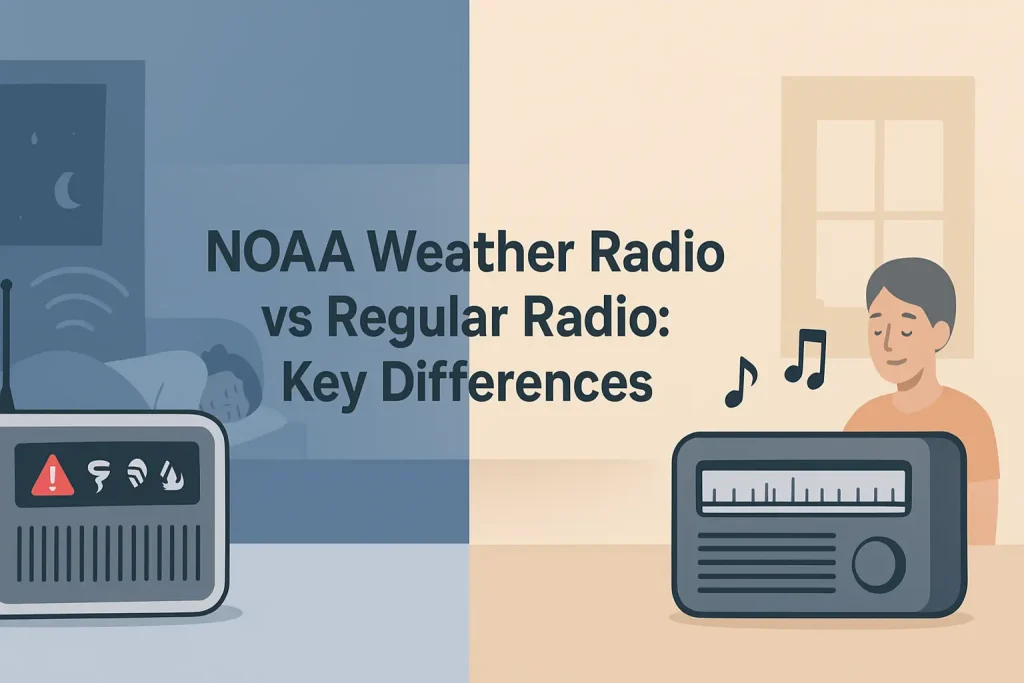
A NOAA weather radio is a dedicated VHF FM receiver locked to the 162.400-162.550 MHz band. It cannot receive commercial AM or FM broadcast stations. A standard AM/FM radio cannot receive NOAA NWR broadcasts on 162 MHz. They are entirely different receiver types operating on entirely different frequency bands.
Commercial AM/FM radio stations relay Emergency Alert System (EAS) messages, which include the same National Weather Service alerts broadcast over NOAA NWR. When a Blizzard Warning is issued, it is sent to NOAA NWR transmitters and simultaneously to AM/FM broadcast stations via the EAS distribution system. Both systems deliver the same official alert content.
The critical difference for winter storm preparedness is automatic alerting. A NOAA weather radio with S.A.M.E. programming monitors passively in standby and sounds an alarm when a matching alert is received, even if the radio is set to minimum volume. A standard AM/FM radio that is turned off or tuned to a music station delivers no alert. You must already be listening to a commercial station that is participating in EAS relay at the exact moment the alert is broadcast, which is not guaranteed for overnight blizzard warnings.
An AM/FM radio is not a substitute for a NOAA weather radio for overnight winter storm alerting. The combination of passive monitoring, S.A.M.E. filtering, and automatic alarm activation is unique to the NOAA NWR receiver design and is specifically why weather radios exist as a separate product category.
For a deeper explanation of how NOAA weather radio differs from other alert systems and why it remains the primary recommended device for emergency preparedness, the overview of how the NOAA weather radio network operates and what makes it different from consumer broadcast radio provides the full technical and operational context.
Do Weather Radios Alert for Ice Storms That Develop Quickly Without Extended Warning Time?
Rapidly developing ice storms present the most challenging scenario for any weather alerting system, including NOAA NWR. The National Weather Service issues Ice Storm Warnings (S.A.M.E. code ISW) and Winter Storm Warnings (WSW) based on forecast model data and current observations. When conditions develop faster than models predicted, the lead time between the warning issuance and onset can be very short.
NOAA NWR broadcasts alerts within minutes of issuance by the local NWS office. From the moment a meteorologist issues and transmits the alert, it appears on NWR broadcasts and triggers S.A.M.E.-programmed radios within seconds. The alert delivery itself is not delayed. The challenge is forecast lead time, which is a meteorological limitation, not a communication system limitation.
A weather radio programmed for Winter Storm Watch alerts (WSA) provides earlier notification of potentially developing ice storm conditions before a formal warning is issued. A Winter Storm Watch is issued when conditions are considered favorable for winter storm development within 24 to 48 hours. Activating WSA on your weather radio gives you advance warning time to complete preparations even when the warning itself arrives with minimal lead time.
The most resilient approach to rapidly developing ice storms is to have your weather radio activated before any storm is forecast, with both the WSA (watch) and ISW (warning) event codes programmed to alarm, so you receive the earliest possible notification regardless of how quickly conditions deteriorate.
Does NOAA Weather Radio Broadcast Alerts for Power Outages Caused by Winter Storms?
NOAA weather radio does not broadcast utility-specific power outage information. Power outage reporting is managed by individual utility companies and state public utilities commissions through their own communication channels, outage tracking websites, and automated customer notification systems. NOAA NWR is a weather hazard alerting system, not a utility status system.
However, NOAA NWR does broadcast Civil Emergency Messages (CEM) in coordination with state and local emergency management agencies. In states with active coordination between the NWS and emergency management offices, CEM broadcasts during major winter storms may include information about declared emergencies, warming shelter locations, and resource availability, though this varies significantly by state and event.
For power outage information during a winter storm, the recommended sources are your utility company’s outage map (accessible via smartphone when cell service remains available), the utility’s automated telephone system, and local AM radio stations that continue broadcasting via backup generator during grid outages. Your weather radio handles the meteorological alerting component; these other sources handle the infrastructure status component.
Weather radio and utility status monitoring are complementary, not redundant. Use both during an active blizzard event.
A properly programmed NOAA weather radio, with fresh batteries installed before the season and all winter storm S.A.M.E. event codes activated, is the most reliable early warning tool available for households in blizzard-prone regions. It operates independently of every other infrastructure system that a winter storm can disable, and it costs less than a single evening’s emergency supply run. Set it up in October, test it in November, and let it do its job when conditions make everything else unreliable.
Start with the complete setup and programming walkthrough for getting the most out of your weather radio, confirm your FIPS code, activate every relevant winter storm event code, and install lithium AA batteries before the first forecast storm of the season arrives.
| Photo | TOP RATED WALKIE TALKIES | Price |
|---|---|---|
 | Retevis RT628 Kids Walkie Talkies, Toys Gifts for 4-12 Year Old Girl Boy | Check Price On Amazon |
 | Cobra ACXT545 Weather-Resistant Walkie Talkies, Rechargeable, 22 Channels | Check Price On Amazon |
 | Retevis RT388 Kids Walkie Talkies, Outdoor Toys for Kids Camping Essentials | Check Price On Amazon |
 | Cobra RX680 Walkie Talkies (2-Pack), IP54 Water Resistant Design | Check Price On Amazon |
 | Retevis RT22 Walkie Talkies Long Range Rechargeable with Earpiece (2 Pack) | Check Price On Amazon |
 | Midland GXT1000VP4 GMRS JIS4 Two-Way Radio, Black,2 Pack | Check Price On Amazon |
 | Retevis RT628 Walkie Talkies for Kids,Toys Gifts for 6-12 Years Old Boys Girls,Long Range 2 Way Radio 22CH VOX,Birthday Gift,Family Walkie Talkie for Camping Hiking Indoor Outdoor | Check Price On Amazon |