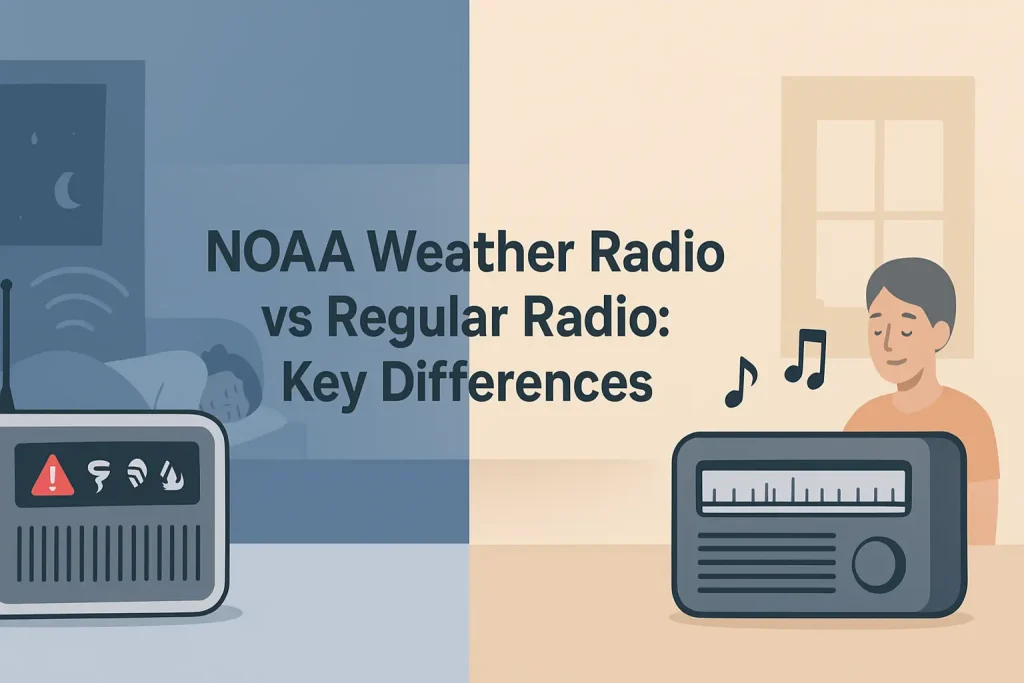
NOAA weather radios broadcast alerts 24 hours a day on seven dedicated frequencies between 162.400 and 162.550 MHz, but most people only discover this after a storm knocks out their phone signal. The radios on Amazon range from basic $25 receivers to fully programmable S.A.M.E. units that wake you only for your specific county, and knowing which tier you actually need prevents both overspending and under-preparing.
This guide covers the top weather radios available on Amazon across four tiers: basic alert receivers, S.A.M.E.-programmable desktop units, portable hand-crank and solar models, and combination multiband receivers. Every pick is an FCC-compliant NOAA receiver with verified S.A.M.E. capability where noted.
| Photo | Popular Portable Walkie Talkies | Price |
|---|---|---|
 | SKIWARRIOR Multifunctional Smart Wireless Ski Goggles with Walkie-Talkie, Anti-Fog Zeiss Lens, Music & Call Function (Cylindrical Blue) | Check Price On Amazon |
 | SINORISE Super Mini Walkie Talkies, Two-Way Radios, 3 Pack | Check Price On Amazon |
 | KOSPET Tank M4C Smart Watch Rugged, Dual-Band GPS, 5ATM & IP69K Waterproof | Check Price On Amazon |
 | Retevis RT15 Walkie Talkies 3 Pack, Birthday Gift, Outdoor Adventure Kit | Check Price On Amazon |
 | Rechargeable Walkie Talkies Toys for Kids: DIY Astronaut Walkie Talkies for Boys Christmas Birthday Gifts for 3 4 5 6 7 8 9 10 Boy Walkie Talkie Outdoor Hiking Toy 2 Way Radio Camping Outdoor Game | Check Price On Amazon |
What Is a NOAA Weather Radio and Why Does It Beat Your Phone for Alerts?
A NOAA Weather Radio All Hazards (NWR) receiver is a dedicated radio that continuously monitors one of seven VHF frequencies between 162.400 and 162.550 MHz, where NOAA National Weather Service offices broadcast alerts around the clock. Unlike a smartphone push notification, an NWR receiver does not depend on cell tower capacity, internet connectivity, or app permissions to deliver an alarm.
According to NOAA NWR documentation, the network operates over 1,000 transmitters covering all 50 states, adjacent coastal waters, Puerto Rico, the US Virgin Islands, and Guam. Each transmitter broadcasts at 300 to 1,000 watts of effective radiated power, which is why a simple tabletop receiver with a basic whip antenna can reliably pick up the signal from 40 miles away under normal propagation conditions.
The core technology that separates a useful weather radio from a basic one is S.A.M.E. (Specific Area Message Encoding). S.A.M.E. is a digital header broadcast before every alert that contains a 6-digit FIPS (Federal Information Processing Standards) location code identifying the affected county or counties. A weather radio without S.A.M.E. decoding capability sounds an alarm for every alert broadcast from the transmitter, which can cover an entire state. A S.A.M.E.-capable receiver compares the incoming FIPS code against the codes you have programmed and only triggers if your county is named in the alert.
The practical difference is significant during severe weather season. In a state like Oklahoma or Texas, a non-S.A.M.E. radio might sound 40 to 80 alerts per week across an entire NWS forecast area. A S.A.M.E.-programmed radio for a single county in the same area might sound 3 to 8 alerts per week, making each alarm genuinely actionable rather than easy to ignore.
A NOAA weather radio also activates during non-weather emergencies, including AMBER Alerts, Civil Emergency Messages, Hazardous Materials Warnings, and National Information Center alerts from FEMA. This makes it part of the broader Integrated Public Alert and Warning System (IPAWS), not just a storm warning device.
The single most important purchase decision for a weather radio is whether it includes S.A.M.E. decoding, not which brand or form factor you choose.
How to Read NOAA Weather Radio Specs Before You Buy
Every weather radio listing on Amazon includes specification language that is easy to misread. Understanding four key specifications prevents buying a radio that either fails to alert you or alerts you for the wrong county.
S.A.M.E. Alert Filtering: The Non-Negotiable Specification
S.A.M.E. (Specific Area Message Encoding) decoding is the technology that lets a weather radio filter alerts by your specific FIPS county code. A radio that lists “S.A.M.E.” in its specs can be programmed with one or more 6-digit FIPS codes so it only alarms for the counties you specify.
The number of S.A.M.E. location codes a radio can store matters if you live near a county border, travel between locations, or want to monitor alerts for a family member’s county. Budget models store 1 to 3 FIPS codes. Mid-range and premium models store 25 to 50 codes. For most single-location home use, 1 to 3 codes is sufficient. For emergency preparedness coordinators or people with property in multiple counties, higher code capacity is worth the added cost.
Alert Types Covered: EAS vs. Weather-Only Models
Some lower-cost weather radios are programmed to respond only to standard NWS weather alerts such as Tornado Warnings, Severe Thunderstorm Warnings, Flash Flood Warnings, and Winter Storm Warnings. Full EAS (Emergency Alert System) receivers respond to the complete NOAA alert catalog, which includes AMBER Alerts, Civil Emergency Messages, Hazardous Materials Warnings, Law Enforcement Warnings, and National Periodic Tests.
According to FCC Part 11, which governs Emergency Alert System receivers, a full EAS-compliant receiver must respond to all alert event codes. Not every consumer weather radio sold on Amazon meets the full FCC Part 11 EAS standard. Confirm the listing specifically states “all-hazards” or lists AMBER Alert and Civil Emergency as supported event types if you want the full range of NOAA broadcasts.
Power Source and Backup: What Matters During a Grid Outage
A weather radio that loses power during the storm it was bought to warn you about is useless. The most reliable weather radios offer three power sources: AC wall adapter for normal operation, battery backup (typically 6x AA alkaline batteries or a rechargeable battery pack) for power outages, and a hand-crank generator for long-duration outages when batteries are depleted.
Battery backup capacity varies significantly. A radio drawing 150 mA on standby with 6x AA alkaline batteries (approximately 2,700 mAh total) will run for roughly 18 hours of continuous standby. A radio with a 2,000 mAh rechargeable lithium-ion pack at the same draw rate will last approximately 13 hours. If you live in an area where ice storms or hurricanes produce multi-day outages, prioritize a hand-crank model or a model with an external DC power jack compatible with a 12V vehicle adapter.
Display and Programming Interface
Programming a FIPS S.A.M.E. code requires entering a 6-digit number through the radio’s interface. Radios with small dot-matrix LCD displays and dedicated programming buttons make this process straightforward. Radios with single-line segment displays and multi-function button combinations are significantly harder to program, particularly for older users.
Look for a model that displays the incoming alert type and affected area on screen during an alarm. This lets you quickly assess whether the alert requires immediate action without waiting for the full audio broadcast to complete. The easiest way to find your 6-digit FIPS code is through the NOAA S.A.M.E. code lookup tool at weather.gov.
Understanding these four specifications before browsing any listing will cut your decision time in half and prevent the most common buyer mistakes with weather radios on Amazon.
The 7 NOAA Weather Radio Frequencies: Which One Should Your Radio Receive?
NOAA broadcasts on seven VHF frequencies: 162.400 MHz (WX1), 162.425 MHz (WX2), 162.450 MHz (WX3), 162.475 MHz (WX4), 162.500 MHz (WX5), 162.525 MHz (WX6), and 162.550 MHz (WX7). Every compliant NOAA weather radio sold in the US receives all seven channels automatically. Your receiver scans all seven and locks onto the strongest signal from the nearest NOAA transmitter.
The channel designation (WX1 through WX7) is a consumer label, not a priority ranking. There is no single “best” WX channel. Your radio automatically identifies the channel with the strongest signal in your area during an initial scan and locks to it. If your primary channel has poor reception, your radio should be set to scan all seven rather than fixed to one frequency.
A small number of older or very inexpensive weather radios only receive three to five of the seven frequencies. This was a common limitation of early 1990s weather radios. Any weather radio manufactured after roughly 2000 and sold by a reputable brand receives all seven frequencies. If a listing does not explicitly state “all 7 NOAA frequencies” or “162.400-162.550 MHz,” confirm the channel count in the specifications before purchasing.
Reception quality at your specific location depends on the distance and terrain between your home and the nearest NOAA transmitter, not on which of the seven channels is assigned to your area. You can find the nearest transmitter and its assigned frequency using the NOAA NWR transmitter location search tool at weather.gov/nwr. For homes in valleys, surrounded by hills, or at the edge of a transmitter’s 40-mile coverage radius, a model with an external antenna jack improves reception more reliably than any other specification upgrade.
Every weather radio on this list receives all seven NOAA frequencies. The channel your receiver locks onto is determined by your geography, not your radio model choice.
Here is a visual breakdown of how the top weather radios on this list compare on price, which helps set realistic expectations before the individual reviews.
Price Comparison
Top NOAA Weather Radios on Amazon – Price Comparison by Model
Street price sorted lowest to highest. Prices verified at time of publication.
~$30
~$40
~$60
~$65
~$70
~$280
Single-unit price. Hand-crank and solar models include built-in rechargeable battery. Scanner pricing reflects digital trunking capability beyond standard weather radio function.
Best Overall NOAA Weather Radio on Amazon: Midland WR400
The Midland WR400 weather alert radio stores up to 50 S.A.M.E. location codes, covers all 25 NOAA EAS alert event types including AMBER Alerts, and provides both AC power and 6x AA battery backup in a compact desktop form factor at approximately $55 to $65. It is the highest-performing weather radio under $70 consistently available on Amazon and represents the best value in the category for home emergency preparedness.
The WR400 uses a dot-matrix LCD display that shows the incoming alert type and affected area name during an alarm, so you can read the alert before the audio message completes. Programming is done through a dedicated SAME button and numeric keypad, which makes entering 6-digit FIPS codes straightforward compared to radios that use generic menu navigation with arrow buttons.
Key Specifications:
- Frequencies received: 162.400-162.550 MHz (all 7 NOAA WX channels)
- S.A.M.E. code storage: 50 programmable FIPS location codes
- Alert event types: 25 EAS event codes including Tornado Warning, AMBER Alert, Civil Emergency
- Power: AC adapter (included) plus 6x AA alkaline battery backup
- Alert output: audible alarm plus visual strobe (external strobe jack for hearing-impaired users)
- Price: approximately $55-65 at time of publication
The WR400 includes a headphone jack, a back-light on the display, and a programmable alarm clock function that operates independently of weather alert monitoring. The alert volume is adjustable from a whisper-level alert for daytime use to a 90+ dB alarm loud enough to wake a sleeping adult from another room.
The one limitation worth noting is that the WR400 does not include a hand-crank or solar charging option. It relies entirely on AC power or alkaline batteries. For users who want grid-independence during extended outages, the Eton FRX3+ (covered below) adds hand-crank and solar capability at a similar price point, though with fewer S.A.M.E. code storage slots.
For a deeper look at Midland’s entry-level weather radio that shares the same S.A.M.E. platform at a lower price point, the complete breakdown of the WR120B’s alert performance and programming steps covers everything you need to know before choosing between the two models.
The Midland WR400 is the right choice for most households that want a reliable, full-featured NOAA weather radio for a fixed location with AC power available.
Best Budget NOAA Weather Radio on Amazon: Midland WR120B
The Midland WR120B weather alert radio is the entry point for S.A.M.E.-capable NOAA reception at approximately $25 to $35, making it the most widely purchased weather radio on Amazon. It stores up to 25 S.A.M.E. location codes, covers the primary NWS weather alert event types, and provides AC power with 3x AA battery backup.
The WR120B covers the core alert events that matter most for severe weather: Tornado Warning, Tornado Watch, Severe Thunderstorm Warning, Flash Flood Warning, Flash Flood Watch, Hurricane Warning, Hurricane Watch, and Winter Storm Warning. It does not cover the full EAS catalog that includes AMBER Alerts and Civil Emergency Messages, which is the primary trade-off compared to the WR400.
Key Specifications:
- Frequencies received: 162.400-162.550 MHz (all 7 NOAA WX channels)
- S.A.M.E. code storage: 25 programmable FIPS location codes
- Alert event types: weather hazard events (no full EAS catalog)
- Power: AC adapter plus 3x AA alkaline battery backup
- Display: single-line LCD segment display
- Price: approximately $25-35 at time of publication
The single-line LCD on the WR120B shows the channel number and basic status indicators rather than the full alert text that the WR400 displays. Programming the FIPS S.A.M.E. code on the WR120B requires pressing and holding a combination of buttons while entering digits, which is workable but less intuitive than the WR400’s dedicated SAME button. The instruction manual walks through the process clearly, and it only needs to be done once.
For a family that wants S.A.M.E.-filtered weather alerts for severe thunderstorm and tornado season without spending more than $35, the WR120B delivers the core protection. If AMBER Alert and Civil Emergency coverage matter for your household, the $20 to $30 price difference to the WR400 is worth it.
The Midland WR120B is the correct pick for budget-constrained buyers who want genuine S.A.M.E. filtering over a non-S.A.M.E. radio at any price.
Best Hand-Crank and Solar Weather Radio on Amazon: Eton FRX3+
The Eton FRX3+ emergency weather radio combines S.A.M.E.-filtered NOAA reception with hand-crank charging, a solar panel, a 2,000 mAh internal lithium battery, an AM/FM receiver, and a 1,000 mW LED flashlight in a single portable unit priced at approximately $60 to $70. It is the best-selling emergency preparedness weather radio on Amazon for users who need off-grid power independence during extended outages.
The FRX3+ S.A.M.E. implementation stores a smaller number of FIPS codes than the Midland WR400, and its alert catalog is weather-focused rather than full EAS. However, its power flexibility makes it the correct choice for camping, vehicle emergency kits, hurricane preparedness packs, and any scenario where AC power cannot be assumed.
Key Specifications:
- Frequencies: 162.400-162.550 MHz NOAA WX plus AM (520-1710 kHz) and FM (87.5-108 MHz)
- S.A.M.E. code storage: programmable county-level alert filtering
- Internal battery: 2,000 mAh lithium rechargeable
- Charging inputs: micro-USB, solar panel (integrated), hand-crank generator
- Additional features: 1,000 mW LED flashlight, USB output for device charging (1,000 mA)
- Price: approximately $60-70 at time of publication
The hand-crank on the FRX3+ generates approximately 1 minute of radio playback per 1 minute of cranking at moderate speed. It is not designed to fully recharge the internal battery from crank power alone. The crank provides emergency radio operation when the internal battery is depleted, while the solar panel provides slow passive recharging during daylight. The most practical use of the crank is as a last-resort power source for monitoring an alert, not as the primary charging method.
The USB output port on the FRX3+ can charge a smartphone, though slowly at 1,000 mA output. This makes it useful as a secondary phone charging option during a power outage when the radio’s battery is at a reasonable charge level.
For a comprehensive guide to hand-crank weather radio options beyond just the FRX3+, including how to evaluate crank efficiency, solar panel output ratings, and battery capacity claims across competing models, the guide to choosing a hand-crank emergency radio with real-world battery performance data covers the full category in depth.
For a detailed review of the FRX3+’s S.A.M.E. alert sensitivity and real-world reception quality, the full Eton FRX3+ review with reception testing notes provides a complete performance assessment.
The Eton FRX3+ is the correct choice for emergency preparedness kits, camping use, and households in hurricane or ice storm regions where multi-day power outages are a realistic scenario.
Best Desktop NOAA Weather Radio with AM/FM: Sangean CL-100
The Sangean CL-100 tabletop weather alert radio combines full S.A.M.E. NOAA reception with a high-quality AM/FM tuner, a large backlit display showing alert text, and a clean tabletop form factor at approximately $65 to $75. It is the best option on Amazon for users who want a weather radio that also functions as a primary tabletop radio for daily AM/FM listening without compromising alert reliability.
The CL-100 uses a larger speaker enclosure than dedicated weather-only radios, which produces noticeably better audio quality for both alert playback and music listening. The AM section is particularly strong, receiving distant AM stations that lower-cost combination radios miss entirely. This matters for emergency use because AM broadcasts carry well beyond line-of-sight range and remain functional during ionospheric conditions that affect FM reception.
Key Specifications:
- Frequencies: 162.400-162.550 MHz NOAA WX, AM 520-1710 kHz, FM 87.5-108 MHz
- S.A.M.E. code storage: 23 programmable FIPS location codes
- Display: large backlit LCD showing alert event type, FIPS code, and area name
- Power: AC adapter plus 6x AA alkaline battery backup
- Additional features: alarm clock, sleep timer, digital tuning with 10 AM and 20 FM memory presets
- Price: approximately $65-75 at time of publication
The Sangean brand is a Taiwanese manufacturer with over 50 years of radio manufacturing history. The CL-100 is built to a higher component quality standard than the average consumer weather radio, which is reflected in both its audio performance and its reception sensitivity on fringe NOAA signals. Users at the edge of a NOAA transmitter’s coverage area often report better reception on the CL-100 than on comparably priced Midland or Uniden models, partly due to Sangean’s higher-sensitivity AM/FM front-end design extending into the VHF WX band.
The CL-100’s S.A.M.E. code capacity of 23 is slightly lower than the Midland WR400’s 50-code capacity, but it is more than adequate for the vast majority of single-location home users who only need one primary FIPS code and a few neighboring county codes.
The Sangean CL-100 is the best choice for users who want a weather radio that earns its counter space as a daily-use tabletop radio with premium audio quality.
Best NOAA Weather Radio Clock Radio Combo: Uniden BC365CRS
The Uniden BC365CRS weather alert clock radio integrates a full S.A.M.E. NOAA receiver, an AM/FM tuner, a digital alarm clock, and a large illuminated display into a bedside clock format priced at approximately $35 to $45. It is the most popular weather radio on Amazon for bedroom use because it replaces a standalone clock radio without adding counter space while providing genuine S.A.M.E.-filtered severe weather protection during overnight hours.
The overnight alert scenario is the highest-stakes use case for a weather radio. Tornadoes and severe thunderstorms frequently develop between midnight and 6 a.m., when mobile phone Wireless Emergency Alerts may be received but will not produce sound if the phone is silenced. A dedicated weather radio with an independent alert alarm circuit is not affected by phone mute settings, Do Not Disturb modes, or low battery states.
Key Specifications:
- Frequencies: 162.400-162.550 MHz NOAA WX, AM 520-1710 kHz, FM 87.5-108 MHz
- S.A.M.E. code storage: 25 programmable FIPS location codes
- Display: large backlit LCD clock display with alert text
- Power: AC adapter plus 6x AA alkaline battery backup (clock maintains time during power outage)
- Clock features: dual alarm, 12/24-hour format, snooze
- Price: approximately $35-45 at time of publication
The BC365CRS alert alarm is distinct from the clock alarm function, meaning you can have the radio set to a pleasant wake tone at 7 a.m. while the NOAA alert function operates at maximum volume independently if a Tornado Warning triggers at 3 a.m. These two alarm systems do not interfere with each other. The battery backup maintains both clock timekeeping and weather radio standby monitoring during power outages, which is critical because storms frequently knock out power before the most severe weather arrives.
The Uniden BC365CRS is the correct choice for bedroom use, especially for households with children, elderly family members, or anyone in Tornado Alley who needs a reliable overnight alert that cannot be silenced by phone settings.
Best Portable NOAA Weather Radio for Camping and Hiking: Midland ER310
The Midland ER310 emergency crank weather radio provides S.A.M.E.-filtered NOAA reception in a rugged portable package with a 2,000 mAh internal battery, a hand crank, a solar panel, a 130-lumen flashlight, and a 100-lumen motion-sensor base light, priced at approximately $55 to $65. It is Midland’s most capable portable emergency radio and consistently ranks among the top-selling emergency preparedness radios on Amazon.
The ER310 improves on the Eton FRX3+ in two areas: flashlight brightness (130 lumens vs the FRX3+’s 1,000 mW which approximates roughly 50-80 lumens in practical output) and the addition of an SOS emergency flasher function that strobes for rescue signaling. These features matter specifically in backcountry camping scenarios where the radio doubles as emergency signaling equipment.
Key Specifications:
- Frequencies: 162.400-162.550 MHz NOAA WX plus AM/FM
- S.A.M.E. code storage: programmable county-level FIPS alert filtering
- Internal battery: 2,000 mAh lithium rechargeable
- Charging: micro-USB, solar panel, hand crank
- Flashlight: 130-lumen primary beam, 100-lumen motion sensor base, SOS strobe mode
- USB output: 1,000 mA for device charging
- Price: approximately $55-65 at time of publication
The ER310’s S.A.M.E. implementation covers the primary NWS weather alert event types. It is not a full EAS receiver in the same catalog-depth sense as the Midland WR400. For a portable camping and hiking radio, this distinction rarely matters in practice because the alert events that require immediate physical response (Tornado Warning, Flash Flood Warning, Severe Thunderstorm Warning) are all covered.
The Midland ER310 is the best portable NOAA weather radio on Amazon for outdoor recreation use when you need NOAA alert coverage, flashlight capability, and phone charging in a single compact unit.
Best NOAA Weather Radio for Hearing-Impaired Users: Midland WR300
The Midland WR300 weather radio with strobe alert includes a built-in high-intensity strobe light that activates during weather alerts, plus a jack for connecting an external bed-shaker or third-party strobe device, at approximately $45 to $55. It is the most accessible weather radio for deaf and hard-of-hearing users currently sold on Amazon with genuine S.A.M.E. filtering capability.
NOAA weather radios with external alert output jacks (commonly labeled “External Alert” or “Alert Output”) can connect to bed-shaker devices that vibrate a mattress or pillow to wake a sleeping user who cannot hear the alarm. The jack outputs a standard audio alert signal when an alarm triggers, which activates any compatible bed-shaker or additional strobe light accessory. Midland sells a compatible bed-shaker accessory separately for approximately $20 to $30.
Key Specifications:
- Frequencies: 162.400-162.550 MHz (all 7 NOAA WX channels)
- S.A.M.E. code storage: 25 programmable FIPS location codes
- Built-in strobe: high-intensity white LED strobe activates on alert
- External alert jack: 3.5mm output for bed-shaker or external strobe
- Power: AC adapter plus 3x AA battery backup
- Price: approximately $45-55 at time of publication
The WR300’s S.A.M.E. filtering is essential for hearing-impaired users specifically because a non-S.A.M.E. radio would trigger the strobe multiple times per day in active severe weather regions, causing alarm fatigue and eventual device disconnection. The ability to program the radio to only trigger for your specific FIPS code makes the strobe alert genuinely useful rather than a constant disturbance.
The Midland WR300 is the correct choice for any household member who is deaf, hard-of-hearing, a heavy sleeper, or sleeps with hearing aids removed.
Best All-Hazards Weather Radio with Digital Display: Uniden BC75XLT
The Uniden Bearcat weather alert radio with S.A.M.E. provides all seven NOAA WX channels with full S.A.M.E. filtering, 25 programmable FIPS codes, and a clear alphanumeric LCD at approximately $40 to $50. Uniden’s Bearcat weather radio lineup has been the reliability benchmark in the category for two decades, and the current generation maintains that reputation for consistent alert activation and clear audio output at a competitive price.
Uniden weather radios consistently perform well in NWS alert sensitivity testing because the company’s receiver front-end design draws on its longer history of scanner radio engineering, which prioritizes sensitivity across the VHF spectrum. Users in fringe coverage areas who have had missed alerts on other brands often report improved alert reliability after switching to a Uniden Bearcat weather radio.
Key Specifications:
- Frequencies: 162.400-162.550 MHz (all 7 NOAA WX channels)
- S.A.M.E. code storage: 25 programmable FIPS location codes
- Alert catalog: NOAA all-hazards including AMBER Alert
- Display: alphanumeric LCD showing alert event and area
- Power: AC adapter plus battery backup
- Price: approximately $40-50 at time of publication
The Uniden Bearcat weather radio is the best value choice for users who want proven brand reliability and full AMBER Alert coverage at under $50 without requiring the additional S.A.M.E. code capacity of the Midland WR400.
Side-by-Side Comparison: Top NOAA Weather Radios on Amazon
Use the table below to compare the key specifications that determine which weather radio fits your specific situation and budget.
| Model | S.A.M.E. Codes | Full EAS | Hand Crank | AM/FM | Strobe/Shaker | Price | Best For |
|---|---|---|---|---|---|---|---|
| Midland WR120B | 25 | No | No | No | No | ~$30 | Budget home use |
| Uniden BC365CRS | 25 | Yes | No | Yes | No | ~$40 | Bedroom clock radio |
| Midland WR300 | 25 | Partial | No | No | Yes | ~$50 | Hearing impaired |
| Midland WR400 | 50 | Yes | No | No | Strobe jack | ~$60 | Best overall home |
| Eton FRX3+ | Yes | Partial | Yes | Yes | No | ~$65 | Emergency kit / camping |
| Midland ER310 | Yes | Partial | Yes | Yes | No | ~$60 | Camping / hiking |
| Sangean CL-100 | 23 | Yes | No | Yes (premium) | No | ~$70 | Daily radio + alerts |
Here is an interactive quiz to test your knowledge of NOAA weather radio features and help confirm which specifications matter most for your household situation.
Interactive Quiz
How Well Do You Know NOAA Weather Radio Technology?
6 questions · Takes about 2 minutes · Get your result at the end
How to Program a S.A.M.E. Weather Radio with Your FIPS Code
Programming a S.A.M.E. weather radio with your correct 6-digit FIPS county code is the single step that transforms a weather radio from a state-wide alarm system into a county-specific alert device. Every S.A.M.E. weather radio sold on Amazon can complete this programming in under 5 minutes.
Step 1: Find Your 6-Digit FIPS Code
Go to weather.gov and use the NOAA S.A.M.E. code lookup tool to find the FIPS code for your county. The code is a 6-digit number in the format XYYYYY, where X is the state code (0 for most states) and YYYYY is the county code. Write it down before touching the radio.
Step 2: Put Your Radio in S.A.M.E. Programming Mode
On the Midland WR400 and WR120B, press and hold the SAME button until the display shows “PROGRAM” or a flashing cursor. On the Uniden BC365CRS, press and hold the ALERT button. On the Eton FRX3+, press and hold the WEATHER button until the S.A.M.E. indicator flashes. Every model’s manual includes this step on page 1 of the S.A.M.E. programming section.
Step 3: Enter Your 6-Digit FIPS Code
Use the numeric keypad (on models with one) or the up/down arrows to enter each digit of your FIPS code in sequence. The display confirms each digit as you enter it. If you make an error, press the CLEAR or CANCEL button and start the entry again from digit 1.
Step 4: Save and Verify the Code
Press ENTER or SAVE to store the FIPS code. The radio will display the county name associated with that FIPS code if it has a county name database, or simply confirm the 6-digit number. On the Midland WR400, the stored code appears on the display after saving. Run a manual test by pressing the TEST button if your model has one to confirm the alert function activates correctly.
Step 5: Add Additional FIPS Codes (Optional)
If you want to monitor adjacent counties, repeat steps 2 through 4 for each additional FIPS code up to your radio’s storage limit. For most single-home users, one primary FIPS code is sufficient. Add the adjacent county codes if your home is within 5 miles of a county line or if you want to receive advance warning for storms approaching from a neighboring county.
Programming a S.A.M.E. code takes under 5 minutes once and eliminates the alarm fatigue that causes most people to disconnect their weather radios during active weather seasons.
What Types of Alerts Does a NOAA Weather Radio Actually Broadcast?
NOAA Weather Radio All Hazards broadcasts more than 70 distinct alert event codes. The codes divide into four categories: meteorological warnings and watches, non-weather emergency alerts, administrative and test messages, and special national-level alerts from FEMA.
The most frequently broadcast meteorological alerts, ordered by broadcast frequency in the continental US, include:
- Tornado Warning (issued when rotation is detected or a tornado is confirmed on the ground)
- Tornado Watch (conditions favorable for tornado development, typically 4-8 hour duration)
- Severe Thunderstorm Warning (winds at 58 mph or greater, or hail at 1 inch diameter or greater)
- Flash Flood Warning (imminent or ongoing flash flooding)
- Flash Flood Watch (conditions favorable for flash flooding in the next 12-48 hours)
- Winter Storm Warning (heavy snow, ice, or blizzard conditions expected within 12-24 hours)
- Winter Storm Watch (heavy winter precipitation likely within 48 hours)
- Hurricane Warning (sustained winds of 74 mph or greater within 36 hours)
- Hurricane Watch (hurricane conditions possible within 48 hours)
- Extreme Cold Warning (life-threatening cold wind chills)
Non-weather EAS alerts broadcast over NOAA NWR include:
- AMBER Alert (child abduction emergency, requires a full EAS receiver)
- Civil Emergency Message (issued by state or local government for non-weather emergencies)
- Hazardous Materials Warning (chemical spill or industrial accident threatening public safety)
- Law Enforcement Warning (public safety threat requiring immediate protective action)
- Evacuation Immediate (mandatory evacuation order)
- Nuclear Power Plant Warning
- National Information Center (messages originating from FEMA during declared national emergencies)
Administrative messages include the Weekly Test (every Wednesday between 11 a.m. and noon local time), the Monthly Test (first Wednesday of each month), and the Annual National Periodic Test coordinated by FEMA. These test broadcasts cause some weather radios to display “TEST” and produce a brief alert tone. If you find weekly test alerts disruptive, most S.A.M.E. radios allow you to disable alert activation for test messages while keeping all warning messages active.
According to FEMA IPAWS documentation, the full EAS event code catalog is maintained by FEMA in coordination with NOAA and the FCC. The complete list of all event codes is published in the FCC Part 11 EAS rules and updated periodically when new alert categories are added.
A weather radio that covers the full EAS catalog is not just a storm warning device. It is a complete local and national emergency alert receiver.
Weather Radio Buying Guide: How to Match the Right Model to Your Situation
The correct weather radio for your household depends on four factors: your primary location (fixed home vs portable/travel use), your need for off-grid power independence, whether full EAS coverage beyond weather alerts is required, and your budget. No single model is the best choice across all four dimensions simultaneously.
For Fixed Home Use with AC Power: Prioritize S.A.M.E. Code Capacity and Alert Coverage
A fixed-location home weather radio should be permanently plugged into AC power with battery backup for outages. The Midland WR400 is the best choice at $55 to $65 because its 50-code S.A.M.E. capacity, full EAS coverage, and large display handle every scenario a home user will encounter. The Uniden BC365CRS at $40 is the correct choice if you specifically want a bedroom clock radio format.
Do not choose a home weather radio based on AM/FM reception quality unless you intend to use it as a daily-use radio. The AM/FM sections on dedicated weather radios are functional but not audiophile quality. The Sangean CL-100 tabletop weather radio is the correct exception if premium AM/FM quality is a genuine requirement.
For Emergency Preparedness Kits: Prioritize Power Independence and Portability
An emergency kit weather radio needs to function during multi-day power outages without relying on disposable batteries. The Eton FRX3+ and Midland ER310 both meet this requirement with 2,000 mAh internal batteries, solar panels, and hand cranks. The ER310 has a brighter flashlight (130 lumens vs approximately 50 lumens) and SOS strobe mode. The FRX3+ has better USB charging output documentation.
Both are correct choices for a 72-hour emergency kit. Choose the ER310 if flashlight capability during an outdoor emergency matters. Choose the FRX3+ if you want the most widely reviewed portable weather radio with the most documented user experience data.
For Hearing-Impaired Users: Prioritize External Alert Output
The Midland WR300 is the only mainstream weather radio on Amazon that combines a built-in strobe with an external alert jack for a bed-shaker accessory at a price under $60. No other model in this price range provides both functions. The external jack outputs a standard audio signal that activates any compatible bed-shaker device, and the built-in strobe activates simultaneously.
For Budget Buyers Who Cannot Exceed $35: The Non-Negotiable Minimum
The minimum acceptable weather radio specification at any budget level is S.A.M.E. decoding capability. A non-S.A.M.E. radio at $15 provides less actual value than a S.A.M.E.-capable radio at $30 because alarm fatigue from non-filtered alerts reliably leads to the radio being turned off or unplugged before the next severe weather event. The Midland WR120B at approximately $30 is the correct minimum viable weather radio for any household.
For a more complete framework covering every specification dimension in the weather radio category including antenna options, battery backup capacity calculations, and alert sensitivity testing methodology, the complete weather radio buying guide with specification-by-specification decision framework covers the full selection process in depth.
Match your radio to your scenario first, then optimize for price within that scenario.
Where to Buy NOAA Weather Radios Beyond Amazon
Amazon is the most convenient source for NOAA weather radios with the widest model selection and competitive pricing, but it is not the only option. Several alternatives offer advantages in specific situations.
Walmart carries a limited but reliable selection of Midland and Uniden weather radios in-store, which is valuable when a severe weather season begins and same-day availability matters more than model selection. The Midland WR120B and Uniden Bearcat weather radios are the most consistently available models at Walmart both in-store and online. For a full breakdown of which weather radio models Walmart actually carries and how their pricing compares to Amazon, the current weather radio selection at Walmart with pricing and availability notes provides a direct comparison.
Best Buy carries a narrower weather radio selection but occasionally stocks models not available at Walmart or on Amazon at competitive pricing. RadioShack’s successor stores carry a very limited selection. Home Depot and Lowe’s carry basic weather radios in their emergency preparedness sections, typically limited to one or two Midland or Uniden models.
Battery-powered weather radios are also available at most outdoor retailers including REI and Bass Pro Shops. These locations tend to stock portable hand-crank models like the Eton FRX3+ and Midland ER310 because their customer base skews toward camping and emergency preparedness use cases.
For a comprehensive look at all the places to purchase a weather radio including price comparison data across major retailers, the full guide to weather radio retail sources with current pricing across stores covers every major purchase channel.
For most buyers, Amazon remains the best combination of price, selection, and delivery speed. The advantage of in-store purchase is same-day availability when severe weather season begins without warning.
How to Test Your Weather Radio Before a Real Emergency
A weather radio that has never been tested before a tornado warning is a weather radio you cannot trust during a tornado warning. NOAA provides two official mechanisms for testing your radio without waiting for a real alert.
The Weekly Test is broadcast every Wednesday between 11 a.m. and noon local time by every NOAA NWR transmitter. It is preceded by the standard S.A.M.E. header with the event code “RWT” (Required Weekly Test) and the FIPS codes of all counties in the transmitter’s service area. If your radio is programmed with a FIPS code and you do not hear the Weekly Test tone on Wednesdays, your radio has a reception or programming problem that needs to be resolved before the next severe weather event.
The Monthly Test is broadcast on the first Wednesday of each month and is preceded by a longer test message that simulates the full alert activation sequence including the Attention Signal tone. This is the closest simulation to a real alert that NOAA provides. Both the Weekly Test and Monthly Test can be disabled in S.A.M.E. programming on most current-generation weather radios if you find them disruptive, but keep them enabled until you have confirmed your radio activates correctly at least once.
A manual test you can perform anytime: stand in the room where your weather radio is located, press the WEATHER button to switch to manual monitor mode, and listen for the continuous NOAA broadcast. If you hear clear audio from your nearest transmitter, your radio’s reception hardware is functional. If the audio is noisy, weak, or absent, try repositioning the radio antenna vertically, moving the radio closer to a window, or connecting an external antenna if your model has an external antenna jack.
According to NWS documentation, the most common reason a weather radio fails to activate during a real alert is a FIPS code programming error, not a hardware failure. If you are in doubt, reprogram your FIPS code using the weather.gov lookup tool and confirm the 6-digit number matches your county exactly.
Test your weather radio on the next Wednesday morning to confirm it is working correctly before you need it.
Common Weather Radio Mistakes That Reduce Alert Reliability
Most weather radio failures during severe weather events are caused by user setup errors rather than hardware defects. The five most common mistakes are preventable with a one-time setup verification.
Mistake 1: Buying a Radio Without S.A.M.E. and Then Not Using It Because of Alarm Fatigue
A non-S.A.M.E. weather radio in an active severe weather region will trigger 30 to 80 times per week during spring storm season. Most users unplug it within two weeks. The solution is to spend $5 to $10 more for a S.A.M.E.-capable model and program your FIPS code during the first setup session.
Mistake 2: Programming the Wrong FIPS Code
Using a ZIP code instead of a FIPS code is the most common programming error. ZIP codes and FIPS codes are different numbering systems. A 5-digit ZIP code will not be recognized as a valid S.A.M.E. code and the radio will either reject it or, worse, accept it silently and never alert because no NOAA broadcast matches that number. Always use the 6-digit FIPS code from weather.gov.
Mistake 3: Relying on Battery Backup Without Testing It
Alkaline batteries left in a weather radio for more than 12 months often leak or discharge below usable voltage. Replace the backup batteries annually. Consider writing the replacement date on a piece of tape on the battery compartment. A weather radio that loses power during the storm it is supposed to warn you about failed at the exact moment it mattered.
Mistake 4: Placing the Radio in a Location with Poor Reception
A basement or interior room surrounded by concrete walls significantly attenuates the 162 MHz VHF signal from NOAA transmitters. The ideal location for a weather radio is on the main floor near an exterior wall or window. If your home’s best alert monitoring location is in a basement shelter room, use an external antenna cable to route a roof-mounted or window-level antenna to the radio’s location.
Mistake 5: Disabling Alert Types Before Fully Understanding Them
Some S.A.M.E. weather radios allow you to disable specific alert event types in programming. Users who disable “Flash Flood Watch” because they find it non-urgent also disable the warning chain that precedes Flash Flood Warnings. Disable only administrative test messages if you need to reduce non-emergency activations. Keep all warning-level event types enabled.
Avoiding these five mistakes takes 10 minutes during initial setup and ensures your weather radio functions correctly during the first real emergency that tests it.
Quick Reference: Key Weather Radio Terms Explained
These terms appear throughout weather radio listings, manuals, and NOAA documentation. Each definition below uses plain language without assumed knowledge.
S.A.M.E. (Specific Area Message Encoding): A digital coding system that broadcasts a 6-digit county identifier before every NOAA alert. A S.A.M.E.-capable weather radio compares this code against your programmed FIPS code and only sounds an alarm if your county is named in the alert.
FIPS code: A 6-digit Federal Information Processing Standards number that uniquely identifies your county. You program this into your weather radio to enable S.A.M.E. filtering. Find your code at weather.gov using the S.A.M.E. code lookup tool.
EAS (Emergency Alert System): The national public warning system coordinated by FEMA, the FCC, and NOAA that distributes emergency alerts over broadcast radio, television, and NOAA Weather Radio. A “full EAS” weather radio responds to all EAS event codes including non-weather emergencies like AMBER Alerts.
NWR (NOAA Weather Radio All Hazards): The NOAA network of over 1,000 VHF transmitters broadcasting continuous weather and emergency alerts on frequencies from 162.400 to 162.550 MHz. NWR and “NOAA weather radio” refer to the same system.
WX1 through WX7: Consumer labels for the seven NOAA broadcast frequencies. WX1 = 162.400 MHz, WX2 = 162.425 MHz, WX3 = 162.450 MHz, WX4 = 162.475 MHz, WX5 = 162.500 MHz, WX6 = 162.525 MHz, WX7 = 162.550 MHz. There is no priority ranking between channels. Your radio locks to the strongest signal in your area.
Alert tone / Attention Signal: The distinctive two-tone audio signal (853 Hz and 960 Hz alternating) that NOAA broadcasts for 8 to 25 seconds before every emergency alert message. This tone is what activates a weather radio’s alarm function.
All-hazards receiver: A weather radio that responds to the complete NOAA NWR broadcast catalog including non-weather emergencies. Not all weather radios sold as “NOAA” receivers are all-hazards capable. Check the event code list in the product specifications.
External alert jack: A 3.5mm output on a weather radio that sends an audio signal when an alert activates, used to trigger a bed-shaker or external strobe accessory for hearing-impaired users.
Hand-crank generator: A manual power input on portable emergency radios that generates electricity through physical rotation. It provides emergency radio operation when both AC power and internal batteries are unavailable.
IPAWS (Integrated Public Alert and Warning System): FEMA’s system for coordinating emergency alerts across multiple channels including NOAA Weather Radio, Wireless Emergency Alerts on cell phones, and broadcast EAS. NOAA NWR is one component of IPAWS.
Is a NOAA Weather Radio Still Necessary If You Have a Smartphone?
Wireless Emergency Alerts (WEA) on smartphones cover Tornado Warnings, Flash Flood Emergencies, and other imminent-threat events through the FCC’s CMAS (Commercial Mobile Alert System) on cell frequencies, but they depend entirely on cell tower capacity and your phone’s power and connectivity status. A NOAA weather radio operates independently of cell infrastructure and continues to function when cell towers are overloaded, damaged, or without power.
During major tornado events, cell networks in the affected area experience simultaneous call and data traffic spikes that delay or prevent WEA delivery to some devices. NOAA NWR transmitters operate on their own dedicated power systems and continue broadcasting throughout a storm event. According to FEMA IPAWS documentation, WEA and NOAA NWR are designed as complementary systems, not redundant alternatives. FEMA recommends households maintain a dedicated weather radio as a primary alert mechanism independent of mobile devices.
There is also a functional difference in overnight use. A Wireless Emergency Alert will only produce sound on a smartphone that is not in Do Not Disturb or Airplane mode, has sufficient battery charge, and is within cell coverage. A dedicated weather radio with a direct AC connection and battery backup is unaffected by all four of those conditions simultaneously.
The specific failure mode where a smartphone alert would not reach you is exactly when a weather radio would: during a power outage in a severe storm when your phone battery is low and cell towers near you are down. Relying solely on smartphone alerts for severe weather notification is a single point of failure that a $30 weather radio eliminates.
A smartphone and a NOAA weather radio serve different functions in a household emergency communication plan. They are not substitutes for each other.
Can a NOAA Weather Radio Receive Alerts When It Is Turned Off?
A NOAA weather radio in “standby” or “alert” mode is not turned off. It is in a low-power monitoring state where the receiver continuously scans the programmed NOAA frequency and waits for an Attention Signal tone. When the 853/960 Hz alert tone is detected, the radio’s alarm circuit activates regardless of volume setting. This is fundamentally different from powering the radio off completely.
If you press and hold the power button until the display goes completely dark and the radio powers down fully, it will not receive any alerts. A weather radio in true power-off state provides zero protection. The correct operating mode for a home weather radio is perpetual standby (also labeled “monitor,” “alert,” or “sleep” mode depending on the manufacturer), connected to AC power with battery backup engaged.
Most weather radios labeled as “standby” draw between 100 and 200 milliamps in this mode. At that draw rate, AC power consumption costs approximately $0.10 to $0.15 per month at average US electricity rates, making the cost of continuous operation essentially negligible.
Leave your weather radio in standby mode at all times when it is installed at a fixed location. It will not wear out from continuous operation. The monitoring receiver circuit is designed for permanent on-state operation.
What Is the Difference Between a Weather Watch and a Weather Warning?
A Weather Watch means conditions are favorable for a hazardous weather event to develop in the next 12 to 48 hours, but the event has not yet formed. A Weather Warning means a hazardous weather event is imminent, occurring, or highly probable in the next hour or less. A Warning requires immediate protective action. A Watch means you should monitor conditions and prepare to act.
The distinction applies to every NWS product in the same event category. A Tornado Watch means atmospheric conditions favor tornado development. A Tornado Warning means a tornado has been confirmed by radar or a trained spotter and is in or immediately approaching the warned area. A Severe Thunderstorm Watch means conditions favor severe storms. A Severe Thunderstorm Warning means a severe storm meeting the threshold of 58 mph winds or 1-inch hail is in progress and approaching your area.
A third product, the Advisory, sits between a Watch and a Warning in urgency. Advisories cover conditions that are inconvenient or hazardous but not life-threatening under normal circumstances, such as a Wind Advisory for 35 to 45 mph gusts or a Winter Weather Advisory for 1 to 3 inches of snow. Most weather radios broadcast Advisory products, but they trigger at a lower alarm priority level than Warnings on radios that allow alert-level filtering.
Program your weather radio to alarm for all Warning-level events and Watches for Tornado and Hurricane. Advisories can be set to a lower alert tone or silent display-only notification if you find frequent Advisory activations disruptive during active weather seasons.
How Far Can a NOAA Weather Radio Receive a Signal?
A NOAA NWR transmitter operating at 1,000 watts effective radiated power on 162 MHz VHF provides reliable coverage to approximately 40 miles under normal flat-terrain propagation conditions. Terrain obstructions such as hills, mountains, and large buildings reduce this range. Atmospheric ducting can occasionally extend coverage to 100 miles or more, but this is unpredictable and not reliable for emergency alert planning.
The 162 MHz VHF signal travels primarily by line-of-sight propagation, meaning terrain between your receiver and the transmitter reduces signal strength directly. A home in a valley surrounded by hills 500 feet higher than the transmitter may experience significantly degraded reception despite being within 20 miles of the transmitter. In this scenario, an external antenna mounted at roof height or higher substantially improves reception by elevating the antenna above the terrain obstruction.
Most weather radios include a telescoping whip antenna with approximately 2.15 dBi gain. An external NOAA weather radio external antenna mounted at roof height with 5 to 6 dBi gain and a coaxial cable run to the radio can improve signal strength by 10 to 15 dB in marginal coverage areas, which is often the difference between reliable and unreliable alert reception. Check whether your specific radio model has an external antenna jack before purchasing an external antenna. Most Sangean and higher-end Midland models include this jack. Most budget models do not.
If you live in a fringe coverage area, use the NOAA NWR transmitter location tool at weather.gov/nwr to identify which transmitter serves your area and its rated coverage radius. If you are near the edge of the coverage radius, an external antenna is the most effective single upgrade available for your weather radio system.
Do NOAA Weather Radios Work Without Electricity?
A NOAA weather radio requires power to operate. Without either AC power, battery backup, a charged internal battery, or hand-crank input, the radio cannot receive or alarm for any alert. The question is not whether a weather radio needs power but which power source is available during a storm-caused outage.
The standard configuration for a fixed-location home weather radio is AC power as the primary source with 4 to 6 alkaline AA batteries as automatic backup. When AC power is interrupted, the radio switches to battery power without any user action. The transition is instantaneous and the monitoring state is maintained. The radio continues in standby on battery power until the batteries are depleted.
Battery backup duration depends on battery type, battery condition, and the radio’s standby current draw. A radio drawing 150 mA on standby with 6x AA alkaline batteries at approximately 2,700 mAh total capacity will run for roughly 18 hours. A radio drawing 100 mA with 4x AA batteries at approximately 1,800 mAh total will run for approximately 18 hours as well due to the lower draw rate. Actual standby time is lower if the radio is in active alarm state, which draws significantly more current.
For outages exceeding 18 to 24 hours, which are realistic during ice storms, hurricanes, and major tornado events, a hand-crank and solar portable model like the Eton FRX3+ or Midland ER310 provides power independence beyond what alkaline batteries alone can supply. The hand crank provides emergency radio operation without any battery at all, though it requires continuous manual input to sustain playback.
The correct setup for maximum reliability is a fixed-location AC-powered weather radio with battery backup for 95% of outage scenarios, paired with a hand-crank portable in your emergency kit for the remaining scenarios where battery depletion is a realistic risk.
Are All Weather Radios on Amazon Genuine NOAA-Compatible Receivers?
Not all radios sold on Amazon as “weather radios” are genuine NOAA NWR receivers that monitor the 162.400 to 162.550 MHz dedicated broadcast band. Some listings describe combination AM/FM radios with weather band functionality that is limited or non-alerting. A few listings describe CB or shortwave radios with a “weather” band scan function that monitors NOAA frequencies passively but does not include an alert circuit.
A genuine NOAA weather alert radio must have an alert circuit that activates when the 853/960 Hz NOAA Attention Signal is detected. It should monitor the NOAA frequencies continuously in standby mode, even when the audio is muted. The listing should explicitly state “NOAA weather alert,” “automatic alert,” or “alert mode” as a feature. A radio that requires you to manually tune to a WX channel and listen is a weather band receiver, not a weather alert radio.
S.A.M.E. capability is a separate feature from basic alert functionality. A radio can have an alert circuit (activates on Attention Signal) without S.A.M.E. decoding (county-level filtering). Most reputable current-generation weather radios from Midland, Uniden, Sangean, and Eton include both. Verify both features are listed explicitly in the product specifications before purchasing.
For a broader comparison of the top-rated weather radios across all price tiers including models not available exclusively on Amazon, the comprehensive ranking of the best weather radios across all major retailers provides a complete category overview with specification comparisons.
Stick to established weather radio brands (Midland, Uniden, Sangean, Eton, Kaito) and verify that both “alert” and “S.A.M.E.” appear in the product specifications. These two checks eliminate the majority of non-compliant listings.
Can One Weather Radio Cover Multiple Households or Locations?
A single weather radio monitors one location and the FIPS codes programmed into it. It cannot simultaneously monitor multiple transmitter areas or send alerts to a second location. However, a weather radio that stores 25 to 50 S.A.M.E. codes can be programmed with FIPS codes for multiple counties, which is useful for a single household located near multiple county borders or for monitoring alert areas for family members in different counties when you are at home.
For genuinely covering multiple households, the correct approach is one weather radio per household location. At $25 to $35 per unit for a S.A.M.E.-capable model, equipping a second home, a family member’s apartment, or a parent’s home is cost-effective insurance. The Midland WR120B at approximately $30 is the most practical option for outfitting multiple locations at minimum cost with genuine S.A.M.E. protection.
The NOAA WEA (Wireless Emergency Alert) system on smartphones handles out-of-area monitoring in a complementary way. If a Tornado Warning is issued for your home county while you are traveling, your smartphone will receive the WEA for the county where your phone is located. The weather radio at home continues monitoring your home county FIPS codes independently, ensuring someone at home receives the alert even if you are unreachable.
A single weather radio per fixed location is the correct baseline. Multiple FIPS codes in one radio handle neighboring county monitoring. Separate radios handle separate household locations.
What Is the Shelf Life of a NOAA Weather Radio?
A quality NOAA weather radio from a reputable manufacturer has an operational lifespan of 10 to 20 years under normal use conditions. The limiting factors are typically the speaker (mechanical wear from repeated alarm tones), the LCD display (backlight degradation), and electrolytic capacitors in the power supply section (which can drift out of tolerance after 10 to 15 years at elevated temperatures).
The receiver circuitry itself, which is the core alert function, is solid-state with no moving parts and typically outlasts every other component in the radio. Weather radios from the 1990s with functional receivers but failed displays or speakers are common. The receiver working does not mean the alarm will activate correctly if the output circuitry has aged out of tolerance.
The most important practical consideration is that NOAA and FCC have updated alert event code standards multiple times since the 1990s. A very old weather radio may not respond to newer EAS event codes that were added after its manufacture date. Full EAS compliance requires that the receiver’s event code database match the current FCC Part 11 catalog. Most radios manufactured after 2010 include firmware-fixed event code tables that cover the current standard. Radios manufactured before 2000 may miss newer alert categories entirely.
Replace any weather radio that is more than 15 years old, that has a display that no longer shows alert text, that requires a specific volume level to activate its alarm, or that has battery contacts showing corrosion from previous battery leakage. A $30 to $60 replacement is low-cost insurance against a critical alert failure during a storm event.
A weather radio is an emergency device with a finite service life, not a set-and-forget appliance with unlimited reliability.
A fresh set of AA alkaline backup batteries and an annual test against the Wednesday morning Weekly Test broadcast are the two maintenance actions that keep a weather radio reliable for its full service life.
Every NOAA weather radio on this list is currently available on Amazon with Prime shipping. The Midland WR400 is the correct first choice for most households. The Eton FRX3+ or Midland ER310 is the correct choice for emergency kits and camping. The Midland WR120B is the correct minimum-cost entry point for any household that does not yet have a dedicated weather radio. Choose one, program your FIPS code from weather.gov, and verify your alert on the next Wednesday morning.
| Photo | TOP RATED WALKIE TALKIES | Price |
|---|---|---|
 | Retevis RT628 Kids Walkie Talkies, Toys Gifts for 4-12 Year Old Girl Boy | Check Price On Amazon |
 | Cobra ACXT545 Weather-Resistant Walkie Talkies, Rechargeable, 22 Channels | Check Price On Amazon |
 | Retevis RT388 Kids Walkie Talkies, Outdoor Toys for Kids Camping Essentials | Check Price On Amazon |
 | Cobra RX680 Walkie Talkies (2-Pack), IP54 Water Resistant Design | Check Price On Amazon |
 | Retevis RT22 Walkie Talkies Long Range Rechargeable with Earpiece (2 Pack) | Check Price On Amazon |
 | Midland GXT1000VP4 GMRS JIS4 Two-Way Radio, Black,2 Pack | Check Price On Amazon |
 | Retevis RT628 Walkie Talkies for Kids,Toys Gifts for 6-12 Years Old Boys Girls,Long Range 2 Way Radio 22CH VOX,Birthday Gift,Family Walkie Talkie for Camping Hiking Indoor Outdoor | Check Price On Amazon |