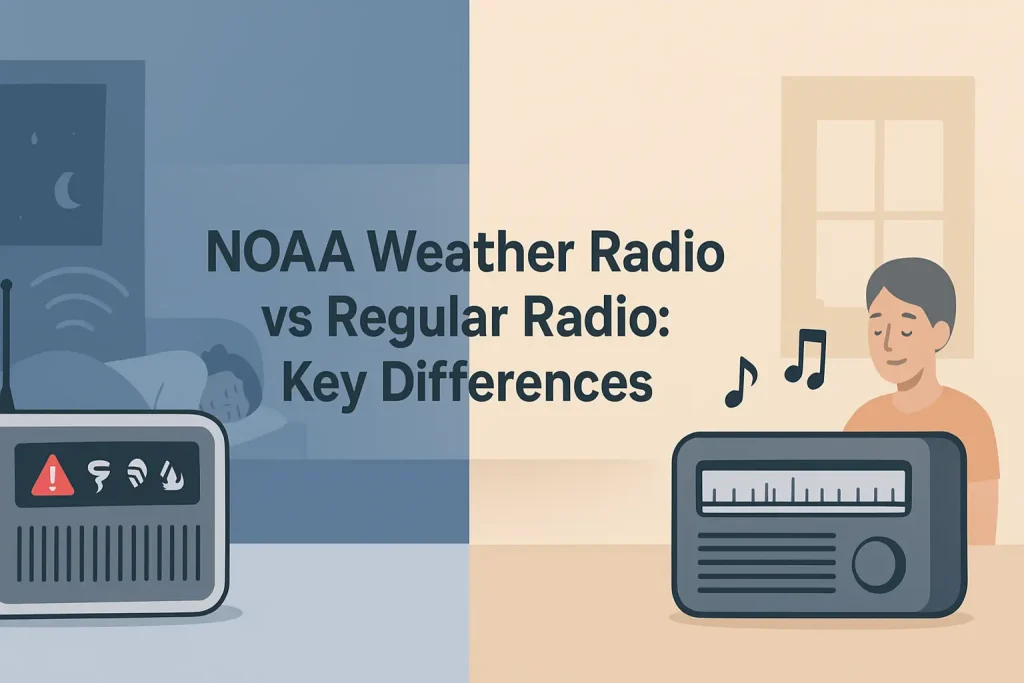
Walmart, Menards, and Home Depot all sell weather radios, but the prices, model selection, and in-store availability vary more than most people expect. Knowing which store offers the best value before you walk in can save you $15 to $40 on the same category of radio.
This comparison covers entry-level, mid-range, and S.A.M.E.-capable weather radios at all three retailers, with real price ranges, model availability, and the trade-offs that matter for emergency preparedness.
| Photo | Popular Portable Walkie Talkies | Price |
|---|---|---|
 | SKIWARRIOR Multifunctional Smart Wireless Ski Goggles with Walkie-Talkie, Anti-Fog Zeiss Lens, Music & Call Function (Cylindrical Blue) | Check Price On Amazon |
 | SINORISE Super Mini Walkie Talkies, Two-Way Radios, 3 Pack | Check Price On Amazon |
 | KOSPET Tank M4C Smart Watch Rugged, Dual-Band GPS, 5ATM & IP69K Waterproof | Check Price On Amazon |
 | Retevis RT15 Walkie Talkies 3 Pack, Birthday Gift, Outdoor Adventure Kit | Check Price On Amazon |
 | Rechargeable Walkie Talkies Toys for Kids: DIY Astronaut Walkie Talkies for Boys Christmas Birthday Gifts for 3 4 5 6 7 8 9 10 Boy Walkie Talkie Outdoor Hiking Toy 2 Way Radio Camping Outdoor Game | Check Price On Amazon |
By the Numbers
Weather Radio Retail Price Snapshot: Menards vs Walmart vs Home Depot
Key price and availability figures for weather radios at major U.S. retailers. Sources: retailer websites, NOAA NWR documentation.
What Is a NOAA Weather Radio and Why Does the Retailer Matter?
A NOAA weather radio (also called an NWR or weather alert radio) is a dedicated receiver that monitors one or more of the seven NOAA Weather Radio All Hazards broadcast frequencies between 162.400 MHz and 162.550 MHz.
Unlike your phone’s emergency alert system, a weather radio operates independently of cellular networks and broadcasts continuously 24 hours a day.
The retailer matters because the same brand (most commonly Midland, Uniden, or Sangean) can appear at different price points depending on the store’s buying agreements and inventory strategy.
Walmart tends to stock entry-level units at the lowest prices. Menards carries a narrower selection but occasionally prices mid-range units competitively. Home Depot skews toward combination emergency radios that include hand-crank and solar charging features.
Knowing the difference before you shop means you get the right radio at the right price, not just whatever is on the shelf closest to the door.
What Weather Radios Does Walmart Carry and What Do They Cost?
Walmart is the most accessible retailer for entry-level weather radios, typically stocking basic NOAA alert receivers in the $18 to $30 range and S.A.M.E.-capable models from $30 to $55.
The most commonly stocked model is the Midland WR120B weather radio, which retails at Walmart for approximately $29 to $35 depending on region.
The WR120B receives all seven NOAA broadcast frequencies and includes S.A.M.E. (Specific Area Message Encoding) technology, which lets you program the unit to alert only for your specific county using a 6-digit FIPS code.
Key Specifications for Midland WR120B:
- Frequencies: 162.400, 162.425, 162.450, 162.475, 162.500, 162.525, 162.550 MHz (all 7 NOAA channels)
- S.A.M.E. alert types: 25 NOAA event categories
- Alert memory: programmable county-level FIPS code entry
- Power: AC adapter with 3x AA battery backup
- Alert light: tri-color LED (red for warning, yellow for watch, green for advisory)
Walmart’s basic weather radio tier (under $25) typically includes the Midland WR100 or comparable entry unit, which receives NOAA frequencies but lacks S.A.M.E. filtering.

Without S.A.M.E., the radio alerts you for every county in your broadcast area, not just yours. In a state like Ohio or Texas, that can mean waking up at 2 a.m. for a tornado warning 200 miles from your location.
Walmart’s online inventory is broader than its physical stores. You can often find the Uniden BC365CRS weather alert clock radio and the Sangean CL-100 through Walmart’s website for pickup or delivery even if the physical store only stocks two or three SKUs.
The primary advantage of buying at Walmart is price. The primary limitation is that store staff rarely have product knowledge about S.A.M.E. programming or battery backup specs, so you need to know what you want before you walk in.
Walmart is the best retailer for budget-conscious buyers who want a basic S.A.M.E.-capable unit and are comfortable programming it themselves.
What Weather Radios Does Menards Carry and What Do They Cost?
Menards carries a smaller weather radio selection than Walmart or Home Depot, typically stocking two to four SKUs in the home improvement and outdoor supply sections, with prices ranging from $25 to $55.
The most commonly stocked brand at Menards is Midland, with the WR120B and WR300 appearing in most regional stores.
The Midland WR300 weather radio is the mid-tier unit most frequently found at Menards, typically priced between $40 and $55.
Key Specifications for Midland WR300:
- Frequencies: all 7 NOAA channels (162.400-162.550 MHz)
- S.A.M.E. programmable locations: up to 25 county codes
- Alert types: 25 NOAA event categories with individual on/off control
- Alarm modes: wake-up alarm, weather alert, and county-specific alert
- Power: AC with 3x AA battery backup
- Display: large backlit LCD with clock
Menards occasionally runs rebate promotions that make weather radios among the lowest effective prices in the market. A $10 or $11 rebate on a $40 unit brings the effective price below what Walmart typically charges for the same model.
The trade-off is that Menards rebates require mail-in processing and are not instant savings at the register.
Menards stores vary significantly by region in what weather radio stock they carry. Stores in the Midwest, where severe weather is most frequent, tend to carry more models and maintain better in-stock status than stores in lower-risk regions.
The Menards website allows inventory checks by store location, which is worth doing before you make a trip specifically for a weather radio purchase.
Menards is the best choice for buyers in the Midwest who want a mid-range S.A.M.E. radio and are willing to use mail-in rebates to get the best net price.
What Weather Radios Does Home Depot Carry and What Do They Cost?
Home Depot’s weather radio selection skews toward combination emergency radios, often stocking units that include hand-crank power, solar charging, AM/FM reception, and USB charging ports alongside NOAA weather alert capability, with prices typically ranging from $30 to $80.
The most commonly stocked weather radio category at Home Depot is the multi-function emergency radio rather than the dedicated desktop NOAA alert unit.
The Midland ER310 emergency crank weather radio and similar combination units are Home Depot’s dominant stock, typically priced between $45 and $65.
Key Specifications for Midland ER310:
- Frequencies: all 7 NOAA weather radio channels (162.400-162.550 MHz)
- S.A.M.E.: yes, with programmable county code filtering
- Power options: hand crank, solar panel, 3x AA batteries, USB-C charging
- Extra features: AM/FM radio, 1000 mAh phone charging bank, SOS beacon
- Battery life: approximately 8 hours continuous on AA batteries at standard volume
If you want a dedicated desktop NOAA alert radio without emergency multi-function features, Home Depot’s selection is limited and typically priced $5 to $15 higher than the equivalent unit at Walmart for the same model.
Home Depot’s advantage is in the combination emergency radio category. If you want one device that covers weather alerts, power outage communication, phone charging, and off-grid use, Home Depot’s selection is broader than Walmart’s or Menards’ in most store locations.
The Sangean CL-100 tabletop weather alert radio occasionally appears at Home Depot, priced at $55 to $70, which is $10 to $20 above the average online price.
Home Depot is the best choice if you specifically want a hand-crank or solar-capable emergency radio and prefer buying in person rather than online.
Use the table below to compare price ranges and model focus across all three retailers.
Price Comparison
Weather Radio Retail Price Comparison: Menards vs Walmart vs Home Depot
In-store price ranges by retailer and radio tier. Prices verified at time of publication. Online prices may differ.
$18-$25
$29-$35
$28-$44 (after rebate: $18-$34)
$40-$55
$45-$65
$55-$70
Prices reflect typical in-store retail. Menards rebate prices require mail-in processing and vary by promotion period. Online prices at all three retailers are typically $5-$15 lower than in-store.
The following widget helps you match the right retailer to your specific situation based on what you need from a weather radio.
Interactive Tool
Which Retailer Should You Buy Your Weather Radio From?
Answer 2 questions to get a retailer and model recommendation matched to your needs.
How Do the Prices Compare for the Same Model at All Three Retailers?
When the same model appears at multiple retailers, the price difference is typically $5 to $15 before any rebates, with Walmart usually carrying the lowest everyday shelf price and Home Depot carrying the highest.
This pattern holds consistently for the Midland WR120B, which is the most widely stocked weather radio across all three chains.
Use the table below to compare typical in-store prices for the same model across all three retailers.
Product Comparison
Same Weather Radio Model: Price Across Walmart, Menards, and Home Depot
Typical in-store retail prices. Prices verified at time of publication. Regional variation applies.
| Model | Walmart | Menards (shelf) | Menards (after rebate) | Home Depot |
|---|---|---|---|---|
| Midland WR120B | $29-$35 | $34-$44 | $18-$34 | Limited / not typically stocked |
| Midland WR300 | $39-$50 | $40-$55 | $30-$45 | Limited / not typically stocked |
| Midland ER310 (crank/solar) | $45-$60 | $50-$60 | $40-$50 (when rebate active) | $55-$65 |
| Sangean CL-100 | $50-$60 (online/pickup) | Rarely stocked | N/A | $55-$70 |
| Uniden BC365CRS | $35-$50 (online/pickup) | Rarely stocked | N/A | Rarely stocked |
All prices are approximate in-store retail. Prices vary by region and change without notice. Menards rebate prices require mail-in processing. Online prices at all three retailers are typically lower.
Does S.A.M.E. Technology Affect the Price, and Is It Worth the Extra Cost?
S.A.M.E. (Specific Area Message Encoding) technology adds approximately $10 to $20 to the retail price of a weather radio compared to a basic NOAA receiver, and it is worth the cost for almost every user.
Without S.A.M.E., your weather radio alerts you for every county within range of your NOAA broadcast transmitter. This can mean dozens of false wake-ups per year for severe weather events occurring far from your location.
A S.A.M.E.-capable radio lets you program up to 25 specific county FIPS codes. The radio only activates its alarm for alerts issued for those exact counties.
According to NOAA NWR documentation, each of the seven broadcast frequencies (162.400-162.550 MHz) covers a radius of roughly 40 miles from the transmitter, which in most U.S. states means a single transmitter covers four to ten counties simultaneously.
If you live in a border area between states or counties, a single NOAA transmitter may cover counties in two or three states. Without S.A.M.E. filtering, your radio activates for all of them.
The $10 to $20 premium for S.A.M.E. capability is the single most cost-effective upgrade in the weather radio category. Any weather radio you purchase at Walmart, Menards, or Home Depot should have S.A.M.E. as a baseline requirement.
The Midland WR120B is the lowest-cost S.A.M.E.-capable unit widely available at all three retailers and represents the best minimum-viable weather radio for home use.
S.A.M.E. technology is worth the premium at every price level, and you should not buy a weather radio without it regardless of which retailer you choose.
What Are the Differences Between Entry-Level, Mid-Range, and Premium Weather Radios at These Retailers?
Weather radios at these three retailers fall into three distinct tiers based on S.A.M.E. capability, number of programmable county codes, individual alert type control, and power backup options, with prices ranging from $18 for entry-level to $70 for premium combination units.
Understanding what you get at each tier prevents overspending on features you do not need and underspending on a radio that wakes you up for irrelevant alerts.
Entry-Level ($18-$30): Basic NOAA Alert Receiver
Receives all 7 NOAA weather radio frequencies. Does not include S.A.M.E. county filtering. Alerts for all weather events within the entire transmitter coverage area. Best for: anyone on a strict budget who understands the limitation of broad-area alerting.
Mid-Range ($30-$50): S.A.M.E.-Capable Desktop Radio
Receives all 7 NOAA frequencies with programmable S.A.M.E. county code filtering. Includes tri-color alert LED, programmable alarm clock, and AA battery backup. Best for: most home users who want reliable county-specific severe weather alerting. The Midland WR120B is the definitive unit in this tier.
Mid-Range Plus ($40-$60): Multi-Code S.A.M.E. with Alert Type Control
All mid-range features plus the ability to program multiple county codes (up to 25 on the Midland WR300) and turn individual NOAA alert event types on or off independently. Best for: households near county borders or users who want to suppress non-emergency advisory alerts during sleeping hours.
Premium Combination ($45-$70): Multi-Power Emergency Radio
All S.A.M.E. features plus hand-crank power, solar panel charging, AM/FM reception, and USB phone charging output. Best for: emergency preparedness households, campers, and anyone who wants one radio that functions during power outages. The Midland ER310 is the standard recommendation in this tier.
If you need a hand-crank option for power outage preparedness, our guide to choosing the right crank-powered emergency radio covers the specific features that separate useful units from underpowered ones.
Most households need the mid-range S.A.M.E. tier, and the Midland WR120B at Walmart’s everyday price of $29-$35 is the right default choice for the majority of buyers.
Is It Cheaper to Buy a Weather Radio Online or In-Store at These Retailers?
Online prices for weather radios are consistently $5 to $20 lower than in-store prices at all three retailers, with Amazon typically offering the lowest price on most Midland, Uniden, and Sangean models.
The gap is most pronounced at Home Depot, where in-store prices on combination emergency radios are often $10 to $20 higher than the same unit’s Amazon listing price.
Walmart’s online price matches its in-store price more closely than Home Depot or Menards, often within $3 to $7, which makes Walmart’s physical stores competitive for buyers who need a weather radio today rather than waiting for shipping.
Menards does not have the same online retail infrastructure as Walmart or Amazon. Most Menards purchases are made in-store, and the mail-in rebate is only available on qualifying in-store purchases, not online orders.
If you want the absolute lowest price and are not in a hurry, buying on Amazon is almost always cheaper than any of the three physical retailers for the same model.
For a full breakdown of online weather radio sources beyond these three retailers, the top-rated NOAA weather radios available through Amazon covers current pricing and model comparisons updated at time of publication.
If you need the radio today, Walmart’s in-store price is your best bet among the three physical options for S.A.M.E.-capable units.
What Are the Best Weather Radio Models You Can Find at All Three Retailers?
The Midland WR120B is the best weather radio available at all three retailers when factoring in price, S.A.M.E. capability, battery backup, and reliability, typically priced at $29 to $44 depending on which store you visit.
The Midland WR300 is the best step-up option for users who want individual alert type control and multi-county S.A.M.E. programming, available at Walmart and Menards for $40 to $55.
For a detailed look at what the WR120B delivers in real-world use, the full performance review of the Midland WR120B covers S.A.M.E. programming steps, alert tone quality, and battery backup duration under actual alert conditions.
Use the table below to compare the top models available at these retailers by key specifications.
Product Comparison
Top Weather Radio Models at Walmart, Menards, and Home Depot: At-a-Glance Specs
Key specs compared across commonly stocked models. Source: manufacturer data sheets, NOAA NWR documentation.
| Model | S.A.M.E. | County Codes | Battery Backup | Hand Crank | Typical Price |
|---|---|---|---|---|---|
| Midland WR100 | No | N/A | 3x AA | No | $18-$25 |
| Midland WR120B | Yes | Programmable FIPS | 3x AA | No | $29-$44 |
| Midland WR300 | Yes | Up to 25 codes | 3x AA | No | $40-$55 |
| Midland ER310 | Yes | Programmable FIPS | 3x AA + USB-C | Yes + Solar | $45-$65 |
| Sangean CL-100 | Yes | Programmable FIPS | 6x AA | No | $55-$70 |
| Uniden BC365CRS | Yes | Programmable FIPS | 4x AA | No | $35-$50 |
Which Retailer Has the Best Weather Radio Selection Overall?
Walmart has the best combination of price, availability, and S.A.M.E. model access for most buyers, carrying the Midland WR120B and WR300 at the lowest everyday prices among the three physical retailers.
Home Depot leads specifically in the combination emergency radio category, stocking more hand-crank and solar units than either Walmart or Menards in most regions.
Menards offers the best net price when rebate promotions are active, particularly for Midland weather radios, but its selection is limited and rebates require mail-in processing.
None of the three retailers match the model variety available online. If selection is your primary concern, Amazon and dedicated weather radio retailers offer more SKUs at lower prices than any of the three physical stores.
For a broader comparison of where to buy weather radios, including online options beyond these three stores, the complete retailer comparison for NOAA weather alert radios covers in-store and online options with current pricing and availability notes.
For buyers who want to walk in and leave with a reliable S.A.M.E. weather radio today, Walmart is the best default choice among the three retailers for most of the country.
What Should You Actually Check Before Buying a Weather Radio at Any of These Stores?
Before buying at any of the three retailers, confirm three things: the radio receives all 7 NOAA frequencies (162.400-162.550 MHz), it includes S.A.M.E. county filtering, and it has battery backup capability for power outages.
These three features are the minimum viable specification for a weather radio in any home.
The box will display the NOAA frequencies covered. If it lists fewer than 7, or if it does not specifically state “S.A.M.E.” or “SAME” on the packaging, do not buy it. You will either miss alerts or be woken up for events in counties far from yours.
Check that the battery backup uses standard AA or AAA batteries rather than a proprietary rechargeable pack. Standard batteries can be replaced immediately during a power outage. A depleted proprietary pack requires a charger you may not have access to.
Verify the FIPS programming process before you leave the store. The Midland WR120B programs S.A.M.E. codes through a simple button sequence described in the included manual. The Midland WR400 and Sangean CL-100 use a similar manual keypad entry process.
Your county’s 6-digit FIPS S.A.M.E. code is available on the NOAA NWR website at weather.gov/nwr/SAMEcodes. Look it up before you go to the store so you can program the radio immediately after unboxing.
If you want a comprehensive overview of what makes a weather radio worth owning before you go shopping, the complete weather radio buying guide walks through every specification that matters for home and emergency use.
Confirming these three specs before you buy ensures you leave the store with a radio that actually works when a severe weather alert is issued for your county.
Quick Reference: Weather Radio Terms Used in This Comparison
NOAA Weather Radio All Hazards (NWR): A national network of radio stations broadcasting continuous weather information directly from National Weather Service offices on 7 dedicated VHF frequencies.
S.A.M.E. (Specific Area Message Encoding): A digital encoding system that allows a weather radio to activate only for alerts issued for specific geographic areas you have programmed, identified by a 6-digit FIPS code.
FIPS code: A 6-digit Federal Information Processing Standards code that identifies a specific county or county equivalent for S.A.M.E. alert programming.
NOAA broadcast frequencies: The 7 dedicated VHF frequencies used exclusively for weather radio broadcasts: 162.400, 162.425, 162.450, 162.475, 162.500, 162.525, and 162.550 MHz.
EAS (Emergency Alert System): The national public warning system that includes NOAA weather radio as one of its primary broadcast channels, alongside broadcast TV, radio, and Wireless Emergency Alerts on cell phones.
Alert event type: One of 25 specific NOAA event categories that can trigger a weather radio alert, including Tornado Warning, Flash Flood Warning, Hurricane Warning, Winter Storm Warning, and Civil Emergency Message.
Battery backup: The ability to operate on batteries when AC power is unavailable, typically 3x or 6x AA alkaline batteries. Critical for weather radio use during power outages caused by the storms the radio warns about.
Combination emergency radio: A multi-function device that combines NOAA weather radio capability with hand-crank power, solar charging, AM/FM reception, and USB phone charging output.
IPAWS (Integrated Public Alert and Warning System): FEMA’s national messaging system that routes emergency alerts to NWR, wireless carriers, and broadcast stations simultaneously.
Does the Eton FRX3 Plus Appear at Any of These Retailers, and How Does It Compare on Price?
The Eton FRX3 Plus emergency weather radio is not commonly stocked in physical Walmart, Menards, or Home Depot stores, though it occasionally appears at Home Depot in the combination emergency radio section, typically priced at $60 to $75.
Online pricing for the FRX3 Plus is typically $50 to $65, making the rare in-store appearance at Home Depot a premium of $5 to $15 over the online price.
Key Specifications for Eton FRX3 Plus:
- Frequencies: all 7 NOAA channels plus AM/FM
- S.A.M.E.: yes, with county-specific alert programming
- Power: hand crank, solar panel, AA batteries, USB charging
- Extras: 2000 mAh phone charging bank, LED flashlight, Bluetooth speaker
- Build: durable rubberized housing
The FRX3 Plus competes directly with the Midland ER310 in the premium combination emergency radio tier. The Eton typically includes a larger battery bank and Bluetooth speaker. The Midland ER310 typically offers better everyday pricing at all three retailers.
For a detailed comparison of the FRX3 Plus against other combination emergency radios, the in-depth review of the Eton FRX3 Plus emergency radio covers its alert reliability, crank power output, and real-world battery bank performance.
If you want the FRX3 Plus specifically, buy it online. Physical retailer availability is inconsistent and in-store pricing is higher than online alternatives.
What Is the Best Weather Radio You Can Buy Right Now Across All Categories?
The Midland WR120B is the best weather radio for most households, balancing S.A.M.E. capability, reliable alert performance, AA battery backup, and a retail price under $35 at Walmart, making it the highest-value unit in the market for standard home use.
For households that want multi-power emergency capability, the Midland ER310 is the best combination unit available at physical retailers, with hand crank, solar, USB-C charging, and S.A.M.E. all in a single device at $45 to $65.
For a curated list of the highest-performing weather radios across all tiers and use cases, the editors’ picks for the best NOAA weather radios across all price tiers covers models from entry-level S.A.M.E. units to professional-grade desktop receivers.
The Midland WR120B at Walmart’s everyday price remains the default recommendation for any household that does not yet own a weather radio and needs one today.
Are There Weather Radios Available at These Retailers That Are Worth Avoiding?
Any weather radio priced under $25 that does not include S.A.M.E. technology should be avoided for primary home use, because it will alert for weather events across a multi-county broadcast area rather than filtering alerts to your specific location.
Generic or store-brand weather radios without clearly labeled NOAA frequency reception across all 7 channels should also be skipped. Some budget units only receive one or two NOAA channels, which creates gaps in alert coverage depending on your location relative to the nearest transmitter.
At Walmart, the Midland WR100 and similar no-S.A.M.E. units are the specific units to skip if you live near county boundaries or in a multi-county broadcast zone.
At Home Depot, combination emergency radios marketed primarily as AM/FM radios with “weather band” added as a secondary feature sometimes lack full S.A.M.E. capability or program fewer than the 25 standard NOAA alert event types. Check the packaging for explicit S.A.M.E. labeling before buying.
A weather radio that wakes your household for alerts 200 miles away is not a safety tool. It is a noise generator that will get switched off after the third middle-of-the-night false alarm, which is exactly when you need it most.
Skip any unit without S.A.M.E., skip any unit that does not cover all 7 NOAA frequencies, and skip any unit that uses a proprietary battery without standard AA backup capability.
Can You Use the Same Weather Radio for Both Home and Camping Use?
A combination emergency radio such as the Midland ER310 or Eton FRX3 Plus can serve both home and camping use reliably because they include battery, hand-crank, and solar power options alongside S.A.M.E. NOAA alert capability on all 7 frequencies.
A dedicated desktop unit such as the Midland WR120B or WR300 is designed for AC-powered home use and relies on battery backup only as a temporary failsafe, not as a primary power source for extended outdoor use.
If you want one radio that serves both purposes, the combination emergency tier at $45 to $65 is the right choice.
If you have a home already equipped with a desktop S.A.M.E. radio, a separate portable hand-crank weather radio for camping priced at $30 to $50 is a more cost-effective solution than replacing your home unit.
A single combination unit serving both home and camping is a practical choice for buyers who want to minimize the number of devices they own and maintain.
How Do You Program S.A.M.E. County Codes on a Weather Radio Purchased at These Retailers?
Programming S.A.M.E. county codes on a Midland WR120B or WR300 requires your county’s 6-digit FIPS code from weather.gov/nwr/SAMEcodes and a 3 to 5 minute process using the unit’s built-in keypad.
The programming process is identical regardless of which retailer you purchased from. Retailer does not affect radio firmware or programming interface.
Step 1: Look up your county’s 6-digit FIPS S.A.M.E. code at weather.gov/nwr/SAMEcodes before starting. Write it down.
Step 2: Power on the radio and press the “MENU” or “PROGRAM” button to enter the setup mode. On the WR120B, this is the “S.A.M.E.” button on the back panel.
Step 3: Use the up/down buttons to navigate to “SAME COUNTY” or equivalent menu item. Press SELECT or ENTER.
Step 4: Enter your 6-digit FIPS code using the numeric keypad or up/down selector. Confirm the entry. The radio will save the code and filter all future alerts to events issued for that county.
Step 5: Test the programming by pressing the “TEST” button or waiting for the next scheduled weekly test broadcast from your nearest NOAA transmitter (every Wednesday between 11 a.m. and noon local time).
For households near a county border, program up to three county codes to ensure alerts cover your actual risk area. The WR120B accepts single or multiple FIPS code entries depending on firmware version. The WR300 supports up to 25 programmed codes.
If your radio does not alert during a known severe weather event in your county, verify the programmed FIPS code matches exactly. A one-digit error in the 6-digit code will cause the radio to monitor a different county entirely.
What Makes the Midland and Uniden Brands the Most Common at All Three Retailers?
Midland and Uniden dominate weather radio shelf space at Walmart, Menards, and Home Depot because both brands have established distribution agreements with major retailers and have built a track record of FCC-compliant NOAA receiver performance at accessible price points.
Midland Radio Corporation has been manufacturing NOAA weather radios since the technology was standardized, and its WR series represents the most widely distributed dedicated weather radio line in U.S. physical retail.
Uniden’s weather radio lineup, including the BC365CRS, combines S.A.M.E. capability with digital clock and alarm functions at a competitive price point, making it a strong alternative to Midland at retailers that stock it.
Sangean, while less common at physical retail locations, is available through Walmart’s online platform and Home Depot, and its CL-100 is regarded as one of the best-performing tabletop S.A.M.E. weather radios at the $55 to $70 tier.
Brand matters less than S.A.M.E. capability, frequency coverage, and battery backup configuration. The Midland WR120B, Uniden BC365CRS, and Sangean CL-100 all receive all 7 NOAA frequencies and implement S.A.M.E. filtering correctly.
Do Any of These Retailers Offer Weather Radios with AM/FM Reception at a Reasonable Price?
Combination weather radios with AM/FM reception are available at all three retailers in the $40 to $65 range, with the Midland ER310 being the most commonly stocked unit across all three stores in this category.
Dedicated weather-only radios at Walmart and Menards in the $29 to $45 range generally do not include AM/FM. If AM/FM reception is a requirement, you will need to step up to the combination emergency radio tier.
The Midland ER310 combination emergency radio adds AM/FM alongside NOAA S.A.M.E. reception, hand crank, solar, and USB charging, making it the most feature-complete unit available at physical retailers in the $45 to $65 price range.
The Sangean CL-100 also includes AM/FM alongside its NOAA S.A.M.E. capability at $55 to $70, with superior audio quality compared to most combination units in its tier.
If AM/FM is not a priority and you want the lowest price for reliable weather alerting, the dedicated S.A.M.E. units (WR120B or WR300) at Walmart and Menards are better value than paying the AM/FM premium.
How Often Do Menards Rebates Apply to Weather Radios, and How Do You Use Them?
Menards weather radio rebates appear several times per year, typically during spring storm season (March through May) and fall severe weather season (September through November), offering $8 to $15 off qualifying Midland weather radio models.
The rebate works through Menards’ standard mail-in rebate process: purchase the qualifying unit in-store, complete the rebate form included in the store’s rebate booklet, and mail it with the original receipt and UPC to the address on the form within the submission window (typically 30 to 60 days from purchase).
Rebate processing typically takes 6 to 8 weeks. Payment arrives as a Menards merchandise credit check (redeemable in-store only), not cash or a credit to your original payment method.
Before going to Menards specifically for a weather radio, check the current rebate booklet at menards.com or pick one up at the service desk to confirm whether a weather radio rebate is active during your visit.
When a Menards rebate is active on the Midland WR120B or WR300, the net effective price after rebate is typically the lowest available at any physical retailer, often matching or beating Walmart’s everyday price.
The limitation of Menards rebates is that you receive merchandise credit rather than cash, so the savings only have value if you regularly shop at Menards for other home improvement purchases.
Is a $20 Walmart Weather Radio Good Enough for Severe Weather Preparedness?
A $20 Walmart weather radio that lacks S.A.M.E. technology is not adequate for reliable severe weather preparedness in most U.S. regions, because it will alert for events across a multi-county broadcast zone rather than filtering alerts to your specific county.
In states with high tornado frequency (Oklahoma, Kansas, Texas, Alabama, Mississippi), a non-S.A.M.E. radio can trigger 30 to 80 false alarms per year for events outside your county, leading most users to disable the alert function entirely.
Spending an additional $10 to $15 for the Midland WR120B with S.A.M.E. capability is the most important upgrade in the weather radio category and the single most impactful $10 most households can spend on home safety equipment.
A $20 basic NOAA receiver is adequate only for coastal or low-tornado-frequency regions where the nearest NOAA transmitter covers only one or two counties within its broadcast radius, minimizing false alarms from distant alerts.
For any household in FEMA’s Tornado Alley or Atlantic hurricane zone, the S.A.M.E.-capable WR120B at $29 to $35 is the minimum acceptable weather radio. The $8 to $15 difference is not worth the false alarm risk over the life of the device.
Where Can You Find the Most Complete Selection of Weather Radios Beyond These Three Retailers?
The most complete selection of NOAA weather radios across all price tiers and feature categories is available online through Amazon, which stocks the full Midland, Uniden, Sangean, and Eton product lines at prices consistently $5 to $20 below in-store retail at Walmart, Menards, and Home Depot.
Amazon’s selection advantage is most significant for mid-tier and premium units. The Midland WR400, Uniden HomePatrol weather receivers, and Sangean CL-100 are available through Amazon at prices that physical retailers either do not carry or significantly markup.
For buyers who want to compare the full range of available models before choosing, the comprehensive guide to the best NOAA weather radios across all price tiers covers the complete landscape including models not stocked at any of the three physical retailers.
For buyers who specifically need a weather radio today and cannot wait for shipping, Walmart provides the best combination of price and in-store availability among the three physical options.
Does the Retailer Affect the Warranty or Return Policy on Weather Radios?
The manufacturer warranty on weather radios such as Midland, Uniden, and Sangean units is identical regardless of which retailer you purchase from, typically one year from date of purchase for manufacturing defects.
Return policies vary by retailer. Walmart accepts weather radio returns within 90 days with receipt. Menards’ return window is 90 days for most electronics with original packaging. Home Depot accepts returns on most electronics within 90 days.
Manufacturer warranty claims go directly to the brand, not the retailer. Keep your receipt and register the product on the manufacturer’s website within 30 days of purchase to establish warranty documentation.
Midland’s warranty support is accessible through midlandusa.com. Uniden’s warranty service is handled through uniden.com. Sangean’s U.S. warranty support operates through sangean.com.
Retailer does not affect warranty coverage, but purchasing from a retailer with a longer or more flexible return window gives you additional recourse in the first 90 days if the unit has an issue that does not qualify for manufacturer warranty replacement.
What Is the Right Weather Radio Purchase Decision Based on Your Situation?
The right purchase depends on three factors: whether you need standard home alerting or off-grid emergency capability, your budget, and whether Menards rebates are currently active in your area.
For standard home use with a budget under $35: buy the Midland WR120B at Walmart for $29 to $35. It covers all 7 NOAA frequencies, includes S.A.M.E. county filtering, and has AA battery backup. It is the right radio for the majority of households in the United States.
For standard home use with the best net price possible: check whether Menards has an active weather radio rebate before buying anywhere. If a rebate is active on the WR120B or WR300, Menards delivers the lowest net price at any physical retailer.
For off-grid or emergency prep use: buy the Midland ER310 at Home Depot or Walmart for $45 to $65. It adds hand crank, solar charging, USB phone charging, and AM/FM to S.A.M.E. NOAA reception. Home Depot has the most consistent stock of this model.
For the widest model selection and lowest overall price: buy online through Amazon rather than any of the three physical retailers. You will save $5 to $20 and have access to models not stocked in any of the three stores.
If you are not sure which weather radio is right for your home, the full weather radio selection guide for home and emergency use walks through every decision factor including S.A.M.E. programming, battery backup requirements, and NOAA transmitter coverage in your area.
Does Walmart Stock the Midland WR120B In-Store or Only Online?
The Midland WR120B is typically stocked in physical Walmart stores in most U.S. regions, particularly in Midwest, Southeast, and South-Central states where severe weather frequency is highest. The radio appears in the electronics or emergency preparedness aisle.
In lower-risk weather regions (Pacific Coast, New England), physical Walmart stores may carry the WR120B only online with in-store pickup rather than on the shelf. Use the Walmart app to check real-time in-store availability before driving to the store.
Walmart’s online listing for the WR120B is available for shipping or pickup in nearly all store locations, with a typical delivery window of 1 to 2 days for standard shipping or same-day for stores with it in stock.
Is the Midland WR300 Worth the Extra Cost Over the WR120B?
The Midland WR300 is worth the extra $10 to $20 over the WR120B if you need to program multiple county codes (the WR300 supports up to 25 FIPS codes vs. the WR120B’s single-county or limited multi-code programming) or if you want to individually turn specific NOAA alert event types on or off.
The WR300’s individual alert type control is particularly useful for households that want to suppress non-emergency advisory alerts during overnight hours while still receiving Tornado Warnings and Flash Flood Warnings.
For a single-county household that wants standard severe weather alerting without the additional programming complexity, the WR120B at $29 to $35 delivers the same essential function at a lower price.
Buy the WR300 if you live near a county border, frequently travel between counties, or want granular control over which of the 25 NOAA alert event types activate your alarm. Buy the WR120B if you want a reliable S.A.M.E. radio at the lowest price that accomplishes the core task.
Can You Find Older Discontinued Weather Radio Models at These Retailers at a Discount?
Discontinued Midland and Uniden weather radio models occasionally appear at clearance prices at Walmart and Home Depot, typically marked down 30 to 50 percent when a new model replaces the previous version on shelf.
A discontinued S.A.M.E.-capable weather radio at clearance is still fully functional and receives all 7 NOAA frequencies correctly. NOAA’s broadcast format and S.A.M.E. encoding have not changed in the underlying technology, so an older generation WR300 or WR120 operates identically to the current version for alert purposes.
The risk with clearance units is no guarantee of in-box contents (missing manual, power adapter, or battery compartment cover) and limited or expired return window.
If you find a clearance unit that is sealed in original packaging, it represents good value. Open-box or floor-display units should be avoided unless the box has been inspected for completeness.
What Do People in Weather Radio Forums Say About Buying at These Retailers?
Users on preparedness forums and NOAA weather radio communities consistently identify Walmart as the best physical retailer for everyday S.A.M.E. weather radio purchases, citing reliable stock of the Midland WR120B and the lowest regular in-store price among the three options.
Menards receives strong recommendations specifically during rebate promotion periods, with forum users in Midwest states citing effective prices as low as $18 to $22 for the WR120B after rebate, which is lower than any non-sale price at Walmart or Home Depot.
Home Depot receives positive mentions for its hand-crank combination radio selection, with users citing it as the most reliable physical retailer for the Midland ER310 and similar off-grid capable units.
A consistent recommendation across all three retailer discussions is to buy online when time is not a factor. Amazon’s everyday pricing on Midland, Uniden, and Sangean units undercuts all three physical retailers on nearly every model.
The consensus from these communities aligns with the data in this comparison: Walmart for everyday S.A.M.E. units, Menards during rebate season, Home Depot for combination emergency radios, and Amazon for best price on any specific model.
Is It Worth Buying an Extended Warranty on a Weather Radio at These Retailers?
Extended warranty plans offered at Walmart, Home Depot, or Menards on weather radios priced at $18 to $70 are not worth the cost for most buyers. The manufacturer warranty covers manufacturing defects for one year, and weather radios are low-complexity devices with few moving parts and no wireless connectivity that could fail.
Weather radios do not have hard drives, wireless chips, or complex software that degrades over time. The most common failure mode is battery backup corrosion from leaving batteries installed for extended periods, which is not covered by any warranty plan.
Remove batteries from the backup compartment when not in a severe weather season or when the radio is primarily powered by AC. This extends the useful life of the radio significantly and costs nothing.
The $5 to $15 cost of a retail extended warranty on a $30 to $50 weather radio represents 10 to 30 percent of the unit’s purchase price. That money is better spent on a quality set of AA alkaline batteries for the backup compartment and a replacement unit in 5 to 7 years when the radio’s speaker begins to degrade.
Which Store Is Actually the Cheapest for a Weather Radio When You Factor Everything In?
When factoring in everyday pricing, Menards rebate availability, and product selection, Menards delivers the lowest net price for S.A.M.E. weather radios when a rebate promotion is active. When no rebate is active, Walmart has the lowest everyday price among the three physical retailers.
Home Depot is the most expensive of the three for equivalent dedicated desktop S.A.M.E. units, though it is competitive for combination emergency radios where its selection is strongest.
Online (primarily Amazon) is cheaper than all three physical retailers for nearly every weather radio model by $5 to $20, with the additional advantage of broader model selection including premium units not stocked at any of the three stores.
The definitive answer: Menards with an active rebate is cheapest for S.A.M.E. desktop units. Walmart is cheapest without a rebate. Home Depot is best for combination emergency radios. Amazon is cheapest for everything if you can wait for shipping.
Buying the right weather radio, regardless of retailer, is one of the most cost-effective emergency preparedness investments a household can make. The Midland WR120B at $29 to $35 provides county-specific severe weather alerting on all 7 NOAA frequencies with battery backup for the cost of a restaurant meal.
If you have not yet decided on a specific model and want to see how the top-rated units compare across the full market, the current editors’ rankings for the best NOAA weather radios at every price point provides a complete breakdown with updated pricing and availability.
| Photo | TOP RATED WALKIE TALKIES | Price |
|---|---|---|
 | Retevis RT628 Kids Walkie Talkies, Toys Gifts for 4-12 Year Old Girl Boy | Check Price On Amazon |
 | Cobra ACXT545 Weather-Resistant Walkie Talkies, Rechargeable, 22 Channels | Check Price On Amazon |
 | Retevis RT388 Kids Walkie Talkies, Outdoor Toys for Kids Camping Essentials | Check Price On Amazon |
 | Cobra RX680 Walkie Talkies (2-Pack), IP54 Water Resistant Design | Check Price On Amazon |
 | Retevis RT22 Walkie Talkies Long Range Rechargeable with Earpiece (2 Pack) | Check Price On Amazon |
 | Midland GXT1000VP4 GMRS Two-Way Radios with Headsets, Black, 2 Pack | Check Price On Amazon |
 | Retevis RT628 Walkie Talkies for Kids,Toys Gifts for 6-12 Years Old Boys Girls,Long Range 2 Way Radio 22CH VOX,Birthday Gift,Family Walkie Talkie for Camping Hiking Indoor Outdoor | Check Price On Amazon |