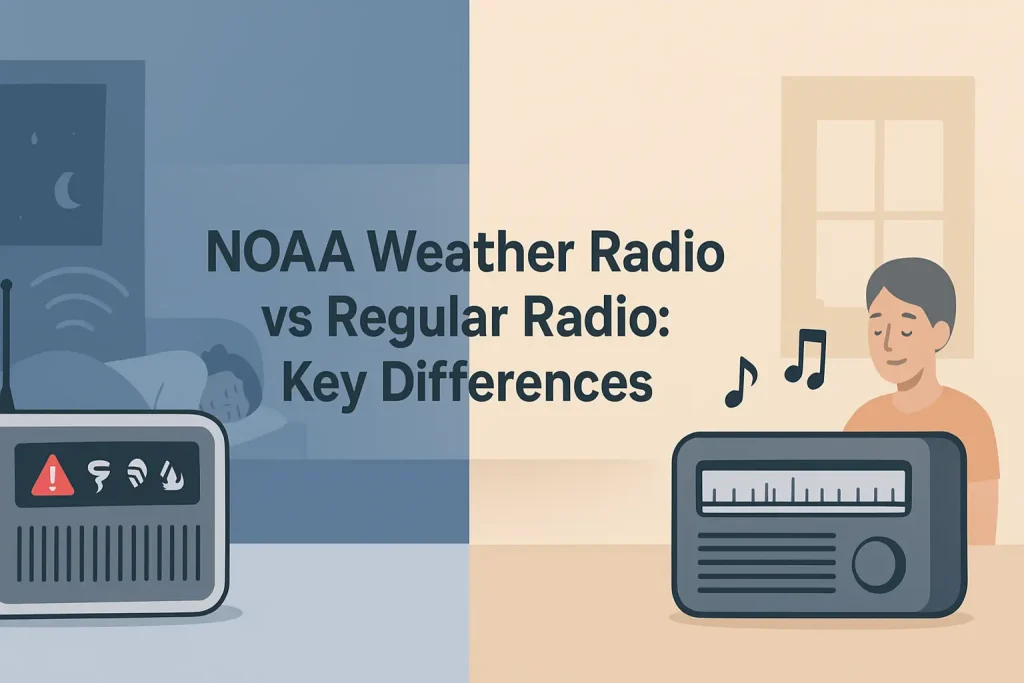
A NOAA weather radio costs between $20 and $150 depending on the features you need. A basic single-zone receiver sits at the low end of that range, while a full-featured S.A.M.E. (Specific Area Message Encoding) model with battery backup, multiple alert zones, and a digital display lands at the top. The price difference is real, and so is the performance gap between tiers.
This guide breaks down every price tier, explains exactly what changes as you spend more, and tells you which features are worth paying for and which ones you can skip.
| Photo | Popular Portable Walkie Talkies | Price |
|---|---|---|
 | SKIWARRIOR Multifunctional Smart Wireless Ski Goggles with Walkie-Talkie, Anti-Fog Zeiss Lens, Music & Call Function (Cylindrical Blue) | Check Price On Amazon |
 | SINORISE Super Mini Walkie Talkies, Two-Way Radios, 3 Pack | Check Price On Amazon |
 | KOSPET Tank M4C Smart Watch Rugged, Dual-Band GPS, 5ATM & IP69K Waterproof | Check Price On Amazon |
 | Retevis RT15 Walkie Talkies 3 Pack, Birthday Gift, Outdoor Adventure Kit | Check Price On Amazon |
 | Rechargeable Walkie Talkies Toys for Kids: DIY Astronaut Walkie Talkies for Boys Christmas Birthday Gifts for 3 4 5 6 7 8 9 10 Boy Walkie Talkie Outdoor Hiking Toy 2 Way Radio Camping Outdoor Game | Check Price On Amazon |
What Does a NOAA Weather Radio Actually Do?
A NOAA weather radio is a dedicated receiver that picks up continuous broadcasts from the National Weather Service on seven VHF frequencies between 162.400 and 162.550 MHz. It does not rely on cellular service, internet connectivity, or a broadcast TV signal, which makes it the most reliable emergency alert device available for most households.
According to NOAA’s National Weather Radio All Hazards (NWR) documentation, the network covers more than 95 percent of the US population within 40 miles of a transmitter. The broadcasts run 24 hours a day and include weather forecasts, severe weather warnings, and non-weather emergencies such as AMBER Alerts, hazardous materials incidents, and civil emergencies.
The critical distinction between a cheap weather radio and a mid-range one comes down to S.A.M.E. technology. S.A.M.E. stands for Specific Area Message Encoding, and it allows your radio to filter alerts by county using a 6-digit FIPS (Federal Information Processing Standards) code. Without S.A.M.E., your radio sounds an alarm for every alert broadcast in your entire state.
With S.A.M.E., it only alerts you for the specific county or counties you program. That difference matters at 3 a.m. when a tornado warning is issued 200 miles away.
The seven NOAA broadcast frequencies are 162.400, 162.425, 162.450, 162.475, 162.500, 162.525, and 162.550 MHz. Your radio scans all seven and locks onto the strongest signal from the nearest NWS transmitter.
Understanding this foundation helps explain why the price tiers exist: you are not just paying for a better speaker or a nicer housing. You are paying for more precise alert filtering, more reliable power backup, and more alert types covered.
The bottom line is that any NOAA weather radio gives you access to the NWR broadcast network, but the features that make it genuinely useful in an emergency start appearing around the $40 price point.
Budget Tier ($20 to $40): What You Get at the Low End
A budget NOAA weather radio in the $20 to $40 range gives you access to all seven NWR broadcast frequencies and an audible alarm when the NWS issues a warning or watch for your area. What it does not give you is county-level filtering, which means every alert for your entire broadcast region will trigger the alarm.
Models in this tier typically include basic functions: a channel selector for the seven WX frequencies, a speaker for live audio monitoring, a tone alert that activates during broadcasts, and either AC power only or AC power with a battery backup slot for 3 to 4 AA batteries. The Midland WR120B weather radio sits at the low end of the mid-range but illustrates what the upper boundary of a budget radio offers.
True budget-tier radios often lack a digital display entirely. You select one of seven channels manually using a dial, and the only visual feedback is a small LED indicator showing power status and alert mode.
Key Specifications for typical budget-tier NOAA weather radios:
- Frequencies covered: 162.400 to 162.550 MHz (all 7 NWR channels)
- S.A.M.E. filtering: Not available
- Battery backup: 3x AA or 4x AA alkaline (varies by model)
- Display: LED indicator only, no digital screen
- Alert types: All-hazards tone alert, no selective filtering
- Price range: $20 to $40
The main limitation is false alarm fatigue. If you live in a state with frequent severe weather activity in neighboring counties or regions, a non-S.A.M.E. radio will alert you for storms that pose no threat to your location. Many users in these regions end up turning the unit off at night, which defeats the purpose of owning one.
A budget radio is appropriate for a single-location household in a low-risk region where you primarily want audio access to NWS broadcasts rather than automated overnight alerting. It is also a reasonable choice for a secondary unit in a location like a garage or workshop where you want live weather audio without investing in a fully featured receiver.
If you are buying a weather radio for overnight emergency alerting, plan to spend at least $40 to get S.A.M.E. filtering. That single feature changes the radio from a noise-maker to a genuinely useful emergency device.
Mid-Range Tier ($40 to $80): Where S.A.M.E. Filtering Changes Everything
The $40 to $80 range is where NOAA weather radios become genuinely useful for overnight emergency alerting. Radios in this tier include S.A.M.E. county-level filtering, a digital display showing current channel and alert status, battery backup, and the ability to store multiple FIPS codes so the radio alerts you for more than one county simultaneously.
S.A.M.E. filtering works by encoding each NWS alert broadcast with a 6-digit FIPS code identifying the county or counties the alert covers. Your radio decodes this code and compares it against the list of FIPS codes you have programmed. If there is a match, the alarm sounds. If there is no match, the radio stays silent.
The mechanism is straightforward: the NWS transmitter encodes a digital header on every alert broadcast containing the event type, affected FIPS codes, and the valid time window. Your radio’s S.A.M.E. decoder chip reads this header before the audio alert begins. This is why a S.A.M.E.-equipped radio can wake you only for a tornado warning in your specific county while ignoring a flood watch 150 miles away.
This only works correctly when you have programmed the right FIPS code into your radio. If you program the wrong county code or leave the factory default in place, S.A.M.E. filtering either blocks legitimate alerts or passes irrelevant ones. You can find the correct FIPS code for your county at the NOAA National Weather Service SAME county codes lookup page.
Representative mid-range models include the Uniden BC365CRS weather radio and the Midland WR300 series. Both include S.A.M.E. filtering, a digital clock display, battery backup, and the ability to program between 5 and 25 individual S.A.M.E. location codes.
Key Specifications for typical mid-range NOAA weather radios:
- Frequencies covered: 162.400 to 162.550 MHz (all 7 NWR channels)
- S.A.M.E. filtering: Yes, 6-digit FIPS county-level filtering
- S.A.M.E. codes stored: 5 to 25 location codes depending on model
- Battery backup: 3x to 6x AA alkaline or included rechargeable pack
- Display: Digital LCD showing channel, time, and alert status
- Alert types: 25 or more NWS event types including tornado, flood, hurricane, winter storm, and civil emergency
- Price range: $40 to $80
One important feature distinction at this tier is the number of alert event types the radio recognizes. The NWS broadcasts alerts for more than 60 event types, but not all radios are programmed to recognize all of them. Mid-range radios typically cover the 25 most common event types, which includes all severe weather warnings and watches, as well as civil emergencies and AMBER Alerts.
Some mid-range models also include a visual strobe alarm output designed for users with hearing impairments, or a dedicated alarm output jack that can trigger an external siren or lamp. This feature starts appearing around the $50 to $60 price point and becomes standard above $70.
For most households in weather-active regions, a mid-range S.A.M.E. radio in the $50 to $70 range represents the best cost-to-value ratio for overnight emergency alerting. You can find detailed coverage of specific models in our complete guide to choosing the right weather radio for your home.
The key takeaway for this tier: the jump from $30 to $50 is the single most valuable dollar you spend on a weather radio, because S.A.M.E. filtering is the feature that makes overnight alerting practical rather than disruptive.
Premium Tier ($80 to $150): What Justifies the Higher Price
Premium NOAA weather radios in the $80 to $150 range offer features that go beyond basic alerting: multiple simultaneous S.A.M.E. zone monitoring, voice synthesis that reads alert text aloud, data logging of recent alerts, alarm relay outputs for external devices, and in some cases combination AM/FM reception alongside the seven NWR frequencies. These radios are built for households with complex alert needs or for users who want the most complete feature set available in a consumer-grade receiver.
The most meaningful premium feature for most buyers is expanded S.A.M.E. zone capacity. A mid-range radio typically stores 5 to 25 FIPS codes. A premium model such as the Midland WR400 weather radio stores up to 50 programmable S.A.M.E. location codes and recognizes all 62 NWS alert event types rather than a subset of 25.
Key Specifications for the Midland WR400:
- Frequencies covered: 162.400 to 162.550 MHz (all 7 NWR channels)
- S.A.M.E. codes stored: 50 programmable location codes
- Alert event types recognized: 62 (full NWS event set)
- Battery backup: 6x AA alkaline
- Display: Large backlit LCD with clock, alert log, and channel indicator
- Alarm output: Dedicated jack for external strobe or siren
- Price range: $70 to $90 street price
Voice synthesis is the second significant premium feature. Instead of playing raw NWS broadcast audio, some premium models use text-to-speech technology to announce the alert type, affected area, and time window in a standardized format before the full audio broadcast plays. This is useful in noisy environments where the raw audio may be difficult to understand immediately after a nighttime alarm activation.
Data logging records the last several alerts your radio received, including event type, FIPS code, and timestamp. This is particularly useful for households that want to review overnight alerts in the morning rather than relying on memory after being woken at 2 a.m.
The alarm relay output deserves specific attention. This is a 3.5mm or RCA jack that sends a trigger signal when an alert activates, allowing you to connect the radio to an external strobe light, a bed shaker, or a whole-house alarm system. This feature is essential for users with hearing impairments and is also used in commercial installations where a single radio needs to trigger alerts in multiple rooms.
Some premium models also include AM/FM reception, making the unit a complete emergency receiver for situations where NWR broadcasts are disrupted and you need to fall back to commercial broadcast radio for information. The Eton FRX3+ combines weather radio reception with AM/FM and multiple power sources including a hand crank and solar panel, representing a different premium approach focused on off-grid resilience.
One feature that does not justify the premium price for most buyers is digital voice quality enhancement. Some premium radios advertise “clearer audio” processing, but NWR broadcasts are transmitted at a fixed audio quality from the NWS transmitter side. Your receiver’s audio processing cannot improve the source signal, only the speaker output volume and clarity. A radio with a larger speaker and more amplifier wattage will genuinely sound clearer; a radio that claims digital audio “enhancement” is largely marketing language.
The premium tier is worth the investment for users monitoring multiple counties (RV travelers, property owners with land in multiple counties, emergency management volunteers), users with hearing impairments who need the alarm relay output, and users who want full 62-event-type coverage with data logging for documented alert history.
For most single-household users in a fixed location, a well-specified mid-range radio at $50 to $70 delivers 90 percent of what the premium tier offers at half the price.
Hand-Crank and Solar NOAA Weather Radios: What They Cost and What You Trade
Hand-crank and solar NOAA weather radios occupy a price range of $25 to $80 and prioritize power independence over feature completeness. Most combination emergency radios in this category include NOAA weather reception alongside AM/FM, a USB charging port for smartphones, an LED flashlight, and a solar panel, all powered by a rechargeable internal battery that can also be charged via hand crank or USB. The tradeoff is that S.A.M.E. filtering is often absent or limited on combination emergency radios below $50.
The physics of the hand-crank charging system matter here. A typical hand crank generates roughly 3 to 5 minutes of radio playback per 1 minute of cranking at a 1:3 to 1:5 energy conversion ratio. This is sufficient for short-duration monitoring during an active emergency but not for sustained overnight alerting. The hand crank is a backup power source, not a primary one.
This only creates a problem when users rely on the crank as their primary power method and assume the radio is always ready. If the internal battery is depleted and no USB charge or solar input has been provided, cranking the radio for one minute gives you roughly 3 to 5 minutes of alert capability. For overnight alerting in a power outage, you need either a radio with a separate AA battery tray as backup or a model with a larger capacity rechargeable battery (typically 2,000 mAh or above) that has been kept charged via USB.
Representative models in this category include the Midland ER310 emergency weather radio and the Eton FRX3 hand-crank weather radio, both of which include S.A.M.E. filtering alongside their multi-power-source design. The Midland ER310 includes S.A.M.E. filtering, a 2,000 mAh internal battery, USB phone charging at 1A output, and an SOS alarm function, with a street price around $50 to $60.
Key Specifications for the Midland ER310:
- Frequencies covered: All 7 NOAA NWR channels (162.400 to 162.550 MHz)
- S.A.M.E. filtering: Yes, county-level FIPS code programming
- Internal battery: 2,000 mAh rechargeable lithium-ion
- Charge inputs: USB, solar panel, hand crank
- USB output: 1A for smartphone charging
- Additional features: AM/FM reception, LED flashlight, SOS alarm
- Price range: $50 to $65
The price premium for combination emergency radios versus dedicated weather radios of equivalent specification is approximately $10 to $20. You are paying for the hand-crank mechanism, solar panel, USB output circuitry, and the additional AM/FM tuner.
For households that already have a dedicated plug-in weather radio and want a portable emergency backup for power outages, a combination radio at $50 to $60 with S.A.M.E. filtering is a sound investment. Our full breakdown of hand-crank weather radio options and what each power source actually delivers covers the specific models in more detail.
If your only weather radio is a hand-crank combination unit and you rely on it for overnight alerting, keep it plugged in via USB whenever grid power is available to maintain full battery charge, and verify the S.A.M.E. codes are programmed correctly before storm season begins each year.
Portable vs. Desktop NOAA Weather Radios: How Form Factor Affects Price
Desktop NOAA weather radios designed for stationary home use generally offer more features per dollar than portable handheld units at the same price point. A desktop unit at $50 typically includes S.A.M.E. filtering, 25 or more stored FIPS codes, a large LCD display with clock, and a dedicated alarm output jack. A portable unit at $50 may sacrifice the alarm output and reduce the stored FIPS code count to save space and power.
The size constraint in portable units directly affects the speaker quality and the battery capacity. A desktop unit can house a 2-inch to 3-inch speaker with 0.5W to 1W of audio amplification, producing clear audio in an average-size room. A compact portable unit typically uses a 1-inch to 1.5-inch speaker with 0.2W to 0.3W of amplification, which is adequate for personal use but not for alerting across a room during sleep.
Portable NOAA weather radios in the $25 to $50 range are well-suited for camping, travel, and situations where grid power is unavailable. Products like the Sangean CL-100 portable weather radio deliver S.A.M.E. filtering and AM/FM reception in a compact form factor with 6x AA battery operation and a street price around $45 to $55.
Key Specifications for the Sangean CL-100:
- Frequencies covered: All 7 NOAA NWR channels plus AM/FM
- S.A.M.E. filtering: Yes, with county-level FIPS code entry
- Power source: 6x AA alkaline batteries (no AC adapter included)
- Display: Digital LCD with channel and clock display
- Battery life: Approximately 100 to 120 hours of standby with alert monitoring active
- Price range: $45 to $55
For home use where the radio will remain on a nightstand or shelf plugged into AC power with battery backup, a desktop unit gives you more features for the same money. For travel, camping, or a go-bag emergency kit, a portable unit with AA battery operation is more practical because you can replace batteries anywhere without a charger.
The one scenario where form factor matters most is the go-bag. A weather radio in a 72-hour emergency kit should use AA or AAA alkaline batteries as its primary power source, not a rechargeable internal battery. In a multi-day power outage, you can purchase AA batteries at any open convenience store. You cannot recharge a proprietary lithium pack without grid power or a solar charging setup.
Choose the form factor based on where the radio will be used most often. A desktop unit is the better value for home use; a portable AA-powered unit is the smarter choice for a travel kit or emergency go-bag.
Here is a visual comparison of NOAA weather radio prices across common models and tiers:
Price Comparison
NOAA Weather Radio Models – Price Comparison by Tier
Street price, sorted lowest to highest. Prices verified at time of publication.
~$22
~$30
~$45
~$50
~$58
~$80
~$95
~$150+
Single-unit street prices. S.A.M.E.-capable models require manual FIPS code programming to enable county-level filtering. Prices verified at time of publication.
How to Compare NOAA Weather Radio Features Across Price Tiers
Use the table below to compare the core features that change as you move up the price tiers, so you can identify exactly which tier matches your alerting needs.
| Feature | Budget ($20-$40) | Mid-Range ($40-$80) | Premium ($80-$150) |
|---|---|---|---|
| All 7 NWR frequencies (162.400-162.550 MHz) | Yes | Yes | Yes |
| S.A.M.E. county-level filtering (FIPS codes) | No | Yes | Yes |
| S.A.M.E. codes stored | None | 5 to 25 | 25 to 50 |
| NWS alert event types recognized | All (tone only) | 25 event types | 62 event types |
| Digital display | Usually no | Yes | Yes (larger) |
| Battery backup (AA alkaline) | 3x to 4x AA | 3x to 6x AA | 6x AA or rechargeable |
| Alarm output jack (for strobe/siren) | No | Some models | Yes |
| Alert event logging | No | Rarely | Yes |
| AM/FM reception | No | Some models | Many models |
| Best for | Secondary room, workshop, low-risk area | Primary home alerting, most households | Multi-county monitoring, hearing impairment, commercial use |
Which Features Are Worth Paying More For?
Not every premium feature on a weather radio delivers proportional value for every user. Three features consistently justify spending more: S.A.M.E. filtering, battery backup capacity, and the alarm output jack for external devices. Three features that are often marketed as upgrades but rarely change real-world performance are digital audio enhancement, wider speaker frequency response, and backlit display intensity.
S.A.M.E. filtering is the single most important feature on any weather radio used for overnight alerting. It is the difference between a radio that wakes you for relevant emergencies and one that trains you to ignore false alarms. Every household in a weather-active region should have at least one S.A.M.E.-capable radio, regardless of budget.
Battery backup capacity matters more than most buyers realize. A radio with 3x AA backup provides roughly 12 to 18 hours of standby alert monitoring on fresh alkaline batteries. A radio with 6x AA backup extends that to 24 to 36 hours. In a multi-day severe weather event where grid power is interrupted, the difference between 6x AA and 3x AA backup could determine whether your radio is functional when you most need it.
The alarm output jack is essential for users with hearing impairments who need a visual or tactile alert. It is also valuable for households where the weather radio is located in a room separate from the bedroom, and for any installation where a single radio needs to trigger alerts in multiple locations via a connected siren or strobe system. This feature typically starts appearing at the $55 to $65 price point.
Voice synthesis, which reads the alert type and affected county aloud in a synthesized voice, is genuinely useful for users who are disoriented immediately after being woken by an alarm. Whether it justifies a $20 to $30 price premium over an equivalent non-synthesis model is a personal decision.
Alert event logging is primarily useful for documentation purposes, such as emergency management volunteers who need to record all alerts received during a monitoring period. For most residential users, it adds minimal value over checking the NWS website the next morning.
The quick reference terms below cover the key concepts used throughout this guide and in weather radio product listings:
Quick Reference
NOAA Weather Radio Key Terms
- S.A.M.E. (Specific Area Message Encoding): A digital encoding system embedded in NWS alert broadcasts that allows your weather radio to filter alerts by county using a 6-digit FIPS code.
- FIPS code: A 6-digit Federal Information Processing Standards code that identifies a specific US county for S.A.M.E. alert filtering. You program your county’s FIPS code into your radio to receive only relevant alerts.
- NWR (NOAA Weather Radio All Hazards): The national network of radio stations broadcasting continuous weather and emergency information on seven VHF frequencies between 162.400 and 162.550 MHz.
- EAS (Emergency Alert System): The national public warning system that distributes emergency alerts across broadcast media, including NWR, commercial radio, and television. Weather radios are EAS receivers.
- IPAWS (Integrated Public Alert and Warning System): FEMA’s umbrella system that coordinates EAS, Wireless Emergency Alerts (WEA), and NWR into a unified national alerting infrastructure.
- Tone alert: The attention signal broadcast before each NWS alert message, consisting of a 1050 Hz tone that triggers the alarm circuit in your weather radio.
- WX channels (WX1-WX7): The seven dedicated NOAA weather radio broadcast frequencies. Your radio scans all seven and locks onto the strongest signal from the nearest NWS transmitter.
- Alarm output jack: A 3.5mm or RCA output on premium weather radios that sends a trigger signal when an alert activates, allowing connection to an external strobe light, siren, or bed shaker.
- Alert event types: The specific categories of emergency that a weather radio recognizes and responds to. The NWS broadcasts more than 62 event types; budget radios may only recognize 25 of the most common.
- Battery backup: A secondary power source, typically AA alkaline batteries, that keeps the radio operational during grid power outages. Capacity ranges from 3x AA (12-18 hours standby) to 6x AA (24-36 hours standby).
The most important purchasing decision is the jump from no S.A.M.E. to S.A.M.E., not the jump from mid-range to premium. Spend your money there first.
Where to Buy a NOAA Weather Radio and What to Watch Out For
NOAA weather radios are available from Amazon, Walmart, Target, Best Buy, sporting goods retailers, and directly from manufacturers like Midland and Uniden. Prices for the same model vary by up to 20 percent across retailers, and Amazon typically offers the widest selection with the most competitive pricing on mid-range and premium models. Our guide to the best places to purchase a weather radio at each price point compares retailer options in more detail.
The main thing to verify before purchasing is whether the model you are buying actually includes S.A.M.E. filtering. Some product listings use the phrase “weather alert radio” or “NOAA weather radio” without specifying S.A.M.E. capability, and the distinction is not always obvious in the product title. Look for the phrase “S.A.M.E.” or “Specific Area Message Encoding” in the feature list, or check for a stated number of FIPS codes the radio can store (typically 5 or more).
A second verification step is confirming that the battery backup uses standard AA or AAA alkaline batteries rather than a proprietary rechargeable pack. A proprietary pack that cannot be replaced by the user creates a reliability risk in extended power outages. If the radio you want uses a proprietary pack, verify that the manufacturer sells replacement packs and that they are currently available.
Refurbished or open-box weather radios from reputable sellers are generally reliable purchases because weather radios have no moving parts beyond the speaker and are not subject to the wear patterns that affect devices with motors or optical drives. A refurbished Midland WR400 at 30 percent below retail is a reasonable purchase if it comes with a return window.
Our curated list of the top-rated NOAA weather radios currently available on Amazon includes verified S.A.M.E. models at each price tier, so you can skip the product listing verification step and go directly to confirmed options.
When comparing prices, factor in the cost of batteries for the backup supply. A radio requiring 6x AA batteries for full backup will cost approximately $4 to $6 more to stock than one requiring 3x AA. Over several years of battery replacements triggered by power outages, this adds up to a real cost difference worth including in your comparison.
Total Cost of Ownership: Beyond the Purchase Price
The purchase price of a NOAA weather radio is only part of the total cost of ownership. Over a typical 5-year ownership period, battery replacement costs, any required accessories, and the cost of a secondary unit for a different room or go-bag are the additional expenses to budget for.
Battery replacement is the most consistent ongoing cost. A radio kept in continuous alert-monitoring mode on AC power with AA battery backup in standby mode will not consume the backup batteries unless there is a power outage. In low-outage regions, you may replace the backup batteries once every 1 to 2 years as a precautionary refresh. In regions with frequent storm-related outages, you may replace them after each significant event. Budget $4 to $8 per battery refresh cycle depending on battery count and brand.
The bulk AA alkaline battery packs from brands like Energizer or Amazon Basics are the most cost-effective option for weather radio backup power. A 48-count pack runs approximately $15 to $18 and covers multiple refresh cycles for most households.
External accessories that meaningfully extend the capability of a mid-range or premium weather radio include a replacement external antenna for users in fringe reception areas and a plug-in strobe light triggered by the 3.5mm alarm output jack for users with hearing impairments. An external antenna for a weather radio typically costs $15 to $30 and can improve reception by 3 to 6 dB in areas more than 40 miles from the nearest NWR transmitter.
A second weather radio for a second location in the home (such as a bedroom and a basement) is worth budgeting if your household covers multiple floors. You do not need a premium model for the secondary unit. A mid-range $40 to $50 S.A.M.E. model programmed to the same FIPS codes as your primary unit covers the second location effectively.
The total 5-year cost for a typical mid-range setup (one $55 primary unit, one $45 secondary unit, and two battery refresh cycles per unit over 5 years) is approximately $120 to $140. That works out to roughly $24 to $28 per year for a two-radio household with continuous overnight alert monitoring capability.
For a complete overview of what to look for across all feature categories before purchasing, our comprehensive roundup of the best NOAA weather radios across all categories covers the top picks at each tier with verified specs.
The total cost of ownership argument favors mid-range over budget clearly: spending $25 more on S.A.M.E. filtering at purchase eliminates years of false alarm fatigue and the behavior of turning the radio off at night, which reduces your protection to zero.
The Midland WR120B: A Detailed Look at the Entry-Level S.A.M.E. Option
The Midland WR120B sits at the boundary between the budget and mid-range tiers, offering S.A.M.E. filtering and 25 programmable alert event types at a street price of approximately $25 to $35. It is one of the most widely available weather radios in the US and represents the minimum viable S.A.M.E. option for most households.
The WR120B includes all seven NOAA NWR channel frequencies, S.A.M.E. county-level filtering with support for up to 25 stored FIPS location codes, an audible alarm with adjustable volume, a backlit LCD display, and 3x AA battery backup. It does not include an alarm output jack for external devices, AM/FM reception, or alert event logging.
Key Specifications for the Midland WR120B:
- Frequencies covered: 162.400 to 162.550 MHz (all 7 NOAA NWR channels)
- S.A.M.E. filtering: Yes, up to 25 stored FIPS location codes
- Alert event types: 25 NWS event types
- Battery backup: 3x AA alkaline
- Display: Backlit LCD with channel, time, and alert indicator
- Alarm output: Not included
- Price range: $25 to $35
The WR120B’s main limitation is the 3x AA battery backup, which provides approximately 12 to 18 hours of standby monitoring on fresh batteries. In a multi-day power outage, you will need to replace the batteries at least once to maintain continuous monitoring. The mid-range WR400 solves this with 6x AA backup.
For a household that wants S.A.M.E. filtering at the lowest possible entry price and does not need the alarm output jack or extended battery capacity, the WR120B is a sound choice. It performs the core function of county-level overnight alerting reliably and is available at nearly every major retailer.
Is a More Expensive Weather Radio Actually Worth It?
The value case for spending $80 versus $40 on a weather radio is strong for specific user types and weak for others. For a single-county household with no hearing impairment, no need for multi-zone monitoring, and stable grid power with occasional short outages, a $40 to $55 mid-range S.A.M.E. radio does everything a $100 premium model does for overnight alerting. The additional features of the premium model (50 FIPS codes, 62 alert types, alarm output, data logging) simply do not apply to that user’s situation.
The value case for premium is strong in four specific situations:
- Multi-county monitoring: If you own property in multiple counties, commute between counties regularly, or manage a rural property that spans county lines, the expanded FIPS code storage (25 to 50 codes) and multi-zone simultaneous monitoring of premium models is genuinely useful.
- Hearing impairment: The alarm output jack on premium models enables connection to a visual strobe, bed shaker, or whole-house alarm system. This is not a luxury feature for affected users; it is the difference between receiving and missing a life-safety alert.
- Emergency management or commercial use: Businesses, emergency management offices, schools, and community organizations that need documented alert logs and full 62-event-type coverage have legitimate reasons to purchase premium-tier hardware.
- Extended power outage resilience: Combination premium radios with hand-crank, solar, and large-capacity internal batteries (2,000 mAh or above) provide multi-day alert capability without battery replacement. This is specifically valuable in hurricane-prone or wildfire-affected regions where power outages routinely last 3 to 7 days.
Outside these four situations, the mid-range $50 to $70 tier delivers the most value for the broadest group of buyers. The step from no-S.A.M.E. to S.A.M.E. is always worth the money. The step from mid-range to premium is only worth the money if you specifically need the features that differentiate it.
The honest answer is that a $50 Uniden BC365CRS or Midland WR300 will protect the average household just as effectively as a $120 premium unit for overnight severe weather alerting in a single county. Spend the $50 difference on a second unit for a second room instead.
Does a NOAA Weather Radio Require a Subscription or Monthly Fee?
No, a NOAA weather radio requires no subscription, no monthly fee, and no registration. You pay for the hardware once, program your FIPS code once, and the radio receives NWS broadcasts indefinitely at no additional cost. The NWR broadcast network is a free federal public service funded by NOAA and the National Weather Service, operating on seven dedicated VHF frequencies between 162.400 and 162.550 MHz.
This is a meaningful distinction from cellular-based weather alert services, which may require a smartphone with an active data plan or a third-party app subscription to function. A NOAA weather radio operates independently of cellular infrastructure, which is precisely why it remains operational during the grid failures and cellular network congestion that accompany major severe weather events.
There is no FCC license required to own or operate a NOAA weather radio. The device is a receive-only unit and does not transmit on any frequency. FCC licensing requirements for radio equipment apply only to transmitting devices.
Can a Budget Weather Radio Miss a Tornado Warning?
A budget weather radio without S.A.M.E. filtering will not miss a tornado warning issued for your county. It will sound an alarm for every tornado warning, severe thunderstorm warning, flash flood warning, and other NWS alert issued anywhere within the broadcast range of your nearest NWR transmitter, regardless of whether the warning applies to your county. This is the alert fatigue problem, not a missed alert problem.
The risk is not that a budget radio misses warnings. The risk is that after being woken repeatedly for warnings 100 miles away over several months, users develop the habit of either silencing the radio at night or ignoring the alarm. That behavioral adaptation is where the missed-warning risk enters the picture.
A radio with S.A.M.E. filtering set to your county’s FIPS code will alert you only when your county is specifically named in the NWS broadcast. This eliminates the noise that drives users to disable the overnight function.
The failure mode for S.A.M.E.-equipped radios is the inverse: if you program the wrong FIPS code, or fail to program any FIPS code, the radio either alerts for the wrong area or stays silent for all alerts. Verify your county’s 6-digit FIPS code at the NOAA NWS S.A.M.E. codes page and confirm it is programmed correctly after any power interruption that resets the radio’s memory.
What Is the Difference Between a Weather Radio and a Weather Alert App?
A NOAA weather radio and a smartphone weather alert app both distribute NWS warnings, but they use fundamentally different infrastructure and fail in different scenarios. A weather radio receives direct VHF broadcasts from the NWR transmitter network, operates on battery backup, and functions without cellular or internet service. A smartphone alert app depends on cellular data connectivity and a charged device to deliver alerts.
During major severe weather events, cellular networks frequently experience congestion or partial failure in the affected region. NOAA weather radio broadcasts are unaffected by cellular network load because they operate on a separate dedicated VHF infrastructure. This is the primary reason emergency management agencies consistently recommend a dedicated weather radio over smartphone-only alerting for severe storm preparedness.
Wireless Emergency Alerts (WEA), the system that sends the loud government emergency tone to your cell phone, also relies on cellular network availability. WEA alerts are broadcast over cellular towers using a dedicated emergency channel, but if towers are damaged, overloaded, or without power, WEA delivery is not guaranteed. NWR broadcasts continue as long as the NWS transmitter has power, which is maintained by emergency generator backup at most transmitter sites.
The recommended approach is to use both: a smartphone with WEA enabled for alerts when you are mobile, and a dedicated NOAA weather radio with S.A.M.E. filtering for overnight home alerting when your phone may be silenced or charging in another room.
How Many S.A.M.E. Codes Do You Actually Need?
Most households need only 1 to 3 S.A.M.E. FIPS codes: the code for their home county, and optionally the code for any adjacent county where they frequently travel or have family. A radio that stores 5 to 10 FIPS codes is more than sufficient for 95 percent of residential users.
The 25 to 50 FIPS code capacity advertised on premium models is primarily useful for emergency management personnel monitoring a multi-county region, broadcast facilities that need to alert for all counties in a viewing or listening area, and commercial installations such as hospitals, schools, or government offices that serve populations spread across multiple counties.
RV travelers and people who spend time in multiple states are the other group that benefits from expanded FIPS code storage. If you want your weather radio to alert for whichever county you happen to be in on a given night, you need to either reprogram the FIPS code each time you move or store multiple codes in advance. Storing 10 to 20 codes for common travel destinations is practical with a premium model and cumbersome on a budget radio that requires manual keypad entry.
For a standard household in a fixed location, the 5 to 25 FIPS code capacity of a mid-range radio is more than adequate. Do not pay the premium tier price solely for expanded FIPS code storage unless you have a specific multi-county monitoring need.
Do All Weather Radios Receive AMBER Alerts?
AMBER Alerts are transmitted over the NWR network as one of the 62 NWS alert event types, using the same S.A.M.E. encoding system as weather alerts. A weather radio programmed to receive all alert types will activate for AMBER Alerts issued for your programmed FIPS code area. However, not all weather radios are configured to receive all 62 event types.
Budget radios with no S.A.M.E. capability will trigger on the AMBER Alert tone because they respond to any NWS broadcast tone, but they cannot distinguish between alert types or filter by county. Mid-range radios recognizing 25 event types typically include AMBER Alert (classified as a civil emergency under EAS event code CAE) in their recognized event set. Premium radios with full 62-event-type coverage recognize the full range of civil and hazard alerts.
To confirm whether a specific model receives AMBER Alerts, check the product’s list of supported EAS event codes. Look for the code “CAE” (Child Abduction Emergency) or the label “AMBER Alert” in the supported events list. If the list is not provided in the product description, contact the manufacturer’s support line with the model number.
One important note: AMBER Alerts are not limited to S.A.M.E.-encoded NWR broadcasts. They are also distributed via WEA to cell phones and through commercial broadcast media under the EAS. Your weather radio is one of multiple distribution channels, not the only one.
Can You Use a Weather Radio Without Programming the S.A.M.E. Code?
Yes, you can use a S.A.M.E.-capable weather radio without programming any FIPS codes. In its default state, the radio will alert for all NWS broadcasts received from the nearest transmitter, regardless of the affected county. This is equivalent to operating without S.A.M.E. filtering, which means you will receive alerts for the entire broadcast coverage area, not just your county.
This default behavior is sometimes described in product manuals as “all counties” or “all events” mode. It is the factory default on most S.A.M.E.-capable radios, which is why users who set up a new weather radio without reading the programming instructions often experience the same false-alarm fatigue as budget-radio owners.
Programming the FIPS code is a one-time setup step that takes approximately 2 to 5 minutes on most mid-range models. The process involves accessing the radio’s menu, navigating to the S.A.M.E. setup or location programming section, and entering your 6-digit county FIPS code using the keypad or navigation buttons. Your county’s FIPS code is available at weather.gov/nwr/counties, searchable by state and county name.
Some radios reset their S.A.M.E. programming after a complete power loss (both AC and battery backup depleted simultaneously). Check your radio’s manual to confirm whether FIPS codes are stored in non-volatile memory or require reprogramming after a full power reset.
What Is the Loudest NOAA Weather Radio Available?
The loudest consumer NOAA weather radios produce alarm volumes in the range of 85 to 95 decibels measured at 1 meter distance. For context, 85 dB is approximately the volume of a loud lawn mower heard from a few feet away, and 95 dB is comparable to a power saw. Most mid-range and premium weather radios in the $50 to $100 range produce alarm volumes of 85 to 90 dB, which is sufficient to wake most adults in an adjacent room through a closed door.
The Midland WR400 and comparable premium models advertise alarm output levels of 90 dB or higher. For users who require extremely loud alarms due to heavy sleeping, hearing loss, or the need to alert occupants across a large home, a radio with an external alarm output jack connected to a dedicated high-volume siren can produce substantially louder alerts than any built-in speaker.
A dedicated external siren connected via the alarm output jack of a premium weather radio can produce 100 to 110 dB in the room where it is placed, which is audible through multiple walls and floors in most residential construction. This combination of a premium weather radio plus external siren is the most reliable approach for large homes or households with members who are difficult to rouse.
If loudness is your primary criterion and you do not have hearing impairment, a mid-range radio with a large speaker and 1W audio amplification in the $50 to $70 range will be adequate for most single-story homes. The alarm output plus external siren approach is the correct solution for multi-story homes and users with hearing loss.
Is the Most Expensive Weather Radio the Best One for Your Home?
Not necessarily. The best NOAA weather radio for your home is the one that matches your specific alerting requirements, not the one with the most features. A $120 premium model with 50 FIPS code storage and full 62-event-type coverage is genuinely useful for an emergency management volunteer monitoring a multi-county region. For a family in a single county who wants reliable overnight tornado alerting, a $50 mid-range model with S.A.M.E. filtering, 25 stored FIPS codes, and 6x AA battery backup does the job just as effectively.
The most accurate way to select a weather radio is to start from your specific requirements and work up the price tiers until you find the lowest-cost model that meets all of them. If your requirements are single-county S.A.M.E. filtering, overnight alerting, and battery backup for outages up to 24 hours, a $45 to $55 mid-range model is the right answer. If you additionally need an alarm output for a connected strobe, add $15 to $25 to your budget for a model that includes that feature.
Buying a $100 radio when a $50 one covers your requirements does not make you more protected. It means you have $50 that could go toward a second unit for a second room or a go-bag emergency kit.
Our full comparison of the best weather radios at every price point provides specific model recommendations matched to specific use cases, so you can make a direct match between your requirements and the right hardware.
The single best investment in weather radio protection for most households is a mid-range S.A.M.E.-capable radio at $45 to $65, correctly programmed with your county’s FIPS code, kept plugged into AC power with fresh AA batteries in the backup tray. That setup costs less than $70, requires no subscription, and provides reliable overnight alerting for the life of the device.
Are Combination Emergency Radios Worth the Extra Cost Over Dedicated Weather Radios?
A combination emergency radio that includes hand-crank charging, solar input, AM/FM reception, and USB phone charging output typically costs $15 to $30 more than a dedicated weather radio of equivalent S.A.M.E. specification. Whether that premium is worth paying depends on how you plan to use the radio and whether the additional features match a real need in your preparedness plan.
The hand-crank and solar features are primarily valuable in scenarios where grid power is unavailable for extended periods and you cannot recharge a battery via USB. For a dedicated home weather radio kept plugged into AC power with AA battery backup, the hand-crank mechanism adds cost and complexity without adding meaningful resilience. The AA battery backup tray already provides 24 to 36 hours of standby time, which covers the vast majority of power outage durations in most regions.
The combination radio becomes the clearly superior choice for a portable go-bag or 72-hour emergency kit, for camping and outdoor use where AC power is unavailable, and for hurricane or wildfire preparedness in regions where power outages routinely last multiple days or weeks. In those specific contexts, the ability to recharge the internal battery via hand crank or solar input without needing grid power or a power bank is genuinely valuable.
The USB phone charging output on combination radios is useful in extended outage scenarios where keeping a smartphone charged for communication matters. A 2,000 mAh internal battery provides approximately 50 to 80 percent of a smartphone charge depending on phone battery capacity, which is enough to make calls or receive texts for several additional hours after grid power fails.
AM/FM reception alongside NOAA weather channels adds value during extended emergencies where NWR broadcasts may be supplemented or replaced by commercial broadcast radio coverage of ongoing events. For everyday use, AM/FM is rarely needed on a dedicated weather radio, but it costs relatively little to include and adds flexibility in extended emergency scenarios.
The honest assessment: for a fixed home installation, a dedicated mid-range weather radio at $50 to $70 is the better value. For a portable emergency kit or go-bag, a combination radio at $55 to $80 with S.A.M.E. filtering and multi-power-source capability is the smarter choice. Our selection of the best weather radios on Amazon covers both dedicated and combination options with specific model recommendations for each use case.
Buy the type that matches where and how you will actually use it, not the type with the most features on the box.
A NOAA weather radio with S.A.M.E. filtering, correctly programmed with your county’s FIPS code, is the most reliable overnight emergency alert device available for less than $100. The $40 to $70 mid-range tier covers the requirements of most households completely. Start there, verify your FIPS code is correct, keep fresh batteries in the backup tray, and you have addressed one of the most important elements of home emergency preparedness at a cost that is genuinely accessible for almost any budget.
| Photo | TOP RATED WALKIE TALKIES | Price |
|---|---|---|
 | Retevis RT628 Kids Walkie Talkies, Toys Gifts for 4-12 Year Old Girl Boy | Check Price On Amazon |
 | Cobra ACXT545 Weather-Resistant Walkie Talkies, Rechargeable, 22 Channels | Check Price On Amazon |
 | Retevis RT388 Kids Walkie Talkies, Outdoor Toys for Kids Camping Essentials | Check Price On Amazon |
 | Cobra RX680 Walkie Talkies (2-Pack), IP54 Water Resistant Design | Check Price On Amazon |
 | Retevis RT22 Walkie Talkies Long Range Rechargeable with Earpiece (2 Pack) | Check Price On Amazon |
 | Midland GXT1000VP4 GMRS JIS4 Two-Way Radio, Black,2 Pack | Check Price On Amazon |
 | Retevis RT628 Walkie Talkies for Kids,Toys Gifts for 6-12 Years Old Boys Girls,Long Range 2 Way Radio 22CH VOX,Birthday Gift,Family Walkie Talkie for Camping Hiking Indoor Outdoor | Check Price On Amazon |