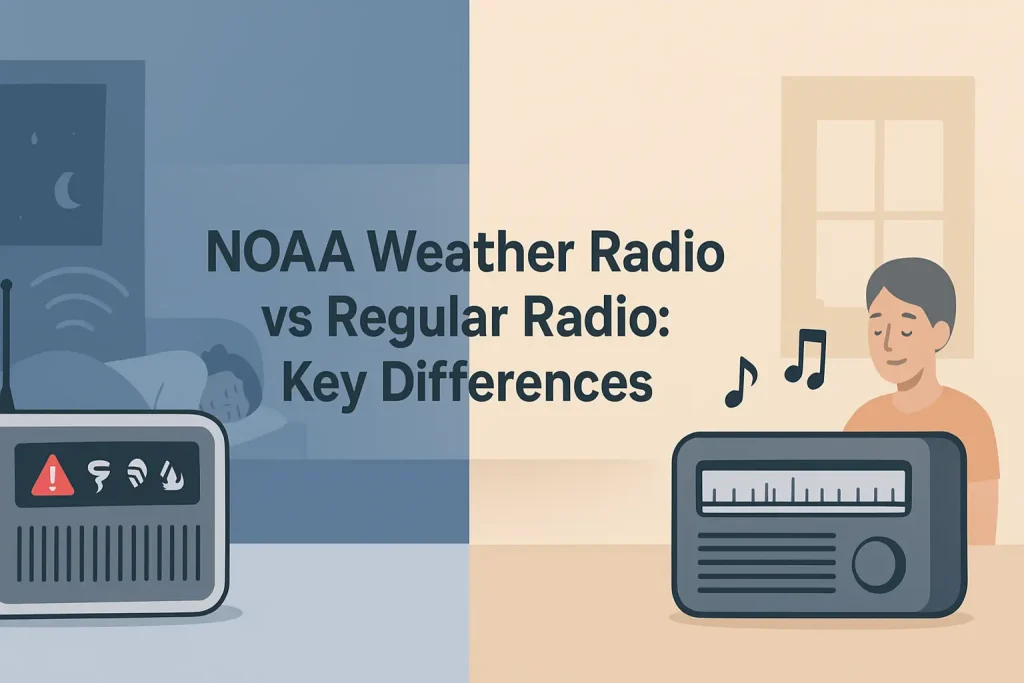
You can get a free NOAA weather radio through several legitimate programs, and you do not need to spend $50 or more to get reliable S.A.M.E. alert protection. Government assistance programs, FEMA preparedness grants, utility company giveaways, and community emergency management offices distribute free or deeply discounted weather radios every year to qualifying households.
The key is knowing where to look and what qualifies you. This guide covers every proven method for getting a free or near-free NOAA weather radio, what to do if you do not qualify for free programs, and what specifications actually matter when you receive one.
| Photo | Popular Portable Walkie Talkies | Price |
|---|---|---|
 | SKIWARRIOR Multifunctional Smart Wireless Ski Goggles with Walkie-Talkie, Anti-Fog Zeiss Lens, Music & Call Function (Cylindrical Blue) | Check Price On Amazon |
 | SINORISE Super Mini Walkie Talkies, Two-Way Radios, 3 Pack | Check Price On Amazon |
 | KOSPET Tank M4C Smart Watch Rugged, Dual-Band GPS, 5ATM & IP69K Waterproof | Check Price On Amazon |
 | Retevis RT15 Walkie Talkies 3 Pack, Birthday Gift, Outdoor Adventure Kit | Check Price On Amazon |
 | Rechargeable Walkie Talkies Toys for Kids: DIY Astronaut Walkie Talkies for Boys Christmas Birthday Gifts for 3 4 5 6 7 8 9 10 Boy Walkie Talkie Outdoor Hiking Toy 2 Way Radio Camping Outdoor Game | Check Price On Amazon |
By the Numbers
NOAA Weather Radio Coverage and Alert System – Key Facts
Sources: NOAA National Weather Service, FCC Part 11, FEMA IPAWS documentation
What Is a NOAA Weather Radio and Why Does It Matter?
A NOAA weather radio is a dedicated receiver tuned to the seven National Weather Radio All Hazards (NWR) broadcast frequencies, which range from 162.400 MHz to 162.550 MHz. These frequencies operate independently of cellular networks, internet connections, and commercial broadcast stations.
That independence is exactly what makes a NOAA weather radio essential for emergency preparedness. When a tornado warning is issued at 2:00 AM, a weather radio with S.A.M.E. (Specific Area Message Encoding) technology wakes you up with a loud alarm and a recorded voice message, even if your phone is silenced and the power is out.
S.A.M.E. technology uses 6-digit FIPS (Federal Information Processing Standards) county codes to filter alerts. You program your county code into the radio, and it only triggers for warnings that affect your specific area. Without S.A.M.E., the radio sounds an alarm for every county in your state, which creates alert fatigue and causes people to ignore the device entirely.
NOAA Weather Radio All Hazards broadcasts more than weather alerts. The system also transmits AMBER alerts, Hazardous Materials Emergency alerts, Civil Emergency Messages, and National Information Center messages under the Integrated Public Alert and Warning System (IPAWS), which is administered by FEMA. A single weather radio covers all of these alert types without any subscription fee.
The most important specification to verify when you receive a free weather radio is whether it includes S.A.M.E. decoding capability. Entry-level models without S.A.M.E. exist, and while they receive NOAA broadcasts, they cannot filter by county. A radio without S.A.M.E. is significantly less useful for most households.
If you want to understand the full range of specifications to look for before accepting or purchasing a weather radio, our complete guide to choosing the right weather radio features and specifications covers every decision factor in detail.
Can You Actually Get a Free NOAA Weather Radio?
Yes, free NOAA weather radios are distributed through several legitimate programs in the United States. The most reliable sources are FEMA Hazard Mitigation Grant Program funds administered by state emergency management agencies, utility company emergency preparedness initiatives, local government and emergency management offices, non-profit disaster preparedness organizations, and community outreach programs tied to severe weather awareness weeks.
The availability of these programs varies significantly by state and county. States with high tornado activity (Oklahoma, Kansas, Texas, Alabama, and Missouri) and hurricane-prone coastal states (Florida, Louisiana, North Carolina, and Texas) tend to have the most active free weather radio distribution programs. If you live in a lower-risk area, free programs are less common but still exist through non-profit channels.
Free radios distributed through official programs are almost always functional S.A.M.E.-capable units. The Midland WR120 and similar entry-level S.A.M.E. models are the most commonly distributed units through these programs because they cost between $25 and $35 wholesale, making them practical to distribute in bulk.
Free programs do not require you to prove you cannot afford a weather radio. Many are open to any resident of a qualifying county or any household that registers during a specific distribution event. The limiting factor is almost always inventory, not eligibility screening.
Getting a free NOAA weather radio is genuinely possible, but it requires some research and timing to find active programs in your specific location.
How to Get a Free Weather Radio Through FEMA and State Emergency Management Programs
FEMA’s Hazard Mitigation Grant Program (HMGP) allocates federal funds to states after major disaster declarations. State emergency management agencies can use a portion of these funds for public preparedness education, which includes distributing free weather radios to residents in high-risk areas.
The process for accessing these programs varies by state, but the steps below work for most FEMA-funded weather radio distribution initiatives.
Step 1: Identify your state emergency management agency. Every US state has a dedicated emergency management agency. Examples include the Texas Division of Emergency Management (TDEM), the Alabama Emergency Management Agency (AEMA), and the Florida Division of Emergency Management (FDEM). Search “[your state] emergency management agency weather radio” to find your state’s program page.
Step 2: Check for active distribution programs. State emergency management agency websites maintain lists of current preparedness programs. Look for “weather radio distribution,” “severe weather preparedness,” or “hazard mitigation outreach” sections. Some states list upcoming free distribution events on their social media channels rather than their main website.
Step 3: Contact your county emergency management office directly. County-level emergency management offices often distribute weather radios independently of state programs. They receive separate preparedness funding and frequently hold distribution events at community centers, fire stations, and county fairs. Call your county emergency management office and ask specifically whether they have weather radios available.
Step 4: Register for severe weather awareness events. Most states hold an annual Severe Weather Awareness Week, typically in the spring before tornado season. These events often include free weather radio giveaways at participating libraries, community centers, and government offices. The National Weather Service (NWS) coordinates these events and posts schedules on weather.gov.
Step 5: Check FEMA’s Ready.gov resources. FEMA’s Ready.gov website lists current emergency preparedness programs and links to state-level initiatives. The site does not always list free radio programs directly, but it provides contact information for local emergency management offices that do.
The biggest mistake people make with this approach is checking once and giving up. FEMA-funded programs are episodic rather than permanent. A program that was not active last year may be running now due to a new disaster declaration or a new grant cycle. Check quarterly if you are serious about finding a free unit.
How to Get a Free Weather Radio Through Your Utility Company
Electric utility companies in severe weather states have strong financial incentives to encourage weather radio adoption among their customers. When a tornado or ice storm knocks out power, utilities face significant emergency repair costs, liability exposure, and customer service strain. A customer base that evacuates early or shelters appropriately reduces those costs.
Several major utility companies have run free or heavily discounted weather radio programs as part of their customer safety and community resilience initiatives. Examples include programs from utilities in the Tennessee Valley Authority (TVA) service area, Entergy Corporation service territories across the South, and various rural electric cooperatives across the Midwest and Southeast.
To find out whether your utility offers a free weather radio program, take these steps. First, call your electric utility’s customer service number and ask specifically about emergency preparedness programs, safety rebates, or storm preparedness giveaways. Second, check your utility’s website under “safety,” “community,” or “programs” sections. Third, watch for bill inserts and email newsletters from your utility in the spring, which is when most severe weather preparedness campaigns launch.
Rural electric cooperatives are especially likely to offer these programs. They are member-owned, they operate in areas with high tornado and severe weather exposure, and they have community engagement missions that go beyond basic power delivery. The National Rural Electric Cooperative Association (NRECA) has supported weather radio distribution initiatives, and individual co-ops often implement their own programs.
Natural gas utilities and water utilities occasionally run similar programs, though less frequently than electric utilities. If your electric utility does not have a program, it is worth a quick call to your gas or water provider as well.
How to Get a Free Weather Radio Through Local Government and Non-Profit Organizations
Local government offices and community non-profits distribute free weather radios through channels that are completely separate from FEMA grants and utility programs. These sources are often overlooked because they are not nationally advertised.
Public libraries in tornado-prone and hurricane-prone states sometimes maintain a lending program for weather radios, similar to how some libraries lend tools or Wi-Fi hotspots. This does not get you a unit to keep permanently, but it covers you during severe weather season at no cost. Check with your local library’s reference desk and ask whether they have any emergency preparedness equipment available for checkout.
The American Red Cross distributes weather radios through its local chapter preparedness programs. Red Cross chapters in high-risk states frequently hold community preparedness events where weather radios are available at no cost to attendees. Find your local Red Cross chapter at redcross.org and look for upcoming preparedness workshops or community events.
Community Action Agencies (CAAs), which are federally funded non-profit organizations that serve low-income households, sometimes include weather radios in emergency preparedness kits distributed to qualifying clients. If you are already receiving services from a Community Action Agency, ask your caseworker whether weather radios are available through the agency’s emergency preparedness programming.
Churches and faith-based organizations in severe weather states often stock small preparedness supplies, including weather radios, for distribution to congregation members and community residents in need. This is particularly common in rural communities in Alabama, Mississippi, and Oklahoma where severe weather risk is high and formal government programs are less accessible.
Search “[your county] free weather radio” and “[your city] emergency preparedness giveaway” annually. Local programs do not always maintain a permanent web presence, so fresh searches produce better results than bookmarking a single page.
Severe Weather Awareness Week: The Highest-Volume Free Radio Distribution Event
Severe Weather Awareness Week is the single largest annual event for free weather radio distribution in the United States. It is coordinated nationally by the National Weather Service (NWS) and implemented at the state level, typically in March or April in most states and in June in hurricane-prone Gulf Coast states.
During Severe Weather Awareness Week, participating businesses, government agencies, and organizations give away weather radios at sponsored events. Home Depot, Lowe’s, Walmart, and regional grocery chains have participated in past years by selling weather radios at deeply discounted prices or by partnering with local emergency management agencies for free giveaways in store.
The National Weather Service office in your region posts Severe Weather Awareness Week events on weather.gov. Navigate to your regional NWS office page (searchable by zip code at weather.gov) and look for awareness week announcements in January or February each year. These posts typically include a list of participating locations and distribution event schedules.
State-level awareness weeks vary in name. Texas calls it Severe Weather Preparedness Week. Florida designates a Hurricane Preparedness Week. Oklahoma, which has the highest annual tornado count of any US state, runs an extensive week of events with multiple distribution points across the state. Search your state’s name plus “weather awareness week” to find the current year’s schedule.
If you miss the main awareness week events, check for follow-up distribution. Some state programs have leftover inventory after Severe Weather Awareness Week and distribute it through county emergency management offices or library systems in the following months.
What to Do If You Cannot Find a Free Program: Low-Cost Alternatives Under $30
If no free program is currently active in your area, the next best option is a low-cost S.A.M.E.-capable weather radio available at major retailers for under $30. A functional S.A.M.E. weather radio does not need to cost more than $25 to $35 to provide reliable county-level alert protection.
The Midland WR120B, one of the most commonly distributed free weather radios, retails for approximately $30 and includes full S.A.M.E. decoding, 25 programmable alert types, and a battery backup compartment for AA batteries. It is the functional floor for what a weather radio should do.
Key Specifications for the Midland WR120B:
- Frequencies: 162.400 to 162.550 MHz (all 7 NOAA WX channels)
- S.A.M.E. alert types: 25 programmable event types
- Location codes: up to 25 programmable FIPS county codes
- Power: AC adapter with 3x AA battery backup
- Alert output: 90 dB alarm with voice message playback
The Midland WR120B weather radio is available at most major retailers and on Amazon. At this price point, the investment is comparable to a single tank of gas and provides a communication capability that no smartphone app or smart speaker can reliably replicate during a power outage.
If budget is a hard constraint, check Amazon Warehouse Deals and eBay for used or open-box S.A.M.E. weather radios. A used Uniden BC365CRS weather alert radio in working condition can be found for $10 to $15 and provides the same S.A.M.E. alert protection as a new unit.
When buying used, confirm that the unit powers on, that the alarm sounds at full volume, and that it can be programmed to a specific FIPS county code before completing the purchase. A used weather radio with a non-functional alarm or a broken S.A.M.E. programming interface provides no real protection.
Hand-Crank and Solar Weather Radios: Are Free Programs Available?
Hand-crank and solar combination weather radios are less commonly distributed through free programs because they cost significantly more than basic plug-in models. A quality hand-crank weather radio with solar charging, a USB power bank output, and S.A.M.E. decoding costs between $35 and $70, which is two to three times the wholesale cost of a basic unit.
That said, some free programs do distribute hand-crank combination units. FEMA’s Individual Assistance programs, which provide direct support to households after a major disaster declaration, sometimes include combination radios in emergency preparedness kits. If your area has recently received a major disaster declaration, check disasterassistance.gov for available resources.
The Eton FRX3+ hand-crank solar weather radio is one of the most capable combination units available at the mid-range price point. Our detailed look at the Eton FRX3 Plus features and real-world performance covers its S.A.M.E. decoding, solar charging speed, and hand-crank power output in detail.
Key Specifications for the Eton FRX3+:
- Frequencies: 162.400 to 162.550 MHz (7 NOAA WX channels) plus AM/FM
- Power sources: AC adapter, hand crank, solar panel, 2000 mAh internal lithium battery
- USB output: 1000 mAh USB charging port for phone emergency charging
- S.A.M.E.: Yes, with programmable county codes
- Flashlight: Built-in LED with red flashing emergency signal mode
If a hand-crank weather radio is your goal, our in-depth guide to selecting and using hand-crank weather radios explains which models deliver reliable power from the crank versus those that produce barely enough voltage to run the radio for more than a few minutes.
What Specifications Matter Most When You Receive a Free Weather Radio
When you receive a free weather radio through any of the programs above, verify these four specifications before you leave the distribution event or before you open the box at home. A weather radio that lacks any of these four capabilities is significantly less useful than one that has all of them.
S.A.M.E. County-Level Filtering: This is the most critical specification. S.A.M.E. (Specific Area Message Encoding) allows the radio to decode 6-digit FIPS county codes embedded in NOAA broadcasts and alert only when a warning applies to your programmed counties. Without S.A.M.E., the radio sounds for every alert broadcast from your nearest NWR transmitter, which can cover dozens of counties. Most free program radios include S.A.M.E., but confirm before programming.
Alert Alarm Volume (minimum 85 dB): A weather radio that cannot wake a sleeping adult in a closed bedroom provides no protection for nighttime tornado warnings, which account for a disproportionate share of tornado fatalities. The National Weather Service recommends a minimum alarm volume of 85 dB. Most current models produce 90 dB or higher at maximum alarm volume.
Battery Backup: Power outages frequently accompany the same storms that trigger weather alerts. A radio that only operates on AC power goes silent at the moment it is needed most. Confirm the unit accepts standard AA or AAA batteries as a backup power source. Some models use a 9-volt backup; this is acceptable but less convenient than AA batteries.
All 7 NWR Channel Reception: NOAA broadcasts on seven specific frequencies. Your nearest transmitter may not be on the default WX1 (162.550 MHz) channel that many radios auto-scan first. A radio that receives all seven frequencies guarantees you can find and lock to your strongest local signal. Radios that only receive three or four NWR channels exist and are inadequate for reliable coverage.
If the free radio you receive fails any of these four checks, it may still be worth keeping as a backup unit, but invest $25 to $35 in a S.A.M.E.-capable primary radio for your home.
Quick Reference
NOAA Weather Radio Key Terms Explained
Plain-language definitions for technical terms used throughout this guide. Source: NOAA NWS, FCC Part 11, FEMA IPAWS documentation.
NWR (NOAA Weather Radio All Hazards): The national network of radio stations operated by the National Weather Service, broadcasting on 7 dedicated frequencies between 162.400 and 162.550 MHz, 24 hours a day.
S.A.M.E. (Specific Area Message Encoding): A digital encoding system embedded in NWR broadcasts that allows receivers to filter alerts by geographic area using FIPS county codes.
FIPS Code: A 6-digit Federal Information Processing Standards code assigned to each US county, used to program S.A.M.E. weather radios for county-specific alert filtering.
EAS (Emergency Alert System): The national public warning system coordinated by FEMA, FCC, and NOAA. NWR broadcasts are one delivery channel within EAS.
IPAWS (Integrated Public Alert and Warning System): FEMA’s system for sending public alerts across multiple platforms, including NWR, wireless emergency alerts (WEA), and broadcast EAS.
NWS (National Weather Service): The NOAA agency responsible for issuing weather forecasts, warnings, and operating the NWR transmitter network across the United States.
Alert Alarm: The loud audible tone (minimum 85 dB) triggered by a weather radio when it decodes a matching S.A.M.E. alert for your programmed county codes.
WX Channels (WX1 to WX7): The seven NOAA weather radio broadcast frequencies, ranging from 162.400 MHz (WX4) to 162.550 MHz (WX1). Each NWR transmitter broadcasts on one of these frequencies.
HMGP (Hazard Mitigation Grant Program): FEMA’s post-disaster grant program that funds state and local mitigation activities, including free weather radio distribution to residents in high-risk areas.
Battery Backup: A secondary power source (typically AA or 9V batteries) that keeps a weather radio operational when AC power is lost during a storm.
How to Program S.A.M.E. County Codes on Your Free Weather Radio
Receiving a free weather radio is only half the task. A S.A.M.E.-capable weather radio that has not been programmed with your county’s FIPS code will either alert for your entire state or not alert at all, depending on the default factory setting.
Programming takes under 5 minutes and only requires knowing your 6-digit FIPS county code. Follow these steps for most S.A.M.E.-capable weather radios, including the Midland WR120, Midland WR400, and Uniden BC365CRS.
Step 1: Find your FIPS county code. Go to the NOAA NWR S.A.M.E. FIPS code lookup at weather.gov/nwr/counties. Enter your state and county to retrieve your 6-digit FIPS code. Write it down before starting the programming process.
Step 2: Find your local NWR transmitter frequency. On the same NOAA page, identify the frequency (WX1 through WX7) for the transmitter nearest your location. Lock the radio to that channel for the strongest signal.
Step 3: Enter programming mode. On most Midland models, press and hold the “S.A.M.E.” or “PROGRAM” button for 3 seconds until the display shows a county code entry prompt. On Uniden models, press “MENU” and navigate to “SAME SETTINGS.”
Step 4: Enter your FIPS code. Use the channel or number buttons to enter each digit of your 6-digit FIPS code. Most radios allow you to program multiple county codes (between 3 and 25 depending on the model), which is useful if you live near a county line or frequently travel to adjacent counties.
Step 5: Select alert types. After programming location codes, most radios prompt you to select which alert event types trigger the alarm. For maximum protection, select all alert types. You can narrow this down later if you find certain alert categories are too frequent in your area.
Step 6: Test the alarm. Press the “TEST” or “ALERT” button to confirm the alarm sounds at full volume. The alarm should be clearly audible from an adjacent room with the door closed. If it is not, relocate the radio to a more central position in your home.
Confirming your radio is programmed correctly before severe weather season begins is the single most important step after receiving a free unit.
Comparing Free and Low-Cost Weather Radios: What the Price Difference Actually Gets You
Use the table below to compare what you get at each price tier before deciding whether to accept a basic free unit or invest in a more capable model.
| Feature | Free Program Radio | $25-$35 Entry Model | $40-$70 Mid-Range |
|---|---|---|---|
| S.A.M.E. county filtering | Usually yes | Yes | Yes |
| All 7 NWR frequencies | Varies | Yes | Yes |
| Battery backup | Sometimes | AA batteries | AA batteries |
| Alarm volume | 85-90 dB | 90 dB | 90+ dB |
| Programmable location codes | 1-5 counties | 5-25 counties | 25-50 counties |
| Backlit display | Rarely | Sometimes | Yes |
| AM/FM receiver | No | Rarely | Often yes |
| Best for | Basic bedroom alert protection | Primary home alert system | Home plus travel or camping |
A free program radio provides real protection if it includes S.A.M.E. and battery backup. If the free unit you receive is missing either feature, use it as a secondary radio and purchase an entry-level S.A.M.E. model as your primary alert device.
Where to Buy a Weather Radio If Free Programs Are Not Available in Your Area
If free programs have no current availability in your area, weather radios are sold at most major US retailers and online. Knowing where to shop matters because prices vary significantly between retailers, and some channels offer models not available at others.
Walmart, Target, and Home Depot carry the Midland WR120B NOAA S.A.M.E. weather radio and similar entry-level units in their electronics and emergency preparedness sections. These in-store options are convenient and allow you to inspect the unit before purchase.
Amazon carries the widest selection of weather radios at every price tier. For a broader look at the best-reviewed weather radio options across multiple price points, our curated list of top-rated weather radios available on Amazon covers the strongest options at each budget level with verified specification data.
For a more complete overview of where to find weather radios in physical stores and through specialty retailers, our guide to finding weather radios at retail stores and online covers every major purchase channel including specialty emergency preparedness retailers.
The Uniden BC365CRS NOAA weather alert clock radio is a strong entry-level option that doubles as a clock radio, which makes it easier to keep plugged in and ready in a bedroom rather than stored in a drawer. It includes S.A.M.E. decoding, 10 programmable FIPS codes, and a battery backup compartment for 3 AA batteries.
Key Specifications for the Uniden BC365CRS:
- Frequencies: 162.400 to 162.550 MHz (all 7 NOAA WX channels)
- S.A.M.E. location codes: 10 programmable FIPS county codes
- Additional reception: AM and FM broadcast bands
- Power: AC adapter with 3x AA battery backup
- Clock: Digital display with alarm clock function
If you want a more comprehensive review of top weather radio options across all price tiers before making a purchase decision, our ranked comparison of the best weather radios for home and emergency use covers every major model with side-by-side specifications.
Seasonal Timing: When Free Weather Radio Programs Are Most Active
Free weather radio distribution programs follow a predictable seasonal calendar tied to severe weather awareness campaigns and FEMA grant cycles. Knowing when programs peak gives you the best chance of finding a free unit.
The highest concentration of free weather radio distribution events occurs in late winter and early spring, specifically between February and May, when states with tornado risk run Severe Weather Awareness Week campaigns. This window represents the best opportunity of the year to find a free unit at a community event.
Hurricane-prone states in the Gulf Coast and Southeast run secondary distribution events in late May and early June, aligned with the start of the Atlantic hurricane season on June 1. Florida, Louisiana, and Texas in particular see renewed preparedness program activity during this period.
FEMA Hazard Mitigation Grant funds are typically awarded 6 to 18 months after a major disaster declaration. If your state received a major disaster declaration in the previous 12 months, check for new distribution programs being announced in the current year. These programs often launch quietly through county emergency management offices rather than through statewide media coverage.
Winter months (November through January) are the quietest period for free distribution programs, though some areas with significant ice storm and winter weather risk run preparedness campaigns tied to winter storm awareness weeks in November.
The bottom line is to search for free weather radio programs in February, March, and April for most US states, and in May for Gulf Coast and Atlantic coastal states. Searching at these times gives you the highest probability of finding an active program with available inventory.
Is a Smartphone Weather App Good Enough? Why a Dedicated Weather Radio Still Matters
Wireless Emergency Alerts (WEA) delivered to smartphones are an effective supplement to weather radios, but they do not replace a dedicated NOAA weather radio for three specific failure scenarios. Understanding these scenarios explains why free weather radio programs continue to receive federal and state funding even as smartphone alert systems have expanded.
The first failure scenario is power outage during a storm. The same severe weather event that triggers a tornado warning frequently knocks out power to cellular towers. A study by the FCC’s Public Safety and Homeland Security Bureau found that widespread power outages during major storm events cause significant cellular network degradation within 4 to 8 hours, with some areas experiencing complete cellular failure. A weather radio with AA battery backup continues operating independently of the cellular network.
The second failure scenario is cellular network congestion during emergencies. When a tornado warning is issued for a populated area, thousands of people simultaneously call 911, check weather apps, and send text messages. This surge in network demand can delay or prevent WEA delivery to individual devices. NOAA weather radio broadcasts are unaffected by cellular network load.
The third scenario is overnight alert reliability. WEA alerts can be suppressed by Do Not Disturb settings, app notification permissions, and phone software updates that change alert behavior. A dedicated weather radio with a 90 dB alarm sounds regardless of phone settings, software state, or battery level on a mobile device.
According to NOAA’s National Weather Service, the average lead time for a tornado warning before the tornado strikes is 13 minutes. Those 13 minutes are only useful if the alert reaches you reliably, immediately, and loudly enough to wake you from sleep. A dedicated weather radio is the only device that consistently delivers on all three of those requirements.
Smartphones and weather radios work best together. Use both, but treat the weather radio as the primary alert device for overnight protection and power outage scenarios.
Does a Free Weather Radio Receive All NOAA Alert Types?
A free weather radio that receives all seven NWR frequencies and includes S.A.M.E. decoding will receive all alert types that NOAA broadcasts through the NWR system. The alert types are determined by the broadcast content from your regional NWS office, not by the hardware capabilities of your radio.
NOAA’s NWR system broadcasts more than 40 named alert event types. The most commonly activated include Tornado Warning, Tornado Watch, Severe Thunderstorm Warning, Flash Flood Warning, Flash Flood Watch, Hurricane Warning, Winter Storm Warning, and Blizzard Warning. The system also broadcasts non-weather alerts including AMBER alerts (for child abductions), Hazardous Materials Emergency, Nuclear Power Plant Warning, and Civil Emergency Messages.
The distinction between “Warning” and “Watch” alerts matters for how you program your radio. A Warning means the hazard is occurring or imminent. A Watch means conditions are favorable for the hazard to develop. Many households program their weather radio to alarm only on Warnings to reduce false wake-up events, but this approach can cause you to miss a Watch that provides more lead time for preparation. Configuring the radio to alarm on both Warnings and Watches for your highest-risk hazard types (tornado and hurricane in most regions) is the most conservative and recommended approach.
The Midland WR400 weather radio allows separate alarm configuration for each of its 25 S.A.M.E. event types, giving you precise control over which events trigger the full alarm versus a softer audio notification. This level of programming flexibility is typically found in mid-range units ($40 to $60) rather than in the basic free program radios.
Can You Get a Free Weather Radio If You Are Deaf or Hard of Hearing?
Yes. Specialized weather radio equipment for deaf and hard-of-hearing individuals is available through specific assistance programs, and some of this equipment is available at no cost through FEMA and state accessibility programs.
The primary device category for this population is a weather radio with a bed shaker output (a vibrating pad placed under a mattress or pillow) and a strobe light alert system. These combination alert devices ensure that a sleeping individual who cannot hear a 90 dB audio alarm receives the warning through tactile and visual signals.
The National Association of the Deaf (NAD) and the Hearing Loss Association of America (HLAA) both maintain resources for finding accessible alert systems. State vocational rehabilitation programs and state deaf and hard-of-hearing agencies sometimes provide these devices at no cost to qualifying individuals. Contact your state’s deaf and hard-of-hearing services office to ask about weather alert accessibility programs.
FEMA’s emergency preparedness resources specifically address accessible alert systems for people with disabilities. The Ready.gov/disabilities page lists resources and contacts for accessible emergency alert equipment, including weather radios with bed shakers and strobe outputs.
The NOAA weather radio with bed shaker and strobe alert combination units start at approximately $60 for models that integrate with standard weather radio alert systems. These units are eligible for distribution through some accessibility assistance programs.
How Do I Know If My Free Weather Radio Is Actually Working?
The National Weather Service conducts required weekly and monthly tests of the NWR system, and these tests are the easiest way to verify that your weather radio is receiving signals correctly. Required Weekly Tests (RWT) are broadcast every Wednesday between 11 AM and noon local time in most areas. Required Monthly Tests (RMT) are broadcast on the first Wednesday of each month.
During a Required Weekly Test, your weather radio should display a test message and produce either a brief alert tone or a spoken announcement depending on your radio’s settings. If your radio does not respond to the weekly test, the problem is most likely one of three things: the radio is not set to the correct NWR frequency for your area, the S.A.M.E. county code is programmed incorrectly, or the radio’s alert mode has been muted or set to a non-alarm response for test events.
To verify your radio responds to the weekly test without waiting for Wednesday, use the manual test button if your model has one. Most Midland and Uniden weather radios have a dedicated “TEST” or “ALERT” button that simulates an alarm trigger. Press it once to confirm the alarm sounds and the display shows alert information.
If your radio consistently fails to respond to weekly NWR tests after verifying the frequency and FIPS code settings, the unit may have a hardware fault. Contact the distribution organization that provided the free radio and request a replacement. Most free program radios are covered by at least a 90-day warranty from the manufacturer.
What Is the Difference Between a NOAA Weather Radio and a Weather App?
A NOAA weather radio receives dedicated VHF broadcasts on frequencies between 162.400 and 162.550 MHz from the National Weather Service transmitter network, operating independently of cellular networks, internet infrastructure, and app notification systems. A weather app delivers alerts through internet data connections dependent on cellular network availability, app notification permissions, and device battery level.
The practical differences become significant during major storm events. A NOAA weather radio with battery backup continues receiving alerts after a power outage. A smartphone app stops receiving alerts when the cellular network is congested or when the phone battery dies. According to NOAA, the NWR transmitter network broadcasts continuously 24 hours a day, 365 days a year, on dedicated federal infrastructure not shared with commercial communication services.
Weather apps provide visual information, radar imagery, and forecast data that a basic weather radio does not. The two systems serve complementary purposes. The weather radio is optimized for reliable nighttime alerting and power-outage resilience. The weather app is optimized for advance planning, radar tracking, and daytime situational awareness. Use both.
Do I Need to Pay a Monthly Fee to Use a NOAA Weather Radio?
No. NOAA weather radio reception requires no subscription, no monthly fee, no internet connection, and no account registration. The NWR broadcast system is a free federal public service operated by the National Weather Service. You pay for the hardware once and receive alerts indefinitely with no ongoing cost.
This is one of the key advantages of a dedicated weather radio over app-based alert systems, which may require premium subscriptions for full alert functionality. The FCC, NOAA, and FEMA jointly operate the public alert infrastructure that NOAA weather radios access, and that infrastructure is funded by federal appropriations rather than subscription revenue.
The only ongoing costs associated with weather radio ownership are replacement batteries for the backup power compartment (typically AA batteries, approximately $5 to $10 per year depending on how often alerts activate battery mode) and occasional replacement of the unit if it fails after several years of use.
Can a NOAA Weather Radio Replace a Two-Way Radio for Emergency Communication?
No. A NOAA weather radio is a receive-only device. It cannot transmit on any frequency. It receives NWR broadcasts from the National Weather Service but has no capability to contact other people, call for help, or communicate with emergency services.
For two-way emergency communication, a separate device is required. FRS (Family Radio Service) walkie-talkies operate on 22 channels in the 462-467 MHz band and require no FCC license for use. GMRS (General Mobile Radio Service) radios operate at up to 5 watts on handheld units and up to 50 watts on mobile units, require a $35 FCC license, and provide significantly greater range than FRS devices.
A complete home emergency communication setup should include both a NOAA weather radio (for receiving NWR broadcasts and EAS alerts) and a set of FRS or GMRS radios (for communicating with family members or neighbors when cellular networks are down). These are complementary tools, not substitutes for each other.
For information on the best weather radios across all major brands and price points, including models that combine AM/FM reception with NOAA monitoring, our comprehensive comparison of weather radio models for every household situation covers the full range of available options.
What Happens If I Live in a Rural Area Without Good NWR Coverage?
NOAA’s NWR transmitter network covers approximately 95% of the US population, but coverage is based on population density rather than geographic area. Some rural areas, particularly in mountainous terrain, remote western states, and areas of Alaska, fall outside reliable NWR reception range.
If you live in a potentially low-coverage area, take these steps to determine your actual reception quality before relying on a weather radio for alerts. First, check the NOAA NWR coverage map at weather.gov/nwr/coverage. The map shows theoretical coverage based on transmitter location and power output, but actual coverage varies with terrain. Second, test reception by scanning all seven NWR frequencies (162.400, 162.425, 162.450, 162.475, 162.500, 162.525, and 162.550 MHz) and checking signal quality on each channel.
If NWR reception is weak at your location, an external antenna can significantly improve signal strength. A simple VHF dipole antenna cut for 162.5 MHz (approximately 17.5 inches per element) mounted outdoors and connected to your weather radio via a coaxial cable can extend reliable reception range by 10 to 20 miles depending on terrain.
Households in areas with genuinely no NWR coverage should consider a combination approach using a weather radio with an external antenna connector and a cellular-based WEA backup. Satellite-based emergency alert devices are also available for extremely remote locations where both NWR and cellular coverage are absent.
Are Free Weather Radios Available for Businesses and Schools?
Yes. Businesses and schools are eligible for the same state and local government free weather radio programs that serve individual households. In addition, several programs specifically target public institutions.
The National Weather Service’s “Weather-Ready Nation” initiative actively encourages businesses, schools, and community organizations to become “Weather-Ready Nation Ambassadors.” Organizations that achieve this designation commit to specific preparedness actions, including installing weather radios, and they may receive free equipment through NWS partnerships with retailers and emergency management agencies.
Many state emergency management agencies have separate grant programs for schools and childcare facilities that include weather radio equipment. After high-profile tornado events that caused school casualties, several states mandated that all K-12 schools and licensed childcare facilities have operational weather alert systems. Some of these mandates came with associated grant funding to cover the cost of equipment.
Contact your state emergency management agency and ask specifically about business and school weather radio programs. The eligibility criteria and available inventory vary significantly by state, but this is a well-funded area of emergency preparedness programming in most high-risk states.
Where Can I Find the Most Comprehensive List of Free Weather Radio Programs Near Me?
No single national database lists every active free weather radio distribution program in real time. The programs are administered locally, change seasonally, and are often not publicized beyond local community channels. The most reliable approach is direct outreach to the organizations most likely to have active programs.
Start with these five contacts in this order. First, your county emergency management office (search “[county name] emergency management” for direct contact information). Second, your state emergency management agency website’s preparedness programs section. Third, your regional NWS office page at weather.gov. Fourth, your local electric utility’s customer service line. Fifth, your nearest American Red Cross chapter at redcross.org.
For any of these contacts, ask specifically: “Do you have a free weather radio distribution program currently active?” and “When is your next free weather radio distribution event?” These specific questions produce better results than asking generally about “emergency preparedness programs.”
Set a calendar reminder to search and call again every February, which is the start of the most active period for free weather radio distribution events in most US states. Persistence and timing are the primary factors in successfully locating a free unit.
A dedicated NOAA weather radio receiving on any of the seven NWR frequencies between 162.400 and 162.550 MHz, with S.A.M.E. county-level filtering and battery backup, is one of the most reliable emergency alert tools available to any US household. Free programs exist in every state, they distribute thousands of units annually, and they require nothing more than knowing where to ask. Start with your county emergency management office, check in February for the highest program availability, and verify your FIPS county code is programmed before severe weather season begins.
| Photo | TOP RATED WALKIE TALKIES | Price |
|---|---|---|
 | Retevis RT628 Kids Walkie Talkies, Toys Gifts for 4-12 Year Old Girl Boy | Check Price On Amazon |
 | Cobra ACXT545 Weather-Resistant Walkie Talkies, Rechargeable, 22 Channels | Check Price On Amazon |
 | Retevis RT388 Kids Walkie Talkies, Outdoor Toys for Kids Camping Essentials | Check Price On Amazon |
 | Cobra RX680 Walkie Talkies (2-Pack), IP54 Water Resistant Design | Check Price On Amazon |
 | Retevis RT22 Walkie Talkies Long Range Rechargeable with Earpiece (2 Pack) | Check Price On Amazon |
 | Midland GXT1000VP4 GMRS JIS4 Two-Way Radio, Black,2 Pack | Check Price On Amazon |
 | Retevis RT628 Walkie Talkies for Kids,Toys Gifts for 6-12 Years Old Boys Girls,Long Range 2 Way Radio 22CH VOX,Birthday Gift,Family Walkie Talkie for Camping Hiking Indoor Outdoor | Check Price On Amazon |