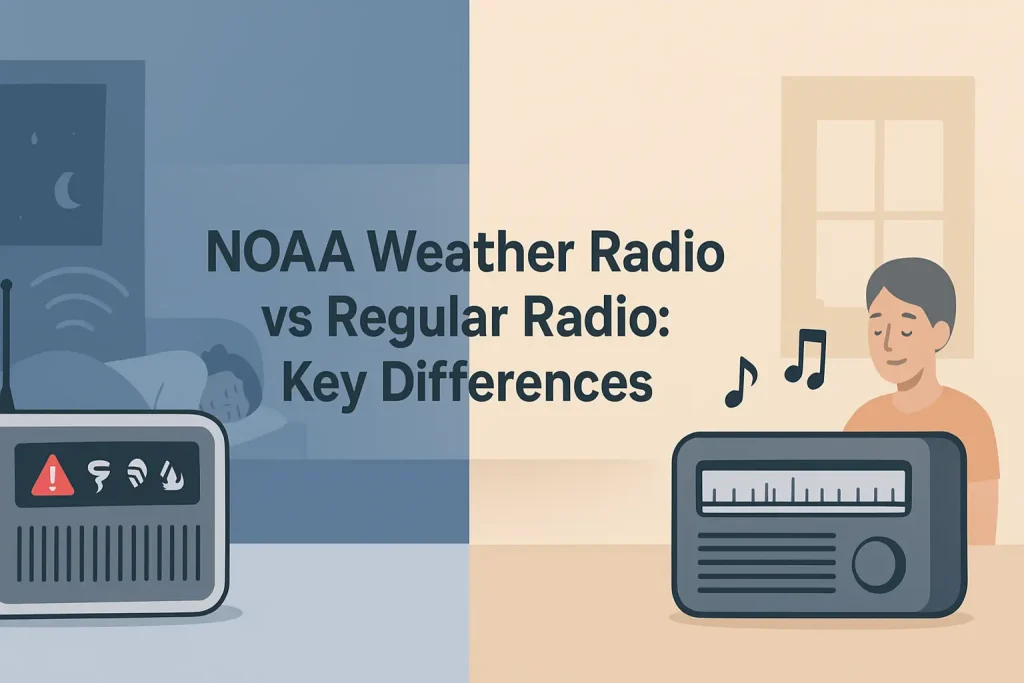
Your iPhone already has a weather app, but it cannot wake you up at 3 a.m. with a tornado warning for your specific county. NOAA Weather Radio All Hazards broadcasts emergency alerts 24 hours a day on seven dedicated frequencies between 162.400 and 162.550 MHz, and the right iOS app can turn your phone into a fully functional NOAA receiver with S.A.M.E. (Specific Area Message Encoding) filtering so you only hear alerts for the counties that matter to you.
This guide covers the top NOAA weather radio apps for iPhone, what separates a genuinely useful alert app from a glorified radar widget, and exactly how to configure each app for reliable overnight alerting.
| Photo | Popular Portable Walkie Talkies | Price |
|---|---|---|
 | SKIWARRIOR Multifunctional Smart Wireless Ski Goggles with Walkie-Talkie, Anti-Fog Zeiss Lens, Music & Call Function (Cylindrical Blue) | Check Price On Amazon |
 | SINORISE Super Mini Walkie Talkies, Two-Way Radios, 3 Pack | Up to 12 Hours Battery Life, for Baseball Coaches, Restaurants, Retail Stores, Hospitals, Outdoor Sports & Travel | Check Price On Amazon |
 | KOSPET Tank M4C Smart Watch Rugged, Dual-Band GPS, 5ATM & IP69K Waterproof | 1.96" AMOLED Display, 170+ Sport Modes, Built-in LED Flashlight/Walkie-Talkie, Heart Rate/Sleep Monitor for Android & iPhone | Check Price On Amazon |
 | Retevis RT15 Walkie Talkies 3 Pack, Birthday Gift, Outdoor Adventure Kit | Durable, Lightweight, VOX, Key Lock, Mini Walkie Talkies for Adults, School Family Outdoor Travel Camping Hiking | Check Price On Amazon |
 | Rechargeable Walkie Talkies Toys for Kids: DIY Astronaut Walkie Talkies for Boys Christmas Birthday Gifts for 3 4 5 6 7 8 9 10 Boy Walkie Talkie Outdoor Hiking Toy 2 Way Radio Camping Outdoor Game | Check Price On Amazon |
By the Numbers
NOAA Weather Radio Apps for iPhone – Key Facts
Sources: NOAA National Weather Service, FCC, IPAWS documentation
What Is a NOAA Weather Radio App and How Is It Different from a Weather App?
A NOAA weather radio app streams the live audio broadcast from NOAA Weather Radio All Hazards transmitters and decodes S.A.M.E. alert headers to push county-specific emergency notifications to your phone. A standard weather app pulls forecast data from NWS servers on a schedule, which means alerts can arrive minutes later than a live NOAA broadcast.
The distinction matters most during fast-moving events. According to NOAA’s National Weather Service documentation, tornado warnings have an average lead time of 13 minutes. A delay of even 2-3 minutes from a polling-based weather app cuts that window significantly.
NOAA Weather Radio All Hazards is a network of more than 1,000 transmitters broadcasting continuously on seven VHF frequencies: 162.400, 162.425, 162.450, 162.475, 162.500, 162.525, and 162.550 MHz. Each transmitter covers a radius of roughly 40 miles and encodes S.A.M.E. headers into every alert transmission.
S.A.M.E. (Specific Area Message Encoding) is the digital sub-tone system that identifies which counties an alert applies to. Without S.A.M.E. filtering, your radio app alerts you for every county served by your nearest NOAA transmitter, which can mean dozens of false wake-ups per storm season.
A good NOAA weather radio app for iPhone does three things a standard weather app cannot: it streams live NWS audio so you hear the full alert text, it decodes S.A.M.E. headers to filter alerts by your specific county FIPS code, and it can push override notifications even when your phone is in silent mode.

If you want to understand the full NOAA broadcast infrastructure before choosing an app, our overview of how the NOAA weather radio network operates and what it broadcasts covers the transmitter network, alert types, and EAS encoding in detail.
What Should You Look for in a NOAA Weather Radio App for iPhone?
The single most important feature is S.A.M.E. county filtering with a manual FIPS code entry option. Without it, an app serving a NOAA transmitter that covers 15 counties will wake you up for every severe thunderstorm watch across all of them, most of which will not be anywhere near your home.
According to FEMA’s IPAWS documentation, each S.A.M.E. location code is a six-digit FIPS code (Federal Information Processing Standards) identifying a specific county or county equivalent. A properly configured app should let you program at least three to five FIPS codes for locations where you live, work, and spend time outdoors.
The second feature to evaluate is alert delivery when the app is backgrounded or the phone is locked. iOS imposes aggressive background processing restrictions. An app that only alerts you when it is open is not a safety tool.
Look specifically for apps that use push notification delivery through a backend server rather than relying solely on the iOS background refresh mechanism. Server-pushed notifications survive iOS background restrictions far more reliably than apps that try to monitor NOAA streams locally on the device.
The third feature is audio streaming quality and reliability. Some apps stream directly from NOAA transmitter audio feeds. Others rely on NWS API data and synthesize alerts as text-to-speech. Live audio streaming gives you the complete alert text as the NWS meteorologist reads it, including the specific hazard description, affected areas, and recommended action.
Below are the evaluation criteria to apply when comparing iOS NOAA weather radio apps:
- S.A.M.E. county filtering: Can you enter specific 6-digit FIPS codes for your county?
- Background alerting: Does the app deliver alerts when backgrounded or screen-locked?
- Silent mode override: Can critical alerts override iPhone silent/Do Not Disturb?
- Alert type selection: Can you enable only specific NWS event codes (tornado warning vs. frost advisory)?
- Live NOAA audio: Does the app stream actual NOAA broadcast audio or only text data?
- Multiple location support: Can you monitor more than one county or state at a time?
- Offline alert fallback: Does the app have a secondary alert path if your internet drops?
The best NOAA weather radio app for your iPhone is the one that gets you out of bed before the tornado is on your block, not the one with the most attractive radar animation.
What Are the Best NOAA Weather Radio Apps for iPhone?
The top-performing NOAA weather radio apps for iPhone in active use by emergency preparedness communities are Weather Radio by Elerts, NOAA Weather Radio (by WDT), Weather Alert USA, MyRadar with NOAA alerts, and the NWS Official app. Each handles S.A.M.E. filtering, background delivery, and alert type customization differently, and the right choice depends on whether you prioritize live audio streaming, deep county filtering, or the lowest price.
The following section covers each app’s core specifications, S.A.M.E. implementation, iOS background behavior, and the specific use case it serves best.
Weather Radio by Elerts
Weather Radio by Elerts is the most direct iOS equivalent of a dedicated hardware NOAA weather radio. It streams live audio from NOAA NWR transmitters and decodes S.A.M.E. headers in real time, delivering push notifications tied to your specific county FIPS code even when the app is backgrounded and your phone is silenced.
The app connects to your nearest NOAA transmitter based on GPS location and lets you manually override the transmitter selection if your GPS-selected transmitter has poor signal quality. This matters if you live near a county line where a transmitter from an adjacent county actually serves your area more reliably.
Key Specifications:
- Alert delivery: Server-pushed push notifications (not iOS background refresh only)
- S.A.M.E. filtering: County-level FIPS code entry, up to 5 locations
- Audio: Live NOAA transmitter audio stream
- Silent mode override: Yes, via iOS Critical Alerts (requires user permission)
- Alert types: All NWS event codes, individually selectable
- Price: Free with optional premium subscription for multi-location monitoring
The iOS Critical Alerts permission is what separates Elerts from most weather apps. Critical Alerts bypass both the iPhone silent switch and Do Not Disturb, using a distinct louder tone that cannot be muted by standard notification settings. You have to explicitly grant this permission in iOS Settings, and Elerts is one of the few NWS-connected apps that has received Apple’s authorization to request it.
The iPhone speaker dock with nightstand mount pairs well with Elerts if you use your phone as a bedside weather monitor, since it keeps your screen visible and volume accessible during overnight alert events.
NOAA Weather Radio by WDT (Weather Decision Technologies)
The NOAA Weather Radio app by WDT streams live NWS audio and provides alert filtering by county, NWS zone, and fire weather zone. WDT powers weather alerting services for several broadcast networks, so the backend infrastructure for alert delivery is more robust than most consumer-grade apps.
This app supports simultaneous monitoring of multiple locations, which makes it the preferred choice for families monitoring alerts for a home county and a vacation property in a different state at the same time.
Key Specifications:
- Alert delivery: Server-pushed notifications via WDT backend
- S.A.M.E. filtering: County, NWS zone, and fire weather zone
- Audio: Live NWS audio stream per transmitter
- Silent mode override: iOS Critical Alerts support on select alert types
- Alert types: Full NWS event code library, grouped by hazard category
- Price: Free with in-app purchase for multi-location and additional alert tiers
WDT’s fire weather zone filtering is a specific advantage for users in the western US, where wildfire-related Red Flag Warnings and Evacuation Warnings are issued by fire weather zone rather than county. Most county-only FIPS-based apps miss these alerts entirely.
Weather Alert USA
Weather Alert USA takes a different technical approach. Rather than streaming NOAA audio, it polls NWS API data and delivers text-based push alerts with alert-type filtering and county FIPS selection. The alert latency is slightly higher than a live audio streaming app (typically 30-90 seconds after NWS issuance), but the app’s iOS integration is more stable on older iPhones running iOS 14 and earlier.
This app is the right choice for users who want reliable text-format alerts without the battery drain of a continuous audio stream. Live NOAA audio streaming keeps a network connection open at all times, which increases battery consumption by roughly 8-15% during active streaming on most iPhone models.
Key Specifications:
- Alert delivery: Push notifications via NWS API polling
- S.A.M.E. filtering: County FIPS code entry
- Audio: Text-to-speech synthesis (no live NOAA stream)
- Silent mode override: Standard push notification (no Critical Alerts authorization)
- Alert types: Selectable by NWS event code category
- Price: Free with ad-supported tier; one-time purchase to remove ads
The absence of iOS Critical Alerts support means this app will not wake you through Do Not Disturb unless you manually configure your iPhone to allow notifications from this app during scheduled sleep. This is a meaningful limitation for overnight tornado or flash flood monitoring.
MyRadar Weather Radar with NOAA Alerts
MyRadar is primarily a radar visualization app, but its NOAA alert layer and push notification system are among the most reliable on iOS. The app receives NWS alerts through the IPAWS (Integrated Public Alert and Warning System) feed and delivers county-level push notifications with polygon overlays showing the exact affected area on the radar map.
The polygon-based alerting is genuinely useful. Instead of a text notification saying “Tornado Warning for [County] County,” MyRadar shows you the exact warning polygon on the radar map so you can see whether the warned area is actually moving toward your street or is 15 miles northeast of your location.
Key Specifications:
- Alert delivery: IPAWS feed via MyRadar backend server
- S.A.M.E. filtering: GPS-based location with manual county override
- Audio: No live NOAA audio stream in base app
- Silent mode override: iOS Critical Alerts on Pro tier
- Alert types: All IPAWS NWS event codes
- Price: Free (basic); MyRadar Pro subscription for Critical Alerts and ad-free use
MyRadar Pro is available as a monthly or annual subscription and unlocks Critical Alerts permission, extended radar history, and the NOAA audio streaming feature. For users who want radar visualization and NOAA alerting in a single app, the Pro tier is the most capable combined solution on iOS.
NWS Official App (National Weather Service)
The official NWS app is published by the National Weather Service and pulls alert data directly from weather.gov. Alert delivery relies on iOS push notifications with no server-side override layer, and the app does not stream live NOAA audio. It does provide the complete NWS alert text for all active warnings, watches, and advisories for any county you select.
This app functions best as a secondary reference tool rather than a primary overnight alerting system. The alert text is authoritative (it is the actual NWS product text), but the delivery mechanism is not as reliable as server-pushed apps during high-volume alert events when the NWS API is under load.
Key Specifications:
- Alert delivery: Standard iOS push notifications
- S.A.M.E. filtering: County and NWS forecast zone selection
- Audio: None
- Silent mode override: No Critical Alerts support
- Alert types: All NWS products (warnings, watches, advisories, statements)
- Price: Free
The NWS app is worth installing as a backup to confirm the full text of an active alert after your primary app wakes you. It gives you the complete NWS product text including the hazard description, affected area, and the specific meteorologist’s statement, which consumer apps sometimes truncate.
Use the table below to compare the five apps across the features that matter most for emergency alerting.
| App | Live NOAA Audio | S.A.M.E. FIPS Filtering | Critical Alerts (Silent Override) | Multi-Location | Price |
|---|---|---|---|---|---|
| Weather Radio by Elerts | Yes | Yes (up to 5) | Yes (free) | Premium | Free / Premium |
| NOAA WR by WDT | Yes | Yes (county + zone) | Select types | Yes | Free / In-app |
| Weather Alert USA | No (TTS only) | Yes | No | Limited | Free / One-time |
| MyRadar Pro | Pro only | GPS + manual | Pro only | Yes | Free / Subscription |
| NWS Official | No | Yes | No | Yes | Free |
For overnight emergency alerting, Weather Radio by Elerts and NOAA WR by WDT are the two apps that deliver live NOAA audio with S.A.M.E. FIPS filtering and server-pushed notifications. Those two features together are the minimum threshold for reliable severe weather alerting on iPhone.
Here is a comparison of the key specs across the best NOAA weather radio apps for iPhone, helping you make the right choice based on your alerting priorities.
Quick Reference
NOAA Weather Radio App – Key Terms Explained
Plain-language definitions for terms used throughout this guide. Source: NOAA NWS, FCC, IPAWS documentation.
- S.A.M.E. (Specific Area Message Encoding)
- A digital sub-tone system embedded in NOAA broadcasts that identifies which counties an alert applies to using a 6-digit FIPS code. Apps with S.A.M.E. filtering only alert you for counties you specify.
- FIPS Code
- A 6-digit Federal Information Processing Standards number that uniquely identifies a US county. You enter your county’s FIPS code into a NOAA app to receive only alerts for that county.
- iOS Critical Alerts
- A special Apple notification permission that bypasses the iPhone silent switch and Do Not Disturb mode. Only apps with Apple authorization can request this permission.
- NWS (National Weather Service)
- The federal agency within NOAA that issues weather warnings, watches, and advisories. NWS meteorologists at 122 local forecast offices write and broadcast all official alerts.
- IPAWS (Integrated Public Alert and Warning System)
- FEMA’s national alert aggregation system that distributes NWS alerts to multiple delivery channels simultaneously, including Wireless Emergency Alerts, EAS broadcasts, and NOAA radio.
- EAS (Emergency Alert System)
- The national public warning system that interrupts broadcast television, radio, and cable with emergency alerts. NOAA Weather Radio is a primary distribution point for EAS messages.
- NWR (NOAA Weather Radio All Hazards)
- The network of more than 1,000 NOAA transmitters broadcasting continuously on 7 VHF frequencies between 162.400 and 162.550 MHz. NWR covers 95% of the US population within 40 miles of a transmitter.
- WX Frequencies (WX1-WX7)
- The seven NOAA broadcast channels labeled WX1 through WX7 on dedicated weather radios, corresponding to 162.550, 162.400, 162.475, 162.425, 162.450, 162.500, and 162.525 MHz respectively.
- Server-pushed notification
- An alert delivered by the app’s backend server directly to your phone via Apple Push Notification Service (APNs). More reliable than iOS background refresh because the server initiates delivery, not the app.
- Background refresh
- An iOS mechanism that allows apps to periodically check for new data while not in active use. Apple throttles background refresh aggressively on battery-saving modes, which can delay weather alerts.
How Does S.A.M.E. County Filtering Work on an iPhone App?
S.A.M.E. filtering on an iPhone app works by matching the 6-digit FIPS location codes embedded in every NOAA alert broadcast against the FIPS codes you have programmed into the app. When a NOAA transmitter broadcasts a tornado warning, the S.A.M.E. header encodes the FIPS codes for every county included in the warning polygon. Your app only triggers a notification if one of those FIPS codes matches your list.
This is the same mechanism used by dedicated hardware NOAA weather radios like the Midland WR400 weather radio and the Uniden BC365CRS weather alert clock radio, both of which accept manual FIPS code programming through their keypad interfaces.
To find your county’s FIPS code, go to the NOAA Weather Radio coverage map at weather.gov/nwr and search by state and county. The FIPS code is a 6-digit number where the first two digits are the state code and the last four digits are the county code. For example, Jefferson County, Alabama is FIPS code 001073.
A critical configuration detail: if an app only offers GPS-based automatic county detection without manual FIPS entry, you cannot add secondary monitoring locations like a family member’s county or your workplace county in a different NWS forecast zone. Manual FIPS entry is a non-negotiable feature for anyone who travels between counties regularly or monitors alerts for multiple locations.
The mechanism works because NOAA’s broadcast infrastructure encodes S.A.M.E. headers at the transmitter level, not the app level. This means S.A.M.E. filtering is available to any app that either streams live NOAA audio and decodes the headers locally, or receives NWS alert data from a backend server that has already decoded those headers from the NWS feed.
The failure mode to watch for: if you set only your home county FIPS code and a fast-moving tornado warning is issued for an adjacent county that borders your neighborhood, some apps will not alert you until the NWS expands the warning polygon to include your county, which may happen after the storm has already crossed the county line.
The practical fix is to program your home county plus all immediately adjacent counties into your S.A.M.E. filter list. This expands your alerting radius without generating excessive false alerts for distant counties.
How to Configure Your iPhone for Reliable NOAA Weather Radio Alerting
Configuring your iPhone correctly for overnight NOAA weather radio alerting requires changes at both the app level and the iOS system level. The app settings handle what alerts you receive. The iOS settings determine whether those alerts can reach you when your phone is locked, silenced, or in Do Not Disturb mode.
Follow these steps to configure your iPhone for reliable NOAA alerting, starting with the iOS system settings that control notification delivery:
- Enable Critical Alerts in iOS Settings: Go to Settings, then Notifications, then select your weather radio app. Enable “Critical Alerts” if the option appears. If it does not appear, the app has not received Apple’s Critical Alerts authorization and cannot override Do Not Disturb.
- Set notifications to “Immediate Delivery”: In iOS 15 and later, go to Settings, then Notifications, then Scheduled Summary. Verify your weather radio app is not included in the Scheduled Summary list, which delays notifications until a specified time.
- Disable Low Power Mode for overnight monitoring: Low Power Mode reduces background app refresh aggressively. For overnight weather monitoring, keep your phone plugged into a charger and Low Power Mode off.
- Allow Background App Refresh for your weather app: Go to Settings, then General, then Background App Refresh. Enable it for your weather radio app specifically.
- Configure Do Not Disturb exceptions: In iOS Focus settings, add your weather radio app as an allowed app under your Sleep or Do Not Disturb focus. For apps with Critical Alerts authorization, this step is less critical but still recommended as a backup.
- Enter your FIPS codes in the app: Open the app and navigate to location settings. Enter the 6-digit FIPS code for your home county. Add adjacent county FIPS codes if the app supports multiple entries.
- Select only the alert types you need: Enable tornado warnings, severe thunderstorm warnings, flash flood warnings, and any hazards specific to your region. Disable frost advisories and wind advisories unless you have a specific need for them, as these low-urgency alerts desensitize you to genuine emergency notifications over time.
- Test the configuration: Some apps include a test alert feature. If yours does not, check the NOAA NWS test broadcast schedule (the NWS issues weekly required monthly tests on NOAA radio transmitters, typically on the first Wednesday of each month) to verify your app receives and displays the test alert correctly.
A dedicated hardware backup is worth having alongside your app setup. The Sangean CL-100 tabletop NOAA weather alert clock radio operates independently of your phone and internet connection, broadcasting on 162.400-162.550 MHz directly from NOAA transmitters with its own S.A.M.E. decoder chip.
Proper iOS configuration is what separates a weather app installed on your phone from a functional NOAA weather radio replacement running on your phone.
Can an iPhone App Replace a Dedicated NOAA Weather Radio?
An iPhone NOAA weather radio app can replicate most of the alerting functions of a dedicated hardware weather radio, but it cannot replicate the hardware radio’s independence from internet connectivity and power infrastructure. A dedicated NOAA weather radio like the Midland WR120 NOAA weather alert radio receives alerts directly from NOAA transmitters on 162.400-162.550 MHz without requiring WiFi, cellular data, or a functioning app backend server.
During the exact scenarios where you most need weather alerts, such as severe ice storms that knock out power or widespread cellular network outages during a major hurricane, your iPhone app’s alert delivery chain may fail at multiple points. The cellular network may be congested. Your WiFi router may be offline. The app’s backend server may be overloaded.
A hardware NOAA weather radio avoids all of these failure points because it is a direct radio frequency receiver. The NOAA transmitter broadcasts at up to 1,000 watts effective radiated power, and your hardware receiver picks up that signal directly without any internet infrastructure in between.
Use the table below to decide which scenario calls for an app versus a dedicated receiver.
| Factor | iPhone App | Hardware NOAA Radio |
|---|---|---|
| Internet required | Yes (WiFi or cellular) | No |
| Power outage operation | Battery only (hours) | Battery/crank/solar |
| S.A.M.E. FIPS filtering | App-dependent | Hardware chip (reliable) |
| Silent mode override | Critical Alerts only | Always (hardware alarm) |
| Alert latency after NWS issuance | 5-90 seconds | Under 5 seconds |
| Radar and map visualization | Yes (most apps) | No |
| Multi-location monitoring | Yes (premium apps) | One location per unit |
The recommendation for most households is to use both. Run a NOAA weather radio app on your iPhone for day-to-day monitoring, multi-location tracking, and radar context. Keep a battery-powered or hand-crank hardware NOAA radio as a backup for power outage scenarios.
The Midland ER310 emergency hand-crank NOAA weather radio operates on 3 AA batteries, a hand-crank generator, or a solar panel, making it functional for 72-hour emergency scenarios where both power and cellular service are disrupted. It includes a built-in S.A.M.E. decoder and accepts FIPS code programming through its keypad.
To understand how a dedicated weather radio and your smartphone work together as a layered alert system rather than competing tools, our guide on using a weather radio alongside your phone for layered emergency alerting covers the specific configuration for each device and which alert scenarios each one handles better.
What Are the Limitations of NOAA Weather Radio Apps on iPhone?
The primary limitation is iOS’s background processing architecture. Apple designed iOS to prioritize battery life over persistent background activity, which creates a fundamental conflict with the requirements of a reliable overnight alert system. An app that needs to maintain a continuous connection to a NOAA audio stream or poll an NWS server every 30 seconds is fighting iOS resource management at all times.
This happens because iOS uses a process called “app suspension” that pauses background apps entirely when the system decides to conserve resources. Server-pushed notifications (via Apple Push Notification Service) bypass this suspension, but apps relying on local background refresh do not.
The condition under which background refresh fails most often: Low Power Mode activated, battery below 20%, or the iPhone has not been used for more than 2 hours. All three conditions are common during overnight monitoring.
The second limitation is cellular network dependency during the exact events when cellular networks are most likely to fail. Major severe weather events, particularly widespread ice storms, derecho wind events, and landfalling hurricanes, frequently cause cellular tower outages from power loss, physical damage, or network congestion from millions of simultaneous calls and data connections.
According to FCC post-storm infrastructure reports, cellular network availability dropped by 30-60% in the direct landfall zones of several recent major hurricanes within the first 24 hours after landfall. An iPhone NOAA app that relies on cellular data for alert delivery is unreliable precisely when the alerts are most critical.
The third limitation is that iPhone apps cannot receive the NOAA signal directly. The iPhone does not have a VHF receiver capable of tuning 162.400-162.550 MHz. Every NOAA weather radio app for iPhone routes the alert through an internet intermediary, whether that is a live audio stream from a web-based NOAA receiver, an NWS API feed, or the IPAWS distribution system. There is no app that gives you direct radio frequency reception from a NOAA transmitter on an iPhone.
Understanding why a smartphone app differs fundamentally from a true NOAA receiver matters for anyone making decisions about emergency preparedness. Our comparison of what NOAA weather radio delivers versus what Wireless Emergency Alerts on your phone provide explains exactly why the two systems have different failure modes and why one does not substitute for the other.
How Do NOAA Weather Radio Apps for iPhone Compare to Android?
Android has a significant technical advantage over iPhone for NOAA weather radio apps: Android allows true persistent background services that can maintain continuous connections without the aggressive throttling iOS applies. Several Android NOAA apps use a persistent foreground service that keeps a live NOAA audio stream open continuously, which is not achievable on iOS without draining the battery significantly.
The practical consequence is that the best-rated NOAA weather radio apps on Android, including Weather Alert by Weatherology and StormWatch Plus, have more consistent overnight alerting track records than their iOS equivalents, based on user review patterns in storm chaser and emergency preparedness communities.
On iOS, the Critical Alerts permission system partially compensates for this gap. An iOS app with Critical Alerts authorization can wake your phone and sound an alarm through Do Not Disturb mode, which is functionally equivalent to the persistent service approach for the most important alerts.
The key difference is that on Android, the app itself maintains the live audio connection and processes S.A.M.E. headers locally on the device. On iOS, reliable overnight alerting depends on a backend server monitoring the NOAA feed and pushing a notification to your phone, which adds a dependency on the app developer’s server infrastructure remaining operational.
If you use an Android device, our guide to the best NOAA weather radio apps for Android and how to configure background alerting covers the top Android options with specific setup instructions for persistent background monitoring.
What NOAA Alert Types Should You Enable on Your iPhone App?
Enabling every available NWS alert type on your weather radio app will generate dozens of notifications per week in most parts of the US, most of which require no action from you. The goal is to configure your alert types so that every notification you receive represents a genuine threat requiring immediate awareness or action, and no genuine emergency threat goes unnotified.
NOAA Weather Radio All Hazards broadcasts more than 25 distinct event code types, ranging from Tornado Warnings (immediate life threat) to Frost Advisories (agricultural nuisance). Your app’s alert type settings map directly to these NWS event codes.
Use the table below to prioritize which NWS event codes to enable based on the hazard level and required response.
| NWS Event Code | Priority Level | Enable for Overnight? | Required Action |
|---|---|---|---|
| Tornado Warning | Extreme | Yes | Shelter immediately |
| Tornado Watch | Severe | Yes | Prepare to shelter |
| Severe Thunderstorm Warning | Severe | Yes | Seek shelter, prepare |
| Flash Flood Warning | Severe | Yes | Move to high ground |
| Hurricane Warning | Severe | Yes | Evacuate or shelter |
| Winter Storm Warning | Moderate | Optional | Prepare supplies |
| Evacuation Warning | Severe | Yes | Prepare to evacuate |
| Civil Emergency Message | Varies | Yes | Follow instructions |
| Hazardous Materials Warning | Severe | Yes | Shelter in place |
| Frost Advisory / Wind Advisory | Low | No | No immediate action |
The NOAA NWS also broadcasts non-weather emergency alerts through the NOAA Weather Radio All Hazards network, including AMBER Alerts, Civil Emergency Messages, and Hazardous Materials Warnings. These are transmitted using the same S.A.M.E. encoding system on the same 162.400-162.550 MHz frequencies, and most weather radio apps include them in the alert type menu alongside weather-specific event codes.
Configure your alert type list to include all extreme and severe weather event codes plus any hazard types specific to your region. Disable low-priority advisory-level alerts for overnight monitoring to preserve the psychological effectiveness of your notifications: if every alert is urgent, none of them feel urgent.
Which iPhone NOAA App Is Best for Specific Use Cases?
The best NOAA weather radio app for iPhone varies by use case, and recommending one app for every user ignores meaningful differences in how people monitor weather alerts. A homeowner monitoring for overnight tornado warnings has different requirements than a backcountry hiker who needs alerts 60 miles from the nearest cellular tower, or a parent monitoring weather for a child’s outdoor sporting event.
Below are the top recommendations by specific use case, with the reasoning behind each choice:
Best for Overnight Home Monitoring: Weather Radio by Elerts
Elerts is the best choice for overnight home use because it combines live NOAA audio streaming, S.A.M.E. FIPS code filtering, and iOS Critical Alerts authorization in a free app. Critical Alerts authorization means it can wake you through Do Not Disturb at 2 a.m. with a tornado warning for your specific county, which is the primary use case for overnight monitoring.
The live audio stream also gives you the full NWS alert text read by the meteorologist, including the storm’s direction, speed, and the specific areas at greatest risk, which is more actionable than a text notification summary.
Best for Multi-Location Monitoring: NOAA WR by WDT
WDT’s app is the best choice for users monitoring multiple locations simultaneously, such as a primary residence in one county and a vacation property, elderly parent’s home, or college student’s campus in different NWS forecast zones. The app’s simultaneous multi-location alert delivery is more reliable than Elerts’ premium multi-location tier for users monitoring locations in different NOAA transmitter service areas.
The addition of NWS fire weather zone filtering also makes WDT the better choice for users in wildfire-prone areas of the western US where Red Flag Warnings and Spot Fire Weather Forecasts are issued by fire weather zone rather than county FIPS code.
Best for Low Battery Impact: Weather Alert USA
Weather Alert USA is the best choice if battery life is the primary constraint. It polls NWS API data instead of maintaining a continuous audio stream, which reduces the background power consumption from roughly 8-15% battery drain per night (audio streaming) to under 2% (API polling). The trade-off is 30-90 second alert latency after NWS issuance and no Critical Alerts override, so you must configure iOS Do Not Disturb exceptions manually.
Best for Radar Context Plus Alerting: MyRadar Pro
MyRadar Pro is the best choice for users who want to understand the spatial relationship between a warning polygon and their specific address, not just receive a text notification that a warning exists. The polygon overlay on the live radar map shows you exactly which neighborhoods are within the warned area and whether the storm is moving toward or away from your location.
This spatial context is particularly valuable for flash flood warnings, where the warned area may be upstream of your location and the flood threat will arrive hours after the warning is issued, rather than immediately.
Best as a Free Secondary Reference: NWS Official App
The NWS Official app is the best choice as a secondary reference tool to read the complete NWS product text after your primary app wakes you. The full NWS alert text includes the Tornado Emergency statement, the Particularly Dangerous Situation designation, and the meteorologist’s specific guidance, all of which are often truncated in consumer app notifications.
Install it alongside your primary alerting app, not as a replacement for it.
For those who want to understand the full geography of NOAA transmitter coverage before choosing which app and which FIPS codes to program, our resource on finding NOAA weather radio transmitters by state and their coverage areas maps every NWS transmitter by location, frequency, and broadcast range so you can identify which transmitter actually serves your address.
The right iPhone NOAA app depends entirely on whether you prioritize Critical Alerts reliability, multi-location coverage, battery conservation, or spatial radar context.
How to Test Your NOAA Weather Radio App Is Working Correctly
Testing your NOAA weather radio app before a severe weather season starts is not optional. An app that fails silently because of an iOS configuration error, an expired push notification token, or a backend server issue will give you no warning of the problem until the first real severe weather event, at which point it is too late.
NOAA conducts Required Monthly Tests (RMT) of the NOAA Weather Radio All Hazards network, typically broadcast on the first Wednesday of each month in most NWS regions. These tests use actual S.A.M.E. encoding and are distinguishable from real alerts by the “RMT” event code in the S.A.M.E. header. A properly configured app should receive and display these monthly tests, giving you a monthly verification that your alert chain is working end to end.
NOAA also broadcasts Required Weekly Tests (RWT) on most transmitters, typically on Wednesdays between 11 a.m. and noon local time. These shorter tests use a simpler format than the RMT and may not trigger a push notification in all apps depending on how the app handles test event codes, but they appear in the audio stream of apps that play live NOAA audio.
To verify your configuration is correct, check the following after each monthly test:
- Did your app send a push notification during the RMT window, even if flagged as a test?
- Did the notification arrive while your phone was locked and screen was off?
- Did the notification sound play while your phone was in silent mode (Critical Alerts only)?
- Does the notification display the correct county name matching your programmed FIPS code?
- Does tapping the notification open the app and display the full alert text?
If any of these checks fail, troubleshoot in this order: verify Background App Refresh is enabled for the app in iOS Settings, verify notifications are not routed to Scheduled Summary, verify Critical Alerts permission is granted, delete and reinstall the app to refresh the APNs push token, and contact the app developer if the problem persists after reinstallation.
A backup hardware weather radio on your nightstand solves the “what if the app fails silently” problem definitively. The Uniden BC355N portable weather and scanner radio receives all seven NOAA weather frequencies and operates entirely independently of your phone, internet connection, and any app configuration.
What Is the Difference Between NOAA Alerts and Wireless Emergency Alerts on iPhone?
Wireless Emergency Alerts (WEA) are the government-broadcast messages that make your iPhone make that loud buzzing sound in your pocket during a tornado warning, even if you have no weather app installed. WEA is delivered directly through the cellular network as a broadcast message to all compatible phones within range of specific cell towers, without any app, internet connection, or S.A.M.E. subscription required.
According to FEMA’s IPAWS documentation, WEA messages are geotargeted to cell towers covering the warned area, not to individual county FIPS codes. This means WEA delivery can cover a slightly different geographic area than a NOAA S.A.M.E. alert for the same event, and WEA delivery depends on cellular network infrastructure remaining operational.
WEA also has character limits that result in alert text truncation. A NOAA Weather Radio All Hazards broadcast of a tornado warning includes the full NWS product text, including storm speed, direction, and specific areas at greatest risk. The WEA version of the same alert is compressed to fit within the message character limit.
WEA cannot be filtered by county. If your cell phone is located within range of a tower covering the warned area, you receive the alert regardless of whether the tornado warning applies to your specific street or a location 30 miles away from you.
A NOAA weather radio app with S.A.M.E. FIPS filtering complements WEA by providing county-specific filtering, full NWS alert text, and alert types that WEA does not carry. WEA complements a NOAA app by providing a cellular-network-level alert delivery path that works even if your app’s backend server is unreachable.
Use both. They have different failure modes and different strengths, and the overlap between them is exactly what emergency communication redundancy is designed to create.
For a deeper analysis of the technical differences, delivery timings, and failure scenarios for each alert channel, our comparison of NOAA weather radio versus Wireless Emergency Alerts and which one is faster during a tornado warning covers the infrastructure behind each system and the specific scenarios where one outperforms the other.
Is a Paid NOAA Weather Radio App Worth the Cost on iPhone?
A paid NOAA weather radio app is worth the cost if it provides iOS Critical Alerts authorization, server-pushed notifications with a reliable backend infrastructure, and multi-location S.A.M.E. filtering. These three features together are what separate a genuinely reliable overnight alerting tool from a free app that works most of the time.
The price range for premium NOAA weather radio app features on iOS runs from a one-time in-app purchase of $1.99-$4.99 to monthly subscriptions of $1.99-$4.99 per month for apps that include premium radar features alongside weather alerting. The apps that charge for alerting as their primary value (rather than as an add-on to radar or forecast features) are generally priced lower.
The free tiers of Weather Radio by Elerts and NOAA WR by WDT provide Critical Alerts support and single-location S.A.M.E. filtering without payment. For a single-home user who only needs alerts for one county, both apps deliver professional-grade alerting at no cost.
The paid upgrade is most justified for users monitoring multiple locations simultaneously (requiring premium multi-location support), users in wildfire-prone areas needing fire weather zone filtering, and users who want an ad-free experience during emergency alert events.
A $35 annual subscription to a premium weather alerting service is less than the cost of a dedicated mid-range dedicated NOAA weather radio with S.A.M.E. filtering, and the app gives you map context, multi-location support, and notification delivery to your existing phone rather than requiring a separate device.
The argument against paying for an app-only solution is that it creates a single point of failure: if the app’s backend service is discontinued, your alerting infrastructure disappears with it. A hardware NOAA radio receiving directly from NOAA transmitters on 162.400-162.550 MHz is immune to that failure mode.
Does Your iPhone Need to Be Unlocked or On to Receive NOAA App Alerts?
Your iPhone does not need to be unlocked, and the screen does not need to be on, to receive NOAA weather radio app alerts through push notifications. Standard push notifications delivered via Apple Push Notification Service (APNs) arrive and display on the lock screen regardless of whether the screen is on or the phone is unlocked.
The variable is whether those notifications make sound when your phone is in silent mode. Standard notifications are silenced by the iPhone’s physical mute switch. Only apps with iOS Critical Alerts authorization can sound an audible alarm through the mute switch and Do Not Disturb mode.
This is the mechanism that determines whether a tornado warning wakes you at 3 a.m. without any action on your part: the app must have Critical Alerts authorization, you must have granted that permission in iOS Settings, and the app’s backend server must have pushed the notification before the storm reaches your location.
For background audio streaming apps like Elerts, the NOAA audio stream requires an active network connection and Background App Refresh permission to remain active while the screen is off. The push notification delivery path for alerts is independent of the audio stream and does not require the audio stream to be active at the moment the alert is issued.
Can You Use a NOAA Weather Radio App Offline or Without Cell Service?
No iPhone NOAA weather radio app can receive NOAA alerts offline or without internet connectivity. The iPhone does not have a VHF receiver chip capable of tuning 162.400-162.550 MHz, so there is no path to receive NOAA transmissions directly. Every iOS NOAA app requires either WiFi or cellular data to receive alert notifications.
This is a hardware limitation of the iPhone, not a software limitation. Android phones have the same limitation: no current consumer smartphone includes a VHF receiver for the 162 MHz band.
If you need offline NOAA weather radio reception, you need a dedicated hardware receiver. The Kaito KA500 5-way powered emergency weather radio receives all seven NOAA weather frequencies on battery, solar, hand-crank, USB, and AC power with no internet connection required. It is one of the most commonly recommended offline backup weather radios in emergency preparedness communities.
In scenarios where both power and cellular infrastructure are disrupted (the scenarios most likely to involve life-threatening weather), a battery or hand-crank weather radio receiving directly from NOAA transmitters on 162.400-162.550 MHz is the only reliable alert path available to most households.
If you are in a location with WiFi but no cellular service, such as a mountain cabin with satellite internet, NOAA weather radio apps that use WiFi for push notification delivery will function normally. The requirement is internet connectivity, not specifically cellular connectivity.
To understand the full technical picture of which NOAA frequencies serve your specific geographic area and which transmitter your hardware radio or streaming app connects to, our reference on all seven NOAA weather radio frequencies and which transmitters broadcast on each one maps the frequency assignments across the NWR network.
What Happens If Your NOAA Weather App Misses an Alert?
If your NOAA weather radio app misses a tornado warning, the most likely causes in order of probability are: iOS Critical Alerts permission was not granted (app sounded no alarm through Do Not Disturb), Background App Refresh was disabled (app’s local monitoring was suspended by iOS), the app’s push notification token had expired and was not renewed (app appeared installed but was no longer registered with APNs), or the app’s backend server experienced a delay during a high-volume event when many users in a storm-affected region were simultaneously receiving alerts.
The failure mode that is hardest to detect is an expired push notification token. This happens when an app is installed and not opened for several months. iOS may internally unregister the app’s APNs token, and the app will appear fully installed and configured but will silently fail to receive push notifications until the user opens the app and it re-registers with APNs.
The fix is straightforward: open your NOAA weather radio app at least once per month, and verify it successfully receives the monthly Required Monthly Test broadcast from NOAA. If your region does not receive a test notification during the monthly RMT window, reinstall the app to force APNs token re-registration.
The deeper solution is treating your iPhone NOAA app as one layer of a multi-device alert system, not the single point of protection. The Midland WR300 NOAA weather alert radio with S.A.M.E. and AC and battery backup provides a completely independent alert path that does not depend on your phone’s configuration, push notification status, or internet connectivity.
Redundancy in emergency alert systems is not overcaution. It is the direct lesson from every documented case of tornado fatalities where the affected household had a weather app installed but was not woken by it during the overnight event.
Are There Any NOAA Weather Radio Apps That Work with Apple Watch?
Several NOAA weather radio apps deliver alert notifications to Apple Watch via the standard iOS notification forwarding system. When your iPhone receives a push notification from a weather radio app, Apple Watch displays a corresponding notification and vibrates, provided your iPhone and Watch are connected and notification mirroring is enabled for the app in the Apple Watch app on your iPhone.
Weather Radio by Elerts and MyRadar both forward alert notifications to Apple Watch through this standard notification path. Neither app has a standalone watchOS app that operates independently of the iPhone, so Apple Watch alerting requires the iPhone to be within Bluetooth range or connected via the same WiFi network.
The Apple Watch vibration haptic for standard notifications is distinguishable from the Critical Alerts sound on iPhone, but the Watch will also vibrate for Critical Alerts when your iPhone triggers one. If you sleep with your Apple Watch, a tornado warning Critical Alert from Elerts will both sound on your iPhone and vibrate on your wrist simultaneously.
The limitation is that Apple Watch itself has no independent path to receive NOAA weather radio data. It is entirely dependent on the iPhone’s notification delivery chain. If the iPhone misses the alert (due to any of the failure modes described above), the Watch also misses it.
What Frequency Does NOAA Weather Radio Broadcast On?
NOAA Weather Radio All Hazards broadcasts on seven dedicated VHF frequencies: 162.550 MHz (WX1), 162.400 MHz (WX2), 162.475 MHz (WX3), 162.425 MHz (WX4), 162.450 MHz (WX5), 162.500 MHz (WX6), and 162.525 MHz (WX7). Each frequency is assigned to specific transmitters across the NWS network to prevent adjacent transmitters from interfering with each other.
These seven frequencies are within the VHF high band (136-174 MHz), which provides line-of-sight propagation with a typical range of 30-40 miles per transmitter at standard antenna heights. NOAA transmitters operate at effective radiated power levels up to 1,000 watts to maximize coverage area from each tower location.
A dedicated weather radio receiver does not need to know which frequency your nearest NOAA transmitter uses. It scans all seven frequencies and locks onto the strongest signal automatically. iPhone apps that stream live NOAA audio also handle transmitter selection automatically based on your GPS location.
For the complete breakdown of which transmitters operate on each frequency and how to identify the strongest NOAA signal in your specific area, our reference on NOAA weather radio broadcast frequencies and transmitter coverage maps covers the full seven-frequency assignment across all NWS transmitter regions.
What Is S.A.M.E. Technology and Why Does It Matter for iPhone Users?
S.A.M.E. (Specific Area Message Encoding) is the digital encoding system that embeds county identification codes at the beginning of every NOAA weather radio alert broadcast. Without S.A.M.E. filtering, a NOAA weather radio receiver or app alerts you for every county covered by your nearest NOAA transmitter, which may include 10-20 counties across a 40-mile radius. With S.A.M.E. filtering, you only receive alerts for the specific counties you have programmed using their 6-digit FIPS codes.
For iPhone users, S.A.M.E. filtering matters because it determines whether your overnight alerting is actionable or fatiguing. A weather radio app without county filtering will generate multiple false wake-up alerts per storm season for counties that are not near your home, leading most users to disable overnight notifications entirely after the first few unnecessary wake-ups.
S.A.M.E. was developed by NOAA and adopted as an EAS (Emergency Alert System) standard, meaning it is used across the entire NOAA Weather Radio All Hazards network and encoded by NWS meteorologists at each of the 122 local forecast offices when issuing alerts. The technology was designed specifically to solve the coverage-area mismatch problem: a single NOAA transmitter covers multiple counties, but individual households only need alerts for the one or two counties where they actually live and work.
The FIPS code format used by S.A.M.E. encodes a 6-digit location identifier where the leading zero plus two-digit state code occupies the first three characters and the three-digit county code occupies the last three characters. A FIPS code of 0 in the state field followed by all zeros in the county field is the national activation code used for Presidential Alerts and national emergency system tests.
Do NOAA Weather Radio Apps Work When You Are Traveling Outside Your Home County?
NOAA weather radio apps work when you are traveling. Most apps with GPS-based location detection automatically update the active NOAA transmitter feed to the transmitter nearest your current location as you travel. S.A.M.E. filtering based on GPS location also updates automatically to alert you for the county where you are physically located, not only the home county FIPS codes you have manually programmed.
This is one area where smartphone apps have a clear advantage over dedicated hardware NOAA weather radios. A hardware weather radio programmed with your home county FIPS codes continues alerting for your home county even when you take the device with you to a different state. To receive alerts for a different location on a hardware radio, you must manually reprogram the FIPS codes through the keypad.
Apps with automatic GPS-based location detection, including Weather Radio by Elerts and MyRadar, resolve this automatically. They maintain your manually programmed home county FIPS codes for primary monitoring while also alerting for your current GPS location if you travel more than a defined distance from your home location.
The failure mode when traveling: if your phone is in Airplane Mode, GPS location updates may not trigger correctly, and the app may continue alerting for your last known location rather than your current one. This is unlikely to cause a problem in practice since Airplane Mode also disables push notification delivery, but it is worth noting for users who use Airplane Mode for extended overnight periods.
Why Is a Dedicated Hardware NOAA Radio Still Recommended Alongside an iPhone App?
A dedicated hardware NOAA weather radio is recommended alongside an iPhone app because the two devices fail under completely different conditions. Your iPhone app fails when your internet connection fails, when iOS aggressively suspends background processes, or when the app’s backend server is overloaded during a major regional storm event. Your hardware NOAA radio fails when its batteries are dead or when you are more than 40 miles from the nearest NOAA transmitter with no obstructions in between.
In a standard residential setting, battery failure is the primary hardware radio failure mode, and it is entirely preventable with monthly battery checks and a set of backup alkaline batteries kept in the radio. Internet infrastructure failure during a major severe weather event is not preventable by the user, which is why the hardware radio’s independence from internet infrastructure is its primary emergency preparedness value.
The NWS recommends having a battery-powered or hand-crank NOAA weather radio as part of a basic 72-hour emergency kit, specifically because power and cellular outages are common during the exact severe weather events that generate the most NOAA alerts. A charged phone running a weather app is useful in normal conditions. A battery or hand-crank hardware radio is the reliable backup for the scenario where normal conditions have already failed.
The American Red Cross emergency hand-crank and solar weather radio is the entry-level hardware backup recommended most frequently by emergency management professionals for 72-hour kit use. It covers all seven NOAA weather frequencies, operates on three power sources, and requires no internet connectivity or subscription to function.
The combination of a well-configured iPhone NOAA app and a battery or hand-crank hardware receiver gives you reliable weather alerting under normal conditions and under the degraded infrastructure conditions that accompany major severe weather events.
Weather Radio by Elerts with iOS Critical Alerts configured for your home county FIPS code is the most reliable NOAA weather radio app available for iPhone today, and pairing it with any dedicated hardware weather radio with S.A.M.E. capability gives you the two-layer alert system that emergency management professionals actually recommend for household severe weather preparedness.
Start by downloading Weather Radio by Elerts, granting Critical Alerts permission in iOS Settings, and entering your county’s 6-digit FIPS code from the NOAA transmitter coverage map at weather.gov/nwr. Then verify the configuration works by waiting for the next monthly Required Monthly Test broadcast from your nearest NOAA transmitter.
| Photo | TOP RATED WALKIE TALKIES | Price |
|---|---|---|
 | Retevis RT628 Kids Walkie Talkies, Toys Gifts for 4-12 Year Old Girl Boy | Kids Camping Essentials Outdoor Toys, Birthday Gift, 22CH, VOX, Keypad Lock, Durable, Easy to Use Walkie Talkies for Kids | Check Price On Amazon |
 | Cobra ACXT545 Weather-Resistant Walkie Talkies, Rechargeable, 22 Channels | Long Range 28-Mile Two-Way Radio Set (2-Pack) | Check Price On Amazon |
 | Retevis RT388 Kids Walkie Talkies, Outdoor Toys for Kids Camping Essentials | 4-12 Year Old Boy Birthday Gift, 22 CH VOX Flashlight Clear Sound, Kids Walkie Talkies 2 Pack for Camping Hiking Adventure | Check Price On Amazon |
 | Cobra RX680 Walkie Talkies (2-Pack), IP54 Water Resistant Design | Rugged & Splashproof Two Way Radios Long Range, 60 Pre-Programmed Channels, Weather Alerts | Check Price On Amazon |
 | Retevis RT22 Walkie Talkies Long Range Rechargeable with Earpiece (2 Pack) | Slim & Lightweight 2 Way Radio For Camping & Hiking, Pocket-Friendly Antenna, Ready to Use, 10-Hour Battery, USB-C Charging | Check Price On Amazon |
 | Midland GXT1000VP4 GMRS Two-Way Radios with Headsets, Black, 2 Pack | 50 Channels, 142 Privacy Codes, Up to 36 Mile Long Range, JIS4 Water Resistant, NOAA Weather Alert, Rechargeable NiMH | Check Price On Amazon |
 | Retevis RT628 Walkie Talkies for Kids,Toys Gifts for 6-12 Years Old Boys Girls,Long Range 2 Way Radio 22CH VOX,Birthday Gift,Family Walkie Talkie for Camping Hiking Indoor Outdoor | Check Price On Amazon |