Your weather radio is useless the moment the power goes out, the batteries die, or you forget to charge it before a storm. That is the single most important thing to understand when choosing between solar, hand crank, and battery-powered weather radios. Each power source solves a different version of that problem, and picking the wrong one for your situation means silence exactly when you need alerts the most.
By the Numbers
| Photo | Popular Portable Walkie Talkies | Price |
|---|---|---|
 | SKIWARRIOR Multifunctional Smart Wireless Ski Goggles with Walkie-Talkie, Anti-Fog Zeiss Lens, Music & Call Function (Cylindrical Blue) | Check Price On Amazon |
 | SINORISE Super Mini Walkie Talkies, Two-Way Radios, 3 Pack | Check Price On Amazon |
 | KOSPET Tank M4C Smart Watch Rugged, Dual-Band GPS, 5ATM & IP69K Waterproof | Check Price On Amazon |
 | Retevis RT15 Walkie Talkies 3 Pack, Birthday Gift, Outdoor Adventure Kit | Check Price On Amazon |
 | Rechargeable Walkie Talkies Toys for Kids: DIY Astronaut Walkie Talkies for Boys Christmas Birthday Gifts for 3 4 5 6 7 8 9 10 Boy Walkie Talkie Outdoor Hiking Toy 2 Way Radio Camping Outdoor Game | Check Price On Amazon |
Weather Radio Power Sources – Key Specifications and Standards
Sources: NOAA National Weather Radio All Hazards documentation, FCC Part 95, manufacturer data sheets.
This guide covers all three power source types across dedicated NOAA weather radios, portable emergency radios with hand crank and solar panels, and battery-only models with S.A.M.E. (Specific Area Message Encoding) alert filtering.
You will get power source specifications, real-world charging performance, and a direct recommendation based on your actual use case, whether that is a home base station, a camping kit, or a go-bag for emergency evacuation.
What Are the Three Power Sources in Weather Radios and How Do They Work?
Weather radios use three primary power sources: a built-in rechargeable battery (charged via AC adapter or USB), a hand crank dynamo generator, and a solar photovoltaic panel. Most emergency weather radios combine two or three of these in a single unit, but the primary source determines how reliable the radio is under different failure conditions.
Understanding how each source works at a functional level is critical before comparing models.
How Does the Hand Crank Power Source Work?
A hand crank weather radio uses a small DC generator driven by a manual crank mechanism, typically located on the side of the unit. Turning the crank rotates a permanent magnet inside a coil of wire, generating alternating current that is rectified and regulated to charge an internal battery or power the radio directly.
This happens because the rotating magnetic field induces voltage in the wire coil through electromagnetic induction, a principle governed by Faraday’s Law. This only produces useful power when you are actively cranking at the correct speed, typically 100-150 RPM for most consumer models.
If you stop cranking, the radio stops receiving power from the crank source immediately. Fix this by ensuring the internal battery is at least partially charged before relying on the crank in an emergency, so the battery sustains reception during pauses.
Most hand crank generators in consumer weather radios are rated at 5-8V output at 100-200 mA, which translates to 0.5 to 1.6 watts of input power. That is enough to run the radio receiver circuit and charge the internal battery slowly, but it is not enough to charge a large external device at full speed.
Key Specifications (typical hand crank section):
- Generator output: 5-8V DC after rectification, 100-200 mA
- Charging efficiency: 1-2 minutes of cranking yields approximately 10-15 minutes of radio reception
- Compatible internal batteries: NiMH AA (600-900 mAh) or lithium-ion cell (1,000-2,000 mAh)
- Typical crank diameter: 50-70 mm for leverage advantage
The hand crank is a guaranteed last-resort power source. It does not depend on sunlight, grid power, or a charged battery.
How Does the Solar Panel Power Source Work?
Solar weather radios use amorphous or monocrystalline silicon photovoltaic panels bonded to the top or back surface of the radio housing. Photons from sunlight excite electrons in the silicon, creating a direct current that charges the internal battery through a charge controller circuit.
This happens because photovoltaic cells generate voltage when photons above a threshold energy level strike the semiconductor junction. This only produces charging current when the panel receives direct sunlight above approximately 1,000 lux, roughly equivalent to outdoor daylight without heavy cloud cover.
If the panel is in shade or indoors near a window, charging current drops to near zero for most consumer-grade panels. Fix this by placing the radio in direct outdoor sunlight, angled toward the sun, for at least 8-10 hours to fully recharge a depleted internal battery.
Consumer solar panels on emergency weather radios are typically 0.5 to 2 watts peak output. At 1 watt into a 1,000 mAh battery, a full charge takes approximately 3-5 hours of direct sunlight at peak panel efficiency.
Key Specifications (typical solar section):
- Panel output: 0.5-2W peak in direct sunlight
- Minimum effective light level: approximately 1,000 lux (full outdoor daylight)
- Full recharge time (1,000 mAh battery): 3-5 hours direct sunlight
- Trickle charge capability: yes, in partial sunlight at reduced current
Solar charging is the most passive of the three sources, but it is completely dependent on weather and light conditions.
How Does the Battery Power Source Work?
Battery-powered weather radios use either a built-in rechargeable lithium-ion (Li-ion) or nickel-metal hydride (NiMH) battery, or a removable alkaline AA/AAA battery compartment. The battery provides steady DC voltage to the radio circuit without requiring any external input beyond an initial charge.
Li-ion batteries in dedicated NOAA weather radios typically range from 1,000 to 3,000 mAh and are charged via micro-USB, USB-C, or a proprietary DC jack. NiMH AA batteries (rechargeable) typically provide 600-2,500 mAh per cell depending on grade.
A fully charged 2,000 mAh Li-ion battery powering a weather radio in receive-only mode (no alarm sounding, just monitoring) will run the radio for approximately 20-40 hours depending on audio volume and circuit efficiency. With the alarm activated and speaker at full volume, run time drops to 8-15 hours.
Key Specifications (typical battery section):
- Li-ion battery range: 1,000-3,000 mAh (most emergency radios)
- NiMH AA backup: 2-4 cells, 600-2,500 mAh per cell
- Receive-only run time (2,000 mAh Li-ion): 20-40 hours
- Recharge time via USB: 2-4 hours for full charge
- Shelf life (alkaline backup cells): 5-7 years in storage
The battery source delivers the most consistent and convenient power for daily monitoring, but it is the most vulnerable to depletion during extended outages when no charging source is available.
Solar vs Hand Crank vs Battery: What Are the Real-World Performance Differences?
The three power sources differ most critically in reliability during an extended power outage lasting more than 48 hours, which is exactly the scenario a weather radio is designed for. Battery power wins on convenience and standby time. Hand crank wins on guaranteed availability. Solar wins on sustained autonomous operation in the right conditions.
Here is a direct side-by-side comparison across the dimensions that matter most for emergency communication reliability.
Use the table below to compare the three weather radio power sources across the key reliability and performance dimensions.
| Attribute | Battery (Li-ion/NiMH) | Hand Crank | Solar Panel |
|---|---|---|---|
| Power independence from grid | Limited (finite charge) | Full (unlimited if cranking) | Conditional (needs sunlight) |
| Usable indoors at night | Yes | Yes | Only on stored battery charge |
| Hands-free passive operation | Yes (until depleted) | No (requires active cranking) | Yes (in direct sunlight) |
| Emergency backup when all else fails | No (can go flat) | Yes (always available) | No (weather-dependent) |
| Best sustained run time (72+ hrs) | Only with large battery (3,000+ mAh) | Requires regular cranking | Yes (if sun available daily) |
| Reliability during a hurricane (indoors, 3 days) | Good (if pre-charged) | Good (manual backup) | Poor (no sunlight indoors during storm) |
| Best for camping / outdoor use | Good (if USB charging available) | Good (backup) | Excellent (daily recharge in open air) |
| Physical durability risk | Battery degrades over 2-5 years | Crank mechanism can wear or break | Panel can crack or degrade in UV |
No single power source is superior in every scenario, which is why most serious emergency preparedness recommendations call for a radio that combines all three.
The following section explores which specific scenarios favor each power source and names the top models in each category.
Which Power Source Is Best for Home Emergency Preparedness?
For a home base emergency weather radio, a dedicated battery-powered NOAA receiver with AC primary charging and alkaline AA backup is the most reliable option. The Midland WR400 weather alert radio exemplifies this approach, drawing AC power during normal conditions and automatically switching to battery backup when the grid fails.
This setup works because the AC adapter keeps the internal battery topped up continuously, so the radio always has a full charge when a storm hits. The failure mode is a battery that has been left uncharged for months in storage, producing zero run time when the grid goes down. Fix this by charging the radio fully every 90 days if it is not plugged into AC continuously.
Key Specifications (Midland WR400):
- Frequencies: 162.400-162.550 MHz (all 7 NOAA WX channels)
- S.A.M.E. codes: 25 programmable event types, up to 50 location codes
- Power: AC adapter primary, 6x AA alkaline backup
- Alert types: Tornado Warning, Severe Thunderstorm Warning, Flash Flood Warning, Hurricane Warning, Winter Storm Warning, Hazardous Materials Warning, Civil Emergency Message, AMBER Alert, and more
- Display: backlit LCD with county and alert type identification
S.A.M.E. (Specific Area Message Encoding) is the alert filtering technology built into most modern NOAA weather radios. It lets you program the radio to sound the alarm only for your specific county or counties, using a 6-digit FIPS location code, rather than waking you for every alert issued across your entire state.
For home use, solar and hand crank are secondary features rather than primary power sources. A solar panel on an indoor tabletop radio captures negligible light through a window, producing charging currents of 10-50 mA at best, which is insufficient to sustain a depleted battery.
According to NOAA NWR documentation, a weather radio should remain powered and monitoring at all times during severe weather season to capture automatic S.A.M.E. alarms in the middle of the night. This requires a continuously available power source, which the AC-plus-battery combination delivers most reliably.
The Uniden BC365CRS weather clock radio offers a similar AC-plus-battery setup with an integrated alarm clock display, making it practical as a bedside unit that alerts you during overnight storm events.
For a permanent home station, a battery-primary radio plugged into AC with alkaline backup is the right choice. The addition of solar or hand crank provides redundancy but does not change the primary recommendation.
Which Power Source Is Best for Camping and Outdoor Use?
For camping and outdoor use, a combination solar-plus-battery portable weather radio is the most capable long-term option because daylight recharges the battery passively while you are outdoors. The Eton Scorpion solar emergency radio and the Midland ER310 emergency crank weather radio both combine solar, hand crank, and internal Li-ion battery in a single portable unit.
This works because a camper spending time outdoors during daylight hours provides exactly the condition solar panels need, direct unobstructed sunlight at angles that maximize panel exposure. The Midland ER310 carries a 2,000 mAh Li-ion battery that can be recharged by its solar panel in approximately 8-10 hours of direct outdoor sunlight.
Key Specifications (Midland ER310):
- Internal battery: 2,000 mAh Li-ion
- Solar panel: monocrystalline, approximately 1W peak output
- Hand crank: 1 minute cranking = approximately 10 minutes radio play time
- Charging inputs: micro-USB (5V), solar panel, hand crank
- NOAA channels: all 7 (162.400-162.550 MHz)
- S.A.M.E. alerts: yes
- USB phone charging output: 5V 500 mA
- Weight: approximately 340 grams
The hand crank on a camping radio serves as the guaranteed backup for early-morning or night-time alerts when the solar panel cannot charge. Two minutes of cranking at moderate effort will produce enough power for a 20-30 minute weather broadcast reception session.
For multi-day backcountry trips where grid power is completely unavailable, the combination radio is the only practical option. A battery-only radio will deplete in 1-3 days depending on usage, leaving you without weather alerts on day 4 of a week-long trip.
The Kaito KA500 emergency solar crank radio is a budget option combining five power sources including solar, hand crank, AA batteries, USB, and a built-in dynamo flashlight. It covers all 7 NOAA weather frequencies and costs less than $40 at time of publication.
For outdoor and camping use, solar-primary with hand crank backup and a Li-ion internal battery is the most capable and self-sufficient combination available.
Which Power Source Is Best for Emergency Go-Bag and Evacuation Kits?
For a go-bag or evacuation kit, a compact combination radio with a high-capacity Li-ion battery, hand crank backup, and USB-C charging input offers the best balance of portability, power independence, and reliable operation under unpredictable conditions. Weight and size matter significantly when every pound in an evacuation bag counts.
The go-bag scenario is the one case where you must plan for using the radio in a shelter, a vehicle, or outdoors in variable weather without knowing what power sources will be available. The hand crank is the most critical feature in this context because it guarantees a functional radio even if the battery is depleted and no sunlight or USB power is accessible.
The Eton FRX3+ emergency weather radio is a purpose-built go-bag option with a 1,000 mAh Li-ion battery, solar panel, hand crank, and a USB phone charging output. It weighs 340 grams and fits easily in a standard emergency bag. You can read a detailed breakdown of its features in our full hands-on assessment of the Eton FRX3 Plus performance and build quality.
Key Specifications (Eton FRX3+):
- Internal battery: 1,000 mAh Li-ion
- Solar panel: amorphous silicon, approximately 0.5W peak
- Hand crank: 1 minute = approximately 10 minutes reception
- Charging input: micro-USB
- NOAA: all 7 channels, S.A.M.E. alerts
- Bands: AM, FM, NOAA WX
- Phone charging output: USB 5V 500 mA
- IP rating: splash resistant (not rated IP67)
- Weight: 340 grams
A key consideration for go-bag radios is the USB phone charging output. During an evacuation, your smartphone may be your primary communication device. A weather radio that can top up your phone’s battery from its own reserve adds significant practical value beyond weather alerts alone.
Avoid solar-only radios for go-bag use. A hurricane scenario means days of overcast skies with heavy rain, precisely the conditions that render a solar panel useless. The hand crank is the non-negotiable backup in that scenario.
For go-bag use, choose a lightweight combination radio under 400 grams with at least 1,000 mAh Li-ion, a functional hand crank, USB-C or micro-USB input, and a USB phone charging output.
How Do Solar-Powered Weather Radios Perform in Real Conditions?
Solar weather radios are frequently marketed with claims that make them sound like self-sustaining devices, but the actual performance of consumer solar panels in real emergency conditions is significantly more limited than most buyers expect. Understanding the real numbers prevents a dangerous false sense of security during an extended outage.
Consumer solar panels on emergency radios range from 0.5 to 2 watts peak output under ideal laboratory conditions (direct sunlight, 25 degrees Celsius, AM 1.5 spectrum). In practice, the effective output in partially cloudy conditions drops to 20-40% of peak, producing 0.1 to 0.4 watts of actual charging current. Through a window in an average home, effective solar input is typically less than 5% of the panel’s rated output due to glass transmission losses and indirect light angles.
This matters because a 1W panel at 100% efficiency into a 2,000 mAh Li-ion battery takes 10-12 hours to fully charge from empty at the nominal 3.7V battery voltage. At 30% real-world efficiency in partial cloud, that same charge takes 33-40 hours of light exposure, which is longer than a typical severe storm event lasts.
According to NOAA National Weather Service guidance on emergency preparedness, weather radios should be treated as always-on monitoring devices during severe weather season. Solar-only radios cannot fulfill this role in high-latitude winter conditions where daily sunlight hours fall below 8, or during multi-day storm systems with persistent overcast.
The practical conclusion is that solar charging is most reliable as a supplemental recharging source during the recovery phase after a storm, when skies clear and you need to replenish the battery before the next event. For detailed guidance on solar weather radio models and their real performance specifications, see our in-depth guide to choosing and using solar-powered emergency weather radios.
Solar is a valuable feature to have, but it is not a substitute for a fully charged battery or a functional hand crank as primary emergency power sources.
How Do Hand Crank Weather Radios Perform Under Sustained Use?
Hand crank weather radios perform reliably for short bursts of emergency reception but are physically demanding and mechanically fragile under sustained use. The key limitation is not energy output but human endurance and mechanical wear on the crank assembly.
A typical hand crank mechanism on a consumer emergency radio requires 100-150 RPM to generate effective charging current. Sustaining that speed for more than 3-5 minutes continuously is fatiguing for most adults, particularly during a high-stress emergency scenario. Children and elderly users may find sustained cranking difficult above the 2-minute mark.
The mechanical durability of consumer hand crank assemblies varies significantly by build quality. Budget radios under $30 frequently use plastic gear assemblies that can strip or crack under aggressive cranking, especially when the internal battery is fully depleted and the user is cranking harder to generate more power. Radios from established brands like Midland, Eton, and Kaito use reinforced nylon or metal gear trains that withstand normal use reliably.
According to published user reviews aggregated on RadioReference.com forums and verified retailer platforms, the most common failure mode for hand crank radios is the gear assembly breaking at the crank shaft attachment point after 6-18 months of intermittent use. This is a design limitation of consumer-grade components, not a product defect in most cases.
The Midland ER310 crank emergency weather radio uses a reinforced crank mechanism rated for higher duty cycles than most competitors in its price range, and its 2,000 mAh Li-ion battery means you need to crank far less frequently than on radios with smaller internal reserves.
For a comprehensive deep-dive into hand crank weather radio models, durability testing data, and practical performance benchmarks, our complete buyer’s guide to hand crank emergency weather radios covers the top-rated options across every price tier.
Use the hand crank as a true emergency backup, not as a primary daily charging method, and the mechanism will last through years of occasional use without failure.
What Is S.A.M.E. Technology and Why Does It Matter for Your Power Source Choice?
S.A.M.E. (Specific Area Message Encoding) is the alert filtering system built into modern NOAA weather radios that allows the radio to trigger an alarm only for alerts affecting specific counties or geographic areas you program in advance. Without S.A.M.E., the radio activates for every alert issued across the entire broadcast area of the NOAA transmitter, which can cover dozens of counties.
S.A.M.E. directly affects your power source choice because radios with S.A.M.E. monitoring must remain powered on continuously to receive and decode the S.A.M.E. header data transmitted before each alert. A hand crank radio that has been turned off to conserve battery cannot receive a 3 a.m. tornado warning. A solar radio with a depleted battery in an overnight power outage also cannot activate.
The NOAA NWR S.A.M.E. system uses 6-digit FIPS location codes to identify specific counties, parishes, or geographic areas. When a NOAA transmitter broadcasts an alert, the S.A.M.E. header is transmitted as a data burst before the audio message. Your radio’s decoder chip reads that header, checks it against your programmed FIPS codes, and sounds the alarm only if the affected area matches your location.
Key S.A.M.E. specification requirements:
- FIPS code format: 6-digit numerical code (state FIPS + county FIPS combined)
- Maximum programmable locations: 5-50 codes depending on model
- Alert event types decoded: 25+ including Tornado Warning, Flash Flood Warning, Hurricane Warning, Winter Storm Warning, Hazardous Materials, Civil Emergency, AMBER Alert
- Reception requirement: radio must be powered on and in monitoring mode at the time of broadcast
- Broadcast frequency: any of the 7 NOAA WX channels (162.400-162.550 MHz)
For S.A.M.E. to work reliably, your radio needs a power source that can sustain continuous 24-hour monitoring mode. This means either AC-powered battery charging, a fully charged and recently refreshed Li-ion battery, or a solar panel with sufficient daily sunlight to keep the battery above 50% charge.
A hand crank radio used as the sole power source for S.A.M.E. monitoring is not a reliable strategy. You cannot crank continuously while sleeping, and the radio cannot alert you if the battery has gone flat before the storm hits.
The best weather radios for S.A.M.E. monitoring are AC-powered with battery backup. For emergency and go-bag use, a pre-charged Li-ion battery in a combination radio is the minimum viable S.A.M.E. power configuration.
Which Specific Models Should You Consider for Each Power Source Type?
The market divides clearly into three categories: dedicated home NOAA weather alert receivers, portable combination emergency radios, and budget hand crank portable radios. The right model depends on whether your primary use case is home monitoring, camping and outdoor use, or emergency evacuation preparedness.
Use the table below to compare the top-recommended models across all three power source categories.
| Model | Primary Power | Battery (mAh) | Solar | Hand Crank | S.A.M.E. | Price (approx.) | Best For |
|---|---|---|---|---|---|---|---|
| Midland WR400 | AC + 6x AA backup | AA alkaline backup | No | No | Yes (50 codes) | $50-70 | Home base station |
| Uniden BC365CRS | AC + 3x AA backup | AA alkaline backup | No | No | Yes (25 codes) | $30-50 | Home, bedroom alert |
| Midland ER310 | Li-ion 2,000 mAh | 2,000 mAh Li-ion | Yes (~1W) | Yes | Yes | $60-85 | Camping, go-bag |
| Eton FRX3+ | Li-ion 1,000 mAh | 1,000 mAh Li-ion | Yes (~0.5W) | Yes | Yes | $45-65 | Go-bag, evacuation |
| Kaito KA500 | Li-ion + 3x AA | 500-800 mAh Li-ion | Yes (~0.5W) | Yes | Yes | $30-45 | Budget outdoor, backup |
| Sangean CL-100 | AC + 3x AA backup | AA alkaline backup | No | No | Yes (25 codes) | $55-80 | Home, premium build |
The Sangean CL-100 table-top weather radio is the most precisely built home weather radio in this comparison, with a solid plastic housing and a dedicated NOAA alert speaker system designed for louder nighttime alarm activation.
Choosing the right model starts with identifying your primary use case, then confirming the power configuration matches the failure scenario you most need to survive.
For a broader comparison of top-rated options across all categories, our curated list of the best NOAA weather radios by use case and budget covers additional models with detailed specifications and purchase guidance.
The following interactive tool will help you identify which power source combination matches your specific situation in under two minutes.
Answer two quick questions below to get a power source recommendation matched to your actual use case and emergency scenario.
Interactive Tool
Find the Right Weather Radio Power Source for Your Situation
Answer 2 questions to get a personalized recommendation matched to your use case and emergency scenario.
Quick Reference: Key Terms Used in This Guide
The following terms appear throughout this guide and are defined here for reference.
- NOAA NWR (National Weather Radio All Hazards): A nationwide network of radio stations broadcasting continuous weather information on 7 dedicated frequencies between 162.400 and 162.550 MHz, operated by the National Oceanic and Atmospheric Administration.
- S.A.M.E. (Specific Area Message Encoding): An alert filtering technology that lets a weather radio trigger alarms only for specific counties or geographic areas, using programmed 6-digit FIPS location codes.
- FIPS code: A 6-digit Federal Information Processing Standard code identifying a specific US county or parish for S.A.M.E. alert filtering purposes.
- Li-ion (Lithium-ion): A rechargeable battery chemistry commonly used in emergency radios, offering high energy density (typically 1,000-3,000 mAh capacity) and a lifespan of 300-500 charge cycles before significant capacity loss.
- NiMH (Nickel-Metal Hydride): A rechargeable battery chemistry used in some emergency radios, typically in AA cell format (600-2,500 mAh per cell), with lower energy density than Li-ion but easily replaceable.
- mAh (milliampere-hour): A unit of battery capacity. A 2,000 mAh battery stores twice the energy of a 1,000 mAh battery, all else being equal.
- Hand crank dynamo: A manual DC generator in emergency radios that converts rotational mechanical energy into electrical current via electromagnetic induction, providing power without any external source.
- Photovoltaic (PV) panel: A solar energy conversion panel that generates direct current from photons. Consumer emergency radio panels range from 0.5 to 2 watts peak output under ideal conditions.
- EAS (Emergency Alert System): The national public warning system that coordinates with NOAA NWR to distribute emergency alerts. Weather radios receive EAS alerts on the NOAA WX frequencies.
- Duty cycle: The ratio of transmit, receive, and standby time in radio operation. For weather radios in monitoring mode, the typical duty cycle is 0/5/95 (no transmitting, 5% receiving, 95% standby).
- WX channels (WX1-WX7): The seven NOAA weather radio broadcast frequencies: 162.400, 162.425, 162.450, 162.475, 162.500, 162.525, and 162.550 MHz.
- USB power bank: A portable rechargeable battery pack with USB output used to charge devices including weather radios. Typical capacities range from 5,000 to 30,000 mAh, providing multiple full charges for most emergency radios.
What Are the Long-Term Maintenance Requirements for Each Power Source?
Long-term reliability of your weather radio depends heavily on how you maintain each power source component. All three power sources degrade over time in different ways, and ignoring maintenance schedules is the most common reason emergency radios fail exactly when needed.
How Long Does a Weather Radio Li-ion Battery Last?
A lithium-ion battery in a consumer weather radio degrades to approximately 80% of its original capacity after 300-500 full charge cycles, and to below 60% capacity after 700-1,000 cycles. At the typical emergency radio usage pattern of one full cycle per month, this represents a useful lifespan of 3-5 years before significant capacity loss occurs.
The failure mode most relevant to emergency preparedness is storage degradation. A Li-ion battery stored at low charge (below 20%) in high ambient temperature (above 35 degrees Celsius) degrades permanently within 6-12 months. Fix this by storing emergency radios at 40-60% charge in a cool environment, and recharging to full charge every 90 days.
A replacement Li-ion battery pack for most emergency radios costs $8-20 and extends the useful life of the radio by another 3-5 years. Replace the battery if you notice the radio losing more than 30% of its original run time.
How Long Do Alkaline AA Backup Cells Last in Storage?
Energizer and Duracell alkaline AA batteries have a shelf life of 7-10 years when stored at room temperature (21 degrees Celsius) and removed from the radio between emergencies. Stored inside the radio’s battery compartment, especially in a warm environment like a car glove compartment or attic, shelf life drops to 2-3 years due to heat-accelerated self-discharge and increased risk of leakage.
Battery leakage is the most destructive maintenance failure for weather radios. Alkaline cells that leak potassium hydroxide into the battery contacts can permanently corrode the contacts and render the entire radio non-functional. Replace alkaline backup cells annually if stored inside the radio, or use Energizer Ultimate Lithium AA cells, which have a 20-year shelf life and zero risk of potassium hydroxide leakage.
The Energizer Ultimate Lithium AA batteries cost approximately $1.50-2.00 per cell but deliver 20-year shelf life and function down to -40 degrees Fahrenheit, making them the correct choice for emergency radio backup cells.
How Does the Solar Panel Degrade Over Time?
Consumer amorphous silicon solar panels on emergency radios degrade at approximately 0.5-1% per year under normal outdoor UV exposure, following standard photovoltaic degradation curves. After 10 years, the panel produces approximately 90-95% of its original output under identical conditions.
Physical damage is a more significant risk than electrochemical degradation for consumer panels. Cracking, delamination at the panel edges, or surface scratching from abrasion can reduce output by 10-30% and cannot be repaired. Store solar radios in a padded sleeve or case when not in use to prevent panel surface damage.
What Are the Most Common Mistakes People Make When Buying a Weather Radio?
The five most common buyer mistakes with weather radios all relate to power source mismatches with actual use cases. Understanding these mistakes prevents buying a radio that fails at the critical moment.
Mistake 1: Buying a solar-only radio for indoor home use. A solar-only weather radio placed indoors near a window charges at approximately 5-10% of its rated output due to glass transmission losses and indirect light angles. The radio will not maintain a sufficient charge for continuous S.A.M.E. monitoring without a secondary power input. Buy an AC-capable model for home use.
Mistake 2: Storing a weather radio without an AC connection and assuming the battery stays charged. Li-ion batteries self-discharge at approximately 1-2% per month at room temperature. A radio fully charged and then stored unplugged for 18 months may have less than 70% of its nominal charge when you reach for it during a storm. Connect home weather radios to AC continuously, or recharge every 90 days.
Mistake 3: Relying on the hand crank as the primary power source for 24-hour S.A.M.E. monitoring. No hand crank radio can maintain S.A.M.E. alert monitoring while you sleep, because the crank requires active input. The crank is an emergency supplement to a depleted battery, not a primary monitoring power source. Always ensure the battery is pre-charged.
Mistake 4: Buying a radio without S.A.M.E. filtering. A non-S.A.M.E. weather radio will activate for every alert issued by the NOAA transmitter serving your area, which may cover 20-50 counties. This produces false alarm fatigue that causes people to silence or unplug the radio, defeating its emergency purpose entirely. Every weather radio purchased should include S.A.M.E. alert filtering as a minimum specification.
Mistake 5: Purchasing based on the highest battery capacity number without checking the charging options. A 3,000 mAh battery with only an AC charging input is useless in a multi-day grid outage unless you also have a USB power bank. Check that every radio you consider has at least two charging input methods, either AC plus USB, or USB plus solar, or USB plus hand crank.
Avoiding these five mistakes narrows the field to a much smaller set of genuinely reliable emergency weather radios in any price range.
How Should You Prepare Your Weather Radio Before Storm Season?
Weather radio preparation before storm season requires five specific actions that take less than 30 minutes total but dramatically increase the probability that the radio functions correctly when a severe weather event occurs at 2 a.m. on a school night.
- Verify NOAA channel reception: Scan through all 7 NOAA WX channels (162.400, 162.425, 162.450, 162.475, 162.500, 162.525, 162.550 MHz) and confirm at least one or two channels produce a clear, uninterrupted audio signal. NOAA transmitters occasionally change primary frequency or reduce power for maintenance. Your strongest local channel may not be the same channel every year.
- Confirm S.A.M.E. FIPS codes are programmed correctly: Look up your county’s current FIPS S.A.M.E. code at the NOAA Weather Radio website and compare it to your programmed codes. FIPS codes are stable but programming can be lost if the radio’s battery goes fully flat and the memory is cleared. Re-enter codes if there is any uncertainty.
- Test the alert alarm with a manual test: Most S.A.M.E. weather radios have a test button that triggers the alarm without waiting for a NOAA test broadcast. Verify the alarm volume is loud enough to wake you from sleep in the room where the radio is located. NOAA recommends 85 dB minimum alarm level for reliable sleep arousal.
- Check and replace backup batteries if needed: Remove AA backup cells and inspect for corrosion, swelling, or date codes older than 3 years. Replace with fresh Energizer Ultimate Lithium AA cells rated for 20-year shelf life. For radios with integrated Li-ion, charge to 100% and verify the run time matches the specification.
- Clean the solar panel surface if present: Dust, fingerprints, and film buildup on the solar panel surface reduce output by 5-15%. Wipe the panel with a damp microfiber cloth and dry completely before placing the radio in its operating location.
For a full checklist of weather radio setup steps connected to broader emergency communication planning, our guide on building a complete weather radio emergency preparedness system covers NOAA channel selection, S.A.M.E. code programming, and backup communication planning for the full household.
Completing these five steps once per year, at the start of tornado season in March or hurricane season in June, ensures your radio is fully operational when severe weather arrives.
Where Can You Buy a Weather Radio and What Should You Expect to Pay?
Weather radios are available at major retailers including Amazon, Walmart, Target, Best Buy, and Home Depot, as well as direct from manufacturers like Midland and Eton. Prices range from $25 for a basic portable S.A.M.E. model to $100+ for a premium home base unit with external antenna connections and a large backlit display.
Use the price ranges below to calibrate your expectations by category.
Use the table below to identify the right price tier for your use case and power source requirements.
| Price Tier | Price Range | Typical Power Sources | S.A.M.E. | Best For |
|---|---|---|---|---|
| Budget | $25-40 | AA battery or basic Li-ion, sometimes hand crank | Basic (5-25 codes) | First purchase, secondary backup |
| Mid-range | $40-75 | Li-ion + solar + hand crank, or AC + AA backup | Full (25-50 codes) | Home base or go-bag, most buyers |
| Premium | $75-150 | AC primary + large Li-ion + AA backup, external antenna jack | Full (50+ codes, multiple zones) | Home base, rural areas with weak NOAA signal |
The mid-range tier between $40 and $75 offers the best combination of S.A.M.E. capability, multiple power sources, and build quality for most buyers. Spending less than $40 frequently means accepting a radio without full S.A.M.E. filtering or a reliable backup power source.
For guidance on exactly where to purchase weather radios and which retailers offer the best selection in each price tier, see our overview of where to find and buy NOAA weather radios with the best availability and pricing.
Buying from a major retailer or directly from the manufacturer provides the best warranty support and return policy if the radio arrives with a defective component.
Is a Hand Crank Radio Enough on Its Own for Emergency Preparedness?
A hand crank radio alone is not sufficient for primary emergency weather monitoring because it cannot maintain continuous S.A.M.E. alert monitoring while you sleep. The hand crank requires active manual input to generate power, which means the radio goes dark the moment you stop cranking. A tornado warning issued at 3 a.m. will not wake you if the radio has no power to decode the S.A.M.E. alarm signal.
Hand crank radios are essential as backup power sources within a multi-power-source radio, not as standalone emergency communication devices. The correct mental model is that the hand crank extends the useful life of the radio after the battery is depleted, not that it replaces the battery as the primary power source.
Every hand crank emergency radio sold also includes at least one other power source, either an internal Li-ion battery, an AA cell compartment, a solar panel, or a USB charging input. The hand crank value comes from being the source of last resort when all other options are exhausted.
If you can only afford one weather radio and it has a hand crank as one of multiple power sources, keep the Li-ion battery charged above 50% at all times. Use the hand crank only when the battery has dropped below 10% or is fully depleted. This strategy preserves the radio’s S.A.M.E. monitoring capability during overnight emergencies while retaining the crank as a genuine last-resort backup.
Can Solar Power Alone Keep a Weather Radio Running During a Hurricane?
Solar power alone cannot reliably keep a weather radio operational during a hurricane. Hurricanes produce persistent multi-day overcast conditions with cloud cover reducing available sunlight to below 5% of clear-sky levels. A 1-watt solar panel receiving 5% of its rated input generates approximately 0.05 watts, which is insufficient to power the radio receiver circuit (typically 0.3-0.8 watts in receive mode) let alone charge the battery.
This is the exact scenario where the solar marketing of many emergency radios is most misleading. The solar panel on a portable emergency radio is designed for use during clear-sky recovery periods after a storm, not during the storm itself. Relying on solar power during a Category 3 hurricane is as unreliable as relying on a residential rooftop solar system to power your home during a storm-related blackout.
The correct approach for hurricane preparedness is to fully charge the internal Li-ion battery and a separate USB power bank before the storm makes landfall, ensure fresh alkaline AA backup cells are installed or available, and treat the solar panel as a recovery-phase asset for restoring charge after the storm passes and skies clear.
A 20,000 mAh USB power bank costs approximately $30-50 and can fully recharge most emergency weather radios 8-12 times, providing 200-400 hours of radio monitoring time from a single pre-charged external bank. This is the most underrated emergency power accessory for weather radio users in hurricane-prone regions.
The Anker PowerCore 20000 mAh USB power bank is a reliable and widely available option that charges most emergency radios via USB-A or USB-C and costs approximately $45 at time of publication.
How Do You Program S.A.M.E. Codes on a Weather Radio?
Programming S.A.M.E. codes on most NOAA weather radios follows a 5-step process that takes less than 5 minutes once you have your county’s FIPS code ready. The FIPS code format is a 6-digit number identifying your state (2 digits) and county (3 digits), with a leading zero for the full 6-digit entry.
- Find your FIPS S.A.M.E. code: Visit the NOAA Weather Radio website (weather.gov/nwr) and use the county search tool to find your specific 6-digit FIPS code. Write it down before touching the radio. Programming errors caused by an incorrect FIPS code will result in the radio never triggering alerts or triggering for the wrong county.
- Enter programming mode: On most Midland radios, press and hold the SAME button for 3 seconds until the programming screen appears. On Uniden models, locate the PROG or MENU button and navigate to the SAME setup screen using the channel selection dial. Exact button sequences vary by model, so consult the model-specific manual.
- Enter the 6-digit FIPS code: Use the numeric keypad or channel dial to enter each digit in sequence. On radios without a numeric keypad, you scroll through digits 0-9 and press a confirm button to advance to the next digit. Take your time and verify each digit before confirming.
- Select alert event types: After entering the FIPS code, most radios prompt you to select which alert types activate the alarm. For maximum protection, enable all event types including Tornado Warning, Severe Thunderstorm Warning, Flash Flood Warning, Hurricane Warning, Hazardous Materials Warning, and Civil Emergency Message.
- Test the programming: After saving, use the radio’s manual test function to verify the alarm activates. If the radio includes a signal test feature, listen for the S.A.M.E. digital header tone followed by the spoken alert message. If the test produces no alarm, re-enter the FIPS code and confirm event types are enabled.
You can program up to 5 FIPS codes on most mid-range weather radios, allowing you to receive alerts for your home county, workplace county, and any additional counties relevant to your regular travel routes. Program all relevant locations, not just your home county.
What Happens If Your Weather Radio Misses an Alert?
If your weather radio fails to sound an alert during a real NOAA broadcast, the failure is almost always caused by one of four specific conditions: the radio is powered off, the battery is depleted, the S.A.M.E. FIPS code does not match the affected area in the broadcast, or the radio is tuned to a NOAA WX channel that does not cover your geographic area at adequate signal strength.
Power failure is the most common cause. A radio stored unplugged for more than 3 months with a degraded Li-ion battery may have insufficient charge to maintain the standby monitoring circuit. Fix this by connecting the radio to AC continuously during storm season, or by verifying the battery charge level monthly.
FIPS code mismatch is the second most common cause. NOAA broadcasts include a specific list of affected FIPS codes in the S.A.M.E. header. If your programmed code does not appear in that list for a particular event, the radio correctly does not alarm. This is not a malfunction. It means either the event did not affect your county, or you programmed the wrong FIPS code. Verify your FIPS code against the NOAA NWR county lookup tool at weather.gov/nwr.
Weak signal on the selected WX channel is a less common but real cause of missed alerts, particularly in rural areas more than 40 miles from the nearest NOAA transmitter. The NOAA NWR network covers 95% of the US population, but fringe areas experience signal strength below the S.A.M.E. decoder threshold. Fix this by connecting an external wire antenna (a 28-inch wire attached to the antenna jack oriented vertically) to improve receive sensitivity by 6-10 dB.
A dedicated external weather radio antenna costs $15-40 and can transform a marginal signal into a reliable decode in fringe coverage areas. Premium home base radios including the Midland WR300 and the Sangean CL-100 include an external antenna jack for exactly this purpose.
Do You Need Both a Hand Crank and Solar Panel, or Is One Enough?
For most emergency preparedness scenarios, a combination of hand crank and solar panel in the same radio is more valuable than either source alone because they cover different failure conditions. Solar covers extended clear-weather outages without requiring physical effort. Hand crank covers nighttime and storm-weather scenarios when solar is unavailable.
If you must choose only one secondary power source to complement a Li-ion battery, the hand crank is the more universally reliable option. It functions at any time of day, in any weather, and at any location, without dependency on environmental conditions. Solar is highly effective but conditional.
The real-world cost difference between a hand crank-only combination radio and a solar-plus-hand-crank combination radio is typically $10-15 at the same build quality tier. The Midland ER310 includes both sources and costs $60-85. The Eton FRX3+ includes both and costs $45-65. For the marginal price difference, buying the triple-source radio (battery plus solar plus crank) is the correct decision for emergency preparedness in virtually every scenario.
A single-source radio, whether battery-only, solar-only, or crank-only, is always a less capable emergency tool than a combination radio at the same or lower price point. The combination design exists precisely because no single power source is reliable under all emergency conditions.
Can You Charge a Smartphone with a Weather Radio?
Many combination emergency weather radios include a USB-A output port that can charge smartphones and other USB devices from the radio’s internal Li-ion battery. This feature is present on the Midland ER310, Eton FRX3+, and Kaito KA500, among others. The USB output is typically rated at 5V 500 mA, which is 2.5 watts, equivalent to a slow charger for modern smartphones.
At 5V 500 mA, a 2,000 mAh radio battery can transfer approximately 1,500-1,800 mAh to an external device after accounting for conversion losses, providing a 30-40% charge to a typical 4,000 mAh smartphone battery. This is enough to make one emergency phone call or send several text messages, which is the intended use case.
Do not use the radio’s USB output to fully charge a smartphone from zero during an emergency if you also need the radio for ongoing weather monitoring. Fully charging a 4,000 mAh phone from a 2,000 mAh radio battery will deplete the radio completely, leaving no power for weather reception. Charge the phone to 20-30% for emergency communication capability, then preserve the remaining radio battery for weather monitoring.
Radios with solar and hand crank charging can partially offset the drain from phone charging by replenishing the battery between charges. The Midland ER310’s solar panel in direct outdoor sunlight produces enough input power to simultaneously run the radio receiver and slowly recharge the battery, extending the available phone charging capacity over multiple days.
How Do NOAA Weather Radio Alerts Work During a Tornado Warning?
When a tornado warning is issued for your county, the NOAA Weather Forecast Office transmits a digital S.A.M.E. data burst on all relevant NOAA WX channels (162.400-162.550 MHz) lasting approximately 1 second, followed by a 1,050 Hz attention tone for 8-25 seconds, followed by the spoken alert message. Your weather radio’s decoder chip continuously monitors the S.A.M.E. data for your programmed FIPS codes, 24 hours a day, triggering the alarm instantly when a match is detected.
This process happens because the S.A.M.E. system uses Audio Frequency Shift Keying (AFSK) at 1200 baud to encode the alert data, including event type, affected FIPS codes, valid duration, and originator code. The decoder chip in the radio compares each received FIPS code against your programmed list at the hardware level, operating in low-power standby mode to conserve battery.
The entire detection and alarm trigger process from the start of the S.A.M.E. header to the alarm sounding takes less than 5 seconds. This is faster than Wireless Emergency Alerts (WEA) on smartphones, which can experience network delays of 30-90 seconds during high-traffic storm events when cellular networks are congested.
According to NOAA NWR documentation, the NOAA weather radio network transmits alerts to receivers within range before the corresponding WEA message reaches cell towers in many severe weather scenarios. A properly programmed S.A.M.E. weather radio with a reliable power source is therefore the fastest publicly available severe weather alerting system for residential use in the United States.
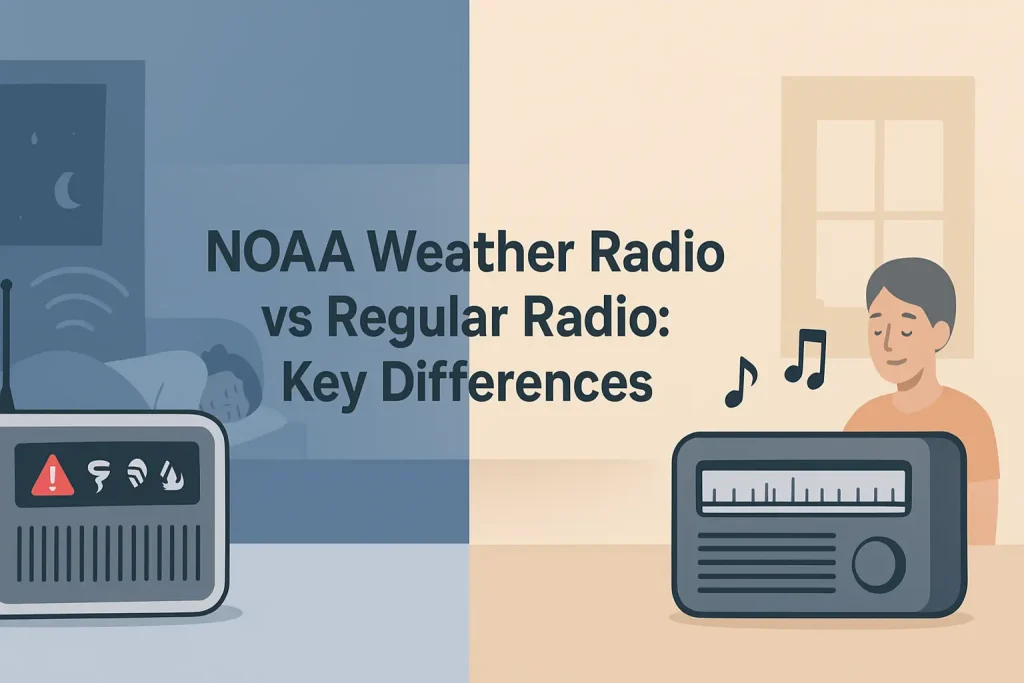
What Is the Difference Between a Weather Radio and a Standard AM/FM Radio for Emergency Use?
A dedicated NOAA weather radio receives exclusively on the 7 NOAA WX frequencies (162.400-162.550 MHz) in the VHF-FM band, while a standard AM/FM radio receives broadcast stations in the AM band (530-1700 kHz) and FM band (87.5-108 MHz). These are entirely different frequency ranges requiring different receiver circuits. A standard AM/FM radio cannot tune to NOAA weather frequencies, and a dedicated NOAA weather radio cannot receive AM or FM broadcast stations.
The functional difference for emergency use is that NOAA weather radios include the S.A.M.E. decoder circuit that allows the radio to wake itself from standby and sound an alarm when an alert is issued for your county. AM/FM radios do not have this capability. You must be actively listening to an AM/FM station and that station must choose to broadcast the EAS alert in real time for you to receive the warning.
Many combination emergency radios include both AM/FM reception and NOAA WX reception in the same unit. The Midland ER310, Eton FRX3+, and Kaito KA500 all receive AM, FM, and NOAA WX. This is the correct configuration for an emergency preparedness radio because AM broadcasts can carry emergency information during regional disasters when local FM stations are also affected, and the NOAA WX channels provide the automatic S.A.M.E. alert function.
A smartphone with a broadcast FM radio chip and a weather alert app does not replicate the function of a dedicated NOAA weather radio. Smartphone alert apps depend on a functioning cellular data or Wi-Fi connection. NOAA WX reception on a dedicated radio requires only battery power and a functioning NOAA transmitter within 40 miles of your location, with no internet infrastructure dependency.
Is a More Expensive Weather Radio Actually Worth It?
A weather radio above $75 is worth the additional cost if your home is located in a fringe NOAA coverage area requiring an external antenna connection, if you need multiple S.A.M.E. zone programming for complex household travel patterns, or if you need a louder alarm system than most mid-range radios provide. For most urban and suburban households within 30 miles of a NOAA transmitter, a $40-70 mid-range radio delivers all the essential capabilities.
The specific features that justify spending above $75 are an external antenna jack, a 3.5mm headphone/external speaker output, a backlit alphanumeric display showing the full alert text, and programming for more than 25 FIPS location codes simultaneously. These features are absent from most budget and lower mid-range models.
The Midland WR120 weather alert radio at approximately $30 is the minimum viable S.A.M.E. radio for most buyers. The Midland WR400 at $50-70 adds significantly more FIPS code storage and a larger display. Spending above $100 produces diminishing returns unless your specific use case requires the premium features described above.
For a detailed breakdown of what the price premium actually buys in terms of specifications, reliability, and features, our guide covering the top-performing NOAA weather radios across all price tiers compares the key specification differences between budget, mid-range, and premium models side by side.
What Is the Difference Between Solar and Battery Weather Radios in Winter?
Winter is the scenario where solar weather radios perform least reliably and battery radios perform most dependably. At 45 degrees north latitude (roughly the level of Minneapolis, Minnesota), available sunlight hours drop to 8-9 hours per day in December, compared to 15-16 hours in June. Cloud cover during winter storm systems further reduces effective solar input to near zero for periods of 2-7 days.
Li-ion battery chemistry also degrades in cold temperatures. A Li-ion battery stored at 0 degrees Celsius (32 degrees Fahrenheit) delivers approximately 80% of its room-temperature capacity. At -20 degrees Celsius (-4 degrees Fahrenheit), capacity drops to 50-60% of rated value. This is relevant if the radio is stored in an unheated garage or vehicle in northern climates.
Alkaline AA cells are less affected by moderate cold but drain faster in temperatures below -10 degrees Celsius. Energizer Ultimate Lithium AA cells maintain approximately 90% of rated capacity at -20 degrees Celsius, making them the preferred backup choice for radios stored in cold environments.
For home emergency preparedness in winter storm scenarios, the AC-powered battery radio with alkaline AA backup remains the most reliable configuration. The solar panel adds no value during a blizzard and the hand crank provides the last-resort backup if the grid fails for more than 3-5 days and the battery depletes completely.
Winter storm preparedness with a weather radio means one specific action above all others: connect the radio to AC power before winter storm season begins in November and leave it connected continuously through April. This single habit eliminates the most common failure mode for home weather radios in cold-weather emergency scenarios.
Whether you are buying your first weather radio or replacing an aging unit, the power source combination you choose determines how reliably that radio performs when you need it most. A battery-primary radio plugged into AC works best for the home. A solar-and-crank combination works best for outdoor and go-bag use. In both cases, confirm the radio includes full S.A.M.E. filtering, all 7 NOAA WX channels, and at least two independent power inputs before purchase.
| Photo | TOP RATED WALKIE TALKIES | Price |
|---|---|---|
 | Retevis RT628 Kids Walkie Talkies, Toys Gifts for 4-12 Year Old Girl Boy | Check Price On Amazon |
 | Cobra ACXT545 Weather-Resistant Walkie Talkies, Rechargeable, 22 Channels | Check Price On Amazon |
 | Retevis RT388 Kids Walkie Talkies, Outdoor Toys for Kids Camping Essentials | Check Price On Amazon |
 | Cobra RX680 Walkie Talkies (2-Pack), IP54 Water Resistant Design | Check Price On Amazon |
 | Retevis RT22 Walkie Talkies Long Range Rechargeable with Earpiece (2 Pack) | Check Price On Amazon |
 | Midland GXT1000VP4 GMRS Two-Way Radios with Headsets, Black, 2 Pack | Check Price On Amazon |
 | Retevis RT628 Walkie Talkies for Kids,Toys Gifts for 6-12 Years Old Boys Girls,Long Range 2 Way Radio 22CH VOX,Birthday Gift,Family Walkie Talkie for Camping Hiking Indoor Outdoor | Check Price On Amazon |