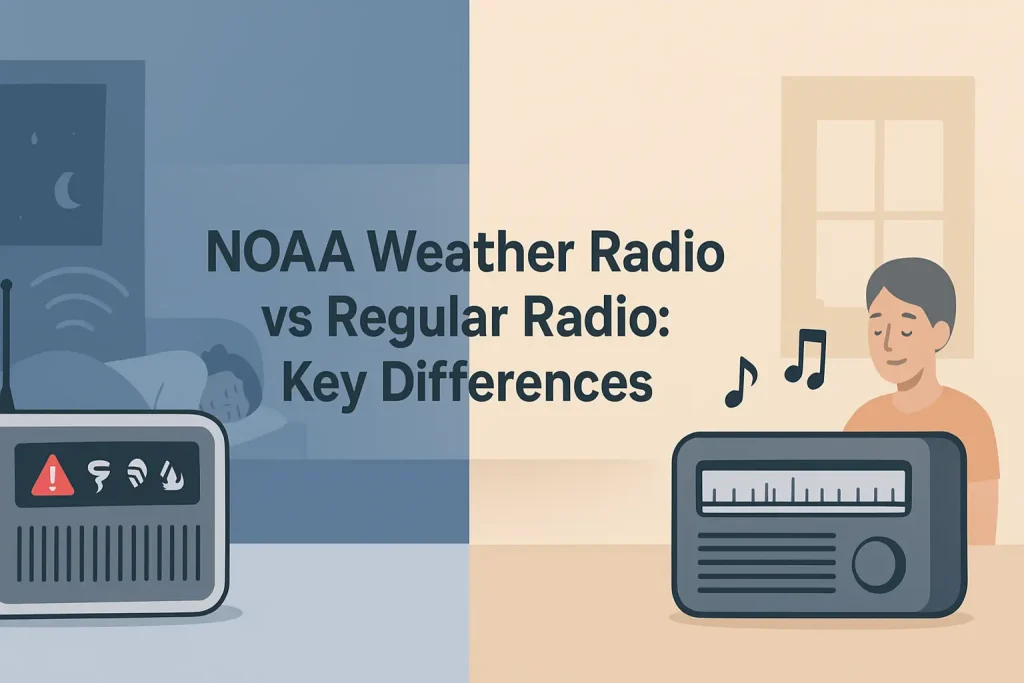
A software-defined radio (SDR) can receive all seven NOAA Weather Radio All Hazards (NWR) frequencies between 162.400 and 162.550 MHz using nothing more than a $25 USB dongle and free software on your computer. The catch is that SDR gives you a passive monitoring tool, not the dedicated alert receiver that wakes you up at 3 a.m. when a tornado warning is issued for your county.
This guide covers everything you need to receive NWR broadcasts on SDR hardware, from choosing the right dongle and antenna to configuring SDR# or GQRX, decoding EAS tones, and understanding where SDR fits alongside a dedicated weather radio for emergency preparedness.
| Photo | Popular Portable Walkie Talkies | Price |
|---|---|---|
 | SKIWARRIOR Multifunctional Smart Wireless Ski Goggles with Walkie-Talkie, Anti-Fog Zeiss Lens, Music & Call Function (Cylindrical Blue) | Check Price On Amazon |
 | SINORISE Super Mini Walkie Talkies, Two-Way Radios, 3 Pack | Up to 12 Hours Battery Life, for Baseball Coaches, Restaurants, Retail Stores, Hospitals, Outdoor Sports & Travel | Check Price On Amazon |
 | KOSPET Tank M4C Smart Watch Rugged, Dual-Band GPS, 5ATM & IP69K Waterproof | 1.96" AMOLED Display, 170+ Sport Modes, Built-in LED Flashlight/Walkie-Talkie, Heart Rate/Sleep Monitor for Android & iPhone | Check Price On Amazon |
 | Retevis RT15 Walkie Talkies 3 Pack, Birthday Gift, Outdoor Adventure Kit | Durable, Lightweight, VOX, Key Lock, Mini Walkie Talkies for Adults, School Family Outdoor Travel Camping Hiking | Check Price On Amazon |
 | Rechargeable Walkie Talkies Toys for Kids: DIY Astronaut Walkie Talkies for Boys Christmas Birthday Gifts for 3 4 5 6 7 8 9 10 Boy Walkie Talkie Outdoor Hiking Toy 2 Way Radio Camping Outdoor Game | Check Price On Amazon |
By the Numbers
NOAA Weather Radio on SDR: Key Specifications and Standards
Sources: NOAA National Weather Service NWR documentation, FCC Part 11 EAS rules, NOAA transmitter network data.
What Is SDR and How Does It Receive NOAA Weather Radio Frequencies?
Software-defined radio (SDR) is a radio receiver where the signal processing traditionally done by analog hardware (filters, demodulators, mixers) is instead performed by software running on a computer or mobile device. An SDR dongle converts the incoming RF signal into a digital stream, and your computer does the rest.
For receiving NWR, this means a single USB dongle covers all seven NOAA frequencies simultaneously if your software supports wideband monitoring. The RTL-SDR architecture, based on the Realtek RTL2832U chip originally designed for digital TV reception, became the entry point for most hobbyists because dongles cost under $30 and the software ecosystem is mature and free.
The seven NWR frequencies are all in the VHF high band (136-174 MHz), which RTL-SDR dongles receive natively. No upconverter or extra hardware is needed. You set your SDR software to 162.400, 162.425, 162.450, 162.475, 162.500, 162.525, or 162.550 MHz, select NFM (narrow FM) modulation, and the audio comes through immediately if a transmitter is within range.
This happens because NWR transmitters broadcast at 300 watts of effective radiated power (ERP) on a continuous 24-hour schedule, and VHF signals in this frequency range propagate efficiently over line-of-sight distances of 40 miles or more from the transmitter antenna. A basic telescoping whip antenna on an SDR dongle placed near a window is often enough to receive a strong signal.
If the signal sounds distorted or breaks up, the most common cause is that the dongle is receiving too much signal strength from a nearby transmitter, which overloads the front-end amplifier. Fix it by adding a 20 dB attenuator inline or by reducing the RF gain setting in your software.

SDR reception of NWR is receive-only and completely legal under FCC rules. No license is required to listen to any frequency. Transmission on NWR frequencies is restricted to NOAA-authorized equipment, but passive monitoring has no regulatory barrier.
Which SDR Hardware Works Best for Receiving NWR?
The RTL-SDR Blog V3 dongle is the most recommended starting point for NWR reception because it covers 500 kHz to 1.75 GHz, includes a bias tee for powering an active antenna, and costs approximately $30. It outperforms generic RTL2832U dongles in front-end filtering and noise performance, which matters when a strong NWR transmitter is nearby and could cause overload.
The SDR dongle category covers several options at different price points. The table below shows the most commonly used hardware for NWR reception.
Use the table below to choose the right SDR hardware for your NWR monitoring setup based on budget, sensitivity, and feature requirements.
| Device | Frequency Range | NWR Coverage | Noise Figure | Price | Best For |
|---|---|---|---|---|---|
| RTL-SDR Blog V3 | 500 kHz – 1.75 GHz | All 7 NWR freqs | ~3.5 dB | ~$30 | Best overall starter |
| Nooelec NESDR Smart | 25 MHz – 1.75 GHz | All 7 NWR freqs | ~3.8 dB | ~$25 | Budget entry |
| Airspy HF+ Discovery | 0.5 kHz – 260 MHz | All 7 NWR freqs | <1 dB | ~$170 | Weak-signal, fringe areas |
| SDRplay RSP1A | 1 kHz – 2 GHz | All 7 NWR freqs | ~1.5 dB | ~$110 | Mid-range all-rounder |
| HackRF One | 1 MHz – 6 GHz | All 7 NWR freqs | ~8 dB | ~$300 | Advanced experimentation |
| Generic RTL2832U dongle | 25 MHz – 1.7 GHz | All 7 NWR freqs | ~5-8 dB | ~$10-15 | Proof-of-concept only |
The HackRF One has a higher noise figure than RTL-SDR options because it is designed as a transmit-capable general-purpose device, not an optimized receiver. For NWR monitoring specifically, the RTL-SDR V3 or Nooelec NESDR Smart delivers better sensitivity per dollar.
Key Specifications for the RTL-SDR Blog V3:
- Chip: Realtek RTL2832U + R820T2 tuner
- Frequency range: 500 kHz to 1.75 GHz (direct sampling mode below 24 MHz)
- Sample rate: Up to 3.2 MS/s (2.4 MS/s stable)
- ADC resolution: 8-bit
- Bias tee: 4.5V at 180mA for active antennas
- Price: ~$30 (single unit with dipole antenna kit)
For NWR monitoring in a fringe reception area more than 60 miles from the nearest transmitter, the Airspy HF+ Discovery or SDRplay RSP1A will outperform RTL-SDR hardware significantly. Their lower noise figures (under 1.5 dB vs approximately 3.5 dB for the RTL-SDR V3) can mean the difference between readable audio and static in weak-signal conditions.
The right SDR dongle for most NWR users is the RTL-SDR Blog V3 paired with a simple antenna, which costs under $35 total and covers all seven NWR frequencies out of the box.
What Antenna Do You Need to Receive NWR on an SDR?
The antenna is more important than the SDR dongle for NWR reception quality. A good antenna on a cheap dongle will outperform a premium dongle on a poor antenna almost every time. NWR broadcasts in the VHF high band at 162 MHz, and antennas cut to resonate at this frequency provide a significant gain advantage over the stub whips bundled with most SDR dongles.
A quarter-wave vertical antenna for 162 MHz is approximately 18 inches (46 cm) long. This length is calculated as: (speed of light in meters per second / frequency in Hz) / 4 = (299,792,458 / 162,400,000) / 4 = approximately 0.462 meters. You can build one from a single piece of copper wire or purchase a VHF discone antenna that covers 162 MHz as part of a wideband range.
The RTL-SDR Blog dipole antenna kit includes a telescoping dipole that can be extended to the correct length for 162 MHz. Each dipole element should be set to approximately 17.5 inches (44 cm) when oriented horizontally, or one element at 18 inches pointed vertically for a monopole configuration.
Antenna placement has more impact on received signal strength than any other variable. Moving the antenna from a desk inside a building to a window position can improve signal-to-noise ratio (SNR) by 10-15 dB. Placing it in an attic or on an exterior mount can improve SNR by an additional 5-10 dB compared to a window-mounted antenna.
This happens because building materials (concrete, metal framing, low-E window glass) attenuate VHF signals at 162 MHz by 5-20 dB depending on construction type. Getting the antenna outside or near unobstructed glass removes that attenuation from the signal path.
For outdoor mounting, a NMO-mount VHF antenna on a short mast provides the best combination of gain and durability. Antennas with 2-3 dBd gain (roughly 4-5 dBi) are appropriate for 162 MHz. Antennas with higher gain are designed to reject signals arriving at high vertical angles, which is counterproductive when the NWR transmitter is on a tower at a different elevation than your receive site.
The single most effective upgrade for weak NWR signal reception is relocating the antenna outdoors and as high as practical, not upgrading the SDR dongle.
How to Set Up SDR Software to Receive NOAA Weather Radio
The two most widely used SDR applications for NWR reception are SDR# (SDRSharp) on Windows and GQRX on Linux and macOS. Both are free, both support RTL-SDR hardware, and both decode the NFM (narrow frequency modulation) signal that NWR transmitters use. The setup process takes approximately 10-15 minutes from initial download to hearing the first NWR broadcast.
Follow these steps to configure SDR# for NWR reception on a Windows computer.
Step-by-Step Guide
How to Configure SDR# for NOAA Weather Radio Reception
7 steps · Estimated time: 15 minutes · Works with RTL-SDR, Nooelec, and most USB SDR dongles
Install the RTL-SDR driver using Zadig
Download Zadig from zadig.akeo.ie and run it with your SDR dongle plugged in. Select the RTL2838UHIDIR device from the dropdown and click “Install Driver” (WinUSB). This replaces the default Windows driver with the WinUSB driver required by SDR#.
Download and extract SDR# (SDRSharp)
Download the latest SDR# package from airspy.com/downloads. Extract the ZIP file to a folder on your C: drive (not Program Files). Run install-rtlsdr.bat from the extracted folder to finalize the SDR# RTL-SDR plugin setup.
Launch SDR# and select RTL-SDR (USB) as the source
Open SDRSharp.exe. Click the gear icon next to the source dropdown at the top left. Select “RTL-SDR (USB)” from the source menu. Click the settings gear next to the source name to open the RTL-SDR configuration panel.
Set RF gain and sample rate
In the RTL-SDR configuration panel, set Sample Rate to 2.4 MSPS. Set RF Gain to approximately 35-40 dB as a starting point (not maximum, which causes front-end overload near strong transmitters). Check “Offset Tuning” to avoid the DC spike at center frequency.
Tune to the strongest NWR frequency in your area
Click Play to start the SDR. Type 162.400 in the frequency box (in MHz) and press Enter. The waterfall display should show a strong carrier signal if a transmitter is within range. If you do not see a signal, try 162.425, 162.450, 162.475, 162.500, 162.525, and 162.550 in sequence.
Select NFM demodulation mode
In the Radio panel on the left side of SDR#, select “NFM” (Narrow FM) as the demodulation mode. NWR uses NFM with a channel bandwidth of approximately 16 kHz. Set the filter bandwidth to 15-20 kHz using the bandwidth slider for the cleanest audio.
Click on the signal in the waterfall to lock in
Click directly on the NWR carrier signal shown in the waterfall or spectrum display. SDR# centers the demodulator on that frequency. You should immediately hear the NWR broadcast voice or data tones. Adjust volume using the AF Gain slider on the left panel.
For GQRX on Linux or macOS, the process is similar: select the RTL-SDR input device in the I/O Devices dialog, set the sample rate to 2,400,000 Hz, tune to 162.400 MHz, select “Narrow FM” in the demodulator section, and set the filter width to 15 kHz. GQRX is available in most Linux package managers and is a native app on macOS.
Once you hear clean NWR audio, you have completed the basic SDR-to-NWR setup and can move on to scanning all seven frequencies and decoding EAS alert tones.
What Are the Seven NOAA NWR Frequencies and Which One Should You Use?
NOAA broadcasts NWR programming on exactly seven frequencies: 162.400, 162.425, 162.450, 162.475, 162.500, 162.525, and 162.550 MHz. Each transmitter uses one of these seven frequencies, and neighboring transmitters use different frequencies to avoid interference. The correct frequency for your location is whichever one shows the strongest signal in your SDR waterfall.
To understand which stations are near you, the NOAA NWR transmitter database lists every transmitter’s call sign, frequency, location, and broadcast range. You can also check our interactive map of NOAA transmitter locations and coverage areas to identify the closest stations before you start tuning.
Use the table below to understand the seven NWR frequencies and their common usage patterns.
| Frequency (MHz) | Designation | Most Common Region | Notes |
|---|---|---|---|
| 162.400 | WX1 | Nationwide | Most widely used channel |
| 162.425 | WX2 | Nationwide | Second most common |
| 162.450 | WX3 | Nationwide | Common in Midwest and Southeast |
| 162.475 | WX4 | Nationwide | Less congested in urban areas |
| 162.500 | WX5 | Nationwide | Common in Western states |
| 162.525 | WX6 | Nationwide | Common in Pacific Northwest and Alaska |
| 162.550 | WX7 | Nationwide | Least congested overall |
You can learn more about the broadcast structure and content format for each of these channels in our complete breakdown of NOAA weather radio frequencies and what each one broadcasts.
With SDR, you can monitor all seven frequencies simultaneously by setting the center frequency to 162.475 MHz (the middle of the seven-channel block) and using a sample rate of at least 2.4 MS/s, which gives you a visible bandwidth of approximately 2.4 MHz around the center. All seven NWR frequencies fall within a 150 kHz span, which means a 2.4 MHz-wide display shows all of them at once in the waterfall.
The strongest signal in your waterfall display is the right frequency for your location. Start there, and bookmark the frequency in your SDR software for quick access.
How to Decode EAS Alert Tones with SDR
The Emergency Alert System (EAS) tones that precede every NWR alert broadcast are digital data bursts that encode the alert type, affected geographic area (using 6-digit FIPS S.A.M.E. codes), duration, and originator. An SDR receiving NWR audio can pipe that audio into free EAS decoding software to parse and display every alert in human-readable form automatically.
EAS uses a two-part header: the Attention Signal (the familiar 8-11 second two-tone burst at 853 Hz and 960 Hz) followed by the SAME (Specific Area Message Encoding) header, which is an FSK (frequency-shift keying) data burst at 1200 baud. The SAME header is transmitted three times in sequence. Decoding software listens for two matching copies and declares a valid alert.
The most widely used free EAS decoder for SDR is Multimon-NG. It runs on Linux, macOS, and Windows (via WSL or Cygwin), and it accepts audio piped from RTL-SDR directly using the rtl_fm command-line tool. The command chain is:
rtl_fm -f 162.400M -M fm -s 22050 -g 40 | multimon-ng -t raw -a EAS –
This command tunes the SDR to 162.400 MHz, demodulates NFM audio at 22,050 Hz sample rate with 40 dB of gain, and pipes the audio stream into Multimon-NG for EAS decoding. Every EAS header received prints to the terminal in plain text, including the SAME code, event type, affected counties, valid time window, and originating station.
On Windows without a Linux subsystem, EAS Decoder for Windows and WxAlertDecoder both accept audio from the SDR’s virtual audio output. You configure SDR# or HDSDR to output audio to a virtual audio cable (VB-Cable is a free option), then point the EAS decoder at that virtual audio device.
This happens because EAS decoders expect analog audio input, not a direct RF connection. The SDR demodulates the FM signal into audio, and the decoder processes that audio stream for the digital SAME tones embedded in the broadcast.
If Multimon-NG produces garbled or missed decodes, the most common cause is RF gain set too high, which creates audio distortion before demodulation. Reduce the gain value in rtl_fm from 40 to 30 and test again. A clean EAS decode produces output like: ZCZC-NWS-SVR-039049+0100-1050000-KGRR/NWS-, where SVR is a Severe Thunderstorm Warning, 039049 is a FIPS code for Kent County, Michigan, and the time code indicates a 1-hour valid period.
EAS decoding with SDR gives you a permanent alert log that dedicated weather radios do not provide. Every decoded alert is date-stamped and saved to a text file, which is useful for monitoring alert frequency patterns over time or verifying that your NWR transmitter is operating correctly.
Can SDR Replace a Dedicated NOAA Weather Radio?
An SDR setup cannot replace a dedicated NOAA weather radio for emergency alerting because SDR requires a computer, power, and software to be running continuously. A dedicated weather radio with S.A.M.E. technology, such as the Midland WR400 or Uniden BC365CRS, runs on battery backup, wakes from standby mode when an EAS alert is received, and sounds an alarm without any other device needing to be on.
The practical difference is significant during a power outage. An SDR connected to a laptop continues to function as long as the laptop battery lasts, but a dedicated weather radio on 6 AA alkaline batteries runs for 40-60 hours on standby. For overnight emergency alerting, a $35-60 dedicated weather radio with S.A.M.E. alert filtering is the correct tool, not an SDR.
To understand what S.A.M.E. filtering does and why it matters for emergency use, our guide on how NOAA weather radio works and what S.A.M.E. technology filters covers the alert structure in detail.
Use the table below to compare SDR-based NWR monitoring against a dedicated weather radio across the factors that matter most for emergency preparedness.
| Factor | SDR + Computer | Dedicated Weather Radio |
|---|---|---|
| Power outage operation | Laptop battery only (~3-8 hrs) | 40-60 hrs on AA batteries |
| Overnight alert wake-up | No (computer must be on) | Yes (alarm from standby) |
| S.A.M.E. county filtering | Via decoding software only | Built-in (hardware SAME chip) |
| Setup complexity | High (drivers, software, config) | Low (plug in, scan, done) |
| EAS alert logging | Yes (full SAME decode log) | Limited (last alert display only) |
| Wideband spectrum monitoring | Yes (all 7 NWR freqs visible) | No (1 or 2 frequencies at once) |
| Cost | $25-30 (dongle only, PC required) | $35-100 (all-in-one device) |
| Best use | Monitoring, learning, logging | Emergency alerting, overnight use |
The correct answer for most households is to use both. A dedicated weather radio handles overnight emergency alerting, and an SDR setup handles daytime monitoring, EAS logging, transmitter signal quality assessment, and learning the NWR system in detail.
If you want to compare the full capabilities of a dedicated weather radio against smartphone-based alert options, our guide on when a dedicated weather radio outperforms wireless emergency alerts on your phone covers the specific failure modes of cellular-based alerts that make a hardware receiver essential.
Quick Reference: SDR Weather Radio Terms Explained
These are the key technical terms used throughout this guide. If a term appeared earlier in the article without enough explanation, the definitions below fill in the gaps.
- SDR (Software-Defined Radio): A radio receiver where signal processing is performed by software instead of analog hardware. A USB dongle converts RF to digital, and software on your computer handles demodulation.
- RTL-SDR: A type of SDR based on the Realtek RTL2832U chip. Originally designed for DVB-T digital TV, it was repurposed for wideband radio reception. Covers approximately 25 MHz to 1.75 GHz.
- NFM (Narrow FM): Narrow frequency modulation. The modulation type used by NWR transmitters. Requires a channel bandwidth setting of 12-20 kHz in SDR software. Do not use WFM (wide FM), which is for broadcast FM radio.
- EAS (Emergency Alert System): The US federal alert system that encodes emergency messages as digital data bursts on NWR broadcasts. Governed by FCC Part 11.
- S.A.M.E. (Specific Area Message Encoding): The protocol within EAS that encodes geographic alert areas as 6-digit FIPS codes, allowing dedicated weather radios to filter alerts by county.
- FIPS Code: Federal Information Processing Standard code. A 6-digit number identifying a specific US county or county equivalent. Used in S.A.M.E. headers to specify which areas an alert covers.
- Waterfall display: A scrolling frequency-vs-time visualization in SDR software. Brighter colors indicate stronger signals. Used to identify active NWR transmitters visually before tuning to them.
- Noise figure (NF): A measure of how much noise an SDR receiver adds to the incoming signal. Lower is better. Measured in decibels (dB). The RTL-SDR V3 has a noise figure of approximately 3.5 dB.
- RF gain: The amplification applied to the incoming signal before the ADC in the SDR. Too low and you lose weak signals. Too high and strong signals cause distortion. Start at 35-40 dB and adjust.
- Bias tee: A circuit in the RTL-SDR V3 that sends 4.5V DC up the coaxial cable to power an active antenna. Must be enabled in software before use.
- Multimon-NG: Free open-source software that decodes digital protocols including EAS/SAME from audio input. Used to convert NWR EAS tones into readable text alerts.
- VHF high band: The frequency range from 136 to 174 MHz. NWR transmitters at 162 MHz fall within this band. Requires no upconverter on RTL-SDR hardware.
How to Monitor Multiple NWR Frequencies Simultaneously with SDR
All seven NWR frequencies span only 150 kHz (from 162.400 to 162.550 MHz). An RTL-SDR with a 2.4 MS/s sample rate displays approximately 2.4 MHz of spectrum, meaning all seven NWR channels are visible simultaneously in the waterfall. This lets you see which transmitters are active, compare their signal strengths, and identify any interference or spurious transmissions on the NWR band without switching frequencies.
To monitor all seven simultaneously as separate audio channels, you need software that supports multiple simultaneous demodulators on the same SDR stream. SDR# supports this via the Community Plugin Pack, specifically the “Multiple VFO” plugin, which allows up to 8 independent demodulators on a single SDR source. Each VFO can be set to a different NWR frequency with its own NFM filter and audio output channel.
An alternative approach uses the command-line tool rtl_fm with multiple instances, each piping to a separate Multimon-NG process. This requires a separate SDR dongle for each frequency if you want truly simultaneous decoding, because RTL-SDR hardware cannot tune to multiple non-contiguous frequencies at the same time. You can listen to one frequency while viewing all seven in the waterfall, but active decoding requires one dongle per frequency.
For a comprehensive NWR monitoring station covering all transmitters in your region, two RTL-SDR dongles on two different NWR frequencies (your primary local frequency plus the backup frequency from the adjacent transmitter) provide redundancy. If the primary transmitter goes offline, your monitoring station automatically continues receiving on the secondary.
This matters for emergency monitoring because NOAA occasionally takes transmitters offline for maintenance without advance notice. With a single-frequency setup, you would miss any alerts broadcast during that window. A dual-dongle setup covering the two strongest NWR signals at your location eliminates that gap.
Monitoring all seven NWR frequencies simultaneously with a single RTL-SDR dongle is primarily a visual and comparative tool, not an active alerting solution, because only one frequency can be demodulated to audio at a time in most single-dongle configurations.
How to Use SDR to Assess NWR Signal Quality at Your Location
SDR gives you signal quality information about your NWR reception that a dedicated weather radio never shows. The waterfall display, signal strength meter (S-meter), and noise floor indicator in SDR software let you quantify exactly how strong your NWR signal is, whether multipath interference is present, and whether your antenna placement is actually improving or degrading reception.
Signal-to-noise ratio (SNR) for NWR in SDR# or GQRX is measured in dB relative to the noise floor. A clean, fully readable NWR signal typically shows 20-30 dB SNR above the noise floor. Marginal reception that produces audio dropouts registers at 5-10 dB SNR. A signal below 3 dB SNR is indistinguishable from noise to the demodulator and produces continuous static.
To test whether a new antenna position improves reception, write down the S-meter value in dB in your current position, move the antenna to the new position, and compare. SDR gives you a precise numeric comparison that “does it sound better” does not provide. A 3 dB improvement in SNR doubles the received signal power. A 10 dB improvement is a tenfold increase in signal power, which typically transforms marginal audio into clear audio.
Multipath interference (where the same signal arrives at your antenna via two different paths with slightly different timing) appears in the waterfall as a broadened or smeared signal peak rather than a sharp vertical line. It causes a characteristic “picket fencing” audio artifact on NFM signals. The fix is to reposition the antenna slightly (even 6-12 inches can break the multipath geometry) or to move it higher.
Identifying your nearest NWR transmitter using SDR data is straightforward: the transmitter producing the highest SNR in your waterfall is your primary coverage source. You can cross-reference the frequency against the NOAA transmitter database to confirm the call sign and location. Our reference page listing every NWR station organized by state, call sign, and frequency makes this identification quick.
Quantifying your NWR signal strength with SDR before purchasing a dedicated weather radio tells you exactly which receiver sensitivity tier you need. A strong 25+ dB SNR signal means any entry-level dedicated weather radio will perform well. A marginal 5-10 dB SNR signal means you need a dedicated radio with a better front-end or an external antenna connection.
SDR Weather Radio on a Raspberry Pi: Running a 24/7 NWR Monitor
A Raspberry Pi 4 running Linux with an RTL-SDR dongle and Multimon-NG creates a low-power, always-on NWR monitoring station that logs every EAS alert received and can send notifications to your phone, email, or home automation system. The Raspberry Pi 4 consumes approximately 3-5 watts under normal load, which costs roughly $3-5 per month in electricity, far less than leaving a full desktop computer running continuously.
The required components are a Raspberry Pi 4, an RTL-SDR V3 dongle, a VHF antenna cut for 162 MHz, and a microSD card with Raspberry Pi OS installed. Total hardware cost is approximately $80-110 for a new Pi 4 plus accessories.
The software stack is fully open-source. Install RTL-SDR drivers using apt-get install rtl-sdr, install Multimon-NG from source, and create a shell script that runs the rtl_fm to Multimon-NG pipe continuously on your strongest local NWR frequency. A cron job at boot starts the monitoring process automatically after any power interruption.
For alert notifications, the decoded EAS text output from Multimon-NG can be parsed by a Python script that looks for specific event codes (TOR for Tornado Warning, SVR for Severe Thunderstorm Warning, FFW for Flash Flood Warning) and triggers a notification via the Pushover API, an MQTT broker for home automation, or a simple email via sendmail. This gives you phone push notifications for NWR alerts without any commercial subscription service.
Key Specifications for a Raspberry Pi NWR Monitor Build:
- Computer: Raspberry Pi 4 Model B (2GB RAM minimum)
- SDR dongle: RTL-SDR Blog V3 (~$30)
- Antenna: VHF dipole or discone cut for 162 MHz (~$15-30)
- Power consumption: 3-5W (SDR adds approximately 0.5W)
- Operating cost: ~$3-5/month at US average electricity rates
- Alert decode latency: Under 3 seconds from EAS tone start to terminal output
This setup is particularly valuable for weather spotters, emergency management volunteers, and amateur radio operators who want a permanent NWR monitoring log without dedicating a full computer to the task. The Raspberry Pi runs headlessly (no monitor needed) and is accessible via SSH from any device on your network.
A Pi-based NWR monitor is the most cost-effective way to run a continuous 24/7 NWR decode station, and it produces a permanent timestamped log of every EAS alert received at your location.
What SDR Software Works Best for NWR on Mobile Devices?
Receiving NWR on Android using SDR hardware is possible with the RTL-SDR dongle connected via USB OTG adapter and the SDR Touch or SDRoid app. Both apps support NFM demodulation at 162 MHz and display the waterfall in real time. SDR Touch costs approximately $10 on the Google Play Store and supports direct RTL-SDR hardware without root access on most Android devices running Android 5.0 or later.
iPhone and iOS do not support direct USB SDR access due to Apple’s hardware restrictions. iOS users can receive NWR via SDR only by using a network-connected SDR running SDR# or OpenWebRX on a computer and accessing the audio stream remotely. For direct NWR alerting on an iPhone, a dedicated weather radio app using cellular data is more practical. Our review of the top-rated NOAA weather radio apps for iPhone covers the best options for iOS-based NWR monitoring.
OpenWebRX is a browser-based SDR interface that runs on a server (Raspberry Pi, NAS, or any Linux machine) and streams the SDR output to any web browser on any device, including iPhones. You set up OpenWebRX on a Raspberry Pi at home, tune it to 162.400 MHz with NFM, and access the live NWR audio from any browser anywhere. This approach requires a static IP or dynamic DNS service for remote access outside your home network.
For portable field use, Android with SDR Touch and an RTL-SDR dongle in a USB OTG configuration is the most practical mobile SDR option for NWR reception. The combination fits in a jacket pocket and receives all seven NWR frequencies with a small telescoping whip antenna extended to approximately 18 inches.
Mobile SDR for NWR is most useful for amateur radio operators, storm chasers, and emergency management personnel who need to verify NWR transmitter status or assess signal quality at a specific field location rather than for overnight emergency alerting.
Troubleshooting SDR Reception of NOAA Weather Radio
The most common SDR problems when receiving NWR are no signal in the waterfall, distorted or clipped audio, missed EAS decodes, and a high noise floor that buries the NWR carrier. Each has a specific cause and a direct fix that does not require new hardware.
Problem: No signal visible in the waterfall at any NWR frequency.
Check that the USB driver installation completed correctly by opening Device Manager and confirming the SDR device shows as “RTL2838UHIDIR” under Universal Serial Bus devices, not under the original “DVB-T” or “Bulk-In Interface” category. If it shows the wrong driver, re-run Zadig. Also confirm the antenna is connected to the SMA port on the dongle, not the USB end.
Problem: Audio is heavily distorted or clipping even though the waterfall shows a strong signal.
RF gain is too high. A strong NWR transmitter within a few miles overloads the RTL-SDR front-end amplifier when gain is set above 40 dB. Reduce RF gain in 5 dB steps until distortion clears. For transmitters within 1-2 miles, gains as low as 15-20 dB may be needed. You can also insert a 20 dB inline SMA attenuator between the antenna and dongle to protect the front-end.
Problem: Multimon-NG misses EAS alerts or produces garbled SAME decode output.
The audio sample rate fed to Multimon-NG must be 22,050 Hz. Using a different sample rate causes the FSK decoder to miss the 1200 baud EAS data. Confirm the -s 22050 flag is present in your rtl_fm command. Also confirm the NWR audio has no heavy filtering applied before Multimon-NG receives it. Wide bandwidth filters in SDR# can clip the EAS FSK sidebands.
Problem: High noise floor across the entire 162 MHz band with no visible NWR carrier.
USB 3.0 ports generate significant interference in the 162 MHz range due to harmonics of the 125 MHz USB 3.0 clock. Move the SDR dongle to a USB 2.0 port. If only USB 3.0 ports are available, use a 1-meter USB extension cable to physically separate the dongle from the computer chassis, which reduces radiated interference by 10-15 dB. Also check for nearby switching power supplies and LED lighting, which are common interference sources at VHF frequencies.
Problem: Audio is readable but fades in and out every few seconds.
This is multipath interference. The NWR signal is arriving at your antenna via two different paths (direct path plus a reflection from a building or metal surface), and the two copies alternately reinforce and cancel each other. Move the antenna to a different position 6-24 inches away and reassess. Moving an antenna horizontally even a short distance changes the phase relationship between the direct and reflected paths significantly.
Systematic troubleshooting starting with the driver, then gain, then sample rate, then physical environment resolves the vast majority of SDR NWR reception problems without any hardware purchases.
Is SDR Receive of NWR Legal and Do You Need Any License?
Receiving any radio frequency in the United States, including all seven NWR frequencies at 162.400-162.550 MHz, requires no license. The FCC does not regulate listeners, only transmitters. Passive reception of NWR with SDR hardware is completely legal under all circumstances for any person in any location in the US.
No additional FCC registration or license is required for the SDR hardware itself. The RTL-SDR dongle is a receive-only device and falls outside FCC transmitter regulations entirely. It does not require FCC Part 15 authorization in the same way that a transmitter would, because it generates no intentional RF emissions above the incidental levels allowed for any digital device.
Transmitting on any NWR frequency (162.400-162.550 MHz) without NOAA authorization is a federal offense. These frequencies are allocated to the US government under FCC rules, and unauthorized transmission on them is subject to enforcement action under 47 U.S.C. Section 325(a). An SDR dongle physically cannot transmit on these frequencies because it is a receive-only device. If you connect a separate transmitter or use a transmit-capable SDR (such as HackRF One or USRP), transmission on 162 MHz without authorization is illegal regardless of power level.
Recording NWR audio or EAS data for personal use, research, or emergency monitoring is legal. Republishing decoded NWR content on a public website or using it for commercial purposes may require coordination with NOAA under the terms of the NWR rebroadcast policy. For personal and emergency preparedness use, no such coordination is needed.
The bottom line is that building and operating an SDR NWR monitoring station has zero regulatory barriers for receive-only operation.
What Can You Learn About NWR by Monitoring It with SDR?
SDR monitoring of NWR reveals technical details about the broadcast system that you cannot observe with a dedicated weather radio. The waterfall display shows the exact carrier frequency, signal bandwidth, and frequency stability of your local NWR transmitter. Professional NWR transmitters operate within 1-2 kHz of their nominal frequency and produce a clean, narrow carrier peak approximately 16 kHz wide in the waterfall.
If a local NWR transmitter is experiencing equipment problems, the waterfall often shows it before the audio degrades noticeably. A drifting carrier (the peak moving left or right over time) indicates a transmitter oscillator problem. A broadened carrier (wider than 20 kHz) indicates overmodulation. A reduced signal level with no corresponding weather-related cause (such as ducting conditions) suggests reduced transmitter power output.
SDR monitoring also lets you observe EAS relay behavior. When a Tornado Warning is issued, the primary WFO (Weather Forecast Office) transmits the EAS alert, and nearby NWR transmitters in adjacent WFO service areas receive and relay it within seconds. Watching the waterfall across multiple NWR frequencies during an active warning shows the relay cascade in real time, with each transmitter’s EAS burst appearing as a brief burst of digital noise in the waterfall approximately 3-10 seconds after the originating station.
This kind of technical understanding of how the NWR system actually works, including its propagation characteristics, transmitter network behavior, and EAS relay structure, is one of the genuine advantages SDR provides over any dedicated weather radio. For amateur radio operators, emergency communications volunteers, and radio enthusiasts, it turns NWR from a passive alert tool into an observable, analyzable system.
Is SDR a Better Alternative to a Dedicated Weather Radio for Emergency Prep?
SDR is not a better alternative to a dedicated weather radio for emergency preparedness. It is a complementary tool that adds monitoring, analysis, and logging capabilities that a dedicated weather radio cannot provide. For the critical function of overnight emergency alerting, battery backup, and standalone operation during power outages, a dedicated weather radio with S.A.M.E. technology is the only appropriate tool.
The distinction matters because households sometimes decide to use their SDR setup as their primary NWR alert system to avoid buying a separate dedicated radio. This creates a dangerous gap: when a tornado warning is issued at 2 a.m. and the power is out, an SDR setup running on a desktop computer is useless. A Sangean CL-100 or Midland WR120 on 6 AA batteries continues to operate through any power outage and wakes the household with an audible alarm filtered to your specific county.
The correct emergency preparedness stack is a dedicated S.A.M.E. weather radio as the primary alert device, with SDR as a supplementary monitoring tool for daytime use, EAS logging, signal quality assessment, and learning how the NWR system works. Neither tool replaces the other because they serve fundamentally different functions.
For a full understanding of what NWR is, what alert types it broadcasts, and how to choose a dedicated receiver, our foundational guide explaining the full structure of the NOAA weather radio system for new users provides everything needed before making a hardware decision.
What Other Frequencies Can You Receive Near the NWR Band with SDR?
The VHF high band covering 136-174 MHz, where all seven NWR frequencies sit, contains several other operationally important signals that an SDR tuned for NWR monitoring can also receive without any hardware changes. This is one of the practical advantages of SDR over dedicated single-purpose receivers.
NOAA environmental monitoring buoys transmit meteorological data on frequencies between 161.500 and 161.650 MHz using a format called NBDP (narrow-band direct printing). These are the same buoys whose data feeds into NWR forecasts. Decoding their data streams with DireWolf or another APRS decoder gives you raw wind speed, wave height, sea surface temperature, and barometric pressure data before it is processed into a forecast.
Aircraft weather observation transmissions (ATIS and AWOS broadcasts) appear in the 118-136 MHz aviation band, which is directly below the NWR band and is within tuning range of all RTL-SDR hardware. These broadcasts use AM modulation (not FM), so you need to switch your SDR software to AM demodulation when monitoring aviation frequencies.
Maritime VHF channels including Channel 16 (156.800 MHz, the international maritime distress and calling frequency) are in the 156-174 MHz band, immediately adjacent to the NWR frequencies. Coast Guard weather broadcasts for maritime areas transmit on VHF Channel 1 (WX1, 162.400 MHz, the same frequency as NWR WX1) and Channel 2 (WX2, 162.425 MHz).
Within the 162-174 MHz range, you will also see land mobile radio traffic from public safety agencies, utilities, and business users operating under FCC Part 90 licenses. These signals appear in the waterfall between and above the NWR channels. Monitoring them requires no license but understanding what you are hearing requires familiarity with local frequency coordination, which RadioReference.com documents for every county in the US.
The NWR band sits in one of the most information-dense parts of the VHF spectrum, and an SDR tuned there gives you a window into meteorological data, maritime safety, aviation weather, and public safety communications all within a single 40 MHz swath that one RTL-SDR dongle covers natively.
Does an SDR Need an Internet Connection to Receive NWR?
An SDR does not need an internet connection to receive NWR. The entire receive chain from RF signal to demodulated audio runs entirely on local hardware and software. The RTL-SDR dongle captures RF energy directly from the antenna, the USB connection carries the digital sample stream to the computer, and SDR software processes it locally. No cloud service, no API call, no network connection of any kind is involved in the signal path.
This is a meaningful advantage over smartphone-based weather alert apps, which depend entirely on cellular data connectivity. In a regional disaster scenario where cellular networks are congested or offline, SDR continues receiving NWR broadcasts as long as your computer has power and the NOAA transmitter is operational. NOAA NWR transmitters run on emergency power backup and are specifically designed to operate through regional power grid failures.
If you use a Pi-based NWR monitoring system and want push notifications to your phone, that notification pathway requires internet connectivity. But the SDR receive and EAS decode function continues regardless of whether the internet is working. The decoded alerts are logged locally and displayed on the terminal even with no network connection present.
An internet connection is only needed for initial software downloads, driver installation, and optional remote access to your SDR setup. Day-to-day NWR monitoring is entirely self-contained.
Can You Receive NWR with SDR in a Vehicle?
Receiving NWR in a vehicle with a portable SDR setup is practical but requires a few additional components. An SDR dongle connected to a laptop via USB, tuned to the local NWR frequency, and running SDR# provides the same audio quality as a fixed home installation as long as the antenna has a clear view of the sky. The main challenge is antenna: the stub whip bundled with most SDR dongles performs poorly inside a vehicle due to the shielding effect of the metal body and roof.
A magnetic mount VHF antenna placed on the vehicle roof and connected to the SDR dongle via a short coax cable and SMA adapter provides significantly better reception than an interior antenna. The metal ground plane provided by the vehicle roof also improves the antenna’s radiation pattern. A 3 dBd gain NMO antenna on a vehicle roof is equivalent to approximately 8-10 dB of improvement over an interior stub whip in most cases.
For storm chasers who use SDR in the field, a powered USB hub connected to a vehicle 12V outlet provides stable, noise-free power to the SDR dongle without the voltage fluctuations that can degrade performance on a direct car USB port. Vehicle electrical systems generate significant noise at VHF frequencies from alternators and ignition systems, and a powered hub with filtering reduces this interference.
Vehicle SDR NWR monitoring is standard practice among storm chasers, emergency management personnel, and amateur radio operators who need to monitor NWR transmitter quality across multiple counties during a weather event. The SDR’s ability to show the waterfall display of all seven NWR frequencies simultaneously makes it easy to identify which transmitter is strongest as you move through different coverage areas.
How Does SDR NWR Compare to a NOAA Weather Radio App on Your Phone?
An SDR receiving NWR directly from the NOAA transmitter network is fundamentally different from a smartphone app that delivers weather alerts over cellular data. The SDR receives the broadcast directly, with no intermediary infrastructure between the NOAA transmitter and your receiver. A phone app receives data relayed through cellular towers, internet servers, and push notification infrastructure, each of which can fail independently during a major weather event.
NOAA NWR has a broadcast latency of seconds from the moment a meteorologist at the Weather Forecast Office sends an alert to the moment it is transmitted. Smartphone app alerts depend on how quickly the app’s server receives the API feed from NWS, processes it, and pushes the notification to your phone. In practice, app alerts lag NWR broadcasts by 30 seconds to several minutes depending on the app and server load.
During active severe weather events, cellular networks frequently experience congestion as large numbers of people attempt to use their phones simultaneously. This congestion can delay or drop push notifications entirely. NOAA NWR, being a dedicated RF broadcast on a frequency separate from any cellular infrastructure, is immune to cellular congestion.
SDR-based NWR monitoring sits between a dedicated weather radio and a phone app in terms of reliability. It is more reliable than a phone app because it does not depend on cellular or internet infrastructure. It is less reliable than a dedicated weather radio for overnight alerting because it requires a computer to be running. For daytime monitoring in a location with AC power available, SDR provides richer data and more flexibility than either a phone app or a dedicated weather radio.
For a structured comparison of what cellular emergency alerts can and cannot do relative to NWR, our detailed analysis of how dedicated weather radio alert reliability compares to wireless emergency alerts during grid-down scenarios provides the specific failure mode data.
Frequently Asked Questions
What frequency should I tune my SDR to first when looking for NOAA weather radio?
Start with 162.400 MHz (WX1), which is the most commonly used NWR frequency nationwide. Set your SDR software to NFM demodulation with a 15-20 kHz filter width. If you see no signal at 162.400 MHz, work through 162.425, 162.450, 162.475, 162.500, 162.525, and 162.550 MHz in order. The strongest signal visible in your waterfall is your primary local NWR frequency.
Your nearest NWR transmitter uses whichever of the seven frequencies was assigned to it when it was licensed. Neighboring transmitters use different frequencies to prevent co-channel interference within their overlapping coverage areas.
Why does my SDR show a signal on 162.400 MHz but I hear no audio?
The most common cause is incorrect demodulation mode. NWR uses NFM (narrow FM). If your SDR software is set to WFM (wide FM, used for broadcast FM music stations), AM, or USB/LSB, you will see the carrier in the waterfall but hear no intelligible audio. Switch the demodulator to NFM and set the filter bandwidth to 15-20 kHz.
A second common cause is that the VFO (variable frequency oscillator) in your SDR software is not clicked precisely on the signal peak in the waterfall. If you are slightly off-frequency, NFM produces a muted or distorted output. Click directly on the center of the signal peak in the spectrum display to lock onto the carrier.
Can I receive NOAA weather radio with a $10 generic RTL2832U dongle or do I need the RTL-SDR Blog V3?
A $10 generic RTL2832U dongle will receive NWR at 162 MHz. The signal is strong enough at most locations that even a low-quality dongle with a 5-8 dB noise figure produces intelligible audio. The RTL-SDR Blog V3 at $30 provides better front-end filtering, a lower noise figure (~3.5 dB), and a more accurate TCXO oscillator, but it is not required to get started.
The difference matters most in fringe reception areas more than 50 miles from the nearest transmitter, where the improved noise figure of the V3 can recover a readable signal that a generic dongle cannot. For locations within 30 miles of a transmitter, a generic dongle works adequately.
What is the difference between SDR receiving NWR and a smartphone app like NOAA Weather Radio?
An SDR receives the NWR RF broadcast directly from the NOAA transmitter via antenna. A smartphone app delivers alerts over cellular data and internet infrastructure. The SDR path has no dependence on cellular networks, internet servers, or push notification services, all of which can fail during major weather events. The app path fails if cellular networks are congested or offline.
SDR also provides the raw EAS audio and SAME data header exactly as transmitted, with no reprocessing or filtering by an app server. This makes SDR more suitable for technical monitoring and logging, while an app is more convenient for casual alert notifications on an always-on device.
Do I need a ham radio license to use an SDR to monitor NWR frequencies?
No license of any kind is required to receive NWR frequencies with an SDR or any other radio receiver. The FCC regulates transmitters, not receivers. Passive reception of any frequency is legal for any person without a license under US law. The NWR frequencies at 162.400-162.550 MHz are government-allocated broadcast frequencies, and listening to them is no different from listening to commercial FM radio.
An FCC license is only required if you want to transmit on radio frequencies. Transmitting on NWR frequencies specifically (162.400-162.550 MHz) without NOAA authorization is a federal offense under 47 U.S.C. regardless of power level.
Why does my EAS decode with Multimon-NG produce garbled or incomplete SAME headers?
The most common cause is an incorrect audio sample rate. The rtl_fm command must use -s 22050 (22,050 Hz) when piping audio to Multimon-NG. Using 48,000 Hz or other rates causes the 1200 baud FSK EAS decoder to fail. The second most common cause is RF overload distorting the audio before it reaches Multimon-NG. Reduce the gain value in your rtl_fm command from 40 to 30 or lower and retest.
Multimon-NG requires two matching SAME header copies out of the three transmitted to declare a valid decode. If RF gain is too high, one or more copies may have audio clipping artifacts that break the FSK pattern. Clean audio at a moderate gain level produces reliable triple-header decodes on strong NWR signals.
Can I use SDR to monitor NWR on a Mac?
Yes. GQRX is available as a native macOS application and supports RTL-SDR dongles directly via the rtl-sdr library installed through Homebrew. Install Homebrew, run brew install librtlsdr, download GQRX from gqrx.dk, and the setup process is identical to Linux. Select the RTL-SDR input, tune to 162.400 MHz, set NFM demodulation with a 15 kHz filter, and you will hear the NWR broadcast immediately if a transmitter is within range.
For EAS decoding on macOS, Multimon-NG can be compiled from source using Homebrew’s gcc. The rtl_fm binary installs with librtlsdr and the pipe command to Multimon-NG works identically on macOS as on Linux.
How do I find out which NWR transmitter frequency is strongest at my specific location before I set up my SDR?
Set your SDR center frequency to 162.475 MHz (the middle of the seven-channel NWR block) with a 2.4 MS/s sample rate. All seven NWR channels (162.400 to 162.550 MHz) appear simultaneously in the waterfall display. The frequency showing the tallest, brightest peak is the strongest NWR signal at your location. That is your primary NWR frequency.
You can also check our resource listing NOAA weather radio stations organized by state, call sign, and coverage frequency to identify stations near your location before you start the SDR setup.
Is it legal to record NWR EAS alerts decoded by Multimon-NG and share them online?
Recording NWR EAS alerts for personal use, research, and emergency preparedness logging is legal. NWR broadcasts are public government information. Publishing decoded EAS text data on a public website for informational purposes is generally considered acceptable under the same principles that allow news organizations to relay NWR alerts. NOAA’s NWR rebroadcast policy primarily restricts entities that rebroadcast the actual NWR audio feed commercially.
If you intend to create a public-facing alert service using decoded NWR data, review NOAA’s NWR rebroadcast authorization policy at weather.gov to confirm your specific use case is covered. For personal emergency logging and notification, no authorization is needed.
Why is my SDR showing a strong NWR signal but the audio keeps cutting out every few seconds?
Intermittent audio dropouts on a strong signal are almost always caused by USB bandwidth issues, not RF problems. SDR dongles running at 2.4 MS/s transfer approximately 4.8 MB/s of data over USB. On a busy USB 3.0 hub shared with other high-bandwidth devices (external hard drives, webcams), the SDR data stream experiences packet drops that cause audio interruptions. Move the SDR dongle to a USB port directly on the computer motherboard rather than a hub.
A second cause is CPU throttling. If the computer drops its clock speed to conserve power (common in battery-saving modes on laptops), SDR software may not process samples fast enough, causing buffer overflows and audio gaps. Set your power plan to “High Performance” or “Balanced” (not “Power Saver”) when running SDR software.
What is the best low-cost SDR antenna for NWR that I can build myself?
A half-wave dipole for 162 MHz is the best free-to-build antenna for NWR. Cut two pieces of wire to exactly 35.5 inches (90 cm) each. Connect one wire to the center conductor of a short coax run and the other wire to the coax shield. Orient the dipole horizontally and place it as high as possible near a window or outside. Total material cost is under $5 if you already have wire and coax on hand.
A quarter-wave ground plane is slightly easier to build and performs comparably. Cut one vertical element to 17.75 inches (45 cm) and four radials to the same length at 45-degree downward angles. The center conductor connects to the vertical element and the shield connects to all four radials. Both designs provide approximately 2 dBd of gain over an omnidirectional isotropic reference, which is meaningfully better than the 2-inch stub whip on most SDR dongles.
Getting started with SDR weather radio reception is straightforward: a $25-30 dongle, a simple wire antenna cut to the right length, and 15 minutes of free software configuration puts all seven NOAA NWR frequencies in your waterfall display. Use SDR to monitor, analyze, and log, but keep a dedicated S.A.M.E. weather radio for overnight emergency alerting when the computer is off and the power might be out when you need it most.
| Photo | TOP RATED WALKIE TALKIES | Price |
|---|---|---|
 | Retevis RT628 Kids Walkie Talkies, Toys Gifts for 4-12 Year Old Girl Boy | Kids Camping Essentials Outdoor Toys, Birthday Gift, 22CH, VOX, Keypad Lock, Durable, Easy to Use Walkie Talkies for Kids | Check Price On Amazon |
 | Cobra ACXT545 Weather-Resistant Walkie Talkies, Rechargeable, 22 Channels | Long Range 28-Mile Two-Way Radio Set (2-Pack) | Check Price On Amazon |
 | Retevis RT388 Kids Walkie Talkies, Outdoor Toys for Kids Camping Essentials | 4-12 Year Old Boy Birthday Gift, 22 CH VOX Flashlight Clear Sound, Kids Walkie Talkies 2 Pack for Camping Hiking Adventure | Check Price On Amazon |
 | Cobra RX680 Walkie Talkies (2-Pack), IP54 Water Resistant Design | Rugged & Splashproof Two Way Radios Long Range, 60 Pre-Programmed Channels, Weather Alerts | Check Price On Amazon |
 | Retevis RT22 Walkie Talkies Long Range Rechargeable with Earpiece (2 Pack) | Slim & Lightweight 2 Way Radio For Camping & Hiking, Pocket-Friendly Antenna, Ready to Use, 10-Hour Battery, USB-C Charging | Check Price On Amazon |
 | Midland GXT1000VP4 GMRS Two-Way Radios with Headsets, Black, 2 Pack | 50 Channels, 142 Privacy Codes, Up to 36 Mile Long Range, JIS4 Water Resistant, NOAA Weather Alert, Rechargeable NiMH | Check Price On Amazon |
 | Retevis RT628 Walkie Talkies for Kids,Toys Gifts for 6-12 Years Old Boys Girls,Long Range 2 Way Radio 22CH VOX,Birthday Gift,Family Walkie Talkie for Camping Hiking Indoor Outdoor | Check Price On Amazon |