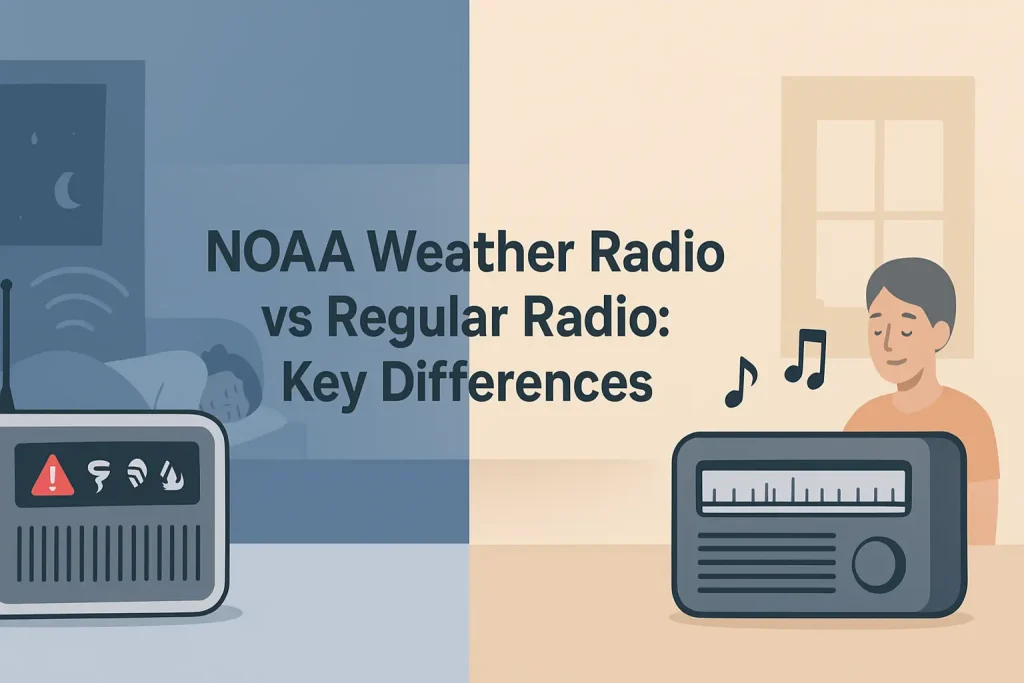
Your smart speaker can tell you a tornado warning is in effect. A dedicated weather radio will wake you up at 2 a.m. with a screaming alarm before the warning is even issued, powered by a battery backup, with zero dependence on your Wi-Fi router or cell tower. Those are fundamentally different devices solving fundamentally different problems.
This guide compares dedicated NOAA weather radios against Alexa (Amazon Echo), Google Home, and Siri (Apple HomePod) across every dimension that matters in an actual emergency: alert speed, reliability when infrastructure fails, audio clarity, S.A.M.E. filtering, and offline capability.
| Photo | Popular Portable Walkie Talkies | Price |
|---|---|---|
 | SKIWARRIOR Multifunctional Smart Wireless Ski Goggles with Walkie-Talkie, Anti-Fog Zeiss Lens, Music & Call Function (Cylindrical Blue) | Check Price On Amazon |
 | SINORISE Super Mini Walkie Talkies, Two-Way Radios, 3 Pack | Up to 12 Hours Battery Life, for Baseball Coaches, Restaurants, Retail Stores, Hospitals, Outdoor Sports & Travel | Check Price On Amazon |
 | KOSPET Tank M4C Smart Watch Rugged, Dual-Band GPS, 5ATM & IP69K Waterproof | 1.96" AMOLED Display, 170+ Sport Modes, Built-in LED Flashlight/Walkie-Talkie, Heart Rate/Sleep Monitor for Android & iPhone | Check Price On Amazon |
 | Retevis RT15 Walkie Talkies 3 Pack, Birthday Gift, Outdoor Adventure Kit | Durable, Lightweight, VOX, Key Lock, Mini Walkie Talkies for Adults, School Family Outdoor Travel Camping Hiking | Check Price On Amazon |
 | Rechargeable Walkie Talkies Toys for Kids: DIY Astronaut Walkie Talkies for Boys Christmas Birthday Gifts for 3 4 5 6 7 8 9 10 Boy Walkie Talkie Outdoor Hiking Toy 2 Way Radio Camping Outdoor Game | Check Price On Amazon |
How Each System Actually Delivers a Weather Alert to You
A dedicated weather radio receives a direct VHF broadcast from NOAA on one of seven frequencies between 162.400 MHz and 162.550 MHz, with zero intermediary steps between the transmitter and your speaker. Smart speakers receive alerts through a completely different path: your home router, your ISP, and either the Wireless Emergency Alert (WEA) system or a third-party skill that polls NWS data.
According to NOAA’s National Weather Service technical documentation, NWR transmitters broadcast continuously 24 hours a day with a typical latency of under 60 seconds from alert issuance to broadcast. Smart speaker alert delivery depends on internet latency, server processing time, and whether the alert skill or integration is active, which adds 30 seconds to several minutes of additional delay in optimal conditions.
The delivery chain for each platform breaks down as follows.
A dedicated weather radio (such as the Midland WR400) decodes the NOAA 1050 Hz alert tone directly from the VHF broadcast, triggers its alarm circuit, and activates the speaker. This happens even if your power is out, provided you have battery backup installed.
An Amazon Echo device running Alexa receives weather alerts through Amazon’s servers, which pull National Weather Service API data. The alert arrives as a notification or spoken announcement only if the device is active and your internet connection is functioning.
A Google Home or Nest device delivers alerts through Google Assistant’s integration with the NWS API. Google requires the device to be on the same Wi-Fi network and does not provide a standalone audible alarm separate from a requested query unless you use a third-party routine.
Apple HomePod with Siri delivers weather information on request or through Shortcuts automation, but does not natively receive or broadcast unsolicited NOAA weather alerts as of current firmware. It relies entirely on iPhone proximity and the WEA system for any emergency notification capability.
The single most important difference is that weather radios are push systems: they alert you without any action on your part, at any hour, even mid-sleep. Smart speakers are pull systems by default: you ask, or they notify only if a specific skill or routine is configured and your internet is live.
What Happens When the Power Goes Out or the Internet Goes Down
A weather radio with AA battery backup or a built-in rechargeable cell continues broadcasting alerts through a regional blackout. The NOAA VHF transmitter network operates on dedicated backup power, and the radio-to-speaker path has no dependency on your home’s electrical infrastructure beyond the radio’s own battery. Smart speakers go silent the moment your router loses power or your ISP drops connectivity.
FEMA’s emergency preparedness guidelines specifically list a battery-powered or hand-crank NOAA weather radio as a core emergency kit item for exactly this reason. No equivalent guidance recommends smart speakers as emergency alert devices.
Consider the infrastructure failure sequence during a major storm event. First, cellular towers become overloaded. Second, cable and fiber ISPs lose power at regional nodes. Third, home routers lose power. At each of those failure points, your smart speaker loses alert capability. A hand-crank solar weather radio has no dependency on any of those systems.
The Midland WR400 uses 6 AA batteries as backup power and will run in alert-standby mode for several days on that battery set. The Uniden BC365CRS includes a built-in battery backup that activates automatically on power loss.
Key Specifications (Midland WR400):
- Frequencies: 162.400 to 162.550 MHz (all 7 NOAA WX channels)
- S.A.M.E. alert types: 25 programmable hazard categories
- Alert memory: 50 S.A.M.E. location codes
- Battery backup: 6x AA
- Alert tone: 1050 Hz EAS attention signal
No smart speaker on the market provides equivalent offline alert capability. That is not a criticism of smart speakers as general-purpose devices. It is a statement about the fundamental design difference between a VHF receiver and a Wi-Fi speaker.
S.A.M.E. Technology: Why Weather Radio Alerts Are More Precise Than Smart Speaker Alerts
S.A.M.E. (Specific Area Message Encoding) technology allows a weather radio to filter incoming NOAA alerts by a 6-digit FIPS county code, so the radio only triggers an alarm for the specific counties you program. Without S.A.M.E., a weather radio in Houston would alarm for every alert issued across all of Texas, which includes counties hundreds of miles away. Smart speakers have no equivalent filtering mechanism at the county level.
According to NOAA’s NWR technical documentation, S.A.M.E. codes are embedded in the EAS header tone that precedes every NWR broadcast alert. A S.A.M.E.-capable receiver decodes that header and compares the embedded FIPS code against its programmed list before activating the alarm circuit.
Alexa’s weather notifications are delivered at the city or metropolitan area level, not at the county level. Google Home weather alerts are similarly coarse in geographic resolution. Neither platform implements FIPS-level filtering comparable to S.A.M.E.
This matters enormously in states with large geographic footprints. A severe thunderstorm warning in western Kansas is irrelevant to a resident of Wichita. A S.A.M.E.-programmed weather radio in Wichita stays silent for that western Kansas alert. An Alexa device set to a Kansas location may or may not announce it depending on how the NWS API feeds the data to Amazon’s notification system.
The Sangean CL-100 supports up to 25 S.A.M.E. location codes simultaneously, which means households near county lines can program both adjacent counties and receive alerts for either without false alarms from distant counties.
Key Specifications (Sangean CL-100):
- S.A.M.E. location codes: 25 simultaneous
- Alert types: 60 NWS alert categories
- Frequencies: all 7 NOAA WX channels
- Power: AC with 3x AA battery backup
- Display: county name readout with alert type
S.A.M.E. filtering is the single most practical advantage of a dedicated weather radio for households in multi-county metro areas or rural counties that border states with different severe weather patterns.
Here is the side-by-side comparison of the four alert systems across the dimensions that matter most in an emergency situation.
Product Comparison
Weather Radio vs Smart Speakers – Emergency Alert Capability Compared
Key alert delivery dimensions compared across four platforms. Sources: NOAA NWR technical documentation, FEMA emergency kit guidelines, manufacturer specs.
| Capability | NOAA Weather Radio | Amazon Alexa | Google Home | Apple Siri (HomePod) |
|---|---|---|---|---|
| Works without internet | Yes | No | No | No |
| Works without home power | Yes (battery backup) | No | No | No |
| County-level S.A.M.E. filtering | Yes (FIPS codes) | City-level only | City-level only | No filtering |
| Unsolicited audible alarm (no user action) | Yes | With skill configured | With routine set up | No (query only) |
| Alert latency from NWS issuance | Under 60 seconds | 1 to 5 minutes | 1 to 5 minutes | On request only |
| Alert types supported | 60+ NWS categories | Severe weather only | Severe weather only | Weather queries only |
| Non-weather emergency alerts (Amber, Civil Emergency) | Yes | No | No | No |
| Price range | $30 to $80 | $50 to $230+ | $50 to $300+ | $100 to $300+ |
Alert latency estimates based on NOAA NWR broadcast specifications and reported smart speaker notification delays under normal network conditions. Smart speaker alert delivery varies with network load and skill configuration. Prices verified at time of publication.
Alexa Weather Alerts: What It Can and Cannot Do
Amazon Alexa can deliver proactive weather notifications through the Alexa app’s notification settings, announce National Weather Service alerts through the “Daily Briefing” feature, and respond to voice queries about current weather and forecasts. None of those capabilities replace a dedicated weather radio for life-safety alerting because all of them require an active internet connection and a functioning Echo device.
The most useful Alexa weather feature for emergency preparedness is the “Emergency Alerts” toggle in the Alexa app settings, which enables Alexa to announce severe weather alerts for your set location without a voice query. According to Amazon’s Alexa product documentation, this feature uses NWS CAP (Common Alerting Protocol) feeds, which are the same data source as most weather apps. The announcement latency is typically 1 to 3 minutes behind NWS issuance under normal network conditions.
Alexa cannot alert you if your Echo device is unplugged, your router is offline, or your ISP has an outage. An Amazon Echo 4th generation draws power from a wall outlet with no internal battery backup. The moment your home loses power, Alexa goes silent regardless of whether a tornado warning is active.
Alexa does not support S.A.M.E.-style county-level filtering. Alert geographic resolution is tied to the address you configure in the Alexa app, which is typically resolved to a city or metro area. Residents of rural counties with small geographic footprints will not get meaningfully different alert behavior from residents of large metro areas.
Alexa is genuinely useful for asking “what is the weather forecast” or “are there any weather alerts in my area” as a convenience feature. It is not a substitute for a dedicated S.A.M.E. weather radio in any emergency preparedness context.
Google Home and Nest Weather Alerts: Capabilities and Limits
Google Home and Nest smart speakers deliver weather alerts primarily through Google Assistant routines and the Google Home app’s notification settings. Google’s Nest devices do not have a native, unprompted weather alarm equivalent to the 1050 Hz EAS tone on a dedicated weather radio. Alert delivery requires either a user query or a pre-configured Google Home routine that checks weather conditions on a schedule.
Google’s approach to emergency alerting is primarily handled through Android phones via Wireless Emergency Alerts (WEA), not through the Nest speaker line. A Google Nest Hub 2nd generation can display weather information on its screen and speak weather forecasts on demand, but it does not have a standalone alert broadcast capability that operates independently of user interaction.
Google Home routines can be set to announce weather conditions at scheduled times, such as every morning at 6 a.m. That is a forecast delivery mechanism, not an emergency alert system. A tornado warning issued at 3 a.m. would not trigger a Google Home announcement unless a specific routine was configured to check for active warnings continuously, which is not a default setting.
Google’s system shares the same fundamental offline vulnerability as Alexa. A Google Nest Mini has no internal battery backup and no VHF receiver. Power outage equals total loss of function.
The practical conclusion for Google Home is identical to Alexa: useful for weather convenience, not suitable as a standalone emergency alert device for severe weather preparedness.
Siri and HomePod Weather Alerts: The Most Limited of the Three
Apple HomePod with Siri provides the weakest emergency alert capability of the three smart speaker platforms. Siri does not proactively announce weather alerts without a user query on HomePod. All weather alert delivery through Apple’s ecosystem occurs on iPhone via Wireless Emergency Alerts (WEA) from the cellular network, not through HomePod speakers.
An Apple HomePod mini can tell you the current weather or a forecast when you ask. It will not wake you up at night with a severe weather alert. Apple’s emergency alert infrastructure is built entirely around the iPhone and WEA, which is a cellular-delivered system separate from NOAA’s VHF broadcast network.
WEA alerts are delivered at the county level through participating cellular carriers, but they depend on cellular network availability. During major storm events, cellular congestion can delay WEA delivery by several minutes. WEA also covers only a subset of NWS alert types: Tornado Warnings, Flash Flood Warnings, and Extreme Wind Warnings are included, but Watch-level alerts and many advisory-level products are not transmitted through WEA.
For Apple ecosystem users, the best combination for emergency preparedness is a dedicated portable NOAA weather alert radio for home alerting plus iPhone WEA for mobile. Relying on HomePod or Siri as your primary severe weather alert device leaves critical coverage gaps.
Alert Speed Comparison: How Fast Does Each System Actually Notify You
Alert latency from NWS issuance to your speaker matters most for fast-moving severe weather events like tornadoes, which can go from warning issuance to impact in 10 to 15 minutes. A dedicated weather radio broadcasting at 162.400 to 162.550 MHz delivers the alert within 60 seconds of NWS transmission because the signal travels from the NOAA transmitter directly to your receiver without passing through any internet infrastructure.
Smart speaker alert delivery introduces several additional steps. The NWS issues an alert, which is encoded in the CAP feed, ingested by Amazon or Google servers, processed, routed to your local device, and then announced. Under normal network conditions, this chain typically adds 1 to 5 minutes of additional latency compared to direct VHF reception.
During the storm events when alerts matter most, internet infrastructure is also most likely to be degraded. Server load on NWS APIs increases during major outbreak events. ISP routing slows under storm-related infrastructure stress. Those conditions push smart speaker latency higher at exactly the moment when speed matters most.
The NOAA NWR broadcast network uses dedicated hardened transmitter sites that continue operating through regional power failures. According to NOAA’s NWR transmitter documentation, the network covers approximately 95% of the US population and 95% of the US land area within range of at least one transmitter. You can check coverage for your specific location through the NOAA transmitter coverage map for your region.
For nighttime alerting, speed combines with volume. A weather radio’s 1050 Hz EAS tone is specifically designed to penetrate sleep. It is a jarring, loud alert tone that will wake most adults from deep sleep. Smart speaker weather notifications use the same conversational speaker voice as a recipe instruction, which is substantially less effective as a sleep-interruption tool.
Non-Weather Emergency Alerts: A Major Gap in Smart Speaker Coverage
NOAA Weather Radio All Hazards (NWR) broadcasts more than just severe weather warnings. The NWR system carries AMBER Alerts (child abduction emergencies), Civil Emergency Messages (chemical spills, nuclear incidents, law enforcement emergencies), National Information Center messages, and Radiological Hazard Warnings. None of those alert categories are delivered through Alexa, Google Home, or Siri.
According to NOAA’s NWR documentation, the system broadcasts over 60 distinct event code categories under the EAS protocol. The word “All Hazards” in the full system name is literal: NWR is the federal government’s primary public warning broadcast channel for any emergency requiring public notification, not just weather.
A Midland WR300 weather radio programmed with your county’s S.A.M.E. code will alarm for a hazardous materials release, an AMBER Alert, or a civil emergency in your county with the same automatic overnight alerting capability it provides for tornado warnings. No smart speaker provides that breadth of emergency coverage without internet connectivity.
This matters most for two scenarios: households in areas near industrial facilities where chemical release is a plausible emergency, and households with children where AMBER Alert delivery speed is a safety priority.
Smart speakers cover the weather use case with varying degrees of reliability when internet is available. They cover none of the non-weather EAS categories that NWR handles. That is a significant gap for households treating their smart speaker as a general emergency communication device.
When Smart Speakers Are Actually Better Than Weather Radios
Smart speakers genuinely outperform dedicated weather radios in several practical areas that are worth acknowledging honestly. Daily forecast delivery, radar interpretation, and real-time storm tracking are all areas where asking “Alexa, what is the weather today” produces a faster and richer response than anything a weather radio can offer.
Weather radios broadcast the recorded voice of a NOAA meteorologist reading current conditions and forecasts for a broad region on a fixed broadcast schedule. That broadcast is useful but not interactive. You cannot ask a weather radio to tell you if the rain will stop before your afternoon event. You can ask Alexa.
Smart speakers also win on non-emergency daily utility. Alexa’s integration with weather data services, Google’s real-time radar overlays in Google Home displays, and Siri’s connection to Apple Weather provide genuinely good daily weather information that a weather radio does not attempt to deliver.
For users in low-risk areas who rarely experience severe weather and primarily want forecast convenience, a smart speaker may be a fully adequate single device. The emergency preparedness argument for a dedicated weather radio becomes strongest in tornado-prone states (Oklahoma, Kansas, Texas, Alabama, Mississippi), hurricane coastal regions, and areas with frequent flash flooding.
The right answer for most households in severe weather-prone areas is both devices serving different roles. The smart speaker handles daily weather convenience, and the dedicated weather radio provides offline, battery-backed, S.A.M.E.-filtered overnight emergency alerting that no smart speaker can replicate.
Choosing the Right Weather Radio to Complement Your Smart Speaker
A S.A.M.E.-capable weather radio with battery backup is the minimum specification for any household using one as an emergency alert device. Entry-level weather radios without S.A.M.E. (sometimes labeled simply as “NOAA weather radios”) will receive all broadcasts on the seven NWR frequencies but cannot filter by county, which means the alarm triggers for every alert in your broadcast region regardless of whether it applies to your location.
The three most important specifications to evaluate when choosing a dedicated weather radio are S.A.M.E. filtering capability, battery backup type, and the number of programmable location codes.
Use the table below to compare the three most common entry-to-mid level weather radios by the specifications that matter for emergency alerting.
| Model | S.A.M.E. Codes | Alert Categories | Battery Backup | Price |
|---|---|---|---|---|
| Midland WR400 | 50 | 25 | 6x AA | $50 to $65 |
| Uniden BC365CRS | 25 | All NWS | Built-in rechargeable | $40 to $55 |
| Sangean CL-100 | 25 | 60 | 3x AA | $55 to $75 |
| Midland ER310 (portable) | Yes | All NWS | Built-in Li-ion + hand crank + solar | $50 to $70 |
| Reecom R-1630 | 999 | All NWS | 9V battery | $80 to $100 |
| Ambient Weather WR-335 | 23 | All NWS | 3x AA | $30 to $45 |
For households in high-risk severe weather zones, the Midland ER310 emergency radio offers the most resilient backup power setup: a built-in lithium-ion battery, hand-crank charging, and a solar panel, which means it can operate indefinitely without any external power source. That capability is worth the similar price point to a desktop-only model for tornado belt and hurricane coast households.
A dedicated weather radio with S.A.M.E. filtering, battery backup, and all-NWS-category coverage costs between $40 and $80 at current retail. For most households, that is the most cost-effective single investment in life-safety emergency communication available.
How to Set Up Your Weather Radio Alongside Your Smart Speaker
A dedicated weather radio placed in a bedroom and programmed with your county’s S.A.M.E. code provides overnight alerting that no smart speaker can match. The setup process takes under 10 minutes and requires knowing your county’s 6-digit FIPS code, which you can find from the NWS S.A.M.E. code lookup tool at the National Weather Service website.
Follow these steps to configure a S.A.M.E. weather radio for your specific county.
- Find your county’s FIPS S.A.M.E. code. Visit weather.gov/nwr and use the state/county lookup to find the 6-digit code for your county. Write it down before starting radio programming.
- Power the radio from AC first. Install batteries as backup but connect the AC adapter so you have stable power during programming. A power interruption during code entry can corrupt the stored codes.
- Enter programming mode. On most Midland and Uniden models, press and hold the S.A.M.E. button for 3 seconds until “PROG” appears on the display.
- Enter your county FIPS code. Use the channel selector or numeric buttons to enter each digit of the 6-digit code. The Midland WR400 uses the up/down buttons to scroll each digit, then advances to the next position automatically after 2 seconds.
- Confirm the code entry. Press the S.A.M.E. button once to confirm. The display should show your county name if it is in the radio’s internal database. If only the code number shows, the code was entered correctly but the radio lacks a name for that county.
- Select your alert categories. For full emergency coverage, leave all alert types enabled. If you want to suppress watch-level products to reduce overnight alarms, you can disable Watch alerts while keeping Warning and Advisory categories active.
- Test the programming. Press the test button (labeled “TEST” or “WX”) to confirm the radio is receiving a signal on your local NWR channel. Most modern radios auto-scan all 7 channels and lock to the strongest signal.
- Position the radio in your bedroom. Place it on a nightstand with the volume set to maximum. The 1050 Hz alert tone is designed to wake sleeping adults, but distance and closed doors reduce effective alarm volume.
After programming, test the battery backup by unplugging the AC adapter and confirming the radio remains powered. Replace batteries every 12 months even if they test as functional, because alkaline batteries degrade in storage.
To understand what NOAA Weather Radio is and how the broadcast network operates, the guide explaining what NOAA Weather Radio broadcasts and why it exists covers the technical structure of the NWR system in detail.
Which Seven NOAA Frequencies Should You Know
NOAA Weather Radio All Hazards broadcasts on seven VHF frequencies between 162.400 MHz and 162.550 MHz. Every S.A.M.E.-capable weather radio auto-scans all seven channels and locks to the one with the strongest received signal in your location. Manual channel selection is only needed if your radio is near the edge of two transmitter coverage areas and you want to lock to a specific transmitter’s geographic region.
The seven NWR broadcast frequencies are:
- WX1: 162.550 MHz
- WX2: 162.400 MHz
- WX3: 162.475 MHz
- WX4: 162.425 MHz
- WX5: 162.450 MHz
- WX6: 162.500 MHz
- WX7: 162.525 MHz
According to NOAA’s NWR transmitter documentation, WX1 (162.550 MHz) is the most widely used frequency and carries the majority of transmitters in high-density population areas. WX2 (162.400 MHz) is the second most common. Most desktop weather radios auto-select the appropriate channel during initial setup, so manual frequency entry is rarely required.
For a complete breakdown of which frequencies serve which regions, the detailed guide to all seven NOAA weather radio broadcast frequencies and their coverage areas maps each frequency to the transmitters that use it most.
Smart speakers have no knowledge of NWR frequencies because they do not receive VHF broadcasts. Alexa, Google Home, and Siri deliver weather data through internet APIs, not through radio reception. The seven NWR frequencies are relevant only to dedicated weather radio receivers and compatible scanner radios with weather band coverage.
The Real-World Emergency Scenario: Why Redundancy Matters
The most honest way to evaluate weather radios versus smart speakers is to walk through the failure scenarios of each during an actual severe weather event. Most catastrophic weather communication failures happen not because a device is inherently bad, but because a household relied on a single point of failure.
Scenario 1: Power goes out at midnight during a tornado warning. An Alexa Echo is dead. A Google Nest Hub is dead. A HomePod is dead. A Midland WR400 on 6 AA batteries alarms immediately because the NOAA transmitter 38 miles away is still broadcasting on 162.550 MHz.
Scenario 2: Internet goes out during a severe thunderstorm watch period. All three smart speaker platforms lose their NWS data feed. A weather radio continues receiving because it uses the VHF broadcast spectrum, not internet data.
Scenario 3: Cellular towers are overloaded during a regional severe weather outbreak. WEA alerts delivered to smartphones are delayed by 3 to 7 minutes. The weather radio received the alert within 60 seconds of NWS transmission because VHF radio frequency propagation is unaffected by cellular congestion.
Scenario 4: A household relies on a smart speaker with emergency alerts configured and the alert skill working correctly. The alert arrives 4 minutes after NWS issuance. In a fast-moving EF2 tornado scenario, that 4-minute delay is the difference between shelter time and impact time.
Emergency management professionals consistently recommend layered alert systems precisely because no single channel is 100% reliable. A weather radio is not an alternative to a smart speaker. It is a different layer of protection that smart speakers cannot provide.
For households located near high-risk geography, the S.A.M.E.-capable NOAA weather radio costs roughly the same as one month of a streaming subscription. The cost-to-protection ratio is extremely favorable.
Weather Radio vs Wireless Emergency Alerts on Your Phone: Where Smart Speakers Fit
Wireless Emergency Alerts (WEA) delivered to smartphones operate on a different system from both NOAA Weather Radio and smart speaker notifications. WEA uses a cellular broadcast technology called Cell Broadcast Service (CBS), which allows a single transmission to reach all compatible devices in a geographic cell simultaneously without depending on individual data connections or internet routing. WEA is meaningfully more reliable than smart speaker alert delivery but still has significant gaps compared to dedicated weather radio.
WEA delivers Tornado Warnings, Flash Flood Warnings, Extreme Wind Warnings, Tsunami Warnings, and a limited set of other high-priority alerts. It does not deliver Watches, Advisories, non-weather EAS categories, or many of the lower-tier NWS products that a weather radio broadcasts. WEA also depends on cellular infrastructure, which can fail during major disaster events that damage towers or overload capacity.
The comparison between WEA, smart speakers, and dedicated weather radios is covered in detail in our analysis of how weather radio compares to wireless emergency alert delivery on smartphones.
Smart speakers occupy the weakest position in this three-way comparison. WEA works without internet and reaches county-level geographic precision. Weather radios work without internet and reach sub-county precision through S.A.M.E. Smart speakers require both internet and a functioning home power supply to deliver any alert at all.
The recommended alert stack for a severe weather-prone household is: dedicated weather radio for home overnight alerting plus WEA on smartphones for mobile coverage. Smart speakers add zero incremental emergency alerting capability that is not already covered by those two systems.
Finding NOAA Transmitter Coverage in Your Area
Not every location in the United States has equal NOAA Weather Radio coverage. The NWR network’s 95% population coverage figure means that approximately 5% of the US population lives in areas with marginal or no reliable NWR signal. Rural areas in mountainous terrain, remote basin regions, and some portions of the rural Great Plains can fall outside consistent coverage of any single transmitter.
Before purchasing a desktop weather radio, it is worth confirming that your address receives a reliable NWR signal. NOAA provides an official transmitter map and coverage lookup tool, but signal strength in real terrain often differs from the theoretical coverage radius shown on maps.
Portable weather radios with a more sensitive receiver front end, such as the Midland WR120B, can receive weaker signals at the edge of transmitter coverage areas better than entry-level desktop models. External antenna connections, available on some higher-end models, further improve reception in fringe areas.
For households in signal-fringe areas, an outdoor or attic-mounted antenna connected to a weather radio can dramatically improve reception. A simple VHF outdoor antenna cut for 162 MHz adds 3 to 6 dBi of gain over a built-in whip antenna and can recover a reliable signal in areas where the built-in antenna produces only marginal reception.
To check coverage for specific states and transmitter locations, the resource mapping NOAA weather radio transmitters organized by state lists the active transmitter stations with their broadcast frequencies and general coverage areas for each state.
NOAA Weather Radio Apps: When Your Phone Is the Best Option
NOAA weather radio apps on iPhone and Android provide a middle path between a dedicated VHF receiver and a smart speaker. These apps stream live NOAA Weather Radio broadcasts or NWS alert feeds over internet or cellular data, providing county-level S.A.M.E. filtering and alert notifications through your phone. They outperform smart speakers for alert precision and alert category breadth but share the cellular and internet dependency that makes them inferior to dedicated receivers during infrastructure failures.
The best NOAA weather radio apps for iPhone use NWS API feeds rather than streaming the raw VHF audio, which means they deliver structured, filterable alerts rather than a continuous audio broadcast. This allows for county-level filtering, alert type selection, and background alerting similar to what a dedicated radio provides when cellular service is available.
Apps like MyRadar, Weather Underground, and the NWS official app all provide push notification weather alerts with better geographic precision than Alexa, Google Home, or Siri. They are genuinely useful additions to a weather monitoring setup for mobile use where carrying a dedicated radio is impractical.
A detailed comparison of the top-rated iPhone NOAA weather radio apps including their alert delivery mechanisms and S.A.M.E.-equivalent filtering capabilities is available in the guide covering the best NOAA weather radio apps available for iPhone users.
The key distinction between app-based alerts and dedicated weather radio remains offline capability. No app works without a cellular or Wi-Fi signal. A dedicated weather radio with battery backup works as long as the NOAA transmitter in your region is broadcasting, which is designed to continue through regional power failures.
Frequently Asked Questions About Weather Radio vs Smart Speaker Alerts
Can Alexa receive NOAA Weather Radio broadcasts directly like a dedicated receiver?
Alexa cannot receive the NOAA VHF broadcast on 162.400 to 162.550 MHz because Echo devices have no VHF radio receiver hardware. Alexa delivers weather alerts through internet-connected NWS API feeds, not through the radio frequency broadcast network. The two systems are architecturally unrelated, and no software update can give an Echo device VHF reception capability.
Some Alexa skills can stream NOAA Weather Radio audio over the internet, which provides the audio content of the NWR broadcast through your Echo speaker. However, that streamed audio requires an active internet connection, cannot trigger an autonomous alarm while the device is idle, and provides none of the hardware-level reliability of a dedicated receiver.
Do smart speakers support S.A.M.E. county-level alert filtering?
None of the three major smart speaker platforms (Amazon Alexa, Google Home, Apple HomePod with Siri) support S.A.M.E. FIPS county-level filtering. Alert geographic resolution on all three platforms is tied to the location configured in the companion app, typically resolved to a city or metro area. Dedicated weather radios filter alerts using the 6-digit FIPS code embedded in NOAA’s S.A.M.E. broadcast header, which identifies alerts down to the individual county level.
For households in large states where severe weather in one region is irrelevant to another region, this distinction produces meaningfully different alert behavior. A S.A.M.E.-programmed weather radio in Dallas, Texas, will not alarm for a tornado warning in El Paso. A smart speaker configured for Texas may surface that alert as part of a broader notification.
What is the difference between a weather radio alarm and a smart speaker weather notification?
A weather radio alarm is a hardware-triggered audible event: when the radio’s receiver decodes the EAS 1050 Hz attention tone from a NOAA broadcast, it activates the alarm circuit and drives the speaker at maximum volume regardless of whether the device is in standby mode. A smart speaker weather notification is a software-triggered audio announcement that uses the same speaker at the same volume level as any other assistant response and requires an active internet connection to receive the alert data that triggers it.
The practical difference is most significant during overnight hours. The 1050 Hz EAS tone used by weather radios is specifically engineered to penetrate sleep and is classified as an attention signal under FCC Part 11 rules governing the Emergency Alert System. Smart speaker notification audio uses no such engineering and is not designed as a sleep-interruption alert mechanism.
Can I use a smart speaker as my only emergency alert device if I live in a tornado-prone area?
Using a smart speaker as your sole emergency alert device in a tornado-prone area creates a serious gap in protection for any event that involves power outages, internet disruptions, or cellular congestion, which are conditions common during the tornado-producing storms themselves. FEMA’s emergency preparedness guidance specifically recommends a battery-powered NOAA weather radio as a core kit item because it continues operating through the infrastructure failures that accompany major severe weather events.
A smart speaker can supplement your alert setup as a daily weather convenience tool, but it does not provide the offline, battery-backed, county-filtered alerting that dedicated weather radios deliver. The combination of a dedicated weather radio in the bedroom and WEA alerts on a smartphone covers both home and mobile scenarios with meaningful redundancy.
Why does my smart speaker sometimes not announce a weather warning that my phone received?
Smart speaker weather alert delivery depends on several conditions that can each fail independently: the alert notification skill or setting must be enabled in the companion app, the device must be connected to Wi-Fi, the router must have internet access, and the NWS API feed that the platform polls must have delivered the alert data. A phone WEA alert bypasses all of those dependencies because WEA uses cell broadcast technology that sends the alert directly to your phone’s cellular radio without requiring an internet connection or any app configuration.
The most common cause of this discrepancy is that the smart speaker’s internet connection was disrupted (even briefly) at the moment the alert was processed. WEA delivers alerts through a completely separate infrastructure path, which is why it often appears on phones before any smart speaker announcement is made.
Do I need to do anything to my Alexa to receive weather alerts, or does it happen automatically?
Alexa does not automatically announce unsolicited weather alerts without configuration. You must enable emergency alerts in the Alexa app under Settings, then Notifications, then Amazon Alexa App, and toggle the “Emergency Alerts” option to on. Without this setting active, Alexa will only provide weather information when you ask for it. The setting must be configured once per account and applies to all Echo devices registered to that account.
Even after enabling the setting, Alexa’s emergency alerts require an active internet connection and will not trigger if your Echo device is unplugged or your network is down. The notification uses the standard Alexa voice announcement format, not a distinct alarm tone.
Can I get NOAA weather alerts on my phone without a smart speaker or a dedicated weather radio?
Yes. Wireless Emergency Alerts (WEA) are delivered directly to compatible smartphones over the cellular network without requiring any app, internet connection, or device configuration. WEA alerts cover Tornado Warnings, Flash Flood Warnings, Extreme Wind Warnings, Tsunami Warnings, AMBER Alerts, and Presidential Alerts. NWS weather apps such as the official NWS app, MyRadar, and Weather Underground provide additional alert categories beyond WEA with county-level precision when you have cellular or Wi-Fi data available.
Phone-based alerts cover mobile scenarios well but share the cellular infrastructure dependency that limits reliability during major events. A dedicated weather radio remains the most reliable option for home overnight alerting because it operates independently of both cellular and internet infrastructure.
How do I find which NOAA transmitter serves my area and what frequency it broadcasts on?
NOAA maintains an official transmitter location database at weather.gov/nwr that lists every NWR transmitter by state, city, frequency, and effective radiated power. Most desktop weather radios auto-scan all seven NWR frequencies (162.400 to 162.550 MHz) and lock to the strongest received signal automatically, so manual frequency selection is rarely necessary. If you live in an area served by multiple transmitters on different frequencies, you may want to manually select the transmitter whose coverage area most closely matches your county for the most accurate S.A.M.E. alert filtering.
Signal strength at your specific address can differ significantly from the theoretical coverage radius shown on the NOAA map due to terrain, building construction, and local interference. A practical test is to scan all seven channels on a weather radio and note which produces the clearest audio with the fewest dropouts.
Is there a way to make Google Home announce weather alerts automatically without asking?
Google Home does not have a native automatic weather alert announcement feature equivalent to Alexa’s Emergency Alerts setting. You can configure a Google Home routine that runs on a schedule to check for active NWS alerts and announce them, but this creates a polling-based alert system rather than a push-based alert, meaning it only announces alerts when the routine runs, not immediately when an alert is issued. A routine set to check every 15 minutes could miss a fast-moving event entirely.
Google’s emergency alerting infrastructure is centered on Android phones through WEA, not through Nest speakers. For automatic, unsolicited weather alerting through a Google Nest device, a third-party integration is required, and no currently available solution provides reliability or latency comparable to a dedicated weather radio.
What alert types does NOAA Weather Radio broadcast that smart speakers do not cover?
NOAA Weather Radio All Hazards broadcasts over 60 distinct EAS event code categories beyond severe weather. Categories not covered by any smart speaker alert system include AMBER Alerts, Civil Emergency Messages, Hazardous Materials Warnings, Nuclear Power Plant Warnings, Radiological Hazard Warnings, Evacuation Immediate orders, Shelter in Place warnings, and Law Enforcement Warnings. Smart speakers exclusively cover weather-related alert categories, and even within weather categories, only the highest-priority Warning-level products are consistently delivered.
The “All Hazards” designation in NOAA Weather Radio All Hazards reflects the full scope of the NWR broadcast mandate. For households near industrial facilities, in areas with dam failure risk, or with children at home (AMBER Alerts), the non-weather alert categories represent a meaningful additional layer of protection that no smart speaker provides.
Can I use a handheld weather radio app instead of buying a dedicated device?
A dedicated weather radio app on iPhone or Android provides most of the alert category coverage and geographic filtering of a dedicated receiver when your phone has cellular or Wi-Fi connectivity. Apps that use the NWS CAP (Common Alerting Protocol) feed can deliver county-level filtered alerts for all 60-plus NWS event categories and will push notifications in the background. The critical limitation is that all app-based alerting fails when cellular and Wi-Fi are unavailable, which is the exact failure scenario that dedicated weather radios are designed to handle.
For emergency preparedness that covers infrastructure-failure scenarios, a dedicated hardware receiver remains the most reliable option. For daily alert awareness and mobile use, a quality weather app provides genuinely useful coverage when connectivity is available.
How much does a good S.A.M.E. weather radio cost compared to a smart speaker?
A S.A.M.E.-capable weather radio with battery backup from a reputable brand (Midland, Uniden, Sangean, or Reecom) costs between $35 and $80 at current retail prices. Entry smart speakers (Amazon Echo Dot, Google Nest Mini) start around $50. Premium smart speakers with better audio (Amazon Echo 4th generation, Google Nest Audio, Apple HomePod mini) range from $100 to $300 or more. A weather radio costs less than an entry smart speaker while providing emergency alerting capability that no smart speaker at any price point replicates.
The cost-to-emergency-alerting-value ratio strongly favors a dedicated weather radio for households in severe weather-prone areas. The smart speaker serves a different and complementary function, and both devices together cost far less than the premium smart speaker tier alone.
Conclusion
A dedicated NOAA weather radio broadcasting on 162.400 to 162.550 MHz with S.A.M.E. county-level filtering and battery backup provides emergency alerting capability that Alexa, Google Home, and Siri cannot replicate: offline operation, sub-60-second alert latency, hardware-triggered sleep-penetrating alarms, and coverage of all 60-plus NWS event categories including AMBER Alerts and Civil Emergency Messages.
Smart speakers are genuinely useful for daily weather forecasts, storm tracking queries, and convenience alerting when your internet is live. They are not emergency communication devices. The right setup for a severe weather-prone household is a dedicated weather radio in the bedroom, programmed with your county’s 6-digit FIPS S.A.M.E. code, with a fresh set of backup batteries installed.
Start by confirming NOAA transmitter coverage at your address, then pick a S.A.M.E.-capable model in the $40 to $70 range, and program your county code this week. That single 10-minute setup step closes the most dangerous gap in your household’s emergency alert coverage.
| Photo | TOP RATED WALKIE TALKIES | Price |
|---|---|---|
 | Retevis RT628 Kids Walkie Talkies, Toys Gifts for 4-12 Year Old Girl Boy | Kids Camping Essentials Outdoor Toys, Birthday Gift, 22CH, VOX, Keypad Lock, Durable, Easy to Use Walkie Talkies for Kids | Check Price On Amazon |
 | Cobra ACXT545 Weather-Resistant Walkie Talkies, Rechargeable, 22 Channels | Long Range 28-Mile Two-Way Radio Set (2-Pack) | Check Price On Amazon |
 | Retevis RT388 Kids Walkie Talkies, Outdoor Toys for Kids Camping Essentials | 4-12 Year Old Boy Birthday Gift, 22 CH VOX Flashlight Clear Sound, Kids Walkie Talkies 2 Pack for Camping Hiking Adventure | Check Price On Amazon |
 | Cobra RX680 Walkie Talkies (2-Pack), IP54 Water Resistant Design | Rugged & Splashproof Two Way Radios Long Range, 60 Pre-Programmed Channels, Weather Alerts | Check Price On Amazon |
 | Retevis RT22 Walkie Talkies Long Range Rechargeable with Earpiece (2 Pack) | Slim & Lightweight 2 Way Radio For Camping & Hiking, Pocket-Friendly Antenna, Ready to Use, 10-Hour Battery, USB-C Charging | Check Price On Amazon |
 | Midland GXT1000VP4 GMRS Two-Way Radios with Headsets, Black, 2 Pack | 50 Channels, 142 Privacy Codes, Up to 36 Mile Long Range, JIS4 Water Resistant, NOAA Weather Alert, Rechargeable NiMH | Check Price On Amazon |
 | Retevis RT628 Walkie Talkies for Kids,Toys Gifts for 6-12 Years Old Boys Girls,Long Range 2 Way Radio 22CH VOX,Birthday Gift,Family Walkie Talkie for Camping Hiking Indoor Outdoor | Check Price On Amazon |