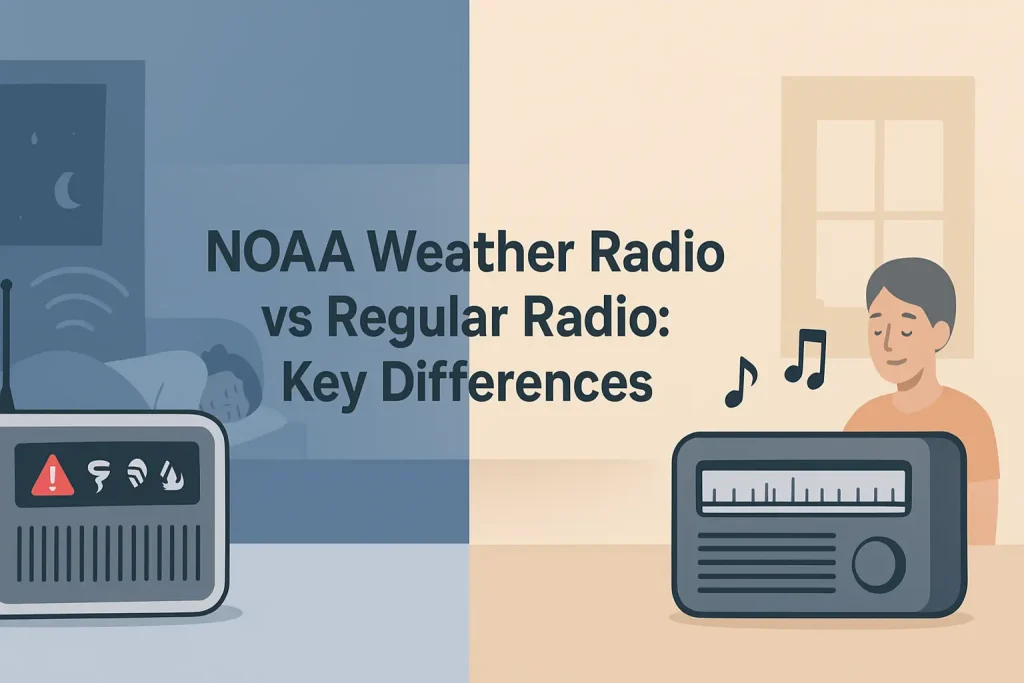
CB radio is one of the few communication tools that works when cell towers go down, power grids fail, and internet service disappears. Adding a weather alert receiver to that same radio means you get NOAA emergency broadcasts on the seven dedicated WX frequencies between 162.400 and 162.550 MHz without carrying a second device.
This guide covers the best CB radios with built-in weather alert capability, what S.A.M.E. technology means for those radios, and exactly which specs separate a radio worth buying from one that will let you down during a storm.
| Photo | Popular Portable Walkie Talkies | Price |
|---|---|---|
 | SKIWARRIOR Multifunctional Smart Wireless Ski Goggles with Walkie-Talkie, Anti-Fog Zeiss Lens, Music & Call Function (Cylindrical Blue) | Check Price On Amazon |
 | SINORISE Super Mini Walkie Talkies, Two-Way Radios, 3 Pack | Check Price On Amazon |
 | KOSPET Tank M4C Smart Watch Rugged, Dual-Band GPS, 5ATM & IP69K Waterproof | Check Price On Amazon |
 | Retevis RT15 Walkie Talkies 3 Pack, Birthday Gift, Outdoor Adventure Kit | Check Price On Amazon |
 | Rechargeable Walkie Talkies Toys for Kids: DIY Astronaut Walkie Talkies for Boys Christmas Birthday Gifts for 3 4 5 6 7 8 9 10 Boy Walkie Talkie Outdoor Hiking Toy 2 Way Radio Camping Outdoor Game | Check Price On Amazon |
What Is a CB Radio with Weather Alert and How Does It Work?
A CB radio with weather alert is a Citizens Band transceiver that adds a dedicated NOAA weather receiver to its standard 40-channel CB operation. It monitors one or more of the seven NOAA WX channels (162.400, 162.425, 162.450, 162.475, 162.500, 162.525, or 162.550 MHz) in the background while you use the CB channels normally.
According to NOAA’s National Weather Radio All Hazards program, these seven frequencies cover approximately 95% of the U.S. population within 40 miles of a transmitter. The CB side of the radio operates on the 11-meter HF band (26.965 to 27.405 MHz) under FCC Part 95D, with a legal maximum of 4 watts on AM and 12 watts peak envelope power on SSB.
The weather alert function works by scanning WX channels during standby. When the NOAA transmitter sends the 1050 Hz alert tone, the radio breaks squelch and broadcasts the emergency message through the speaker automatically.
More capable units include S.A.M.E. (Specific Area Message Encoding) technology. S.A.M.E. lets you program a 6-digit FIPS code for your specific county, so the radio only activates for alerts in your geographic area rather than for every warning broadcast statewide.
A CB radio with weather alert is a type of dual-function HF communication device. It consists of the CB transceiver circuit, a separate VHF receiver tuned to 162 MHz, a tone-detection circuit, and an alert output stage (speaker or alarm). It works with the NOAA NWR transmitter network and the Emergency Alert System to deliver public warnings in real time.
Understanding what the weather alert function actually does sets the correct expectation: this is a passive receiver for NOAA broadcasts, not a two-way weather communication system. The CB radio side handles two-way communication on 40 channels between 26.965 and 27.405 MHz under FCC Part 95D.
Why Add Weather Alert to a CB Radio Instead of a Standalone Weather Radio?
Truck drivers, off-road travelers, and mobile operators already carry a CB radio for communication. Adding a standalone NOAA weather alert radio creates a second device, a second power connection, and a second antenna mount. A combination unit eliminates all three redundancies in a single chassis.
There is also a monitoring advantage. A dedicated CB radio sits at the operator’s position tuned to Channel 19 (27.185 MHz) for highway traffic updates. A combined unit can scan WX channels during the gaps in CB traffic without the operator switching devices or missing either channel’s critical information.
The practical benefit is most significant for over-the-road truckers, RV operators, and emergency preparedness setups. For home base stations used primarily for weather monitoring, a dedicated S.A.M.E. weather radio from Midland or Uniden will offer deeper S.A.M.E. programmability and more alert types than most CB combo units.
The tradeoff is real: most CB radios with weather alert receive NOAA channels but do not include full S.A.M.E. decoding. They alert on all broadcasts for the entire NWR transmitter’s coverage area, which can span multiple counties or even multiple states from a high-power transmitter site.
If county-level precision matters for your use case, check the specific model’s documentation for S.A.M.E. support before purchasing. The Uniden BC980ST and the Cobra 29 LX MAX are the two CB radios most commonly cited for having genuine weather alert integration with alarm tone detection.
Choosing a CB radio with weather alert is the right call when you need mobile two-way CB communication and passive NOAA monitoring from one device at one mounting location. If your primary need is weather alerting with county-level precision, a dedicated S.A.M.E. weather radio is the better tool.
Best CB Radios with Weather Alert: Top Picks Compared
The CB radio market offers only a handful of models with genuine weather alert integration. Most standard CB radios cover 40 AM channels under FCC Part 95D but stop at 27.405 MHz, with no VHF receiver for NOAA WX monitoring. The models below all include dedicated WX channel monitoring as a confirmed hardware feature.
Use the table below to compare the top CB radios with weather alert across the specs that matter most for mobile and base station use.
| Model | CB Channels | WX Channels | S.A.M.E. | Max Power (AM) | SSB | Price (approx.) |
|---|---|---|---|---|---|---|
| Uniden BC980ST | 40 | 7 | No | 4W | Yes (12W PEP) | $100-130 |
| Cobra 29 LX MAX | 40 | 7 | No | 4W | Yes (12W PEP) | $90-120 |
| Cobra 75 WX ST | 40 | 7 | No | 4W | Yes (12W PEP) | $65-85 |
| Uniden BEARCAT 980SSB | 40 | 7 | No | 4W | Yes (12W PEP) | $115-145 |
| Midland 75-822 | 40 | 7 | No | 4W | No | $55-75 |
| Cobra 148 GTL | 40 | 7 | No | 4W | Yes (12W PEP) | $75-100 |
AM power limit 4W per FCC Part 95D, Section 95.435. SSB PEP limit 12W per FCC Part 95D. Prices verified at time of publication. S.A.M.E. county-level filtering is not a standard feature in current CB combo units.
None of the current production CB radios with weather alert include S.A.M.E. FIPS code filtering. This is a meaningful distinction from standalone dedicated weather alert radios built for emergency preparedness monitoring, which commonly support 25 or more programmable S.A.M.E. codes.
Uniden BC980ST: Best Overall CB Radio with Weather Alert
The Uniden BC980ST is consistently the highest-rated CB radio with weather alert among mobile operators and emergency preparedness users. It covers all 40 CB channels on AM and SSB, receives all 7 NOAA WX channels, and includes an automatic weather alert mode that activates the speaker when the 1050 Hz NOAA alert tone is detected.
Key Specifications:
- CB channels: 40 AM/SSB
- AM power output: 4W (FCC Part 95D maximum)
- SSB power output: 12W PEP (FCC Part 95D maximum)
- WX channels: 7 (162.400-162.550 MHz)
- Weather alert: Automatic 1050 Hz tone detection
- S.A.M.E.: Not included
- Display: Large backlit LCD with signal/SWR meter
- Dimensions: Mobile mount, standard DIN-slot compatible
The SSB capability is significant for range. Single sideband transmission on CB (permitted under FCC Part 95D at 12W PEP) provides roughly 3 times the effective range of 4-watt AM at equal distances, because the signal power is concentrated in one sideband rather than split across the carrier and both sidebands.
This happens because AM modulation divides the transmitter’s power between the carrier frequency and two sidebands. SSB suppresses the carrier and one sideband, concentrating all available power into a single usable sideband for a more efficient signal.
This only occurs when both stations are operating in compatible SSB modes (LSB or USB) on the same channel. If one station is in AM and the other is in SSB, the received audio will be unintelligible.
The weather alert function on the BC980ST activates automatically when NOAA broadcasts the standard emergency alert tone. The radio does not require manual channel selection to receive the alert. It monitors all 7 WX channels in a background scan and breaks squelch on whichever channel carries the active broadcast.
The Uniden BC980ST is the best overall choice because it combines SSB range capability, all-7-channel WX monitoring, automatic alert detection, and a readable display in a single mobile-mount chassis. It covers the highest-priority needs of a serious CB operator who also wants passive weather monitoring without a second device.
Cobra 29 LX MAX: Best CB Radio with Weather Alert for Truckers
The Cobra 29 LX MAX is the most widely used CB radio on Channel 19 (27.185 MHz) among over-the-road truck drivers. It includes all 7 NOAA WX channels with automatic alert, a large backlit display, and Cobra’s SoundTracker noise-reduction technology, which reduces background electrical noise from diesel engines and alternators.
Key Specifications:
- CB channels: 40 AM/SSB
- AM power output: 4W (FCC Part 95D maximum)
- SSB power output: 12W PEP
- WX channels: 7 NOAA channels
- Weather alert: Automatic tone detection
- SoundTracker: Proprietary noise reduction active on receive
- Display: Large multi-color LCD
- Backlighting: Multi-color with user-selectable color
The SoundTracker system matters in a heavy-duty vehicle environment. Diesel engines, inverters, and electric power steering systems all inject RF noise into the vehicle’s power supply at frequencies that overlap the 11-meter CB band. SoundTracker applies a receive-side filter that reduces this interference floor without affecting legitimate incoming transmissions.
This happens because electrical noise from vehicle systems enters the radio through the 12V power leads and radiates from the vehicle chassis as unintentional RF emissions. A well-filtered power connection and SoundTracker’s receive processing both reduce the noise floor at the receiver input stage.
If the vehicle’s power connection is not properly filtered and the radio’s squelch is set too low, the noise floor will open the squelch constantly, masking incoming transmissions and draining the operator’s attention. The fix is a ferrite choke on the power leads plus proper squelch threshold adjustment.
The Cobra 29 LX MAX is the strongest choice for truck and commercial vehicle operators who spend extended time on Channel 19 and need reliable weather alert monitoring across long-haul routes where regional NWR transmitters change every 40-50 miles.
Cobra 75 WX ST: Best Compact CB Radio with Weather Alert
The Cobra 75 WX ST is a handheld-style CB unit that connects to a standard mobile CB antenna and operates from a vehicle’s 12V power supply. It places the transceiver in a hand-mic form factor, with all controls built into the microphone body, making it ideal for small cab installations where a traditional dashboard-mount radio does not fit.
Key Specifications:
- CB channels: 40 AM
- AM power output: 4W (FCC Part 95D maximum)
- SSB: Not included
- WX channels: 7 NOAA channels
- Weather alert: Automatic tone detection
- Form factor: Handheld with vehicle power adapter
- Display: Compact backlit LCD on mic body
The 75 WX ST does not include SSB. This limits effective range compared to the BC980ST and Cobra 29 LX MAX on long-haul routes where SSB provides the 3x range advantage. For urban and suburban use where CB contacts are within 2-5 miles on AM, this limitation is not operationally significant.
The compact form factor makes the 75 WX ST well suited for motorcycles, small UTVs, and vehicles with minimal dashboard space. The weather alert function operates identically to full-size units, automatically activating on any of the 7 WX channels when the NOAA alert tone is detected.
The Cobra 75 WX ST is the right choice when installation space is the primary constraint and SSB range is not a requirement. It delivers full weather alert monitoring and 40-channel CB operation in the smallest available CB form factor.
Uniden BEARCAT 980SSB: Best CB Radio with Weather Alert for Base Station Use
The Uniden BEARCAT 980SSB shares its core RF design with the BC980ST but adds a larger display, more granular RF gain control, and a noise blanker circuit specifically tuned for power line interference. It is the preferred choice for fixed base station setups where the radio sits on a desk connected to a base antenna rather than a mobile vehicle antenna.
Key Specifications:
- CB channels: 40 AM/SSB
- AM power output: 4W (FCC Part 95D maximum)
- SSB power output: 12W PEP
- WX channels: 7 NOAA channels
- Weather alert: Automatic tone detection
- Noise blanker: Yes, for power line interference
- RF gain: Variable control
- Clarifier: Fine SSB tuning control
The noise blanker addresses a specific base station problem. Fixed locations near power lines, HVAC systems, and fluorescent lighting experience a different interference profile than vehicle installations. The noise blanker in the BEARCAT 980SSB targets the 60 Hz harmonics and switching transients that power line sources inject into the receive path.
The SSB clarifier control is essential for base station SSB operation. SSB on CB (Lower Sideband is the convention, per FCC Part 95D operator tradition) requires precise tuning because even a small frequency offset produces distorted, Donald Duck-sounding audio. The clarifier adjusts receive frequency in fine increments to match the transmitting station’s exact carrier frequency.
The Uniden BEARCAT 980SSB is the best base station option when fixed-location operation, SSB communication, power line noise, and all-7-channel WX monitoring are all required from a single radio. It is the most complete CB weather alert radio for home emergency preparedness use.
Midland 75-822: Best Budget CB Radio with Weather Alert
The Midland 75-822 is the lowest-cost entry point for CB radio with weather alert capability. It operates on 40 AM channels at 4W under FCC Part 95D and receives all 7 NOAA WX channels with automatic alert tone detection. There is no SSB, no noise blanker, and no SoundTracker-style processing.
Key Specifications:
- CB channels: 40 AM
- AM power output: 4W (FCC Part 95D maximum)
- SSB: Not included
- WX channels: 7 NOAA channels
- Weather alert: Automatic tone detection
- Form factor: Standard mobile mount
- Price range: $55-75
The 75-822 is the right starting point for a first CB installation where the primary goal is having both Channel 19 access and NOAA weather alerts without spending more than $75. It does everything the FCC allows a CB radio to do on AM and receives NOAA alerts reliably.
The absence of SSB means the effective range ceiling is approximately 2-5 miles in flat open terrain on AM, compared to 6-15 miles for an SSB-equipped radio under the same conditions. For a family road trip or a campground where all stations are within a few miles, the AM-only limitation is not operationally significant.
The Midland 75-822 is the correct choice when the budget is under $80 and the use case is short-range AM communication with reliable NOAA weather alert monitoring. It is not the right choice for long-haul trucking or base station use where SSB range matters.
Here is the price comparison widget, showing where each of these models sits on the cost spectrum before you commit to a purchase.
Price Comparison
CB Radios with Weather Alert – Price Comparison by Model
Street price, sorted lowest to highest. Prices verified at time of publication.
~$65
~$75
~$88
~$105
~$115
~$130
Single-unit street price. No FCC license required for CB radio operation under FCC Part 95D. All models receive all 7 NOAA WX channels. S.A.M.E. county-level filtering is not available in any current CB combo unit.
How to Set Up the Weather Alert Function on a CB Radio
Setting up the weather alert function on a CB radio with WX capability takes under five minutes once the radio is mounted and connected to a working antenna. The exact button labels vary by manufacturer, but the functional steps are identical across Cobra, Uniden, and Midland models with weather alert.
The weather alert works correctly only when the CB antenna is also capable of receiving in the 162 MHz VHF range. Most standard CB whip antennas (tuned for 27 MHz) have very poor efficiency at 162 MHz. A dedicated dual-band antenna or a separate small VHF antenna connected to the WX input (if the radio has a separate WX antenna port) will produce much better NOAA reception.
- Connect the antenna and power: Mount the radio in the vehicle, connect the 12V power leads to a switched ignition circuit, and connect the CB antenna coax to the antenna port. Confirm the antenna SWR is below 2.0:1 on Channel 19 (27.185 MHz) using an inline SWR meter before transmitting.
- Power on and locate the WX or WEATHER button: On the Cobra 29 LX MAX and Uniden BC980ST, this is a dedicated front-panel button labeled WX or WEATHER. Press it once to enter WX channel monitoring mode.
- Select the strongest WX channel: The radio will scan or step through WX channels 1-7 (162.400, 162.425, 162.450, 162.475, 162.500, 162.525, 162.550 MHz). Stop on the channel with the clearest, strongest NOAA broadcast for your location. Use a NOAA coverage map to identify which WX channel and transmitter serves your county.
- Enable automatic weather alert: On most Cobra and Uniden models, a secondary button press or menu option enables ALERT mode. In alert mode, the radio returns to its last CB channel and monitors the WX channel in the background. When the 1050 Hz NOAA alert tone is detected, the radio switches to the WX channel automatically and sounds an audible alarm.
- Set the alert volume: Some models allow independent volume control for the alert alarm versus normal receive audio. Set the alert volume high enough to be audible over road noise or sleep. For overnight monitoring at a campsite, this may require a small external speaker or leaving the radio volume at maximum.
- Verify alert function: NOAA conducts weekly tests of the alert system. The standard weekly test occurs on Wednesdays at times that vary by region. Monitor on the selected WX channel during a weekly test to confirm the alert mode activates correctly on your specific unit.
According to NOAA’s NWR technical documentation, the 1050 Hz tone precedes all emergency messages and activates S.A.M.E.-capable receivers. CB radios with weather alert use this same 1050 Hz tone detection, which is why they respond to both actual emergencies and weekly tests without county-level filtering.
If the radio does not activate during the weekly test, the most likely cause is weak WX signal reception due to antenna mismatch. The fix is to select the WX channel with the strongest signal in your area, or to add a small VHF whip antenna if the radio includes a separate WX antenna input. Properly configuring the weather alert mode during the initial setup prevents missed alerts during actual severe weather events.
CB Radio Weather Alert vs Standalone NOAA Weather Radio: Which One Should You Use?
A CB radio with weather alert and a dedicated NOAA weather radio both receive broadcasts on the seven WX channels between 162.400 and 162.550 MHz, but they serve different primary functions and deliver different levels of alert precision. Understanding the difference helps you decide whether a combo unit is sufficient or whether you need both devices.
Use the table below to decide which type of receiver fits your specific situation.
| Feature | CB Radio with Weather Alert | Dedicated NOAA Weather Radio |
|---|---|---|
| Primary function | Two-way CB communication | Weather monitoring and alerting |
| WX channels monitored | 7 (all NOAA channels) | 7 (all NOAA channels) |
| S.A.M.E. county-level filtering | Not available (current models) | Yes (25-50 FIPS codes typical) |
| Alert types supported | 1050 Hz tone only | All 25+ NWR alert event codes |
| Battery backup | Vehicle 12V only (typically) | AC + battery backup standard |
| Two-way communication | Yes (40 CB channels, 4W AM) | No (receive only) |
| False alarm rate | Higher (no county filtering) | Lower with S.A.M.E. programmed |
| Best for | Mobile operators, truckers, travelers | Home, emergency prep, fixed locations |
S.A.M.E. alert types per NOAA NWR documentation. CB power limits per FCC Part 95D, Section 95.435.
The key difference is S.A.M.E. filtering. A CB radio with weather alert will sound its alarm for every county covered by the NWR transmitter serving your location. A single high-power NWR transmitter at 1,000 watts effective radiated power can cover 6-10 counties. Without S.A.M.E. filtering, a tornado warning in a county 80 miles away will trigger the same alarm as one in your backyard.
This is a significant operational difference for home emergency preparedness use. If you are a homeowner in tornado country who needs to be woken up at 3 a.m. only for alerts affecting your specific county, a dedicated S.A.M.E.-capable weather radio is the correct tool. For more detail on understanding which NOAA broadcasts and alert categories apply to your situation, the complete explanation of how the NOAA Weather Radio All Hazards network operates covers the transmitter infrastructure, coverage zones, and alert classification system in full.
For a vehicle operator who passes through multiple counties during a shift, the absence of S.A.M.E. filtering is less problematic. Every alert from every county along the route is potentially relevant. The CB radio’s weather alert function covers this use case completely.
CB Radio Antenna and Reception Quality for Weather Alert Channels
The single most overlooked factor in CB radio weather alert performance is antenna compatibility with the 162 MHz NOAA WX frequencies. A standard CB antenna is cut for resonance at approximately 27 MHz (11 meters wavelength). The NOAA WX channels at 162 MHz are in the VHF band, more than 6 times higher in frequency. A standard CB antenna is severely mismatched at 162 MHz and provides little usable signal on WX channels.
This happens because antenna resonance depends on physical length relative to wavelength. A quarter-wave antenna for 27 MHz is approximately 108 inches (9 feet) long. A quarter-wave antenna for 162 MHz is approximately 18 inches long. The same antenna element cannot be resonant at both frequencies simultaneously without a loading coil or a separate VHF antenna element.
This only affects the receive quality of NOAA WX channels. CB transmission quality at 27 MHz is unaffected by the antenna’s performance at 162 MHz, because the CB transmitter’s output circuit and SWR matching are tuned entirely for the CB band.
If NOAA reception is poor despite the radio being in good working order, the fix options are:
- Add a small dedicated VHF whip antenna for the WX input if the radio has a separate WX antenna port (some Uniden models include this).
- Position the vehicle in an area with line-of-sight to the NOAA transmitter, since VHF signals at 162 MHz are more affected by terrain and building obstructions than the HF CB signals at 27 MHz.
- Use a dual-function CB and VHF antenna designed for both frequency ranges, which uses separate matching networks for each band.
According to NOAA’s NWR documentation, most NWR transmitters operate at either 300 or 1,000 watts ERP (effective radiated power) from antenna heights of 300-2,000 feet above ground. At these power levels, a vehicle with even a moderately mismatched antenna can typically receive NOAA audio within 30-40 miles of the transmitter site, but alert tone detection reliability drops significantly below 20 dB signal-to-noise ratio at the receiver input.
Proper antenna setup for the WX receive function is the most cost-effective improvement available for a CB radio weather alert system. A $20-30 dedicated VHF antenna improvement delivers more reliable alert detection than any software or receiver tuning adjustment.
S.A.M.E. Technology and Why Current CB Radios Do Not Include It
S.A.M.E. (Specific Area Message Encoding) is a digital header system encoded at the beginning of every NOAA Weather Radio alert broadcast. It contains a 6-digit FIPS (Federal Information Processing Standard) code identifying the specific county or counties affected by the alert. A S.A.M.E.-capable receiver decodes this header and only activates its alarm if the broadcast’s FIPS code matches one of the user-programmed codes stored in the radio.
According to NOAA’s NWR documentation, the S.A.M.E. system was developed in the 1990s and became the standard encoding format for NWR broadcasts in 1997. A dedicated S.A.M.E. weather radio can store between 25 and 50 individual FIPS codes, covering specific counties, independent cities, marine zones, or other geographically defined areas.
CB radios do not include S.A.M.E. decoding for a straightforward engineering reason: S.A.M.E. decoding requires a digital signal processor (DSP) chip capable of detecting and parsing the 1050 Hz alert tone plus the FSK (frequency shift keying) digital header that follows it. Adding this DSP to a CB radio increases component cost, firmware complexity, and manufacturing cost.
The market economics do not currently support it. The CB radio user base is primarily mobile operators (truckers, off-road, emergency) who benefit from alert monitoring across multiple counties rather than a single FIPS code. S.A.M.E. filtering reduces false alarms for a fixed home location, but a truck driver crossing 12 counties in an 8-hour shift needs all-county monitoring, not county-specific filtering.
For users who need S.A.M.E. precision alongside CB communication, the practical solution is to pair a CB radio (for two-way communication on 40 channels at 4W AM per FCC Part 95D) with a dedicated S.A.M.E. weather radio for county-level alert precision. Understanding the full range of programmable NOAA WX frequencies is essential for setting up either device correctly, and the detailed breakdown of all seven NOAA weather radio broadcast frequencies and their regional coverage patterns explains which channel to select for any U.S. location.
The absence of S.A.M.E. in CB combo units is a design choice driven by market fit, not a technical impossibility. It is the key hardware limitation to understand before relying on a CB radio’s weather alert function for county-specific emergency notification at a fixed location.
FCC Rules for CB Radio: What You Can and Cannot Do
CB radio in the United States operates under FCC Part 95D (Citizens Band Radio Service) with no license required for individual users. Any person may operate a type-accepted CB radio on all 40 designated CB channels between 26.965 and 27.405 MHz without registering with the FCC or passing any examination.
According to FCC Part 95D, Section 95.407, the maximum power output for CB radios is 4 watts on AM and 12 watts peak envelope power (PEP) on single sideband (SSB). Radios that transmit more than 4W AM or 12W PEP SSB are illegal under FCC rules regardless of the operator’s intent or claimed benefit.
The weather alert receive function on a CB radio is a receive-only feature at 162 MHz. Receiving NOAA broadcasts on VHF WX channels requires no license and no FCC authorization. The receive function itself is entirely passive and creates no regulatory obligation beyond the standard CB radio Part 95D type acceptance requirements for the transmitter portion of the device.
Operators may not legally:
- Modify the transmitter to exceed 4W AM or 12W PEP SSB output power
- Transmit on frequencies outside the 40 designated CB channels
- Use CB radio for commercial hire communication (taxi dispatch, for-hire transportation) without FCC Part 90 authorization
- Interfere intentionally with other CB radio communications
- Use external amplifiers (linear amplifiers) that boost CB output beyond legal limits
External RF amplifiers (commonly called “linears” or “boots” in CB culture) are illegal under FCC Part 95D regardless of whether they have been modified to operate on CB frequencies. The FCC has issued substantial fines (from $10,000 to $25,000 per violation) to operators of illegally modified CB transmitters. The legal 4-watt limit with a properly matched antenna is sufficient for 2-5 mile communication in most terrain, which covers the practical needs of most mobile CB operators.
No FCC license, no exam, and no registration is required to purchase and operate any type-accepted CB radio with a weather alert receiver in the United States. The weather alert receive circuit is not subject to any separate FCC authorization beyond the CB transceiver’s type acceptance certification.
Troubleshooting CB Radio Weather Alert Problems
Most CB radio weather alert failures fall into four categories: no NOAA audio, no alert activation during broadcasts, constant false alerts, and poor signal quality. Each has a specific cause and a specific fix.
Problem: The WX channel plays no audio or very weak audio.
The most common cause is antenna mismatch. The CB antenna tuned to 27 MHz has very low efficiency at 162 MHz. Move to a location with line-of-sight to the nearest NOAA transmitter, or add a dedicated VHF whip antenna to the WX input. Also confirm the radio is set to the correct WX channel for your location. Not all 7 channels are active in every region. Use the NOAA online transmitter locator to find the specific WX channel and frequency for your county.
Problem: The weather alert alarm never activates, even during NOAA weekly tests.
Confirm that ALERT mode is actually enabled on the radio, not just WX receive mode. On most Cobra and Uniden radios, WX receive mode lets you listen to NOAA broadcasts manually, while ALERT mode monitors in the background and activates automatically on the 1050 Hz tone. These are two separate functions, and the button sequence to enable them is different. Check the radio’s manual for the specific ALERT mode activation procedure for your model.
Problem: The alert activates constantly with no NOAA emergency broadcast.
This indicates interference at or near 1050 Hz on the WX channel. The 1050 Hz alert tone detector in budget-grade CB combo units can be triggered by certain AM modulation artifacts, electrical interference from the vehicle, or strong adjacent-frequency signals. Try switching to a different WX channel. If the problem persists on all channels, check for a loose ground connection in the CB antenna feedline, which can inject alternator noise into the receive path.
Problem: Audio during NOAA broadcasts is noisy or distorted.
The VHF receive circuit in CB radios with weather alert is typically a simplified design compared to dedicated weather radios. It is not shielded or optimized for low-noise VHF reception. Engine-on electrical noise from the vehicle charging system is the most common source. Install a ferrite choke on the radio’s 12V power leads close to the radio, and ensure the antenna coax ground braid is properly bonded to the vehicle chassis. If the noise is present only when the engine is running, the source is likely alternator whine, which a ferrite choke typically reduces by 10-15 dB.
Most weather alert issues in CB combo units trace to antenna or RF noise problems, not to radio failures. Resolving the antenna mismatch and power lead noise issues will fix 90% of WX reception and alert activation problems without any hardware replacement.
What to Look for When Buying a CB Radio with Weather Alert
Buying a CB radio with weather alert requires evaluating the CB radio side and the weather alert side as two separate but co-dependent systems. A radio that excels at CB communication but has a poorly implemented weather alert receiver is not a complete solution for emergency preparedness use.
For detailed guidance on evaluating all aspects of a weather alert radio purchase, the complete framework for choosing the right weather alert radio for your specific location and use case covers S.A.M.E. decoding depth, battery backup requirements, and alert type coverage in full.
Weather alert must-have features:
- All 7 NOAA WX channels (162.400-162.550 MHz), not just the most common 3-4
- Automatic 1050 Hz alert tone detection with audible alarm
- Background WX monitoring while operating on CB channels (not manual channel-switch only)
- Adequate VHF receive sensitivity (the radio’s documentation should specify this as a minimum detectable signal in microvolts or dBm)
CB radio features that affect your primary communication performance:
- SSB capability (AM only limits effective range to 2-5 miles; SSB extends this to 6-15 miles in open terrain)
- Noise blanker or SoundTracker for vehicle electrical interference reduction
- RF gain control (useful in base station setups for reducing strong nearby signals)
- SWR meter (critical for antenna tuning verification without a separate instrument)
- Channel scan (automatically scans all 40 channels for activity)
Physical and installation considerations:
- Mounting footprint (standard DIN-slot, under-dash bracket, or compact form factor)
- Microphone type and compatibility with aftermarket microphones
- Display readability in direct sunlight
- Availability of replacement parts and manufacturer support
The most common buyer mistake is choosing based on CB features alone without verifying that the weather alert implementation actually includes background monitoring with automatic activation. Some lower-cost models require the user to manually switch to WX channels to receive broadcasts, which defeats the purpose of an alert radio.
If you are also evaluating non-CB options for weather monitoring while traveling, satellite weather services offer a different kind of coverage. The comparison between terrestrial NOAA weather radio and satellite-based weather services for mobile users addresses coverage gaps, data types, and subscription costs for both approaches.
CB Radio vs Ham Radio for Weather Alert: Which Is Better for Emergency Preparedness?
CB radio and amateur (ham) radio serve different emergency preparedness roles, and both can receive NOAA weather alerts, though neither is the primary purpose of either service. The choice between them for emergency preparedness depends on your communication range needs, willingness to obtain a license, and intended operating scenarios.
CB radio operates on 40 channels between 26.965 and 27.405 MHz under FCC Part 95D with no license required. It provides 2-5 miles of effective range on AM at 4W in typical terrain, with 6-15 miles possible on SSB at 12W PEP. CB weather alert capability is built into several commercial models and covers all 7 NOAA WX channels passively.
Amateur radio operates across dozens of frequency bands from 1.8 MHz to above 1.2 GHz under FCC Part 97. The Technician license class (the entry level, requiring a 35-question written exam with no Morse code requirement) authorizes VHF and UHF operation including the 2-meter band (144-148 MHz) and 70-centimeter band (420-450 MHz). NOAA weather radio broadcasts at 162 MHz fall between these bands, but many ham radio receivers (including the popular Baofeng UV-5R and Yaesu FT-70DR) include wide-band receive capability that covers 162 MHz for weather monitoring.
Use the table below to compare the emergency preparedness capabilities of CB and amateur radio.
| Factor | CB Radio (FCC Part 95D) | Amateur Radio (FCC Part 97) |
|---|---|---|
| License required | No | Yes (Technician minimum) |
| License cost | None | $15 FCC filing fee |
| Max power (handheld) | 4W AM / 12W PEP SSB | Up to 1,500W (Technician: 1,500W on VHF/UHF) |
| Weather alert receive | Built-in on WX-capable models | Wide-band receive on most models (162 MHz) |
| Repeater access | No | Yes (local 2m and 70cm repeaters) |
| Emergency network | REACT Teams (informal) | ARES, RACES, SKYWARN (formal) |
| Best emergency use | Mobile short-range, no exam | Long-range, repeater-linked, formal nets |
Amateur radio power limits per FCC Part 97, Section 97.313. CB limits per FCC Part 95D, Section 95.435. ARES: Amateur Radio Emergency Service (ARRL program). RACES: Radio Amateur Civil Emergency Service (FEMA program).
For emergency preparedness without the commitment of a license exam, CB radio is the immediate solution. For deeper emergency communication capability including repeater-linked VHF networks, formal emergency net participation, and long-range HF communication, the Technician amateur license is a 35-question multiple-choice exam that most people can prepare for in 2-4 weeks.
Many serious emergency preparedness operators maintain both: a CB radio with weather alert for the no-license mobile capability on Channel 19, and a licensed ham radio for repeater-linked communication through ARES or RACES nets. Ham radios with wide-band receive capability can also monitor NOAA WX channels at 162 MHz, providing the same weather alert receive function as a dedicated CB weather alert radio. For more on how amateur radio supports severe weather monitoring through SKYWARN, the guide to ham radio frequencies used for weather reporting and storm spotter networks covers the specific VHF repeater channels and net procedures used during active weather events.
Frequently Asked Questions About CB Radios with Weather Alert
Do all CB radios have weather alert capability?
No. Weather alert is a separate feature, not a standard function of all CB radios. Most CB radios transmit and receive only on the 40 CB channels between 26.965 and 27.405 MHz under FCC Part 95D. Weather alert models add a separate VHF receive circuit for the seven NOAA WX channels at 162.400-162.550 MHz. Before purchasing, verify that the specific model includes “WX” or “weather alert” in its feature list, and that it includes automatic alert activation rather than just manual WX channel monitoring.
What is the difference between WX channels and S.A.M.E. on a weather radio?
WX channel monitoring means the radio can receive audio from the seven NOAA broadcast frequencies at 162.400-162.550 MHz. S.A.M.E. (Specific Area Message Encoding) is a digital header system that precedes every NOAA alert broadcast, containing a 6-digit FIPS county code. A radio with S.A.M.E. decoding only activates its alarm for alerts matching your programmed county code. A radio with WX receive but no S.A.M.E. activates for all broadcasts across the NWR transmitter’s entire coverage area, which may span 6-10 counties. No current production CB radio includes S.A.M.E. decoding.
Can I receive NOAA weather alerts on a CB radio antenna?
Technically yes, but with significantly reduced performance. CB antennas are tuned to resonate at approximately 27 MHz. NOAA WX channels are at 162 MHz, which is more than 6 times higher in frequency. The antenna mismatch reduces signal strength substantially at 162 MHz. The radio will still receive NOAA audio within 20-30 miles of a high-power NWR transmitter, but alert reliability drops in fringe areas. Adding a small dedicated VHF whip to the WX antenna input (available on some Uniden models) significantly improves NOAA reception.
Why does my CB radio’s weather alert keep going off with no apparent emergency?
The most common cause is interference triggering the 1050 Hz alert tone detector. Vehicle electrical systems, alternator noise, and nearby strong AM signals can generate artifacts at or near 1050 Hz that the alert circuit interprets as the NOAA activation tone. Try switching to a different WX channel. If the false alerts occur on all 7 WX channels, install a ferrite choke on the 12V power leads close to the radio and ensure the antenna coax shield is properly grounded to the vehicle chassis. NOAA also conducts weekly tests that will activate the alert circuit normally, typically on Wednesdays.
Is it legal to use a CB radio in a commercial truck without a license?
Yes, for communication on the 40 CB channels. CB radio operation under FCC Part 95D requires no license for any operator, including commercial vehicle operators. There is no distinction in Part 95D between personal and commercial use for standard CB communication. However, using CB radio as a dispatch system for commercial hire vehicles (where customers pay for transportation and the CB radio is used to coordinate those trips) may require additional FCC Part 90 authorization depending on the specifics. For standard trucker communication on Channel 19, no license is required.
What is the best NOAA WX channel to use for weather alerts in my area?
The best NOAA WX channel is whichever frequency has the strongest signal from the NWR transmitter serving your county. NOAA publishes a transmitter locator at weather.gov that shows every NWR transmitter location, its broadcast frequency (one of the seven between 162.400 and 162.550 MHz), its power output (300W or 1,000W ERP), and its coverage area. Enter your zip code to find the transmitter serving your location and the specific frequency it broadcasts on. Program your radio to that channel for the most reliable weather alert reception.
Can I use a CB radio’s weather alert function while transmitting on CB channels?
Yes, on radios with background WX monitoring (also called alert standby mode). In this mode, the radio monitors the WX channel passively while operating normally on CB channels. When the 1050 Hz alert tone is detected, the radio interrupts CB operation, switches to the active WX channel, and sounds the alarm. This is different from manual WX monitoring mode, where you must physically switch to a WX channel and listen. Confirm that your specific model supports background monitoring, as some budget models only offer manual WX channel access without automatic alert detection.
How far does a CB radio signal travel, and does weather affect it?
Under normal conditions, CB radio range is 2-5 miles on AM at 4W in open flat terrain, and 6-15 miles on SSB at 12W PEP in the same conditions. Weather significantly affects CB signal propagation. The 11-meter HF band (27 MHz) is subject to ionospheric skip propagation, where signals reflect off the ionosphere and travel hundreds or thousands of miles, often unexpectedly. This can cause interference from distant stations (skip interference) that makes local communication difficult. During high solar activity periods, skip propagation is more frequent and can make the CB band unusable locally for hours at a time.
What is the difference between the Cobra 29 LX MAX and the Uniden BC980ST for weather alert?
Both radios cover all 7 NOAA WX channels with automatic alert activation and both include SSB capability at 12W PEP. The Cobra 29 LX MAX includes SoundTracker noise reduction, which is specifically tuned for vehicle electrical interference and is beneficial for diesel truck operators. The Uniden BC980ST is generally rated slightly higher for overall receiver sensitivity and audio clarity. For a truck cab with significant electrical noise from the vehicle, the Cobra 29 LX MAX is the better choice. For a personal vehicle or base station where electrical noise is less severe, the Uniden BC980ST’s receiver performance is the deciding factor.
Do I need a separate antenna for NOAA weather alert on my CB radio?
It depends on the radio and your location relative to the NOAA transmitter. If you are within 20-25 miles of a high-power (1,000W ERP) NWR transmitter site with line-of-sight terrain, a standard CB whip antenna will typically deliver adequate NOAA audio despite the frequency mismatch at 162 MHz. If you are in a fringe area, in a valley, or in urban terrain with significant obstructions, adding a small VHF whip antenna (18-inch quarter-wave for 162 MHz) to the WX antenna input will improve alert reliability substantially. Some Uniden CB models include a separate WX antenna input specifically for this purpose.
Can I use a CB radio with weather alert for marine communication?
No. Marine communication uses VHF marine radio on the 156-174 MHz band under FCC Part 80, with Channel 16 (156.800 MHz) as the international distress and calling frequency. CB radio operates on HF at 26.965-27.405 MHz under FCC Part 95D and is not authorized for marine communication. A CB radio cannot transmit or receive on VHF marine channels. For marine weather monitoring specifically, the seven NOAA WX channels at 162.400-162.550 MHz broadcast maritime weather forecasts alongside land weather alerts. The dedicated guide to marine VHF weather channels and coastal NWR broadcasts covers the specific WX channels, forecast schedule, and marine-specific NOAA broadcasts for coastal and inland waterway operators.
Why does my CB radio pick up other stations from hundreds of miles away on the weather alert channel?
The CB band at 27 MHz is subject to ionospheric skip propagation, but NOAA WX channels at 162 MHz are in the VHF band and are not affected by ionospheric skip. If you are hearing distant stations on the WX channel, the most likely cause is the CB transceiver’s receive circuit picking up an out-of-band CB signal that has been harmonically distorted into the VHF range by an illegally modified transmitter nearby, or the WX receive circuit picking up a strong local VHF signal from a nearby pager, business radio, or commercial VHF transmitter adjacent to 162 MHz. Switching WX channels typically resolves interference from a specific nearby transmitter.
What happens to CB radio and weather alert when the power goes out?
A vehicle-mounted CB radio continues to operate on vehicle battery power as long as the battery is charged, independent of commercial power. Base station CB radios require a 12V DC power supply, which fails when the commercial power grid goes down unless it is connected to a battery backup power supply or generator. Most standalone NOAA weather radios include a battery backup compartment (typically 3-6 AA batteries) that keeps the alert function active during power outages. CB radios with weather alert generally do not include battery backup, which is a critical limitation for fixed-location emergency preparedness use. For outage-ready weather monitoring, a dedicated battery-backed S.A.M.E. weather radio is the more reliable solution for home use.
CB Radio with Weather Alert and Satellite Weather: Understanding the Coverage Difference
NOAA Weather Radio All Hazards covers approximately 95% of the U.S. population within 40 miles of a transmitter, according to NOAA NWR documentation. That 5% gap includes remote rural areas, mountainous terrain with blocked line-of-sight to NWR transmitters, and some coastal and offshore zones. In those areas, a CB radio’s weather alert receiver may receive no NOAA signal at all, rendering the alert function inactive precisely where weather monitoring is most critical.
Satellite weather services (including SiriusXM Weather) provide continuous coverage across North America from geostationary satellites, independent of terrain or distance from NWR transmitter sites. For operators in NOAA coverage gaps, satellite weather data provides the only continuous automated weather monitoring available without a cellular data connection.
The tradeoff is subscription cost and data type. SiriusXM Weather requires an active subscription ($20-50 per month depending on data tier) and a compatible display device. NOAA weather radio is free at point of use with no subscription. NOAA provides voice audio broadcasts with spoken forecasts and alert messages. Satellite weather services typically provide graphical radar data, storm tracking, and automated alert notifications to a display unit rather than a spoken broadcast. The comparison between NOAA weather radio and satellite weather services for mobile and remote operators details the coverage maps, data types, and total cost for each approach.
For most CB radio operators in the continental United States, NOAA WX coverage through the CB radio’s weather alert receiver is sufficient. For off-road, backcountry, and maritime operators in NOAA fringe zones, a satellite weather subscription is the backup that fills the gap. CB radio with weather alert and satellite weather are complementary tools, not direct competitors.
A CB radio with a built-in weather alert receiver is one of the most practical dual-function communication tools available without any FCC license requirement. It gives mobile operators 40-channel CB communication at 4W AM or 12W PEP SSB alongside passive NOAA monitoring on all 7 WX frequencies from a single device and a single antenna installation.
The Uniden BC980ST and Cobra 29 LX MAX are the strongest options for operators who need SSB range capability and reliable alert activation. The Midland 75-822 and Cobra 75 WX ST cover the budget and compact form factor needs. None of the current CB combo units include S.A.M.E. county-level filtering, which means a dedicated S.A.M.E. weather radio remains the right companion device for any fixed-location emergency preparedness setup that needs county-specific alert precision.
| Photo | TOP RATED WALKIE TALKIES | Price |
|---|---|---|
 | Retevis RT628 Kids Walkie Talkies, Toys Gifts for 4-12 Year Old Girl Boy | Check Price On Amazon |
 | Cobra ACXT545 Weather-Resistant Walkie Talkies, Rechargeable, 22 Channels | Check Price On Amazon |
 | Retevis RT388 Kids Walkie Talkies, Outdoor Toys for Kids Camping Essentials | Check Price On Amazon |
 | Cobra RX680 Walkie Talkies (2-Pack), IP54 Water Resistant Design | Check Price On Amazon |
 | Retevis RT22 Walkie Talkies Long Range Rechargeable with Earpiece (2 Pack) | Check Price On Amazon |
 | Midland GXT1000VP4 GMRS Two-Way Radios with Headsets, Black, 2 Pack | Check Price On Amazon |
 | Retevis RT628 Walkie Talkies for Kids,Toys Gifts for 6-12 Years Old Boys Girls,Long Range 2 Way Radio 22CH VOX,Birthday Gift,Family Walkie Talkie for Camping Hiking Indoor Outdoor | Check Price On Amazon |