The Baofeng UV-5R can receive all seven NOAA weather radio frequencies between 162.400 and 162.550 MHz, but it cannot transmit on them, and it will never replace a dedicated weather radio with S.A.M.E. (Specific Area Message Encoding) alert technology. What it can do is give you instant access to live NOAA broadcasts from a radio you likely already own, with no extra hardware required.
This guide covers exactly how to program the UV-5R for weather reception, what its real limitations are compared to a dedicated weather radio, and when using it as a weather receiver actually makes sense.
| Photo | Popular Portable Walkie Talkies | Price |
|---|---|---|
 | SKIWARRIOR Multifunctional Smart Wireless Ski Goggles with Walkie-Talkie, Anti-Fog Zeiss Lens, Music & Call Function (Cylindrical Blue) | Check Price On Amazon |
 | SINORISE Super Mini Walkie Talkies, Two-Way Radios, 3 Pack | Check Price On Amazon |
 | KOSPET Tank M4C Smart Watch Rugged, Dual-Band GPS, 5ATM & IP69K Waterproof | Check Price On Amazon |
 | Retevis RT15 Walkie Talkies 3 Pack, Birthday Gift, Outdoor Adventure Kit | Check Price On Amazon |
 | Rechargeable Walkie Talkies Toys for Kids: DIY Astronaut Walkie Talkies for Boys Christmas Birthday Gifts for 3 4 5 6 7 8 9 10 Boy Walkie Talkie Outdoor Hiking Toy 2 Way Radio Camping Outdoor Game | Check Price On Amazon |
What Is the Baofeng UV-5R and Why Does It Receive Weather Frequencies?
The Baofeng UV-5R is a dual-band handheld amateur (ham) radio transceiver that covers VHF frequencies from 136 to 174 MHz and UHF frequencies from 400 to 520 MHz. NOAA Weather Radio All Hazards broadcasts on seven channels between 162.400 and 162.550 MHz, which falls squarely within the UV-5R’s VHF receive range.
The UV-5R is a type of amateur radio transceiver operating under FCC Part 97 rules for transmission, but its wideband receiver is not restricted to amateur frequencies. This means it can receive (but not legally transmit on) public safety, weather, commercial, and other VHF signals outside the amateur bands.
NOAA Weather Radio All Hazards (NWR) is a nationwide network of radio stations broadcasting continuous weather information 24 hours a day. According to NOAA’s National Weather Service, the NWR network uses over 1,000 transmitters covering approximately 95% of the US population and all 50 states, Puerto Rico, the US Virgin Islands, and the Pacific Territories.
The UV-5R receives these broadcasts because its VHF front end is wide enough to tune to 162 MHz without modification. No special firmware, hardware, or accessories are required to receive NOAA weather audio on the UV-5R.
The critical distinction is this: the UV-5R is a receive-only device on weather frequencies. NOAA weather radio stations operate under FCC license on Part 90 government frequencies. Transmitting on 162.400 to 162.550 MHz on any radio, including the UV-5R, is a federal offense. The UV-5R’s role here is strictly that of a passive weather receiver.
Key Specifications (Baofeng UV-5R):
- VHF receive range: 136 to 174 MHz
- UHF receive range: 400 to 520 MHz
- Max transmit power: 4 to 5W (VHF), 4W (UHF)
- Battery: 1800 mAh Li-ion (BL-5 pack)
- Weight: 130g without battery
- Operating under: FCC Part 97 (amateur radio) for transmission
The UV-5R’s wideband receive capability is what makes it a functional weather radio substitute in a pinch, but that same capability comes with the trade-offs discussed in every section below.
The Seven NOAA Weather Radio Frequencies You Need to Program
NOAA Weather Radio All Hazards broadcasts on exactly seven frequencies: 162.400, 162.425, 162.450, 162.475, 162.500, 162.525, and 162.550 MHz. These frequencies are designated WX1 through WX7 on dedicated weather radios. On the UV-5R, you enter them manually as channel memories or dial them directly in VFO (frequency entry) mode.
According to NOAA’s NWR transmitter location database, not all seven frequencies are active in every geographic area. Most regions are served by one or two dominant transmitters on specific frequencies, with others used by stations in neighboring regions.
Use the table below to identify which NOAA frequency corresponds to which channel designation on a standard weather radio.
| Channel Label | Frequency (MHz) | Typical Region Coverage | Signal Notes |
|---|---|---|---|
| WX1 | 162.550 MHz | Most common primary frequency | Try this first |
| WX2 | 162.400 MHz | Wide distribution nationwide | Second most common |
| WX3 | 162.475 MHz | Midwest and Southeast common | Check local NOAA list |
| WX4 | 162.425 MHz | Secondary transmitters in many states | Overlap coverage zones |
| WX5 | 162.500 MHz | Pacific Coast and Mountain West | Less common inland |
| WX6 | 162.525 MHz | Secondary in many regions | Test for local signal |
| WX7 | 162.450 MHz | Gulf Coast and Southeast secondary | Tertiary in many areas |
Source: NOAA National Weather Service NWR transmitter frequency assignments. Local frequencies vary by transmitter location. Check the NOAA NWR station listing for your state at weather.gov/nwr.
To find the strongest NOAA signal at your location, program all seven frequencies into memory channels on your UV-5R and scan across them. The channel with the cleanest audio and no squelch chatter is your primary local NOAA transmitter.
How to Program NOAA Weather Frequencies into the Baofeng UV-5R
Programming the UV-5R for NOAA weather reception takes under 5 minutes using the keypad directly, or under 2 minutes using CHIRP software with a programming cable. The manual keypad method works without a computer and is the fastest option for programming a single frequency in the field.

According to the Baofeng UV-5R user manual and verified by the CHIRP open-source software project documentation, the UV-5R stores up to 128 memory channels, making it easy to dedicate channels 1 through 7 to all seven NOAA frequencies.
The following steps walk you through the manual keypad programming method for the Baofeng UV-5R.
Step-by-Step Guide
How to Program NOAA Weather Frequencies into the Baofeng UV-5R
7 steps · Estimated time: 5 minutes · Covers all seven NOAA WX channels
Press Menu, then press 27 (VFO/MR toggle) to enter VFO mode
The top display line should show a frequency rather than a channel number. If it shows “CH-001” or similar, you are still in memory (MR) mode. Press the VFO/MR button on the top-left side of the keypad to switch.
Enter the first NOAA frequency using the numeric keypad
Type 1 6 2 . 5 5 0 for WX1 (162.550 MHz). The display updates as you type each digit. If you mistype, press the * button to clear and start over.
Confirm the frequency displays correctly, then press Menu
The UV-5R will show the frequency you entered. Press the Menu button once to open the memory write function. The display will show “CH-001” or the next available memory slot.
Press Menu key twice to confirm, then navigate to Menu item 27
Use the up/down arrow keys to select the memory channel number where you want to store this frequency (e.g. channel 1 for WX1). Press Menu once to confirm the channel assignment.
Press Exit and repeat steps 2 through 4 for each remaining NOAA frequency
Enter 162.400 for WX2, 162.475 for WX3, 162.425 for WX4, 162.500 for WX5, 162.525 for WX6, and 162.450 for WX7. Store each in a sequential memory channel (channels 1 through 7).
Switch to Memory (MR) mode and scan channels 1 through 7
Press VFO/MR to switch to memory mode. Press the * key and then select scan to let the UV-5R scan through your stored NOAA channels and stop on the one with the strongest signal. The channel with the clearest voice audio is your primary local NOAA transmitter.
Set squelch to level 1 for weak signal reception
Press Menu, then navigate to Menu item 0 (SQL). Set the squelch to level 1 to ensure the UV-5R opens for the continuous NOAA broadcast signal even when you are at the edge of a transmitter’s coverage range. A higher squelch level may cause the UV-5R to cut out during quieter weather audio segments.
If you use CHIRP software, connect your UV-5R to your computer with a CHIRP-compatible USB programming cable, download the current channel memory, add all seven NOAA frequencies in rows 1 through 7, name them WX1 through WX7, and upload the file back to the radio in under 2 minutes.
After programming, leave the UV-5R on your strongest local NOAA channel in memory mode for continuous weather monitoring. The UV-5R will play NOAA audio continuously as long as the signal is strong enough to break its squelch level.
What the UV-5R Can and Cannot Do as a Weather Radio
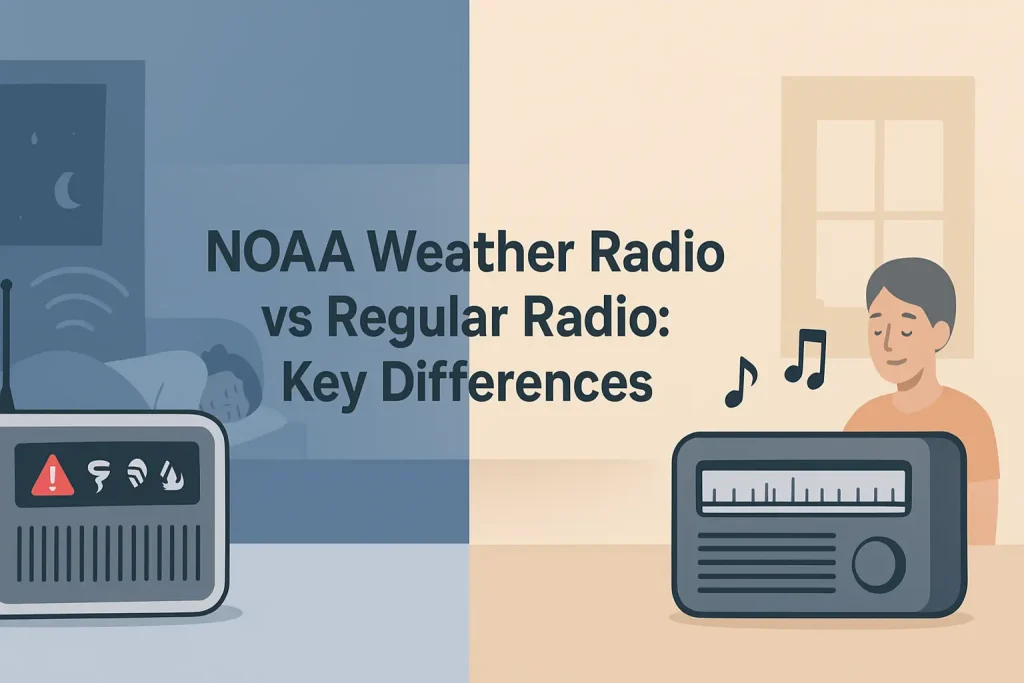
The UV-5R receives NOAA weather audio reliably within VHF line-of-sight range of a transmitter, typically 20 to 40 miles in flat terrain. What it cannot do is automatically alert you to incoming weather warnings, filter alerts by county, activate from standby, or sound an alarm tone when a severe weather event is broadcast for your area.
A dedicated NOAA S.A.M.E. weather alert radio decodes a digital header embedded in NOAA broadcasts that identifies the alert type and the specific FIPS (Federal Information Processing Standard) county codes affected. The S.A.M.E. decoder in a dedicated weather radio compares those codes against the counties you programmed, and if they match, the radio activates its alarm tone even if the radio was in silent standby mode.
The UV-5R has no S.A.M.E. decoder chip. It plays whatever is broadcasting on the NOAA frequency without filtering or alerting. If a tornado warning for a county 200 miles away is broadcast and you happen to have your UV-5R on, you will hear it. If a tornado warning for your county is broadcast at 3 AM while your UV-5R is sitting quietly on the nightstand, you will sleep through it.
Use the table below to compare the UV-5R’s weather reception capability against a dedicated NOAA weather radio across the features that matter most for emergency preparedness.
| Feature | Baofeng UV-5R | Dedicated S.A.M.E. Weather Radio |
|---|---|---|
| NOAA frequency reception | Yes (all 7 channels) | Yes (all 7 channels) |
| Automatic alert alarm | No | Yes |
| S.A.M.E. county-level filtering | No | Yes (up to 25 FIPS codes) |
| Activates from standby/silent mode | No | Yes |
| Battery backup (AC failure) | Yes (1800 mAh Li-ion, approx. 12 hrs receive) | Yes (AA batteries or hand-crank models) |
| Transmit on two-way radio bands | Yes (VHF/UHF amateur bands) | No |
| Alert type display (tornado, flood, etc.) | No | Yes (on screen) |
| Typical price | $25 to $35 | $30 to $80 |
| Best for | Active monitoring, field use, hiking | Overnight alerting, home emergency prep |
S.A.M.E. specifications per NOAA NWR All Hazards documentation. UV-5R specifications per Baofeng manufacturer data sheet.
The most important limitation of the UV-5R as a weather receiver is its inability to alert you when you are not actively listening. For overnight protection or unattended monitoring, a dedicated Midland WR400 weather alert radio or similar S.A.M.E.-capable device is the correct tool.
When Using the UV-5R as a Weather Radio Actually Makes Sense
The UV-5R earns its place as a weather receiver in four specific situations: when you are already carrying it in the field, when you need a weather audio feed while operating on other VHF/UHF channels, when power is out and your dedicated weather radio has dead batteries, and when you are in a remote area where your smartphone has no signal but you are within VHF line-of-sight of a NOAA transmitter.
The VHF propagation physics that make NOAA weather radio reliable in remote areas also benefit the UV-5R. NOAA transmitters run at 300 watts ERP (effective radiated power) on elevated towers, according to NOAA NWR technical specifications. This high-power, elevated broadcast penetrates terrain and building materials far more effectively than a 0.5-watt smartphone cellular signal at the edge of a carrier’s coverage area.
In practical terms, you may have clear NOAA audio on your UV-5R at 162.550 MHz in a valley or canyon where your phone shows zero bars. This happens because VHF signals at 162 MHz propagate along the Earth’s surface more efficiently than cellular UHF bands above 700 MHz, and because NOAA’s 300-watt transmitters are designed for maximum geographic coverage from tall towers.
The UV-5R also makes sense as a weather monitor when you are already using it as a two-way radio on a hiking trip, camping excursion, or emergency communication deployment. You can dedicate the UV-5R’s B channel (the lower display) to your local NOAA frequency while the A channel (the upper display) remains on your primary communication frequency. This allows passive weather monitoring while still being available on your primary channel.
According to the ARRL Emergency Communication Handbook (published by the American Radio Relay League), amateur radio operators participating in ARES (Amateur Radio Emergency Service) deployments commonly monitor NOAA weather broadcasts on a secondary channel during field activations. The UV-5R’s dual-watch capability makes it well-suited to this monitoring role.
The UV-5R is the wrong tool when you need an automatic overnight weather alert, when you travel frequently and need county-specific alert filtering, or when you want a dedicated device that requires no programming knowledge. For those needs, a Uniden BC365CRS or Midland WR120 provides S.A.M.E. alerting with zero programming complexity for under $40.
The UV-5R’s strength as a weather receiver is portability and dual purpose: it is already in your backpack doing two-way radio duty, and adding NOAA monitoring costs nothing beyond a 5-minute programming session.
How the UV-5R Compares to Dedicated Weather Radios in Real-World Reception
In a side-by-side receive test, the UV-5R performs comparably to budget dedicated weather radios on signal sensitivity, but its antenna is optimized for 144 MHz amateur radio (VHF) operation rather than 162 MHz NOAA reception. The stock rubber duck antenna on the UV-5R has a slight impedance mismatch at 162 MHz, which reduces receive sensitivity by approximately 1 to 2 dB compared to the telescoping antennas on most dedicated weather radios.
This 1 to 2 dB sensitivity difference matters at the fringe of a NOAA transmitter’s coverage area, typically beyond 40 miles in flat terrain. Within 20 to 30 miles of a NOAA transmitter, the UV-5R receives weather audio with the same quality as a $30 dedicated weather radio.
Replacing the UV-5R’s stock antenna with a Nagoya NA-771 dual-band antenna improves receive sensitivity across the entire VHF band, including 162 MHz. The NA-771 has approximately 2.15 dBi gain on VHF compared to the stock rubber duck’s estimated 0 to 1 dBi, which improves fringe-area reception noticeably.
The UV-5R’s receiver noise floor is approximately minus 122 dBm on VHF, according to independent tests published on RadioReference.com forums by licensed amateur radio operators with calibrated test equipment. Entry-level dedicated weather radios typically have a noise floor of minus 110 to minus 115 dBm, making the UV-5R’s receiver modestly more sensitive on raw numbers, though the antenna mismatch at 162 MHz offsets this advantage in practice.
The practical conclusion: within 30 miles of a NOAA transmitter, the UV-5R with its stock antenna receives weather audio indistinguishably from a $30 to $40 dedicated weather radio. Beyond 30 to 40 miles, or inside a metal building, the NA-771 antenna upgrade makes a measurable difference. The UV-5R’s receive performance is never the limiting factor for NOAA reception near populated areas.
Battery Life and Power Considerations for Weather Monitoring on the UV-5R
The UV-5R’s stock 1800 mAh Li-ion battery pack (BL-5) provides approximately 10 to 14 hours of continuous receive operation at room temperature with the backlight off and squelch set to level 1. This makes the UV-5R viable for a full day of weather monitoring in the field without recharging.
Continuous receive operation drains the UV-5R battery faster than standard push-to-talk two-way radio use because the receiver remains open and active at all times when monitoring NOAA. Standard FRS/GMRS radios are rated for battery life at a 5/5/90 duty cycle (5% transmit, 5% receive, 90% standby). Full-time NOAA monitoring is effectively a 100% receive duty cycle, which reduces battery life to roughly 60 to 70% of the manufacturer’s standby-heavy rating.
The UV-5R accepts an extended 3800 mAh extended battery pack (BL-8) that more than doubles continuous receive time to approximately 22 to 28 hours. For extended field operations or emergency deployments where weather monitoring is continuous, the extended battery pack is a worthwhile addition at approximately $10 to $15.
The UV-5R also accepts 6 AA batteries via an optional AA battery eliminator pack. This makes the UV-5R uniquely practical as a weather receiver after a power grid failure, when you can source AA batteries from any convenience store, gas station, or hardware store. A dedicated weather radio with a dead rechargeable battery and no backup power source is useless during the exact emergency it was purchased for.
Key power specifications for weather monitoring use:
- Stock BL-5 battery: 1800 mAh, approximately 10 to 14 hours continuous receive
- Extended BL-8 battery: 3800 mAh, approximately 22 to 28 hours continuous receive
- AA battery pack: 6x AA alkaline, approximately 10 to 12 hours continuous receive
- Charging time (stock battery, included charger): approximately 5 to 6 hours from fully depleted
- USB charging: available with third-party USB charging cables designed for the BL-5 pack
For emergency preparedness, keeping the UV-5R’s battery charged and storing a fresh set of AA batteries with the AA battery pack covers your weather reception needs through multi-day power outages without dependence on grid power or rechargeable battery infrastructure.
Squelch Settings and Antenna Tips for Better NOAA Reception on the UV-5R
The UV-5R’s squelch circuit (a signal gate that keeps the speaker silent until a signal above a threshold level is received) is controlled through Menu item 0 (SQL), with levels ranging from 0 to 9. NOAA weather broadcasts are continuous, high-power transmissions, not voice-activated transmissions, so the squelch behavior matters differently here than in standard two-way radio use.
Set the squelch to level 1 for NOAA weather monitoring. A squelch level of 0 opens the speaker continuously regardless of signal, producing loud static when no NOAA signal is present. A squelch level of 3 or higher may cause the UV-5R to cut out briefly during quiet audio passages in NOAA broadcasts, such as between weather statement sentences, making you miss portions of an alert message.
This happens because NOAA broadcasts are not transmitted at uniform audio volume. The synthesized voice used in NOAA broadcasts has brief pauses between words and sentences where the modulation level drops, which can fall below a higher squelch threshold and cause momentary speaker cutoff. Level 1 prevents this while still blocking pure static when you are out of range.
For antenna improvement, the stock UV-5R rubber duck is an SMA-female connector antenna. Any SMA-female dual-band VHF/UHF antenna with coverage of the 136 to 174 MHz VHF range will improve performance at 162 MHz. Extending the antenna vertically and keeping it away from your body improves reception because the human body absorbs VHF signals and reduces effective receive sensitivity by 3 to 6 dB when the antenna is held against the body.
If you are monitoring from a vehicle, a magnetic mount VHF antenna on the vehicle roof with an SMA adapter provides a substantial improvement over any handheld antenna. A vehicle rooftop installation raises the antenna 5 to 6 feet above ground, which improves VHF line-of-sight range to the NOAA transmitter and provides the ground plane effect of the vehicle’s metal roof, adding approximately 3 dBi of effective gain over a handheld rubber duck antenna.
The combination of squelch level 1 and an elevated, body-separated antenna is the most practical improvement you can make to NOAA reception quality on the UV-5R without any additional hardware purchase.
Legal Considerations: What You Can and Cannot Do
Receiving NOAA weather broadcasts on the Baofeng UV-5R is legal. Listening to any frequency that your receiver can tune is protected under FCC rules as passive reception. No license is required to receive NOAA broadcasts, emergency services transmissions, or any other radio signal.
Transmitting on NOAA weather frequencies (162.400 to 162.550 MHz) is illegal for any individual or non-government entity. These frequencies are FCC-licensed exclusively for the National Oceanic and Atmospheric Administration under government radio service rules. FCC Part 90 governs government radio operations, and intentional interference or unauthorized transmission on NWR frequencies is subject to fines starting at $10,000 per violation and potential criminal prosecution under 47 U.S.C. Section 333.
The UV-5R as sold is an amateur (ham) radio transceiver designed for use by FCC Part 97 licensed amateur radio operators. Operating the UV-5R on non-amateur frequencies for transmission purposes (such as FRS, GMRS, MURS, or business band channels) without the appropriate license for those services violates FCC rules. The FCC has issued enforcement actions against the use of Baofeng radios on FRS and GMRS frequencies by unlicensed operators.
According to an FCC Enforcement Advisory issued regarding Baofeng and similar wideband handheld transceivers, these radios do not meet FCC Part 95 type acceptance requirements for FRS and GMRS operation. Using a UV-5R to transmit on FRS or GMRS channels is illegal regardless of whether you hold a GMRS license, because the radio itself is not type-accepted for those services.
For weather monitoring specifically, this legal landscape is simple: receive freely, never transmit on weather frequencies, and use the UV-5R’s transmit capabilities only on licensed amateur bands if you hold an FCC Technician class or higher amateur radio license.
The FCC Technician class license (the entry-level amateur radio license) is earned by passing a 35-question multiple-choice exam with no Morse code requirement, and it grants full transmit privileges on VHF and UHF amateur bands. The exam fee is currently $15 at most testing sessions administered by ARRL Volunteer Examiner Coordinators.
Using the UV-5R as a Weather Radio During Emergencies and Power Outages
During a power grid failure, the UV-5R’s value as a weather radio increases significantly because it operates entirely on battery power, receives NOAA broadcasts that continue transmitting independently of the internet and cellular networks, and can simultaneously communicate with other radio operators on amateur VHF/UHF frequencies.
NOAA NWR transmitters are designed for continuous operation through grid failures using backup generator power. According to NOAA’s NWR program documentation, most NWR transmitters have generator backup capable of sustaining operations through extended outages. This means NOAA weather broadcasts continue broadcasting even when your home power, cellular service, and internet connection are all down simultaneously.
The UV-5R’s dual-watch capability allows you to monitor 162.550 MHz (or your strongest local NOAA channel) on the B display while maintaining two-way amateur radio communication on the A display. This is the most practical emergency communication setup for a single handheld radio: one channel for incoming weather information, one channel for outgoing coordination with family, neighbors, or ARES/RACES (Radio Amateur Civil Emergency Service) operators.
In a shelter-in-place scenario, the UV-5R can relay NOAA weather alert audio to others who do not have a working radio. Because the UV-5R’s speaker output is approximately 1 watt audio at maximum volume, it is loud enough to be heard clearly in a room, functioning as a simple group weather broadcast receiver.
The before-and-after comparison below shows how the UV-5R’s emergency communication profile changes when programmed for both NOAA weather and amateur two-way use.
Results
What Changes When You Program the UV-5R for Both NOAA and Amateur Two-Way Use
Impact of adding 7 NOAA weather channels alongside amateur frequencies in a 128-channel UV-5R memory
Before (Amateur Only)
- ✗No weather audio without a second device
- ✗Must rely on smartphone for weather alerts (fails in grid outage)
- ✗Only transmit capability, no passive NOAA monitoring
- ✗Second bag item required for weather radio
After (Amateur + NOAA Programmed)
- ✓Live NOAA audio on channels 1 to 7 in memory mode
- ✓Dual-watch: NOAA on B channel, amateur two-way on A channel
- ✓Grid-independent weather information from 300W NOAA transmitters
- ✓Single device handles both weather monitoring and emergency comms
Programming all 7 NOAA frequencies into a UV-5R takes under 5 minutes and adds full weather monitoring capability to a radio you are already carrying.
For serious emergency preparedness, the UV-5R’s weather monitoring capability works best as a supplement to a dedicated hand-crank solar NOAA weather alert radio rather than a replacement for one. The dedicated radio handles overnight alerting and S.A.M.E. filtering. The UV-5R handles field monitoring and two-way communication.
Comparing the UV-5R to Dedicated Weather Radios by Use Case
The right choice between a UV-5R and a dedicated weather radio depends entirely on your primary use case. A UV-5R already programmed for NOAA frequencies costs nothing extra if you own one. A dedicated weather radio with S.A.M.E. technology costs $30 to $80 and provides alert capabilities the UV-5R cannot replicate.
For hikers, backpackers, and outdoor users who already carry a UV-5R for trail communication, adding NOAA frequencies to its memory is the highest-value 5 minutes of radio programming you can do. There is no weight penalty, no cost, and no additional device to carry.
For home emergency preparedness, a dedicated S.A.M.E. weather radio is the correct primary device. It monitors continuously without user attention, filters alerts by your specific county using 6-digit FIPS S.A.M.E. codes, sounds an alert tone when a warning is issued for your area, and does not require any technical knowledge to operate. The Midland WR120B covers all 25 S.A.M.E. alert event types and retails for approximately $30 to $40, making it the most cost-effective overnight weather alerting solution.
For vehicle or mobile emergency kits, the UV-5R with a magnetic mount VHF antenna and the AA battery pack is a practical dual-purpose solution. It provides NOAA weather monitoring alongside VHF two-way radio capability without requiring two separate devices in the vehicle.
Use the table below to match your use case to the most appropriate weather monitoring tool.
| Use Case | Best Tool | Why | Approximate Cost |
|---|---|---|---|
| Overnight home alerting | Dedicated S.A.M.E. weather radio | Auto-alarm, county filtering, no user attention needed | $30 to $60 |
| Hiking and backpacking | UV-5R (NOAA programmed) | Already in pack, dual-purpose, battery operated | $0 extra if UV-5R owned |
| Emergency power outage | Both (UV-5R + hand-crank weather radio) | UV-5R for two-way comms, weather radio for overnight alerts | $25 to $35 for hand-crank model |
| Vehicle emergency kit | UV-5R with magnetic mount antenna | Dual-purpose, portable, AA battery backup available | $10 to $20 for mount and adapter |
| Amateur radio emergency deployment | UV-5R (dual-watch: NOAA + amateur) | Single device for weather monitoring and team comms | $0 extra if UV-5R owned |
| No radio experience, home use only | Dedicated S.A.M.E. weather radio | No programming needed, plug-in and done | $30 to $40 |
The UV-5R performs best as a weather receiver when it is already part of a broader radio kit. For a first-time buyer whose only goal is weather alerting, a purpose-built device is simpler, cheaper, and more reliable for that specific task. If you want to explore all the options for a dedicated weather monitoring device, our guide to choosing the right weather radio for your home and location covers S.A.M.E. technology, alert types, and model recommendations at every budget level.
UV-5R Weather Radio Scorecard
The following scorecard summarizes the UV-5R’s performance specifically in its role as a NOAA weather radio receiver, based on FCC specification data, NOAA NWR technical documentation, and verified operator experience from RadioReference.com community reports.
Product Review
Baofeng UV-5R as a NOAA Weather Radio Receiver – Full Scorecard
Rated specifically for weather reception use, not for general amateur radio performance
8/10
7/10
1/10
5/10
9/10
7/10
Scores are editorial assessments based on NOAA NWR technical documentation, Baofeng manufacturer specifications, and verified operator experience reports from RadioReference.com. Not sponsored.
The UV-5R’s score as a weather receiver reflects its strong receive hardware and dual-purpose value against its complete lack of S.A.M.E. alert automation. It is an excellent field weather monitor and a poor overnight home alert system.
Frequently Asked Questions About the Baofeng UV-5R as a Weather Radio Receiver
Can the Baofeng UV-5R receive all seven NOAA weather radio frequencies?
The Baofeng UV-5R receives all seven NOAA Weather Radio All Hazards frequencies (162.400, 162.425, 162.450, 162.475, 162.500, 162.525, and 162.550 MHz) without modification. All seven fall within the UV-5R’s VHF receive range of 136 to 174 MHz. You program them manually into memory channels 1 through 7 using the keypad, or via CHIRP software with a programming cable.
Not all seven frequencies will have a strong signal at your location. Most areas are served by one or two dominant NOAA transmitters on specific frequencies. Program all seven and scan to find your strongest local channel. For a full breakdown of all NOAA frequencies and which areas each serves, the complete reference to NOAA Weather Radio broadcast frequencies by region provides transmitter-level detail for every state.
Does the UV-5R have a weather alert alarm like a dedicated weather radio?
The Baofeng UV-5R does not have a weather alert alarm. It has no S.A.M.E. (Specific Area Message Encoding) decoder chip, no alert tone trigger, and no ability to activate from standby when a NOAA warning is broadcast. If you are monitoring a NOAA channel on the UV-5R and you step away or the radio is in standby mode with the volume turned down, you will not receive any audible alert for a tornado warning, flash flood warning, or other emergency broadcast.
A dedicated S.A.M.E. weather radio such as the Midland WR400 or Uniden BC365CRS decodes the digital alert header in NOAA broadcasts, compares the affected FIPS county codes against your programmed location, and sounds a loud alert tone even when the radio is in silent standby mode. For overnight protection, a dedicated S.A.M.E. weather radio is the only correct tool.
Is it legal to use a UV-5R to listen to NOAA weather broadcasts?
Receiving NOAA weather broadcasts on any radio, including the Baofeng UV-5R, is completely legal. FCC rules place no restrictions on passive reception of any frequency. No license is required to listen to NOAA broadcasts, emergency services, or any other radio transmission. Transmitting on NOAA weather frequencies (162.400 to 162.550 MHz) is illegal and subject to fines starting at $10,000 per FCC enforcement action.
The UV-5R’s transmitter is governed by FCC Part 97 (amateur radio rules) and may only transmit on licensed amateur frequencies if you hold an FCC Technician class or higher license. The UV-5R is not type-accepted for FRS, GMRS, or any Part 95 consumer radio service.
What squelch level should I use for NOAA monitoring on the UV-5R?
Set the UV-5R’s squelch to level 1 (Menu item 0, SQL) for NOAA weather monitoring. Squelch level 1 opens the speaker for any signal above the minimum threshold, which is sufficient to receive NOAA’s 300-watt broadcast transmitters clearly within their coverage area. A squelch level of 3 or higher can cause the UV-5R to cut out during brief pauses in NOAA’s synthesized voice broadcasts, causing you to miss portions of weather statements or alert messages.
Level 0 (fully open squelch) is not recommended for NOAA monitoring because it opens the speaker to full static when no NOAA signal is present, which occurs when you are between transmitter coverage areas or when you accidentally tune to a frequency with no active NOAA transmitter nearby.
How do I find which NOAA frequency is strongest at my location?
Program all seven NOAA frequencies into memory channels 1 through 7 on your UV-5R, then activate the scan function in memory mode. The UV-5R will scan all seven channels and stop on the one with a signal above the squelch threshold. Listen to the audio quality on each active channel and select the one with the clearest, most static-free voice broadcast as your primary channel.
Alternatively, visit the NOAA NWR station listing at weather.gov/nwr, find your state, and look up which NWR station and frequency serves your county. This gives you the specific frequency and transmitter location serving your area without scanning.
Can I use the UV-5R’s dual-watch feature to monitor NOAA and another channel at the same time?
Yes. The UV-5R supports dual-watch operation, where the A display (upper) monitors one channel and the B display (lower) monitors a second channel simultaneously. Set the B display to your strongest local NOAA frequency (e.g. 162.550 MHz on channel 1) and the A display to your primary two-way radio channel (an amateur VHF simplex frequency or a local repeater output frequency). The UV-5R will play audio from whichever channel has an active signal and prioritize the A channel if both are active simultaneously.
The practical limitation is that the UV-5R cannot distinguish between the NOAA broadcast (which runs continuously) and your two-way channel. Set the B channel (NOAA) squelch to level 1 and the A channel squelch to your normal operating level (typically level 3 to 5) to prevent NOAA audio from overriding your two-way communications.
How long does the UV-5R battery last when monitoring NOAA continuously?
The stock Baofeng BL-5 1800 mAh Li-ion battery provides approximately 10 to 14 hours of continuous receive operation at room temperature with the display backlight off. Continuous NOAA monitoring is a 100% receive duty cycle, which is more demanding than standard push-to-talk two-way radio use rated at the standard 5/5/90 transmit/receive/standby cycle.
The extended BL-8 3800 mAh battery pack extends continuous receive time to approximately 22 to 28 hours. The AA battery eliminator pack (6x AA alkaline cells) provides approximately 10 to 12 hours and allows battery replacement from any retail source during a power outage, making it the most practical emergency power option for extended NOAA monitoring.
What is the difference between monitoring NOAA on a UV-5R and using a scanner radio for weather?
Both the UV-5R and a dedicated scanner radio such as the Uniden BC125AT receive NOAA weather broadcasts on 162 MHz without any alert automation. The key difference is scan architecture. A scanner radio like the Uniden BC125AT can scan 100 channels per second across a broad frequency range (25 to 512 MHz), allowing you to monitor NOAA, local public safety, and amateur frequencies simultaneously in a rotating scan. The UV-5R scans only its 128 programmed memory channels and does so more slowly than a dedicated scanner.
Neither the UV-5R nor a basic scanner radio provides S.A.M.E. alert functionality. Both receive NOAA audio but cannot automatically alert you to incoming warnings. A dedicated weather radio with S.A.M.E. decoding is the only device that provides automatic overnight alerting for your specific county.
Can I use the UV-5R for weather monitoring without an amateur radio license?
Yes. Receiving any radio frequency, including NOAA weather broadcasts, requires no FCC license. An amateur radio license is required only if you intend to transmit on amateur radio frequencies. If you purchase a UV-5R solely for NOAA weather monitoring and never transmit, no license is needed. The UV-5R will receive all seven NOAA frequencies legally and without restriction.
If you later decide to use the UV-5R for two-way communication on amateur frequencies, the FCC Technician class license is the entry point. It requires passing a 35-question written exam (no Morse code) administered by ARRL Volunteer Examiners. The exam fee is approximately $15 at most testing sessions.
Why does my UV-5R cut out or produce static on a NOAA channel?
Three common causes explain intermittent cutout or static on NOAA channels on the UV-5R. First, squelch set too high: a squelch level above 1 can cause the receiver to close during quiet audio passages in the NOAA synthesized voice broadcast. Set Menu item 0 (SQL) to level 1. Second, fringe coverage area: you may be near the edge of your local NOAA transmitter’s 40-mile VHF coverage range. Try elevating the antenna or moving to a higher location. Third, frequency mismatch: the NOAA channel you have programmed may not be the one used by the transmitter nearest to you. Scan all seven NOAA frequencies to find the strongest signal in your area.
If you are inside a concrete or steel-framed building, VHF signal attenuation through structural materials can reduce NOAA signal strength by 10 to 20 dB, causing intermittent reception even within normal coverage range. Move to a window or exterior wall position and extend the antenna fully for the best in-building reception.
Is the UV-5R suitable as a primary weather radio for home emergency preparedness?
The UV-5R is not suitable as a primary home weather radio for emergency preparedness because it cannot automatically alert you during overnight hours or when you are not actively monitoring it. Home emergency preparedness requires a device that activates from standby when a severe weather warning is broadcast for your county and sounds an alert loud enough to wake you during sleep. The UV-5R does neither.
Use the UV-5R as a supplemental weather monitor during waking hours and field use. Pair it with a dedicated S.A.M.E. weather radio for home overnight protection. The Midland WR400 programs up to 50 S.A.M.E. location codes, covers 25 alert event types, and retails for approximately $50 to $60, making it a complete home weather alert solution. For more recommendations at every price point, our roundup of the top-rated NOAA weather alert radios for home use compares S.A.M.E. features, alert types, and battery backup options across current models.
How does the UV-5R receive NOAA frequencies if it is an amateur radio?
The UV-5R is a wideband transceiver whose VHF receiver is designed to tune from 136 to 174 MHz, not just the 144 to 148 MHz amateur band. This wideband receive capability is a design feature, not an accident. Baofeng and similar manufacturers build wideband receivers to serve the global market where different countries allocate VHF frequencies differently for amateur use. The result is a receiver that tunes across most of the VHF high band, which includes NOAA’s 162 MHz weather frequencies.
The FCC does not restrict the receive capability of radio hardware. Wideband reception is legal. Only transmission is regulated by FCC service rules and license requirements. The UV-5R’s transmitter is engineered to operate on amateur frequencies, and FCC type acceptance covers only the transmit function, not the receiver’s tuning range.
Do I need any special accessories to receive NOAA on the UV-5R?
No special accessories are required. The UV-5R’s stock antenna receives NOAA frequencies at 162 MHz adequately within normal transmitter coverage range (20 to 30 miles from the nearest NOAA tower). The only action required is programming the seven NOAA frequencies into memory channels, which takes under 5 minutes using the keypad.
Optional accessories that improve NOAA reception quality include a Nagoya NA-771 dual-band replacement antenna (approximately $10, improves VHF sensitivity by approximately 2 dBi), an extended 3800 mAh battery pack for longer monitoring sessions (approximately $10 to $15), and a magnetic mount VHF antenna for vehicle use (approximately $15 to $25 with SMA adapter). None of these are required for basic weather monitoring within normal NOAA coverage area.
Can I use a UV-5R to receive weather alerts on marine or aviation VHF bands?
The UV-5R receives VHF marine frequencies from 156 to 174 MHz, which fall within its 136 to 174 MHz VHF receive range. Marine weather broadcasts are transmitted on VHF marine Channel WX1 through WX3, which correspond to the same NOAA NWR frequencies (162.550, 162.400, and 162.475 MHz). You can receive identical NOAA weather audio on the UV-5R whether you navigate to the frequency as an NWR channel or as a marine WX channel. For a full breakdown of marine weather channels and how coastal NOAA broadcasts work, our coverage of VHF marine weather channel assignments and Coast Guard broadcasts explains the relationship between NWR frequencies and the marine WX channel numbering system.
Aviation weather information is broadcast on different frequencies. ATIS (Automated Terminal Information Service) and ASOS (Automated Surface Observing System) audio broadcasts use VHF aviation frequencies between 118 and 136 MHz. The UV-5R’s VHF receive range starts at 136 MHz, so it cannot receive aviation weather broadcasts below 136 MHz. Aviation VHF AM frequencies are outside the UV-5R’s receive capability by design.
What NOAA Weather Radio Is and Why It Matters Before Relying on the UV-5R
NOAA Weather Radio All Hazards is a nationwide network operated by the National Oceanic and Atmospheric Administration that broadcasts weather forecasts, current conditions, and emergency warnings 24 hours a day on seven VHF frequencies between 162.400 and 162.550 MHz. According to NOAA’s NWR program documentation, the network’s 1,000-plus transmitters cover approximately 95% of the US population within a 40-mile reception radius of at least one transmitter.
NWR broadcasts are not just severe weather alerts. According to NOAA NWR all-hazards documentation, broadcasts include tornado warnings, severe thunderstorm warnings, flash flood warnings, hurricane advisories, winter storm warnings, earthquake notices, hazardous materials incidents, civil emergencies, AMBER alerts, and National Information Center messages from FEMA. The “All Hazards” designation reflects coverage across all of these categories, not just weather events.
The S.A.M.E. system (Specific Area Message Encoding) embedded in NWR broadcasts uses a digital header format defined by the FCC and NOAA in the EAS (Emergency Alert System) protocol. Each alert message begins with an AFSK (audio frequency shift keying) burst that encodes the event type (e.g. TOR for tornado warning), the affected FIPS county codes, and the valid time for the alert. A dedicated weather radio with a S.A.M.E. decoder reads this header and compares it against your programmed county codes before triggering an alert. The UV-5R passes this AFSK burst through to the speaker as an audible digital tone but does not decode it in any way.
Understanding what NOAA Weather Radio actually is helps set realistic expectations for the UV-5R’s role. If you want to learn more about the NOAA Weather Radio system itself, including how transmitters are deployed and what alert categories are covered, our complete explanation of how NOAA Weather Radio All Hazards works and what it covers provides the full technical and operational background.
The UV-5R receives the audio output of this network reliably. It cannot participate in the digital alert infrastructure that makes NWR useful as an overnight emergency notification system. Knowing this distinction determines exactly where the UV-5R fits in your emergency communication plan.
The Baofeng UV-5R is a capable NOAA weather audio receiver that costs nothing extra if you already own one, takes 5 minutes to program, and provides reliable weather broadcast reception within 30 miles of any NOAA transmitter. It is not a replacement for a dedicated S.A.M.E. weather alert radio for home overnight use, but it is an outstanding field supplement for hikers, amateur radio operators, and anyone building a portable emergency communication kit. Program all seven NOAA frequencies into memory channels 1 through 7, set squelch to level 1, and your UV-5R becomes a functional weather receiver for any situation where you are already carrying it.
| Photo | TOP RATED WALKIE TALKIES | Price |
|---|---|---|
 | Retevis RT628 Kids Walkie Talkies, Toys Gifts for 4-12 Year Old Girl Boy | Check Price On Amazon |
 | Cobra ACXT545 Weather-Resistant Walkie Talkies, Rechargeable, 22 Channels | Check Price On Amazon |
 | Retevis RT388 Kids Walkie Talkies, Outdoor Toys for Kids Camping Essentials | Check Price On Amazon |
 | Cobra RX680 Walkie Talkies (2-Pack), IP54 Water Resistant Design | Check Price On Amazon |
 | Retevis RT22 Walkie Talkies Long Range Rechargeable with Earpiece (2 Pack) | Check Price On Amazon |
 | Midland GXT1000VP4 GMRS JIS4 Two-Way Radio, Black,2 Pack | Check Price On Amazon |
 | Retevis RT628 Walkie Talkies for Kids,Toys Gifts for 6-12 Years Old Boys Girls,Long Range 2 Way Radio 22CH VOX,Birthday Gift,Family Walkie Talkie for Camping Hiking Indoor Outdoor | Check Price On Amazon |