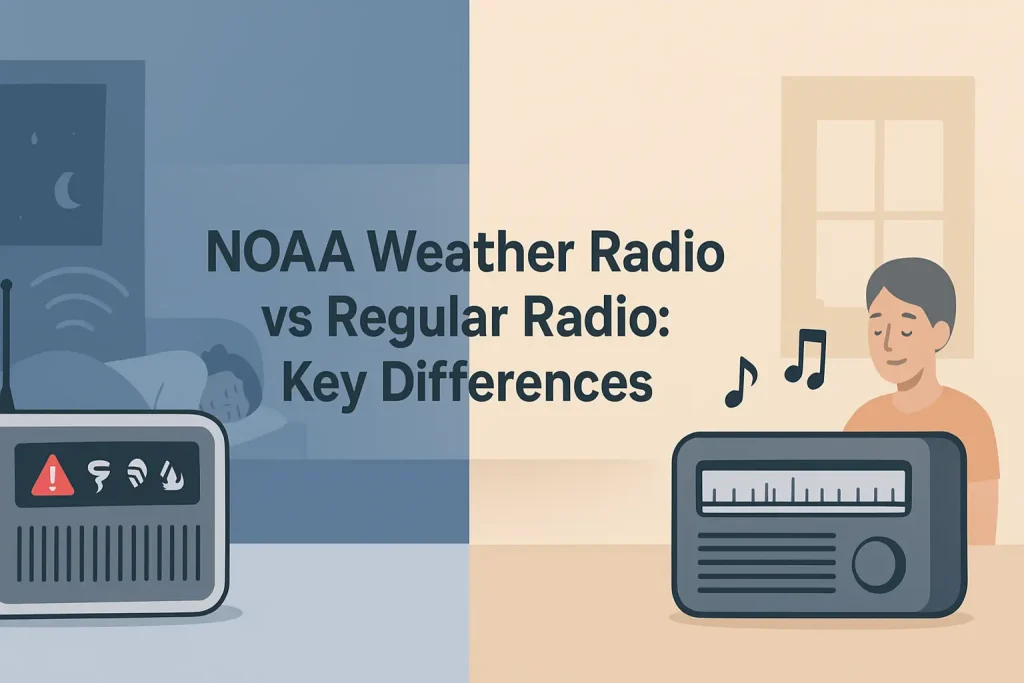
Most weather radios sit on a shelf doing nothing until a storm hits. Then they either wake you up for every county in the state, stay silent when they should alert, or run out of battery at the worst possible moment. The difference between a radio that works when it counts and one that fails comes down to 12 specific features, and most buying guides skip half of them.
This guide covers every feature that actually matters: S.A.M.E. technology, alert types, power sources, audio output, and the specs that separate a reliable emergency receiver from a glorified clock radio.
| Photo | Popular Portable Walkie Talkies | Price |
|---|---|---|
 | SKIWARRIOR Multifunctional Smart Wireless Ski Goggles with Walkie-Talkie, Anti-Fog Zeiss Lens, Music & Call Function (Cylindrical Blue) | Check Price On Amazon |
 | SINORISE Super Mini Walkie Talkies, Two-Way Radios, 3 Pack | Check Price On Amazon |
 | KOSPET Tank M4C Smart Watch Rugged, Dual-Band GPS, 5ATM & IP69K Waterproof | Check Price On Amazon |
 | Retevis RT15 Walkie Talkies 3 Pack, Birthday Gift, Outdoor Adventure Kit | Check Price On Amazon |
 | Rechargeable Walkie Talkies Toys for Kids: DIY Astronaut Walkie Talkies for Boys Christmas Birthday Gifts for 3 4 5 6 7 8 9 10 Boy Walkie Talkie Outdoor Hiking Toy 2 Way Radio Camping Outdoor Game | Check Price On Amazon |
What Is S.A.M.E. Technology and Why Does It Matter More Than Anything Else?
S.A.M.E. (Specific Area Message Encoding) is a digital filtering system built into NOAA weather radios that lets the radio alert you only for your county or counties, instead of broadcasting every alert for your entire state. According to NOAA’s National Weather Radio All Hazards technical documentation, S.A.M.E. uses 6-digit FIPS (Federal Information Processing Standard) codes to identify geographic areas down to the county level.
Without S.A.M.E., a weather radio wakes you up for every tornado warning, flood watch, and winter storm advisory issued anywhere within range of the transmitter. A single NOAA transmitter can cover 40 miles or more, meaning you may receive alerts for dozens of counties you do not live in.
A S.A.M.E.-equipped radio only activates its alarm when the incoming alert matches one of the FIPS codes you have programmed into it. You can program multiple codes, which is useful if you live near a county border or commute between counties.
The Midland WR400 weather radio supports up to 50 programmable S.A.M.E. location codes and recognizes 25 distinct alert types. Without S.A.M.E., any weather radio is essentially a noisy scanner that will exhaust its own battery and your patience within a week.
If you want to understand exactly how S.A.M.E. codes work and how to find your county’s FIPS code, our complete breakdown of how S.A.M.E. weather radio filtering works walks through the programming process step by step.
S.A.M.E. is the single most important feature on any weather radio. Every other feature on this list is secondary to it.
How Many Alert Types Does a Weather Radio Need to Cover?
NOAA’s Emergency Alert System broadcasts more than 60 distinct alert types over NWR (NOAA Weather Radio All Hazards) frequencies, ranging from tornado warnings to AMBER Alerts to hazardous materials incidents. A weather radio that only recognizes 7 or 8 alert types will stay silent for the majority of potential emergencies.
According to NOAA’s NWR documentation, the most critical alert categories include Tornado Warning, Severe Thunderstorm Warning, Flash Flood Warning, Hurricane Warning, Extreme Wind Warning, Winter Storm Warning, Hazardous Materials Warning, Civil Emergency Message, Law Enforcement Warning, and National Information Center messages.
Budget radios often support only the weather-specific alerts and skip civil emergency and law enforcement categories entirely. This is a significant gap for anyone using a weather radio as a general emergency preparedness device.
Mid-range models like the Uniden BC365CRS weather radio support 25 alert types. Premium models from Midland support the full EAS alert library of 60-plus categories.
Key Specifications for alert coverage:
- Entry-level radios: 7-10 alert types (weather only)
- Mid-range radios: 25 alert types (weather plus civil emergency)
- Premium radios: 60-plus alert types (full NOAA EAS library)
For emergency preparedness, choose a radio that covers at least 25 alert types. A radio that only covers weather alerts will miss civil emergencies, AMBER Alerts, and public safety events.
Which NOAA Frequencies Does a Weather Radio Need to Receive?
NOAA broadcasts weather alerts on seven dedicated frequencies between 162.400 MHz and 162.550 MHz. These seven channels (designated WX1 through WX7) cover 95% of the US population, according to NOAA’s NWR network documentation, with transmitters positioned to provide overlapping coverage across the continental United States, Alaska, Hawaii, and US territories.
Any weather radio sold in the United States must receive all seven frequencies to meet basic NWR coverage requirements. A radio that only receives WX1 through WX4 will miss alerts from nearby transmitters on WX5, WX6, or WX7.
The seven NOAA weather radio frequencies are:
- WX1: 162.550 MHz
- WX2: 162.400 MHz
- WX3: 162.475 MHz
- WX4: 162.425 MHz
- WX5: 162.450 MHz
- WX6: 162.500 MHz
- WX7: 162.525 MHz
Most modern weather radios receive all seven channels automatically. Confirm the specification before purchasing an older or deeply discounted model, as some discontinued radios only cover the first four channels.
Receiving all seven NOAA frequencies is a baseline requirement. It is not a premium feature. Any radio that does not cover all seven is not worth purchasing for emergency use.
What Power Sources Should a Weather Radio Have?
A weather radio is an emergency device. It must function when the power grid fails, when batteries run low, and when you are away from an outlet. The best weather radios combine three or more independent power sources: AC adapter, battery backup, hand crank, and solar panel.
The most critical combination for home emergency use is AC power with battery backup. FEMA’s emergency preparedness guidelines recommend keeping at least 72 hours of backup power for any emergency communication device. Six AA alkaline batteries in a weather radio provide approximately 24-36 hours of alert-monitoring standby time at normal volume.
Hand-crank radios generate power through a built-in dynamo. One minute of cranking typically provides 5-10 minutes of radio operation, depending on the model. This is not a primary power source. It is a last-resort option when all other power has been exhausted.
Solar panels on portable weather radios charge an internal lithium battery. Direct sunlight charging rates range from 100mW to 300mW depending on panel size. A full solar charge from empty typically takes 8-12 hours in direct sunlight.
The Eton FRX3+ emergency weather radio combines AC adapter, internal rechargeable lithium battery, hand crank, and solar panel into a single unit. It also includes a USB charging port for phones, which makes it a functional emergency power hub rather than just a receiver.
Key power source priority for a home emergency radio:
- AC adapter (primary power for daily monitoring)
- AA battery backup (48-72 hours of standby during outages)
- Rechargeable internal battery (charged by AC, solar, or crank)
- Hand crank (last resort only)
For a detailed look at weather radios with multiple power backup options including solar and hand crank, our review of portable weather radios built for extended power outages compares runtime, charging rates, and emergency lighting features across the top models.
A weather radio with only AC power is not an emergency device. It is a countertop appliance that becomes useless the moment the grid goes down.
How Loud Does a Weather Radio Need to Be?
NOAA weather alerts are designed to wake sleeping people. A weather radio needs to produce at least 85 dB of audio output at 10 feet to reliably wake an adult in a closed bedroom. Most budget weather radios produce 70-75 dB, which is insufficient to penetrate a closed door or wake a heavy sleeper.
Audio output is rated in watts for the amplifier and decibels for the speaker. A 1-watt audio amplifier driving a quality speaker produces louder, clearer sound than a 2-watt amplifier driving a small, resonant speaker. Speaker quality matters as much as amplifier wattage.
The Midland WR120B weather radio produces a siren alarm in addition to the standard NOAA voice broadcast. This siren function can exceed 90 dB at close range, making it effective for waking people in adjacent rooms.
Some radios allow you to set separate volume levels for the alert alarm and the voice broadcast. This lets you keep the voice volume low for daytime monitoring while keeping the alarm volume high for overnight use.
If your bedroom is more than 15 feet from your weather radio or separated by a closed door, choose a model rated at 90 dB or higher. Lower-rated models will not reliably wake you during a nighttime alert.
What Display Features Matter on a Weather Radio?
A weather radio display serves two functions: showing you the current alert type and status during an active emergency, and displaying programming information so you can verify your S.A.M.E. codes and alert settings. A radio without a display forces you to rely entirely on audio readouts, which makes initial programming difficult and error verification nearly impossible.
The most useful display features are a scrolling alert message that shows the alert type and affected counties in text form, a clock with date display, and a battery level indicator. Backlit displays are important for nighttime readability during power outages.
Some models include a color-coded LED alert indicator. The Midland WR400 uses a red LED for immediate threats (tornado warnings, extreme wind) and an orange LED for watches and advisories. This lets you quickly assess threat level without reading the full display message.
For people who want weather radio functionality built into a bedside alarm clock, our guide to weather radios with alarm clock displays covers the models that combine time display, wake alarm, and NOAA alert reception in a single unit.
A display is not decorative. It is your only way to verify that your S.A.M.E. codes are programmed correctly before you need them in an emergency.
Does a Weather Radio Need a Flashlight?
A built-in flashlight does not improve a weather radio’s reception or alert reliability. It does make a significant difference during the scenario you are most likely to face: a nighttime power outage after a severe weather event. Locating a separate flashlight in a dark house during a storm costs time you may not have.
Flashlights on weather radios range from basic single-LED units producing 30-50 lumens to multi-mode lights producing 100-150 lumens with strobe and SOS modes. The strobe and SOS modes serve as visual distress signals if you need to signal rescuers.
The Eton FRX3+ hand-crank emergency radio with flashlight combines a 100-lumen LED flashlight with SOS strobe mode, a NOAA weather radio receiver, AM/FM broadcast reception, and a USB phone charging port. For a single emergency kit device, it covers more scenarios than any other single product in the category.
A flashlight is not a core radio feature. It is a practical emergency preparedness bonus that adds genuine value during the exact scenarios a weather radio is designed for.
What Is the Difference Between a Weather Watch, Warning, and Advisory?
NOAA issues three distinct alert severity levels over NWR, and a weather radio that cannot distinguish between them through its alarm behavior is less useful than one that does. A watch means conditions are favorable for severe weather to develop. A warning means severe weather is occurring or imminent. An advisory means conditions are less severe but still potentially hazardous.
According to NOAA’s National Weather Service definitions: a Tornado Warning means a tornado has been detected by radar or spotted by a trained spotter and is occurring or imminent. A Tornado Watch means atmospheric conditions favor tornado development. The distinction matters because a warning requires immediate protective action while a watch requires monitoring.
Some weather radios allow you to set different alarm behaviors for watches versus warnings. The Midland WR400 lets you disable watch alerts while keeping warning alerts active, so you are only woken up for immediate threats rather than for every watch issued overnight.
A weather radio that treats all alert types identically (same alarm, same volume, same behavior) will train you to ignore alarms. The ability to differentiate alert severity is a feature that directly affects whether you respond appropriately to a real emergency.
How Does Antenna Quality Affect Weather Radio Reception?
NOAA transmits on frequencies between 162.400 MHz and 162.550 MHz, which is in the VHF high band. VHF high band signals travel by line-of-sight propagation, meaning the signal weakens significantly when terrain, buildings, or distance obstruct the path between you and the transmitter. Antenna quality directly determines whether your radio receives a clear signal at the edge of a transmitter’s coverage area.
Most weather radios use a short telescoping whip antenna. Extended to its full length, this antenna is tuned for the 162 MHz frequency range and produces the best reception. Collapsed or fully retracted, the antenna is significantly detuned and reception drops proportionally.
If you live more than 30 miles from the nearest NOAA transmitter, an external antenna connection becomes important. Some desktop weather radios include a coaxial antenna input that accepts an external VHF antenna mounted in the attic or on the roof. An external antenna elevated 15-20 feet above ground level can extend reliable reception range by 10-20 miles compared to an indoor telescoping whip.
The outdoor VHF antenna for NOAA weather radio is a useful addition for rural users whose telescoping whip produces marginal signal quality. A stronger signal means faster, cleaner alert reception with less chance of a corrupted S.A.M.E. code failing to trigger the alarm.
Always fully extend your weather radio’s telescoping antenna and orient it vertically. A collapsed or horizontal antenna can reduce signal strength by 40-60% on weak signals near the edge of transmitter coverage.
What Is the Role of a Weather Radio’s Squelch and Scan Features?
Squelch is a circuit that keeps the speaker silent until a signal of sufficient strength is received. On a weather radio, squelch prevents the radio from broadcasting static and noise during periods when no NOAA transmission is active. Without squelch, the speaker would emit constant white noise between broadcasts.
Most weather radios set squelch automatically and do not expose it as a user-adjustable setting. This is appropriate for basic home use. A radio that receives continuous static from a weak or distant transmitter may have its squelch threshold set too low. If this happens, repositioning the antenna or switching to a different NWR channel (WX1 through WX7) with a stronger signal from a closer transmitter resolves the issue.
The scan function cycles through all seven NOAA channels to find the one with the strongest signal and locks onto it. This is useful when you first set up a radio in a new location or after moving. Radios without a scan function require you to manually tune through all seven channels and judge reception quality by ear.
The Sangean CL-100 tabletop weather radio includes automatic channel scan with signal strength display, which shows which NWR channel has the strongest signal at your location before you lock it in. This is a useful feature for first-time setup and for users who receive marginal signal quality.
Use the scan function once during setup, then lock the radio onto the strongest channel. Scanning continuously wastes the radio’s processing time and can cause it to switch channels during a weak signal event, potentially missing an alert.
Do You Need a Weather Radio with AM/FM Reception?
A weather radio with AM/FM reception serves as both an emergency alert receiver and a general-purpose broadcast radio. During a prolonged power outage, local AM and FM stations often broadcast emergency updates, shelter locations, and public safety information that supplements NOAA’s automated alerts. Having both functions in a single device reduces the number of items you need to maintain and power in an emergency kit.
AM broadcast operates between 530 kHz and 1700 kHz and provides better building penetration than FM. FM broadcast operates between 87.5 MHz and 108 MHz and provides better audio quality for voice communication. During emergencies, AM stations often carry official emergency management broadcasts because AM signals travel farther and penetrate structures more reliably than FM.
The Midland ER310 emergency crank weather radio with AM/FM includes NOAA weather alert reception, AM/FM tuning, a USB phone charger, a built-in flashlight, and hand-crank plus solar charging. It is the most comprehensive single-unit emergency communication device in its price range.
AM/FM reception adds genuine value in an emergency. It is not merely a convenience feature. Local broadcast stations carry information that NOAA’s automated alert system does not, including shelter-in-place instructions and road closure updates.
How Do You Choose Between a Portable and Desktop Weather Radio?
Desktop weather radios are designed for permanent placement in a bedroom, kitchen, or living area. They typically offer larger speakers for better audio output, AC power as the primary source with battery backup, and larger displays with more detailed alert information. The tradeoff is that they stay in one location and are not useful if you need to evacuate or are away from home.
Portable weather radios run on rechargeable internal batteries, disposable AA or AAA cells, or a combination of solar and hand-crank power. They are lighter, smaller, and designed to function away from AC power. Audio output is typically lower (70-80 dB) than desktop models due to smaller speaker enclosures.
For most households, the best approach is one desktop unit as the primary home alert device and one portable unit as part of a go-bag or evacuation kit. The desktop unit handles nighttime alerting with high-volume alarms. The portable unit travels with you if conditions require evacuation.
Use the table below to match your use case to the right type of weather radio.
| Feature | Desktop Weather Radio | Portable Weather Radio |
|---|---|---|
| Primary power | AC adapter | Battery or rechargeable |
| Battery backup | 6x AA alkaline (24-36 hrs) | Built-in lithium or AA cells |
| Audio output | 85-95 dB typical | 70-82 dB typical |
| Speaker quality | Larger enclosure, better bass | Compact enclosure, narrower range |
| Display | Large with scrolling alerts | Small or no display |
| S.A.M.E. codes | Up to 50 programmable | Up to 25 programmable |
| Alert types | 25-60+ types | 7-25 types |
| Portability | No (requires AC outlet) | Yes (battery independent) |
| Best use case | Permanent home placement | Travel, go-bag, evacuation kit |
| Price range | $30-$100 | $35-$120 |
For a comprehensive comparison of the top-rated models across both categories, our guide to the highest-rated NOAA weather radios available today ranks desktop and portable units side by side with tested alert performance data.
Buy a desktop unit for your bedroom and a portable unit for your emergency kit. One device cannot optimally serve both scenarios at the same time.
Feature 1: S.A.M.E. Technology
S.A.M.E. is the most critical feature on any weather radio. Without it, the radio alerts you for every county within the transmitter’s range, not just yours. According to NOAA’s NWR technical specifications, a single transmitter can cover 1,000-3,000 square miles depending on terrain, meaning a non-S.A.M.E. radio may alert you for 20-50 counties you do not live in.
Every serious weather radio purchase should start with confirming S.A.M.E. is present. The FIPS code for your county is available at the NOAA weather radio S.A.M.E. code lookup tool on weather.gov.
Feature 2: Alert Type Count
Choose a radio that supports at least 25 alert types. This covers weather emergencies, civil emergencies, AMBER Alerts, and law enforcement warnings. A radio supporting only 7-10 alert types will miss the majority of non-weather NOAA broadcasts.
The difference in price between a 10-alert radio and a 25-alert radio is typically $10-$20. That gap is not worth the reduction in emergency coverage.
Feature 3: All 7 NOAA Frequencies
Verify that any radio you consider receives all seven NWR channels: 162.400, 162.425, 162.450, 162.475, 162.500, 162.525, and 162.550 MHz. This is standard on all modern weather radios sold in the US but may be missing on deeply discounted or discontinued models.
A radio that misses even one channel risks missing alerts from a transmitter on that frequency that provides the clearest signal at your location.
Feature 4: Multiple Power Sources
The minimum power configuration for a home emergency weather radio is AC adapter plus AA battery backup. The batteries must be fresh, not the ones that have been sitting in the radio since purchase.
For a go-bag or evacuation kit, add hand-crank or solar charging capability. The Kaito KA500 solar and hand-crank emergency radio provides five power sources including AA batteries, USB charging, solar, hand crank, and AC, making it one of the most power-redundant portable emergency radios available.
Feature 5: Audio Output and Alarm Volume
85 dB minimum for a bedroom alert radio. 90 dB or higher if the radio is in a separate room from where you sleep. Test the alarm volume in your home before relying on it.
A separate alert volume setting (different from the voice broadcast volume) is a useful feature on any radio used as a wake-up alarm.
Feature 6: Display with Alert Text
A scrolling text display that shows the alert type and affected areas is more useful than a simple LED indicator during an active emergency. It lets you quickly assess the threat type and whether it affects your county without waiting for the full audio broadcast to cycle.
Color-coded alert LEDs (red for immediate threats, amber for watches and advisories) add value for nighttime use when you want to assess alert severity at a glance before sitting up to read the display.
Feature 7: S.A.M.E. Code Capacity
Basic weather radios allow 1-5 S.A.M.E. code entries. Mid-range models allow 10-25 codes. Premium models like the Midland WR400 allow up to 50 codes. If you spend significant time in multiple locations (home county, work county, vacation home) or live near multiple county borders, higher code capacity is directly useful.
A radio with only 1 programmable S.A.M.E. code cannot alert you for a second location without reprogramming the first. This is a meaningful limitation for anyone who travels with their radio.
Feature 8: Alarm Differentiation by Threat Level
The ability to set different alarm behaviors for warnings versus watches prevents alarm fatigue. A radio that sounds the same maximum-volume siren for a Tornado Warning as it does for a Freeze Watch will eventually cause you to stop reacting to alarms.
Look for radios that let you assign different alarm tones or volumes to different alert categories. This feature is present on the Midland WR400 and several Uniden desktop models. It is absent on most entry-level units under $30.
Feature 9: Antenna Quality and External Connection
For urban users within 20 miles of a NOAA transmitter, the built-in telescoping antenna is sufficient. For rural users beyond 30 miles from the nearest transmitter, an external antenna coaxial input (typically BNC or F-connector) on the radio allows connection to an outdoor VHF antenna for significantly improved reception.
The outdoor VHF antenna with coaxial cable for weather radio can be mounted in an attic or on an exterior wall and connected to a desktop weather radio with an external antenna input, extending reliable reception range by 15-25 miles compared to an indoor whip.
Feature 10: Scan Function and Channel Lock
A scan function that cycles through all seven NWR channels and identifies the strongest signal simplifies setup and improves reliability. Without it, you must manually tune through all seven channels and rely on audio quality to select the best one.
Once you have identified the strongest channel at your location, lock the radio to that channel. Continuous scanning wastes power and creates a small risk of the radio locking onto a weaker channel during an alert if the primary channel has a momentary signal drop.
Feature 11: Backlight and Visibility in the Dark
Weather radios alert during nighttime storms more often than any other time. A display that is not backlit or that uses a dim passive LCD is unreadable in a dark room during a power outage. An LED-backlit display with adjustable brightness is the minimum standard for any radio intended for nighttime bedroom use.
Some radios include a night-light mode that keeps a dim backlight active continuously for use as an emergency room light during power outages. This is a minor but useful feature when every lumen counts during a blackout.
Feature 12: USB Phone Charging Port
A USB charging port on a weather radio (typically rated at 1A or 2.1A output) allows you to charge a smartphone from the radio’s internal battery during a power outage. This transforms the radio from a single-function alert device into a communication hub that keeps your phone operational when you need it most.
The USB charging feature is most valuable on portable radios with large internal lithium batteries (typically 2,000-4,000 mAh). A 2,000 mAh internal battery can provide approximately one full smartphone charge before it needs recharging via solar or hand crank.
The Midland ER310 emergency weather radio with USB phone charger provides 2,000 mAh of internal battery capacity, 130 lumens of LED flashlight output, and NOAA weather alert reception with S.A.M.E. filtering. It is among the most capable single-unit emergency preparedness radios available under $60.
USB charging is not essential for a bedside desktop unit that runs on AC power. It is highly valuable on any portable emergency radio that you intend to use away from the grid.
How to Compare Specific Weather Radio Models
Use the table below to compare the key specs that determine whether a weather radio will perform reliably in an emergency.
| Model | S.A.M.E. Codes | Alert Types | Power Sources | Flashlight | USB Charging | Price (approx.) |
|---|---|---|---|---|---|---|
| Midland WR120B | 25 | 25 | AC + AA backup | No | No | $30-$40 |
| Midland WR400 | 50 | 25 | AC + AA backup | No | No | $50-$65 |
| Uniden BC365CRS | 25 | 25 | AC + AA backup | No | No | $35-$50 |
| Eton FRX3+ | 7 | 7 | AC, crank, solar, Li-ion | Yes (100 lm) | Yes (1A) | $50-$70 |
| Midland ER310 | 25 | 25 | AC, crank, solar, Li-ion | Yes (130 lm) | Yes (2.1A) | $50-$65 |
| Sangean CL-100 | 25 | 25 | AC + AA backup | No | No | $60-$80 |
| Kaito KA500 | 7 | 7 | AA, crank, solar, USB-in | Yes | Yes | $40-$55 |
Note: Prices verified at time of publication. S.A.M.E. code capacity and alert type counts from manufacturer specifications. “7 alert types” indicates weather-only coverage without civil emergency or AMBER Alert support.
For an in-depth look at one of the most popular entry-level options, our hands-on review of the Midland WR120B and how it performs in real-world alert scenarios covers programming, audio output, and battery backup performance in detail.
The Midland ER310 offers the best combination of S.A.M.E. code capacity, alert types, power source redundancy, and USB charging for a portable unit under $65. The Midland WR400 is the best desktop choice if maximum S.A.M.E. code capacity (50 codes) is a priority.
Here is a visual overview of how the top weather radio models compare across the features that matter most in a real emergency.
Price Comparison
Weather Radio Models – Price Comparison by Tier
Street price sorted lowest to highest. Prices verified at time of publication.
~$35
~$43
~$47
~$57
~$60
~$58
~$70
Single-unit street prices. All models receive all 7 NOAA NWR frequencies (162.400-162.550 MHz). S.A.M.E. code capacity and alert type counts from manufacturer specifications. Prices verified at time of publication.
Common Mistakes When Buying and Using a Weather Radio
The most common and consequential mistake is buying a weather radio and never programming the S.A.M.E. codes. A radio sitting in factory default mode with no S.A.M.E. codes entered will sound for every alert broadcast within transmitter range. Most people who report that their weather radio “goes off constantly for no reason” have not programmed their county’s FIPS code.
The second most common mistake is buying a radio with only one power source. A desktop weather radio that runs only on AC power becomes completely non-functional during the grid outages that most severe weather events cause. The battery backup must contain fresh batteries, not dead ones from a previous emergency.
The third mistake is placing the radio in a closed cabinet or drawer “to keep it out of the way.” A weather radio in a closed cabinet may not produce enough audio volume to wake you. It must be in the open, with its antenna fully extended, in the room where you sleep.
The fourth mistake is never testing the radio. NOAA conducts weekly Required Monthly Tests (RMTs) and periodic Required Weekly Tests (RWTs) over NWR. These tests are broadcast on the same frequencies and with the same S.A.M.E. encoding as real alerts. If your radio does not respond to a weekly test, it will not respond to a real alert. Test your radio’s response to RWT broadcasts every month and replace the batteries at least annually.
For a complete guide to operating and programming your receiver after purchase, our step-by-step guide to setting up and using a NOAA weather radio correctly walks through S.A.M.E. code entry, channel selection, and alert testing from initial power-on through first real emergency response.
A weather radio you have never tested is a decoration. Program it, test it against the weekly NOAA test broadcast, and verify that your county’s FIPS code triggers the alarm correctly.
What to Expect from a Weather Radio at Every Price Point
Entry-level weather radios in the $25-$40 range, such as the Midland WR120B, provide S.A.M.E. filtering, 25 alert types, all 7 NOAA frequencies, and AA battery backup. They cover the essential features for reliable home use without extras.
Mid-range radios in the $40-$70 range add features like 50 S.A.M.E. code capacity, color-coded LED indicators, AM/FM reception, hand-crank power, USB charging, and built-in flashlights. The Eton FRX3+ emergency radio sits in this range and adds substantial value through power redundancy and USB charging.
Premium radios above $70 add features like digital signal processing for cleaner audio on weak signals, advanced alarm customization, external antenna inputs for rural users, and full 60-plus alert type libraries. The Sangean CL-100 tabletop weather radio in the $65-$90 range provides the highest audio quality and most reliable S.A.M.E. decoding of any consumer desktop unit.
For most households, a $40-$60 unit with S.A.M.E., 25 alert types, battery backup, and at least one additional power source covers all practical emergency preparedness needs. Spending above $70 provides incremental improvements rather than fundamental capability gains.
The Eton FRX3+ review on our site covers its real-world performance across all power source modes. Our full Eton FRX3+ performance review with power source testing results includes measured charging times, audio output levels, and S.A.M.E. alert response accuracy under both AC and battery power conditions.
Do not spend above your needs. A properly programmed $35 Midland WR120B will protect your household as reliably as a $100 premium model, as long as it has fresh batteries, its S.A.M.E. codes are entered, and it is not hidden in a drawer.
Frequently Asked Questions About Weather Radio Features
What is the difference between a Tornado Warning and a Tornado Watch on a weather radio?
A Tornado Warning means a tornado has been detected by Doppler radar or confirmed by a trained spotter and is occurring or imminent in the warned area. A Tornado Watch means atmospheric conditions are favorable for tornado development but no tornado has been detected. According to NOAA’s National Weather Service, a warning requires immediate protective action (move to interior room on lowest floor), while a watch requires heightened awareness and preparation to act quickly.
A weather radio with alert differentiation (separate alarm tones for warnings versus watches) helps you respond appropriately without confusing the two. Budget radios that treat all alerts identically can contribute to alarm fatigue that causes people to ignore legitimate warnings.
Can I use one weather radio to monitor alerts for multiple counties?
Yes, if your radio supports multiple S.A.M.E. code entries. Most mid-range weather radios allow 10-25 programmable S.A.M.E. codes. The Midland WR400 allows up to 50 codes. You can enter the 6-digit FIPS code for your home county, your work county, and any other counties you frequently spend time in. The radio will alert you whenever an active alert matches any of your programmed codes.
Find your county’s FIPS code at the NOAA S.A.M.E. code lookup tool on weather.gov by entering your state and county name. A radio with only one programmable S.A.M.E. code cannot cover multiple locations without reprogramming.
Why does my weather radio go off for storms that are far away from me?
If your weather radio activates for storms in distant counties, you have either not programmed your S.A.M.E. county code, or you have entered the wrong FIPS code. A radio in default factory mode with no S.A.M.E. codes entered will alert for every warning broadcast by the NOAA transmitter it is tuned to, regardless of geography. A single transmitter can cover 40 miles or more and may serve dozens of counties.
Access your radio’s programming menu, navigate to the S.A.M.E. code entry section, and enter your 6-digit FIPS code. If you are unsure of the process, the radio’s manual provides model-specific programming steps. Our guide to S.A.M.E. code programming and FIPS code lookup covers the process for the most common weather radio models.
Do I need to replace the batteries in my weather radio if it runs on AC power?
Yes. The AA batteries in your weather radio’s backup compartment are there to keep the radio operating during a power outage. If those batteries are dead when the grid fails, your radio will go silent precisely when you need it most. Replace the backup batteries in your desktop weather radio at least once per year, even if the radio has been running on AC power continuously.
A good practice is to replace them at the same time you change smoke detector batteries. Mark the installation date on the batteries with a marker so you know when they were last replaced.
What is the difference between a weather radio and a weather alert app on my phone?
A weather radio receives NOAA NWR broadcasts directly on dedicated VHF frequencies between 162.400 and 162.550 MHz and does not depend on cellular network availability. A weather alert app on your phone depends on the cellular network and internet connectivity, both of which frequently fail during and immediately after severe weather events. According to FEMA’s emergency communication guidelines, a dedicated NOAA weather radio is the most reliable way to receive emergency alerts when cellular networks are congested or down.
A weather radio also operates continuously in standby mode without draining your phone’s battery. During a multi-day power outage, preserving your phone battery for outbound communication is a meaningful advantage of having a separate dedicated weather receiver.
Can I use my weather radio to listen to regular AM/FM radio?
Only if the radio is specifically marketed as an AM/FM/weather combination unit. A dedicated weather radio only receives the seven NOAA NWR frequencies between 162.400 and 162.550 MHz. It will not receive AM broadcast (530-1700 kHz) or FM broadcast (87.5-108 MHz) unless the manufacturer has included those tuners as additional features.
Models that include AM/FM include the Eton FRX3+, Midland ER310, Kaito KA500, and Sangean CL-100. If AM/FM reception during power outages is important to you (for emergency management broadcasts on local stations), confirm the specification before purchasing.
How do I find the strongest NOAA channel at my location?
If your radio has a scan function, activate it and allow the radio to cycle through all seven NWR channels (WX1 through WX7). The radio will typically lock onto the strongest signal automatically. If your radio does not have a scan function, manually tune through each of the seven channels (162.400, 162.425, 162.450, 162.475, 162.500, 162.525, and 162.550 MHz) and listen for the clearest audio with the least background static.
NOAA’s NWR transmitter location map, available at weather.gov/nwr, shows the nearest transmitters to your location and which channel each one broadcasts on. Use this to identify which two or three channels you should test first.
Is it legal to modify or boost the antenna on a NOAA weather radio?
Weather radios are receive-only devices. They do not transmit. FCC regulations on antenna modifications apply to transmitting devices, not receivers. Connecting an external antenna to a weather radio’s coaxial antenna input is legal and does not require an FCC license or authorization. The modification affects only your ability to receive signals, not your ability to interfere with or affect other users.
An external VHF antenna mounted outdoors and connected via coaxial cable can dramatically improve reception for users in fringe areas more than 30 miles from the nearest NOAA transmitter. An outdoor mount elevation of 15-20 feet above ground level typically provides 10-20 miles of additional reliable reception range compared to an indoor telescoping whip.
Why does my weather radio sometimes miss alerts that my neighbor’s radio catches?
Signal strength differences between two nearby radios usually come from antenna orientation, radio placement, or channel selection. A radio with its telescoping antenna fully extended and oriented vertically receives significantly more signal than one with a partially collapsed antenna. A radio placed near a metal appliance or inside a cabinet will have its signal attenuated by surrounding objects.
Your neighbor’s radio may also be tuned to a different NWR channel that provides a stronger signal at your specific location. Try scanning all seven channels and selecting the one with the clearest audio. If your radio consistently misses alerts that a nearby radio catches, an external antenna connected to an outdoor-mounted VHF antenna will solve the problem in most cases.
Do I need a separate weather radio for my car?
Some car stereos and in-dash navigation units receive NWR broadcasts as part of their AM/FM/WX tuner. If your vehicle’s stereo includes a WX band button or option in the tuner menu, it can receive NOAA weather alerts. A dedicated portable weather radio in the car is an option but typically unnecessary if the vehicle’s head unit covers WX channels.
If you frequently travel in rural areas without reliable cellular signal, a portable weather radio in your go-bag provides NWR coverage independent of your vehicle’s power or electronics. The compact battery-operated portable NOAA weather radio is small enough to fit in a glove compartment and provides reliable NWR reception away from home.
What happens if I do not enter a S.A.M.E. code? Will the radio still alert me?
Yes. A weather radio with no S.A.M.E. codes programmed will alert for every warning, watch, and advisory broadcast on its tuned channel, regardless of geographic area. This is the factory default behavior. It means the radio is fully functional as an alert device, but it will activate far more frequently than necessary if you live in a region served by a transmitter covering many counties.
For a bedroom radio used as a nighttime alert device, the no-S.A.M.E. behavior becomes disruptive very quickly. Program your county’s FIPS code to limit alerts to threats that actually affect your location.
How often should I test my weather radio?
NOAA broadcasts a Required Weekly Test (RWT) every Wednesday between 11:00 AM and noon local time in most areas. These tests are transmitted with S.A.M.E. encoding, which means a properly programmed radio with your county’s FIPS code should respond to the test the same way it responds to a real alert. Verify that your radio activates during the Wednesday test at least once per month.
If your radio does not respond to the Wednesday test, check three things in order: that the radio is powered on, that the volume is not set to zero, and that your S.A.M.E. codes are still correctly programmed. A radio that fails to respond to test broadcasts will fail to respond to real alerts.
Conclusion
The 12 features in this guide separate weather radios that work during actual emergencies from ones that look the part but fail when you need them. S.A.M.E. technology with your county’s FIPS code programmed is the non-negotiable baseline. Everything else (audio volume, power redundancy, alert type coverage, and USB charging) determines how useful the radio is when the grid fails at 2:00 AM during a tornado warning.
A $35-$60 radio with S.A.M.E., 25 alert types, all 7 NOAA channels, and AA battery backup covers every practical emergency preparedness need for a household. Start with the Midland WR120B or Midland ER310 depending on whether you need portable power redundancy, program your county’s FIPS code the day it arrives, and test it against the weekly NOAA test broadcast within the first week.
| Photo | TOP RATED WALKIE TALKIES | Price |
|---|---|---|
 | Retevis RT628 Kids Walkie Talkies, Toys Gifts for 4-12 Year Old Girl Boy | Check Price On Amazon |
 | Cobra ACXT545 Weather-Resistant Walkie Talkies, Rechargeable, 22 Channels | Check Price On Amazon |
 | Retevis RT388 Kids Walkie Talkies, Outdoor Toys for Kids Camping Essentials | Check Price On Amazon |
 | Cobra RX680 Walkie Talkies (2-Pack), IP54 Water Resistant Design | Check Price On Amazon |
 | Retevis RT22 Walkie Talkies Long Range Rechargeable with Earpiece (2 Pack) | Check Price On Amazon |
 | Midland GXT1000VP4 GMRS Two-Way Radios with Headsets, Black, 2 Pack | Check Price On Amazon |
 | Retevis RT628 Walkie Talkies for Kids,Toys Gifts for 6-12 Years Old Boys Girls,Long Range 2 Way Radio 22CH VOX,Birthday Gift,Family Walkie Talkie for Camping Hiking Indoor Outdoor | Check Price On Amazon |