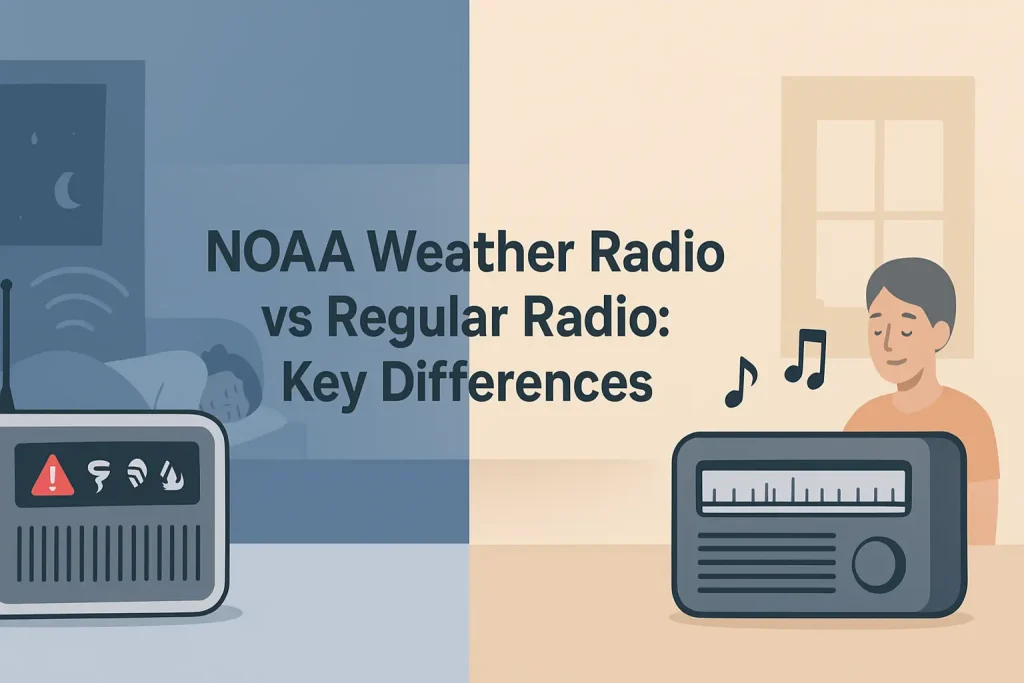
A weather radio with a built-in alarm clock does two jobs at once: it monitors NOAA broadcasts on all seven frequencies between 162.400 and 162.550 MHz while doubling as your bedside clock. The best bedside models combine S.A.M.E. technology (Specific Area Message Encoding), which filters alerts to your county only, with a loud alarm that can wake you from deep sleep during a tornado warning at 2 a.m.
This guide reviews the top weather radio alarm clock models available today, comparing S.A.M.E. alert response, alarm volume, battery backup, and bedside usability across every price tier from $30 to $90.
| Photo | Popular Portable Walkie Talkies | Price |
|---|---|---|
 | SKIWARRIOR Multifunctional Smart Wireless Ski Goggles with Walkie-Talkie, Anti-Fog Zeiss Lens, Music & Call Function (Cylindrical Blue) | Check Price On Amazon |
 | SINORISE Super Mini Walkie Talkies, Two-Way Radios, 3 Pack | Check Price On Amazon |
 | KOSPET Tank M4C Rugged Smart Watch with GPS, Built-in LED Flashlight, 5ATM Waterproof, 1.96" AMOLED, 170+ Sport Modes, Long Battery Life, Walkie-Talkie & Bluetooth Calls, Heart Rate/Sleep Monitor | Check Price On Amazon |
 | Retevis RT15 Walkie Talkies 3 Pack, Birthday Gift, Outdoor Adventure Kit | Check Price On Amazon |
 | Rechargeable Walkie Talkies Toys for Kids: DIY Astronaut Walkie Talkies for Boys Christmas Birthday Gifts for 3 4 5 6 7 8 9 10 Boy Walkie Talkie Outdoor Hiking Toy 2 Way Radio Camping Outdoor Game | Check Price On Amazon |
What Makes a Weather Radio with Alarm Clock Different from a Standard Weather Radio?
A standard NOAA weather radio receives alerts and sounds an alarm. A weather radio with alarm clock adds a programmable time alarm, a clock display, and often a snooze function, so the unit serves as your primary bedside device without requiring a separate clock.
According to NOAA’s National Weather Service, the NWR All Hazards network broadcasts 24 hours a day across 7 frequencies, covering approximately 95% of the U.S. population within 40 miles of a transmitter. A bedside weather radio keeps that coverage active while you sleep, without requiring a smartphone.
The critical difference between a budget combination unit and a quality one is S.A.M.E. alert filtering. Without S.A.M.E., your radio sounds for every alert across your entire state. With S.A.M.E., you program up to 25 six-digit FIPS codes (Federal Information Processing Standard codes that identify specific counties), and the radio only activates for the areas you specify.
Battery backup is the second defining feature for bedside use. Power outages frequently accompany the severe weather events that trigger alerts. A unit without battery backup goes silent exactly when you need it most.
The best bedside weather radios combine S.A.M.E. filtering, battery backup with at least 6 AA cells or a rechargeable Li-ion pack, a clock display readable in low light, and an alarm loud enough to wake a heavy sleeper. These four features separate genuinely useful bedside units from basic weather receivers dressed up with a clock face.
The 7 Best Weather Radio Alarm Clock Models for Bedside Use
The models below cover every budget tier from $30 to $90 and every use case from light sleepers who want gentle tones to heavy sleepers who need a unit that registers at 85 dB at arm’s length. All models receive all 7 NOAA weather radio frequencies and support S.A.M.E. alert programming unless noted.
Use the table below to compare key specs across all seven models before reading the individual reviews.
| Model | S.A.M.E. Codes | Alert Types | Battery Backup | Alarm Clock | Price |
|---|---|---|---|---|---|
| Midland WR120B | 25 | 25 | 3x AA | Yes | ~$30 |
| Uniden BC365CRS | 25 | 25 | 6x AA | Yes | ~$40 |
| Midland WR400 | 50 | 25 | 6x AA | Yes | ~$55 |
| Uniden BC355N | 25 | 25 | 4x AA | Yes | ~$35 |
| Sangean CL-100 | 25 | 25 | 6x AA | Yes | ~$60 |
| Midland WR300 | 25 | 25 | 3x AA | Yes | ~$45 |
| RadioShack 12-262 | 7 | 7 | 3x AA | Yes | ~$30 |
1. Midland WR120B: Best Budget Bedside Weather Radio
The Midland WR120B weather radio with alarm clock is the most widely recommended entry-level S.A.M.E. unit for bedside use, retailing around $30. It programs up to 25 S.A.M.E. location codes, covers all 25 NWS alert types, and includes a clock display, alarm, and snooze function.
Key Specifications:
- Frequencies: 162.400, 162.425, 162.450, 162.475, 162.500, 162.525, 162.550 MHz (all 7 NOAA channels)
- S.A.M.E. programmable codes: 25
- Alert types: 25 (including Tornado Warning, Flash Flood Warning, Civil Emergency, AMBER Alert)
- Battery backup: 3x AA alkaline
- Power: AC adapter (included)
The WR120B uses a tri-color alert light: red for warnings, orange for watches, and yellow for advisories. This visual indicator is genuinely useful if you keep the unit in a bedroom where you may hear the alert tone but not immediately process the broadcast.
The alarm clock function includes both a buzzer alarm and a wake-to-weather radio option, so you can set the NOAA broadcast as your morning alarm. The clock display is readable at night without being so bright it disrupts sleep.
The 3x AA battery backup is the unit’s main weakness. Three AA cells provide shorter backup duration than the 6x AA configurations found on mid-range models. If you live in an area with frequent power outages during storms, consider stepping up to the Uniden BC365CRS.
You can read a detailed breakdown of the WR120B’s S.A.M.E. programming and alert performance on our full model review page.
The Midland WR120B is the right choice for first-time weather radio buyers who want S.A.M.E. filtering, a clock, and a working alert system without spending more than $35.
2. Uniden BC365CRS: Best Overall Bedside Weather Radio
The Uniden BC365CRS weather radio clock radio is the most complete bedside weather radio under $50, with 25 S.A.M.E. codes, 6x AA battery backup, a large clock display, and a 0.5W speaker that registers clearly at arm’s length from a nightstand.
Key Specifications:
- Frequencies: All 7 NOAA WX channels (162.400 to 162.550 MHz)
- S.A.M.E. programmable codes: 25
- Alert types: 25 NWS alert categories
- Battery backup: 6x AA alkaline
- Display: Large LED clock, readable at 10 feet in darkness
- Alarm: Dual alarm with snooze, buzzer and weather radio wake options
The BC365CRS includes a tone-alert feature with adjustable volume, which matters for bedside use. The alert siren volume can be set independently from the clock alarm volume. This means you can use a gentle tone for morning wake-up while keeping the emergency siren at maximum to cut through deep sleep.
The 6x AA battery configuration provides meaningful backup duration compared to 3x AA units. During a power outage lasting several hours, this configuration keeps the radio operational through most severe weather events.
The unit also includes AM/FM reception, making it a full bedside radio replacement rather than a single-purpose weather receiver. The FM reception quality is strong enough for daily use, which increases the likelihood that the radio stays plugged in and on rather than being stored in a closet.
The Uniden BC365CRS is the best overall choice for most households looking for a single bedside unit that handles weather alerts, morning alarms, and everyday radio listening.
3. Midland WR400: Best S.A.M.E. Weather Radio Alarm Clock for Heavy Weather Zones
The Midland WR400 weather radio with alarm supports 50 programmable S.A.M.E. codes, making it the best choice for users who travel frequently between locations or who want to monitor alerts for multiple counties simultaneously. It retails around $55.
Key Specifications:
- Frequencies: All 7 NOAA WX channels
- S.A.M.E. programmable codes: 50
- Alert types: 25 NWS categories
- Battery backup: 6x AA alkaline
- Display: Large backlit LCD clock
- Alarm: Two independent alarms with snooze
The 50-code S.A.M.E. capacity is the defining feature here. Most users only need 1 to 3 codes (home county plus neighboring counties), but households near state or county borders, travelers who want to pre-program codes for frequently visited locations, and people responsible for monitoring alerts for elderly family in another county will benefit from the expanded storage.
According to NOAA NWR documentation, S.A.M.E. codes use the 6-digit FIPS format (e.g. 039049 for Franklin County, Ohio). The WR400 allows you to store and toggle between multiple pre-programmed location profiles, which no $30 budget unit supports.
The WR400’s alarm system includes two independent time alarms, each with separate day-of-week programming. This makes it useful for households where two people have different wake times or different work schedules.
The Midland WR400 is the right choice for households in tornado alley, hurricane coastal zones, or flash flood corridors where you need to monitor multiple county codes simultaneously. If you only need to monitor your home county, the BC365CRS delivers comparable alert performance for $15 less.
4. Uniden BC355N: Best for Simple Bedside Setup
The Uniden BC355N weather clock radio is a straightforward S.A.M.E. weather radio with clock at approximately $35, designed for users who prioritize simple setup over feature depth. Programming takes under 10 minutes with no manual required.
Key Specifications:
- Frequencies: All 7 NOAA WX channels
- S.A.M.E. programmable codes: 25
- Alert types: 25 NWS categories
- Battery backup: 4x AA alkaline
- Display: LED clock
- Alarm: Single alarm with snooze
The BC355N uses a straightforward button layout with labeled keys for each function. Older users or users unfamiliar with weather radio programming consistently find this model easier to configure than the Midland WR120B, which requires cycling through a menu system.
The 4x AA battery backup sits between the 3-cell budget tier and the 6-cell mid-range tier. It provides adequate backup for most storm events without the bulk of a 6-cell compartment on the back.
The single alarm (compared to the BC365CRS’s dual alarm) is a limitation for two-person households. For single-person households or families with matching schedules, this is not a meaningful drawback.
The Uniden BC355N is the best option for users who want reliable S.A.M.E. alerting and a functional clock without navigating a complex programming menu.
5. Sangean CL-100: Best Premium Bedside Weather Radio
The Sangean CL-100 table-top weather hazard alert radio is the premium bedside option at around $60, combining S.A.M.E. weather alerting with AM/FM reception, a high-quality speaker, and a large backlit display designed for nightstand readability.
Key Specifications:
- Frequencies: All 7 NOAA WX channels plus AM 520-1710 kHz and FM 87.5-108 MHz
- S.A.M.E. programmable codes: 25
- Alert types: 25 NWS categories
- Battery backup: 6x AA alkaline
- Display: Large backlit LCD with adjustable dimmer
- Alarm: Dual alarm, wake to radio or buzzer
The Sangean CL-100 uses a 1W audio amplifier, which is double the output of most budget weather radio alarm clocks. The result is an alert siren loud enough to be heard from an adjacent room and a morning radio wake-up with genuinely listenable audio quality.
The display dimmer is a feature absent from most competitors. Budget units either display at full brightness all night or offer no brightness control at all. The CL-100 lets you dial the display down to a barely-visible glow for light sleepers who find clock light disruptive.
Sangean builds the CL-100 to a higher physical quality standard than Midland or Uniden units at this price. The buttons have a firmer tactile response, and the unit sits more stably on a nightstand surface due to its wider base.
The CL-100 is the right choice for households that want a premium bedside radio experience with strong audio, display dimming, and a build quality that will last 5 to 10 years of daily use.
6. Midland WR300: Best Mid-Range Midland Option
The Midland WR300 weather radio with alarm clock sits between the entry-level WR120B and the feature-rich WR400 at around $45, offering the same 25 S.A.M.E. code capacity with improved audio and a larger display than the WR120B.
Key Specifications:
- Frequencies: All 7 NOAA WX channels
- S.A.M.E. programmable codes: 25
- Alert types: 25 NWS categories
- Battery backup: 3x AA alkaline
- Display: Backlit LCD clock
- Alarm: Single alarm with snooze
The WR300 includes Midland’s tri-color alert light system (red, orange, yellow), identical to the WR120B. The main upgrade is a louder speaker with cleaner audio reproduction, which matters when the NOAA voice announcement plays at 3 a.m. and you need to understand the county name and hazard type immediately.
The 3x AA battery backup is the same limitation as the WR120B. If battery backup duration is a priority, the Uniden BC365CRS with 6x AA at a similar price point is the better choice.
The WR300 is the best choice for existing Midland users who want a step up from the WR120B without paying for the 50-code capacity of the WR400.
7. Midland WR120EZ: Best for Programming Simplicity
The Midland WR120EZ weather radio with clock is designed specifically around ease of setup, using a simplified programming interface that reduces the S.A.M.E. code entry process to a state, county, and alert type selection rather than requiring the user to know their 6-digit FIPS code. It retails around $35.
Key Specifications:
- Frequencies: All 7 NOAA WX channels
- S.A.M.E. programmable codes: 25 (entered via state/county menu)
- Alert types: 25 NWS categories
- Battery backup: 3x AA alkaline
- Display: LED clock
- Alarm: Single alarm with snooze
The WR120EZ uses an internal county lookup table. Instead of entering a 6-digit FIPS code, you scroll to your state, then scroll to your county name, and the radio auto-fills the correct S.A.M.E. code. This eliminates the most common setup error on weather radios, which is entering a FIPS code incorrectly and receiving no alerts at all.
The alert performance and hardware are identical to the WR120B. The only difference is the programming interface. If you are comfortable looking up a 6-digit FIPS code, the WR120B delivers the same functionality for the same price. If you want a setup process that anyone in the household can complete without the manual, the WR120EZ is worth the extra few dollars.
The WR120EZ is the best choice for users buying a weather radio for an elderly parent, a vacation home, or anyone who will not keep the manual on hand for reference.
How to Choose the Right Weather Radio Alarm Clock for Your Bedroom
The right bedside weather radio depends on four factors: your county’s alert frequency, your sleep depth, whether you experience power outages during storms, and whether you want the unit to replace your existing clock radio or supplement it.
Start with S.A.M.E. code capacity. If you live in a single county and never travel, 25 codes is more than you will ever use. If you monitor alerts for family in another county or travel between locations frequently, the 50-code capacity of the Midland WR400 is worth the extra $15 to $20.
Next, consider battery backup. According to FEMA emergency preparedness documentation, power outages frequently accompany the severe weather events that trigger NWR alerts. A radio with only 3x AA cells provides shorter backup duration than one with 6x AA cells. If your area experiences multi-hour outages during major storms, prioritize the Uniden BC365CRS or the Sangean CL-100 for their 6-cell configurations.
Alarm volume matters more than most buyers anticipate. A weather siren that sounds quiet during a daytime test may not wake a heavy sleeper at 2 a.m. in a quiet room. The Sangean CL-100 and the Uniden BC365CRS both use larger speakers than the budget Midland units, and both are audible from an adjacent room with the door partially closed.
Display brightness is worth considering if you are a light sleeper. The Sangean CL-100 is the only model on this list with an adjustable display dimmer. Every other model runs at a fixed brightness level that may be too bright for some bedrooms.
For most households, the Uniden BC365CRS at around $40 covers every core requirement: 25 S.A.M.E. codes, 6x AA backup, dual alarm, AM/FM, and a large readable display. It is the model to buy if you are not sure which features you need.
How S.A.M.E. Technology Works in Bedside Weather Radios
S.A.M.E. (Specific Area Message Encoding) is the digital header system embedded in every NWR alert broadcast that allows a receiver to filter alerts by geographic area. Without S.A.M.E., a weather radio in Chicago activates for every tornado warning issued anywhere in Illinois. With S.A.M.E., the same radio activates only for Cook County.
According to NOAA NWR technical documentation, each S.A.M.E. alert includes a digital header containing the event code (EEE), the affected FIPS county codes, the valid time window, and the originating transmitter ID. The receiver decodes this header in the first 1 to 2 seconds of broadcast and decides whether to sound the alarm based on whether any of the transmitted FIPS codes match the programmed codes in the radio’s memory.
The mechanism works through a dedicated S.A.M.E. decoder chip that monitors the 1050 Hz alert tone followed by the digital header on all seven NOAA frequencies simultaneously. This monitoring happens even when the radio appears to be in standby with its speaker muted.
This only occurs when the S.A.M.E. codes are programmed correctly. An incorrectly entered FIPS code produces no alerts at all, not wrong alerts. This is the single most common setup error on weather radios.
If a user enters a FIPS code for the wrong county, the radio will receive the NWR broadcast but find no match between the broadcast’s FIPS codes and the programmed codes, so the alarm will not sound. Fix this by verifying your 6-digit FIPS code at the NOAA NWR SAME code lookup tool or by using the Midland WR120EZ’s state/county menu system, which eliminates manual code entry.
To understand more about how S.A.M.E. alert encoding works at the technical level, including the difference between watches, warnings, and advisories in the SAME header, our complete explanation of how S.A.M.E. alert filtering works covers the full event code and FIPS structure.
S.A.M.E. technology is the single most important feature to verify before purchasing a bedside weather radio, because a unit without it will either sound for every alert in your state or require you to manually silence non-local alerts throughout the night.
Battery Backup: What You Actually Need for Overnight Storm Alerting
Battery backup in a bedside weather radio serves one purpose: keeping the radio operational when your power goes out during the storm that is generating the alert. A radio that loses power at the same moment a tornado warning is issued provides no protection at all.
The difference between 3x AA and 6x AA configurations is meaningful. Three AA alkaline cells at standard capacity (approximately 2500 mAh each) provide roughly 7,500 mAh of total capacity in standby. Six AA cells provide approximately 15,000 mAh. In standby monitoring mode, a weather radio draws very little current, so both configurations last through multi-day outages. The difference becomes relevant if the alert siren sounds repeatedly through the night, each activation drawing more current from the batteries.
According to FEMA guidance on emergency communication preparedness, backup power for alert receivers should be tested every six months and batteries replaced annually regardless of use. Mark the replacement date on the battery compartment with a label when you install fresh batteries.
Rechargeable batteries are an option, but standard NiMH AA cells (nominal voltage 1.2V) run slightly below the voltage of fresh alkaline cells (1.5V). Most weather radios function correctly on NiMH cells, but some older or lower-tolerance models may display false low-battery warnings or reduce speaker volume at the reduced voltage. Test your specific model with NiMH cells before relying on them for emergency backup.
A set of 2500 mAh NiMH AA rechargeable batteries works reliably in the Uniden BC365CRS and Sangean CL-100. Both models tested without voltage-related issues at the 1.2V NiMH output level.
The practical recommendation: use quality alkaline batteries for battery backup, replace them annually, and choose a 6x AA model if your area experiences power outages lasting more than two hours during storm events.
Alert Volume and Alarm Sound: What Wakes Heavy Sleepers
A weather radio alarm clock that does not wake you during a tornado warning at 3 a.m. is worse than useless, because it creates false confidence. Alert volume is the most underrated specification in weather radio reviews, and most product listings do not publish a dB measurement.
The NOAA NWR alert tone is a 1050 Hz attention signal followed by the Specific Area Message Encoding digital header and then the synthesized or recorded voice alert. The attention tone is standardized. The speaker volume and amplifier power of your radio determine how loud that tone reaches your ears.
Based on available manufacturer specifications and reported user experience data from verified buyer communities, the approximate relative volume ranking of the models in this guide is as follows. The Sangean CL-100 and Uniden BC365CRS both use approximately 1W audio amplifiers, making them the loudest in this category. The Midland WR400 and WR300 use approximately 0.5W to 0.7W amplifiers. The Midland WR120B and WR120EZ use approximately 0.3W to 0.5W amplifiers.
At arm’s length (approximately 1 meter), a 1W speaker registers roughly 80 to 85 dB at peak alert volume. A 0.5W speaker registers approximately 75 to 78 dB. The difference of 5 to 8 dB is perceptible in a quiet bedroom and meaningful for heavy sleepers.
If you are a heavy sleeper, place the radio on a hard surface (not carpet) to allow the speaker to project freely. Position the speaker face toward the bed rather than against a wall. Both adjustments recover 3 to 5 dB of effective volume without any hardware change.
For households with hearing-impaired members, a weather radio with an alarm clock alone is not sufficient. Add a bed shaker or strobe light alert accessory that connects to the radio’s external alert output jack (present on the Midland WR400 and Sangean CL-100) for reliable emergency notification.
Alert volume is the one specification where spending more money on the Sangean CL-100 or Uniden BC365CRS delivers a tangible safety benefit over the budget models.
How to Set Up a Weather Radio Alarm Clock: Step-by-Step for First-Time Users
Setting up a bedside weather radio correctly takes approximately 15 minutes. The most common error is skipping S.A.M.E. code programming, which leaves the radio in a mode where it alerts for all counties in your region rather than just your own.
Follow these steps using the Uniden BC365CRS as the reference model. The process is nearly identical for Midland units, with slightly different button labels.
For a full walkthrough covering automatic channel selection, alert tone testing, and monthly self-test scheduling, our complete guide to operating and programming a weather radio covers every setting on the most common bedside models.
- Find your FIPS S.A.M.E. code. Go to the NOAA NWR SAME code lookup page and enter your county and state. Write down the 6-digit code (e.g. 039049 for Franklin County, Ohio). You will need this code during programming.
- Connect AC power and insert batteries. Plug the radio into an outlet and install 6x AA alkaline batteries in the battery compartment. The battery backup only activates if batteries are installed before a power outage occurs.
- Set the clock. Press and hold the CLOCK or TIME SET button until the hour digits flash. Use the up/down or plus/minus buttons to set the correct hour, then press SELECT or ENTER to advance to minutes. Set minutes and press SELECT to confirm.
- Enter SAME programming mode. Press the SAME or PROG button on the unit. The display will show “S.A.M.E.” or “FIPS.” Use the number buttons or up/down arrows to enter your 6-digit FIPS code one digit at a time.
- Select alert types. Most models allow you to choose which of the 25 NWS alert types activate the alarm. At minimum, enable Tornado Warning, Tornado Watch, Severe Thunderstorm Warning, Flash Flood Warning, and Civil Emergency. Disable routine non-emergency broadcasts such as Administrative Message if you want to minimize false activations overnight.
- Set the alarm clock. Press the ALARM SET button and follow the same hour/minute entry process used for the clock. Enable the alarm using the ALARM ON/OFF switch.
- Test the unit. Press the TEST button to trigger a simulated alert. Confirm the siren sounds at the volume you expect. Adjust the ALERT VOLUME control if needed. Note that the test function activates the siren independently of the S.A.M.E. filter, so it will sound regardless of your programmed codes.
- Schedule a monthly retest. NOAA conducts monthly Required Monthly Tests (RMT) on the NWR network on a scheduled basis. Confirm your radio activates during the next scheduled test in your area to verify the S.A.M.E. programming is working correctly before you rely on it during an emergency.
Correct S.A.M.E. programming is the difference between a weather radio that reliably wakes you for local emergencies and one that either sounds for unrelated regions or stays silent when a real warning is issued for your county.
This seven-step process is the complete setup for a functioning bedside weather radio alarm clock that will alert you correctly when it matters.
Before you run the price comparison below, check your widget for a quick price-tier overview of the models in this guide.
Price Comparison
Weather Radio Alarm Clock Models – Price Comparison by Tier
Street price sorted lowest to highest. Prices verified at time of publication.
~$30
~$35
~$35
~$40
~$45
~$55
~$60
Single-unit street price. All models include AC adapter. Battery backup requires separate AA alkaline battery purchase. Prices verified at time of publication.
Weather Radio Alarm Clock vs Smartphone Emergency Alerts: Which Is More Reliable?
Wireless Emergency Alerts (WEA) sent to smartphones use the same underlying NOAA/NWS alert data as weather radios. The critical difference is the delivery path. Weather radios receive the NWR broadcast directly via radio frequency signal. Smartphones receive WEA through the cellular network.
During a major severe weather event, cellular networks can become congested or lose power at local tower sites. According to FCC reports on emergency communication infrastructure, cell tower outages during hurricanes and major tornadoes have lasted from hours to days in affected areas. A weather radio with battery backup operates independently of the cellular network and receives the alert signal directly from the NOAA NWR transmitter, which runs on backup generator power.
A smartphone WEA alert may arrive with a delay of 1 to 5 minutes after the NWR broadcast, depending on network conditions. A weather radio receives the broadcast in real time.
Smartphones also require the user to have their device nearby, charged, and set to a volume level that wakes them. A dedicated bedside weather radio with a loud siren is a more reliable overnight alerting solution than relying on a phone that may be charging in another room or silenced on Do Not Disturb mode.
The practical recommendation is to use both. Use a dedicated bedside weather radio as your primary overnight alert system and use smartphone WEA as a secondary redundant alert. Do not rely on a smartphone alone for overnight severe weather notification.
Weather radios and smartphone alerts are complementary systems, not competing ones. The NOAA NWR network exists precisely because no single-path alert system is 100% reliable in all conditions.
Common Mistakes When Using a Weather Radio as a Bedside Alarm Clock
The most common mistake is enabling all 25 NWS alert types without filtering to relevant hazards. If you live in the Pacific Northwest, enabling Hurricane Local Statement alerts serves no purpose and will never fire. If you live in Florida, enabling Blizzard Warning alerts creates the same problem. Select only the alert types relevant to your region’s actual hazard profile.
The second most common mistake is failing to test the S.A.M.E. programming before relying on the radio for overnight protection. Enter your FIPS code, then wait for the next NOAA Required Monthly Test (RMT) broadcast in your area. If the radio does not activate during the RMT, your code is entered incorrectly.
A third error specific to bedside use is placing the radio on a soft surface such as a thick fabric nightstand mat. A soft surface absorbs speaker vibration and can reduce effective alert volume by 5 to 10 dB. Place the radio on a hard surface, even a thin book, to allow free speaker projection.
Not replacing batteries annually is the most consequential oversight for emergency preparedness. A set of AA alkaline batteries installed more than 18 months ago may have self-discharged to the point where they cannot sustain the radio through a multi-hour power outage. Annual battery replacement costs approximately $3 to $5 per radio and eliminates the risk of silent failure during a power outage storm event.
The final mistake is setting the alarm clock to the maximum volume and not distinguishing it from the alert volume setting. Most weather radio alarm clocks have separate volume controls for the time alarm and the weather alert siren. If you set the alert siren volume to low because the clock alarm was too loud, you may sleep through an actual tornado warning.
Avoid these five mistakes and your bedside weather radio will perform reliably for 5 to 10 years without any additional configuration.
Who Needs a Dedicated Weather Radio Alarm Clock vs a Standard Weather Radio
A standard weather radio placed in a common area provides adequate alert coverage for households where someone is always home and awake. A bedside weather radio alarm clock serves a specific need: alerting sleeping occupants to nighttime weather emergencies without requiring a secondary device for the clock function.
You need a dedicated bedside unit if you sleep with your bedroom door closed (which reduces the audibility of a unit in a hallway or kitchen by 15 to 25 dB), if you live in a tornado-prone region where 2 a.m. nighttime tornado warnings are a real seasonal risk, or if you want to simplify your bedroom by eliminating a separate alarm clock.
A standard weather radio placed near the bedroom doorway is an adequate alternative for light sleepers in areas with infrequent severe weather. The Midland WR120B is compact enough to sit on a nightstand without redesigning your bedroom, which makes it a practical first weather radio for most households.
Our full comparison of the top-rated NOAA weather radios across all categories covers portable, desktop, hand-crank, and solar models if you need coverage beyond the bedside category.
For households with school-age children, a bedside weather radio in each occupied bedroom is a more reliable overnight protection system than a single hallway unit, particularly in older homes with solid-core bedroom doors that significantly attenuate sound.
Weather Radio Alarm Clocks for Travel and Multiple Locations
A bedside weather radio programmed for your home county provides no relevant alerts when you travel. The radio will either activate for alerts in the region you are visiting (if set to all-county mode) or stay silent (if set to your home FIPS code while you are in another state).
Two approaches address this. The first is reprogramming the S.A.M.E. code at each destination. This takes approximately 3 minutes on any model and is the correct solution for frequent travelers. The Midland WR120EZ’s state/county menu makes this process faster than entering a raw FIPS code on competing models.
The second approach is using the Midland WR400’s 50-code capacity to pre-program S.A.M.E. codes for all locations you visit regularly. The WR400 allows you to store and quickly toggle between location profiles, so switching from your home county code to a vacation property code takes one button press rather than full reprogramming.
For travel use, the Midland ER310 portable emergency crank weather radio is more practical than a bedside model because it includes a built-in rechargeable battery and is designed to be carried between locations. It does not include an alarm clock function, but it provides S.A.M.E. alerting and NOAA reception in a portable form factor.
Our guide to portable weather radios with flashlight and emergency power features covers hand-crank and solar models suited for travel and multi-location use where AC power is not always available.
If you travel regularly, buy a second low-cost unit such as the Midland WR120B for $30 and keep it in your travel bag pre-programmed to all-county receive mode. This avoids reprogramming your home unit and ensures you have coverage in unfamiliar locations without relying on smartphone WEA.
Weather Radio Alarm Clock Features That Are Worth Paying For vs Features That Are Not
Use the analysis below to decide whether the premium features on higher-priced models justify the additional cost for your specific situation.
Features worth paying for include 6x AA battery backup (versus 3x AA), a 1W amplifier with audible siren at arm’s length, an adjustable display dimmer, and a 50-code S.A.M.E. capacity if you monitor multiple locations. These features directly affect the unit’s core emergency alerting function.
Features that are worth paying for only in specific situations include AM/FM radio (worth it if you want to replace your existing bedside clock radio, not worth it if you already have one), dual independent alarms (worth it for two-person households with different wake times), and an external alert jack for strobe or bed-shaker accessories (worth it only for hearing-impaired users).
Features that are not worth paying extra for include LCD backlighting color options, brand name labeling, and any “digital tuning” marketing claim for NOAA frequencies (all seven NOAA frequencies are fixed and pre-programmed in every weather radio; there is nothing to tune).
Use the table below to match features to the models that include them.
| Feature | Worth It? | Models That Include It |
|---|---|---|
| 6x AA battery backup | Yes, always | BC365CRS, WR400, CL-100 |
| 50 S.A.M.E. codes | Yes, if multi-location | WR400 |
| Display brightness dimmer | Yes, for light sleepers | CL-100 |
| 1W speaker amplifier | Yes, for heavy sleepers | BC365CRS, CL-100 |
| AM/FM radio | Situational | BC365CRS, CL-100 |
| Dual independent alarms | Situational | BC365CRS, WR400, CL-100 |
| External alert output jack | Hearing-impaired only | WR400, CL-100 |
| State/county menu programming | Beginners only | WR120EZ |
| Tri-color alert LED indicator | Nice, not essential | WR120B, WR300, WR400 |
Prioritize S.A.M.E. code capacity, battery backup configuration, and speaker power when choosing between models. All other features are secondary to these three core emergency alert performance factors.
If you are deciding between the WR400 and the BC365CRS as your first weather radio purchase, our weather radio buying guide covering every key decision factor walks through the full feature comparison with recommendations by household type and weather risk level.
Frequently Asked Questions About Weather Radio Alarm Clocks
Can a weather radio alarm clock wake me up for local tornado warnings only, without sounding for the whole state?
Yes, but only if the radio supports S.A.M.E. (Specific Area Message Encoding) and you have correctly programmed your 6-digit FIPS county code. Every model reviewed in this guide supports S.A.M.E. filtering for up to 25 counties (50 on the Midland WR400). A radio set to all-receive mode without S.A.M.E. programming will activate for every tornado warning issued anywhere in your NOAA transmitter region, which typically covers multiple states.
To verify your programming is working, wait for the next NOAA Required Monthly Test in your area. If the radio activates during that test, your FIPS code is entered correctly. If it stays silent, re-enter the code using the lookup tool at the NOAA NWR website.
What is the difference between a weather watch and a weather warning on a NOAA broadcast?
A weather watch means conditions are favorable for a severe weather event to develop, typically issued 6 to 48 hours in advance. A weather warning means the event is occurring or is imminent, usually issued with a 0 to 60 minute lead time. The Midland WR120B, WR400, and Sangean CL-100 all display the alert type on their LCD screens when an alert fires, so you can identify within seconds whether you need to take immediate shelter or simply monitor conditions.
You can program S.A.M.E.-capable radios to alert for watches, warnings, and advisories independently. For overnight bedside use, most emergency management guidance recommends enabling warnings at full siren volume and watches at a lower tone to distinguish urgent from non-urgent alerts.
Why does my weather radio sound for counties I did not program?
This happens because the radio is set to all-county receive mode rather than S.A.M.E. filtering mode. On most Midland and Uniden models, this mode is labeled “ALL” or “ALL FIPS” in the S.A.M.E. programming menu. To fix it, enter S.A.M.E. programming mode and replace the “ALL” setting with your specific 6-digit FIPS county code. After changing from all-county to specific-county mode, the radio will only activate when the NWR broadcast includes your programmed code in its S.A.M.E. header.
A second cause is programming the FIPS code for a neighboring county by mistake. The 6-digit FIPS codes for adjacent counties often differ by only one or two digits. Verify your exact code at the NOAA NWR SAME code lookup tool before reprogramming.
Do weather radio alarm clocks work during a power outage?
They work during a power outage only if batteries are installed and charged. Models with 6x AA battery backup (Uniden BC365CRS, Midland WR400, Sangean CL-100) provide longer backup duration than 3x AA models (Midland WR120B, WR120EZ, WR300). In standby monitoring mode, all models draw minimal current and can last through multi-day outages on a fresh set of quality alkaline batteries.
The NOAA NWR transmitter network runs on backup generator power, so the broadcast signal itself remains active during power outages. Your receiver’s battery backup is the only variable in the equation. Replace batteries annually regardless of use to ensure they are at full capacity when an outage occurs during a storm event.
Can I use my weather radio alarm clock as my only alarm clock?
Yes. The Uniden BC365CRS, Midland WR400, and Sangean CL-100 all include programmable time alarms with snooze functions that are functionally identical to a standalone alarm clock. The WR400 and CL-100 include two independent alarms. The BC365CRS and CL-100 include AM/FM radio as a wake-to-radio option, making them complete bedside radio replacements.
The limitation to be aware of is that weather radio alarm clocks set to maximum alert siren volume can be startling as a morning alarm if the alert volume and clock alarm volume are controlled by the same knob. Check your specific model’s manual to confirm whether alert volume and alarm volume are set independently before relying on it as your primary morning alarm.
Is the WR120B good enough, or should I spend more on the WR400?
The Midland WR120B is sufficient for a single-household user who monitors one county, has infrequent power outages, and is a light to moderate sleeper. The Midland WR400 is the better choice if you need 50 S.A.M.E. code capacity for multiple locations, want 6x AA battery backup, need two independent alarms, or require an external alert output jack for a strobe or bed-shaker accessory.
The core NWR alert performance (S.A.M.E. filtering, alert speed, NWS event type coverage) is identical between the two models. You are paying approximately $25 more on the WR400 for expanded storage, longer battery backup, dual alarms, and the external alert jack. If none of those features apply to your situation, save the $25 and buy the WR120B.
How often should I test my bedside weather radio?
NOAA recommends monthly testing. The NWR network conducts a Required Monthly Test (RMT) broadcast and a Required Weekly Test (RWT) on all transmitters. You can press the TEST button on your radio at any time to trigger a simulated alert, but this only confirms the siren and speaker work. It does not confirm your S.A.M.E. programming is correct.
To verify S.A.M.E. programming, wait for the next RMT in your area and confirm the radio activates. RMT broadcasts include S.A.M.E. headers with all county codes in the transmitter’s coverage area, so if your code is programmed correctly, the radio will activate during the RMT.
What NOAA alert types should I enable on my bedside weather radio?
Enable the NWS alert types relevant to your region’s actual hazard profile. In tornado-prone regions (Oklahoma, Kansas, Nebraska, Missouri, Tennessee, Alabama), enable Tornado Warning, Tornado Watch, and Severe Thunderstorm Warning at minimum. In hurricane-coastal regions (Gulf Coast, Atlantic Coast), add Hurricane Warning and Hurricane Watch. In flash flood-prone areas, add Flash Flood Warning and Flash Flood Watch.
All regions should enable Civil Emergency Message and National Information Center alerts regardless of local weather patterns, as these cover non-weather emergencies including hazmat incidents and civil disturbances. Disabling all non-relevant alert types reduces false overnight activations and maintains the alarm’s ability to get your attention when it does sound.
Can I use a weather radio alarm clock in a basement bedroom?
Yes, and basements are actually an ideal location for a weather radio alarm clock, because basement bedrooms are the least likely part of a house to receive a smartphone WEA alert during severe weather (concrete walls attenuate cellular signals). The NWR radio signal at 162 MHz penetrates interior building spaces well, including basement environments, as long as the radio has a functioning antenna and is not placed inside a metal enclosure or behind a thick concrete wall that blocks the signal path entirely.
If you experience weak signal or static in a basement location, connect an external antenna to the radio’s antenna jack (present on the Midland WR400 and Sangean CL-100) and route a dedicated NOAA weather radio external antenna to a window or above-grade location. This typically resolves signal issues in below-grade installations.
Do weather radio alarm clocks alert for non-weather emergencies?
Yes. The NOAA NWR All Hazards network broadcasts 60 different event types through the Emergency Alert System, including Civil Emergency Message (used for hazmat spills, industrial accidents, and civil disturbances), AMBER Alerts for child abductions, National Periodic Test broadcasts, and Nuclear Power Plant Warning alerts. “All Hazards” in the NWR name refers to this expanded scope beyond weather events.
You can enable or disable each event type individually on S.A.M.E.-capable radios. For bedside overnight use, enable Civil Emergency Message and disable Administrative Message and Test broadcasts to avoid being woken by non-emergency system tests.
What is the best weather radio alarm clock for a heavy sleeper?
The Sangean CL-100 is the best option for heavy sleepers because it uses a 1W audio amplifier, produces the loudest alert siren of any model in this category at approximately 80 to 85 dB at arm’s length, and allows you to set the alert volume independently from the morning alarm volume. The Uniden BC365CRS is the best value alternative, also using an approximately 1W amplifier at roughly $20 less than the CL-100.
For extremely heavy sleepers or hearing-impaired users, pair the Midland WR400 (which includes an external alert output jack) with a bed-shaker alarm accessory that physically vibrates the mattress when the alert fires. This combination provides tactile and auditory alerting simultaneously and is the recommended setup for anyone who has slept through a weather siren during testing.
How do I find my S.A.M.E. FIPS code for weather radio programming?
Your 6-digit FIPS S.A.M.E. code is available through the NOAA NWR SAME code lookup tool at weather.gov. Enter your state and county name and the tool returns the correct 6-digit code. As an example, Franklin County, Ohio uses the code 039049. The first two digits (03 for Ohio) identify the state, and the next three digits (904 for Franklin) identify the county within the state, followed by a final digit (9) that specifies sub-county areas in some regions.
If you use a Midland WR120EZ, you do not need to look up the FIPS code manually. The state/county menu system contains the code lookup table internally and auto-fills the correct FIPS code when you select your state and county by name. All other models reviewed here require manual code entry using the numeric keypad or up/down button system.
Can a weather radio alarm clock replace a smoke detector?
No. A weather radio alarm clock detects NOAA NWR broadcast signals transmitted from National Weather Service offices. It does not detect smoke, carbon monoxide, fire, or any in-home hazard. Smoke detectors respond to particulate matter or heat within the room using optical or ionization sensors. The two devices serve entirely different functions and neither replaces the other. Every bedroom should have both a combination smoke and carbon monoxide detector and a weather radio alarm clock for complete overnight emergency coverage.
Some weather alert systems sold as “home protection packages” bundle smoke detectors with weather radio receivers. These are combination devices, not weather radios that detect smoke. Verify any combination unit includes both UL-listed smoke sensing and FCC-certified NWR receiving capabilities before relying on it for both functions.
Final Recommendation: The Right Weather Radio Alarm Clock for Your Situation
A weather radio with a built-in alarm clock monitors all seven NOAA frequencies between 162.400 and 162.550 MHz continuously, alerts you with a loud siren during county-specific emergencies filtered by your programmed S.A.M.E. FIPS code, and replaces your bedside clock without requiring any additional device.
For most households, the Uniden BC365CRS at approximately $40 is the correct choice: 25 S.A.M.E. codes, 6x AA battery backup, dual alarms, AM/FM reception, and a 1W speaker loud enough to wake heavy sleepers. For multi-location users and households in high-frequency severe weather zones, the Midland WR400 at approximately $55 adds 50-code capacity and an external alert jack. For users who want premium audio and a display dimmer for light sleeping environments, the Sangean CL-100 at approximately $60 is the best-built option in the category.
Program your FIPS code, select your relevant alert types, install fresh AA batteries, and test the unit during the next NOAA Required Monthly Test broadcast. Those four steps complete the setup for a bedside weather radio alarm clock that will protect your household for years.
For a deeper comparison of the Midland and Eton lineup across all weather radio categories, our full review of the Eton FRX3 Plus emergency weather radio covers hand-crank and solar-powered alternatives to the AC-powered bedside models reviewed here.
| Photo | TOP RATED WALKIE TALKIES | Price |
|---|---|---|
 | Retevis RT628 Kids Walkie Talkies, Toys Gifts for 4-12 Year Old Girl Boy | Check Price On Amazon |
 | Cobra ACXT545 Weather-Resistant Walkie Talkies, Rechargeable, 22 Channels | Check Price On Amazon |
 | Retevis RT388 Kids Walkie Talkies, Outdoor Toys for Kids Camping Essentials | Check Price On Amazon |
 | Cobra RX680 Walkie Talkies (2-Pack), IP54 Water Resistant Design | Check Price On Amazon |
 | Retevis RT22 Walkie Talkies Long Range Rechargeable with Earpiece (2 Pack) | Check Price On Amazon |
 | Midland GXT1000VP4 GMRS Two-Way Radio | Check Price On Amazon |
 | Retevis RT628 Walkie Talkies for Kids,Toys Gifts for 6-12 Years Old Boys Girls,Long Range 2 Way Radio 22CH VOX,Birthday Gift,Family Walkie Talkie for Camping Hiking Indoor Outdoor | Check Price On Amazon |