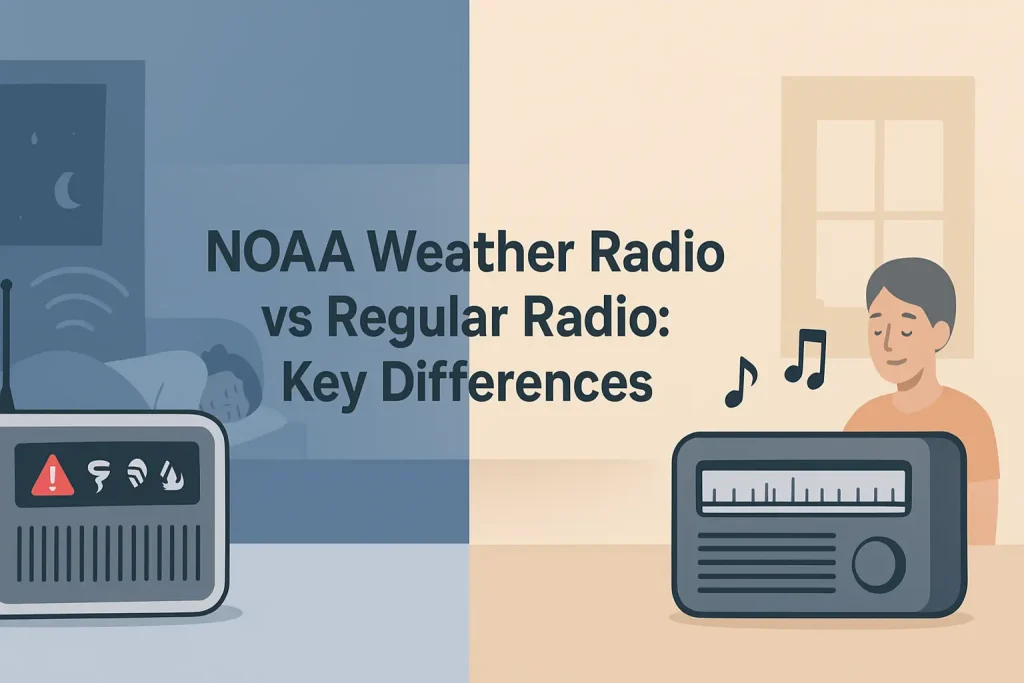
Your child hears a loud alarm from the kitchen counter at 2 a.m. and freezes. The voice on the weather radio announces a tornado warning for your county. You have about 60 seconds to get everyone moving, but your 7-year-old is crying and your 10-year-old is asking questions faster than you can answer them. A weather radio is only useful in an emergency if your kids already know what it means.
This guide covers every NOAA alert type, how to translate each one into language kids can understand, how to run drills that actually stick, and which radio features matter most for family use.
| Photo | Popular Portable Walkie Talkies | Price |
|---|---|---|
 | SKIWARRIOR Multifunctional Smart Wireless Ski Goggles with Walkie-Talkie, Anti-Fog Zeiss Lens, Music & Call Function (Cylindrical Blue) | Check Price On Amazon |
 | SINORISE Super Mini Walkie Talkies, Two-Way Radios, 3 Pack | Check Price On Amazon |
 | KOSPET Tank M4C Smart Watch Rugged, Dual-Band GPS, 5ATM & IP69K Waterproof | Check Price On Amazon |
 | Retevis RT15 Walkie Talkies 3 Pack, Birthday Gift, Outdoor Adventure Kit | Check Price On Amazon |
 | Rechargeable Walkie Talkies Toys for Kids: DIY Astronaut Walkie Talkies for Boys Christmas Birthday Gifts for 3 4 5 6 7 8 9 10 Boy Walkie Talkie Outdoor Hiking Toy 2 Way Radio Camping Outdoor Game | Check Price On Amazon |
What Is a NOAA Weather Radio and Why Does Your Family Need One?
A NOAA weather radio is a dedicated receiver that picks up broadcasts from the National Weather Service on seven frequencies between 162.400 and 162.550 MHz, operating 24 hours a day with no cellular network required. Unlike a phone notification, it works during power outages when paired with battery backup and cannot be silenced by a “do not disturb” setting.
According to NOAA’s National Weather Radio All Hazards (NWR) program documentation, the network covers more than 95% of the US population within 40 miles of a transmitter. The system broadcasts weather warnings, watches, advisories, and civil emergency messages for every county in the United States.
For families, the most important feature is S.A.M.E. technology. S.A.M.E. (Specific Area Message Encoding) uses a 6-digit FIPS code to filter alerts so your radio only sounds for your county, not every county in the state. Without S.A.M.E. programming, a NOAA weather alert radio will alarm for alerts across an entire broadcast area, which can span dozens of counties and produce false alarms that train children to ignore the sound.
A properly programmed weather radio is the fastest way to receive a life-safety alert at home, faster than any phone-based system, and the only system that works if cell towers are overloaded during a major disaster.
How NOAA Weather Radio Alerts Work: The Three Tiers Every Parent Should Know
NOAA weather alerts fall into three tiers: warnings, watches, and advisories. Each tier means something different and requires a different response, and your kids need to know the difference before the alarm sounds at midnight.
A warning means a hazardous weather event is occurring or is imminent. It requires immediate action. A watch means conditions are favorable for a hazardous event to develop, usually within 6 to 48 hours. An advisory means conditions are less severe than a warning but can still cause inconvenience or danger if you are unprepared.
The distinction between these three tiers is where most families fail. Children who hear both a “tornado watch” and a “tornado warning” on the same device in the same tone of voice learn to treat them as equivalent. They are not. A tornado warning means take shelter now. A tornado watch means stay aware and be ready to move.
Use the table below to understand how each tier maps to an action your family should take.
| Alert Tier | What It Means | Timeframe | Family Action | Kid-Friendly Translation |
|---|---|---|---|---|
| Warning | Event is happening or about to happen | 0-60 minutes | Move to shelter immediately | “Go now, no stopping” |
| Watch | Conditions are right for the event to develop | 6-48 hours | Prepare and monitor | “Get ready, stay close” |
| Advisory | Conditions are inconvenient or potentially dangerous | Varies | Use caution, check plans | “Be careful outside” |
| Emergency Alert | Imminent threat to life (non-weather) | Immediate | Follow specific instructions | “Listen to every word” |
| Statement | Update on an existing watch or warning | Ongoing | Monitor for changes | “The radio is updating us” |
| Test | Weekly NWS system test | Scheduled | No action required | “Practice alarm, not real” |
The simplest system to teach young children is a three-word response tied to each tier: “Go now” for a warning, “Get ready” for a watch, and “Be careful” for an advisory. Repeat those three phrases every time you run a drill until the response is automatic.
Every NOAA Alert Type Explained in Language Kids Can Understand
The NWR system broadcasts more than 60 distinct event codes, covering everything from a tornado warning to a hazardous materials release to an AMBER Alert. You do not need to teach your children all 60, but you do need to cover the 10 most common ones your radio is likely to broadcast for your region.
Each explanation below follows a simple formula: what the radio says, what it means in plain language, and what your family does. Read each one with your children before a storm season begins, not after the alarm sounds.
Tornado Warning
A tornado warning means a tornado has been detected by radar or a trained spotter has seen one. This is the highest-urgency alert the weather radio will broadcast.
Tell your child: “A tornado is on the ground or very close. We go to our safe spot right now and we do not wait.” The safe spot should be identified, practiced, and memorized in advance. It is typically an interior room on the lowest floor, away from windows, such as a bathroom or closet.
Tornado Watch
A tornado watch means the atmosphere has the ingredients for tornadoes to form, but none have been confirmed yet. The watch area is typically several counties or an entire state.
Tell your child: “The weather could make a tornado today. We stay home, we watch the radio, and we know where our safe spot is.” A tornado watch issued by the Storm Prediction Center (SPC) in Norman, Oklahoma, covers a geographic box and can remain active for 6 hours or more.
Severe Thunderstorm Warning
A severe thunderstorm warning means a storm with winds of at least 58 mph or hail at least 1 inch in diameter has been detected. Lightning is always present in a severe thunderstorm warning area.
Tell your child: “This storm can break windows and knock down trees. Stay inside and away from windows.” Children often underestimate thunderstorms compared to tornadoes. Reinforce that a severe thunderstorm warning is a real danger, not just rain.
Flash Flood Warning
A flash flood warning means flooding is occurring or will occur imminently. Flash floods are the deadliest weather hazard in the United States, responsible for more deaths per year than tornadoes, according to NOAA’s Office of Water Prediction.
Tell your child: “Water is rising fast somewhere nearby. We stay out of low areas, we never walk or drive through water on the road.” The phrase “turn around, don’t drown” is the official NOAA guidance and is simple enough for children to memorize.
Hurricane Warning
A hurricane warning means sustained winds of 74 mph or higher are expected within 36 hours. Hurricane warnings are issued by the National Hurricane Center for coastal areas and can extend inland.
Tell your child: “A very powerful storm with dangerous wind and flooding is coming. We follow our family plan.” For families in hurricane-prone areas, the plan should include whether to evacuate or shelter in place, and children should know which option your family uses and why.
Winter Storm Warning
A winter storm warning means heavy snow, sleet, or ice accumulation is expected and travel will be dangerous. Criteria vary by region. In the South, 2 inches of snow can trigger a warning, while in the Great Lakes region the threshold can exceed 12 inches.
Tell your child: “Roads and sidewalks will be very slippery. We stay inside and off the roads.” Reinforce that the danger is not just snow depth but also ice accumulation on power lines and the risk of carbon monoxide from generators or vehicles used incorrectly indoors.
Extreme Cold Warning and Wind Chill Warning
An extreme cold warning is issued when wind chill values reach dangerous levels, typically -20°F or colder, depending on the region. Frostbite can develop in as little as 10 minutes at these temperatures with any wind present.
Tell your child: “It is dangerously cold outside. Skin can freeze in minutes. We cover everything and limit time outside.” Use a specific number your child can picture: “It feels like it is 30 below zero out there.”
Hazardous Materials Warning
A hazardous materials warning is issued by local emergency management for chemical spills, industrial accidents, or toxic releases. It is one of the non-weather alerts the NWR system broadcasts as part of the All Hazards network.
Tell your child: “Something dangerous got into the air nearby. We close all the windows and doors and wait for the radio to tell us it is safe.” Teach children that this alert means “stay inside and seal the house,” not “go outside to look.”
Civil Emergency Message
A civil emergency message is issued by local, state, or federal officials for non-weather public safety threats such as dam failures, wildfires, or civil unrest. It can interrupt regular programming at any time.
Tell your child: “Someone in charge is telling us about a danger that is not a storm. We listen carefully for what to do.” Emphasize that this message will give specific instructions, and those instructions override everything else.
AMBER Alert
An AMBER Alert (America’s Missing: Broadcast Emergency Response) is issued when a child abduction has been confirmed and there is enough information to broadcast a description. The NWR system broadcasts AMBER Alerts as part of the IPAWS (Integrated Public Alert and Warning System) network.
Tell your child: “A child is missing and people are looking for them. We watch for the description the radio gives and tell a safe adult if we see anything.” For younger children, this is also a natural moment to review stranger safety without creating unnecessary fear.
Knowing the ten most common alert types by name, meaning, and required action is the foundation of every effective family weather radio plan.
Age-by-Age Guide: How to Explain Weather Alerts to Children
Children at different developmental stages process emergency information differently. A script that works for a 9-year-old can terrify a 4-year-old and bore a 14-year-old. Tailor your explanation to the child in front of you, not the alert type in the manual.
Ages 3 to 5: Simple Colors and Actions
Children ages 3 to 5 cannot process abstract threat levels, but they can learn colors and physical actions. Assign a color to each alert tier and tie it to a physical movement your family always does together.
Red means “we move fast to our safe spot.” Yellow means “we stay inside and stay together.” Green means “the radio is just talking, we listen.” Repeat this system every time the radio sounds, including during weekly test broadcasts, until the color-action connection is automatic.
Never use the word “dangerous” without an immediate action attached. “It is dangerous” produces anxiety without a release. “It is dangerous, so we go to the bathroom right now” gives the child’s nervous system a task to execute instead of a fear to sit with.
Ages 6 to 8: Cause and Effect with Simple Vocabulary
Children ages 6 to 8 can understand cause and effect. They can learn that the alarm happens because weather is changing and the radio is telling us before it gets here.
Use a simple cause-effect frame: “The clouds made a tornado. The radio heard about it from the weather station far away. The radio told us so we have time to get safe.” This three-part structure maps to how the NWR system actually works: NWS issues the alert, transmitters broadcast it on 162.400-162.550 MHz, your radio decodes the S.A.M.E. header and sounds the alarm.
Children this age can also start learning the word distinction between “warning” and “watch.” Use a traffic light analogy: a warning is a red light, a watch is a yellow light, an advisory is a green light where you are still careful.
Ages 9 to 12: Real Information with Real Reasons
Children ages 9 to 12 respond well to real information and actual reasons. Vague explanations feel dismissive to this age group and can breed distrust of the alert system.
Explain that a tornado warning means the radar at the National Weather Service office detected rotation in a storm cloud, or a trained spotter saw a funnel. Explain that the radio is connected to a network of weather stations run by NOAA. Tell them the radio broadcasts 24 hours a day on a frequency that no music or talk station uses, so it never gets interrupted.
Children this age can also take on a role in the family plan. Assign them a specific task during a warning: grab the go-bag, help younger siblings to the safe spot, count everyone and report to a parent. A role reduces fear and builds competence.
Ages 13 and Up: Full Transparency and Participation
Teenagers can and should know exactly how the system works. They are old enough to monitor the radio, look up S.A.M.E. codes for your county, and understand the difference between a National Weather Service warning and a local emergency management message.
Involve teenagers in programming your S.A.M.E. weather radio with your county’s 6-digit FIPS code. Walk through the process together: find your state and county FIPS code on the NOAA NWR S.A.M.E. county list, enter it into the radio’s programming menu, test the alert by triggering a manual review. This hands-on process transforms a teenager from a passive alarm-hearer into an informed participant.
Teenagers who understand the system are also less likely to dismiss alerts as false alarms. When they know that a tornado warning requires confirmed radar rotation or a visual spotter report, they understand why it is different from a watch, and they respect it accordingly.
How to Run a Weather Radio Drill That Kids Actually Remember
A drill that happens once a year and is announced in advance teaches almost nothing. A drill that happens unannounced, runs realistically, and debrefs immediately afterward teaches muscle memory that activates under stress.
FEMA’s Ready.gov emergency preparedness guidelines recommend practicing your family emergency plan at least twice a year, and for weather emergencies specifically, once before severe weather season begins for your region. For most of the US tornado belt, that means a drill in late February or early March, before the peak April-June tornado season documented by the Storm Prediction Center.
Step 1: Choose the Right Moment for an Unannounced Drill
Run the drill when your children are doing something normal: watching television, eating dinner, or doing homework. The point is to replicate the actual conditions of an alert, which never arrives at a convenient time.
Trigger the drill by playing the NOAA alert tone through a speaker or by using your weather radio’s manual test function. Some models like the Uniden BC365CRS weather alert radio allow you to trigger a manual test of the alarm circuit. Use that function during a drill rather than a verbal announcement to preserve the realism.
Step 2: Time the Response
Use a stopwatch to time how long it takes every family member to reach the designated safe location. The target for a tornado warning response is under 60 seconds from alarm to shelter, based on NWS guidance for the average lead time between a tornado warning issuance and tornado impact in populated areas.
If a family member takes more than 90 seconds, identify the specific point where the delay occurred: were they unsure where to go, did they stop to grab something, did they need to wake up? Each specific delay point has a specific fix.
Step 3: Debrief Immediately After the Drill
Sit down together within 5 minutes of the drill ending. Ask each child three questions: What did the alarm mean? Where did you go? What would you do if I was not home?
The third question is the most important one for school-age children. Emergency events do not wait for parents to be present. Every child who is old enough to be home alone needs to know the shelter location, the safe location in every room of the house, and who to call after reaching shelter.
Step 4: Practice the Middle-of-the-Night Scenario
Most parents never practice a nighttime drill. Most severe weather fatalities in residential structures happen at night when people are asleep. Run one nighttime drill per year by setting the weather radio alarm at 11 p.m. or later and timing the response from sleep to shelter.
Children who have practiced this specific scenario wake up with an action already in progress rather than waking up confused. The difference between a practiced and an unpracticed response in a child awakened by an alarm at 2 a.m. is significant in terms of both speed and anxiety.
A well-practiced family drill turns a weather radio from an alarm that causes panic into a signal that triggers a memorized, effective response.
Here is a step-by-step guide to running an effective family weather radio drill that builds real skills in every household member.
Step-by-Step Guide
How to Run a Family Weather Radio Drill – Step by Step
5 steps · Estimated time: 20 minutes including debrief
Assign every family member a role before the drill begins
One child leads younger siblings to the shelter room. One parent grabs the go-bag. The other parent does a room count. Written roles eliminate confusion when the alarm sounds.
Trigger the alarm without warning using your radio’s test function
Use the manual test tone on your S.A.M.E. weather radio rather than announcing the drill. Real emergencies never give advance notice. Hearing the actual alarm tone is part of the training.
Time the response from first alarm tone to full shelter
Start the stopwatch the moment the alarm sounds. Stop it when every family member has reached the shelter room and the door is closed. Your target is under 60 seconds for a tornado warning response.
Ask each child three debrief questions in the shelter room
Ask: What did the alarm mean? Where did you go? What would you do if no adult was home? Write down the answers that were wrong and address them immediately while the experience is fresh.
Schedule one nighttime drill per year without advance notice
Set the weather radio alarm after 10 p.m. on a non-school night. Nighttime response is the scenario most families never practice and the one that matters most. A child who has done it once reacts very differently from one who has never been awakened by the alarm.
How to Program Your Weather Radio for Family Use: S.A.M.E. Codes Explained
A weather radio without S.A.M.E. programming will alarm for every county in its broadcast area, which can cover 40 or more counties. For a family with young children, an alarm that sounds for a tornado warning 200 miles away at 3 a.m. produces the same fear response as a real local warning, trains children to treat the alarm as noise, and makes the device a source of anxiety rather than safety.
S.A.M.E. (Specific Area Message Encoding) works by embedding a 6-digit FIPS code into every NWR broadcast. Your radio decodes that header and only triggers the alarm if the FIPS code matches the county codes you have programmed. According to NOAA’s NWR technical documentation, every NWR broadcast includes a digital header identifying the event type, the affected area by FIPS code, and the expiration time of the message.
How to Find Your S.A.M.E. Code
Every county in the United States has a unique 6-digit FIPS code. The NOAA NWR SAME county listing is available at weather.gov and lists every state, territory, and county with its corresponding code. The format is a 6-digit number where the first digit is always 0, the next two digits are the state FIPS code, and the final three digits are the county code.
For example, Cook County, Illinois uses FIPS code 017031. Harris County, Texas uses 048201. You can program up to 25 county codes on most mid-range weather radios, which means if your family lives near a county line or if your children’s school is in an adjacent county, you can monitor both areas simultaneously.
How to Program S.A.M.E. Codes on Common Weather Radios
The programming process varies slightly by model, but the general sequence for most programmable S.A.M.E. weather radios follows these steps: press the “Menu” or “Program” button, navigate to the S.A.M.E. or location settings, enter your 6-digit FIPS code using the keypad or arrow buttons, and confirm by pressing “Enter” or “Set.” Most radios allow you to store 1 to 25 codes depending on the model.
The Midland WR400 weather alert radio stores up to 50 S.A.M.E. codes, more than any other model in its price range, and allows you to label each code with a location name for easy identification.
Key Specifications for the Midland WR400:
- Frequency: 162.400-162.550 MHz (all 7 NOAA WX channels)
- S.A.M.E. code storage: 50 programmable county codes
- Alert types monitored: 25 NWR event codes
- Power: AC adapter with 6x AA battery backup
- Display: backlit LCD showing alert type and county
Correct S.A.M.E. programming is the single most effective step you can take to make your weather radio family-appropriate, because it eliminates the false alarms that teach children to ignore the alarm sound.
Choosing the Right Weather Radio for a Family with Kids
The best weather radio for a family with children is one that combines reliable S.A.M.E. alert filtering, a loud enough alarm to wake sleeping children, battery backup for power outages, and a display clear enough to read in low light. You do not need the most expensive model, but you do need one that performs these four functions without compromise.
According to NOAA’s NWR receiver guidelines, a compliant weather radio must receive all seven NOAA broadcast frequencies (162.400, 162.425, 162.450, 162.475, 162.500, 162.525, and 162.550 MHz), support S.A.M.E. alert filtering, and include a specific alarm tone that distinguishes weather alerts from regular broadcasts.
Use the table below to compare the key family-relevant features across the most widely used consumer weather radio models.
| Model | S.A.M.E. Codes | Battery Backup | Alert Volume | Display | Price Range |
|---|---|---|---|---|---|
| Midland WR400 | 50 codes | 6x AA batteries | Loud (90+ dB) | Backlit LCD | $50-70 |
| Uniden BC365CRS | 25 codes | 3x AA batteries | Loud (85 dB) | LCD | $35-50 |
| Sangean CL-100 | 25 codes | 3x AA batteries | Standard (80 dB) | Large LCD | $40-60 |
| Midland HH54VP2 | 25 codes | 3x AA batteries | Standard | LCD | $25-40 |
| Reecom R-1630C | 25 codes | 3x AA batteries | Loud | LED display | $40-55 |
| Midland WR120B | 25 codes | 3x AA batteries | Standard | LCD | $30-45 |
For a family with children, the two features that matter most are battery backup capacity and alarm volume. A radio that sounds at 90 dB or higher will wake a sleeping child from two rooms away. A radio with 6x AA battery backup rather than 3x AA will run for longer during a multi-day power outage following a major storm.
If your children are likely to be home alone or in a bedroom with the door closed, choose a model with the highest alarm volume rating available in your price range. The Midland WR400 is the most commonly recommended model for families specifically because of its alarm loudness and large S.A.M.E. code capacity.
For families in apartments or homes without a dedicated safe room, the considerations for weather radio placement and alert response differ slightly from single-family homes, and you can find specific guidance in our complete guide to weather radio setup for apartment and condo living.
Where to Place Your Weather Radio for Maximum Family Safety
Placement determines whether your weather radio wakes your family in time or whether the alarm sounds in an empty kitchen while everyone sleeps through it. The goal is simple: every sleeping family member should hear the alarm clearly with bedroom doors closed.
The most effective placement for a family home is in a central hallway within 10 feet of the bedrooms, with the volume set to maximum. This location allows the alarm to propagate through closed doors to multiple bedrooms simultaneously. A second radio in the master bedroom is not redundant; it is a backup that ensures at least one adult wakes up even if the hallway unit has a battery failure.
One Radio Per Floor for Multi-Story Homes
Sound does not travel effectively between floors, especially through concrete subfloors or insulated decking. A family with children sleeping on a different floor from the parents should have at least one weather radio on each sleeping floor.
The Midland HH54VP2 portable weather radio is a compact and affordable option for a second-floor placement. At under $35, it provides full S.A.M.E. alert capability with 3x AA battery backup and is small enough to fit on a nightstand or bookshelf without occupying a power outlet.
Keep a Battery-Powered Unit in Your Go-Bag
A go-bag (a pre-packed emergency kit kept near your exit) should include a portable weather radio with fresh batteries. If your family needs to shelter away from home during an event, such as in a school gymnasium or community shelter, you will lose access to your home unit. A portable hand-crank emergency weather radio doubles as a backup power source for small devices and requires no batteries at all.
FEMA’s emergency preparedness checklist specifically recommends a battery-powered or hand-crank NOAA weather radio as a core item in every household emergency kit. For detailed guidance on hand-crank models and how they compare to battery-powered units, our in-depth guide to hand-crank weather radio models and their power options covers every major option currently available.
The right placement combined with a backup portable unit ensures your family receives the alert regardless of where they are in the house or whether the power is on.
What to Do When Your Kids Wake Up to an Alert: A Room-by-Room Action Plan
The 60 seconds after a weather radio alarm sounds are the most important in your family’s emergency response. Children who wake up to an alarm without a pre-loaded action plan freeze, ask questions, or wait for instructions that may not come. A room-by-room action plan eliminates the decision-making burden from that critical minute.
Post a laminated card in every bedroom that lists: the alert sound means “go to [specific room],” the shelter room is [room name on this floor], bring your shoes and your pillow for protection, and wait for a parent to come. The card does not need to explain the NWR system. It only needs to answer the two questions a woken child will ask: “What is happening?” and “Where do I go?”
The Shelter Room: What It Needs and What to Keep There
The shelter room for a tornado warning or severe thunderstorm warning should be an interior room on the lowest floor of the home with no exterior walls or windows. A bathroom with a bathtub is ideal because the tub provides additional protection from debris. A closet under a staircase is the second-best option in most home layouts.
Keep a pre-packed shelter kit in or near that room. The kit should include a battery-powered flashlight (or a wind-up emergency flashlight that requires no batteries), a portable weather radio, a basic first aid kit, water for 24 hours, and a blanket or sleeping bag per person. Children should know this kit exists and where it is stored.
After the All-Clear: What the Radio Will Tell You
Teach your children that the all-clear does not come from the absence of alarm sound. It comes from the weather radio broadcasting the end of the warning or from an official statement that the threat has passed. Exiting shelter before the warning expires can expose a family to a second tornado, a storm surge, or continuing flood conditions.
The NWR system broadcasts a “cancellation” message when a warning is lifted before its scheduled expiration, and it broadcasts a “continuation” or “updated” statement if the warning is extended. Teach older children to listen for these messages specifically, rather than assuming silence means safety.
A clear room-by-room action plan, a stocked shelter kit, and the knowledge of what the all-clear sounds like are the three elements that turn a practiced family into an effective one when an alert sounds at 3 a.m.
Teaching Kids to Tell Real Alerts from Weekly Tests
NOAA broadcasts a weekly test of the NWR system every Wednesday between 11 a.m. and noon local time. The test uses the same alarm tone as a real alert, followed by an announcement that identifies it as a test. Children who have never heard this announcement before will react to the test tone the same way they react to a real warning, with fear and confusion.
The solution is simple: listen to the weekly test together as a family, at least once, before your children encounter it alone. When you hear the alarm together, name what it is while it is happening: “This is the Wednesday test. Listen for the man to say ‘this is only a test.’ After he says that, we know everything is fine.”
The Difference Between the Test Tone and a Real Warning
The NWR system uses the EAS (Emergency Alert System) attention signal, a two-tone audio signal at 853 Hz and 960 Hz, to precede all broadcasts including tests. What distinguishes a test from a real alert is the voice announcement that follows. A real tornado warning will include the affected county name, the nature of the threat, and instructions. A test will include the phrase “this is a test of the NOAA weather radio.”
Teach children ages 6 and up to listen past the alarm tone for the voice announcement. Reinforce: “If you hear a county name, it is real. If you hear the word ‘test,’ it is practice.” This single distinction prevents the “cry wolf” effect where children treat all alarms as noise.
Monthly and Annual EAS Tests
Beyond the weekly NWR test, FEMA and the FCC coordinate a nationwide EAS test through IPAWS (Integrated Public Alert and Warning System) annually, typically in the fall. This test involves a national-level EAS message that will broadcast on weather radios, television, and radio simultaneously.
The nationwide test is louder and more intrusive than the weekly NWR test and can startle children who have never experienced it. If your children are home during the scheduled test date (announced publicly by FEMA), prepare them in advance: “The whole country is testing its emergency alert system today. Our weather radio, the TV, and the radio will all make a loud sound at the same time. That is normal and it is just a test.”
Children who understand the test schedule respond to real alerts with more confidence because they are not learning that alarm sounds are unpredictable and random.
Addressing Fear: How to Talk to Kids Who Are Scared of the Weather Radio
Some children develop significant anxiety about the weather radio alarm after hearing it for the first time, or after experiencing a real severe weather event while the alarm was sounding. This fear is a normal response to an unfamiliar and loud sound associated with danger. The goal is not to eliminate the emotional response but to channel it into an effective action.
The most common parenting mistake with weather radio fear is minimization. Telling a child “it is not a big deal” or “you do not need to be scared” fails to address the actual cognitive process driving the fear, which is uncertainty about what will happen and whether the child can cope with it. The effective alternative is to replace uncertainty with competence.
The “I Know What to Do” Framework
Fear of the weather radio alarm almost always tracks directly to uncertainty about what to do when it sounds. A child who knows exactly where to go, what their job is, and what happens next is a child with a coping mechanism. A child who does not know those things has nothing to hold onto when the alarm sounds.
After each drill, ask every child: “Do you know what to do when the alarm sounds?” If the answer is yes, follow up with “show me.” If the answer is no, spend another 10 minutes on the specific gap. Competence is the antidote to weather-related anxiety in children, more reliably than reassurance alone.
Books and Resources That Help Young Children Process Weather Fear
Several children’s books address weather safety and emergency preparedness in age-appropriate language. FEMA’s “A Scary Thing Happened” coloring book series (available free from ready.gov/kids) addresses natural disasters including tornadoes and floods in a format designed for children ages 5 to 8. The American Red Cross publishes similar materials for ages 3 to 12 through their Preparedness Academy program.
For children who respond better to visual and hands-on engagement, the National Weather Service’s JetStream Online Weather School (at weather.gov/jetstream) includes age-appropriate explanations of weather phenomena. Walking a child through what a tornado actually is, how it forms, and how rare a direct hit on any specific home is can reduce the catastrophic thinking that drives weather anxiety in some children.
Building competence and reducing uncertainty are the two most effective tools for helping a child move from weather radio fear to weather radio confidence.
How to Create a Family Weather Communication Plan Beyond the Radio
A weather radio is the first link in a family communication chain, not the entire chain. When a severe weather event strikes while family members are at different locations (one parent at work, children at school, a teenager at a friend’s house), the weather radio at home cannot coordinate their response. A full family weather communication plan bridges this gap.
FEMA’s Ready.gov recommends that every family establish two meeting locations: one near the home for events like a house fire, and one outside the neighborhood for events that require evacuation. Write both locations on a card that every family member keeps in their backpack or wallet.
Designated Out-of-State Contact
During a major regional disaster, local cell phone circuits become overloaded. Calls within the affected area often fail while calls to out-of-state numbers succeed, because the cell towers routing those calls are outside the congested zone. Assign one out-of-state family member or friend as your family’s designated contact point. Every family member knows to call that one number to confirm their status.
Teach children ages 8 and up to memorize this number and to call it if they cannot reach you directly. Write it on the same card as the meeting locations.
Walkie-Talkies as a Local Backup for Short-Range Communication
For families who want a short-range backup communication option that does not depend on cell networks, a pair of FRS walkie-talkies can provide reliable contact within a neighborhood or campground without any license requirement. FRS radios operate on 22 channels in the 462-467 MHz range, capped at 2 watts on channels 1-14 by FCC Part 95E, and provide a real-world range of 0.5 to 1 mile in suburban environments.
A Midland T71 FRS family walkie-talkie set is a practical option for keeping a parent in contact with a child during the immediate aftermath of a storm event when cell networks are congested. These radios require no license and are simple enough for children ages 8 and older to operate independently.
A complete family weather communication plan includes the weather radio for initial alert reception, a designated meeting point for household members, an out-of-state contact number for post-event check-in, and a short-range radio option for local coordination when cell service is unavailable.
For families building a full emergency preparedness communication kit, our complete guide to weather radios in a broader emergency preparedness system covers how to integrate multiple communication layers including weather radio, two-way radios, and backup power for a complete household plan.
Common Mistakes Families Make with Weather Radios and How to Fix Them
Most families buy a weather radio, plug it in, and put it in the kitchen. That is enough to receive an alert during the day when the family is in the kitchen. It is not enough to wake a child sleeping in a second-floor bedroom on a stormy Wednesday night.
The following mistakes appear consistently in post-event reports from NOAA’s storm damage survey teams and are the primary reasons weather radios that are owned and functioning still fail to protect families during severe weather events.
Mistake 1: Not Programming S.A.M.E. Codes
An unprogrammed weather radio will alarm for every county in its broadcast area, which in densely populated regions can trigger multiple alarms per week for events that are not near your location. Families who experience this begin muting or silencing the radio, which defeats its purpose entirely.
Fix: Spend 10 minutes programming your county’s 6-digit FIPS code into your radio. Find it at weather.gov/nwr/county. If your children’s school is in a neighboring county, add that code as well. Most radios support up to 25 codes.
Mistake 2: Relying Only on a Phone App
Wireless Emergency Alerts (WEA) are delivered to your phone by cell towers using the Commercial Mobile Alert System (CMAS). During major severe weather events, cell tower congestion, tower damage, or power loss to towers can delay or prevent WEA delivery. According to FEMA’s IPAWS documentation, a dedicated NWR receiver broadcasting on 162.400-162.550 MHz continues to operate independently of the cellular network.
A phone app and a weather radio are not equivalent. A weather radio is a dedicated receiver that operates regardless of cellular network status.
Mistake 3: Keeping the Radio in a Location Where It Cannot Wake Sleeping Children
A radio in the kitchen cannot wake a child in a second-floor bedroom with the door closed. Sound attenuation through walls, floors, and doors is significant at typical radio speaker volumes of 80-85 dB.
Fix: Place the weather radio in a central hallway or near the bedroom corridor, and set the alarm volume to maximum. For families with multiple floors, add a second radio unit on the upper sleeping floor.
Mistake 4: Not Replacing Backup Batteries Annually
AA alkaline batteries self-discharge at approximately 2-3% per month at room temperature even without use. A set of batteries left in a weather radio for 3 years will provide significantly reduced backup capacity during a power outage. According to Energizer’s published discharge specifications, AA alkaline batteries should be replaced annually in emergency devices regardless of apparent charge level.
Fix: Replace weather radio backup batteries at the same time you change smoke detector batteries, typically during daylight saving time changes in spring and fall.
Mistake 5: Never Running a Drill
A weather radio that has never been tested produces an alarm that no family member has heard before when an actual warning is issued. The unfamiliar sound in the middle of the night, combined with the urgency of the announcement, produces confusion and paralysis rather than effective response.
Fix: Trigger the manual test function on your radio with your family present at least twice a year. Let every family member hear the alarm tone and voice announcement format in a non-emergency context before they hear it under real conditions.
Correcting these five mistakes transforms a weather radio from a device you own into a device that actually protects your family.
If you are researching which weather radio to buy before setting up your family plan, our full breakdown of what to look for when choosing a weather radio for your home covers every key feature, including S.A.M.E. capability, alarm volume ratings, battery backup options, and price tiers from entry-level to premium models.
For families who want to compare the top-performing models side by side before purchasing, our ranked comparison of the best weather radios currently available includes real-world alert performance data for every major model across all price ranges.
And if you have a family member who may have difficulty hearing the alarm or reading the display during an alert, our dedicated guide to weather radios with accessibility features for older adults and those with hearing or vision limitations covers the models with the loudest alarms, largest displays, and strobe alert options.
Here is a quick-reference guide to the weather alert types your family is most likely to hear, organized by the action your children should take.
Tabbed Guide
Weather Alert Response Guide by Child Age Group
Select your child’s age group for tailored language and action guidance for each alert type.
Simple color-and-action system for preschool children
For children ages 3 to 5, skip the alert name entirely. Use a color code tied to a physical action. Red alarm means “run to the safe bathroom with a grown-up.” Yellow alarm means “sit still and wait for Mommy or Daddy.” Any alarm that says “test” means “everything is fine, the radio is just practicing.”
The goal at this age is one automatic action, not understanding. Repeat the color-action pair every time the weekly Wednesday test sounds until the response is a reflex. Never explain the severity of a tornado to a child under 5 without an immediate, reassuring action attached to the explanation.
Frequently Asked Questions About Weather Radio for Families
At what age can a child understand weather radio alerts well enough to respond alone?
Most children can follow a one-step emergency action (go to a specific room) reliably by age 5 to 6 with repeated practice. By age 9 to 10, most children can distinguish between a warning and a watch, execute their assigned role in a family drill, and operate a simple weather radio to listen for the all-clear. The threshold for leaving a child home alone with a weather radio depends less on age and more on whether the child has completed at least two supervised drills and can answer the three debrief questions correctly.
The key marker is not comprehension of the NWR system but automatic response to the alarm tone. A child who can hear the alarm and immediately move to the shelter room without waiting for adult direction is ready to be home alone during a weather event.
What is the difference between a weather watch and a weather warning?
A weather watch means conditions are favorable for a hazardous event to develop, typically within 6 to 48 hours. A weather warning means the event is occurring or is imminent, usually within 60 minutes or less. The National Weather Service issues watches when the atmosphere has the ingredients for severe weather but confirmation has not yet occurred. A warning requires either radar confirmation of a developing threat or a confirmed visual sighting by a trained spotter.
The practical difference for families is simple: a watch means prepare and monitor, a warning means take shelter immediately. Treating a watch with the same urgency as a warning will train your family to delay during a real warning. The distinction is worth teaching clearly and reinforcing in every drill.
Can I use a weather radio app on my phone instead of a dedicated weather radio?
A weather radio app delivers alerts through the cellular network and requires both cell coverage and battery power on your phone. A dedicated NWR receiver on 162.400-162.550 MHz broadcasts directly to your radio without any network dependency. During major severe weather events, cell towers can become congested, damaged, or lose power. A dedicated weather radio will continue to receive NWR broadcasts under these conditions when a cell-dependent app cannot.
Apps are a useful supplement, not a replacement. FEMA’s household preparedness guidance specifically recommends a dedicated battery-powered or hand-crank NOAA weather radio as a distinct device from a phone, because the failure scenarios for the two systems do not overlap.
Do I need a different weather radio if I live near a county line?
You do not need a different radio, but you do need to program multiple S.A.M.E. codes. Most mid-range weather radios support 25 county codes, and the Midland WR400 supports 50. If your home is near a county line, your children attend school in an adjacent county, or you frequently travel through neighboring counties, program all relevant FIPS codes into your radio. Each code costs nothing to add, and the radio will alarm for any warning issued for any of your programmed counties.
Find the 6-digit FIPS code for every relevant county at the NOAA NWR SAME county listing at weather.gov/nwr/county. The process takes about 2 minutes per county on most radios.
Why does my weather radio go off for counties far away from me?
This happens because your radio has not been programmed with S.A.M.E. county codes, or the codes were entered incorrectly. An unprogrammed weather radio alarms for every alert broadcast by the NWR transmitter in your area, which can cover 40 or more counties within its 40-mile broadcast radius. The fix is to enter your county’s 6-digit FIPS code through the radio’s programming menu.
If you have already programmed codes and are still receiving distant alerts, verify the code entry format. NOAA FIPS codes are always 6 digits. Some older radios require the code to be entered without a leading zero, while others require all 6 digits including the leading zero. Check your radio’s manual for the correct entry format for your model.
Is it legal for my child to operate a weather radio?
Yes. NOAA weather radios are receive-only devices. They do not transmit on any frequency and do not require an FCC license of any kind to own or operate. There are no age restrictions on using a dedicated weather radio receiver. The FCC only requires licensing for devices that transmit on radio frequencies, such as GMRS radios (which require a Part 95 license under 47 CFR Part 95E) or amateur radios (which require a Technician license under Part 97).
A child of any age can safely operate a weather radio receiver, including programming S.A.M.E. codes and adjusting volume settings. Encouraging older children and teenagers to manage the family weather radio builds competence and engagement with the emergency preparedness system.
What should I do if my child is at school when a weather warning is issued?
Schools in tornado-prone and hurricane-prone areas are required by state and local regulations to have weather monitoring systems and shelter-in-place plans. Your child’s school is responsible for executing its own emergency response plan when a warning is issued during school hours. Contact your school’s office to confirm they have a weather monitoring system, a designated shelter location, and a communication protocol for notifying parents after a warning.
Your role as a parent is to avoid driving to the school during an active warning, as roadway exposure during a tornado warning or flash flood warning is significantly more dangerous than the school shelter. Establish in advance whether you will pick your child up after the all-clear or whether the school holds children until a parent arrives. Have a backup contact on your child’s emergency card who can pick them up if you cannot.
How do I know if my weather radio is receiving signals correctly?
The easiest verification method is to wait for the NOAA weekly test broadcast, which occurs every Wednesday between 11 a.m. and noon local time. Your radio should receive the test tone and voice announcement clearly. If you do not receive the Wednesday test after 2 to 3 consecutive weeks, check the following: confirm the radio is set to the correct NWR frequency for your area (use the NOAA transmitter locator at weather.gov/nwr/coverage to find the nearest transmitter and its broadcast frequency), verify the radio is not in a location that blocks the signal (basements and interior rooms without windows sometimes receive weak NWR signals), and check the antenna is fully extended if your model has an extendable antenna.
Most coverage issues inside homes are solved by moving the radio to a window or exterior wall location where the signal path to the NWR transmitter is less obstructed.
Can a weather radio alert me for wildfires and not just storms?
Yes. NOAA Weather Radio All Hazards broadcasts alerts beyond weather events as part of the IPAWS network. NWR broadcasts include Red Flag Warnings for wildfire conditions (issued by NWS when fire weather conditions are critical), Air Quality Alerts, Hazardous Materials Warnings from local emergency management, and Civil Emergency Messages. The “All Hazards” designation in the NWR name reflects this broader scope beyond meteorological events.
Your S.A.M.E.-programmed weather radio will receive these non-weather alerts for your county using the same filtering and alarm system it uses for tornado and severe thunderstorm warnings. No additional programming is required to receive non-weather IPAWS alerts through your NWR receiver.
What is the difference between a Wireless Emergency Alert on my phone and a NOAA weather radio alert?
A Wireless Emergency Alert (WEA) is a text-style message delivered by cell towers to every cell phone in a geographic area using the FCC’s Commercial Mobile Alert System (CMAS) under 47 CFR Part 10. A NOAA weather radio alert is a direct broadcast on 162.400-162.550 MHz received by a dedicated radio receiver. The two systems are independent of each other and maintained by different agencies: FEMA administers WEA through IPAWS, while NOAA operates the NWR transmitter network.
WEA has a geographic targeting resolution of approximately 0.1 miles when delivered via cell tower geometry, but it requires functioning cell towers and a charged phone. NWR broadcast coverage is geographically broader but filtered precisely by your programmed S.A.M.E. codes, requires no network infrastructure, and continues to function during cell network outages. For maximum family protection, use both systems rather than relying on either one exclusively.
How long will my weather radio run on battery backup during a power outage?
Runtime depends on the radio model, the battery type, the battery capacity, and whether the radio is in receive-only monitoring mode or actively alarming. In continuous monitoring mode (speaker off, alarm circuit active), a weather radio with 3x AA alkaline batteries typically runs for 24 to 48 hours. A radio with 6x AA batteries, such as the Midland WR400, can sustain continuous monitoring mode for 48 to 72 hours under normal temperature conditions.
Lithium AA batteries extend this runtime by approximately 30 to 40% compared to alkaline at the same capacity, because lithium cells maintain voltage under load more consistently than alkaline, especially at temperatures below 50 degrees Fahrenheit. For a weather radio that may be used in an unheated shelter area during a winter storm, lithium batteries are the more reliable backup power choice. Replace backup batteries annually regardless of apparent charge level.
What is a Red Flag Warning and should I teach my kids about it?
A Red Flag Warning is issued by the National Weather Service when weather conditions are critical for wildfire development or spread, typically involving a combination of low humidity below 15%, sustained winds above 25 mph, and dry fuel conditions. It is a non-precipitation weather warning that NWR broadcasts as an official alert event. In wildfire-prone regions of the western United States, Red Flag Warnings can be as life-safety-critical as tornado warnings are in the central US.
For families in California, Oregon, Washington, Arizona, Colorado, and other high-fire-risk states, teaching children the meaning of a Red Flag Warning is as important as teaching tornado watch versus warning. The response to a Red Flag Warning is not shelter-in-place but heightened awareness, no outdoor burning, and readiness to evacuate quickly if a fire ignites nearby. Program your county’s S.A.M.E. code into your weather radio and confirm it receives the Red Flag Warning event code for your area.
A weather radio that is set up correctly, placed where it can wake your family, programmed with your county’s codes, and supported by a practiced family plan is one of the most effective life-safety investments any household can make.
Setting up and maintaining a weather radio as part of a broader household preparedness kit is straightforward once you know what to look for. For guidance on adding a weather radio to a complete emergency preparedness kit including power backup and USB charging capability, our guide to weather radios with built-in USB phone charging for emergency power situations covers the models that double as backup chargers when grid power is lost.
A weather radio programmed with your county’s S.A.M.E. codes, placed where it can wake every sleeping family member, and backed by a practiced family plan is the foundation of residential weather safety. Teach your children one alert type at a time, run two drills a year, and review the three-tier response system before every severe weather season so that when the alarm sounds at 2 a.m., everyone in your house already knows exactly what to do.
| Photo | TOP RATED WALKIE TALKIES | Price |
|---|---|---|
 | Retevis RT628 Kids Walkie Talkies, Toys Gifts for 4-12 Year Old Girl Boy | Check Price On Amazon |
 | Cobra ACXT545 Weather-Resistant Walkie Talkies, Rechargeable, 22 Channels | Check Price On Amazon |
 | Retevis RT388 Kids Walkie Talkies, Outdoor Toys for Kids Camping Essentials | Check Price On Amazon |
 | Cobra RX680 Walkie Talkies (2-Pack), IP54 Water Resistant Design | Check Price On Amazon |
 | Retevis RT22 Walkie Talkies Long Range Rechargeable with Earpiece (2 Pack) | Check Price On Amazon |
 | Midland GXT1000VP4 GMRS JIS4 Two-Way Radio, Black,2 Pack | Check Price On Amazon |
 | Retevis RT628 Walkie Talkies for Kids,Toys Gifts for 6-12 Years Old Boys Girls,Long Range 2 Way Radio 22CH VOX,Birthday Gift,Family Walkie Talkie for Camping Hiking Indoor Outdoor | Check Price On Amazon |