NOAA broadcasts weather alerts 24 hours a day on seven dedicated frequencies between 162.400 and 162.550 MHz. A weather radio with no power during an outage is useless, which makes crank and solar power essential.
Why Are Crank and Solar Power Essential for Emergency Weather Radios?
Crank and solar power keep your emergency weather radio receiving alerts when the grid fails. You need a power source that does not rely on fresh alkaline batteries stored in a drawer.
NOAA Weather Radio All Hazards broadcasts vital alerts on frequencies between 162.400 and 162.550 MHz. The receiver in your radio needs sustained power to monitor these bands continuously.
What Exactly Makes Crank Power Reliable?
A hand crank provides mechanical energy converted into electrical current by a small internal generator. This happens because turning the crank spins a magnet inside a coil of wire.
This only occurs when you turn the crank at a steady rate. If you spin it too slowly, the result is low voltage that cannot charge the internal battery.
Fix this by maintaining a steady pace of two revolutions per second. The Eton FRX3 Plus uses a dynamo crank to provide roughly 10 to 15 minutes of radio listen time per minute of cranking.
How Does Solar Charging Work on Emergency Radios?
Small photovoltaic panels on the radio convert sunlight into direct current to charge the internal battery. A monocrystalline solar panel provides higher efficiency on cloudy days compared to an amorphous panel.
This only occurs when the solar panel faces direct sunlight without glass blocking the UV rays. If the panel stays in deep shade, the result is zero charge.
Fix this by placing the radio in a sunny window during the day. The Kaito Voyager KA600 includes a folding solar panel to maximize sun exposure.
Crank and solar power guarantee you receive life saving alerts without relying on the power grid. Always keep your radio cranked and placed in the sun.
By the Numbers
Crank and Solar Emergency Weather Radios – Key Specifications
Sources: NOAA NWR documentation, manufacturer data sheets, FCC Part 95.
Which Emergency Radios Listen to NOAA Weather Frequencies Correctly?
An emergency weather radio must receive the seven NOAA frequencies between 162.400 and 162.550 MHz. A standard AM or FM broadcast radio cannot pick up these channels.
According to NOAA NWR documentation, a weather radio without S.A.M.E. (Specific Area Message Encoding) technology will sound an alert for every county in your state. A S.A.M.E. radio filters alerts using 6 digit FIPS codes.
You must program your specific county FIPS code into the radio to prevent alert fatigue. If you do not program the code, you will ignore real warnings because the radio goes off too often.
Fix this by entering your county code through the radio keypad. A Midland WR400 stores up to 50 programmable S.A.M.E. codes for detailed county level filtering.
Always program your local county code into the S.A.M.E. memory to avoid missing local alerts. Generic weather alerts without S.A.M.E. are useless for real emergencies.
How Does the Eton FRX3 Plus Compare to the Kaito Voyager KA500?
The Eton FRX3 Plus focuses on smartphone charging and compact design. The Kaito Voyager KA500 focuses on multi band reception and lighting options.
You need to compare all features to choose the right radio for your blackout kit. Use the table below to decide between the Eton and Kaito models.
The two crank and solar radios below offer different benefits for your emergency setup. Compare them to find the best fit for your needs.
Product Comparison
Eton FRX3 Plus vs Kaito Voyager KA500 – Side by Side
Key specs compared. Source: manufacturer data sheets, NOAA NWR documentation.
| Specification | Eton FRX3 Plus | Kaito Voyager KA500 |
|---|---|---|
| NOAA Weather Band | Yes (7 channels) | Yes (7 channels) |
| Power Sources | Crank, Solar, AAA | Crank, Solar, AA, AC |
| S.A.M.E. Technology | No | No |
| Phone Charger | Yes (USB) | No |
| AM/FM/SW Reception | AM/FM only | AM/FM/SW/Noaa |
| Our verdict | Best for phone charging | Best for news reception |
NOAA frequencies per NOAA NWR documentation. S.A.M.E. absent on both models.
If you need to keep your phone alive during a blackout, pick the Eton model. If you need to listen to international shortwave news, pick the Kaito model.
Complete Buying Guide: How to Choose an Emergency Radio for Your Kit
You need an emergency radio that receives all seven NOAA frequencies and offers multiple power sources. Avoid models that only run on alkaline batteries.
Determine Your Power Source Priority
A reliable emergency radio must include a hand crank and a solar panel for off grid use. Batteries expire and lose charge over time in storage.
Cranking generates direct current to power the receiver directly. Solar panels trickle charge the internal battery to maintain a baseline power level during the day.
Check for S.A.M.E. S.A.M.E. Technology
Without S.A.M.E. technology, your radio will sound an alarm for every alert in your state. You will wake up for flash floods hours away from your home.
A S.A.M.E. radio uses 6 digit FIPS codes to filter alerts to your specific county. Fix alert fatigue by buying a radio with S.A.M.E. decoding.
The Midland WR120B supports S.A.M.E. programming for up to 25 counties. Keep your local codes updated for the best results.
Review Battery Capacity and Phone Charging
Look for a 2000 mAh internal battery or larger if you plan to charge a phone. A small 600 mAh battery will only power the radio itself.
Fix a dead phone during an outage by using a radio with a USB output port. The Eton FRX5-B includes a 2600 mAh battery for multiple phone charges.
Choose a radio with S.A.M.E. programming and multiple power sources for your kit. Do not rely on a single power source during an emergency.
Real User Experiences: What Preppers Say About Crank and Solar Radios
Preppers report that hand cranking gets tiring after 10 minutes of continuous use. Solar charging is slow but essential for sustained monitoring.
Users on preparedness forums note that placing the radio in a sunny window fully charges it over a weekend. Cranking is reserved for immediate power needs.
If you rely only on the crank, your hands will cramp before the radio charges fully. Fix this by using solar power for the base load.
Combine solar charging for baseline power with cranking for emergency bursts of power. Avoid using the hand crank as your sole power source.
Troubleshooting Crank and Solar Weather Radios: Common Problems and Solutions
Solar charging drops to zero in the shade. Always ensure the solar panel faces direct sunlight without a glass barrier.
The hand crank feels loose and produces no charge. This happens because the internal dynamo gear has stripped teeth.
Fix a stripped dynamo by replacing the radio unit. You cannot easily repair internal generators at home.
Keep the crank engaged and rotate at a steady two turns per second. Fix zero charge by checking the internal battery connection.
What Is the Difference Between an NOAA Weather Radio and a Standard AM/FM Radio?
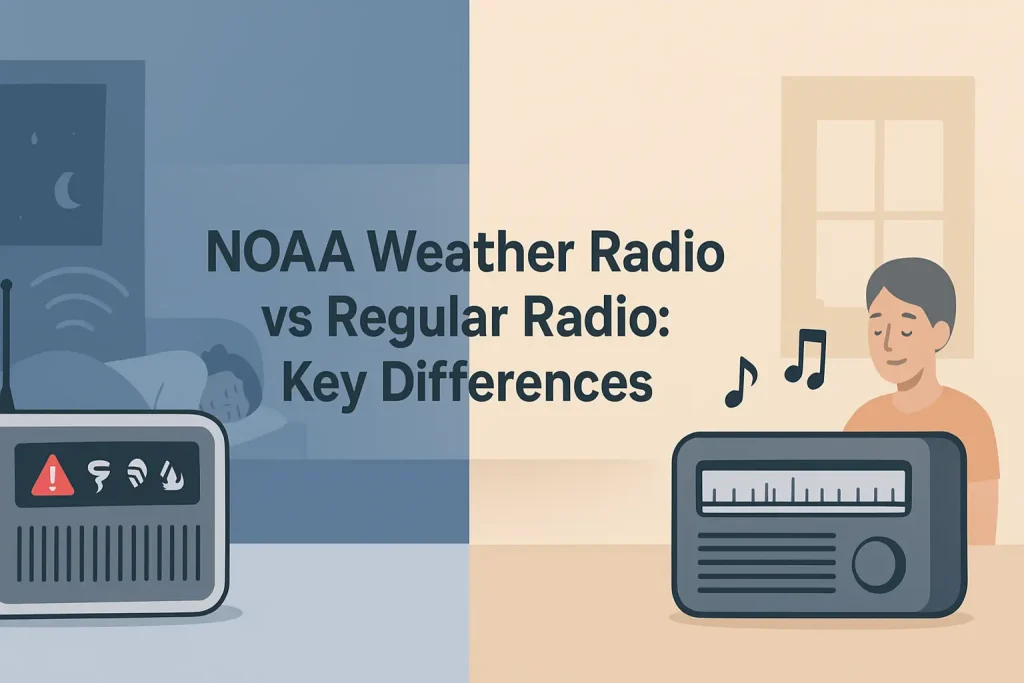
NOAA broadcasts on frequencies between 162.400 and 162.550 MHz, which standard AM/FM receivers cannot pick up. A weather radio includes a dedicated receiver for these seven channels.
Standard AM/FM radios only tune to the 540-1600 KHz and 88-108 MHz bands. You need a dedicated NOAA receiver for emergency alerts.
Always use a dedicated weather radio for emergency alerts. Do not rely on a standard music radio for warnings.
How Do I Program S.A.M.E. Codes into My Weather Radio?
You program S.A.M.E. codes by entering your 6 digit county FIPS code through the radio keypad. This filters alerts to your specific county area.
Find your FIPS code on the NOAA Weather Radio website. Fix alert fatigue by entering your specific county code today.
Enter your local 6 digit FIPS code into the radio menu to limit alerts to your area. This prevents you from ignoring real alerts.
Can I Use Any USB Power Bank to Charge My Crank Weather Radio?
Yes, if the radio includes a USB input port, you can use any 5V USB power bank to charge the internal battery. This is faster than cranking.
You can connect a high capacity power bank to the radio for days of runtime. Fix a dead internal battery by plugging in a USB power source.
Use a USB power bank for instant power if you have one available. Keep the crank and solar options in reserve for when the power bank is empty.
Why Does My Crank Radio Stop Holding a Charge After a Year?
The internal NiMH battery degrades over time and loses its capacity to hold a charge. This happens because the battery needs regular charge and discharge cycles.
Fix a degraded internal battery by cycling the battery every three months. Let the battery drain fully, then crank or solar charge it to full capacity.
Cycle your internal battery every few months to prevent capacity loss. Do not leave the radio in storage fully discharged.
Do I Need a License to Listen to NOAA Weather Radio?
No, you do not need a license to listen to NOAA Weather Radio broadcasts. The NOAA NWR network is a public service for all weather and hazard alerts.
NOAA broadcasts weather, natural, environmental, and public safety alerts 24 hours a day. You do not need an FCC license to monitor these public safety frequencies.
Always listen to NOAA NWR broadcasts for free. There are no licensing restrictions for receivers designed to pick up the 162.400 to 162.550 MHz band.
How Long Will a Solar Charged Weather Radio Last in the Dark?
A solar charged weather radio will last 8 to 12 hours in the dark on a full internal battery. This depends on the battery capacity and volume level.
The radio uses more power when the audio is turned up to maximum volume. Fix a quick drain by lowering the speaker volume during the night.
Lower the speaker volume to extend the charge life. Crank the radio for 5 minutes if the battery indicator drops to zero.
Are Digital Weather Radios Better Than Analog Crank Radios?
Digital weather radios offer clearer audio and better S.A.M.E. decoding compared to analog crank radios. Analog radios are cheaper but prone to interference on the 162.400 to 162.550 MHz band.
If you experience static on an analog radio, fix it by switching to a digital model. A digital radio mutes the speaker until an alert arrives to prevent noise.
Choose a digital radio if you can afford the higher price. Choose an analog crank radio only if you need basic alerts and power options.
Can I Use an FRS Walkie-Talkie to Listen to NOAA Weather Radio?
Yes, some GMRS and FRS walkie-talkies include a NOAA weather scan feature. You can listen to the seven weather channels on a dedicated secondary band.
Walkie-talkies do not have S.A.M.E. technology or an alert siren. You must manually scan the channels to hear updates.
Use a walkie-talkie as a backup scanner for NOAA frequencies. Do not rely on it as your primary weather alert radio for sleeping.
Is an Emergency Crank Radio Worth the Money for Home Use?
Yes, an emergency crank radio is worth the money for home use during power outages. It provides life saving alerts without grid power.
A crank radio costs between $30 and $60 and works for 10 years or more. Fix home power anxiety by keeping a crank radio in your emergency kit.
Keep a crank and solar radio in your home kit for reliable alert coverage. The price is small for guaranteed weather alerts during a blackout.
What Causes Interference on My Weather Radio Reception?
Interference on your weather radio reception is caused by local electronics, fluorescent lights, or metal obstructions. This happens because the 162.400 to 162.550 MHz band is sensitive to electrical noise.
Move the radio near a window to reduce obstructions. Fix electrical noise by turning off nearby appliances.
Locate your radio near a window away from televisions and computers. Use the built in antenna for best reception.
What Is the Best Emergency Weather Radio with Crank and Solar Power Available Today?
The Eton FRX3 Plus is the best emergency weather radio with crank and solar power available today. It includes a 2600 mAh battery and a USB phone charger.
The Eton FRX3 Plus receives all seven NOAA weather channels. It also features a bright LED flashlight and a rugged design for outdoor use.
For maximum durability and smartphone charging, the Eton FRX3 Plus is the best choice. Fordesktop S.A.M.E. alert programming, use the Midland WR400 instead.
Always choose a radio with multiple power sources and proven NOAA reception. Keep your emergency kit stocked with a reliable solar and crank weather radio.
NOAA provides continuous weather alerts on 162.400 to 162.550 MHz. Use the hand crank for immediate power and the solar panel for long term charging.