Radio interference disrupts critical aviation communications, risking flight safety and operational efficiency. This guide explains exactly how aviation professionals should file FCC interference complaints, the investigation process that follows, and the most effective ways to document and resolve these issues. You’ll learn when to contact the FCC versus the FAA and how to track your complaint through to resolution.
Understanding Radio Interference in Aviation Communications
Radio interference in aviation communications occurs when unwanted signals disrupt the clear transmission and reception of critical flight information. Understanding the different types of interference is the first step toward effective reporting and resolution. When unwanted signals overlap with essential communications, they can create anything from minor annoyances to serious safety hazards.
| Photo | Popular Portable Walkie Talkies | Price |
|---|---|---|
 | SKIWARRIOR Multifunctional Smart Wireless Ski Goggles with Walkie-Talkie, Anti-Fog Zeiss Lens, Music & Call Function (Cylindrical Blue) | Check Price On Amazon |
 | SINORISE Super Mini Walkie Talkies, Two-Way Radios, 3 Pack | Up to 12 Hours Battery Life, for Baseball Coaches, Restaurants, Retail Stores, Hospitals, Outdoor Sports & Travel | Check Price On Amazon |
 | KOSPET Tank M4C Smart Watch Rugged, Dual-Band GPS, 5ATM & IP69K Waterproof | 1.96" AMOLED Display, 170+ Sport Modes, Built-in LED Flashlight/Walkie-Talkie, Heart Rate/Sleep Monitor for Android & iPhone | Check Price On Amazon |
 | Retevis RT15 Walkie Talkies 3 Pack, Birthday Gift, Outdoor Adventure Kit | Durable, Lightweight, VOX, Key Lock, Mini Walkie Talkies for Adults, School Family Outdoor Travel Camping Hiking | Check Price On Amazon |
 | Rechargeable Walkie Talkies Toys for Kids: DIY Astronaut Walkie Talkies for Boys Christmas Birthday Gifts for 3 4 5 6 7 8 9 10 Boy Walkie Talkie Outdoor Hiking Toy 2 Way Radio Camping Outdoor Game | Check Price On Amazon |
According to FCC regulations, particularly 47 CFR Part 87 covering aviation services, interference with aviation communications is treated with high priority due to safety implications. The FCC defines harmful interference as any emission, radiation, or induction that endangers the functioning of a radio navigation service or other safety services, or seriously degrades, obstructs, or repeatedly interrupts a radiocommunication service.
Aviation radio interference can originate from numerous sources, including other legitimate transmitters, malfunctioning equipment, environmental factors, or even intentional jamming. Identifying the specific type and source is crucial for proper reporting and swift resolution.
Common Types of Aviation Radio Interference
Aviation radio systems can experience several distinct types of interference, each with unique characteristics that help identify the source and determine the appropriate reporting channel.
- Co-channel Interference: Occurs when two transmitters use the same frequency simultaneously. In aviation, this might happen when aircraft from different regions enter the same airspace.
- Adjacent Channel Interference: Happens when signals from nearby frequencies leak into the channel you’re using. Often results from improperly filtered transmitters or receivers.
- Harmonic Interference: Created when a transmitter produces signals at multiples of its fundamental frequency. Common with aging or poorly maintained equipment.
- Intermodulation: Occurs when two or more strong signals mix in a receiver or transmitter, creating new frequencies that can fall on aviation channels. Often associated with overmodulation problems that cause signal distortion.
- Broadband Noise: General interference across multiple frequencies, often from electrical equipment, power lines, or environmental factors.
- Pulse Interference: Short bursts of interference that can momentarily block communications. Often from radar systems or switching equipment.
The severity of these interference types varies based on factors like signal strength, duration, and which specific aviation frequencies are affected. Communication on primary air traffic control frequencies requires the highest protection level.
How to Identify the Source of Radio Interference
Accurately identifying the source of radio interference is crucial for effective reporting and quick resolution. Follow these systematic steps to narrow down potential interference sources.
- Document the pattern: Note when interference occurs, its duration, and specific flight paths or locations where it’s most noticeable.
- Check for consistency: Determine if the interference follows specific patterns related to time of day, geographic location, or altitude.
- Rule out onboard sources: Verify that the issue isn’t coming from your own aircraft systems by testing communications when certain systems are powered down.
- Monitor multiple frequencies: Check if interference affects specific frequencies or entire bands to help determine if it’s narrowband or broadband interference.
- Use direction-finding equipment: When available, radio direction finders can help locate the physical source of interference.
- Coordinate with other aircraft: Confirm if other pilots in the area experience the same issues, which can help triangulate the source.
For persistent or severe interference, spectrum analyzers and specialized RF monitors can provide visual evidence of the interference patterns. These tools can identify signature characteristics of different interference types and are particularly valuable for documentation purposes.
Always follow standard position reporting formats for each flight phase when documenting where interference occurs, as this provides investigators with precise location data.
FCC vs. FAA Jurisdiction: Determining Where to File Your Complaint
One of the most common points of confusion is whether to file an interference complaint with the FCC, the FAA, or both. This section provides clear guidance on jurisdiction boundaries and how to determine the appropriate reporting channel.
The Federal Communications Commission (FCC) has primary jurisdiction over radio spectrum management and unauthorized transmissions. They handle complaints related to:
- Unauthorized radio transmissions on aviation frequencies
- Interference from non-aviation sources affecting aviation communications
- Equipment compliance issues for radio transmitters
- Enforcement against illegal operators or jammers
The Federal Aviation Administration (FAA) has jurisdiction over aviation safety and certified aircraft equipment. They handle:
- Interference between properly certified aviation systems
- Issues with FAA-operated communication facilities
- Airworthiness concerns related to avionics
- Air traffic control communication problems
In many cases, especially those involving military frequency restrictions that civilians cannot access, dual reporting may be necessary to ensure comprehensive investigation.
When to Contact the FCC vs. the FAA
The following scenarios will help you quickly determine whether your interference issue falls under FCC jurisdiction, FAA jurisdiction, or requires reporting to both agencies.
| Scenario | Agency to Contact | Reason |
|---|---|---|
| Interference from suspected unauthorized transmitter | FCC Primary, FAA Secondary | FCC enforces against unauthorized users |
| Interference between certified aircraft radios | FAA Primary | Equipment certification and airworthiness issue |
| Interference from ground-based electronic devices | FCC Primary | Non-aviation device regulation falls under FCC |
| Interference affecting multiple aircraft in same area | Both FCC and FAA | Potential safety issue (FAA) and spectrum violation (FCC) |
| Suspected intentional jamming of aviation frequencies | FCC Primary, FAA and FBI Secondary | Criminal violation of Communications Act |
For emergency situations where interference presents an immediate safety hazard, contact air traffic control immediately and follow up with formal complaints to both agencies.
Step-by-Step Guide to Filing an FCC Interference Complaint
Filing an effective FCC interference complaint requires specific information and proper documentation. Follow this comprehensive process to ensure your complaint receives appropriate attention and action.
- Gather essential information: Before starting the complaint process, collect all relevant details about the interference, including frequencies affected, times of occurrence, geographic locations, and suspected sources.
- Access the FCC Consumer Complaint Center: Visit the FCC’s online portal at consumercomplaints.fcc.gov.
- Select complaint type: Choose “Radio” as the complaint type, then select “Interference” from the sub-categories.
- Provide contact information: Enter your professional contact details. For aviation personnel, include your role (pilot, controller, technician) and affiliated organization.
- Describe the interference: In the description field, provide a clear, detailed account of the interference using technical language appropriate for FCC investigators.
- Attach supporting documentation: Upload any evidence you’ve collected, such as audio recordings, spectrum analyzer screenshots, or flight logs showing correlation between interference and location.
- Specify safety implications: Clearly indicate if the interference has created or could create safety hazards for aircraft operations.
- Submit and record confirmation number: After submission, you’ll receive a confirmation number. Save this for tracking purposes.
For aviation professionals dealing with international equipment movement, interference reporting may involve additional steps. Check the import-export documentation requirements for international equipment if the suspected interference source involves recently imported communications equipment.
Essential Information to Include in Your FCC Complaint
The effectiveness of your interference complaint largely depends on including specific technical details that help the FCC identify and address the source. Ensure your complaint includes all of the following critical information.
- Exact frequencies affected: Provide precise frequency information (e.g., 121.5 MHz, 128.8 MHz) rather than general descriptions.
- Geographic coordinates: Include latitude/longitude or airport/navaid identifiers where interference was experienced.
- Time and date patterns: Specify exact times when interference occurs, noting any patterns (e.g., “occurs daily between 1400-1600 local time”).
- Signal characteristics: Describe the interference sound (static, voices, music, pulsing, etc.) and any identifying features.
- Effect on communications: Explain exactly how the interference impacts your ability to communicate (partial blockage, complete communications failure, intermittent issues).
- Aircraft information: For airborne interference, include aircraft type, altitude, heading, and flight number if applicable.
- Equipment affected: Specify the make/model of radio equipment experiencing interference.
- Duration: Indicate how long interference typically lasts when it occurs.
- Previously attempted solutions: Document any troubleshooting steps already taken.
Remember that vague descriptions like “interference on approach frequency” are much less effective than specific reports such as “continuous tone interference on 124.15 MHz when within 15 nautical miles northwest of KBOS, between 2,000-5,000 feet, occurring daily between 0900-1200 local time.”
Documentation and Evidence Collection Best Practices
Proper documentation of radio interference significantly increases the likelihood of successful resolution. Follow these evidence collection best practices to strengthen your FCC complaint.
When possible, record audio samples of the interference using the aircraft’s communication system or a handheld recorder. These recordings should capture both the interference and normal communications for comparison. Label recordings with date, time, frequency, and location.
Maintain a detailed interference log with the following information for each occurrence:
- Date and precise time (use UTC for consistency)
- Duration of interference
- Frequency affected
- Signal strength (if measurable)
- Aircraft position (coordinates, fix, or relative to a navaid)
- Altitude
- Weather conditions (which can affect propagation)
- Description of interference characteristics
- Impact on communications/operations
For technical personnel with access to appropriate equipment, spectrum analyzer screenshots provide compelling evidence. These should show the interference signal in context with the normal band usage, with clear frequency markers and time stamps.
When dealing with interoperability issues between digital and analog systems, document which specific system combinations experience interference problems to help investigators narrow down potential causes.
The FCC Investigation Process: What Happens After You File
After submitting your interference complaint, the FCC follows a structured investigation process. Understanding this process helps set appropriate expectations and allows you to provide additional information if needed.
The typical FCC investigation process follows these stages:
- Initial Review (1-3 days): An FCC analyst reviews your complaint for completeness and jurisdiction. Aviation-related interference complaints typically receive priority classification due to safety implications.
- Case Assignment (3-7 days): Your complaint is assigned to an investigator in the Enforcement Bureau, often in the field office closest to the reported interference location.
- Preliminary Analysis (7-14 days): The investigator analyzes the technical details provided and may contact you for clarification or additional information.
- Investigation Planning (14-21 days): For complex cases, the FCC develops an investigation strategy, which may include coordination with the FAA if aviation safety is concerned.
- Field Investigation (varies): For serious or persistent interference, FCC field agents may deploy spectrum monitoring equipment to locate the source. This phase can take days to weeks depending on the complexity.
- Source Identification: Once the source is identified, the FCC determines if the interference results from rule violations, equipment malfunction, or other causes.
- Enforcement Action (if applicable): If violations are found, the FCC proceeds with appropriate enforcement measures.
- Resolution and Notification: You will be notified of the investigation outcome, though specific enforcement details may be confidential.
Throughout this process, the FCC may coordinate with the FAA, especially when the interference affects air traffic control or navigation systems. For cases involving international borders, coordination with foreign telecommunications authorities may extend the timeline.
For interference affecting multiple aircraft or critical communications, the investigation timeline may be accelerated. However, intermittent interference or cases requiring extensive monitoring may take longer to resolve.
How to Track Your FCC Complaint Status
Tracking the status of your interference complaint is essential for timely resolution. The FCC provides several methods to monitor your complaint’s progress through the investigation system.
- Using your confirmation number: Visit the FCC Consumer Complaint Center and enter your complaint number in the status lookup tool.
- Email updates: The FCC sends automated status updates to the email address provided in your complaint.
- Direct contact: For aviation-related interference, you can contact the FCC Operations Center at 202-418-1122 for status updates on high-priority cases.
Status designations typically progress through these stages:
- Received: Your complaint has been submitted successfully
- Under Review: An analyst is evaluating your complaint
- Assigned: Your case has been assigned to an investigator
- Investigation In Progress: Active investigation is underway
- Pending Information: The FCC needs additional information from you
- Resolved: Investigation is complete
If your complaint status remains unchanged for more than 30 days, consider following up directly with the FCC. For interference affecting aviation safety, the FAA can also request status updates through inter-agency channels if resolution appears delayed.
Common FCC Enforcement Actions for Interference Violations
When the FCC confirms a source of harmful interference, especially affecting aviation communications, they have several enforcement options available depending on the nature and severity of the violation.
For confirmed violations, the FCC may issue:
- Notice of Violation (NoV): A formal notification of rules violations that requires a response explaining corrective actions.
- Notice of Apparent Liability (NAL): Proposes monetary fines, with penalties for aviation interference typically starting at $10,000 and potentially reaching hundreds of thousands of dollars for serious or willful violations.
- Equipment Seizure: For unauthorized transmitters or jammers, the FCC can confiscate equipment causing harmful interference.
- License Revocation: For licensed operators causing interference, the FCC can suspend or revoke operating privileges.
- Criminal Referral: Intentional jamming of aviation frequencies may be referred to the Department of Justice for criminal prosecution.
Recent enforcement actions demonstrate the FCC’s serious approach to aviation interference. In 2022, the Commission issued a $2.8 million fine to a company whose equipment caused interference to airport landing systems, and in 2021, an individual received both fines and criminal charges for deliberately jamming air traffic control frequencies.
The FCC determines enforcement severity based on factors including safety impact, whether the violation was intentional, duration of interference, and the violator’s cooperation in resolving the issue.
Advanced Troubleshooting for Persistent Interference
Some interference issues persist even after initial complaints. This section covers advanced troubleshooting techniques and escalation procedures for challenging interference problems.
For aviation professionals dealing with ongoing interference despite initial reporting, consider these advanced approaches:
- Multi-point monitoring: Coordinate with other aircraft or ground stations to document interference from different locations simultaneously, helping triangulate the source.
- Temporal pattern analysis: Create detailed logs correlating interference with specific activities, times of day, or operational patterns that might reveal non-obvious sources.
- Frequency spectrum scanning: Use wideband receivers or spectrum analyzers to identify suspicious signals near the affected frequencies that might be causing adjacent channel interference.
- Equipment isolation testing: Systematically power down and isolate aircraft systems to identify if onboard equipment might be contributing to the problem.
- Environmental factor assessment: Consider how terrain, buildings, weather conditions, or seasonal changes might affect signal propagation and interference patterns.
When interference affects navigation or critical communications, proper power supply filtering can help eliminate radio interference from onboard systems while the external source is being located.
For complex cases, consider requesting specialized FCC assistance. The FCC’s Enforcement Bureau maintains a High-Value Interference Investigation Team (HVIIT) with advanced direction-finding equipment that can be deployed for aviation interference affecting multiple aircraft or critical communications systems.
When and How to Escalate Unresolved Interference Cases
When standard complaint procedures don’t result in resolution, knowing how to properly escalate your case becomes critical, especially for interference affecting aviation safety.
Follow this escalation path for persistent interference cases:
- First escalation level: Contact the FCC Operations Center (202-418-1122) to request case status and note continued interference. Reference your original complaint number.
- Second escalation level: Submit a formal escalation request to the Enforcement Bureau Field Office in your region, including:
- Original complaint number
- Documentation of continued interference
- Safety impact assessment
- Log of all follow-up attempts
- Third escalation level: For safety-critical situations with no resolution, contact:
- The FCC’s Public Safety and Homeland Security Bureau
- The FAA’s Regional Spectrum Management Office
- Your airline’s or organization’s safety department
- Final escalation: For cases with significant safety implications, consider involving:
- Aviation industry associations (AOPA, NBAA, ALPA)
- Congressional representatives with aviation oversight responsibilities
When escalating, always maintain professional communication and provide clear documentation of the interference pattern, its operational impact, and all previous reporting efforts. Quantify safety implications whenever possible, such as the number of flights affected or specific operational limitations imposed by the interference.
Preventing Future Radio Interference in Aviation Systems
While resolving current interference is critical, implementing preventative measures can significantly reduce future occurrences. These aviation-specific strategies help maintain communication integrity and flight safety.
For aircraft operators and technicians:
- Regular avionics inspections: Schedule comprehensive checks of all communications equipment, focusing on cable shielding, connector integrity, and ground bonding.
- Transmitter maintenance: Ensure all transmitters are operating within specified parameters, particularly frequency stability and output filtering.
- Interference detection equipment: Consider installing basic interference monitoring capability in frequently affected aircraft.
- Staff training: Educate flight crews and maintenance personnel on recognizing, documenting, and reporting interference.
For airport and ground facility operators:
- Frequency coordination: Implement regular coordination meetings with all radio frequency users in the vicinity of your facility.
- Perimeter monitoring: Consider installing spectrum monitoring equipment to provide early detection of potential interference sources.
- Local awareness: Educate nearby businesses and residential areas about potential interference sources like grow lights, computer equipment, and unauthorized transmitters.
- Technical standards: Implement and enforce strict RF emissions standards for all equipment operating on or near airport property.
For avionics manufacturers and installers:
- Enhanced filtering: Design and install robust front-end filtering for communications receivers.
- Shielding improvements: Utilize advanced shielding techniques for both transmitters and receivers.
- Interference rejection: Implement digital signal processing techniques that can identify and reject common interference patterns.
- Testing protocols: Develop comprehensive interference susceptibility testing during installation and maintenance.
Proactive approaches to interference management not only prevent disruptions but also build institutional knowledge that makes future troubleshooting more efficient when problems do occur.
Additional Resources and Support
For ongoing support with aviation radio interference issues, the following resources provide specialized assistance, technical guidance, and regulatory updates.
FCC Resources
- FCC Operations Center: 202-418-1122 (24/7 support for interference issues)
- Enforcement Bureau Field Offices: https://www.fcc.gov/enforcement/eb-field-offices (Regional investigation teams)
- Public Safety and Homeland Security Bureau: https://www.fcc.gov/public-safety-and-homeland-security (For safety-critical communications)
FAA Resources
- Regional Spectrum Management Offices: https://www.faa.gov/about/office_org/headquarters_offices/ato/service_units/techops/safety_operations_support/spec_management
- Aviation Safety Reporting System: https://asrs.arc.nasa.gov/ (For reporting interference affecting safety)
Technical Resources
- RTCA DO-307: “Aircraft Design and Certification for Portable Electronic Device (PED) Tolerance”
- ARINC 718: “Mark 3 Aviation VHF Communications Transceiver”
- Radio Technical Commission for Aeronautics (RTCA): https://www.rtca.org/ (Technical standards for aviation communications)
- IEEE Electromagnetic Compatibility Society: https://www.emcs.org/ (Technical resources for interference mitigation)
Training and Educational Resources
- AOPA Air Safety Institute: https://www.aopa.org/training-and-safety/air-safety-institute (Pilot resources for communications issues)
- FAA Safety Team (FAAST): https://www.faasafety.gov/ (Training resources for aviation professionals)
- National Association of Radio and Telecommunications Engineers: https://www.narte.org/ (Technical certification and training)
These resources provide comprehensive support for aviation professionals dealing with radio interference issues. When combined with proper reporting procedures and documentation practices, they form a complete toolkit for maintaining the integrity of critical aviation communications systems.
| Photo | TOP RATED WALKIE TALKIES | Price |
|---|---|---|
 | Retevis RT628 Kids Walkie Talkies, Toys Gifts for 4-12 Year Old Girl Boy | Kids Camping Essentials Outdoor Toys, Birthday Gift, 22CH, VOX, Keypad Lock, Durable, Easy to Use Walkie Talkies for Kids | Check Price On Amazon |
 | Cobra ACXT545 Weather-Resistant Walkie Talkies, Rechargeable, 22 Channels | Long Range 28-Mile Two-Way Radio Set (2-Pack) | Check Price On Amazon |
 | Retevis RT388 Kids Walkie Talkies, Outdoor Toys for Kids Camping Essentials | 4-12 Year Old Boy Birthday Gift, 22 CH VOX Flashlight Clear Sound, Kids Walkie Talkies 2 Pack for Camping Hiking Adventure | Check Price On Amazon |
 | Cobra RX680 Walkie Talkies (2-Pack), IP54 Water Resistant Design | Rugged & Splashproof Two Way Radios Long Range, 60 Pre-Programmed Channels, Weather Alerts | Check Price On Amazon |
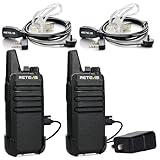 | Retevis RT22 Walkie Talkies Long Range Rechargeable with Earpiece (2 Pack) | Slim & Lightweight 2 Way Radio For Camping & Hiking, Pocket-Friendly Antenna, Ready to Use, 10-Hour Battery, USB-C Charging | Check Price On Amazon |
 | Midland GXT1000VP4 GMRS Two-Way Radios with Headsets, Black, 2 Pack | 50 Channels, 142 Privacy Codes, Up to 36 Mile Long Range, JIS4 Water Resistant, NOAA Weather Alert, Rechargeable NiMH | Check Price On Amazon |
 | Retevis RT628 Walkie Talkies for Kids,Toys Gifts for 6-12 Years Old Boys Girls,Long Range 2 Way Radio 22CH VOX,Birthday Gift,Family Walkie Talkie for Camping Hiking Indoor Outdoor | Check Price On Amazon |